Tag Archives: pace gallery

ISAMU NOGUCHI: VARIATIONS

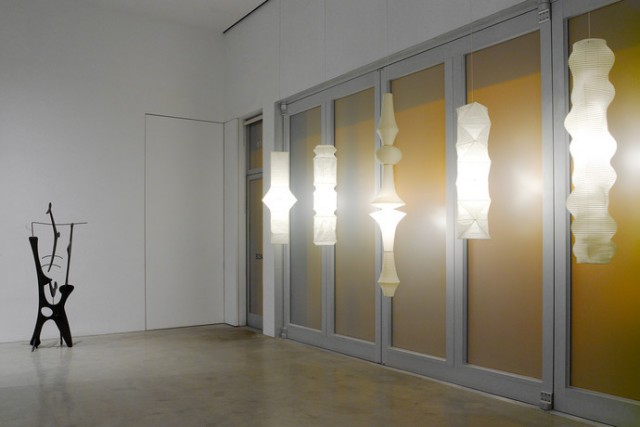
First solo Noguchi show in Manhattan since 2004 includes wide range of works (photo courtesy of Pace Gallery)

First solo Noguchi show in Manhattan since 2004 includes wide range of works (photo courtesy of Pace Gallery)

Who: Isamu Noguchi
What: “Isamu Noguchi: Variations”
Where: Pace Gallery, 508-510 West Twenty-Fifth St. between Tenth & Eleventh Aves., 212-989-4258
When: Tuesday – Saturday through March 21, free, 10:00 am – 6:00 pm
Why: Usually you have to go to Long Island City to see an extensive survey of the work of L.A.-born Japanese-American artist Isamu Noguchi, who built his own museum and garden in Queens in 1985. But for the first time in more than a decade, you can take in a major solo Noguchi show in Manhattan, as “Isamu Noguchi: Variations” continues at two side-by-side Pace galleries in Chelsea through March 21. “Growth can only be new, for awareness is the ever-changing adjustment of the human psyche to chaos,” Noguchi said in his artist statement for the 1946 MoMA exhibition “Fourteen Americans,” continuing, “If I say that growth is the constant transfusion of human meaning into the encroaching void, then how great is our need today when our knowledge of the universe has filled space with energy, driving us toward a greater chaos and new equilibriums. I say it is the sculptor who orders and animates space, gives it meaning.” It is a thrill to see dozens of works, from sculpture (in various materials) and set designs to furniture and paper lanterns in addition to abstract gouaches, laid out in a whole new way in this space, with exciting juxtapositions and calming paths bringing new personal meanings.

JAMES FRANCO: NEW FILM STILLS

James Franco

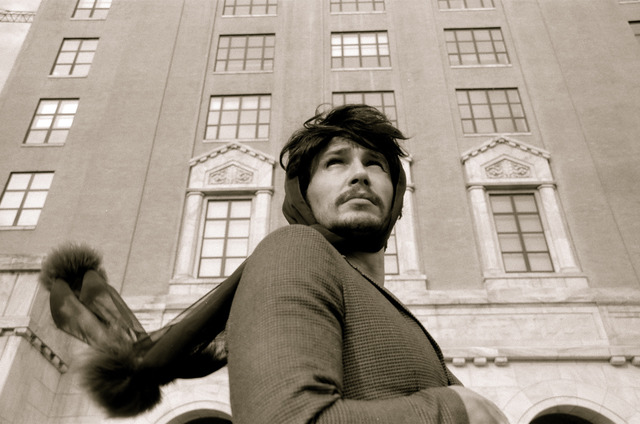
“I’m getting bored,” James Franco writes in the poem accompanying “Untitled Film Still #58,” his re-creation of the Cindy Sherman original

Pace Gallery
534 West 25th St. between Tenth & Eleventh Aves.
Through Saturday, May 3, free, 19:00 am – 6:00 pm
212-989-4258
www.thepacegallery.com

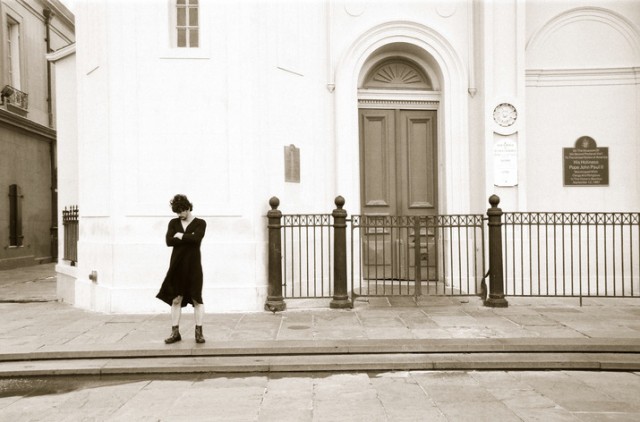
Right up front, we need to admit that we consider ourselves to be Francophiles. We have full admiration and respect for the many guises worn by James Franco. From his days as Daniel Desario on Freaks and Geeks to his work in such films as 127 Hours, Milk, and Rise of the Planet of the Apes, from novels and writings to appearances in art films by Paul McCarthy and Isaac Julien, through his current Broadway debut in Of Mice and Men. So at first, we were more than willing to give Franco, who just turned thirty-six, the benefit of the doubt with his latest gallery installation, “New Film Stills,” which continues at Pace through May 3. For the project, Franco re-created (in general, not painstaking detail) more than two dozen of Cindy Sherman’s seminal “Untitled Film Stills,” in which Sherman photographed herself as different female protagonists from 1977 to 1980, as if playing clichéd woman characters in unknown movies, commenting on gender and class identity, power, and the male gaze. Walking through the gallery, we found ourselves entertained by Franco’s homage/appropriation as he, replete with beard and mustache, lounged on a bed in lingerie, examined himself in a mirror, stood outside wearing a hat or kerchief, or walked gingerly down steps. “Cindy is an artist who used cinema as a source for her work; she ‘played’ at being an actress,” Franco has said about the series. “I am an actor who inserts himself into his work. Where Cindy used cinema as a starting place, I use art as a starting place.”
James Franco

James Franco name-checks D. H. Lawrence, Jack Nicholson, and Dennis Hopper in poem about “Untitled Film Still #42”

But upon further investigation, including perusing the catalog, the cover of which also mimics Sherman’s, we actually grew somewhat agitated and angry at the well-intentioned Franco. Part of the beauty of Sherman’s original photographs were their originality, as well as the mystery and magic that accompanied each one; they were untitled in order to let viewers enjoy and interpret them on an individual basis. In the introduction to the Franco catalog, American academic, poet, and Franco mentor Frank Bidart writes, “To my eye, there’s nothing ‘camp’ about this male figure inhabiting the scenes and tensions and atmospheres in Sherman’s photographs. Just as there is nothing camp or ironic or mocking when he doesn’t imitate them.” They might not be camp, but they lack the magic and mystery — and, of course, originality — of their primogenitors, eventually feeling lazy before unraveling when you read Franco’s accompanying poetry, which is available only in the catalog and comes off more like a school project. Franco has written a poem — four quatrains, some with an additional line — for each of Sherman’s sixty-nine stills. In “Untitled Film Still #27b,” in which Sherman/Franco holds a cocktail glass, a mascara’d tear running down the left side of his/her face, Franco writes, “Living inside one’s skull / Unable to communicate with the outside. / Are we all artists or is a bunch just / Crazy and another bunch just boring? / Tennessee Williams’s sister Rose / Went nuts and was lobotomized / And Tenn put such material into his work. / Did he disrespect her or help us all / By giving us The Glass Menagerie?” In the end, Franco is disrespecting both Sherman, whom he calls “a hero in my pantheon,” and the viewer by deciding what each photograph might or might not mean while name-dropping famous movies, books, and locations. When philosopher and art critic Arthur C. Danto asked Sherman, “Why did you stop doing the untitled film stills?” she responded, “I ran out of clichés.” In the end, “clichés” are exactly where Franco’s misappropriation begins.
ILYA AND EMILIA KABAKOV: ENTER HERE

KABAKOV

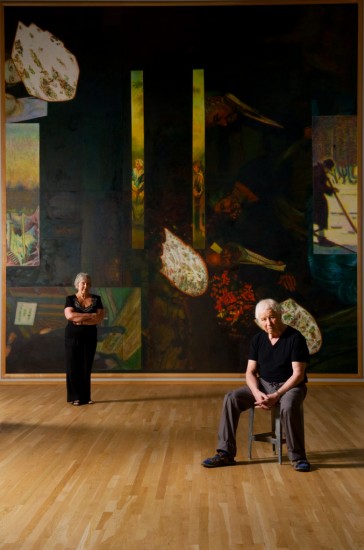
Emilia and Ilya Kabakov discuss their life and work in new documentary (photo by Jacques De Melo)

ILYA AND EMILIA KABAKOV: ENTER HERE (Amei Wallach, 2013)
Film Forum
209 West Houston St.
November 13-26
212-727-8110
www.kabakovfilm.com
www.filmforum.org

“Epic and boring,” Russian newspaper Vedomosti wrote in a review of Ilya and Emilia Kabakov’s highly anticipated 2008 Moscow exhibition; the same can be said about Amei Wallach’s documentary about the renowned Russian art couple, Ilya and Emilia Kabakov: Enter Here. Wallach assembled the same team she worked with on 2008’s Louise Bourgeois: The Spider, the Mistress and the Tangerine (except for her late codirector, Marion Cajori) to follow the Kabakovs as they prepare for a major series of shows in six venues in Moscow, marking Ilya’s return to the city for the first time since fleeing the country twenty years earlier. Wallach is given virtually unlimited access to Ilya, a soft-spoken conceptual artist filled with fascinating and unusual ideas, and Emilia, whom he married in 1992 and who handles his business affairs and assists her husband in the studio. Wallach delves into Ilya’s past as a struggling artist who was rarely allowed to show his work publicly and became part of an underground avant-garde that also included Oleg Vassiliev, Igor Makarevich, and Andrei Monastyrsky, all of whom appear in the film, as does Robert Storr, Matthew Jesse Jackson, and other scholars. Much of Ilya’s work is innately, if not overtly, political, evoking a changing Russia / Soviet Union as it evolved through such leaders as Stalin, Khrushchev, and Brezhnev, quietly exploring many sociopolitical elements of the twentieth and early twenty-first centuries. The film’s emotional high point involves a voiceover reading a letter from Ilya’s mother that she wrote to him when she was eighty, as the camera takes viewers through such monumental yet intimate and personal installations as “Red Wagon” and “The Toilet.” Among the other works featured are “The Palace of Projects,” “Life of Flies,” “Labyrinth (My Mother’s Album),” “School No. 6,” “How to Meet an Angel,” and “Alternative History of Art,” in which Ilya is joined by his past and future alter egos, Charles Rosenthal and Igor Spivak.
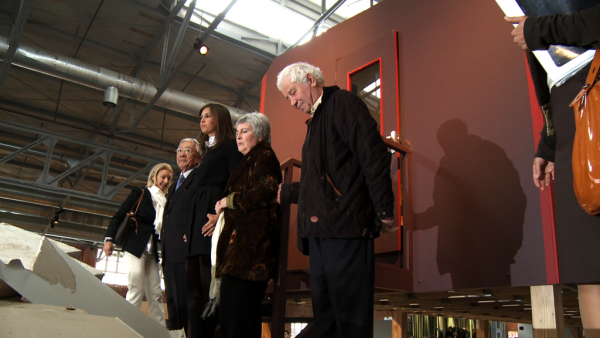
KABAKOV

The Kabakovs attend the opening of their 2008 Moscow exhibition, marking their highly anticipated return to the city

Unlike such other recent art documentaries as Cutie and the Boxer and Gerhard Richter Painting, which focused on unique and engaging characters, the Kabakovs are not particularly entertaining in and of themselves; it’s their work that makes them fascinating, so some stretches of the documentary drag on a bit, and it is difficult for Wallach and editor-cinematographer Ken Kobland to capture on film the feeling of what it is like to experience one of the Kabakovs’ massive installations. (However, it is possible for New Yorkers to see “Catch the Little White Man,” which is on view along with seven paintings at Pace Gallery in Midtown through December 21.) But Ilya and Emilia Kabakov: Enter Here is still a treat, offering an inside look at a husband and wife who are considered the most important Russian artists alive today. “The first thing to say is that art is another world,” Ilya explains early on. “And one must leave one’s body and one’s mentality, and one’s blah, blah, blah . . . and one’s everyday element, and enter another world. This is the major purpose and aim of our work. Leave and come with me to another world.” That’s a difficult offer to pass up. Enter Here begins a two-week run at Film Forum on November 13, with Ilya and Emilia on hand to talk about the film at select screenings on November 13, 16, 23, and 24; the 7:50 show on November 23 will be followed by a Q&A with Wallach and Kobland.

GALLERY NIGHT ON 57th ST.

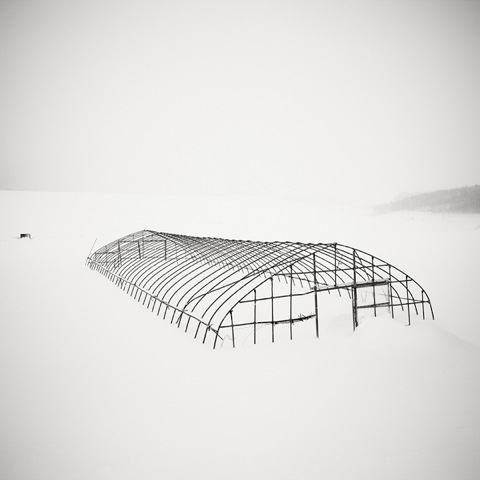
Josef Hoflehner, “Door Open Wide – Japan,” selenium toned silver print, 2012 (courtesy Bonni Benrubi Gallery)

Some three dozen galleries along 57th St. between Third & Eighth Aves. will remain open until 8:00 on Thursday night, many holding opening or closing receptions or other special programming as part of the semiannual Gallery Night on 57th St. Among the participants and their current shows, recommended in a westerly direction, are Nailya Alexander (“Evgeny Mokhorev: Photographs 1991-20120”), Bonni Benrubi (“Joseph Hoflehner: Into the Calm”), Edwynn Houk (“August Sander: Citizens of the Twentieth Century”), Frederico Sève (“Fanny Sanín: Drawings and Studies 1960 to Now”), Pace/MacGill (“A Tribute to Robert Delpire”), the Pace Gallery (“Robert Irwin: Dotting the i’s & Crossing the t’s: Part I”), Tibor de Nagy (“Larry Rivers: Later Works”), Nohra Haime (“Natalia Arias: No Permanent, No Perpetual”), Gering & López (“Ryan McGinness: Women: Sketches & Solutions”), Galerie St. Etienne (“‘Mad as Hell!’ New Work [and Some Classics] by Sue Coe”), Marian Goodman (“Giuseppe Penone”), and Francis M. Naumann (“Sophie Matisse: It’s Time”).

HAPPENINGS: NEW YORK, 1958-1963

Milly Glimcher revisits the Happenings movement at Pace Gallery (photo by twi-ny/mdr)

Pace Gallery
534 West 25th St. between Tenth & Eleventh Aves.
Through Saturday, March 17
www.thepacegallery.com

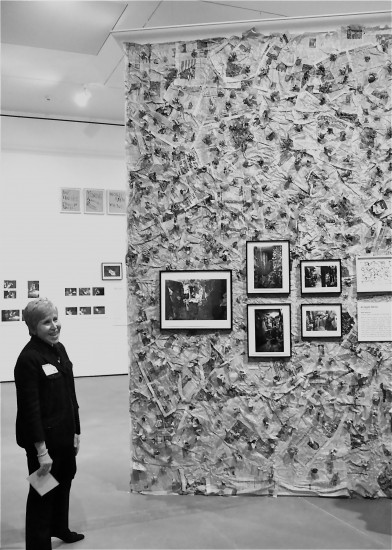
For twenty-five years, the idea of putting on an exhibition detailing the Happenings movement that exploded in New York City during the late 1950s and early 1960s had been percolating inside Milly Glimcher, waiting for the right moment to emerge. That time has come, as the art historian and cofounder of the Pace Gallery (with her husband, Arne) has at last unveiled a surprisingly welcoming show that explores a very specific corner of the development of performance art in downtown Manhattan, complete with all the requisite characters and chaos. Arranged somewhat chronologically by artist, “Happenings: New York, 1958-1963” details extremely low-budget creative gatherings staged by such seminal figures as Red Grooms, Jim Dine, Allan Kaprow, Claes Oldenburg, Carolee Schneeman, and Robert Whitman, with original artwork, photographs, programs, scripts, film clips, advertisements, and other ephemera collected by Glimcher as she met with all of the surviving artists. Many of the photos were taken by Robert McElroy, who died of Alzheimer’s disease shortly after the exhibition opened. Other participants in the events, which took place at such locations as Judson Church, the Reuben Gallery, and the Delancey Street Museum, included Lucas Samaras, Trisha Brown, Tom Wesselman, Yvonne Rainer, and Robert Rauschenberg. Glimcher has done a splendid job curating the exhibition, allowing visitors to delve in as deep as they want as they wander through sections dedicated to Grooms’s “A Play Called Fire,” Dine’s “Car Crash,” Kaprow’s “18 Happenings,” Oldenburg’s “Snapshots from the City,” Schneeman’s “Quarry Transposed,” and others. It would have been easy for “Happenings” to have turned into a “You had to be there” experience, but instead it offers more than just a taste of what it was all like.

CARSTEN NICOLAI: PIONIER

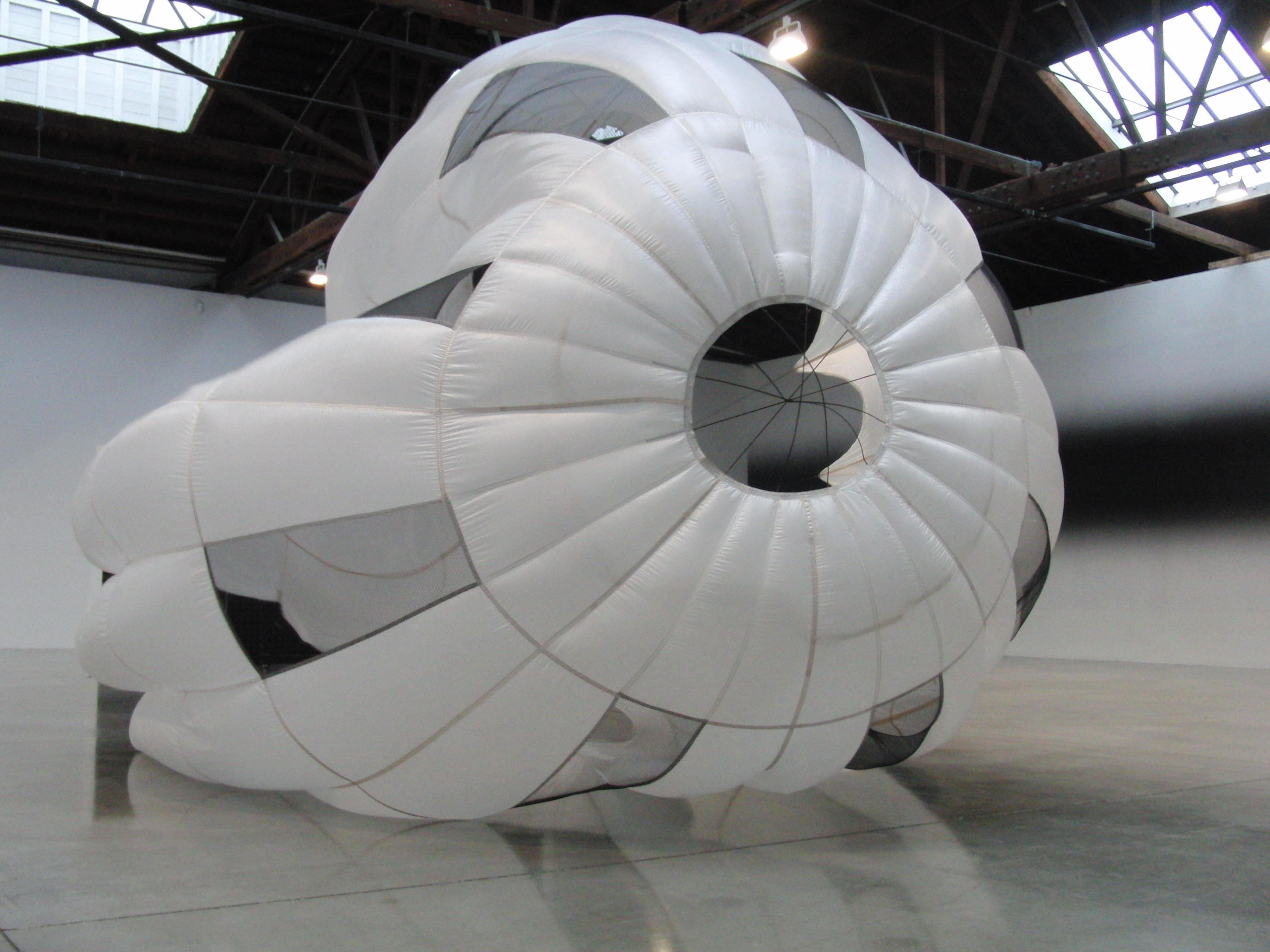
Carsten Nicolai, “Pionier,” parachute, wind machine, sound proof panels, timer, 2011 (photo by twi-ny/mdr)

The Pace Gallery
545 West 22nd St. between Tenth & Eleventh Aves.
Through October 22, free
www.thepacegallery.com
pionier slideshow

In such works as “thermic,” “polar,” and “rota,” Berlin-based audiovisual artist Carsten Nicolai melds the technical with the organic, the scientific with the conceptual, the artificial with the natural, delving into the creative process itself while also examining scale and proportion. He also doesn’t mind including a “wow” factor, which is a central part of his latest work, “pionier i,” on view at the Pace Gallery in Chelsea through October 22. Every four minutes, a large wind-machine, connected to a parachute, turns on, the parachute rising up horizontally, dominating the otherwise empty white gallery space. After reaching full size, it slowly crumples to the ground as the machine automatically turns off. “In my opinion the emphasis of self-generating processes is a reaction to the claim to plan everything,” Nicolai explains on his website. “Many of my works underlie a rule and introduce a model as organizing scheme to recognize chaotic movements. I am interested in both moments, they lie really close together.” An engaging work that delights visitors by placing a familiar object in an unusual location, “pionier i” can also be seen as representing the fleeting nature of life as well as that old saw, what goes up must come down.

GALLERY NIGHT ON 57th ST.

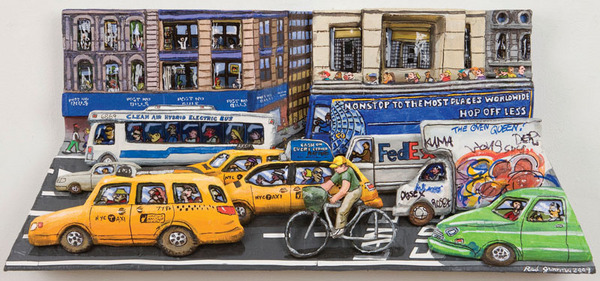
Red Grooms, “Bumper to Bumper,” acrylic and mixed media on wood, 2009 (courtesy Marlborough Gallery)

More than forty galleries along 57th St. between Lexington & Eighth Aves. will remain open until 8:00 on Thursday night, many holding opening or closing receptions or other special programming as part of the semiannual Gallery Night on 57th St. Among the participants, and their current shows, are Edwynn Houk (“Herb Ritts,” “Hannes Schmed: Cowboy”), the Pace Gallery (“Ad Reinhardt: Works from 1935-1945”), Bernarducci.Meisel (“The New York Project: Paintings of the City by Artists from Around the World”), Marian Goodman (“Gabriel Orozco: Corplegados and Particles”), Tibor de Nagy (“John Beerman: Recent Paintings”), Gering & López (David Levinthal’s “Attack of the Bricks: Star Wars”), Michael Rosenfeld (“Evolution in Action”), Marlborough (“Red Grooms, New York: 1976-2011”), Howard Greenberg (“Beyond Words: Photography in the New Yorker”), and Galerie St. Etienne (“The Lady and the Tramp: Images of Women in Austrian & German Art”).