Tag Archives: pace gallery

DAVID BYRNE: TIGHT SPOT / SOCIAL MEDIA

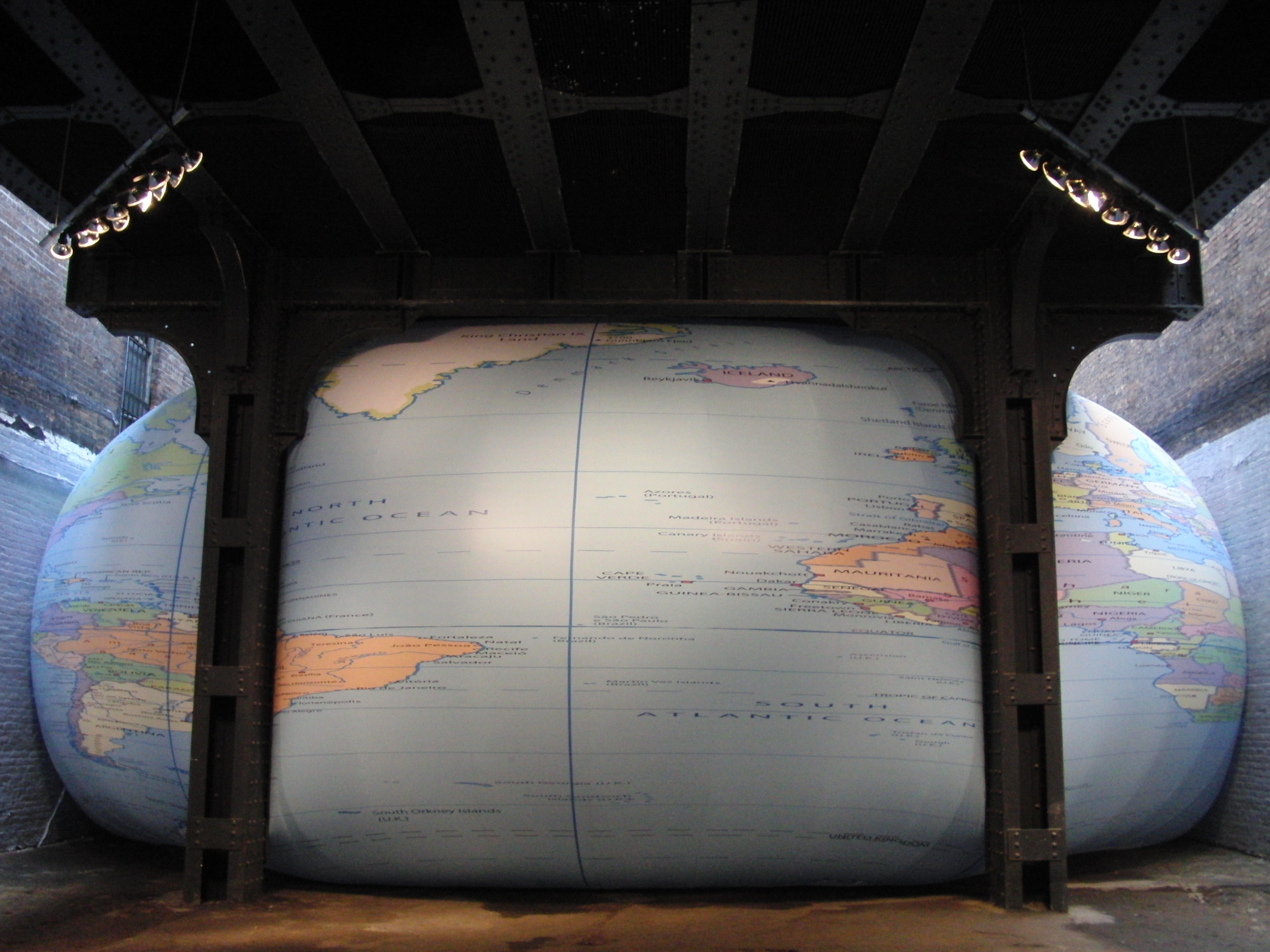
David Byrne, “Tight Spot,” cold air inflatable with audio, 2011 (photo by twi-ny.mdr)

Pace Gallery
510 West 25th St. between Tenth & Eleventh Aves.
“Tight Spot” through October 1
“Social Media” through October 15
www.thepacegallery.com
tight spot slideshow

In 1983, David Byrne wore a really big suit on the Talking Heads’ Stop Making Sense tour. In the summer of 2008, he wired the cavernous Battery Maritime Building for “Playing the Building,” in which visitors could sit down at a specially programmed organ and, essentially, play the building. Size is at the center of his latest performance installation as well, “Tight Spot,” a 19.5′ x 46′ x 46′ inflatable globe squeezed into a former garage on West 25th St., directly under the High Line. In fact, sections of the oval orb spill out against the High Line beams, stretching the names of geographic locations featured on the three-dimensional map, from North and South America to Europe and Africa. Meanwhile, a vibrating chant emanates from inside the globe, Byrne’s voice filtered through a computer program to make it sound, among other things, nonhuman. The closer you get to the work, commissioned by the Pace Gallery, the more powerful the sounds, until you can feel it humming in your ear if you place your head against it. Yes, the world has got itself in one tight spot right now, and Byrne makes that abundantly clear in this crowd pleaser, which remains on view through October 1. Meanwhile, Byrne has two pieces next door inside Pace, where “Social Media” continues through October 15. In addition to works by Miranda July, Penelope Umbrico, Christopher Baker, and others that incorporate elements from YouTube, Craigslist, Twitter, Flickr, Google, QR codes, and other forms of computer interactivity, Byrne has contributed “Democracy in Action,” a wall hanging in which twenty digital frames show video of parliamentarians around the world engaging in physical altercations, and four of his Apps, large-scale vertical advertisements for humorous fake apps he made up, including Coverup, which claims to be able to put clothes on you; Buzzclip, which purports to remove body hair by using smartphone vibrations; Weaselface, which promises to “add snark and satire to any text”; and Bigamist, which helps people cheat on their spouse.

TARA DONOVAN: PINS & MYLAR

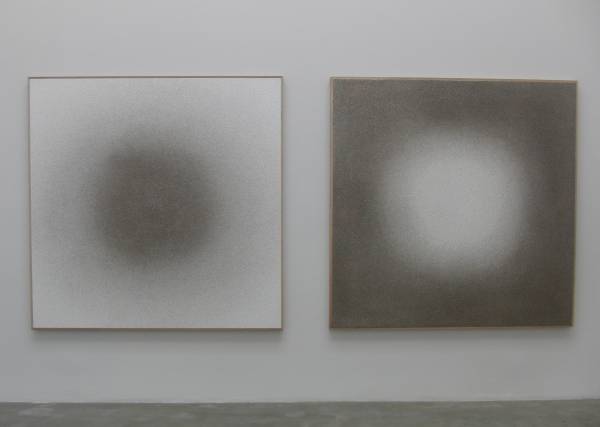
Tara Donovan’s pin drawings are on view at the Pace Gallery on West 25th St. through March 19 (photo by twi-ny/mdr)

The Pace Gallery
510 West 25th St.: “Drawings (Pins),” through March 19
545 West 22nd St.: “Untitled (Mylar),” through April 9
Tuesday – Saturday, free, 10:00 am – 6:00 pm
www.thepacegallery.com

Using such everyday materials as Styrofoam cups, plastic drinking straws, paper plates, fishing line, rubber bands, and toothpicks, Brooklyn-based artist Tara Donovan creates large-scale sculptures and installations that take on a life of their own. In the summer of 2008, for the site-specific solo exhibition “Tara Donovan at the Met,” she lined the walls of the Gioconda and Joseph King Gallery with thousands of tiny silver Mylar loops, giving the walls a fascinating texture evoking water bubbles, topographical maps, and other formations. In September 2009 at Lever House, she transformed more than a ton of transparent polyester film into a horizontal kaleidoscope visible from inside the gallery as well as from the street outside the front window. The first Calder Prize winner and recipient of a MacArthur Fellowship, Donovan currently has two shows up in Chelsea, again using unusual materials in unique ways. At the Pace Gallery on West 25th St., “Drawings (Pins)” consists of a dozen works that from a distance appear to be shaded gray-and-white ink or pencil drawings but up close are revealed to have been made with nickel-plated steel pins. While some of the works resemble Hiroshi Sugimoto’s peaceful, contemplative photographs of the sea, others are more graphic and dynamic, with circles and rays of light jumping off the white-painted gatorboard canvases.

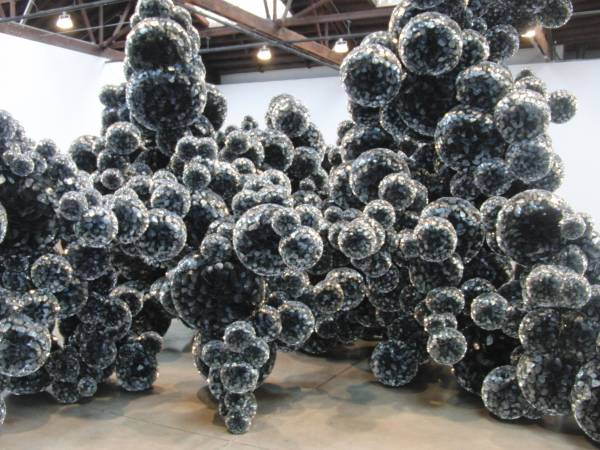
Tara Donovan’s large-scale Mylar sculpture is on view at the Pace Gallery on West 22nd St. through April 9 (photo by twi-ny/mdr)

The more abstract pieces work better than the more fanciful creations, which have too much of a wow effect and lack subtlety, although seen as a whole, the exhibit does a fine job of exploring what catalog essayist Jonathan T. D. Neil refers to as “the phenomenology of perception, the psychology of vision, and the opticality of modernism.” Meanwhile, there is also too much of a wow effect at the Pace Gallery on West 22nd St., where Donovan’s large-scale silver Mylar installation, reaching eleven feet high and spreading out like a fungus across the space, sparkles and shines as visitors walk around it, watching it glitter with the changing light. As with the pin drawings, the Mylar monster is impressive when viewed up close and the process becomes more apparent, but the piece is ultimately more style over substance.

KIKI SMITH: LODESTAR / SOJOURN

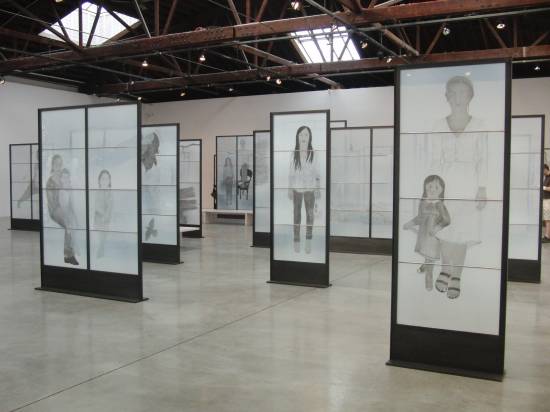
Kiki Smith’s “Lodestar” continues at the Pace Gallery in Chelsea through June 19 (photo by twi-ny/mdr)

LODESTAR
The Pace Gallery
545 West 22nd St. between Tenth & Eleventh Aves.
Tuesday – Saturday through June 19
Admission: free
www.thepacegallery.com
“Lodestar” slideshow

German-born American artist Kiki Smith has been examining nature, the human body, and, particularly, the role of women in art and society for more than three decades, from her days as a member of the Colab group in the late 1970s through to today, as seen in two strong, powerful shows currently on view in Chelsea and Brooklyn. Inspired by Prudence Punderson’s lovely late-eighteenth-century silk needlepoint “The First, Second, and Last Scene of Mortality,” which depicts three stages of a woman’s life, Smith has created a pair of site-specific installations that center on the life cycle of women from birth to death, a compelling celebration of creative inspiration and innate spirituality. At the Pace Gallery in Chelsea, “Lodestar” consists of nearly thirty hand-painted mouth-blown stained-glass panels that tell an abstract narrative of pilgrimage. Smith collaborated with Munich glass atelier Mayer’sche Hofkunstanstalt GmbH-Mayer and Bill Katz, who designed the panels as well as three white benches where people can sit and take in the wonder of it all. Smith’s line drawings are spectacular, particularly one in which a baby’s beautiful head is just entering the world. Smith incorporates such symbols as lightbulbs, birds, and chairs as women proceed from life to death in dramatic opaque panels that can be seen from both sides, as if the past is always present. The title, “Lodestar,” evokes the guiding North Star as well as the word “motherlode,” paying homage to femininity.

Kiki Smith’s “Sojourn” runs at the Brooklyn Museum through September 12 (photo by twi-ny/mdr)

SOJOURN
Brooklyn Museum of Art
200 Eastern Parkway
Wednesday – Sunday through September 12
Suggested contribution: $10 (free first Saturday of the month after 5:00)
718-638-5000
www.brooklynmuseum.org
“Sojourn” slideshow

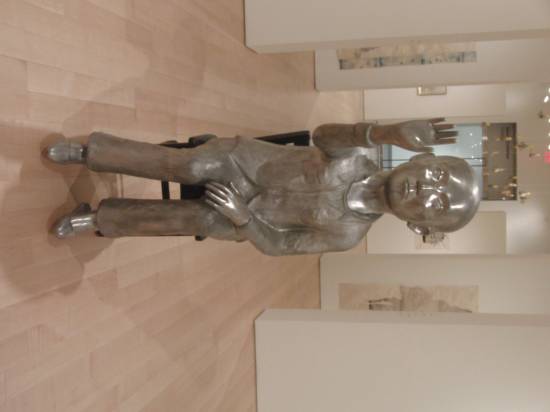
A related exhibition, “Sojourn,” continues the tale at the Elizabeth A. Sackler Center for Feminist Art at the Brooklyn Museum. Winding around Judy Chicago’s “Dinner Party,” the site-specific installation begins with “Field,” a bronze sculpture of a woman sitting on a chair, holding up her hand as if telling the viewer to proceed at their own risk. Divided into small roomlike segments, “Sojourn” features lifesize bronze sculptures, pencil and ink drawings on fragile Nepal paper, hanging lightbulbs and aluminum constructions, and even a wooden casket. The works feature such titles as “Messenger,” “Visitation,” “Annunciation,” “The Leaving,” and “I put aside myself that there was room enough to enter,” with several drawings the same as those seen at the Pace Gallery. In addition, Smith has added oil paintings, an embroidery, a projected video, and haunting, ghostlike papier-mâché figures to two rooms and the staircase of the Major Henry Trippe House, part of the museum’s outstanding period rooms in the Decorative Arts Galleries, once again evoking the past alongside the present. Taken together, “Lodestar” and “Sojourn” mark a major step forward in the career of one of America’s most important artists, a must-see pilgrimage well worth the journey.

TWI-NY TALK: BARBARA POLLACK

Barbara Pollack will be discussing her new book about the Chinese art market at Pace Gallery in Chelsea on June 1 (photo by Joe Gaffney)

THE WILD, WILD EAST: AN AMERICAN ART CRITIC’S ADVENTURES IN CHINA (Timezone 8, May 2010, $24.95)
Tuesday, June 1, the Pace Gallery, 545 West 22nd St. between Tenth & Eleventh Aves., free, 6:00
Thursday, June 10, China Institute, 125 East 65th St., $15, 6:30
www.barbarapollack.com

Barbara Pollack is not your average art critic. The brash, funny, opinionated New Yorker has a law degree from Northeastern University, has been a professor at SVA for more than ten years, has worked in public relations, is a contributing editor for ARTnews, has written for such publications as Vanity Fair, the New York Times, and the Washington Post, and knows how to throw a New Year’s Eve party. In addition, she is a visual artist with photography and video work in the collections of such institutions as the Brooklyn Museum, the Guggenheim, the Museum of Fine Arts in Houston, and the New York Public Library.

Pollack is also one of the world’s leading authorities on Chinese art, covering the burgeoning scene since 1997. She’s traveled to the mainland numerous times over the years, meeting with artists, collectors, dealers, and others involved in the exploding Asian art market as research for her just-published book, THE WILD, WILD EAST: AN AMERICAN ART CRITIC’S ADVENTURES IN CHINA. We recently accompanied Pollack on a walk through Chelsea, where gallery owners rushed out of their offices to hug her and share stories about art and life. She’ll be back in Chelsea on June 1 for the official New York City launch of her book, taking place at the Pace Gallery at 6:00. The event is free and open to the public. And on June 10 she’ll be giving a lecture at the China Institute. In between various other speaking engagements, Pollack took the time to answer a few of our questions via e-mail for our latest twi-ny talk.

twi-ny: You’ve traveled to China many times in researching this book and over the course of your career. How does the Chinese art world respond to you specifically, both in person and to the book itself, now that it’s published?

Barbara Pollack: In New York, I am just another person trying to make a living by writing about art. But in China, I get treated like a star critic with a certain degree of power. This is because for a long time there were very few people really writing about the art. That is changing now. Generally, my book was met with excitement but a certain degree of surprise. The Chinese artists — always size queens — expected a bigger book. They are used to publishing these mammoth catalogues, too large to lift, and are not accustomed to this Calvin Tomkins style of reportage. Others, particularly some of the westerners portrayed in the book, thought I did not make them out to be important enough.

twi-ny: In the last twenty years, the Sixth Generation of Chinese filmmakers — Jia Zhangke, Wang Xiaoshuai, Zhang Yuan, and others — have gained international renown for their work, including making films that are at times critical of mainland China. Is there a similar type of group when it comes to the art world in China? Are they heavily censored, or do they have an evolving freedom of expression as compared with past decades?

BP: As opposed to Chinese filmmakers, Chinese artists are able to produce without the interference of the Ministry of Culture. Not all of their work gets shown in China, though most of it does, but they also are now international art stars producing for galleries and museums all around the world, so restrictions rarely impede their output. The youngest generation, those born after the Open Door Policy and new market economy were in effect, are not taking advantage of their freedom to make political work. Mostly, they reflect a global outlook, heavily influenced by Japanese animation and American pop culture, in what is often called the Me Generation or Spoiled Brat art.

twi-ny: Is the art market’s current obsession with Asian art a fad, or do you think the work warrants it and is here to stay?

BP: Many Chinese artists, such as MacArthur award winner Xu Bing, Guggenheim star Cai Guo-Qiang, and outspoken renegade Ai Weiwei, have proven that they are worthy of international attention, even if there are Chinese artists who have been overhyped. Until the late 1990s, the art world was extremely narrow-minded and unwilling to think that a major talent could come from somewhere other than Europe or North America. That has changed forever, good riddance. So Asian art is not just a fad but the result of a growing awareness of art production throughout the world. Another reason Asian art, especially Chinese art, is not going to go away is that influx of Asian collectors into the international art market. They wield a lot of power and are willing to back artists from their home countries. In the end, they will boost careers of many artists even if we in the West disagree with their taste.

twi-ny: What is America’s greatest misconception about China, especially following the 2008 Beijing Olympics.

BP: I can’t even begin to answer this question. Sometimes, I don’t recognize the China I know from news coverage of the country. Of course, the China that I have come to know is the one packed with new millionaires — both collectors and artists — who have definitely benefited from China’s booming economy. I would have an entirely different understanding if I spent time away from Beijing and Shanghai, looking at the China that exists beyond its art world.

Barbara Pollack will be signing books on June 1 at the Pace Gallery in Chelsea, followed by a lecture at the China Institute on June 10.