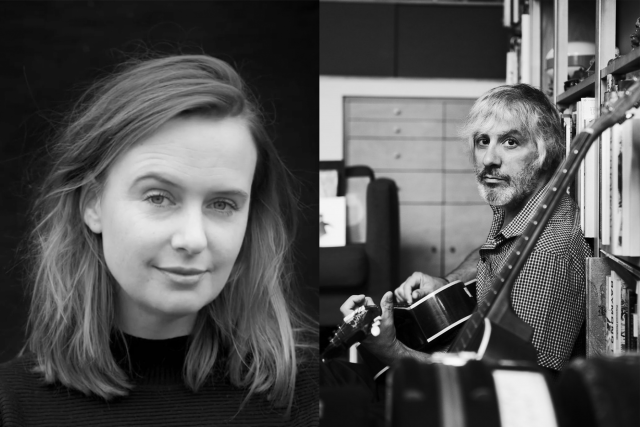
John Wilson talks with David Byrne about his latest Pace show and new book on February 7
Who:David Byrne,John Wilson What: Live virtual discussion Where:Pace Gallery, 540 West Twenty-Fifth St., Pace Gallery YouTube When: Monday, February 7, free (online), 7:00 Why: In his endlessly creative and fun HBO docuseries How To with John Wilson, Astoria native John Wilson uses footage shot all around New York City to delve into such issues as small talk, scaffolding, memory improvement, finding a parking spot, and making the perfect risotto. In his endlessly creative and fun career, British-born musician, singer, playwright, and visual artist David Byrne has made albums (solo and with Talking Heads), given concerts, directed films, and had gallery shows; currently, his brilliant American Utopia continues on Broadway at the St. James Theatre through April 3, and his latest exhibition, “How I Learned About Non-Rational Logic,” is running at Pace’s Twenty-Fifth St. space through March 19. The show consists of several series of drawings Byrne has done over the last twenty years, including his unusual depictions of dingbats sketched during the pandemic. (He describes his fascination with dingbats here.)
Byrne and Wilson have previously collaborated on the 2015 true crime concert documentary Temporary Color; they now will sit down together for a discussion at Pace in conjunction with the publication of Byrne’s new book, A History of the World (in Dingbats) (Phaidon, March 9, $39.95). “How We Learned About Non-Rational Logic: A Conversation on Humor and Bookmaking” takes place in person at Pace, where attendees will receive a signed copy of the book; the event will also be streamed for free over YouTube. “This idea of non-rational logic was not something I made up, but I realized that it kind of resonated with both the fact that I make music and the fact that these drawings follow a kind of logic that isn’t kind of based on logical or rational thinking,” Byrne notes in the above behind-the-scenes video. There should be plenty of such non-rational logic in what promises to be a very funny and illuminating talk.
DRIFT: FRAGILE FUTURE
The Shed, the McCourt
545 West 30th St. at Eleventh Ave.
Wednesday – Sunday through December 19, exhibition $25, Drifters and exhibition $35
Includes admission to Ian Cheng: Life After BOB
646-455-3494 theshed.org online slideshow
Since 2007, the Amsterdam-based duo DRIFT, a partnership between Lonneke Gordijn and Ralph Nauta, have been exploring the intersection and interdependence of humans, nature, and technology. Their environmentally conscious, multidimensional works are like individual ecosystems that present hope for a future potentially doomed by climate change. Continuing through December 19 at the Shed at Hudson Yards, Fragile Future is a wonderland of experiential installations, presented by Superblue, which specializes in immersive art.
The exhibition begins with Fragile Future, a light sculpture with a modular system based on the growth of dandelions, constructed from LED lights, phosphor bronze, printed circuit board, and the hairs and seeds of dandelions themselves. Coded Coincidence consists of dozens and dozens of beaded lights that move about a long, rectangular, netted space, sudden gusts of air making them mimic the flight of elm seeds in the spring. There’s an emotional aspect to the movement as they travel in groups and gather in a corner, or, with a kind of sadness, one gets trapped in the netting, alone until it can be freed and join the rest of the herd.
Ego might be composed of nylon fiber, ultra-high molecular weight polyethylene fiber monofilaments, polyester, and polyvinyl fluoride and run by motors set to specific algorithms, but it seems to have an organic life of its own. Created for Nederlandse Reisopera’s production of Monteverdi’s opera L’Orfeo, about the love between Orpheus and Eurydice and his descent into the underworld, Ego is a monumental handmade woven block that rises, falls, spreads out, collapses, and twists and turns as if magically floating through space, evoking human emotions amid a gentle soundscape. Describing its construction, Gordijn explains in a Drift video, “It depends on how that ego is shaped, how flexible it is, or how rigid it is. Because if it is rigid, there is only one truth, and if it’s flexible, you can move along with what is needed in order for it to accept certain truths or accept how life is or how the world is being built. And I think it’s a big difficulty in everybody’s life to be flexible in your vision and to be flexible in your perspective. But we have to be flexible, and I like that about Ego, that it can be a very rigid block but it can also completely change. It can be a solution.”
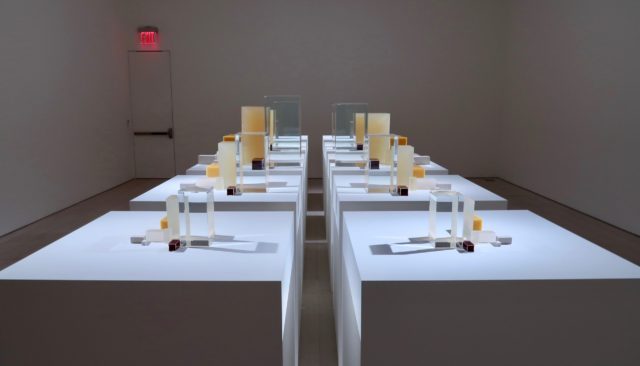
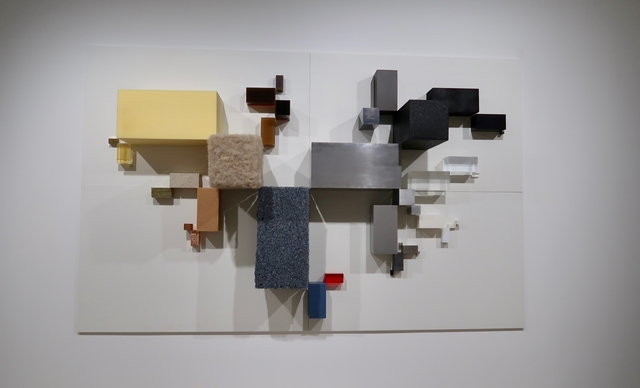
The next room is filled with “Materialism,” a collection of reverse-engineered sculptures that reduce such consumer products as a Big Mac menu, a coffee cup, an iPhone, a pencil, and a bicycle into colored blocks based on the size of their raw materials, resulting in miniature architectural models meant to reveal how we exploit the earth and its labor force.
In the two-channel, twelve-minute film Drifters, Drift’s iconic concrete blocks float through New York City at one end of a long room and across mountains, rivers, and forests at the other end, searching for where they came from and what awaits them.
The pièce de resistance takes place in the McCourt, the Shed’s 17,000-square-foot McCourt performance venue, only at certain times and with an extra charge, so plan your visit carefully. Four levitating Drifters, real versions of the blocks from the film in the previous room, move slowly throughout the space for more than an hour, set to a droning soundtrack by Anohni, the English singer-songwriter who used to lead the band Antony and the Johnsons. The blocks are floating without wires, engaged in a butoh-like dance as they very (very) slowly flip, lower, and rise, sometimes dangling just overhead. Occasionally they gently bump into each other in a kind of soft kiss. The audience can walk around the area, sit in folding chairs, or lie down on their backs on the floor as these monoliths put on a mesmerizing show that could be an outtake from Stanley Kubrick’s 2001: A Space Odyssey. During the performance, I asked Gordijn how they did it. After offering two guesses that she quickly said no to, I suggested a third, which she simply smiled at. It’s extraordinarily peaceful and relaxing while also instilling hope for a future where humans, nature, and technology can exist together in harmony.
[On December 10 and 11, Ego will be activated by special dance performances, featuring Company Wo. (Daniel Kersh, Marcella Ann Lewis, Erika Choe, Jordan Demetrius Lloyd, and Myssi Robinson) from 11:30 to 5:00 and Project-TAG (Mizuho Kappa) from 5:30 to 8:00 on Friday and Limón Dance Company (Jessica Sgambelluri) from 11:30 to 2:00 and Battery Dance (Durgesh Gangani, Jillian Linkowski, Razvan Stoian, Randall Riley, Sarah Housepian, and Vivake Khamsingsavath) from 2:30 to 8:00 on Saturday.]
Drift exhibit at Pace features self-portraits of founders Lonneke Gordijn and Ralph Nauta (photo by twi-ny/mdr)
DRIFT MATERIALISM: PAST, PRESENT, FUTURE
Pace Gallery
540 West Twenty-Fifth St. between Tenth & Eleventh Aves.
November 5 – December 18, free www.pacegallery.com
In an April 2020 online Pace discussion with musician Lee Ranaldo — he was supposed to play live with Ego when it was previously at Pace but it was canceled because of the pandemic — Gordijn said about the lockdown, “One of the beautiful things I found in the last days or weeks, actually, was that I realized that every night at a certain time, a group of crows is flying the same circles as if they’re all waiting for each other. Every day it is around 8:00, before sunset. This sort of connection with a place, where you start to get to know the animals, the plants, and the particularities, that is what I would love to explore more and the relationship that you can have with that.”
It is that kind of worldview that makes Drift’s work so compelling. In conjunction with Drift: Fragile Future, Pace is presenting “Drift Materialism: Past, Present, Future,” which expands on the “Materialism” room at the Shed. Continuing through December 18, the small show features sculptures that resemble Russian Constructivism filtered through children’s blocks. For the large-scale wall hanging 1980 Beetle, Gordijn and Nauta took apart a Volkswagen and put it back together. The resulting blocks represent forty-two materials, reduced to their accumulated mass.
Drift usually deconstructs inanimate objects, but two new works explore the molecular elements of the human body, side-by-side self-portraits of Gordijn and Nauta that are exactly equal. In the back room, the augmented reality Block Universe consists of a plexiglass sun surrounded by planets; the gallery supplies iPads that depict orbiting Drifters and other elements. The title comes from the theory that everything is happening at once, that past, present, and future exist in unison.
“We’re not having relationships with the materials and objects around us anymore,” Nauta explains in a Drift video. “And if you start losing the connection with this, you’re going to be very unhappy, because you lose the wonder in life.”
Next up is Drift’s kinetic sculpture Amplitude, a permanent commission slated to go on view at 45 Rockefeller Plaza, providing yet more wonder.
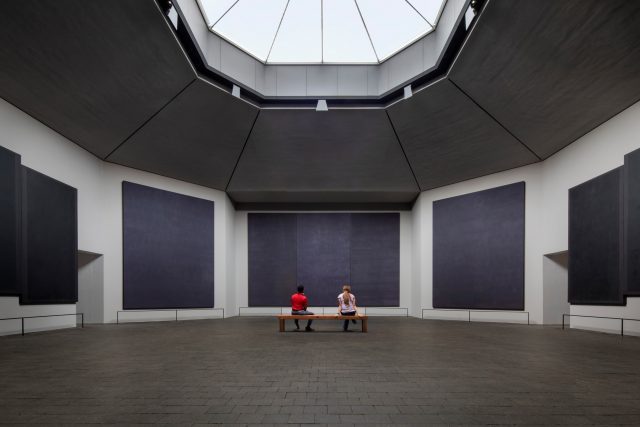
Who: Dr. Alejandro Chaoul, Marc Glimcher, David Leslie What: Virtual guided meditation Where:Pace Gallery Zoom webinar When: Monday, May 10, free with RSVP, 2:00 Why: I’ve spent much time standing in front of paintings by Mark Rothko, drawn into their sheer beauty and psychological and emotional depth. Next week we can all do so virtually in a special presentation from Pace Gallery. In 1964, Dominique and John de Menil commissioned Rothko to create murals for what would become known as the Rothko Chapel in Houston; the Russian-born artist completed a suite of fourteen paintings in 1967 but died before the chapel opened to the public in 1971. “The Rothko Chapel is oriented towards the sacred, and yet it imposes no traditional environment. It offers a place where a common orientation could be found – an orientation towards God, named or unnamed, an orientation towards the highest aspirations of Man and the most intimate calls of the conscience,” Dominique de Menil said of the ecumenical space. Rothko previously wrote to his benefactors, “The magnitude, on every level of experience and meaning, of the task in which you have involved me, exceeds all of my preconceptions. And it is teaching me to extend myself beyond what I thought was possible for me.” In honor of the fiftieth anniversary of the space, Pace Gallery is hosting a Monday meditation led by Tibetan meditation teacher Dr. Alejandro Chaoul, recorded in the chapel. The meditation will be followed by a conversation between Pace president and CEO Marc Glimcher, Rothko Chapel executive director David Leslie, and Dr. Chaoul. Admission is free with advance RSVP.
Laurie Anderson will revisit Nam June Paik’s 1984 Good Morning, Mr. Orwell for Performa telethon (photo courtesy Electronic Arts Intermix (EAI), New York)
Who: Jason Moran, Ragnar Kjartansson, Lang Lang, Yvonne Rainer, Jennifer Rubell, Laurie Anderson, Omer Fast, Maria Hassabi, Jesper Just, William Kentridge, Liz Magic Laser, Rashid Johnson, Shirin Neshat, more What: Virtual benefit gala for Performa Where:Pace Gallery When: Wednesday, November 18, free with RSVP, 2:00 to 10:00 pm Why: Performa is celebrating its fifteenth anniversary with an eight-hour gala fundraiser featuring live performances, specially commissioned artist editions, and testimonials, an online mashup of Nam June Paik’s 1984 Good Morning, Mr. Orwell and Barbara Kruger’s 1989 critique of Jerry Lewis and his annual MDA Labor Day Telethon, aired live from the seventh floor of Pace Gallery in Chelsea. “Nam June Paik’s innovations in broadcast and large-scale architectural installations of television monitors changed the way we think about the screen as an art form,” Performa founder and director RoseLee Goldberg said in a statement. “Half a century after Paik’s legendary interventions in television, we find ourselves in a unique situation: We must now rely on the screen in new ways in the midst of a pandemic that has cost over one million lives. Like Paik, we approach the screen as an exciting platform for artists to communicate their work and ideas.”
Produced in collaboration with E.S.P. TV, the fundraiser honors founding patron Toby Devan Lewis and will include a giant tally board, confetti, giant checks, balloons, a bank of people on telephones, and other telethon staples while acknowledging the Covid-19 crisis, election unrest, the BLM movement, and other critical contemporary social issues. The show will be highlighted by performances from Derrick Adams & Dave Guy, Jérôme Bel, Torkwase Dyson (reading an excerpt from Myself a Distance), David Hallberg, Glenn Kaino, Ragnar Kjartansson, Lang Lang, Marching Cobras, Jason Moran, Oyinda, Yvonne Rainer, Jennifer Rubell, Jacolby Satterwhite, Rufus Wainwright, Hank Willis Thomas & Ebony Brown, Samson Young, and Laurie Anderson, who will pay tribute to Paik; there will also be screenings of Lynda Benglis’s On Screen, The Grunions Are Running, and Document and testimonials from Tamy Ben-Tor, Elmgreen & Dragset, Omer Fast, Maria Hassabi, Jesper Just, William Kentridge, Liz Magic Laser, Kelly Nipper, Rashid Johnson, Shirin Neshat, and others, along with archival footage and never-before-seen behind-the-scenes outtakes. Six artist editions will make their debut and will be available only during the broadcast, by Korakrit Arunanondchai, Barbara Kruger, Kia LaBeija, Michèle Lamy, Cindy Sherman, and Laurie Simmons. The twentieth Performa Biennial, curated by David Breslin and Adrienne Edwards, is scheduled for 2021, but it might look very different from previous ones depending on the state of the pandemic.
Who:Lonneke Gordijn,Lee Ranaldo What:Online conversation hosted by Pace Gallery Where: Pace Gallery Instagram Live When: Thursday, April 23, free, 5:00 Why: If you haven’t been to Pace’s huge new home in Chelsea yet, it will be a little while longer before you get to check it out. But during the lockdown, Pace is hosting a series of livestreamed performances and conversations. On March 12, musician, composer, visual artist, writer, producer, and Sonic Youth cofounder Lee Ranaldo was scheduled to play a duet with EGO, a shapeshifting sculptural installation by DRIFT, a Dutch studio that was established in 2006 by Ralph Nauta and Lonneke Gordijn to bring people together with nature and technology. That event was cancelled because of the coronavirus, but on April 23 at 5:00, Ranaldo and Gordijn will take part in “Duet: Lonneke Gordijn in Conversation with Lee Ranaldo.” The free talk, focusing on creative collaboration in today’s complex world, will be streamed live on Instagram.
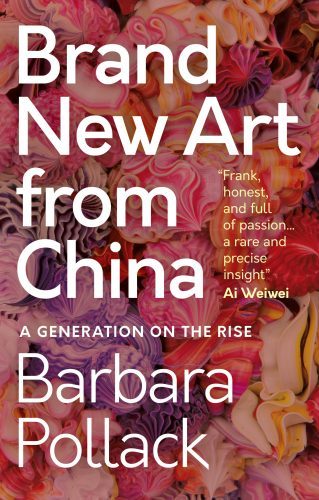
Who: Barbara Pollack What: Conversation, gallery talk, book signing in conjunction with publication of Brand New Art from China: A Generation on the Rise (Tauris, $25, September 2018) Where: James Cohan Gallery, 291 Grand St.; Pace Gallery, 537 West Twenty-Fourth St.; Asia Society, 725 Park Ave. at 70th St. When: Thursday, September 20, free, 6:00; Tuesday, September 25, free, 6:00; Monday, December 3, $20, 6:30 Why: In 2010, when twi-ny interviewed art critic, curator, teacher, and writer Barbara Pollack about her book The Wild, Wild East: An American Art Critic’s Adventures in China, she said, “In New York, I am just another person trying to make a living by writing about art. But in China, I get treated like a star critic with a certain degree of power.” Pollack’s well-deserved prominence is evident in her follow-up, Brand New Art from China: A Generation on the Rise, which features a quote on the front from Ai Weiwei, who says, “Frank, honest, and full of passion. . . . a rare and precise insight.” A good friend of twi-ny’s, Pollack herself is certainly frank, honest, and full of passion. (Full disclosure: Pollack’s literary agent is also twi-ny’s business manager.) Pollack is indeed a superstar in China, where artists clamor for her to write about their work. The new book explores such Chinese artists as Cao Fei, Chen Tianzhuo, Chen Zhou, Gao Ling, Guan Xiao, Jin Shan, Li Liao, Liu Wei, Qiu Xiafoei, Zhang Xiaogang, and Xu Zhen, in such chapters as “The Last Chinese Artists,” “The Me Generation,” and “Post-Truth.” Here’s a brief excerpt about Xu:
There are many occasions when Xu Zhen has eschewed references to Chinese culture entirely or mixed up symbols so seamlessly that the only reaction could be total confusion. At one of MadeIn’s first exhibitions, the company produced an entire survey of “art from the Middle East,” combining aesthetic strategies from conceptual art practices with just enough stereotypes of the war-torn, Islamic-dominated region to evoke a Middle Eastern identity. There were mosques made of Styrofoam and Charlie Hebdo political cartoons woven into tapestries. There were sculptures made of barbed wire and a field of broken bricks set on an invisible waterbed, so the ground seemed to move like a silent earthquake. When these works were shown at James Cohan Gallery in New York in 2009—with the title “Lonely Miracle: Art from the Middle East”—most visitors had no choice but to assume these were products of a collective of Arab artists, which was exactly the point. In this globally driven art world, it is easy to fake ethnicity. All it takes is a bit of irony and just enough cultural references to add locality to the mix.
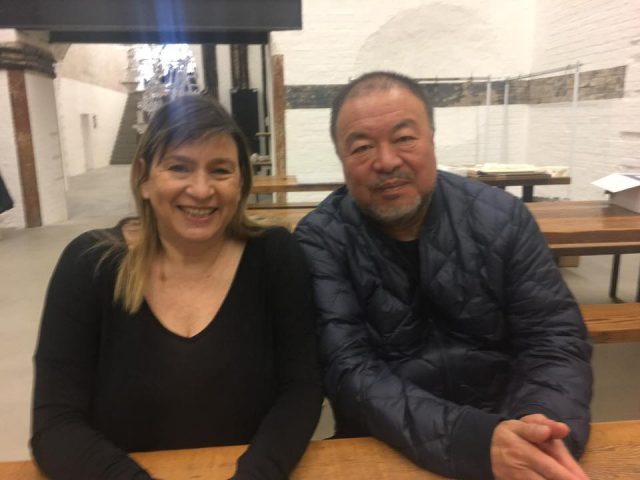
Ai Weiwei supplied a quote for Barbara Pollack’s latest book on Chinese art (photo by Joe Gaffney)
Pollack will be at James Cohan Gallery on September 20 at 6:00, in conversation with Xiaoyu Weng, the Robert H. N. Ho Family Foundation associate curator of Chinese art at the Guggenheim, followed by a book signing. On September 25 at 6:00, she will lead the gallery talk “Zhang Xiaogang & the Future of Chinese Art” at Pace in Chelsea, where “Zhang Xiaogang: Recent Works” is on view through October 20. To get a taste of Pollack’s thoughts on Zhang’s earlier work, here’s another excerpt from the book:
So, Zhang Xiaogang’s emphasis on a Chinese identity is not the result of isolation and ignorance of Western art practices but a reaction to his initial embrace of those trends. In Europe, he faced his crisis head-on by seeing the masterpieces of Western art history and feeling as if there was nothing more he could add to that legacy. Back in China, however, he was surrounded by a new cultural experience that could not be captured through Western iconography and symbols. His rejection of the West was not total. Instead, he embraced an approach that allowed for innovation in both Western and Chinese traditions for art.
On December 3 at 6:30, Pollack will be at Asia Society for a Meet the Author program, consisting of a PowerPoint presentation, a conversation with senior curator of modern and contemporary art Michelle Yun, and a book signing. If you can’t make it to the talk, you can follow the live webcast here. Pollack recently broke her foot, but as she declared on social media, “Nothing is keeping me away from this event!”
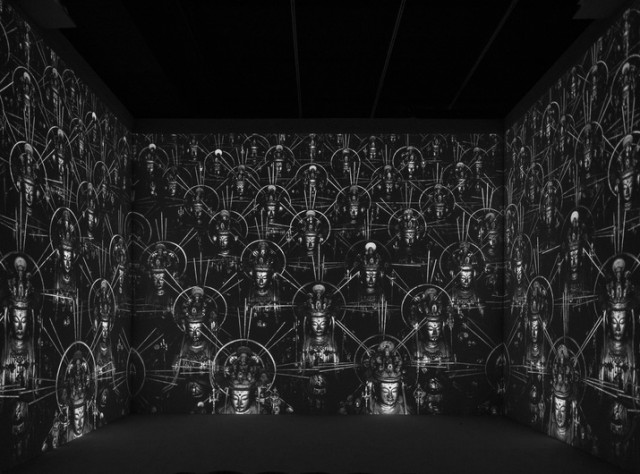
Hiroshi Sugimoto’s three-channel video, “Accelerated Buddha,” explores the nature of time and space, life and death, art and spirituality (photo courtesy the artist’s studio and Pace Gallery)
Pace Gallery
510 West 25th St. between Tenth & Eleventh Aves.
Tuesday – Saturday through March 5, free, 10:00 am – 6:00 pm
212-255-4044 www.pacegallery.com www.sugimotohiroshi.com
Japanese artist Hiroshi Sugimoto explores the nature of impermanence and the relationship between art and spirituality in his multimedia installation “Sea of Buddha,” on view through March 5 at Pace on West Twenty-Fifth St. In 1995, after a seven-year effort, Sugimoto was given permission to photograph the one thousand gilded wooden Buddha statues at Sanjῡsangen-dō (Hall of Thirty-Three Bays) in Kyoto, at a specific time in the morning when the general public is not allowed in and the summer sun casts a particularly special glow on the objects. Perhaps “given” is the wrong word, as he had to pay the temple handsomely for the privilege (and still has to hand over an additional fee every time he displays the photographs). Sugimoto, who lives and works in Tokyo and New York and has previously re-created reality in such series as “Portraits,” “Dioramas,” and “Theaters,” took forty-eight black-and-white pictures of the very similar but not identical statues. Only thirty-six were able to fit in his installation at Pace, where they are arranged at eye level on two sides of an oval room that serves as a kind of shrine. Numbers are critical to the project; Sugimoto, who was inspired by Walter De Maria’s “The Broken Kilometer,” has stated that the total number of photos relate to the forty-eight stages of death; thirty-three (the number of bays at Sanjῡsangen-dō) is a popular numeral in the Bible, associated with Noah, Jesus, King David, Jacob, and others; and some Buddhist teachings state that one thousand enlightened Buddhas will bring wisdom to the world. At first glance, the photos look the same, taken from the same angle, but each Buddha is as different as each human on the planet. An enveloping serenity can be felt as you make your way through the space, more spiritual than religious. In a small adjoining area, Sugimoto’s “Accelerated Buddha” plays on a loop, a mesmerizing five-minute immersive video, projected corner-to-corner onto three sides of the room, in which Sugimoto cuts between the forty-eight photos at an ever-faster pace, starting off very slowly and ending up in a furious blur, echoing the subjective human experience of time from birth to death while also evoking Yayoi Kusama’s Infinity Rooms. The exhibition also features five of Sugimoto’s “Seascapes,” gelatin silver prints of horizon lines on the ocean, quiet, entrancing shots of water and air. “Every time I view the sea, I feel a calming sense of security, as if visiting my ancestral home,” Sugimoto has said of the series. “I embark on a voyage of seeing.” Sugimoto’s latest show at Pace is yet another voyage well worth seeing.