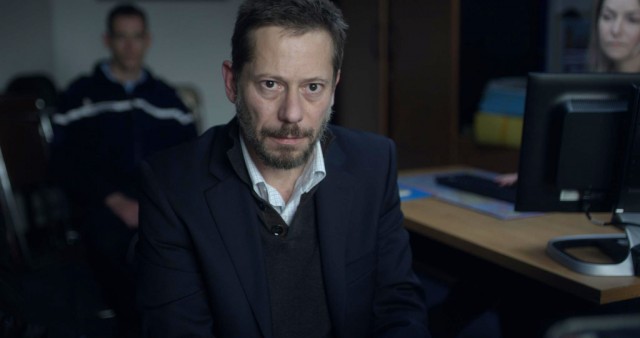
Mathieu Amalric stars as a husband and father in deep trouble in film he also directed and cowrote
THE BLUE ROOM (LA CHAMBRE BLEUE) (Mathieu Amalric, 2014)
Film Society of Lincoln Center
Monday, September 29, Alice Tully Hall, 9:00 pm
Tuesday, September 30, Francesca Beale Theater, 9:00 pm
Festival runs September 26 – October 12
212-875-5050
www.filmlinc.com
www.lachambrebleue-lefilm.com
 Real-life partners Mathieu Amalric and Stéphanie Cléau strip Georges Simenon’s short 1955 novel The Blue Room to its bare essentials — and we do mean bare — in their intimate, claustrophobic modern noir adaptation, which makes its North American premiere at the New York Film Festival September 29 and 30. In addition to being one of the world’s most talented actors, starring in such films as Kings and Queen, The Diving Bell and the Butterfly, A Christmas Tale, and Venus in Fur, Amalric has directed several previous works, including On Tour, which earned him the Best Director prize at Cannes. In The Blue Room, Amalric plays Julien Gahyde, a successful agriculture equipment salesman whose passionate affair with a local pharmacist’s wife, Esther Despierre (Cléau, who cowrote the script with Amalric), appears to have ended in murder. The film opens with Grégoire Hetzel’s lush, sweeping music as the camera makes its way to a blue hotel room where Julien and Esther have just made love offscreen. “Did I hurt you?” she asks. “No,” he responds. “You’re angry,” she says. “No,” he repeats as she laughs and a drop of blood falls on a creamy white sheet. Only then do we see the naked, sweaty couple, whose lurid tale has been succinctly revealed by this highly stylized, beautifully orchestrated scene. Next we hear Julien being interrogated by a magistrate (Laurent Poitrenaux) about a suspicious death, and soon we see Julien in handcuffs in the police station. We don’t know exactly what crime he has been accused of, nor do we know the victim — it could be Julien’s wife, Delphine (Léa Drucker), Esther’s husband, Nicolas (Olivier Mauvezin), or maybe even Esther herself. But as director Amalric, cinematographer Christophe Beaucarne, and editor François Gedigier cut between the past and the present, the details slowly unfold — although that doesn’t mean they ever become completely clear.
Amalric fills The Blue Room with bold splashes of color amid all the darkness and muted skin tones, from the red towel that signals Julien and Esther’s illicit rendezvous to Delphine’s blue bikini to the strikingly red hair of Nicolas’s mother (Véronique Alain) and the shiny green and yellow John Deere equipment he sells. Amalric and Cléau trim so much out of the original story that it too often feels overly cold and calculating, the manipulation too clear and obvious. The nudity also lacks subtlety; Amalric and Cléau might be comfortable with each other sans clothing, but it seems to be a bit of an obsession with Amalric the director. Nonetheless, The Blue Room, shot in the old-fashioned aspect ratio of 1:33 and running a mere seventy-six minutes, is a gripping yarn, a lurid tale of sex and murder, pain and passion, and femmes fatale, told from the point of view of a relatively quiet, reserved man who never thought his world could just fall apart like it does. With such plot elements as adultery and murder and even the presence of a young daughter (Mona Jaffart), the story cannot fail to call to mind French author Gustave Flaubert’s classic novel of provincial France and misplaced passion, Madame Bovary, but the near-echoes never become too loud, merely adding a somewhat puzzling flavor to the film, like a dream half remembered. Amalric will participate in a Q&A following the September 29 screening at 9:00 at Alice Tully Hall; in addition, he will sit down for a free HBO Directors Dialogue that same day at 6:00 in the Walter Reade Theater, where he’s sure to discuss such influences as Alfred Hitchcock, François Truffaut, Claude Chabrol, Otto Preminger, and Fritz Lang.

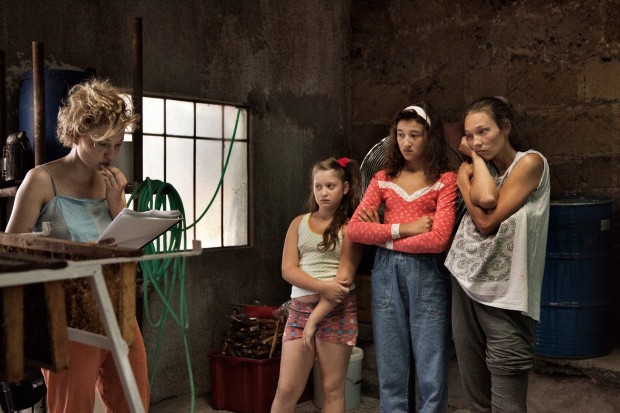
 Winner of the Grand Prix at the Cannes Film Festival, Alice Rohrwacher’s The Wonders is a sweet little gem of a movie, focusing on a German-Italian family that finds itself at a critical crossroads. Set in Rohrwacher’s (Corpo celeste) hometown in the countryside between Umbria-Lazio and Tuscany, the film follows the travails of a beekeeping family led by the gangly Wolfgang (Sam Louwyck), a grumpy ne’er-do-well from one of the Germanic countries who is trying to live some kind of back-to-the-land life away from authorities in an undeveloped backwater. His allegiance to old-fashioned tradition includes overworking his four young daughters while his wife, Angelica (Alba Rohrwacher, the director’s older sister), keeps at a distance and live-in friend Cocò (Sabine Timoteo) keeps stirring up the pot. At the center of it all is twelve-year-old Gelsomina (first-time actress Maria Alexandra Lungu, who was discovered in a catechism class), an exceptional beekeeper who wants her father to allow the family to participate in a television contest, Countryside Wonders, that could earn them much-needed money. But her father prefers taking care of things himself — though not very well, particularly when he acquires a camel for no apparent reason. Suspicious of the government and contemporary society, Wolfgang likes living in relative isolation; inviting strangers into their world could reveal the illegal working conditions, not to mention abuse of child labor laws. But Gelsomina is determined to improve their existence, starting with the competition, which is hosted by the beguiling, fairy-tale-like Milly Catena (Monica Bellucci in a marvelous white head piece, partially poking fun at her own sex-symbol image).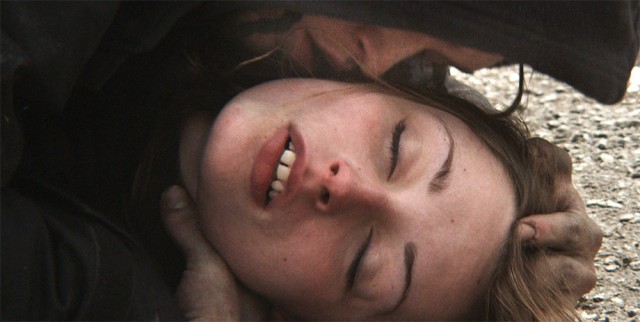
 Josh and Benny Safdie’s Heaven Knows What is a harrowing tale about addiction and obsession, but it turns out that its back story is much more compelling than what shows up onscreen. Josh was researching a film about the Diamond District when he came upon Arielle Holmes, a nineteen-year-old temp assistant. He was determined to find out more about her and shortly discovered that she was a homeless junkie with a wild, unpredictable druggie boyfriend, Ilya. Josh and Benny, who had previous collaborated on such indie features as The Pleasure of Being Robbed and Daddy Longlegs and the documentary Lenny Cooke, commissioned Holmes to write her story, and she quickly delivered 150 pages that ultimately inspired the film, in which Holmes plays Harley, a young heroin addict living on the streets of New York City, spanging money (begging for spare change) for her next fix while in a combative relationship with Ilya (Caleb Landry Jones). Harley has done something to alienate Ilya, and she says she will kill herself to prove her love and devotion. He tells her to go ahead and do it, so she slits one of her wrists and is rushed to the hospital. That sets the stage for the rest of the lurid and sordid narrative, as Haley bounces between the cruel Ilya and her drug dealer, the far more easygoing and mellow Mike (real-life street legend Buddy Duress in his acting debut); she is also followed around by Skully (rapper Necro), who wants to save her from herself but is clearly in no position to do so.
 Shortly after meeting Ron “Stray Dog” Hall at the Biker Church in Branson, Missouri, writer-director Debra Granik (Down to the Bone) cast the Vietnam vet as Thump Milton in her second feature, the Oscar-nominated Winter’s Bone. Upon learning more about him, she soon decided that he would be a great subject for a documentary, so she took to the road, following him across the country in the engaging and revealing Stray Dog. Nearly always dressed in black, including his treasured leather jacket covered in medals and patches — when he puts it in a suitcase for a trip, it’s a ritual like he’s folding the American flag — Hall is a wonderfully grizzled old man with a fluffy white beard. At home, he is learning Spanish online so he can communicate better with his new wife, Alicia, a Mexican immigrant, and her two sons (who still live across the border). He visits with his teenage granddaughter, who is making some questionable decisions about her future. In Missouri, he owns and operates the At Ease RV Park, where he gives breaks to fellow vets who can’t always afford to pay the rent. And when he goes on the road, participating in the Run for the Wall, joining up with thousands of other bikers heading for the annual service at the Vietnam Veterans Memorial in Washington, DC, he stops along the way at other ceremonies honoring soldiers who have gone missing, are POWs, or were killed in action in Vietnam, Iraq, Afghanistan, and other wars.