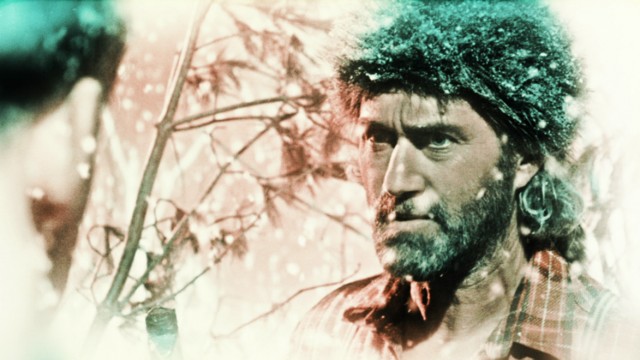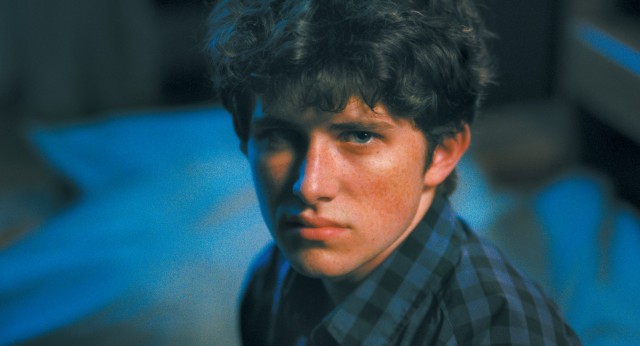
Vincent (newcomer Victor Ezenfis) is desperate to put his family back together in Eugène Green’s SON OF JOSEPH
SON OF JOSEPH (LE FILS DE JOSEPH) (Eugène Green, 2016)
Film Society of Lincoln Center
West 65th St. between Eighth & Amsterdam Aves.
Sunday, October 9, Bruno Walter Auditorium, $20, 8:00
Monday, October 10, Walter Reade Theater, $20, 6:00
Festival runs September 30 – October 16
212-875-5050
www.filmlinc.org
www.kinolorber.com
 Eugène Green returns to the New York Film Festival with the glorious French satire / black comedy / biblical parable Son of Joseph, a masterful blending of sound, image, and story that is as stunning to listen to as it is to watch. Newcomer Victor Ezenfis stars as Vincent, an intractable young teen who is desperate to discover who his father is, no matter how hard his single mother (Natacha Regnier), a nurse, tries to keep that information from him. “I don’t want to help people,” he says. “I love no one.” His sneaky ways finally reveal the man’s name, and Vincent tracks him down only to discover that the man, Oscar Pormenor (Mathieu Amalric), is a boorish, self-obsessed publisher who is cheating on his wife with his sexy secretary, Bernadette (Julia de Gasquet). At a party for his company’s latest book, The Predatory Mother, ever-so-chic critic Violette Tréfouille (Maria de Medeiros) mistakes Vincent for an up-and-coming novelist, with Oscar cluelessly declaring him the next Céline before finding out who the boy really is. Soon a disappointed Vincent is befriended by Oscar’s brother, Joseph (Fabrizio Rongione), but neither is aware of the connection. As Vincent is introduced to art and literature, he attempts to manipulate everyone around him in order to form the family he’s always wanted.
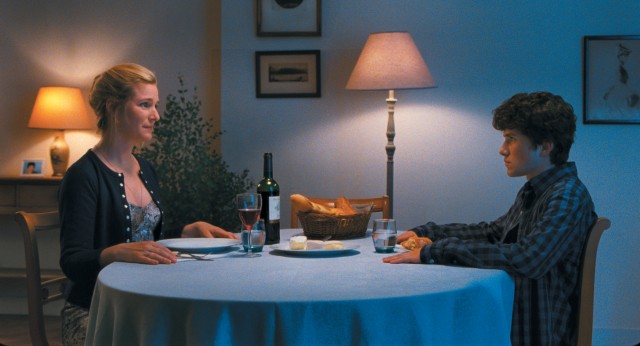
A single mother (Natacha Regnier) has her hands full with son Vincent (Victor Ezenfis) in extraordinary biblical parable
Green, an American expatriate living and working in France, divides Son of Joseph into five chapters named for major biblical events, including “The Sacrifice of Abraham,” “The Golden Calf,” and “The Flight to Egypt.” Vincent is mesmerized by a poster in his room of Caravaggio’s “The Sacrifice of Isaac”; at the Louvre, Joseph shows him religious paintings such as Philippe de Champaigne’s “The Dead Christ” and Georges de la Tour’s “Joseph the Carpenter.” Ever the absurdist, Green (Toutes les nuits, Le monde vivant) turns to the surreal for the finale, which features a revelation that elicited an audible gasp of wonder from the audience when I saw it, an exhalation in which I heartily participated. As in 2014’s architectural wonder La Sapienza, which also starred Rongione, each frame is composed like a work of art, courtesy of longtime Green cinematographer Raphaël O’Byrne, along with editor Valérie Loiseleux, set designer Paul Rouschop, and costume designer Agnès Noden. The entrancing color schemes and long two-shots in addition to spectacular sound by Benoît De Clerck immerse you in Green’s unique and unusual fantasy world.
The actors, who speak in Green’s trademark overly mannered and stiff style, occasionally look directly into the camera, speaking lines to the viewer, but Son of Joseph never gets preachy. It’s a bizarrely entertaining tale of family, of fathers and sons, and mothers and sons, where all the details matter. Inside a church, Vincent witnesses musical ensemble Le Poème Harmonique perform a work in Latin by Domenico Mazzocchi about a mother dealing with the death of her son. Earlier, when Vincent turns down a friend’s offer to join his sperm-selling operation, it’s not merely because he might find the job distasteful; deep down, he doesn’t want any other kid to go through life not knowing who his father is. He might say, “I don’t want to help people. I love no one.” But he proves himself wrong in this stunner. Coproduced by Jean-Pierre and Luc Dardenne, Son of Joseph is screening October 9 at 8:00 and October 10 at 6:00 at the New York Film Festival; both screenings will be followed by a Q&A with Green, who also appears in the film as the grizzled hotel concierge.
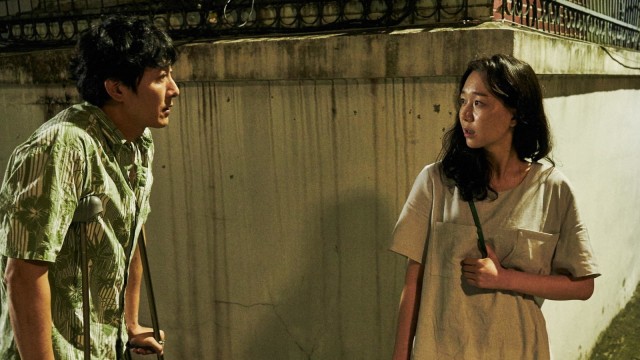
 “Don’t try to know everything,” Min-jung (Lee Yoo-young) says in Hong Sang-soo’s latest unusual and brilliant romantic drama, Yourself and Yours. It’s impossible to know everything that happens in Hong’s films, which set fiction against reality, laying bare cinematic narrative techniques. With a propensity to use protagonists who are directors, it is often difficult to tell what is happening in the film vs. the film-within-the-film. He also repeats scenes with slight differences, calling into question the storytelling nature of cinema as well as real life, in which there are no do-overs. In the marvelous Yourself and Yours, scenes don’t repeat, although the existence of a main character might. Min-jung is in a relationship with painter Young-soo (Kim Joo-hyuk), who is dealing with the failing health of his mother when he is told by a friend (Kim Eui-sung) that Min-jung was seen in a bar drunk and arguing with another man. Young-soo refuses to believe it, since he and Min-jung are facing her drinking problem by very carefully limiting the number of drinks she has when she goes out with him. But when the friend insists that numerous people have seen her in bars with other men and imbibing heavily, Young-soo confronts her, and she virulently defends herself, claiming that they are lies and that he should have more faith in her. She leaves him, and over the next several days she has encounters with various men, but she appears to be either a pathological liar or have a memory problem as she tells the older Jaeyoung (Kwon Hae-hyo), a friend of Min-jung’s, that she is a twin who does not know the painter; later, with filmmaker Sangwon (Yu Jun-sang), she maintains that they have never met despite his assertion that they have. Through it all, Young-soo is determined to win her back. “I want to love each day with my loved one, and then die,” he explains with romantic fervor. He also acknowledges Min-jung’s uniqueness: “Her mind itself is extraordinary,” he says.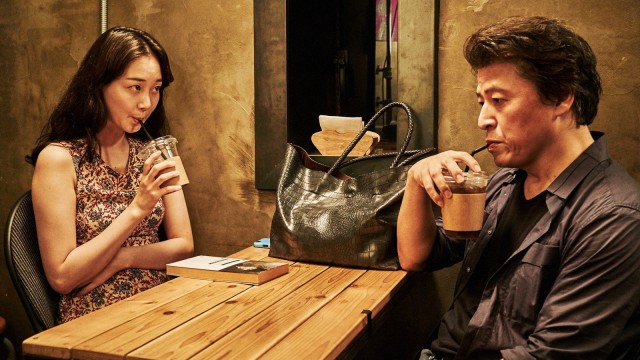
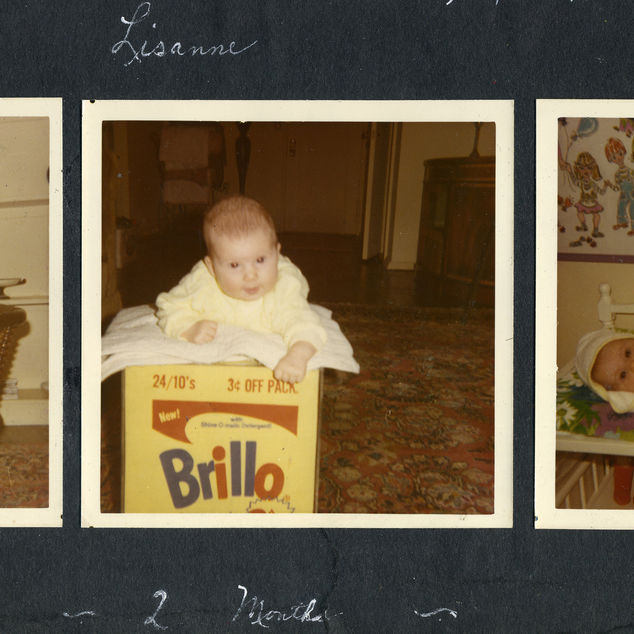
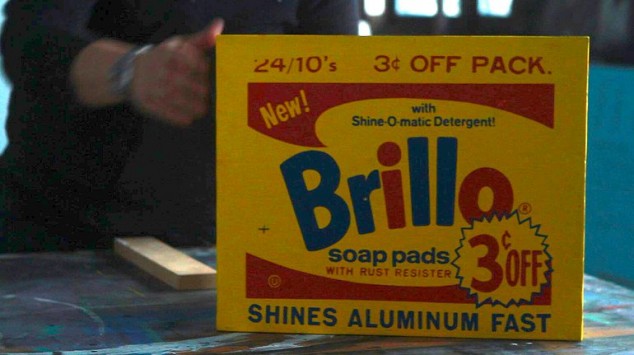
 Brillo Box (3¢ Off) is a charming and delightful look at art, family, and popular culture, as director Lisanne Skyler turns her camera on her mother and father to explore what became a major point of contention in their marriage. In 1969, young collectors Martin and Rita Skyler purchased a yellow “Brillo Box (3¢ Off)” by Andy Warhol for $1,000 from Ivan Karp at O.K. Harris in SoHo; five years earlier, in 1964, when the Skylers got engaged, the “Brillo Boxes” sold for $200 when they were first displayed. In 1971, Martin traded the box for a drawing by Abstract Expressionist dot painter Peter Young. In 2010, the Skylers’ “Brillo Box (3¢ Off)” sold at Christie’s for $3 million. In this intimate and lighthearted documentary, Skyler traces the history of Warhol’s Brillo Boxes — which were wood copies of the original boxes found in stores, designed by Abstract Expressionist James Harvey — the provenance of the specific box her family owned, and the birth, death, and rebirth of Pop art, via interviews with her parents as well as experts in the art world. “I started out not trying to be a connoisseur or anything like that but thinking that something I enjoyed doing could also just be another way of making money grow,” her father explains. Meanwhile, her mother felt a closer connection with the art, particularly with the Brillo Box, which she encased in Plexiglas and used as a coffee table. The Skylers also bought and sold works by Jake Berthot, Frank Stella, Roy Lichtenstein, Chuck Close, Jasper Johns, Cy Twombly, and Richard Serra.