Tag Archives: this week at the new york film festival

3 FACES

3 Faces

Iranian auteur Jafar Panahi plays himself in gorgeously photographed and beautifully paced 3 Faces

3 FACES (SE ROKH) (Jafar Panahi, 2018)
IFC Center
323 Sixth Ave. at West Third St.
Opens Friday, March 8
212-924-7771
www.ifccenter.com

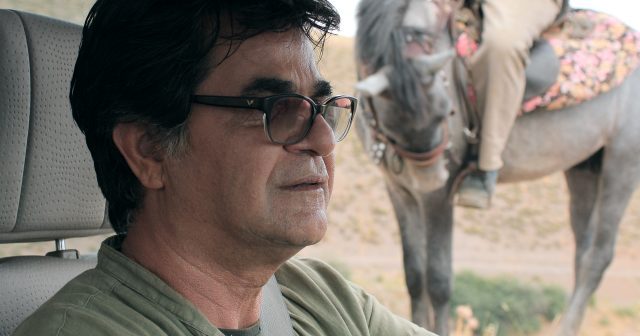
One of the most brilliant and revered storytellers in the world, Iranian auteur Jafar Panahi proves his genius yet again with his latest cinematic masterpiece, the tenderhearted yet subtly fierce road movie 3 Faces. The film, which made its US premiere this past fall at the New York Film Festival, won the Best Screenplay prize at Cannes, and screened in January as part of IFC’s inaugural Iranian Film Festival New York, is now back at IFC for a theatrical run beginning March 8. As with some of Panahi’s earlier works, 3 Faces walks the fine line between fiction and nonfiction while defending the art of filmmaking. Popular Iranian movie and television star Behnaz Jafari, playing herself, has received a video in which a teenage girl named Marziyeh (Marziyeh Rezaei), frustrated that her family will not let her study acting at the conservatory where she’s been accepted, commits suicide onscreen, disappointed that her many texts and phone calls to her hero, Jafari, went unanswered. Deeply upset by the video — which was inspired by a real event — Jafari, who claims to have received no such messages, enlists her friend and colleague, writer-director Panahi, also playing himself, to head into the treacherous mountains to try to find out more about Marziyeh and her friend Maedeh (Maedeh Erteghaei). They learn the girls are from a small village in the Turkish-speaking Azeri region in northwest Iran, and as they make their way through narrow, dangerous mountain roads, they encounter tiny, close-knit communities that still embrace old traditions and rituals and are not exactly looking to help them find out the truth.
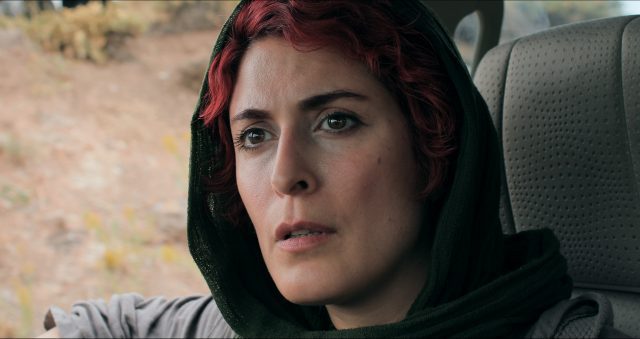
3 Faces

Iranian star Behnaz Jafari plays herself as she tries to solve a mystery in Jafar Panahi’s 3 Faces

Panahi (Offside, The Circle) — who is banned from writing and directing films in his native Iran, is not allowed to give interviews, and cannot leave the country — spends much of the time in his car, which not only works as a plot device but also was considered necessary in order for him to hide from local authorities who might turn him in to the government. He and Jafari stop in three villages, the birthplaces of his mother, father, and grandparents, for further safety. The title refers to three generations of women in Iranian cinema: Marziyeh, the young, aspiring artist; Jafari, the current star (coincidentally, when she goes to a café, the men inside are watching an episode from her television series); and Shahrzad, aka Kobra Saeedi, a late 1960s, early 1970s film icon who has essentially vanished from public view following the Islamic Revolution of 1978-79, banned from acting in Iran. (Although Shahrzad does not appear as herself in the film, she does read her poetry in voiceover.) 3 Faces is gorgeously photographed by Amin Jafari and beautifully edited by Mastaneh Mohajer, composed of many long takes with few cuts and little camera movement; early on there is a spectacular eleven-minute scene in which an emotionally tortured Jafari listens to Panahi next to her on the phone, gets out of the car, and walks around it, the camera glued to her the whole time in a riveting tour-de-force performance.
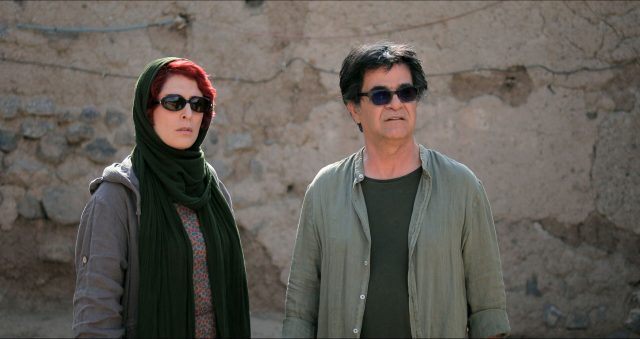
3 Faces

Behnaz Jafari and Jafar Panahi encounter culture clashes and more in unique and unusual road movie

3 Faces is Panahi’s fourth film since he was arrested and convicted in 2010 for “colluding with the intention to commit crimes against the country’s national security and propaganda against the Islamic Republic”; the other works are This Is Not a Film, Closed Curtain, and Taxi Tehran, all of which Panahi starred in and all of which take place primarily inside either a home or a vehicle. 3 Faces is the first one in which he spends at least some time outside, where it is more risky for him; in fact, whenever he leaves the car in 3 Faces, it is evident how tentative he is, especially when confronted by an angry man. The film also has a clear feminist bent, not only centering on the three generations of women, but also demonstrating the outdated notions of male dominance, as depicted by a stud bull with “golden balls” and one villager’s belief in the mystical power of circumcised foreskin and how he relates it to former macho star Behrouz Vossoughi, who appeared with Shahrzad in the 1973 film The Hateful Wolf and is still active today, living in California. Panahi, of course, will not be present for the opening at IFC, as his road has been blocked, leaving him a perilous path that he must navigate with great care.
I AM CUBA

I Am Cuba

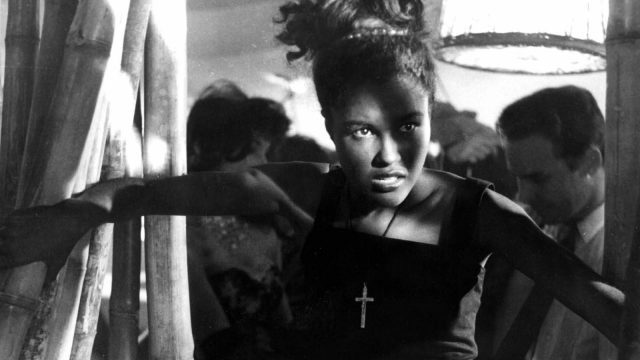
A reluctant prostitute named Maria is unhappy to have to deal with American gamblers in Mikhail Kalatozov’s I Am Cuba

I AM CUBA (SOY CUBA) (Mikhail Kalatozov, 1964)
Film Forum
209 West Houston St.
February 15-21
212-727-8110
filmforum.org

The Revivals section of last year’s New York Film Festival included a rare screening of Mikhail Kalatozov’s 1964 political epic, I Am Cuba, in a 4K restoration from Milestone. It’s now back for a one-week run beginning at Film Forum on February 15. In the early 1960s, the Soviet Union wanted to cement its hold on Cuba and celebrate its new Communist regime by making a propaganda film celebrating the Cuban Revolution and the end of Fulgencio Batista’s dictatorial reign. The Soviets actually disowned the result, considering it too arty and inaccessible for their needs. But it’s quite a film, a lavishly photographed black-and-white gem that was championed by Martin Scorsese and Francis Ford Coppola when it was resurrected at the Telluride Film Festival in 1992.

I Am Cuba

The 4K restoration of I Am Cuba comes to Film Forum February 15-21

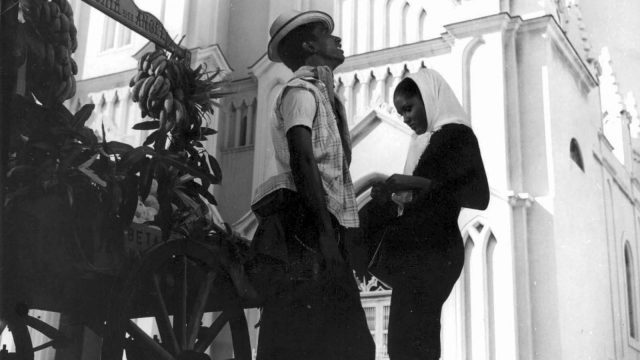
I Am Cuba is divided into four sections that tell the story of the nation from different points of view. The film opens in a casino where American men degrade Cuban prostitutes; one of the men demands to see the home of one of the women, Maria, so he trudges with her through a poverty-stricken region and meets an unexpected man. Next, Pedro, a tenant farmer, is told that the land he has been working for decades has been sold to the American company United Fruit, so he takes dire action while protecting his family. (“I used to think the most terrifying thing in life is death,” he says. “Now I know the most terrifying thing in life is life.”) In the third story, a university student named Enrique is overeager to get involved in a campus rebellion, especially after saving a young woman from drunk American soldiers and witnessing a cold-blooded shooting by the police. The final part deals with a pacifist villager named Mariano who is being goaded by a soldier to join the military fight for freedom.

I Am Cuba

A pacifist would rather stay home than fight in I Am Cuba

I Am Cuba is one of the most visually stunning films ever made. Kalatozov and cinematographer Sergei Urusevsky, who had previously collaborated on the extraordinary Palme d’Or winner The Cranes Are Flying, create breathtaking tracking shots from virtually impossible angles, high in the air and underwater, assisted by camera operator Alexander Calzatti, who was practically a stuntman to achieve whatever was necessary. A joint production of the Soviet company Mosfilm and the new Cuban Institute of Cinematographic Art and Industry, the film was written by Soviet poet and novelist Yevgeny Yevtushenko and Cuban director and writer Enrique Pineda Barnet and features interstitial narration by Havana-born actress Raquel Revuelta as the voice of the nation. “Is this a happy picture?” she asks. “Don’t avert your eyes. Look! I am Cuba. For you, I am the casino, the bar, the hotels. But the hands of these children and old people are also me.” Later she encourages her citizenry to take up arms, softly stating, “I am Cuba. Your hands have gotten used to farming tools. But now a rifle is in your hands. You are not shooting to kill. You are firing at the past. You are firing to protect your future.” The film, of course, takes on added relevance today given the US government’s relationship with Cuba and the death of Fidel Castro in November 2016; there are also scenes that seem to prefigure the coming civil rights and peace movements in the US that occurred after the film was made. [Note: The 6:40 screening on February 15 will be introduced by Amy Heller and Dennis Doros of Milestone Films.]

THE WAR AT HOME

The War at Home

Restored documentary follows ten years of student protests at the University of Wisconsin in Madison

THE WAR AT HOME (Glenn Silber, 1979)
New York Film Festival: Film Society of Lincoln Center, Francesca Beale Theater
West 65th St. between Eighth Ave. & Broadway, 212-875-5610
Tuesday, October 9, 8:00
Metrograph, 7 Ludlow St. between Canal & Hester Sts., 212-660-0312
Opens Friday, October 12
www.filmlinc.org
metrograph.com

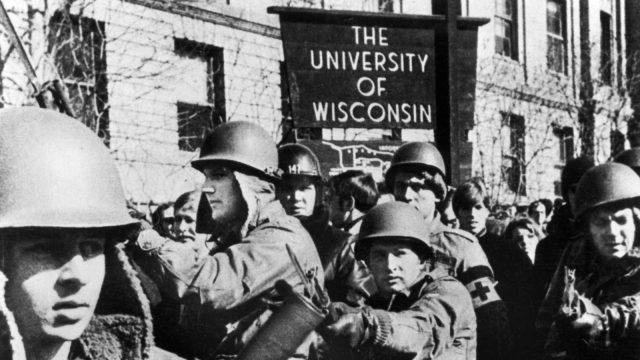
In 1979, the Oscars paid tribute to a changing sentiment in the country regarding the Vietnam War and its veterans, showering accolades on The Deer Hunter and Coming Home. The next year, Vietnam was not so front and center, although a small but important film was nominated for Best Documentary Feature (and also won the Special Jury Prize at Sundance): Glenn Silber and Barry Alexander Brown’s The War at Home, an eye-opening look at the year-by-year history of the antiwar movement at the University of Wisconsin in Madison from 1963 into the early 1970s. Following a Kickstarter campaign to raise funds for a rerelease of a new 4K digital restoration by IndieCollect, The War at Home is screening October 9 in the Revivals section of the fifty-sixth annual New York Film Festival before opening for a theatrical run at Metrograph on October 12. Although the revival shows its age, the film is startlingly relevant, serving as both a primer and a warning about peaceful protest today. “When we were producing The War at Home in our twenties, we often said we were ‘making this film for our children’ because we understood that we had lived through an extraordinary political and turbulent period,” Silber and Brown explain on the Kickstarter page. “The film is also about the lessons of this politically intense time when a generation of young Americans confronted their government’s policies and lies.”

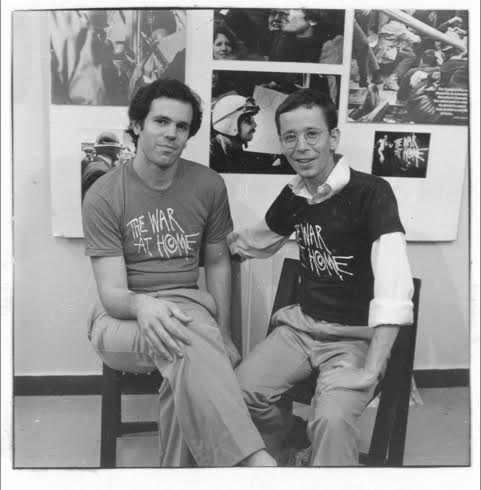
Glenn Silber and Barry Alexander Brown in 1979 while making The War at Home

Glenn Silber and Barry Alexander Brown in 1979 while making The War at Home

The film traces the antiwar movement in Madison chronologically, combining new interviews of participants on both sides of the issue with archival footage of the brutality of the war and clips of such politicians as Presidents John F. Kennedy, Lyndon B. Johnson, and Richard M. Nixon, presidential candidates Eugene McCarthy, Hubert Humphrey, and Charlene Mitchell, Defense secretary Robert McNamara, and Congressman Gerald R. Ford. In one of the film’s most poignant moments, Sen. Ted Kennedy says to a UW audience that he knows what they are against but asks what they are for. Silber and Brown speak with such pivotal figures as Karleton Armstrong, Wisconsin Student Association vice president Margery Tabankin, sociology professor Maurice Zeitlin, black activists Wahid and Liberty Rashad, Elinore Pullen, Susan Colson, ROTC cadet Jack Calhoun, Evan Stark, Quaker peace activist Betty Boardman, businessman and Holocaust survivor Jack Von Mettenheim, underground newspaper editor Ken Mate, Madison mayor Paul Soglin, campus journalist Jim Rowen, and poet Allen Ginsberg, along with campus police chief Ralph Hanson, Sen. Gaylord Nelson, Madison police chief inspector Herman Thomas, university president H. Edwin Young, and Vietnam veterans Al Jenkins, Doug Bradley, and Ron Carbon. “We were trying to build a whole counterculture,” says Students for a Democratic Society head Henry Haslach, noting that their goal was to have an impact on all social issues, not just the war. The film shows the protestors as they burn draft cards, occupy an administration building, demonstrate against Dow chemical, hold a student strike, travel to the 1968 Democratic National Convention, and participate in a national moratorium while featuring songs by Bob Dylan, Phil Ochs, Buffalo Springfield, and Sgt. Barry Sadler and a remarkable political advertisement that makes today’s attack ads look mild.

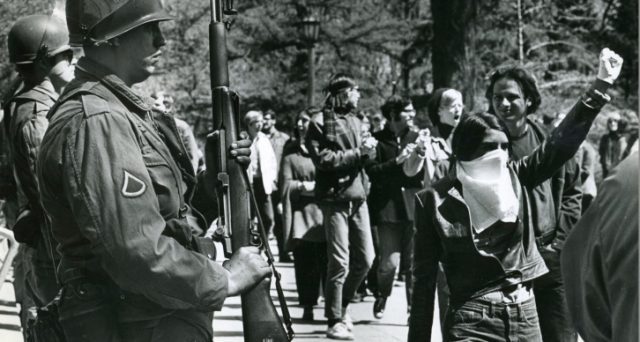
(photo by Roger Turner / Wisconsin State Journal)

University of Wisconsin was a hotbed of student protests during the Vietnam War (photo by Roger Turner / Wisconsin State Journal)

Nearly forty years after its initial release, The War at Home is no mere time capsule, particularly as Wisconsin is now a key swing state, and Silber will be at the NYFF screening to talk about the film’s current relevance. “Today, we’re facing another president who’s threatening war, destroying our environmental protections, rejecting climate change, lying to the public, debasing the truth, attacking the news media, and tearing at the very fabric of our democratic institutions. That’s why the resistance has sprung up and is fighting back,” he and Brown write on the Kickstarter page. After the Tuesday screening at the festival, The War at Home will open at Metrograph on Friday, with Silber and Brown appearing at Q&As with an all-star lineup: October 12 at 8:30 with Michael Moore, October 13 at 1:00 with Alex Gibney, October 14 at 1:00 with Mark Rudd, and October 15 at 7:15 with Amy Goodman.

NYFF56 MAIN SLATE: 3 FACES

3 Faces

Iranian auteur Jafar Panahi plays himself in gorgeously photographed and beautifully paced 3 Faces

NEW YORK FILM FESTIVAL: 3 FACES (SE ROKH) (Jafar Panahi, 2018)
Film Society of Lincoln Center
West 65th St. between Eighth Ave. & Broadway
Monday, October 8, Alice Tully Hall, 5:00
Saturday, October 13, Walter Reade Theater, 8:30
Festival runs through October 14
212-875-5610
www.filmlinc.org

One of the most brilliant and revered storytellers in the world, Iranian auteur Jafar Panahi proves his genius yet again with his latest cinematic masterpiece, the tenderhearted yet subtly fierce road movie 3 Faces. Making its US premiere this week at the New York Film Festival — it previously won the Best Screenplay prize at Cannes — 3 Faces walks the fine line between fiction and nonfiction while defending the art of filmmaking. Popular Iranian movie and television star Behnaz Jafari, playing herself, has received a video in which a teenage girl named Marziyeh (Marziyeh Rezaei), frustrated that her family will not let her study acting at the conservatory where she’s been accepted, commits suicide onscreen, disappointed that her many texts and phone calls to her hero, Jafari, went unanswered. Deeply upset by the video — which was inspired by a real event — Jafari, who claims to have received no such messages, enlists her friend and colleague, writer-director Panahi, also playing himself, to head into the treacherous mountains to try to find out more about Marziyeh and her friend Maedeh (Maedeh Erteghaei). They learn the girls are from a small village in the Turkish-speaking Azeri region in northwest Iran, and as they make their way through narrow, dangerous mountain roads, they encounter tiny, close-knit communities that still embrace old traditions and rituals and are not exactly looking to help them find out the truth.

3 Faces

Iranian star Behnaz Jafari plays herself as she tries to solve a mystery in Jafar Panahi’s 3 Faces

Panahi (Offside, The Circle) — who is banned from writing and directing films in his native Iran, is not allowed to give interviews, and cannot leave the country — spends much of the time in his car, which not only works as a plot device but also was considered necessary in order for him to hide from local authorities who might turn him in to the government. He and Jafari stop in three villages, the birthplaces of his mother, father, and grandparents, for further safety. The title refers to three generations of women in Iranian cinema: Marziyeh, the young, aspiring artist; Jafari, the current star (coincidentally, when she goes to a café, the men inside are watching an episode from her television series); and Shahrzad, aka Kobra Saeedi, a late 1960s, early 1970s film icon who has essentially vanished from public view following the Islamic Revolution of 1978-79, banned from acting in Iran. (Although Shahrzad does not appear as herself in the film, she does read her poetry in voiceover.) 3 Faces is gorgeously photographed by Amin Jafari and beautifully edited by Mastaneh Mohajer, composed of many long takes with few cuts and little camera movement; early on there is a spectacular eleven-minute scene in which an emotionally tortured Behnaz Jafari listens to Panahi next to her on the phone, gets out of the car, and walks around it, the camera glued to her the whole time in a riveting tour-de-force performance.

3 Faces

Behnaz Jafari and Jafar Panahi encounter culture clashes and more in unique and unusual road movie

3 Faces is Panahi’s fourth film since he was arrested and convicted in 2010 for “colluding with the intention to commit crimes against the country’s national security and propaganda against the Islamic Republic”; the other works are This Is Not a Film, Closed Curtain, and Taxi Tehran, all of which Panahi starred in and all of which take place primarily inside either a home or a vehicle. 3 Faces is the first one in which he spends at least some time outside, where it is more risky for him; in fact, whenever he leaves the car in 3 Faces, it is evident how tentative he is, especially when confronted by an angry man. The film also has a clear feminist bent, not only centering on the three generations of women, but also demonstrating the outdated notions of male dominance, as depicted by a stud bull with “golden balls” and one villager’s belief in the mystical power of circumcised foreskin and how he relates it to former macho star Behrouz Vossoughi, who appeared with Shahrzad in the 1973 film The Hateful Wolf and is still active today, living in California. 3 Faces is screening October 8 at Alice Tully Hall and October 13 at the Walter Reade Theater; Panahi, of course, will not be present at either show, as his road has been blocked, leaving him a perilous path that he must navigate with great care.
NYFF56 REVIVALS: I AM CUBA

I Am Cuba

A reluctant prostitute named Maria is unhappy to have to deal with American gamblers in Mikhail Kalatozov’s I Am Cuba

NEW YORK FILM FESTIVAL: I AM CUBA (SOY CUBA) (Mikhail Kalatozov, 1964)
Film Society of Lincoln Center
West 65th St. between Eighth Ave. & Broadway
Sunday, October 7, Walter Reade Theater, 9:00
Festival runs through October 14
212-875-5610
www.filmlinc.org

The Revivals section of the fifty-sixth New York Film Festival includes a rare screening of Mikhail Kalatozov’s 1964 political epic, I Am Cuba, in a 4K restoration from Milestone. In the early 1960s, the Soviet Union wanted to cement its hold on Cuba and celebrate its new Communist regime by making a propaganda film celebrating the Cuban Revolution and the end of Fulgencio Batista’s dictatorial reign. The Soviets actually disowned the result, considering it too arty and inaccessible for their needs. But it’s quite a film, a lavishly photographed black-and-white gem that was championed by Martin Scorsese and Francis Ford Coppola when it was resurrected at the Telluride Film Festival in 1992.

I Am Cuba

A 4K restoration of I Am Cuba is being shown in the Revivals section of the New York Film Festival

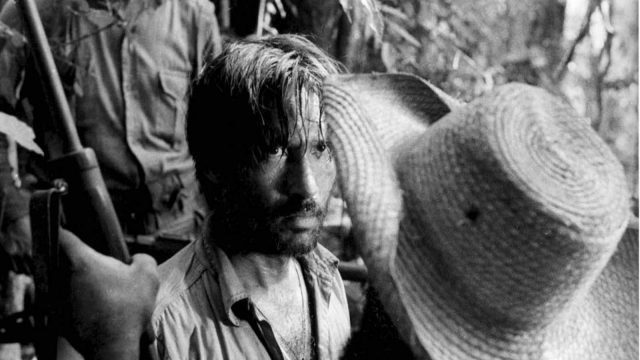
I Am Cuba is divided into four sections that tell the story of the nation from different points of view. The film opens in a casino where American men degrade Cuban prostitutes; one of the men demands to see the home of one of the women, Maria, so he trudges with her through a poverty-stricken region and meets an unexpected man. Next, Pedro, a tenant farmer, is told that the land he has been working for decades has been sold to the American company United Fruit, so he takes dire action while protecting his family. (“I used to think the most terrifying thing in life is death,” he says. “Now I know the most terrifying thing in life is life.”) In the third story, a university student named Enrique is overeager to get involved in a campus rebellion, especially after saving a young woman from drunk American soldiers and witnessing a cold-blooded shooting by the police. The final part deals with a pacifist villager named Mariano who is being goaded by a soldier to join the military fight for freedom.

I Am Cuba

A pacifist would rather stay home than fight in I Am Cuba

I Am Cuba is one of the most visually stunning films ever made. Kalatozov and cinematographer Sergei Urusevsky, who had previously collaborated on the extraordinary Palme d’Or winner The Cranes Are Flying, create breathtaking tracking shots from virtually impossible angles, high in the air and underwater, assisted by camera operator Alexander Calzatti, who was practically a stuntman to achieve whatever was necessary. A joint production of the Soviet company Mosfilm and the new Cuban Institute of Cinematographic Art and Industry, the film was written by Soviet poet and novelist Yevgeny Yevtushenko and Cuban director and writer Enrique Pineda Barnet and features interstitial narration by Havana-born actress Raquel Revuelta as the voice of the nation. “Is this a happy picture?” she asks. “Don’t avert your eyes. Look! I am Cuba. For you, I am the casino, the bar, the hotels. But the hands of these children and old people are also me.” Later she encourages her citizenry to take up arms, softly stating, “I am Cuba. Your hands have gotten used to farming tools. But now a rifle is in your hands. You are not shooting to kill. You are firing at the past. You are firing to protect your future.” The film, of course, takes on added relevance today given the US government’s relationship with Cuba and the death of Fidel Castro in November 2016; there are also scenes that seem to prefigure the coming civil rights and peace movements in the US that occurred after the film was made. I Am Cuba is screening on October 7 at 9:00 at the Walter Reade Theater in the Revivals section of the New York Film Festival, which also includes Djibril Diop Mambéty’s Hyenas, Glenn Silber’s The War at Home, and Aleksei Guerman’s Khrustalyov, My Car!

NYFF56 PROJECTIONS: DIAMANTINO

Diamantino

Giant fluffy puppies get in the way of a Portuguese soccer star’s dreams in Diamantino

NEW YORK FILM FESTIVAL: DIAMANTINO (Daniel Schmidt & Gabriel Abrantes, 2018)
Film Society of Lincoln Center
West 65th St. between Eighth Ave. & Broadway
Thursday, October 4, Walter Reade Theater, 9:30
Friday, October 5, Howard Gilman Theater, 6:30
Saturday, October 13, Howard Gilman Theater, 9:15
Festival runs through October 14
212-875-5610
www.filmlinc.org

At the fifty-sixth annual New York Film Festival, you can catch a documentary, foreign-language picture, political thriller, high-tech crime chiller, comedy, romantic melodrama, fantasy and sci-fi, and more — all in one wildly entertaining film. Diamantino, Gabriel Abrantes and Daniel Schmidt’s full-length feature debut, is an absurdist multigenre mashup that is as tense as it is funny, an unpredictable romp that evokes Ernst Lubitsch, Howard Hawks, Michel Gondry, Philip K. Dick, South Park, Cinderella, James Bond, Being There, Minority Report, and Au Hasard Balthazar while feeling wholly original. Carloto Cotta stars as the title character, Diamantino Matamouros, a Portuguese soccer star à la Cristiano Ronaldo (pre-sexual assault allegations) who sees giant fluffy puppies when he is on the field. After botching a penalty kick in the World Cup Final, the stupendously beautiful star learns that his beloved father and mentor (Chico Chapas) has died. His evil twin sisters, Sónia (Anabela Moreira) and Natasha (Margarida Moreira), become his agents and make a secret deal with the mysterious Dr. Lamborghini (Carla Maciel) and a government minister (Silva Joana). Meanwhile, investigators Aisha Brito (Cleo Tavares) and Lucia (Vargas Maria Leite) — lovers who are soon to be married — are looking into Diamantino’s finances and devise a plan to get close to him by having Aisha pose as a male refugee named Rahim who Diamantino adopts as his son.

Diamantino

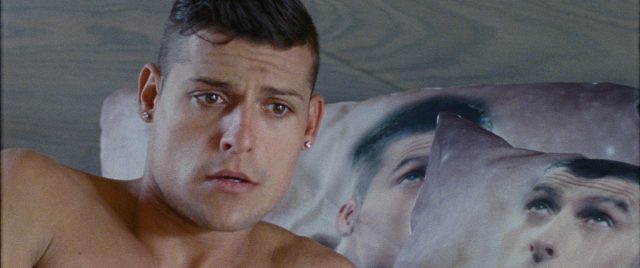
Diamantino Matamouros (Carloto Cotta) is surrounded by images of himself in Gabriel Abrantes and Daniel Schmidt’s dazzling feature debut

Everyone except his sisters, who know better, thinks he is some kind of genius mastermind, but Diamantino is actually an addled simpleton who understands very little about life. He enjoyed playing soccer, likes eating Nutella and whipped cream sandwiches, and, following his tearful retirement, hangs out with his cat, Mittens, and dedicates himself to raising Rahim, who he does not realize is actually a grown woman. He’s reminiscent of Chance the Gardener (Peter Sellers) in Being There, but his airheaded statements — which are outrageously funny — are seldom mistaken for brilliance, except when he’s manipulated into making fascistic political statements he doesn’t understand.

Diamantino is stunningly photographed by Charles Ackley Anderson, who quickly adapts the film’s visual style as it switches from fantasy to love story to futuristic thriller, with numerous memorable shots, including Lucia in a white nun’s habit on a motorbike, Diamantino and Rahim sleeping on pillows with large images of the soccer star’s head, and a huge fluffy puppy playing goal in the championship game. American-born directors and longtime collaborators Abrantes and Schmidt, who edited the film with Raphaëlle Martin-Holger, show a deep love and respect for movies, infusing Diamantino with charm and energy, humor and compassion, honoring, in their own way, the history of cinema. The rest of the cast and crew do their part as well, from art director Bruno Duarte and composers Ulysse Klotz and Adriana Holtz to the Moreira sisters and multidisciplinary Portuguese star Manuela Moura Guedes as television interviewer Gisele. Winner of the Grand Jury Prize at Cannes Critics’ Week, Diamantino is screening in the Projections section of the New York Film Festival on October 4 and 5, with Schmidt and Abrantes participating in Q&As after each show. Also, an October 13 screening at 9:15 has just been added.

NYFF56: NEW YORK FILM FESTIVAL 2018

Emma Stone in the film THE FAVOURITE. (photo by Yorgos Lanthimos. © 2018 Twentieth Century Fox Film Corporation All Rights Reserved)

Yorgos Lanthimos’s The Favourite opens the fifty-sixth annual New York Film Festival (photo by Yorgos Lanthimos / © 2018 Twentieth Century Fox Film Corporation / All Rights Reserved)

Film Society of Lincoln Center, Walter Reade Theater, Elinor Bunin Munroe Film Center, Alice Tully Hall
West 65th St. between Broadway & Amsterdam Ave.
September 28 – October 14
212-875-5601
www.filmlinc.org/nyff2018

The fifty-sixth annual New York Film Festival is under way, consisting of more than two weeks of international shorts, features, documentaries, experimental works, and immersive, interactive virtual reality presentations. There are documentaries about Roger Ailes, Steve Bannon, Carmine Street Guitars, Maria Callas, the Memphis Belle, Bill Cunningham, and Watergate; retrospective tributes to Dan Talbot and Pierre Rissient; talks with Claire Denis, Alfonso Cuarón, Alice Rohrwacher, Errol Morris, Jia Zhangke, Mariano Llinás, Willem Dafoe, Morgan Neville, Frederick Wiseman, and Ed Lachman; revivals of such films as Edgar G. Ulmer’s Detour, Mikhail Kalatozov’s I Am Cuba, and Ronald Neame’s Tunes of Glory; and postscreening Q&As with Jodie Foster, Michael Almereyda, Richard Thompson, Alex Gibney, Elizabeth Holtzman, Lesley Stahl, Emma Stone, Julian Schnabel, Joel and Ethan Coen, Laetitia Casta, Elisabeth Moss, Eric Stoltz, Robert Pattinson, Olivier Assayas, Tamara Jenkins, Vincent Lacoste, Carey Mulligan, Jake Gyllenhaal, and many others. Below is a list of at least one highlight per day; keep checking twi-ny for reviews and further information.

Saturday, September 29
Special Events: The Other Side of the Wind (Orson Welles, 2018), Alice Tully Hall, $25, 2:15

Sunday, September 30
Revivals: Enamorada (Emilio Fernández, 1946), Howard Gilman Theater, $17, 12 noon

Charles Ferguson documentary takes  a new look at Watergate break-in and its aftermath

Charles Ferguson documentary takes a new look at Watergate break-in and its aftermath

Monday, October 1
Free Events — NYFF Live: In Conversation with Frederick Wiseman, moderated by Kent Jones, EBM Amphitheater, free, 7:00

Tuesday, October 2
Retrospective: A Touch of Zen (King Hu, 1971/75), Howard Gilman Theater, $17, 6:30

Wednesday, October 3
Talks — On Cinema: Claire Denis, Walter Reade Theater, $25, 6:00

Thursday, October 4
Retrospective: Mother India (Mehboob Khan, 1957), Howard Gilman Theater, $17, 6:30

Friday, October 5
Projections: Your Face (Tsai Ming-liang, 2018), Howard Gilman Theater, $17, 4:30

Saturday, October 6
Talks — Directors Dialogues: Alfonso Cuarón, Walter Reade Theater, free, 2:30

Sunday, October 7
Talks — Film Comment Live: Filmmakers Talk, with Louis Garrel, Jodie Mack, Alex Ross Perry, and Albert Serra, EBM Amphitheater, free, 7:00

Monday, October 8
Special Events: An Afternoon with Barry Jenkins, in Conversation with Darryl Pinkney, Alice Tully Hall, $25, 12 noon

Tuesday, October 9
Retrospective: My Dinner with André (Louis Malle, 1981), Howard Gilman Theater, $17, 6:30

Wednesday, October 10
Retrospective: The American Friend (Wim Wenders, 1977), Howard Gilman Theater, 6:30

Thursday, October 11
Convergence: iNK Stories – Fire Escape: An Interactive VR Series (Navid Khonsari, 2018), followed by a Q&A, EBM Amphitheater, 6:00 & 7:30

Friday, October 12
Convergence: Virtual Reality Documentary Program, featuring My Africa (David Allen, 2018), narrated by Lupita Nyong’o, The Drummer (Ana Kler, 2017), and the world premiere of Hope Amongst the Haze (Tiffany Hill, 2018), EBM Amphitheater, $10, 4:00 & 6:00

Saturday, October 13
Spotlight on Documentary — Divide and Conquer: The Story of Roger Ailes (Alexis Bloom, 2018), Howard Gilman Theater, $25, 2:45

Sunday, October 14
Special Events: The Wild Pear Tree (Nuri Bilge Ceylan, 2018), Francesca Beale Theater, $25, 12 noon