Tag Archives: MoMA

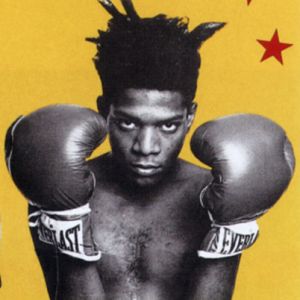
WIKIPEDIA EDIT-A-THON: BASQUIAT STILL FLY @55

You can help MoMA update Wikipedia articles on black artists on November 10

You can help MoMA update Wikipedia articles on black artists on November 10

Museum of Modern Art
The Lewis B. and Dorothy Cullman Education and Research Building
The Library and Archives Reading Rooms, sixth floor
4 West 54th St. between Fifth & Sixth Aves.
Tuesday, November 10, free with RSVP
www.moma.org

Influential artist Jean-Michel Basquiat, who died at the age of twenty-seven in 1988, would have turned fifty-five this December 22, so MoMA is using that as the inspiration behind its November 10 event, “Wikipedia Edit-a-thon: Basquiat Still Fly @55.” On Tuesday night at 6:00, everyone is invited to bring their own laptops and power cords and help update Wikipedia articles on Basquiat and other black artists, focusing on “the multicultural and gender gaps in Wikipedia.” No art, editing, writing, or HTML experience or knowledge is required, and light refreshments will be served. Advance RSVP is required here.

ONE-WAY TICKET: JACOB LAWRENCE’S MIGRATION SERIES AND OTHER WORKS

Jacob Lawrence

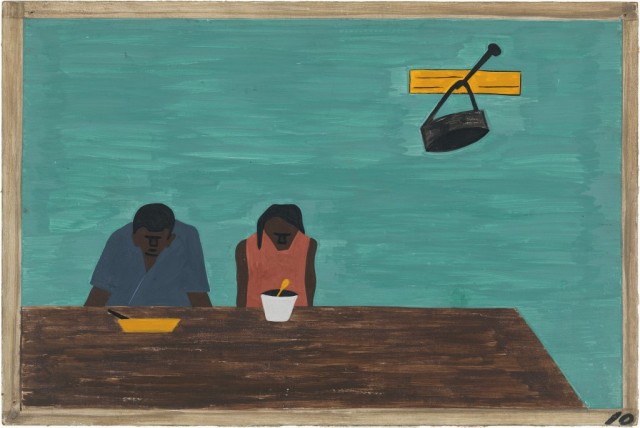
Jacob Lawrence, the Migration Series, 1940-41, Panel 10: “They were very poor,” casein tempera on hardboard (© 2015 the Jacob and Gwendolyn Knight Lawrence Foundation, Seattle / Artists Rights Society, New York)

Museum of Modern Art
Special Exhibitions Gallery, third floor
11 West 53rd St. between Fifth & Sixth Aves.
Through September 7, $25 (including audio program and film screenings)
212-708-9400
www.moma.org

Jacob Lawrence, who was born in 1917 in Atlantic City and moved with his family to Harlem when he was thirteen, depicted the twentieth-century African American experience in stunning, colorful panels painted in a style he called dynamic cubism. Half of his seminal 1941 series about the Great Migration is regularly on view at MoMA, but for this special exhibit, the midtown institution has teamed with the Phillips Collection, which owns the other half, to present the complete sixty-piece work for the first time in New York in twenty years. Lawrence was twenty-three when he created the Migration Series, tracing the movement of African Americans from the south to the north in search of a better life, beginning during the WWI era and continuing into the 1960s. Each panel is a work of art that stands on its own, but together they paint a fascinating portrait that unfolds like a documentary film. The works are arranged chronologically at eye level around the large gallery, with the caption for each right underneath the panel. Taken as a whole, it’s a dizzying array of dazzling color, but individually they tell quite a story as well.

panel 23

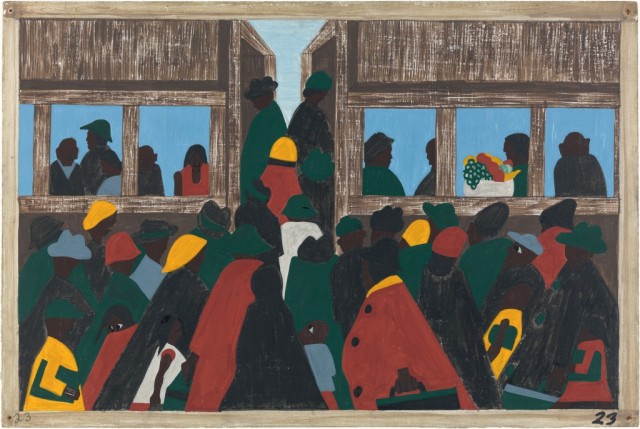
Jacob Lawrence, the Migration Series, 1940-41, Panel 23: “In a few sections of the South the leaders of both groups met and attempted to make conditions better for the Negro so that he would remain in the South,” casein tempera on hardboard (© 2015 the Jacob and Gwendolyn Knight Lawrence Foundation, Seattle / Artists Rights Society, New York)

In panel 1, men, women, and children line up at the train station to leave for Chicago, New York, or St. Louis, yellows and blues peeking out among muted browns and greens. In panel 5, a train is barreling past, black smoke floating back, a bright light beaming ahead. In panel 10, a man and a woman are sitting at a table, staring down at their meager food; the caption succinctly states: “They were very poor.” In panel 10, a white judge looks down from on high at two black men huddled below; the caption explains: “Among the social conditions that existed which was partly the cause of the migration was the injustice done to the Negroes in the courts.” In panel 18 (“The migration gained in momentum”), the departure of the men, women, and children is almost biblical in nature, evoking the exodus. Throughout the sixty panels, Lawrence plays with perspective and geometric as well as abstract shapes and patterns, creating scenes that often swirl with movement and life. The Migration Series is a towering achievement, an emotionally powerful work that feels as relevant today as it did when it was first presented more than sixty years ago. The exhibit is supplemented with paintings and drawings by Charles Alston, Romare Bearden, and Charles White, archival footage of Marian Anderson, Duke Ellington, and Billie Holiday, photographs by Dorothea Lange, Ben Shahn, and Gordon Parks, writings by Langston Hughes, Claude McKay, and Richard Wright, and other ephemera related to black life in America in the early to mid-twentieth century. And be sure to visit the excellent MoMA website that examines each panel of the Migration Series in detail.

YOKO ONO: ONE WOMAN SHOW, 1960-1971

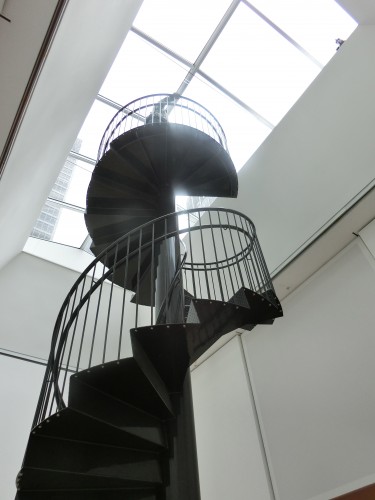
Yoko Ono’s “To See the Sky” offers visitors the chance to commune one-on-one with the heavens (photo by twi-ny/mdr)

Yoko Ono’s “To See the Sky” offers visitors the chance to commune one-on-one with the heavens (photo by twi-ny/mdr)

Museum of Modern Art
The International Council of the Museum of Modern Art Exhibition Gallery, sixth floor
11 West 53rd St. between Fifth & Sixth Aves.
Through September 7, $25 (including audio program and film screenings)
212-708-9400
www.moma.org

In December 1971, Yoko Ono staged an unofficial one-woman show at MoMA, which she called the “Museum of Modern [F]art,” in which she supposedly released a glass jar full of flies into the sculpture garden, scattering art everywhere, even though a sign inside noted, “This Is Not Here.” Ono now has an honest-to-goodness solo show at MoMA, an involving and affecting retrospective of her conceptual work from 1960 through 1971, and although it’s titled “One Woman Show,” it’s about as participatory as these things can get. Visitors are invited to walk right on “Painting to Be Stepped On,” although many people still opt to carefully tiptoe around it; play a game of chess in the sculpture garden on “White Chess Set,” in which all of the pieces are white; slip under a black sheet and perform on a small stage for “Bag Piece”; make physical contact with others in “Touch Poem for a Group of People,” although the room was empty the several times I passed by; climb a rickety spiral staircase in “To See the Sky” and privately commune with the outside world via a skylight at the top; and choose to carry out any of the myriad instructions that comprise Ono’s storied Grapefruit book, though not necessarily right on the premises. However, you should not do what John Lennon did when he first met Ono in 1966 and take a bite out of the green apple that sits on a transparent pedestal at the opening of the exhibit. “Ono’s art has uncovered not only often concealed aspects of the act of engaging with an artwork (revealing, for instance, the central role the viewer plays in its creation) but also the ways in which cultural, social, and political life influence and affect each other,” explains MoMA curator-at-large Klaus Biesenbach in his catalog essay, “Absence and Presence in Yoko Ono’s Work,” continuing, “Looking back on her conceptual 1971 exhibition at the Museum of Modern Art, we see that she knew long ago that her groundbreaking practice warranted a solo exhibition there. Forty-four years later, that show is finally a reality, with the same radicality and presence it had when she first imagined it.”

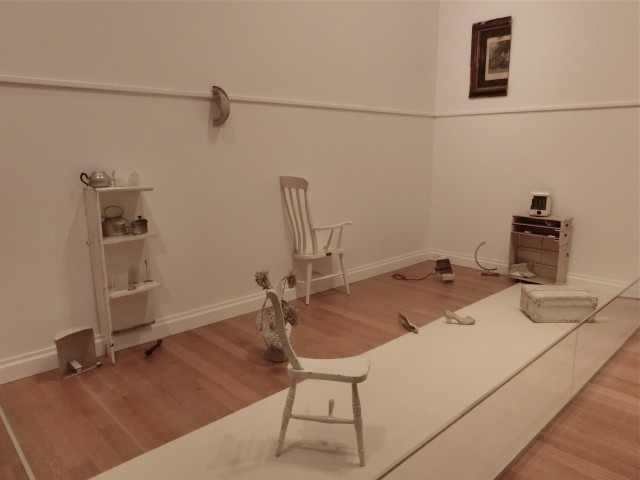
Yoko Ono’s “Half-a-Room” slices domesticity in half (photo by twi-ny/mdr)

Yoko Ono’s “Half-a-Room” slices domesticity in half (photo by twi-ny/mdr)

The MoMA exhibition also includes such other Ono works as “Cut Piece,” a film by Albert and David Maysles of her sitting calmly as audience members cut off parts of her outfit; “A Box of Smile,” small boxes in a wall that provide pleasant surprises; “Film No. 4,” an onscreen procession of derrières; a room of paraphernalia and music she made with the Plastic Ono Band; “Fly,” which follows flies making their way across a woman’s naked body; footage of political demonstrations she and Lennon led, including “Bed-In”; and other drawings, sculptures, films, posters, invitations, and installations. There’s more in the exhibition catalog, which contains a number of essays and letters written by Ono in the section entitled “Yoko’s Voice”; in November 2014’s “Don’t Stop Me!” she writes, “Let me be free. Let me be me! Don’t make me old, with your thinking and words about how I should be. You don’t have to come to my shows. I am giving tremendous energy with my voice, because that is me. Get my energy or shut up.” She might have been referring specifically to her live musical performances, but the admonition relates to this early-career retrospective as well. Many people come to Ono and her work with a preconceived notion of who she is and what she does, often negative; “Yoko Ono: One Woman Show, 1960-1971” reveals her to be a much misunderstood artist who actually has a lot to say about the state of humanity, nearly universally positive, still seeking to attain world peace. And what’s wrong with that? (The final week of the show will feature the Gallery Sessions programs “Yoko Ono: From Grapefruit to Green Apple” on August 31 at 1:30 and September 2-3 at 11:30, “Yoko Ono: One Woman Show, 1960-1971” on September 5 at 1:30, and “Make Your Own Yoko Ono Piece” on September 6 at 11:30, and museumgoers can sit down and play on Ono’s “White Chess Set” in the sculpture garden on Tuesday, Wednesday, Friday, and Saturday from 1:00 to 4:00.)

PIERRE HUYGHE AT MoMA AND THE MET

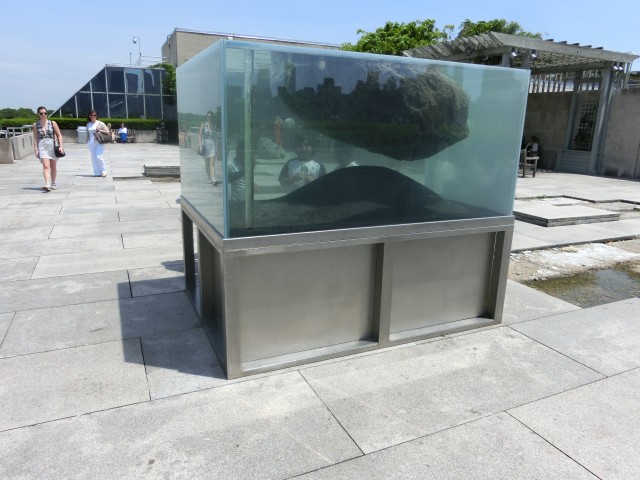
Pierre Huyghe’s Met Garden Rooftop Commission melds magic and science, ecology and archaeology (photo by twi-ny/mdr)

Pierre Huyghe’s Met Garden Rooftop Commission melds magic and science, ecology and archaeology (photo by twi-ny/mdr)

PIERRE HUYGHE: THE ROOF GARDEN COMMISSION
Metropolitan Museum of Art, Iris and B. Gerald Cantor Roof Garden
1000 Fifth Ave. at 82nd St.
Daily through November 1, recommended admission $12-$25
212-535-7710
www.metmuseum.org
rooftop slideshow

Native Parisian Pierre Huyghe is having quite a summer, with installations and films on view at both MoMA and the Met. Through November 1, his site-specific Roof Garden Commission at the latter will slowly devolve, affecting the surrounding cement slabs and dirt underneath it. A curious aquarium that seems to leak water, the piece resembles an architectural dig of sorts, an intervention on the popular Met roof that offers spectacular vistas and in past years has featured works by Jeff Koons, Ellsworth Kelly, Roxy Paine, and Dan Graham. Inside the aquarium, the 2002 Hugo Boss Prize winner has placed a large boulder of Manhattan schist that somehow is floating (perhaps referencing Koons’s basketballs?) along with some living lamprey and tadpole shrimp. Meanwhile, creatures are turning up in the mini-swamps that spring up amid the dirt and water around the central fixture as the paving stones are upended because of the evolving damage. (The water is not actually leaking from the fish tank but dripping separately.) Huyghe also works in some additional magic into his science-and-art environment; the aquarium occasionally clouds up so visitors can temporarily not see inside it. The ecological, archaeological work feels right at home amid the views of Central Park; as Huyghe notes in the small exhibition catalog, “Walking through Central Park, you realize that all events there — the stone, the frozen lake, the plane overhead, the maintenance worker — are equally necessary. The important thing is not necessarily the big event. There is an ecology in the broadest sense of the word; different states of life, each element playing a role — even sometimes antagonistically.”
HUMAN MASK

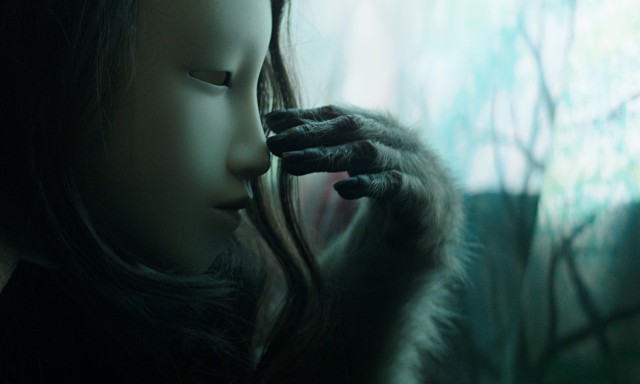
Pierre Huyghe, video still, HUMAN MASK, 2014 (photo courtesy of the artist, Hauser & Wirth, London, and Anna Lena Films, Paris)

UNTITLED (HUMAN MASK) (Pierre Huyghe, 2014)
Metropolitan Museum of Art, Gallery 916
1000 Fifth Ave. at 82nd St.
Daily through August 9, recommended admission $12-$25
www.metmuseum.org

Inside the Met, in Gallery 916, Huyghe’s intriguing nineteen-minute Untitled (Human Mask) is screening through August 9. The 2014 film follows what appears to at first to be a young girl as she wanders through an abandoned restaurant in Japan. However, the star is in fact a macaque monkey in a wig and a smooth, expressionless Noh-like white mask, inspired by the YouTube clip “Fuku-chan Monkey in wig, mask, works Restaurant!” Huyghe, who has worked with animals in masks before, shot the film in Fukushima shortly after the 2011 earthquake and tsunami. The monkey, one of the actual waitresses from the Kayabuki sake house in the viral video, makes her way through the restaurant as if wandering in a postapocalyptic landscape, evoking evolution and what humanity hath wrought on the earth. Despite the mask covering her face, she appears filled with emotion as she looks out the window and dreams of a green forest. It’s an eerie, affecting film that serves as a fascinating companion piece to Huyghe’s rooftop installation. On July 24, MetFridays — Conversation with an Educator will delve deeper into the work in an interactive dialogue with museum education assistant Marianna Siciliano.

Pierre Huyghe. Untilled (Liegender Frauenakt) [Reclining female nude]. 2012. Concrete with beehive structure, wax, and live bee colony; figure: 29 1/2 x 57 1/16 x 17 11/16" (75 x 145 x 45 cm), base: 11 13/16 x 57 1/16 x 21 5/8" (30 x 145 x 55 cm), beehive dimensions variable. The Museum of Modern Art, New York. Purchase. © 2015 Pierre Huyghe

Pierre Huyghe, “Untilled (Liegender Frauenakt) [Reclining female nude],” concrete with beehive structure, wax, and live bee colony, 2012 (The Museum of Modern Art, New York. Purchase. © 2015 Pierre Huyghe)

PIERRE HUYGHE: “UNTILLED (LIEGENDER FRAUENAKT)”
Museum of Modern Art
The Abby Aldrich Rockefeller Sculpture Garden
11 West 53rd St. between Fifth & Sixth Aves.
Through August 15, $25 (including admission to galleries and film screenings)
212-708-9400
www.moma.org

Meanwhile, over at MoMA, another outdoor sculpture incorporating living creatures and an indoor film by Huyghe are being highlighted. MoMA is unveiling its recent acquisition, Huyghe’s 2012 “Untilled (Liegender Frauenakt),” through August 15 in the Sculpture Garden, a reclining female nude whose head is a live bee colony. The work references classical Greek statuary (although it was actually cast from a bronze by Max Weber) as well as such concepts as the hive mentality and the controversy over the importance of the survival of the bees in relation to the future of the planet. The Italian honeybees have been overseen by Manhattan beekeeper Andrew Cote since April, and they’ve been getting busy under a shady tree in the garden. Cote and MoMA expect the colony to reach as many as 75,000 bees at its densest point, meaning they might provide a little extra buzz to the upcoming Summergarden: New Music for New York concerts in the Sculpture Garden on July 19 & 26.
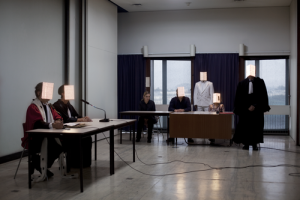
The Host and The Cloud. 2009–10. France. Directed by Pierre Huyghe. Courtesy the artist and Marian Goodman Gallery, New York

Pierre Huyghe’s 2009–10 THE HOST AND THE CLOUD will be shown at MoMA July 14 & 16 (photo courtesy the artist and Marian Goodman Gallery, New York)

MOMA PRESENTS: PIERRE HUYGHE’S THE HOST AND THE CLOUD
MoMA Film, Museum of Modern Art
The Lewis B. and Dorothy Cullman Education and Research Building
4 West 54th St. between Fifth & Sixth Aves.
Tuesday, July 14, and Thursday, July 16, 7:00
Tickets: $12, in person only, may be applied to museum admission within thirty days, same-day screenings free with museum admission, available at Film and Media Desk and online beginning at 9:30 am
212-708-9400
www.moma.org

The very welcome Huyghe infestation continues with two screenings of his rather cerebral 2009–10 film, The Host and the Cloud, on July 14 and 16 at 7:00 in the research and education building. The two-hour depiction of a controlled experiment is set in the abandoned Musée National des Arts et Traditions Populaires, focusing on the Day of the Dead, Valentine’s Day, and May Day, as different forms of entertainment, ritual, and political actions are performed over the course of one year by characters wearing LED masks. As always, Huyghe melds fiction and reality as he explores ethnographic representation. The official description notes, “Navigating through history within the museum, a group of people is exposed to influence, live situations that appear accidentally, simultaneously, or without any sense of order in the building. Nothing that takes place is staged. People can imitate, repeat, or transform these situations endlessly to variable intensity.” The July 14 show will be introduced by MoMA curators Stuart Comer (Department of Media and Performance Art) and Laura Hoptman (Department of Painting and Sculpture), while the July 16 screening will be introduced by Artist’s Institute director and curator Jenny Jaskey.
GLORIOUS TECHNICOLOR — FROM GEORGE EASTMAN HOUSE AND BEYOND: SINGIN’ IN THE RAIN

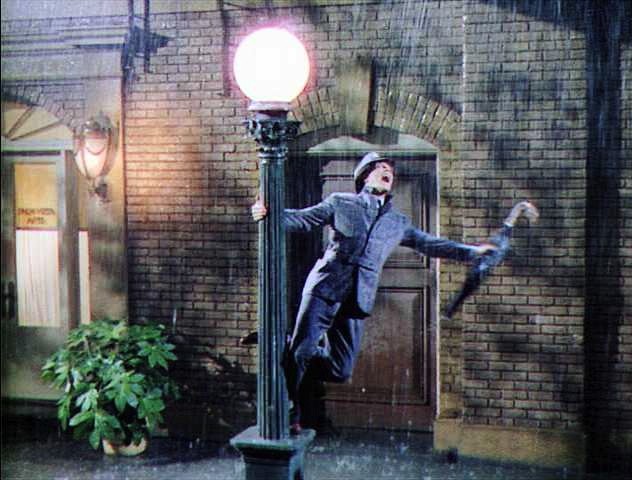
Gene Kelly dazzles during unforgettable solo scene in classic MGM musical SINGIN’ IN THE RAIN

Gene Kelly dazzles during unforgettable solo scene in classic MGM musical SINGIN’ IN THE RAIN

SINGIN’ IN THE RAIN (Stanley Donen & Gene Kelly, 1952)
MoMA Film, Museum of Modern Art
11 West 53rd St. between Fifth & Sixth Aves.
Saturday, June 20, 5:00, and Thursday, June 25, 4:30
Series runs through August 5
Tickets: $12, in person only, may be applied to museum admission within thirty days, same-day screenings free with museum admission, available at Film and Media Desk beginning at 9:30 am
212-708-9400
212-875-5601
www.moma.org

The 1952 MGM musical Singin’ in the Rain is one of the all-time-great movies about movies, in this case focusing on the treacherous transition from silent films to talkies. It’s the mid-1920s, and the darlings of the silver screen are handsome Don Lockwood (Gene Kelly) and blonde bombshell Lina Lamont (Jean Hagen). They’re supposedly just as hot offscreen as on, as Don explains to radio gossip host Dora Bailey (Madge Blake, later best known as Aunt Harriet on the Batman TV series) at their latest Hollywood premiere, but in actuality the debonair Don can’t stand the none-too-bright yet still conniving Lina. After accidentally bumping into Kathy Selden (Debbie Reynolds), an independent-thinking young woman who claims to not even like the movies, Don is soon trying to chase her down, determined to get to know her better. Meanwhile, studio head R. F. Simpson (Millard Mitchell) decides he has to capitalize on the surprise success of the first talking picture, The Jazz Singer, by turning the latest Lockwood-Lamont movie, The Dueling Cavalier, into a talkie, with initially disastrous results, threatening to bring everything and everyone crashing down.
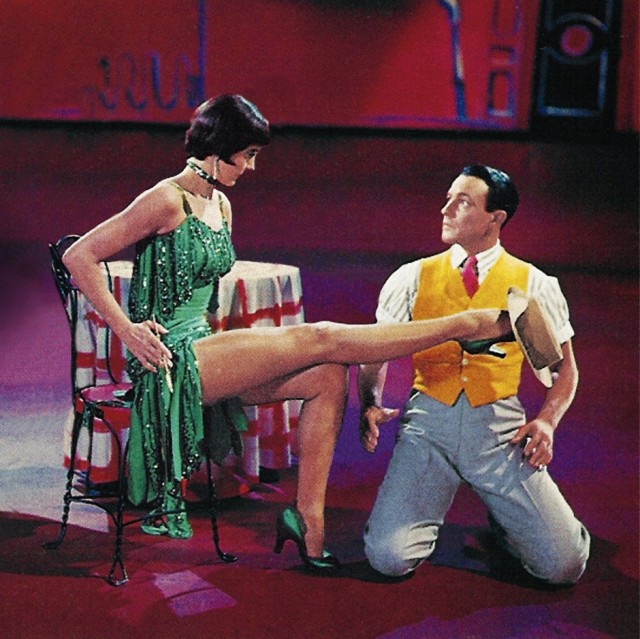
Cyd Charisse joins Gene Kelly for fantastical Broadway Melody ballet in SINGIN’ IN THE RAIN

Cyd Charisse joins Gene Kelly for fantastical Broadway Melody ballet in SINGIN’ IN THE RAIN

Written by the legendary team of Betty Comden and Adolph Green and directed by Kelly and Stanley Donen (On the Town, Charade), Singin’ in the Rain is an endlessly thrilling and entertaining film, featuring gorgeous Technicolor set pieces photographed by Harold Rosson (the Broadway Melody ballet with Cyd Charisse is particularly spectacular), terrific tunes adapted from previous productions (“Fit as a Fiddle [And Ready for Love,]” “Moses Supposes,” “Good Morning”), and delightful performances by Kelly, whose solo foray through the title song is deservedly iconic; Donald O’Connor as Don’s longtime best friend, Cosmo Brown, who dazzles with a comic Fred Astaire-like turn in “Make ’em Laugh”; and Hagen channeling Judy Holliday from Born Yesterday. (Hagen served as Holliday’s understudy when Born Yesterday hit Broadway in 1947.) While all the elements come together beautifully (although things do get a little too mean-spirited in the end), this is Kelly’s film all the way, his smile and charm dominating the screen as only a genuine movie star can, so to see him playing a movie star merely doubles the fun. (It’s hard to imagine that Howard Keel was supposedly the first choice to play the role.) Curiously, Singin’ in the Rain was nominated for only two Oscars, with Hagen getting a nod for Best Supporting Actress and Lennie Hayton for Best Musical Score. Singin’ in the Rain’ is screening on June 20 & 25 as part of MoMA’s “Glorious Technicolor: From George Eastman House and Beyond” series, a celebration of the one hundredth anniversary of Technicolor, which continues through August 5 with such other delights as Douglas Sirk’s Magnificent Obsession, Vincente Minnelli’s An American in Paris, Michael Curtiz’s The Adventures of Robin Hood, and Victor Fleming’s Gone with the Wind.

GALLERY SESSIONS: BJÖRK EXPLAINED BY A FAN

Björk (photo by twi-ny/mdr)

“Björk” exhibit at MoMA has led to quite a cacophony (photo by twi-ny/mdr)

BJÖRK
MoMA, Museum of Modern Art
11 West 53rd St. between Fifth & Sixth Aves.
Exhibit runs through June 7, $14-$25 (timed tickets available same day only)
212-708-9400
www.moma.org
bjork.com

There doesn’t seem to be a whole lot more that can be said about Björk’s disastrous solo exhibition at MoMA, so reviled that critics are calling for the heads of chief curator at large Klaus Biesenbach and museum director Glenn D. Lowry. The truth hurts; it’s a head-scratchingly absurd show. I went in determined to see something everyone else missed, trying to find something positive in the four-part presentation, having admired Björk Guðmundsdóttir’s work for many years, from her time leading the Sugarcubes to her award-winning performance in Lars von Trier’s Dancer in the Dark to her innovative Biophilia album, app, tour, and concert film. But alas, the simply titled “Björk” exhibition seems to go out of its way to annoy. The MoMA-commissioned ten-minute “Black Lake” music video, for a song from her latest album, Vulnicura, about her breakup with longtime partner Matthew Barney, is fine, a two-screen projection in which she lets loose against Barney, who just last week sued her for custody of their twelve-year-old daughter. “My soul torn apart / My spirit is broken / Into the fabric of all / He is woven,” she sings in a haunting volcanic landscape that features dripping substances evoking Barney’s use of petroleum jelly at the Guggenheim and in Drawing Restraint 9 (in which Björk had a major role) and lava and feces in “River of Fundament.” However, you will have to wait a lot longer than ten minutes to get into the specially designed area in MoMA’s atrium, then wait again after it’s over to enter the theater that shows many of Björk’s cutting-edge videos. Also, several of her unique Biophilia instruments play music in the lobby by the sculpture garden entrance. But it’s the heart of the show that is so disturbing, the time-ticketed “Songlines,” in which an iPod touch guides visitors through eight rooms, a chronological trip through Björk’s eight albums, from 1993’s Debut through January’s Vulnicura. The very small spaces feature handwritten notes and lyrics, costumes, video paraphernalia, and, through headphones, a bizarre fairy-tale-like fictionalized narrative, written by Icelandic poet Sjón and narrated by actress Margret Vilhjalmsdottir, about a young girl (Björk) growing up to become someone. You can’t purchase timed tickets in advance (only same day, onsite), so you might be shut out if you get to MoMA too late in the afternoon. Also, once you start going through “Songlines,” you are not allowed to go back to a previous room; you must proceed forward, and since it’s unlikely you’ll actually need all five minutes for each stop, the audio will often not be in sync with your physical surroundings.

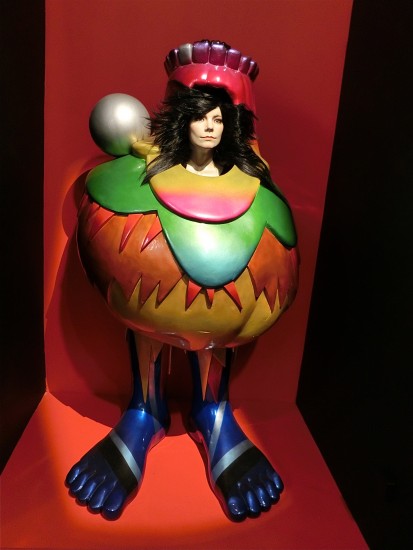
Despite living part-time in New York (and Iceland and London) and having held several concerts in the city on her Vulnicura tour (she had to cancel her April 4 show but will be coheadlining the Governors Ball on Randall’s Island on June 6), Björk has not participated in any events and given only one interview (to Time magazine) in conjunction with the exhibit — although there are mannequins of an ornately designed Björk in “Songlines” — so MoMA is leaving it up to others to put it all in perspective and try to make sense of this utter mess. But they’re not exactly calling in the big guns; instead, on April 10 at 11:30 and April 22 at 1:30, the gallery session “Björk Explained by a Fan” will be led by an unnamed “dedicated fan of the composer, musician, and artist,” moderated by a museum educator. On April 12 and 18 at 11:30, “Sights and Sounds” will delve into how sound can be made visible. On April 17 and 24 at 11:30, “Björk” will examine art in relation to post-technological culture. And on April 26 at 11:30 and April 30 at 1:30, anyone can participate in “Björk: Human Behavior,” an open group discussion about Björk’s exploration of the connections between nature and human behavior; people are encouraged to share “their personal experience of the Björk exhibition,” which could be quite fascinating in and of itself. All talks are first-come, first-served and do not include a visit to the show. I can’t imagine that any of these talks will enhance your personal experience of a show that has been called “abominable,” “an ill-conceived disaster,” “oh so disappointing,” “a waste of time,” “a strangely unambitious hotchpotch,” and, quite simply and right to the point, “bad.”

HENRI MATISSE: THE CUT-OUTS

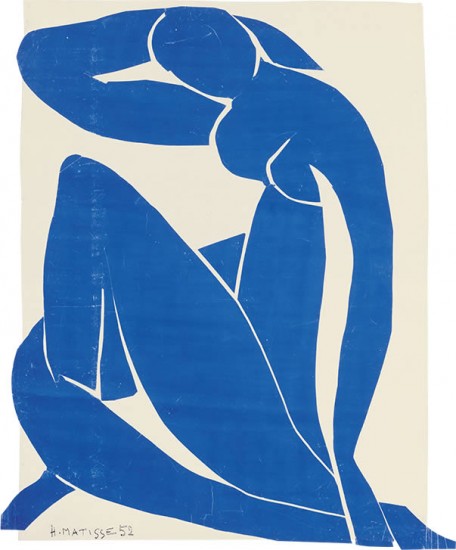
Henri Matisse, “Blue Nude,” gouache on paper, cut and pasted, on paper, mounted on canvas, spring 1952 (Musée national d’art moderne/Centre de création industrielle, Centre Georges Pompidou, Paris)

Henri Matisse, “Blue Nude,” gouache on paper, cut and pasted, mounted on canvas, spring 1952 (Musée national d’art moderne/Centre de création industrielle, Centre Georges Pompidou, Paris)

Museum of Modern Art
The Joan and Preston Robert Tisch Exhibition Gallery, sixth floor
11 West 53rd St. between Fifth & Sixth Aves.
Timed tickets daily through February 10, $25
212-708-9400
www.moma.org

Near the center of “Henri Matisse: The Cut-Outs,” visitors gather to watch excerpts from Frédéric Rossif’s 1950 Matisse film, which show the white-bearded artist at work, creating masterpieces with only painted paper and a pair of scissors. There’s a smile on everyone’s face as the eighty-year-old Matisse cuts shapes out of yellow paper, perhaps a bit more sophisticated than a young child making a row of paper dolls. And that gets right to the heart of why the exhibition is so successful, and why Matisse’s cut-outs are so beloved: It seems so simple, something that anyone can do, but of course that is not quite true, as no one has ever used a pair of scissors quite like Matisse did. In her catalog essay “Bodies and Waves,” Jodi Hauptman discusses Matisse’s methods when beginning his first “Blue Nude.” She writes, “The process was arduous. Matisse labored for a number of weeks, relentlessly revising. His studio assistant at the time, Paule Martin, pushed by Matisse to work with equal rigor, describes the tense conditions: ‘Whereas subsequent forms were cut in a single movement, the first figure demanded such patience and attention on Matisse’s part, but also from me, that it exhausted me and I was on the brink of collapse. He made me pin tiny squares of paper to enhance the curvature of the thigh or some other part of the body, then remove parts of the figure to remove colour strips, then set it back in place as my febrile fingers fumbled with the pins.’ These enhancements and removals along with markings in chalk can be seen in a series of black and white photographs made by [secretary and studio assistant] Lydia Delectorskaya to document each stage, reminding the artist where he was and where he had been in order for him to decide where to go next.” The process was so organic that Matisse used pins to place the cut-outs on the walls of his studio, moving them around in different configurations until he was ready to mount them on canvas; if you look close enough, you can still see the pinholes on these marvelous works, not quite like a child pinning them onto a board in a classroom.

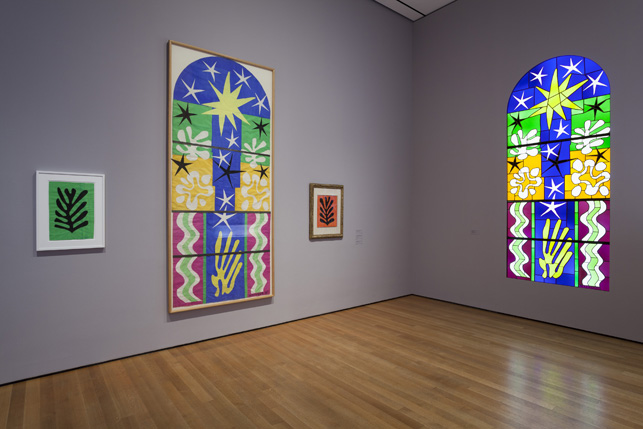
Installation view, “Henri Matisse: The Cut-Outs,” with (from left) “Black Leaf on Green Background,” gouache on paper, cut and pasted, 1952; “Christmas Eve,” maquette for stained-glass window, gouache on paper, cut and pasted, mounted on board, 1952; “Black Leaf on Red Background,” gouache on paper, cut and pasted, 1952; and “Christmas Eve,” stained glass, summer-fall 1952 (photo by Jonathan Muzikar © 2014 the Museum of Modern Art)

Installation view, “Henri Matisse: The Cut-Outs,” with (from left) “Black Leaf on Green Background,” gouache on paper, cut and pasted, 1952; “Christmas Eve,” maquette for stained-glass window, gouache on paper, cut and pasted, mounted on board, 1952; “Black Leaf on Red Background,” gouache on paper, cut and pasted, 1952; and “Christmas Eve,” stained glass, summer-fall 1952 (photo by Jonathan Muzikar © 2014 the Museum of Modern Art)

“Matisse: The Cut-Outs” consists of some 170 cut-outs, drawings, maquettes, stained glass, photographs, screenprints, illustrated books, and other ephemera related to Matisse’s use of cut paper painted over with gouache, which he began in the 1930s but became his preferred medium in the mid-to-late-1940s. This creative resurgence resulted in glorious works that combine a childlike innocence with a complex mastery of space, light, shape, and color, melding abstraction with imagery of the natural world. In “Icarus,” a maquette for the 1947 book Jazz, a silhouetted figure with a red heart floats among yellow stars. (“You have no idea how, during the cut-out paper period, the sensation of flight which emanated from me helped me better to adjust my hand when it used the scissors,” Matisse said. “It’s a kind of linear and graphic equivalence to the sensation of flight.”) Leaflike images come alive in “White Alga on Red and Green Background,” “Two Masks (The Tomato),” and “Composition with Red Cross.” A somewhat figurative element is added in “Black Boxer,” a black image over a red rectangle on a green background. Matisse displays a more spiritual side in his maquettes, studies, and trials for stained-glass windows for the Chapel of the Rosary in Vence. His four blue nudes, dating from spring 1952, are simply breathtaking, as blue geometric shapes and white spaces come together to form seated figures with slightly different body positions like a contemplative four-part dance. That summer, Matisse made the nine-panel room installation “The Swimming Pool,” an extraordinary horizontal swirl about which he said, “I have always adored the sea and now that I can no longer go for a swim, I have surrounded myself with it.” It was MoMA’s conservation of the piece that led to the idea of staging the cut-out exhibition in the first place, so now the work surrounds visitors from around the world.

Matisse at the Hôtel Régina, Nice, April 15, 1950 (photo by Walter Carone © Getty Images)

Matisse at the Hôtel Régina, Nice, April 15, 1950 (photo by Walter Carone © Getty Images)

An April 15, 1950, black-and-white photograph by Walter Carone shows Matisse in his bed, using a long pole to draw on the wall of his room at the Hôtel Régina in Nice with charcoal. The wall already includes elements that would become “The Thousand and One Nights.” It’s a charming photo of the artist, apparently relaxing in bed while continuing to work. Of course, just as the cut-outs themselves are not simple, neither were Matisse’s last years, much of which was spent in bed and in his wheelchair. The catalog essay “The Studio as Site and Subject” notes, “In a 1952 interview with the writer André Verdet, Henri Matisse describes a cluster of colourful cut-paper forms pinned to his studio walls as a ‘little garden.’ ‘You see,’ he explains, ‘as I am obliged to remain often in bed because of the state of my health, I have made a little garden all around me where I can walk . . . There are leaves, fruits, a bird.’ As Matisse speaks, he points to ‘a large mural composition of cut paper that encompassed half the room.’” The artist is referring to pieces that he would use to create “The Parakeet and the Mermaid,” but he could just as well be describing what visitors experience as they walk through this magical exhibition, like meandering through a colorful garden filled with joy and beauty. “Matisse: The Cut-Outs” is a revelatory show, the happiest of the season, displaying a childlike wonder as experienced by an aging yet still determined artist of extraordinary talent.