Tag Archives: MoMA

IF EVERYTHING IS SCULPTURE WHY MAKE SCULPTURE? ARTIST’S CHOICE: PETER FISCHLI

(photo by twi-ny/mdr)

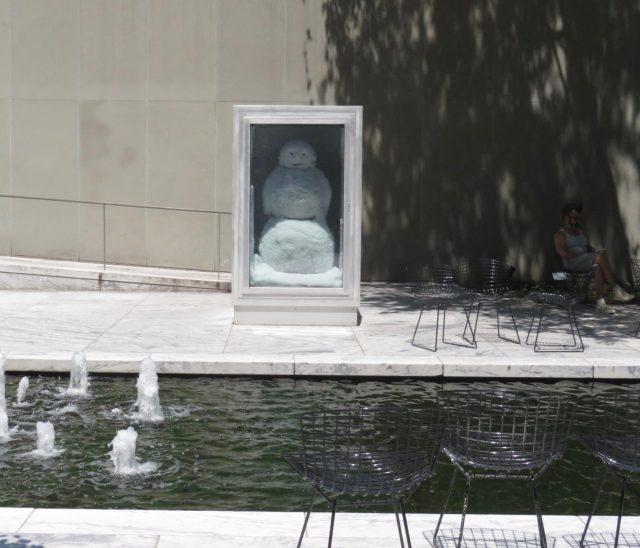
Peter Fischli’s “Snowman” is centerpiece of exhibition in Abby Aldrich Rockefeller Sculpture Garden at MoMA (photo by twi-ny/mdr)

Museum of Modern Art
The Abby Aldrich Rockefeller Sculpture Garden
West 54th St. between Fifth & Sixth Aves.
Early hours: open daily 9:00 – 10:30 am, free
www.moma.org
online slideshow

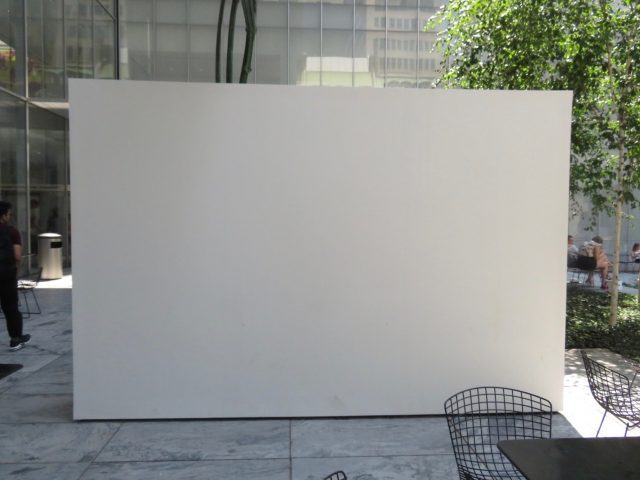
Two years ago, the subversive DIY aesthetic of longtime collaborators Peter Fischli and David Weiss was on view at the Guggenheim in the engaging retrospective “How to Work Better.” Fischli has now headed to MoMA — Weiss passed away in 2012 — for the “Artist’s Choice” show “If Everything Is Sculpture Why Make Sculpture?” It’s the thirteenth in the three-decade-old series, which has previously turned over the curatorial reins to Mona Hatoum, Elizabeth Murray, David Hammons, Stephen Sondheim, and others, and is the first one to take place in the Abby Aldrich Rockefeller Sculpture Garden, where the Swiss artist has created an intervention that will delight regular visitors to the outdoor space, who will notice subtle and not so subtle changes, while also charming newcomers to the garden. Only one of Katharina Fritsch’s “Figurengruppe (Group of Figures)” stands on the main level, “Yellow Madonna,” the others apparently spending the summer in the Hamptons. Ben Vautier’s word painting on wood, “If Everything Is Sculpture Why Make Sculpture?,” is a rare example of a painting hanging outside, not concerned about the elements ruining it. Only the first three bronze versions of Henri Matisse’s exquisite “The Back” adorn the north wall, the ghostly outline of the missing fourth clearly visible. Fischli and Wade Guyton’s “Untitled Aspen Wall Nr. 6” is an out-of-place gallery wall with nothing hanging on it. Fischli has left in several mainstays of the garden, including Aristide Maillol’s “The Mediterranean” and “The River,” Hector Guimard’s “Entrance Gate to Paris Subway,” Pablo Picasso’s “She-Goat,” and Isa Genzken’s “Rose II” while adding Tony Smith’s “Moondog 1964,” Herbert Ferber’s “Roof Sculpture with S Curve, II,” and Robert Breer’s “Osaka I” white dome.
(photo by twi-ny/mdr)

Peter Fischli and Wade Guyton’s gallery wall sits empty in MoMA sculpture garden (photo by twi-ny/mdr)

The centerpiece of the exhibit is “Snowman,” a human-size, frost-covered copper snowman in a large vitrine with a special coolant system to prevent it from melting in the summer heat. It’s adapted from a 1990 commission Fischli and Weiss made for a thermic power plant in Saarbrücken, Germany, that used its own energy to keep the snowman frozen. It’s a big crowd pleaser while also continuing the artists’ DIY sensitivity — as Fischli has stated, the snowman is a “sculpture that almost anyone can make” — and questioning of just what art is. “The snowman may be a metaphor for our climate crisis, but it’s running on electricity, so it’s a contradiction, because it’s also contributing to global warming,” Fischli told the New Yorker last summer, “but the piece is about taking care of something and protecting it . . . and being dependent on something. Someone else has to take care of him. And the contradiction between artificial and nature, because I’m making snow from a machine.” Oh, and be sure to pick up a brochure in one of Fischli’s specially designed boxes. The snowman and other works selected by Fischli (by Franz West, Mary Callery, Elie Nadelman, and William Tucker) will remain on view in the garden through next spring. You can also visit the garden on Thursday nights when MoMA presents concerts at 6:30 with Combo Chimbita on July 26, OSHUN on August 2, Xenia Rubinos on August 9, Kemba on August 16, Zenizen on August 23, and Mutual Benefit on August 30.
FREE SUMMER EVENTS JULY 8 – 14

Rebecca Manson

Rebecca Manson’s “Closer and the View Gets Wider” will be installed in Tribeca Park on July 9 (photo courtesy Rebecca Manson)

The free summer arts & culture season is under way, with dance, theater, music, art, film, and other special outdoor programs all across the city. Every week we will be recommending a handful of events. Keep watching twi-ny for more detailed highlights as well.

Sunday, July 8
Summergarden: New Music for New York: Juilliard Concert I: New Music for Mixed Ensembles, featuring Tanada II by Shin-ichirō Ikebe, Leonora Pictures by Philip Cashian, and A Sibyl by James Primosch, Abby Aldrich Rockefeller Sculpture Garden, Museum of Modern Art, 8:00

Monday, July 9
Public Art Opening: Rebecca Manson at Tribeca Park, installation of “Closer and the View Gets Wider,” Tribeca Park, 6:00

Tuesday, July 10
Bryant Park Reading Room: Poetry, with Shara McCallum, Jill McDonough, Alessandra Lynch, and Donald Revell, produced in partnership with Alice James Books, Bryant Park, 7:00

Wednesday, July 11
Films on the Green: The Discreet Charm of the Bourgeoisie (Luis Buñuel, 1972), J. Hood Wright Park, 351 Fort Washington Ave., 8:30

Moonstruck

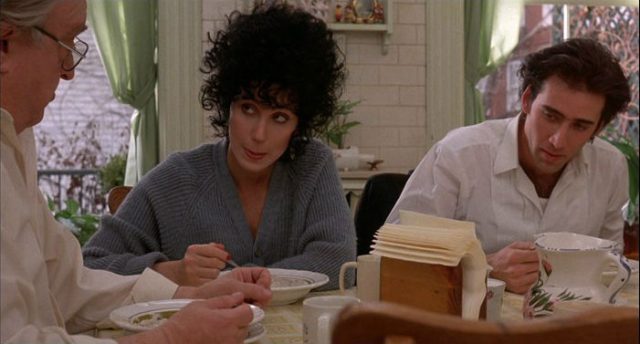
Moonstruck will screen for free at Oculus Plaza on July 13

Thursday, July 12
BRIC Celebrate Brooklyn! Festival: Antibalas, Combo Chimbita, DJ Nickodemus, Prospect Park Bandshell, 7:30

Friday, July 13
Tribeca Drive-In Presents Westfield Dinner and a Movie: Moonstruck (Norman Jewison, 1987), Oculus Plaza, 7:30

Saturday, July 14
NYC Audubon: “It’s Your Tern!” Festival, Governors Island, 12 noon – 4:00

KAZUO MIYAGAWA — JAPAN’S GREATEST CINEMATOGRAPHER: SINGING LOVEBIRDS

SINGING LOVEBIRDS

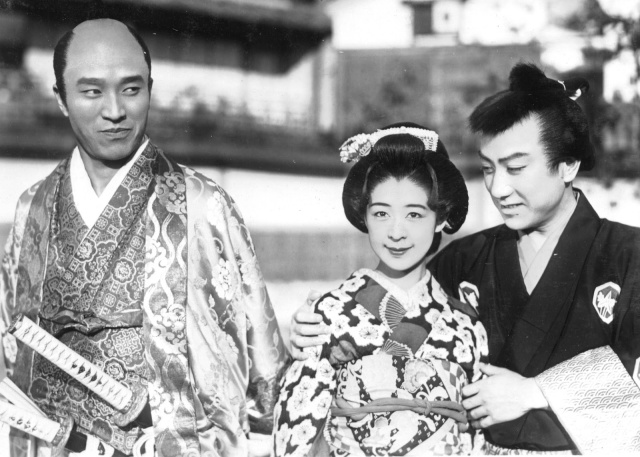
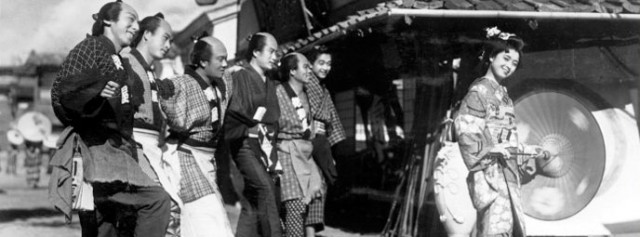
Oharu (Haruyo Ichikawa) finds herself caught between Lord Minezawa (Dick Mine) and Reisaburō (Chiezō Kataoka) in Singing Lovebirds

SINGING LOVEBIRDS (OSHIDORI UTAGASSEN) (鴛鴦歌合戦) (Masahiro Makino, 1939)
Museum of Modern Art, MoMA Film
11 West 53rd St. between Fifth & Sixth Aves.
Friday, April 13, 4:30, and Saturday, April 14, 1:30
Series runs April 12-29 at MoMA and Japan Society
212-708-9400
www.moma.org
www.japansociety.org

In the 1930s, on the cusp of WWII, Japan was in the process of creating its own cinematic musical genre. One of the all-time classics is the wonderful Singing Lovebirds, a period romantic rectangle set in the days of the samurai. Oharu (Haruyo Ichikawa) is in love with handsome ronin Reisaburō (Chiezō Kataoka), but he is also being pursued by the wealthy and vain Otomi (Tomiko Hattori) and the merchant’s daughter, Fujio (Fujiko Fukamizu), who has been promised to him. Meanwhile, Lord Minezawa (jazz singer Dick Mine) has set his sights on Oharu and plans to get to her through her father, Kyōsai Shimura (Takashi Shimura), a former samurai who now paints umbrellas and spends all of his minuscule earnings collecting antiques. “It’s love at first sight for me with this beautiful young woman,” Lord Minezawa sings about Oharu before telling his underlings, “Someone, go buy her for me.” But Oharu’s love is not for sale. Directed by Masahiro Makino, the son of Japanese film pioneer Shōzō Makino, Singing Lovebirds is utterly charming from start to finish, primarily because it knows exactly what it is and doesn’t try to be anything else, throwing in a few sly self-references for good measure.
SINGING LOVEBIRDS

A romantic rectangle is at the center of Masahiro Makino’s charming 1939 musical, Singing Lovebirds

Made in a mere two weeks while Kataoka was ill and needed a break from another movie Masahiro Makino was making — he tended to make films rather quickly, compiling a resume of more than 250 works between 1926 and 1972 — Singing Lovebirds features a basic but cute script by Koji Edogawa, playful choreography by Reijiro Adachi, a wide-ranging score by Tokujirō Ōkubo, silly but fun lyrics by Kinya Shimada, and sharp black-and-white cinematography by Kazuo Miyagawa, who would go on to shoot seminal films by Akira Kurosawa, Kenji Mizoguchi, Yasujirō Ozu, and Kon Ichikawa. There are fab touches throughout the film, from the comic-relief group of men who follow Otomi around, professing their love, to the field of umbrellas made by Kyōsai that resembles a mural by Takashi Murakami, to a musical number sung by Lord Minezawa in which the musicians are clearly not playing the instruments that can be heard on the soundtrack. And of course, it’s also worth it just to hear the great Takashi Shimura, who appeared in so many classic Kurosawa films, sing, although he doesn’t dance. Singing Lovebirds might not have tremendous depth, primarily focusing on money and greed, love and honesty, but the umbrellas do serve as clever metaphors for the many different shades of humanity, for places to hide, and for ways of seeking protection from a world that can be both harsh and beautiful.

Singing Lovebirds is screening April 13 and 14 in the MoMA / Japan Society series “Kazuo Miyagawa: Japan’s Greatest Cinematographer,” which runs April 12-29 at both venues and includes such other Miyagawa-photographed gems as Hiroshi Inagaki’s rarely shown The Rickshaw Man, Yasujirô Ozu’s Floating Weeds, Kenji Mizoguchi’s Tales of the Taira Clan, and Kozaburo Yoshimura’s Bamboo Doll of Echizen in addition to works by Daisuke Ito, Akira Kurosawa, Kon Ichikawa, Kazuo Mori, Masahiro Shinoda, Kazuo Ikehiro, Yasuzô Masumura, and Kenji Misumi. Miyagawa passed away in 1999 at the age of ninety-one, having shot more than eighty films over a fifty-year career. This first major U.S. retrospective of his work, which explores his innovative techniques with the camera and influential legacy, was organized by MoMA’s Joshua Siegel and Japan Society’s Aiko Masubuchi and Kazu Watanabe. In conjunction with the series, Film Forum is showing new 4K restorations of Mizoguchi’s Sansho the Bailiff and A Story from Chikamatsu through April 12. As a bonus, Japan Society is hosting the talk “Cinematographer, Kazuo Miyagawa” on April 14 at 3:00 (free with any series ticket), with Miyagawa’s eldest son, Ichiro Miyagawa, and Miyagawa’s longtime camera assistant, Masahiro Miyajima, moderated by Joanne Bernardi.

CAROLEE SCHNEEMANN AT MoMA

(photo by twi-ny/mdr)

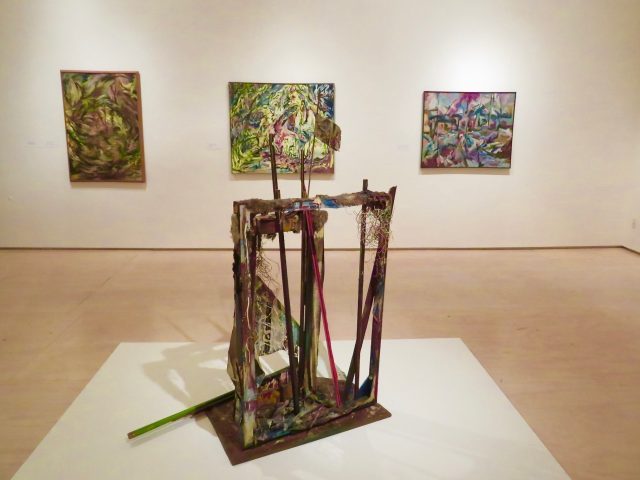
Carolee Schneemann’s early paintings and sculptures are a revelation at MoMA PS1 retrospective (photo by twi-ny/mdr)

Doc Fortnight 2018: George (Jeffrey Perkins, 2017) and Carolee, Barbara, and Gunvor, (Lynne Sachs, 2018), MoMA Film, Museum of Modern Art, 11 West 53rd St. between Fifth & Sixth Aves., 212-708-9400, Wednesday, February 21, $12, 7:30
“Art and Practice with Carolee Schneemann,” MoMA PS1, 22-25 Jackson Ave. at 46th Ave., 718-784-2084, Thursday, February 22, free with advance RSVP, 6:00
Exhibition continues at MoMA PS1 Thursday – Monday through March 11, suggested admission $5-$10, free for NYC residents
www.moma.org
www.caroleeschneemann.com

MoMA PS1’s “Carolee Schneemann: Kinetic Painting” is a revelatory exploration of the career of the immensely influential multidisciplinary artist. The seventy-eight-year-old Pennsylvania-born Schneemann will reveal yet more this week during two special programs. On February 21 at 7:30, she will be at MoMA for the world premiere screening of Lynne Sachs’s Carolee, Barbara, and Gunvor, a nine-minute short about Schneemann, Barbara Hammer, and Gunvor Nelson, which is screening with Jeffrey Perkins’s George, about George Maciunas and Fluxus, as part of “Doc Fortnight 2018: MoMA’s International Festival of Nonfiction Film and Media.” Schneemann, Perkins, and Sachs will participate in a discussion after the films; in addition, Alison Knowles will re-create her interactive 1963 piece Shoes of Your Choice. (MoMA PS1 will also be hosting “An Evening in Honor of Carolee Schneemann,” a screening and discussion on March 5 with Melissa Ragona, Jenny Jaskey, Branden W. Joseph, and the artist.) “Carolee Schneemann: Kinetic Painting” continues through March 11, an expansive two-floor survey that shines a light not only on Schneemann’s well-known feminist video and performance pieces but her exceptional paintings and sculptures. Superbly curated by Sabine Breitwieser with consulting curator Branden W. Joseph and organized at MoMA PS1 by Erica Papernik-Shimizu with Oliver Shultz, the show takes deep looks at such Schneemann works as Meat Joy, in which a group of people roll around with raw beef, chicken, and fish; Interior Scroll, in which Schneemann pulls a long strip of paper from her vagina and reads the contents; and Up to and Including Her Limits, for which she strapped herself in a harness and used her body to draw on a surface. In 1993, Schneemann declared, “I’m a painter. I’m still a painter and I will die a painter. Everything that I have developed has to do with extending visual principles off the canvas.” For the Abstract Expressionist Pinwheel, a white-gloved staff member will spin the painting upon request. Like Joseph Cornell, she made shadowbox-type works, and her collections of sharp, often aggressive detritus hang on the walls like three dimensional paintings. Colorado House is a “failed” painting turned into a freestanding sculpture. Magnetic audio tape falls out of the bottom of One Window Is Clear — Notes to Lou Andreas Salomé, a tribute to the Russian-German psychoanalyst and writer.

(photo by twi-ny/mdr)

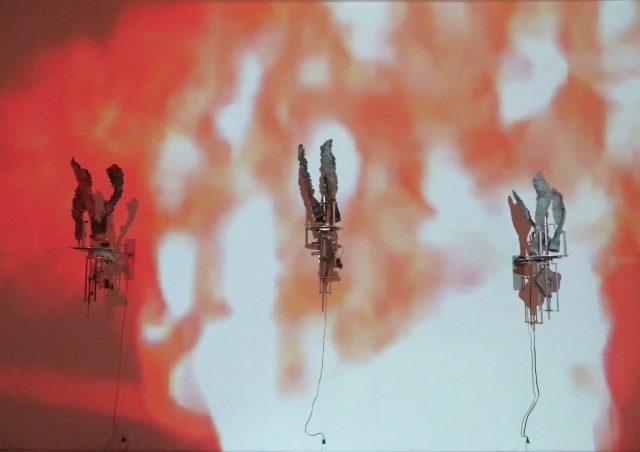
Carolee Schneemann’s Flange 6rpm consists of seven foundry-poured aluminum sculptures that move at six revolutions per minute (photo by twi-ny/mdr)

“My work can take substance from the materials I find,” Schneemann wrote to French poet and activist Jean-Jacques Lebel in 1964, which helps explain Blood Work Diary, a visual document of her menstrual flow. For Body Collage, a naked Schneemann, coated in wallpaper paste and molasses, rolls around in paper shreds. Her body is also one of the main subjects in Fuses, a film in which she makes love with her then-partner, James Tunney, while her beloved cat, Kitch, hangs around nearby. Kitch can be found in several works, but it’s Cluny (and later Vesper) who Schneemann gets perhaps a little too close to in Infinity Kisses. Meanwhile, Vulva’s Morphia is so hot that Schneemann includes four electric fans to cool off the thirty-five vaginal depictions, with such text as “Vulva decodes feminist constructivist semiotics and realizes she has no authentic feelings at all; even her erotic sensations are constructed by patriarchal projections, impositions, and conditioning.” That statement gets to the heart of Schneemann’s six-decade oeuvre, taking back the female body, and the power that comes with that, and redefining it, with no limits. Particularly in the era of #MeToo, “Carolee Schneemann: Kinetic Painting” is an extraordinary exhibition by an extraordinary artist who has never been afraid to make the private public, and political.

PROJECTS 107: LONE WOLF RECITAL CORPS LIVE PERFORMANCES

(photo by Scott Shaw)

Special live performance celebrated opening of Terry Adkins exhibition at MoMA (photo by Scott Shaw)

Museum of Modern Art
11 West 53rd St. between Fifth & Sixth Aves.
Through October 9
212-708-9400
www.moma.org

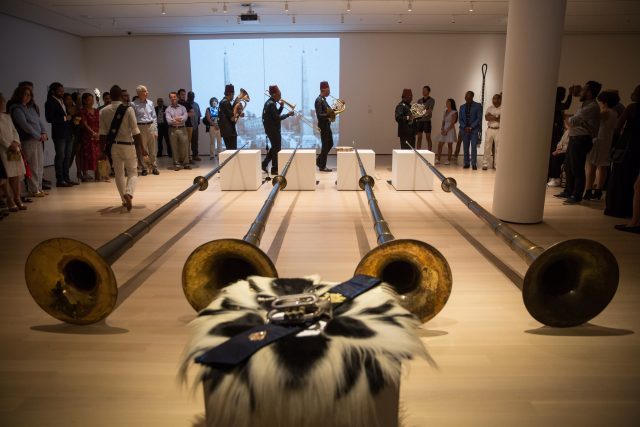
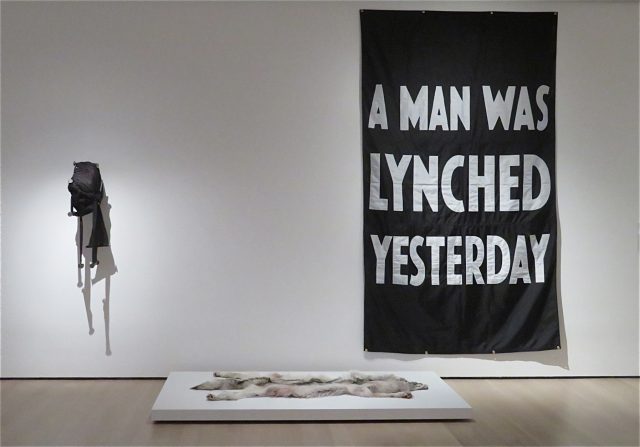
Washington-born multimedia artist Terry Adkins died in 2014 in Brooklyn at the age of sixty. MoMA is paying tribute to his legacy with the small but intimate exhibition “Projects 107: Lone Wolf Recital Corps,” consisting of film, sculpture, instrumentation, paraphernalia, and live performances. Adkins founded the Lone Wolf Recital Corps collective in Zurich in 1986, collaborating with a wide range of artists in numerous disciplines while honoring such figures as Matthew Henson, Bessie Smith, John Coltrane, George Washington Carver, Zora Neale Hurston, and John Brown. The exhibit, which continues through October 9, features such works as “Methane Sea,” constructed of rope, steel, wood, and tape and evoking something that could be found aboard a slave ship; “Omohundro,” an unusual brass and copper instrument; “Upperville,” concrete in which African porcupine quills emerge; a banner that reads “A Man Was Lynched Yesterday,” a replica of the flag the NAACP used to hang out their window on Fifth Ave. after such tragedies; “Amulet,” an almost noose/whip-like black wall hanging made of rubber, rope, electrical wire, tape, and steel; four eighteen-feet-long akrhaphones (the “rha” in the middle of the name is an homage to Adkins’s father); “Sus Scrofa (Linnaeus),” a contrabass covered by a boar hide and skull; and a trio of performance videos, The Last Trumpet from Performa 13 in November 2013; Facets: A Recital Compilation from Skidmore College the previous year; and, also from 2012, Atum (Honey from a Flower Named Blue), in which Clifford Owens puts on the wolf skin that is on view under the abovementioned banner. There is also background on Adkins alter ego and Lone Wolf mystery member Blanche Bruce, named after the first elected African American politician and only former slave to serve a full term in the Senate. “My quest has been to find a way to make music as physical as sculpture might be, and sculpture as ethereal as music is,” Adkins said in a 2006 interview with Dana Roc. In conjunction with the exhibition, there will be a series of live performances, held in the gallery space, the downstairs theater, and the education center next door; advance tickets are recommended.

Terry Adkins exhibition makes its points through sound and image (photo by twi-ny/mdr)

Terry Adkins exhibition makes its points through sound and image at MoMA (photo by twi-ny/mdr)

Monday, September 18
An Evening with Kamau Amu Patton, featuring restaging of Patton’s Amun (The Unseen Legends) with live electroacoustic improvisation to Patton’s Theory of Colors, screening of Patton’s 2008 performance Proliferation of Concept / Accident Tolerant, and discussion with Patton and Akili Tommasino, Roy and Niuta Titus Theater, $12, 7:00

Wednesday, September 20
A Living Space, with Sanford Biggers, Juini Booth, Demetrius Oliver, Clifford Owens, Kamau Amu Patton, and Dread Scott restaging passages from 2013 recital Postlude (Corpus Specere), exhibition space, $12, 7:00

Sunday, September 24
Envy of the World (A Blues for Terry Adkins), with Blanche Bruce on chordophone, Cavassa Nickens and Jamaaladeen Tacuma on bass, Kamau Amu Patton on banjo, and recitation by Arthur Flowers, Tyehimba Jess, and Rashid Johnson, exhibition space, $12, 7:00

Tuesday, September 26
A Visionary Recital (after Terry Adkins), with Charles Gaines on percussion, Jason Moran on piano, and Jamaaladeen Tacuma on bass, improvising new composition by Gaines based on scrolling projection of Lone Wolf text translated into music, Roy and Niuta Titus Theater, $12, 7:00

Wednesday, September 27
The Legacy of Terry Adkins and the Lone Wolf Recital Corps, panel discussion with Charles Gaines, Clifford Owens, and Kamau Amu Patton, moderated by Valerie Cassel Oliver and Akili Tomassino, Education and Research Building, Celeste Bartos Theater, $15, 6:00

Saturday, September 30
PopRally Presents: Twilight Brothers, with Sacred Order members Clifford Owens and Kamau Amu Patton and Da’Niro Elle Brown, Zachary Fabri, LaMont Hamilton, and Kambui Olujimi, followed by lobby reception and DJ set by Patton and Brown, exhibition viewing, and open bar, Roy and Niuta Titus Theater, $25, 9:00

ROBERT RAUSCHENBERG: AMONG FRIENDS

“Mud Muse” is one of many collaborations in MoMA exhibit “Robert Rauschenberg: Among Friends” (photo by twi-ny/mdr)

“Mud Muse” is one of many collaborations in MoMA exhibit “Robert Rauschenberg: Among Friends” (photo by twi-ny/mdr)

Museum of Modern Art
11 West 53rd St. between Fifth & Sixth Aves.
Through September 17
212-708-9400
www.moma.org

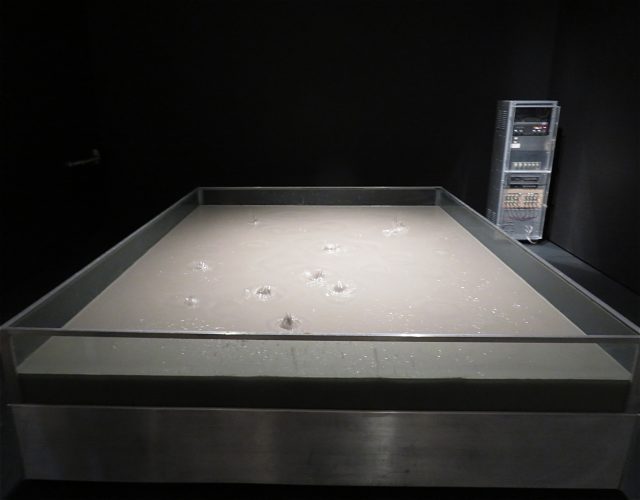
“Robert Rauschenberg: Among Friends” is almost too much of a good thing, a massive MoMA retrospective of the interdisciplinary artist who died in 2008 at the age of eighty-two. The exhausting exhibition consists of more than 250 works, highlighting his collaborations while celebrating the vast nature of his practice. “Oh, I love collaborating, because art can be a really lonely business, if you’re really just working from your ego,” he says in an old interview on the audio guide. The show follows the Texas native from his Black Mountain College years through his time in Italy and North Africa, from his early combines and classical-influenced pieces to performances, silkscreens, objects, “Experiments in Art and Technology” (E.A.T.), and more. Many of his greatest hits are here, including “Bed,” “Monogram,” “Canyon,” “Gift for Apollo,” and his illustrations for Dante’s Inferno, alongside collaborations with Jasper Johns, John Cage, Jean Tinguely, Willem de Kooning, Susan Weil, Brice Marden, Sturtevant, Alex Hay, and more. Among the most unusual works is the bubbling “Mud Muse” created with Carl Adams, George Carr, Lewis Ellmore, Frank Lahaye, and Jim Wilkinson. And most entertaining is Rauschenberg’s involvement in the dance world, making sets for and even performing in pieces by Paul Taylor, Merce Cunningham, Trisha Brown and Laurie Anderson, Harry Shunk and Janos Kender, and others, some filmed by Charles Atlas. The exhibition is supplemented with works by such Rauschenberg contemporaries as Aaron Siskind, Cy Twombly, Lucinda Childs, Andy Warhol, Marcel Duchamp, Niki de Saint Phalle, and Robert Whitman. Meanwhile, the audio guide includes contributions from Yvonne Rainer, Calvin Tompkins, Weil, Marden, Brown, Virginia Dwan, Atlas, Julie Martin, and Rauschenberg’s son, Christopher. So how does one make sense of it all? MoMA is hosting a series of talks and performances to help sort everything out. The exhibition continues through September 17; the below “gallery experiences” are free with museum admission, with no advance RSVP required. (Only the September 12 “Dante Among Friends” performance requires paid ticketing.)

Peter Moore. Performance view of Robert Rauschenberg’s Pelican (1963), 1965. © Barbara Moore/Licensed by VAGA, New York, NY. Courtesy Paula Cooper Gallery, New York

Peter Moore, “Performance view of Robert Rauschenberg’s Pelican (1963),” 1965 (© Barbara Moore/Licensed by VAGA, New York, NY. Courtesy Paula Cooper Gallery, New York)

Wednesday, September 6, 11:30 & 3:30
“Dance among Friends: Robert Rauschenberg’s Collaborations with Trisha Brown, Merce Cunningham, and Paul Taylor,” featuring Changeling, Three Epitaphs, Tracer, You Can See Us, and excerpts from other works, Sculpture Garden

“Robert Rauschenberg’s Process,” with Lauren Kaplan

Wednesday, September 6, 11:30
Thursday, September 7, 1:30
Wednesday, September 13, 1:30
Thursday, September 14, 11:30 & 1:30

“No One Is an Island,” with Kerry Downey

Thursday, September 7, 1:30
“Rauschenberg Among Friends,” with Elisabeth Bardt-Pellerin

Saturday, September 9, 11:30
Sunday, September 17, 1:30

“100 Ways to Make a Picture,” with Petra Pankow

Sunday, September 10, 11:30
Monday, September 11, 11:30

“A Bit of This and That: Robert Rauschenberg’s Combines,” with Jane Royal

Tuesday, September 12
“Collaborators, Friends, Lovers,” with Tamara Kostianovsky, 11:30

“Dante among Friends,” with Robin Coste Lewis and Kevin Young responding in music and poetry to Rauschenberg’s Thirty-Four Illustrations for Dante’s Inferno, curated and hosted by Terrance McKnight, $5-$15, 7:00

LOUISE LAWLER: WHY PICTURES NOW

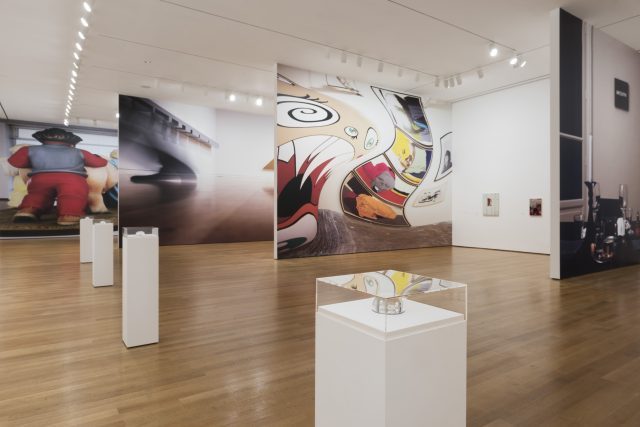
nstallation view of Louise Lawler: WHY PICTURES NOW. The Museum of Modern Art, New York, April 30-July 30, 2017. © 2017 The Museum of Modern Art. Photo: Martin Seck

“Louise Lawler: WHY PICTURES NOW” features paperweights, distorted images, and other works that examine truth in unique ways (© 2017 The Museum of Modern Art; photo by Martin Seck)

MoMA, Museum of Modern Art
11 West 53rd St. between Fifth & Sixth Aves.
Through July 30, $25
212-708-9400
www.moma.org

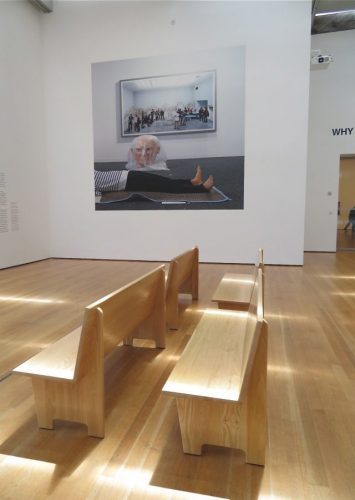
Right outside “Louise Lawler: WHY PICTURES NOW” on MoMA’s sixth floor are several benches that seem ideally placed for tired museumgoers ready to take a break before entering the exhibition. Curiously, however, the benches do not face the introductory text, the entrance, or the barely visible projections of various phrases on a wall. And if you do sit on one of the benches, a security guard will immediately tell you to get up, because it is actually part of the show, a collaboration between Lawler and Cameron Rowland called “New York State Unified Court System.” (The legal reference relates to Lawler’s widespread use of appropriation.) It’s a genius way to begin the exhibition, the first major New York museum survey of Lawler’s work, which for forty-five years has focused on how art is presented to and experienced by the viewer. Born in Bronxville in 1947, Lawler is best known for her photographs of paintings and sculptures by other artists, as the works are in the process of being hung or taken down in museums or seen in collectors’ homes and auction houses, often with sly twists. In an untitled 1950–51 silver dye bleach print, an empty bench sits in front of a Joan Miró canvas that is mostly out of the frame of the photo. In “Monogram,” Jasper Johns’s “White Flag” is on the wall behind a bed covered by a monogrammed sheet. In “White Gloves,” an art handler wearing white gloves is carefully unwrapping a portrait by Gerhard Richter, which is staring right back at the viewer. In her paperweights series, such photos as “Reception Area” and “Untitled (Flavin)” are difficult to see (unless you’re rather tall), placed as they are in small paperweights on individual stands. For her “Adjusted to Fit” series, Lawler takes pictures of others’ artworks, then creates large-scale distorted adhesive vinyl prints that she stretches out to fit on gallery walls; in “Big,” Maurizio Cattelan’s “Picasso — Puppet” is being unpacked, the body of the sculpture lying on the floor, the giant head behind it still in plastic, and behind that is Thomas Struth’s “Pergamon Museum IV, Berlin,” a photograph of people milling about a display of Greek friezes and a headless statue. Thus, Lawler challenges the viewer to get their mind around a series of gazes in which they appear to be both subject and object.

(photo by twi-ny/mdr)

Don’t get too comfortable on benches at entrance to “Louise Lawler: WHY PICTURES NOW” (photo by twi-ny/mdr)

For her “Tracings” series, Lawler, who was part of the Pictures Generation with Cindy Sherman, Robert Longo, Barbara Kruger, David Salle, Laurie Simmons, Richard Prince, and others, creates black-and-white drawings of some of her photographs, including “Pollyanna” and “Triangle,” on adhesive vinyl, removing the color and details, leaving behind a large-format blueprint that looks like it was drawn right on the wall. Of particular interest is “Salon Hodler,” which appears in the show as a regular photograph, inside a paperweight, as a digital gif, and as a tracing. There are numerous chairs in this part of the gallery, where visitors are encouraged to sit and study any of the tracings, yet another wry comment from Lawler, giving museumgoers the opportunity to take their time with works that lack the kind of content evident in the other rooms. The show also features postcards, printed matchbooks, announcement cards, envelopes, press releases, and other items Lawler made for various gallery shows, in addition to collaborations with Lawrence Weiner, Sherrie Levine, Allan McCollum, Felix Gonzalez-Torres, and Andrea Fraser. Finally, out in the Abby Aldrich Sculpture Garden is “Birdcalls,” a seven-minute sound installation recorded and mixed by Terry Wilson in which Lawler chirps and peeps the names of twenty-eight well-known male artists, from Vito Acconci and John Baldessari to Dan Graham and Donald Judd, from Anselm Kiefer and Sol LeWitt to Julian Schnabel and Cy Twombly, not a single woman in the bunch, noting the inherent, primary white male privilege of the international art world. It’s also important to point out that the title of the exhibit, “WHY PICTURES NOW,” purposely does not have a question mark, instead making a firm statement. To cap it all off, Lawler provides us with one last message that we can literally bring home with us: If the artwork on the exhibition poster doesn’t look familiar, that’s because it’s actually not part of the show.