Tag Archives: MoMA

THE NEW MoMA

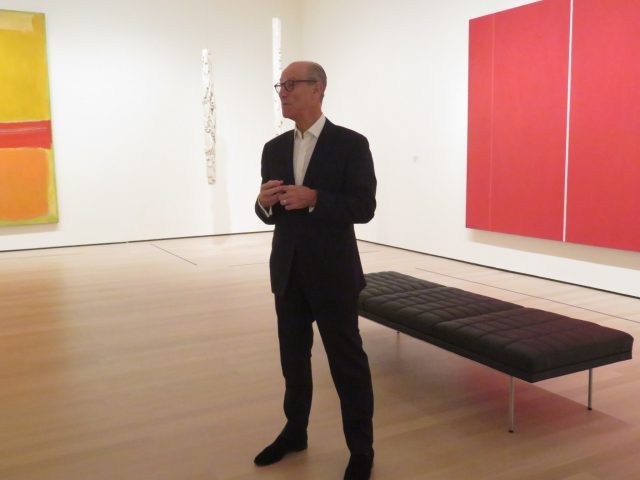
MoMA director Glenn D. Lowry shows off the new museums curatorial (photo by twi-ny/mdr)

MoMA director Glenn D. Lowry shows off museum’s ambitious new approach (photo by twi-ny/mdr)

MoMA, Museum of Modern Art
11 West 53rd St. between Fifth & Sixth Aves.
Opens Monday, October 21, $14-$25 (sixteen and under free)
212-708-9400
www.moma.org

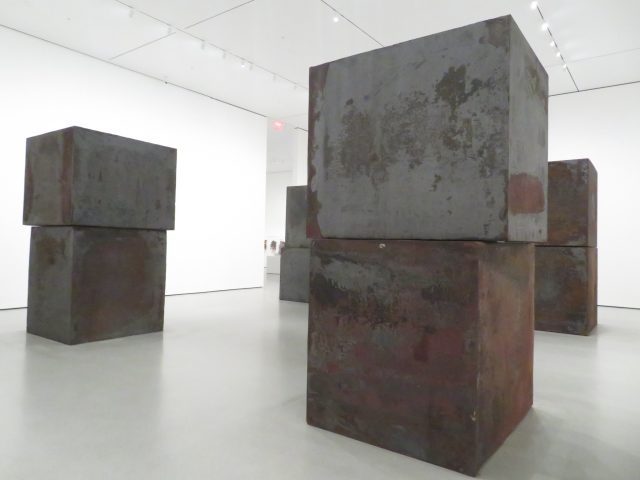
Perhaps no single work of art encapsulates the newly renovated, revamped, and expanded Museum of Modern Art as much as Richard Serra’s 2015 Equal, which gets its own room on the fourth floor. Eight forged weatherproof steel blocks are stacked in pairs, four on four. Despite their title, they are not the same: the random patterns on their sides are not consistent, the light that gleams through gaps in the stacks reveals the blocks are not exact replicas of each other, and they are positioned on different sides. It announces a new MoMA, reopening today with much fanfare after closing on June 16 for four months of reinstallation, a reimagination and reevaluation of how to display items from its ever-growing collection of more than two hundred thousand works. At an intimate press preview, museum director Glenn D. Lowry used all the right words and phrases to bring MoMA into 2019 and beyond, including “a more global perspective,” “pluralism,” “dialogues,” and “diversity.”

He was standing in gallery 404, “Planes of Color,” carefully chosen as representative of the institution’s updated curatorial approach. Instead of being essentially chronological, the room combines painting and sculpture in a more complex way, creating what Lowry said is a “conversation through time and space.” Thus, brought together are an obvious grouping of Russian-born American artist Mark Rothko’s No. 10 and No. 5/No. 22, American artist Ad Reinhardt’s Number 107, and American artist Barnett Newman’s Abraham and Vir Heroicus Sublimis, along with the less-expected choices of Ukraine-born American artist Louise Nevelson’s Hanging Column from Dawn’s Wedding Feast and Indian artist Vasudeo S. Gaitonde’s exquisite Painting, 4. “I hope that my painting has the impact of giving someone, as it did me, the feeling of his own totality, of his own separateness, of his own individuality, and at the same time of his connection to others,” Newman said in a 1965 interview with David Sylvester. “If a meeting of people is meaningful, it affects both their lives.” The same goes for this meeting of artworks.
(photo by twi-ny/mdr)

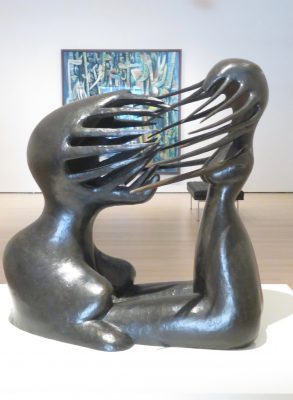
Maria Martins’s The Impossible, III tears apart conventional ideas of curation (photo by twi-ny/mdr)

In gallery 503, “Around Les Demoiselles d’Avignon,” thirteen works by Pablo Picasso from 1905 to 1912 are joined by Louise Bourgeois’s 1947-53 Quarantania, I sculpture and Faith Ringgold’s 1967 painting American People Series #20: Die 1967, a Guernica-inspired canvas about race, class, and violence. One of the museum’s greatest hits, Les Demoiselles d’Avignon, hangs in a corner, given no special prominence. Similarly, Vincent van Gogh’s The Starry Night and Henri Rousseau’s The Sleeping Gypsy, two other perennial favorites, are side by side on a far wall in gallery 501, along with turn-of-the-twentieth-century earthenware by George Ohr. The works on display will rotate every six months, although the classics will most likely always be on view, but not necessarily in the same place. “My ambition is to get past worrying about the canon,” Lowry said. “We’re shaking it up.”

The Worlds to Come gallery on the second floor was inspired by Jack Whitten’s Atopolis: For Édouard Glissant, an eight-panel acrylic canvas depicting a tattered America as if seen from space; it is accompanied by Trisha Donnelly’s Untitled video, Kara Walker’s ink and pencil on paper Christ’s Entry into Journalism, Michaela Eichwald’s Duns Scotus on artificial leather, Deana Lawson’s pigmented inkjet print Thai, and Nairy Baghramian’s styrofoam, aluminum, and cork Maintainers A, a wide range of disciplines and artists that the wall text puts in context of MoMA’s new curatorial decision-making: “Employing a range of forms and materials, some of these works address historical traumas and their present-day echoes, while others imagine a more hopeful future rooted in multiplicity and diversity. Purposefully open-ended, this grouping of works refuses a tidy summation of the art of our time.”
(photo by twi-ny/mdr)

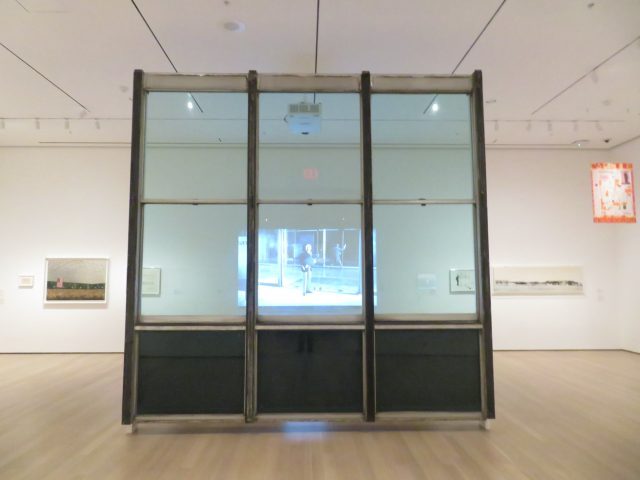
MoMA mixes artistic disciplines in revamped galleries (photo by twi-ny/mdr)

You can find the unexpected everywhere. An excerpt from Jacques Tati’s 1967 comedy Playtime can be viewed in gallery 417 through a piece of the facade from the 1952 UN Secretariat Building in a space dedicated to architecture. Alma Woodsey Thomas’s Fiery Sunset is in a gallery otherwise filled with paintings and sculptures by Henri Matisse. (Matisse’s The Swimming Pool gets its own room, as do Rosemarie Trockel’s Book Drafts and Joan Jonas’s Mirage.) The “Picturing America” gallery includes photographs by Dorothea Lange, Aaron Siskind, Rudy Burckhardt, Edward Weston, Walker Evans, and others alongside paintings by Edward Hopper, another example of the cross disciplines MoMA is now emphasizing.

Visitors to the second-floor contemporary galleries are greeted by Dara Birnbaum’s Technology/Transformation: Wonder Woman video, complete with explosion; to the right are two dozen of Cindy Sherman’s Untitled Film Stills, while to the left is Louise Lawler’s Does Andy Warhol Make You Cry?, a photo of Andy Warhol’s Gold Marilyn Monroe from a 1988 Christie’s auction. It’s a bold, if cheeky, way for MoMA to exclaim its dedication to women artists, blowing up the past.
(photo by twi-ny/mdr)

Richard Serra’s 2015 Equal gets its own room in new MoMA (photo by twi-ny/mdr)

Among what’s new are the Paula and James Crown Creativity Lab, where adults can learn about process and create their own art (kids can still drop in at the Samuel and Ronnie Heyman Family Art Lab in the Education and Research Building), and the fourth-floor Marie-Josée and Henry Kravis Studio, which will host live and experimental programming beginning with David Tudor’s immersive audio installation Rainforest V (variation 1); Tudor’s Forest Speech will be performed in the space October 24, 26, and 27 ($10-$15, 8:00) by Phil Edelstein, Marina Rosenfeld, Stefan Tcherepnin, Spencer Topel, and Jeremy Toussaint-Baptiste as well as three days each in November and December by different sets of musicians.

The museum’s initial exhibitions are all culled from the collection, furthering MoMA’s goal of making more of it available to the public: “Taking a Thread for a Walk,” “The Shape of Shape Artist’s Choice: Amy Sillman,” “Energy,” “Projects 110: Michael Armitage,” “Haegue Yang: Handles” (which will be activated daily at 4:00), “Private Lives Public Spaces” (home movies from dozens of artists and filmmakers), “Surrounds 11: Installations,” “Sur moderno: Journeys of Abstraction ― The Patricia Phelps de Cisneros Gift,” “member: Pope.L, 1978–2001,” and “Betye Saar: The Legends of Black Girl’s Window.” Philippe Parreno’s immersive, site-specific Echo provides sound, light, and movement in the entries on both West Fifty-Third and Fifty-Fourth St., yet more evidence that art is everywhere, in this case putting the visitor at the very center. “It is nearly impossible to make people understand each other,” explained Maria Martins, whose spiky 1946 bronze sculpture The Impossible, III greets people in gallery 401, the theme of which is “Out of War.” With its focus on diversity, juxtapositional dialogues, rotating works, and reconsidered approach to curation, MoMA is trying to get people to understand art, and each other, a whole lot better, in ways that make sense in our current era.
KIRSTEIN AND BALANCHINE’S NEW YORK CITY BALLET: FOUR MODERN WORKS

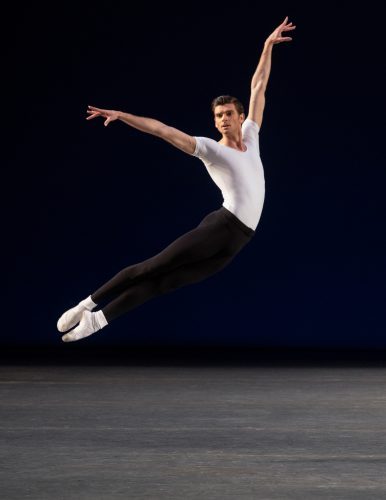
Peter Walker in George Balanchine’s Agon. Photo: Erin Baiano

Peter Walker will be part of NYCB performance at MoMA that includes excerpt from George Balanchine’s Agon (photo by Erin Baiano)

MoMA, Museum of Modern Art
Donald B. and Catherine C. Marron Atrium
11 West 53rd St. between Fifth & Sixth Aves.
March 16-18, free with museum admission of $14-$25, 12:00 and 3:00
Exhibit runs through June 7, $14-$25
212-708-9400
www.moma.org

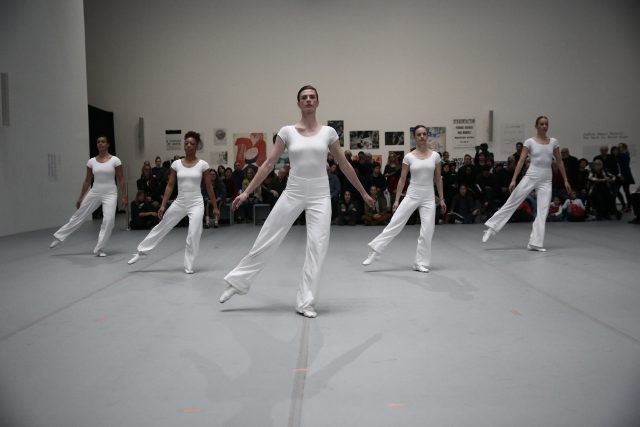
In conjunction with the wide-ranging exhibition “Lincoln Kirstein’s Modern,” MoMA is presenting “Kirstein and Balanchine’s New York City Ballet: Four Modern Works,” a series of dance performances in the Donald B. and Catherine C. Marron Atrium on Saturday, Sunday, and Monday at noon and 3:00. The exhibit, which opens on Sunday and continues through June 7, consists of nearly three hundred paintings, photographs, sculptures, letters, videos, drawings, and ephemera collected by or associated with the Rochester-born Lincoln Kirstein, a polymath, cultural critic, Presidential Medal of Freedom honoree, librettist, and writer who cofounded the New York City Ballet with George Balanchine and was part of the Monuments, Fine Arts, and Archives unit during WWII. The presentation, hosted by NYCB corps de ballet member Silas Farley, will include excerpts from 1941’s Concerto Barocco, 1946’s The Four Temperaments, 1948’s Orpheus, and 1957’s Agon, accompanied by Brooklyn-born pianist Elaine Chelton. The works will be performed by Farley, Gonzalo Garcia, Anthony Huxley, Sara Adams, Ashley Laracey, Unity Phelan, Peter Walker, Devin Alberda, Marika Anderson, Eliza Blutt, Meaghan Dutton-O’Hara, Laine Habony, Baily Jones, Olivia MacKinnon, Jenelle Manzi, Miriam Miller, Andrew Scordato, and Mary Elizabeth Sell. It’s free with museum admission, but there is limited seating.

BRUCE NAUMAN: DISAPPEARING ACTS

(photo by twi-ny/mdr)

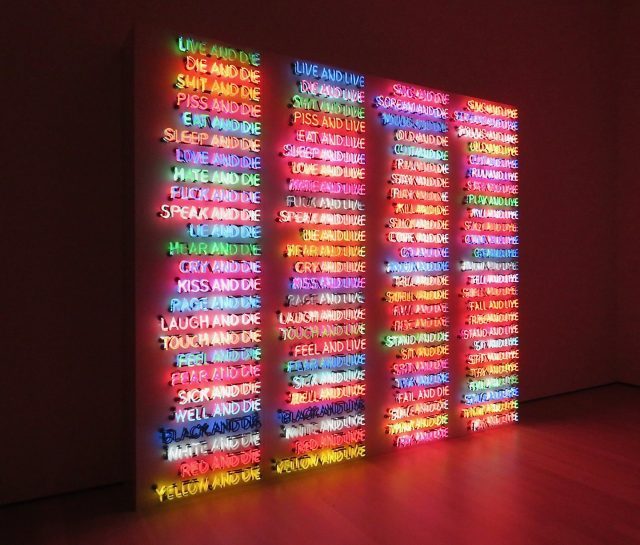
Bruce Nauman, One Hundred Live and Die, neon tubing with clear glass tubing on metal, 1984 (photo by twi-ny/mdr)

MoMA, Museum of Modern Art
11 West 53rd St. between Fifth & Sixth Aves.
Daily through February 18, $14-$25
212-708-9400
MoMA PS1
22-25 Jackson Ave. at 46th Ave.
Thursday – Monday through February 25, suggested admission $10
718-784-2084
www.moma.org

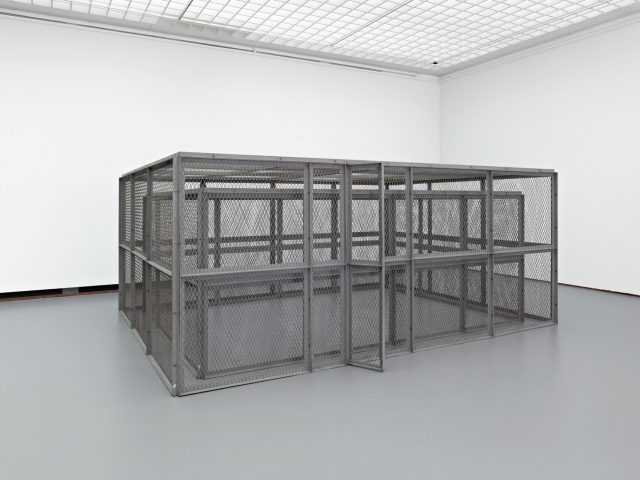
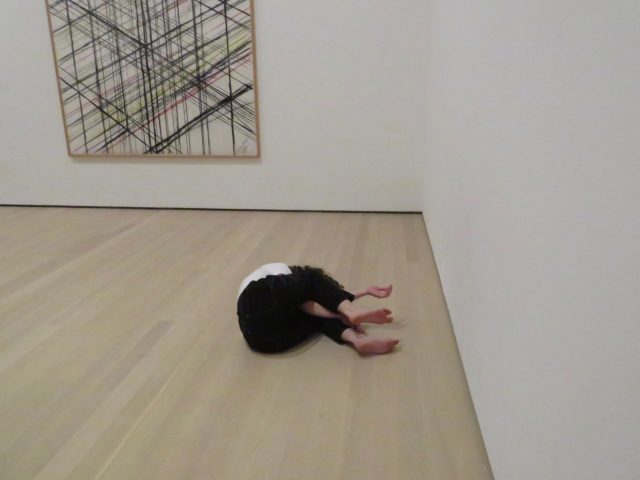
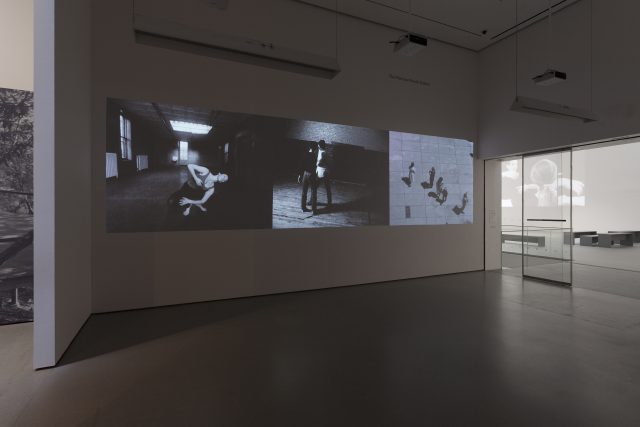
Jazz trumpet legend Miles Davis said, “Don’t play what’s there. Play what’s not there.” That approach applies to the wide-ranging exhibition “Bruce Nauman: Disappearing Acts,” which will disappear from MoMA PS1 on February 25 and MoMA’s main Midtown location on February 18. For six decades, the Indiana-born artist has been creating painting, drawing, sculpture, video, sound, and installation that addresses both the artist and the viewer directly, examining physical and psychological presence and absence. At PS1, Mapping the Studio is a multichannel installation consisting of speeded-up shots of Nauman’s workspace, taken by surveillance cameras overnight; occasionally, a mouse runs past, headlights shine from outside, or other movement is noticed, but it passes by so fast you won’t necessarily know what you’ve seen. In the hall, Naumann has a detailed chart of what happens when, but it is so expansive as to be overwhelming in and of itself. In Two Fans Corridor, visitors are encouraged to stand in an empty space surrounded by three walls as fans on either side, behind the right and left walls, blow air toward no one while adding a sound element. One person at a time can walk through Double Steel Cage Piece, a prisonlike construction with narrow alleys that can cause claustrophobia even though you can see the outside; meanwhile, audible from the previous room is Get Out of My Head, Get Out of This Room, making it seem like a disembodied voice is yelling those words at the person making their way through the cage. For Untitled (Wall-Floor Positions), a dancer arrives at predetermined times and performs on the floor and against the wall, but most of the time there is nobody there. You might not know what to make of Lighted Performance Box unless you look at the ceiling, where light is projected; you can’t go in the box, and there is no “performance.”

Bruce Nauman. Double Steel Cage Piece. 1974. Steel, 84 11⁄16 × 154 5⁄16 × 204 11⁄16″ (216 × 392 × 520 cm). Museum Boijmans van Beuningen, Rotterdam. © 2018 Bruce Nauman/Artists Rights Society (ARS), New York. Photo: Jannes Linders, Rotterdam

Bruce Nauman, Double Steel Cage Piece, steel, 1974 (Museum Boijmans van Beuningen, Rotterdam. © 2018 Bruce Nauman/Artists Rights Society, New York. Photo by Jannes Linders, Rotterdam)

Corridor Installation (Nick Wilder Installation) is a series of narrow passages, some of which you can walk down, and some of which you cannot; Nauman adds cameras and monitors, but what you see on the monitors does not mesh with your actual experience. In the painting Beating with a Baseball Bat, a shadowy figure has his arms lifted above his head as if to inflict violence, but there is no bat in his hands. In My Last Name Exaggerated Fourteen Times Vertically, Nauman employs neon tubing to make his name unreadable, as if erasing himself. Wax Impressions of the Knees of Five Famous Artists is made of fiberglass and polyester resin, not wax, and the impressions were not made by the five artists identified nearby. And A Cast of the Space under My Chair is a concrete sculpture of empty space from a nonexistent chair.

(photo by twi-ny/mdr)

Bruce Nauman, Seven Virtues/Seven Vices, limestone, in seven parts, 1983-84 (photo by twi-ny/mdr)

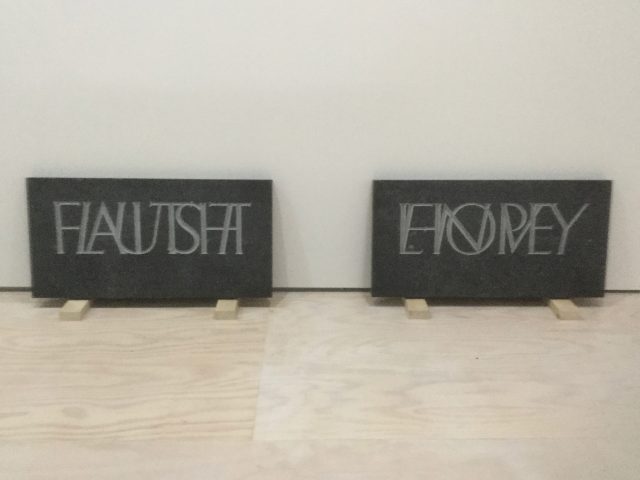
Nauman also plays with opposites in Seven Virtues / Seven Vices, seven limestone blocks in which one vice and one virtue (for example, “Envy” and “Hope”) are spelled out in classical type over each other, making it difficult to read either. A black man and a white woman interchangeably say the same hundred phrases, including “I am a good boy” and “You are a good boy,” in Good Boy Bad Boy, which blurs distinctions between race and gender. Clown Torture is a room of television sets that show clowns being tortured, instead of the clowns doing the torturing. Leaping Foxes, made for this exhibition, is a group of skinless polyurethane animals hanging from the ceiling, stagnant in death. Nauman’s own body figures prominently throughout the exhibition. Contrapposto Split refers to one of his most famous series, in which he walks in a classical pose, but here he does so in 3-D, his body impossibly cut in half, the top out of sync with the bottom, something that is evident in a number of other old and recent videos projected on long walls.

Bruce Nauman (American, born 1941) Untitled (Wall-Floor Positions) c. 1965 Performance reenactment

Bruce Nauman, Untitled (Wall-Floor Positions), performance reenactment, ca. 1965 (photo by twi-ny/mdr)

“Disappearing Acts” is spread throughout three floors of MoMA PS1; back in Manhattan, it takes up the sixth floor with several large-scale installations that continue the theme of what’s there and what’s not there. “Nauman’s work teaches us that making and thinking about art involve all parts of the brain and body. As we move through his environments or stand in front of a drawing such as Make Me Think Me, ideas surface about what it means to be alert — to be in the world,” MoMA director Glenn D. Lowry writes in his foreword to the catalog. (You can read a free fifty-five-page sample from the catalog here.) “Challenging the ways in which conventions become codified, his work erases all forms of certainty, mandating that we craft our own meanings rather than accede to more familiar rules. The lessons learned from Bruce’s penetrating intelligence become more and more necessary every day, and I am confident that the importance of his work will be clear as long as people find meaning in art.” In a May 1973 article in Interview, Nauman said, “I thought I might have to give up art, but I couldn’t think of anything else to do.” Thank goodness for Lowry, and for us, that Nauman did not give up art but forged ahead, pushing boundaries every step of the way. Going Around the Corner Piece is a huge cube you cannot go into, but you can walk around it, watching yourself appear and disappear on four black-and-white monitors placed on the floor. Audio-Video Underground Chamber shows what seems to be live footage of an empty room. You have to sign up in advance to be given the key to Kassel Corridor: Elliptical Space and be the one person every hour allowed to unlock the door and enter the extremely narrow area between two curved walls.

In Days, disembodied voices call out the days of the week from two rows of microphones; as you make your way through the room, you lose track of time and space. The neon sculpture One Hundred Live and Die flashes such phrases as “Cry and Live,” “Rage and Die,” “Laugh and Live,” “Kiss and Die,” “Live and Live,” and “Die and Die” in multiple colors. And Model for Trench and Four Buried Passages alters one’s understanding of what a model is, in this case a giant circular construction of plaster, fiberglass, and wire that calls out with emptiness. But there’s nothing empty about “Disappearing Acts,” an exciting retrospective filled with importance and meaning of your own choosing, in addition to plenty of fun. (There will be a closing party at MoMA PS1 on February 22, from 8:00 to midnight, with the galleries open late, DJ sets in the VW Dome, screenings of the documentary The Bruce Nauman Story, cocktails, and more.)

JUDSON DANCE THEATER: THE WORK IS NEVER DONE

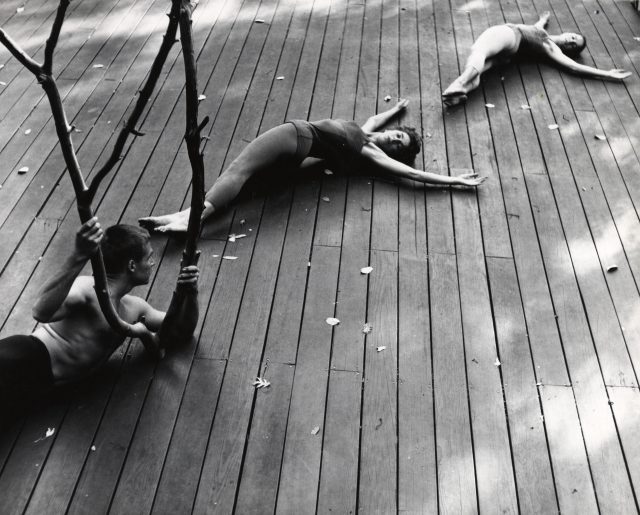
Anna Halprin. The Branch. 1957. Performed on the Halprin family’s Dance Deck, Kentfield, California, 1957. Performers, from left: A. A. Leath, Anna Halprin, and Simone Forti. Photo: Warner Jepson. Courtesy of the Estate of Warner Jepson

Anna Halprin, “The Branch,” 1957. Performed on the Halprin family’s Dance Deck, Kentfield, California, 1957. Performers, from left: A. A. Leath, Anna Halprin, and Simone Forti (Photo by Warner Jepson. Courtesy of the Estate of Warner Jepson)

MoMA, Museum of Modern Art
11 West 53rd St. between Fifth & Sixth Aves.
Through February 3, $25
212-708-9400
www.moma.org

On April 24, 2010, I was observing revolutionary dancer and choreographer Anna Halprin lead a workshop at Judson Memorial Church when she saw me sitting by myself, came over to me, grabbed my hand, and playfully demanded that I participate. Soon I was making a drawing, running around in circles, and sliding across the floor. Halprin, who is ninety-eight, is one of numerous artists being celebrated in the wonderful MoMA exhibition “Judson Dance Theater: The Work Is Never Done,” which continues through February 3. The wide-ranging show consists of approximately 275 photographs, videos, posters, scores, sketches, instructions, programs, announcements, audio clips, newspaper articles, and other ephemera detailing the history of the arts institution that began in the lovely and historic Judson Memorial Church, located on Washington Square South, in 1962, five years after the church started hosting gallery shows by such artists as Robert Rauschenberg and Claes Oldenburg. Throughout the run of the show, there have also been live performances in MoMA’s Marron Atrium.

Lucinda Childs. Interior Drama. 1977. Performed in Lucinda Childs: Early Works, 1963–78, as part of Judson Dance Theater: The Work Is Never Done, The Museum of Modern Art, New York, September 16, 2018–February 3, 2019. Performers: Katie Dorn, Sarah Hillmon, Sharon Milanese, Caitlin Scranton, Shakirah Stewart. Digital image © 2018 The Museum of Modern Art, New York. Photo by Paula Court)

Lucinda Childs, Interior Drama, 1977. Performed in “Lucinda Childs: Early Works, 1963–78,” as part of “Judson Dance Theater: The Work Is Never Done,” performed by Katie Dorn, Sarah Hillmon, Sharon Milanese, Caitlin Scranton, and Shakirah Stewart (Digital image © 2018 the Museum of Modern Art, New York. Photo by Paula Court)

“So, what was Judson? It was a place. It was a group of people. It was a movement,” MoMA media and performance art curator Ana Janevski says on the audio guide. Associate curator Thomas J. Lax adds, “Judson was a group of emerging choreographers, visual artists, composers, and filmmakers. A new kind of avant-garde. They rehearsed, experimented, argued, collaborated, and in the process transformed the world of dance together.” The exhibition highlights choreographers Lucinda Childs, Merce Cunningham, Yvonne Rainer, Steve Paxton, Trisha Brown, Simone Forti, David Gordon, and James Waring, composers La Monte Young, John Cage, and Philip Corner, dancers Fred Herko, Rudy Perez, and Judith Dunn, visual artists Carolee Schneemann, Stan Vanderbeek, Robert Morris, Robert Whitman, Rosalyn Drexler, Fred McDarrah, Oldenburg, and Rauschenberg, and dance critic Jill Johnston. There’s an entire section devoted to Halprin and her architect husband, Lawrence Halprin, including photographs, exercises, a letter from Young, a Cunningham lecture, and more centered around their Dance Deck summer workshop.

nstallation view of Judson Dance Theater: The Work Is Never Done, The Museum of Modern Art, New York, September 16, 2018–February 3, 2019. © 2018 The Museum of Modern Art. Photo: Peter Butler

Installation view of “Judson Dance Theater: The Work Is Never Done” (© 2018 the Museum of Modern Art. Photo by Peter Butler)

Just as I took part in one of Halprin’s workshops at Judson Memorial Church, you can participate in a class or workshop in MoMA’s atrium being taught by Movement Research, which has been based at the church since 1991. There will be morning classes taught by Nial Jones, Joanna Kotze, Bebe Miller, and Paloma McGregor, afternoon somatics classes with mayfield brooks, iele palooumpis and Jaime Ortega, Bradley Teal Ellis, and K. J. Holmes, and workshop manifestations with Ellis, brooks, and Jennifer Monson, in addition to a reading group, the “Tracing Beyond” Studies Project with panelists Ambika Raina, Miguel Gutierrez, Parijat Desai, Tara Aisha Willis, and David Thomson on January 24, and Fun Friday on January 25 with Antonio Ramos. All events are free with advance registration and will give you an inside look at what has made Judson Dance Theater so influential and critical in the history of dance and performance in New York City and around the globe. “Judson is Open Arms, Judson is Big Momma,” dancer, choreographer, and teacher Aileen Passloff explains on the audio guide. “Judson is come in whatever you need we’re gonna try to give it to you. You will need a shower, come here. There’s a shower, there’s a toilet, there’s a place to eat your lunch. You want to practice, there’s a place to practice. You know the thing about those guys is, well, they believed in us, and they believed in the world.”

MUST-SEE WEEK 2019

must see week

Multiple venues
January 21 – February 10
www.nycgo.com

The rising price of admissions in New York City got you down? You can check out some big-time Big Apple institutions January 21 to February 10 during Must-See Week, when tickets to many cultural stalwarts go BOGO, offering two-for-one discounts. Among the participating attractions are the 9/11 Tribute Museum, the Bronx Zoo, the Brooklyn Botanic Garden, the Brooklyn Museum, the Cooper Hewitt, the Empire State Building Observatory, the Intrepid, the Mount Vernon Hotel Museum & Garden, the Museum at Eldridge Street Synagogue, the Museum of Chinese in America, MoMA, the Museum of the City of New York, the New York Botanical Garden, the New York City Ballet, the Chamber Music Society of Lincoln Center, the Rink at Rockefeller Center, the UN, and more. While you can get some tickets in advance, others require in-person vouchers.

THE CONTENDERS 2018: BLACKkKLANSMAN

BlacKkKlansman

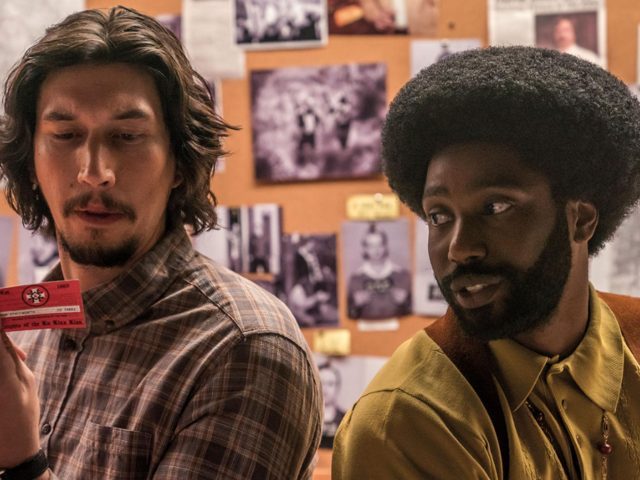
Detectives Flip Zimmerman (Adam Driver) and Ron Stallworth (John David Washington) go undercover to infiltrate the KKK in Spike Lee’s BlacKkKlansman

BLACKkKLANSMAN (Spike Lee, 2018)
MoMA Film, Museum of Modern Art
11 West 53rd St. between Fifth & Sixth Aves.
Sunday, November 25, 2:00
Series runs through January 8
212-708-9400
www.moma.org
www.focusfeatures.com

BlacKkKlansman is Spike Lee’s best fiction film since 1989’s Do the Right Thing, a comic thriller inspired by the real-life story of Ron Stallworth (John David Washington), a Colorado cop who went undercover with the KKK. “Dis joint is based upon some fo’ real, fo’ real sh*t,” the movie announces at the start. Stallworth, wearing an impressive natural afro, is hired by Chief Bridges (Robert John Burke) to diversify the force. When the police hear that Black Power activist Stokely Carmichael, now using the name Kwame Ture (Corey Hawkins), will be speaking at an event sponsored by the Colorado College Black Student Union, the chief and Sergeant Trapp (Ken Garito) send Stallworth in to scout out the situation. There he meets Patrice Dumas (Laura Harrier), a dedicated activist fighting the racist system, with a particular dislike for cops. Seeing an ad for the KKK in the local paper, Stallworth proposes to his bosses that he infiltrate the secretive organization, and they come up with a plan in which Stallworth will gain intelligence over the phone, speaking with local KKK leaders. The only problem is that Stallworth, in a major rookie mistake, used his real name when first talking to Walter Breachway (Ryan Eggold), which complicates the operation. But they proceed, as Detective Flip Zimmerman (Adam Driver) insinuates himself into the group in person, applying for membership and trying to find out about any future marches, cross burnings, or other attacks, gaining the trust of the straightforward Breachway and the goofy Ivanhoe (Paul Walter Hauser), while the nasty Felix Kendrickson (Jasper Pääkkönen) quickly grows suspicious of him. In the meantime, Stallworth develops a phone friendship with Grand Wizard David Duke (Topher Grace) and begins dating Dumas, while Kendrickson’s wife, Connie (Ashlie Atkinson), desperately wants to prove her racism by participating in the KKK’s schemes — which are explicitly limited to “white Christian men.”
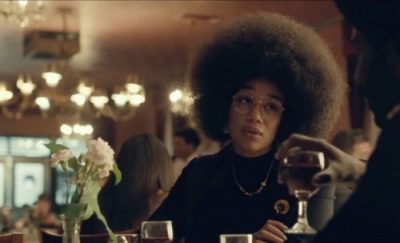
Patrice Dumas (Laura Harrier) fights for justice in

Patrice Dumas (Laura Harrier) fights for justice in Spike Lee’s BlacKkKlansman

Written by Charlie Wachtel, David Rabinowitz, Kevin Willmott, and Lee, BlacKkKlansman takes plenty of liberties with the facts — for example, Stallworth has never identified his white partner, Dumas is a fictional character (although based on Angela Davis and Kathleen Cleaver), and the time shifts a few years ahead — but the heart and soul of the story is true, and Lee captures it with gusto. The film is wickedly funny and frighteningly realistic, all too relevant to today’s rising racist hatred around the world. As Dumas teaches Stallworth about his responsibility to the black race, Stallworth does the same with Zimmerman about his Jewishness. “Why you acting like you don’t have skin in the game?” Stallworth asks him. Photographed by Chayse Irvin and edited by Barry Alexander Brown, BlacKkKlansman is also one of Lee’s best-looking, most-accomplished films, featuring a terrific score by Terence Blanchard along with songs by such diverse musicians as James Brown, Prince, the Edwin Hawkins Singers, Looking Glass, and Emerson, Lake & Palmer. Washington — who played a student in Lee’s Malcolm X, starring his father, Denzel Washington — and Driver have a great chemistry that propels the film, which was released on the first anniversary of the Unite the Right white supremacist rally in Charlottesville.

Several lines of dialogue specifically evoke what his happening in America today, and Lee seals the deal with a finale that includes footage of Duke and President Trump refusing to condemn what went down in Virginia on August 12, 2017. (He also has Trump impersonator Alec Baldwin play a not-too-bright white supremacist; actually, none of the racists is endowed with much intelligence.) As is his trademark, Lee pulls no punches; especially effective is how he switches between Jerome Turner (Harry Belafonte) relating the true story of the lynching of Jesse Washington and the Klansmen watching D. W. Griffith’s Birth of a Nation. Because, of course, we all have a skin in this game. BlacKkKlansman is screening November 25 at 2:00 in MoMA’s annual series “The Contenders,” consisting of works the museum believes will last the test of time, which continues through January 8 with such other 2018 films as Morgan Neville’s Won’t You Be My Neighbor? (followed by a discussion with Neville and producer Nicholas Ma), Paul Dano’s Wildlife (followed by a discussion with Dano, cowriter Zoe Kazan, and actors Carey Mulligan and Jake Gyllenhaal), Paul Schrader’s First Reformed (followed by a discussion with Shrader and Ethan Hawke), and John Krasinski’s A Quiet Place (followed by a discussion with Krasinski).

BEING: NEW PHOTOGRAPHY 2018

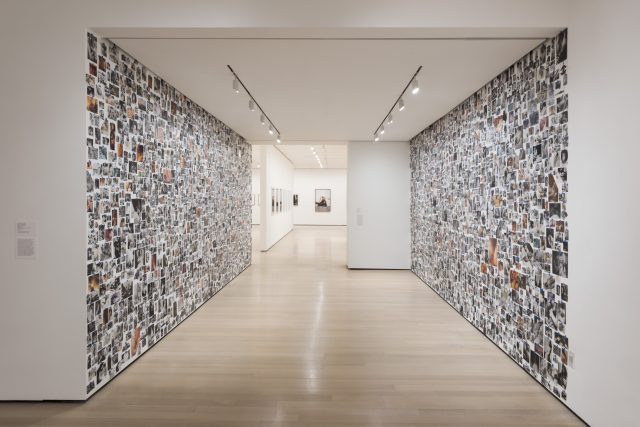
 Installation view of Carmen Winant’s “My Birth,” 2018, part of “Being: New Photography 2018,” Museum of Modern Art (© 2018 the Museum of Modern Art / Photo by Martin Seck)

Installation view of Carmen Winant’s “My Birth,” 2018, part of “Being: New Photography 2018,” Museum of Modern Art (© 2018 the Museum of Modern Art / Photo by Martin Seck)

Museum of Modern Art
11 West 53rd St. between Fifth & Sixth Aves.
Through August 19
212-708-9400
www.moma.org

“Photographs can and in many ways should exist to contradict one another and to build out a narrative that is confusing and in some ways sort of compulsive,” explains Carmen Winant, one of seventeen photographers included in MoMA’s biannual look at new photography, this year called “Being,” which asks the question “How can photography capture what it means to be human?” Winant’s large-scale “My Birth,” consisting of more than two thousand found images of women giving birth, lines a narrow passageway in the exhibit, which continues through August 19. “This could be a shared narrative that both collapses time, and also sort of points to the difference between kinds of experience,” she adds in her online statement. That could be said for many of the works in the show, which features photographers from Brazil, America, Ethiopia, Poland, India, Italy, Germany, and Palestine, all between the ages of thirty-one and forty-four. Harold Mendez’s “At the edge of the Necró polis” explores ritual and remembrance. Images of water are central to Matthew Connors’s series “Unanimous Desire,” taken in North Korea. Stephanie Syjuco’s “Cargo Cults: Head Bundle” is a self-portrait of the Philippine immigrant in traditional dress but with an Urban Outfitters shopping bag on her head. In “Gesellschaft beginnt mit drei” (“Society Begins with Three”), Andrzej Steinbach delves into personal identity by having a trio of models change position and clothing. The exhibit, organized by assistant curator Lucy Gallun, also includes work by Sofia Borges, Sam Contis, Shilpa Gupta, Adelita Husni-Bey, Yazan Khalili, Aïda Muluneh, Hương Ngô and Hồng-Ân Trương, B. Ingrid Olson, Joanna Piotrowska, Em Rooney, and Paul Mpagi Sepuya. “I just want you to really question,” Husni-Bey says about “The Council,” but that relates to all of the photographs in this compelling presentation.