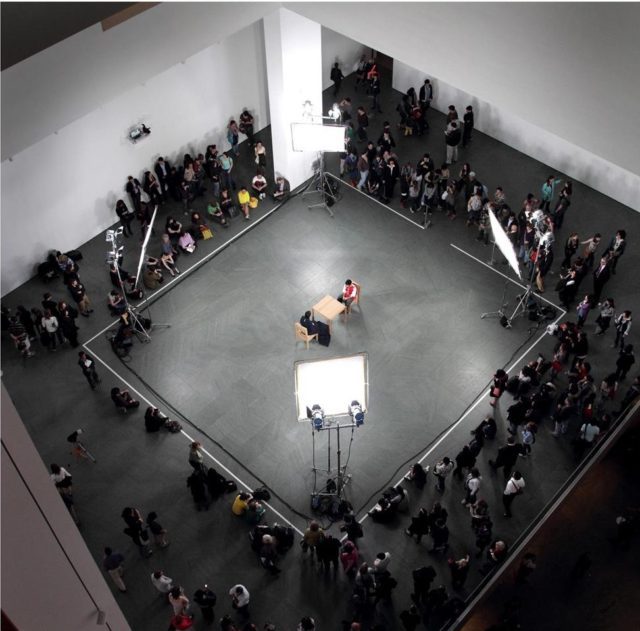
Marina Abramović, The Artist Is Present, MoMA performance, 2010 (photo by Marco Anelli / courtesy of the Marina Abramović Archives)
Who: Marina Abramović, Glenn Lowry, Marco Anelli What: Livestreamed discussions in conjunction with new gallery show, “Performative” Where:Sean Kelly Gallery YouTube,MoMA online When: Tuesday, March 15, free with RSVP, 6:15 [now postponed]; Thursday, March 24, free with RSVP, 7:30 Why: In 2010, MoMA staged the widely hailed immersive exhibition “Marina Abramović: The Artist Is Present,” a chronological career survey highlighted by the re-creation of many of the Belgrade-born artist’s performance pieces, centered by the title work, in which she and a visitor sat across from one another, staring into each other’ eyes for as long as possible as the audience watched. In conjunction with the new Sean Kelly exhibit “Marina Abramović: Performative,” which explores four key turning points in Abramović’s oeuvre, the gallery is presenting a pair of live discussions between and Abramović and special guests, sitting down together but most likely not having a staring contest.
On March 15 at 6:15, Abramović will be at Sean Kelly with Glenn Lowry, the longtime MoMA director who oversaw the 2010 show; the livestream will be available on YouTube. [ed note: This event has been postponed because of the knife attack at MoMA over the weekend.] On March 24 at 7:30, Abramović will be at MoMA for a virtual conversation with Italian photographer Marco Anelli. “Performative,” consisting of photographs, video, objects, and ephemera, is on view at Sean Kelly Gallery at 475 Tenth Ave. through April 16, featuring looks at Abramović’s Rhythm 10,The Artist Is Present, the participatory Transitory Objects, and Seven Deaths.
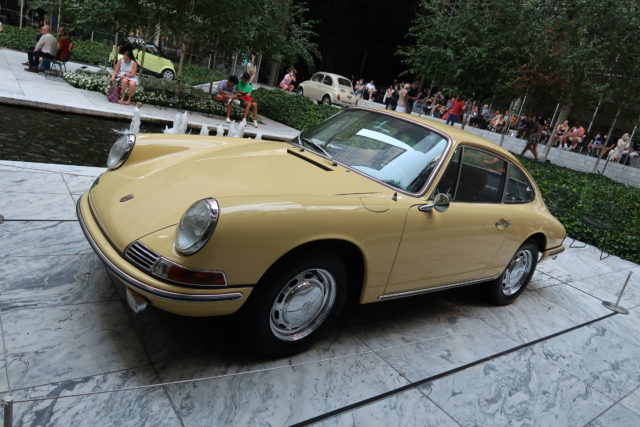
Four classy cars will be parked in MoMA’s sculpture garden through October 15 as part of “Automania” (photo by twi-ny/mdr)
AUTOMANIA
Museum of Modern Art
The Abby Aldrich Rockefeller Sculpture Garden
West 54th St. between Fifth & Sixth Aves.
Through October 15 www.moma.org online slideshow
You better rev it up and go if you want to catch the part of MoMA’s current “Automania” exhibition that is parked in the Abby Aldrich Rockefeller Sculpture Garden, as it will be pulling out at the end of the week.
In 1998, the Guggenheim presented “The Art of the Motorcycle,” a survey of the history of two-wheeled motorized transport, a show that was greeted with a significant amount of disdain for elevating a vehicle into the realm of fine art. On July 4, MoMA opened “Automania,” which includes nine cars and an Airstream in addition to lithographs, posters, photographs, signs, books, paintings, short films, and other ephemera. Four of the cars are on view through October 15 in the sculpture garden, alongside Henri Matisse’s The Back I-IV, Aristide Maillol’s The River, Alexander Calder’s Man-Eater with Pennants, and Isa Genzken’s Rose II.
“Automania” features such colorful vehicles as a 2002 Smart Car Coupé (photo by twi-ny/mdr)
Joining those familiar works are a 2002 Smart Car Coupé, a 1973 Citroën DS 23 Sedan, a 1953 Jeep M-38A1 Utility Truck, a 1965 Porsche 911 Coupé, and a 1968 Fiat 500f City Car. Just outside the entrance to the garden is a 1990 Ferrari Formula 1 Racing Car. Each vehicle is accompanied by a label and audio guide entry detailing its creation and use. “Commonly referred to as the Cincquecento, the Nuova 500 is a compact, rear-engine city car that helped make automobile ownership attainable for an Italian public recovering from the economic devastation of World War II,” the text for the Fiat explains. On the third floor you’ll find a 1963 Airstream Bambi Travel Trailer, a 1946 Cisitalia 202 GT Car, a 1963 E-Type Roadster, and a 1959 Volkswagen Type 1 Sedan.
While making your way through the exhibit, you can listen to “I’m in Love with My Car: An Automania Driving Mix” a playlist that includes songs by Grace Jones, Yo La Tengo, Chuck Berry, War, the Beach Boys, Tracy Chapman, Prince, Buzzcocks, the Beatles, Public Enemy, Bruce Springsteen, the Rolling Stones, and others.
MoMA talk will focus on Garrett Bradley’s multichannel video installation America
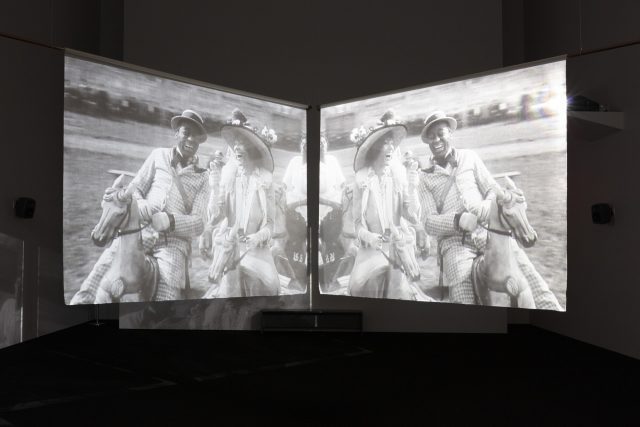
Who:Garrett Bradley, Thelma Golden What: Live Q&A about Projects: Garrett Bradley Where:MoMAYouTube When: Thursday, January 21, free, 8:00 Why: In November, MoMA posted “Re-Imaging America,” a conversation between artist Garrett Bradley, Studio Museum in Harlem associate curator Legacy Russell, and Studio Museum in Harlem director and chief curator Thelma Golden, discussing Bradley’s multichannel video installation America, continuing at MoMA through March 21 as part of the Elaine Dannheisser Projects Series. The work combines twelve new black-and-white short films (about Harry T. Burleigh, James Reese Europe, the Negro National League, and other historical subjects) and a score by Trevor Mathison and Udit Duseja with archival footage of the unreleased 1914 film Lime Kiln Club Field Day, which is thought to be the oldest-surviving feature-length work with an all-Black cast, a love story starring Bert Williams and Odessa Warren Grey. “I knew that Bert was required to wear blackface, and I did not, even in my initial introduction to the material, feel that it took away from his brilliance. But it became critical to prove that, and to prove it using what already existed within the original footage,” Bradley says in the talk.
“That is one of the exciting challenges in working with archives — the prospect of revealing a new dimension of something that appears fixed. How could I make it clear that Bert’s power and creative genius were not confined to his performance alone? His vision extended far beyond our immediate gaze as audience members, and could be seen in-between the scenes themselves. It could be seen in a simple portrait, unmasked and still. I wanted to open America with these moments that made clear who he was, separate from the character in the film and outside of the narrative. It was important we saw him giving direction and in negotiation with the surrounding power structures. It became all the more critical that we had a moment to sit with certain frames — certain truths — that are less discernible at seventeen frames per second.” On January 21 at 8:00, Golden, who curated the exhibition with Russell, will host a live “Virtual Views” Q&A with Bradley on MoMA’s YouTube channel; museum members can send in questions beforehand here. The discussion will also be archived for later on-demand viewing, and you can check out three audio clips of Bradley delving into her work here.
“IN TIMES LIKE THESE”: AMOS AND EFRATIA GITAI
MoMA, Museum of Modern Art
11 West 53rd St. between Fifth & Sixth Aves.
Thursday, March 5, $8-$12, 7:00
Series continues through March 9
212-708-9400 www.moma.org primolevicenter.org/events
In conjunction with the publication of the English-language edition of Efratia Gitai: Correspondence 1929–1994, MoMA will host “‘In Times Like These’: Amos and Efratia Gitai,” a series of events featuring the author’s son, award-winning Israeli filmmaker Amos Gitai. Born in 1909 in Palestine to Russian Zionist parents, Efratia Gitai wrote letters throughout her life to Amos, her Bauhaus architect husband Munio Weinraub, and friends, sharing her views on the state of the world, from the Bolshevik Revolution and Viennese psychology to Churchill, Hitler, and kibbutzes. On March 5 at 7:00, Amos Gitai will introduce “The Letters of Efratia Gitai: A Staged Reading,” a ninety-minute presentation featuring Cannes Best Actress winner Barbara Sukowa (Berlin Alexanderplatz, Hannah Arendt) and Belgian actor and producer Ronald Guttman (Coastal Disturbances, Mildred Pierce) dramatizing the letters, which were curated by Rivka Gitai, Amos’s wife; they will be accompanied on piano by sixteen-year-old Yali Levy Schwartz. The series continues through March 9 with screenings of four of Amos Gitai’s films, Carmel, Esther, Berlin-Jerusalem, and Kedma, several of which will be introduced by the filmmaker.
MoMA, Museum of Modern Art
11 West 53rd St. between Fifth & Sixth Aves.
Through February 1, $14-$25 (sixteen and under free)
212-708-9400 www.moma.org
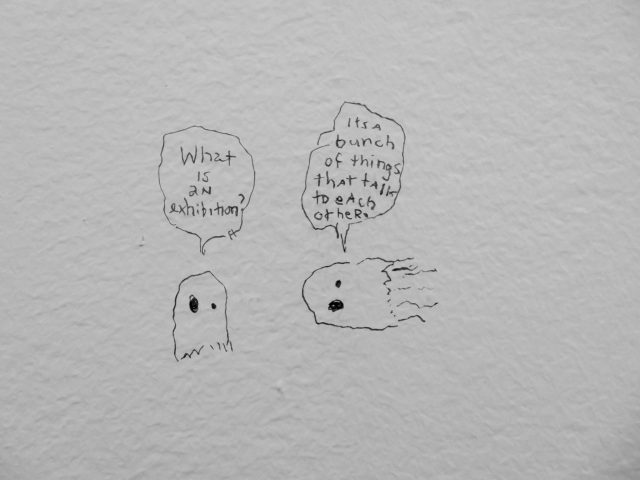
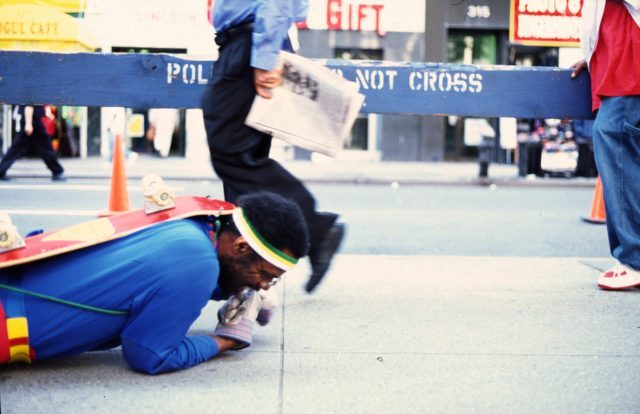
The first thing you must do when you go to MoMA is check out whether there is a backpack hanging on the wall at the end of the “member: Pope.L 1978–2001” exhibition; if it’s not there, it means that Newark-born Conceptual artist William Pope.L is somewhere in the galleries, either performing on a yellow square near the front, doodling on the walls, or interacting with visitors. Since the late 1970s, Pope.L has been holding interventions and live performances that expose racism, classism, poverty, homelessness, and other societal ills. “I am a fisherman of social absurdity, if you will,” he has said. “I am more provocateur than activist. My focus is to politicize disenfranchisement, to make it neut, to reinvent what’s beneath us, to remind us where we all come from.” The show, which continues through February 1, features photographs, film footage, and paraphernalia from many of his Crawls and acts of resistance, in which he takes to the streets in unusual ways as a form of protest.
Pope.L has been adding doodles to the walls during run of show at MoMA (photo by twi-ny/mdr)
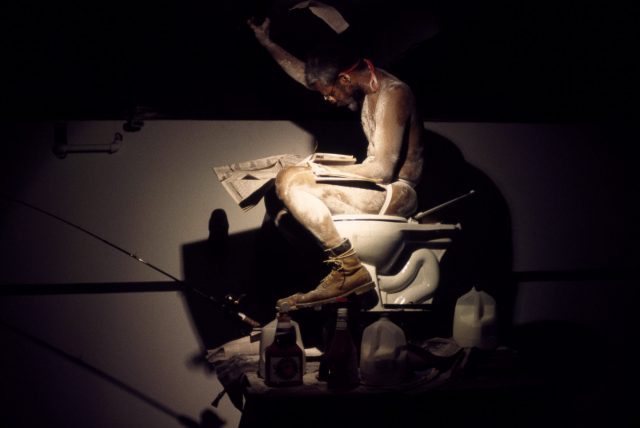
In Thunderbird Immolation, he doused himself with cheap wine and surrounded himself with matches, evoking the Buddhist ritual of self-immolation but here calling into question the marketing of cheap alcohol in poor minority communities. For The Great White Way and Snow Crawl, Pope.L put on a Superman suit. For Member a.k.a. Schlong Journey, he donned business attire and had a long white cardboard tube with a stuffed white bunny on the end protruding from his crotch, as if it were an enormous phallus, as he walked around Harlem, revealing issues of black masculinity and white supremacy. For Sweet Desire a.k.a. Burial Piece, he buried himself in the ground standing up, only his shoulders and head visible, and looked at a melting bowl of ice cream that he could not bend his head over and eat, emphasizing “have-not-ness.” And for Eating the Wall Street Journal, Pope.L built a tall toilet throne which he climbed up to and then, while sitting on the bowl, read, then tore up, chewed, and spat out pages of the newspaper because of its promise of individual wealth.
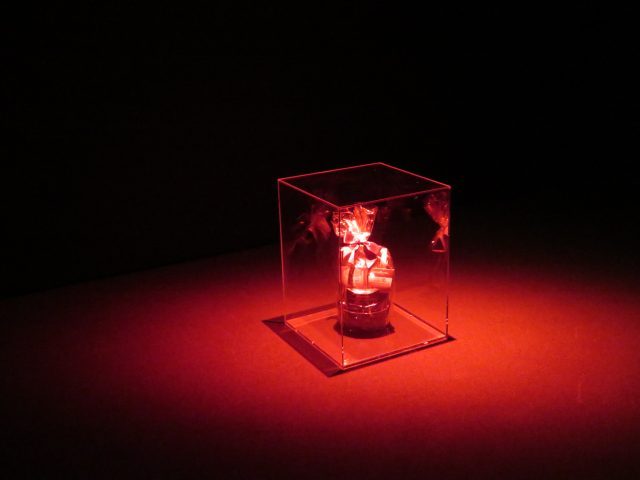
In a back room, you can watch several of his experimental performances, including Eracism, Aunt Jenny Chronicles, and Egg Eating Contest; be sure to look behind the screen for a bonus. The Black Factory Archive consists of items donated by people from around the country that they consider black objects. “The Black Factory is an industry that runs on our prejudices,” Pope.L wrote of the project. “We harvest all your confusions, questions, and conundrums, and transform them into the greatest gift of all: possibility!” And in ATM Piece, he chained himself to the front door of a midtown bank, wearing only a skirt made out of bills. Throughout the galleries, you’ll also see small rectangles cut out of the wall; “Typically what cannot be seen is what we most like to see,” he says of the work, Hole Theory. On January 26 at 2:00, MoMA’s Creativity Lab will host a discussion on Pope.L with Brooklyn-based artist Steffani Jemison and MoMA curatorial assistant Danielle Jackson that examines Pope.L’s influence.
Pope.L exhibitions at MoMA and the Whitney are filled with hidden surprises (photo by twi-ny/mdr)
Member is part of “Pope.L: Instigation, Aspiration, Perspiration,” a collaboration between MoMA, the Public Art Fund, and the Whitney. On September 21, PAF staged Conquest, in which blindfolded volunteers from across the diversity spectrum crawled from the West Village through Washington Square Park and ultimately to Union Square Park. Groups of five, from people in wheelchairs to pregnant women, from the elderly to the blind and deaf and men and women with prosthetic limbs, as well as able-bodied participants, crawled one block each, raising ideas of physical privilege. And Pope.L’s Choir is on view at the Whitney through March 8 in the free main-floor space, a thousand-gallon tank surrounded by microphones that fills up with water sourced from the Hudson after he poured in some water from Flint, Michigan, then empties out via a pipe system as snippets of gospel music and other sounds can be heard. Around the gallery are such phrases as “NGGR WATER,” “HLLOW WTR,” and “NDVSBL WTR,” evoking Jim Crow, segregated drinking fountains, and the lead crisis in Flint. “I think there’s a kind of arrogance in using this kind of material in this quantity,” he says on the audioguide to Choir. ”I think that in some ways, I’m expressing a kind of privilege in being able to do this. There’s a kind of edge to that in the work.” That statement applies directly to member at MoMA and Pope.L’s entire career as well.
Giant fluffy puppies get in the way of a Portuguese soccer star’s dreams in Diamantino
DIAMANTINO (Daniel Schmidt & Gabriel Abrantes, 2018)
MoMA, Museum of Modern Art
11 West 53rd St. between Fifth & Sixth Aves.
Wednesday, January 1, 2:00
Series continues through January 8 www.moma.org www.kinolorber.com
The Museum of Modern Art’s annual “Contenders” series consists of films released over the past twelve months that the institution believes will stand the test of time, regardless of how much money it made at the box office or how many awards it might win. On New Year’s Day, MoMA is screening two under-the-radar gems to welcome in 2020. At 2:00 on January 1, you can catch a documentary, foreign-language picture, political thriller, high-tech crime chiller, comedy, romantic melodrama, fantasy and sci-fi, and more — all in one wildly entertaining film. Diamantino, Gabriel Abrantes and Daniel Schmidt’s full-length feature debut, is an absurdist multigenre mashup that is as tense as it is funny, an unpredictable romp that evokes Ernst Lubitsch, Howard Hawks, Michel Gondry, Philip K. Dick, South Park, Cinderella, James Bond, Being There,Minority Report, and Au Hasard Balthazar while feeling wholly original. Carloto Cotta stars as the title character, Diamantino Matamouros, a Portuguese soccer star à la Cristiano Ronaldo (pre-sexual assault allegations) who sees giant fluffy puppies when he is on the field. After botching a penalty kick in the World Cup Final, the stupendously beautiful star learns that his beloved father and mentor (Chico Chapas) has died. His evil twin sisters, Sónia (Anabela Moreira) and Natasha (Margarida Moreira), become his agents and make a secret deal with the mysterious Dr. Lamborghini (Carla Maciel) and a government minister (Silva Joana). Meanwhile, investigators Aisha Brito (Cleo Tavares) and Lucia (Vargas Maria Leite) — lovers who are soon to be married — are looking into Diamantino’s finances and devise a plan to get close to him by having Aisha pose as a male refugee named Rahim who Diamantino adopts as his son.
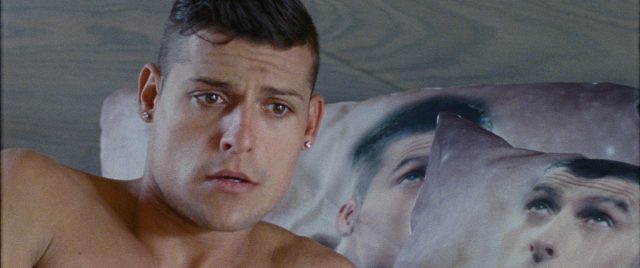
Diamantino Matamouros (Carloto Cotta) is surrounded by images of himself in Gabriel Abrantes and Daniel Schmidt’s dazzling feature debut
Everyone except his sisters, who know better, thinks he is some kind of genius mastermind, but Diamantino is actually an addled simpleton who understands very little about life. He enjoyed playing soccer, likes eating Nutella and whipped cream sandwiches, and, following his tearful retirement, hangs out with his cat, Mittens, and dedicates himself to raising Rahim, who he does not realize is actually a grown woman. He’s reminiscent of Chance the Gardener (Peter Sellers) in Being There, but his airheaded statements — which are outrageously funny — are seldom mistaken for brilliance, except when he’s manipulated into making fascistic political statements he doesn’t understand. Winner of the Grand Jury Prize at Cannes Critics’ Week, Diamantino is stunningly photographed by Charles Ackley Anderson, who quickly adapts the film’s visual style as it switches from fantasy to love story to futuristic thriller, with numerous memorable shots, including Lucia in a white nun’s habit on a motorbike, Diamantino and Rahim sleeping on pillows with large images of the soccer star’s head, and a huge fluffy puppy playing goal in the championship game. American-born directors and longtime collaborators Abrantes and Schmidt, who edited the film with Raphaëlle Martin-Holger, show a deep love and respect for movies, infusing Diamantino with charm and energy, humor and compassion, honoring, in their own way, the history of cinema. The rest of the cast and crew do their part as well, from art director Bruno Duarte and composers Ulysse Klotz and Adriana Holtz to the Moreira sisters and multidisciplinary Portuguese star Manuela Moura Guedes as television interviewer Gisele.
Alice Woodard (Emily Beecham) surveys her creation in Jessica Hausner’s Little Joe
Emily Beecham was named Best Actress at Cannes for her role as a scientist and single mother who creates a different kind of monster in Jessica Hausner’s tense and gripping Little Joe, screening at MoMA at 5:00 on January 1. The Austrian director’s first English-language film was inspired directly by Frankenstein and Invasion of the Body Snatchers while evoking elements of Rosemary’s Baby and Little Shop of Horrors as it plays with horror, sci-fi, teen drama, and other genre conventions. Beecham is Alice Woodard, a plant breeder who is developing a flower she believes can make people happy through its “mood-lifting, antidepressant” scent. She names the new species Little Joe, after her son, Joe (Kit Connor), and even sneaks one plant home for him from the highly secured lab, which is blatantly against the rules.
She works at a science institute — a pristine environment with sterile-looking halls and researchers walking around in white lab coats — with Chris (Ben Whishaw), who has a crush on her, Bella (Kerry Fox), who goes everywhere with her dog, assistants Ric (Phénix Brossard) and Jasper (Andrew Rajan), and their boss, Karl (David Wilmot), who is hesitant to release the plant to the public until rigorous testing proves its safety, even though there’s an important plant show coming up where it would be perfect to introduce it. But after the lovely red blooms start emitting clouds of white spores, first Bella’s dog, then Alice’s coworkers and son, along with his friend Selma (Jessie-Mae Alonzo), begin changing.
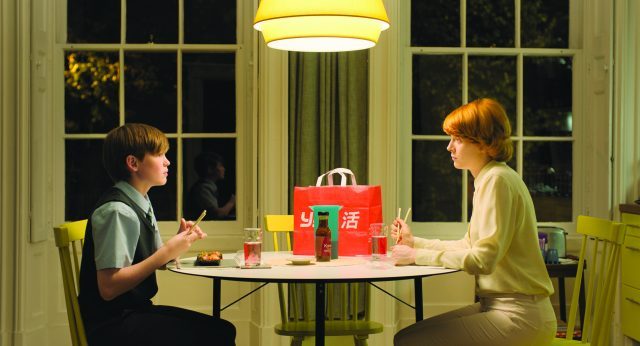
Joe (Kit Connor) and his mother, Alice (Emily Beecham), sit down for takeout in stylized, atmospheric Little Joe
Written by Hausner (Lourdes, Amour Fou) with Géraldine Bajard, Little Joe is thick with foreboding, as scenes play out slowly to creepy electronic music by late Japanese composer Teiji Ito, who scored films by Maya Deren. The film is set in a timeless world of brightly lit, vividly contrasting pastel yellows, reds, greens, pinks, purples, and blues that conjure the 1970s but there are cell phones; cinematographer Martin Gschlacht, editor Karina Ressler, costume designer Tanja Hausner (the director’s sister), and production designer Katharina Wöppermann invoke the atmosphere of such cult faves as auteurs John Carpenter and David Cronenberg and novelist Ira Levin — who wrote The Stepford Wives, The Boys from Brazil, and Rosemary’s Baby — as Alice soon finds herself fighting against what appears to be a spreading conspiracy, all the while exploring her fears with her understanding psychotherapist (Lindsay Duncan). Alice’s bowl-cut red hair is reminiscent of Mia Farrow’s in Rosemary’s Baby (and her last name, Woodard, is similar to Rosemary’s, Woodhouse). Like that classic horror film, Little Joe focuses on the concept of birth and parenthood from a female point of view; even as Alice tries to protect her scientific creation, she is attempting to hold on to her pubescent son as he and his father, Ivan (Sebastian Hulk), become closer. “The ability to reproduce is what gives every living being meaning,” Bella says.
Perhaps the scariest part of the film is how realistic it feels despite its heavily stylized artifice. Hausner consulted with neuroscientist James Fallon, biologist Hanns Hatt, and other experts to research the validity of her plot, particularly in an age where there is global controversy over the efficacy of genetically modified food and animal and human cloning. Beecham (Sulphur and White, Into the Badlands) is superb as Alice, a stand-in for all of us, someone who just wants to bring happiness to the world but, in this case, may not fully understand the price it comes with. “The Contenders 2019” continues through January 8 with such other recent favorites as Uncut Gems, followed by a discussion with directors Benny and Josh Safdie; Sam Mendes’s WWI drama 1917; and Melina Matsoukas’s Queen and Slim.
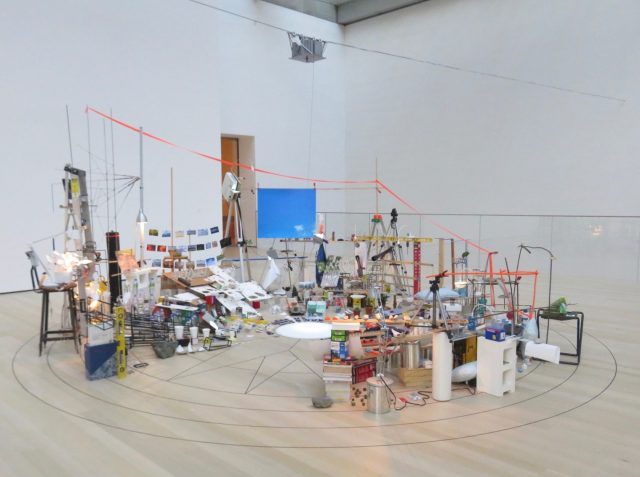
Sarah Sze’s Triple Point (Pendulum) is an architectural wonder (photo by twi-ny/mdr)
MoMA, Museum of Modern Art, sixth floor
11 West 53rd St. between Fifth & Sixth Aves.
Through January 4, $14-$25 (sixteen and under free)
212-708-9400 www.moma.org
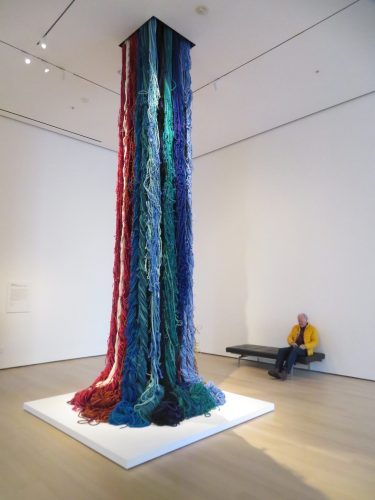
The new MoMA is all about making the most of its collection via diversity, which is just what it does with “Surrounds: 11 Installations,” ten key twenty-first-century architectural works, and one from 1998, that have never been displayed at the museum before. The show includes work by living artists from America, Cuba, Germany, Japan, India, Brazil, and the Netherlands, taking up all of the sixth floor. Inspired by her love of nature as a child, Sheila Hicks’s Pillar of Inquiry / Supple Column, which is outside the gallery space, is composed of lushly colored thick strands of acrylic fiber that pour down through the ceiling of MoMA’s top floor, evoking a kind of rainbow beanstalk reaching into the heavens. Hito Steyerl compares climate change to the 2008 financial crisis in Liquidity Inc. in telling the story of former financial analyst Jacob Wood, who became a mixed-martial-arts fighter; viewers sit on torn judo mats, which Steyerl describes as a storm-ravaged raft, while watching DIY-style news reports that are hijacked by masked anarchists. Arthur Jafa’s APEX features eight-plus minutes of 841 fast-moving images focusing on black culture, from Tupac and Miles Davis to Mickey Mouse and Mick Jagger, set to electronic club beats.
Sheila Hicks’s Pillar of Inquiry / Supple Column pours out from above — or reaches into the heavens (photo by twi-ny/mdr)
Sou Fujimoto’s Architecture Is Everywhere comprises dozens of miniature constructions made of common objects on small plinths with tiny little white figures on them. Twigs with a woman sitting on a bench and a man standing nearby are accompanied by the statement “The forest is always to me the archetype of architecture.” Screws with figures relaxing on top of them are joined by the words “Different heights are in fact different worlds. A new set of relationships between people.” Visitors contribute to Rivane Neuenschwander’s Work of Days merely by walking through a room of transparent adhesive contact sheets from her studio that collect dust from each of us. Press the button to start Janet Cardiff and George Bures Miller’s The Killing Machine, a kinetic sculpture, based in part on Franz Kafka’s “In the Penal Colony,” that transforms a dentist visit into an execution, with multiple television screens and a disco ball but no apparent victim.
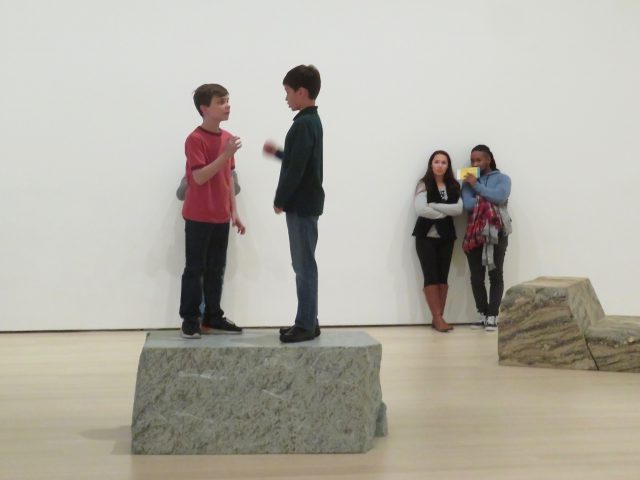
Two boy sopranos perform as part of Allora & Calzadilla’s Fault Lines in MoMA installation exhibition (photo by twi-ny/mdr)
Every hour on the hour between eleven and four, two boy sopranos enter Allora & Calzadilla’s Fault Lines and perform beautiful choral music composed by Guarionex Morales-Matos with confrontational words taken from major literary sources as the singers make their way through a room filled with stone sculptures. The exhibition, which also includes works by Sadie Benning, Mark Manders, and Dayanita Singh, concludes with Sarah Sze’s crowd-pleasing Triple Point (Pendulum), a delicate large-scale intimate circular environment of hundreds of objects, from books, rocks, photographs, and styrofoam cups to water bottles, cracker boxes, lamps, and levels. A tenuously attached pendulum swings from above, in danger of bringing the whole thing down like a wrecking ball, but it never quite makes contact with any of the detritus, which also evokes Sze’s studio. There’s an inviting opening at one side, but viewers know not to step inside this intricately created world, the title of which refers to water’s ability to exist in three states: ice, liquid, and steam. “Surrounds: 11 Installations” bodes well for what the new MoMA has in store.



 The Museum of Modern Art’s annual “Contenders” series consists of films released over the past twelve months that the institution believes will stand the test of time, regardless of how much money it made at the box office or how many awards it might win. On New Year’s Day, MoMA is screening two under-the-radar gems to welcome in 2020. At 2:00 on January 1, you can catch a documentary, foreign-language picture, political thriller, high-tech crime chiller, comedy, romantic melodrama, fantasy and sci-fi, and more — all in one wildly entertaining film. Diamantino, Gabriel Abrantes and Daniel Schmidt’s full-length feature debut, is an absurdist multigenre mashup that is as tense as it is funny, an unpredictable romp that evokes Ernst Lubitsch, Howard Hawks, Michel Gondry, Philip K. Dick, South Park, Cinderella, James Bond, Being There, Minority Report, and Au Hasard Balthazar while feeling wholly original. Carloto Cotta stars as the title character, Diamantino Matamouros, a Portuguese soccer star à la Cristiano Ronaldo (pre-sexual assault allegations) who sees giant fluffy puppies when he is on the field. After botching a penalty kick in the World Cup Final, the stupendously beautiful star learns that his beloved father and mentor (Chico Chapas) has died. His evil twin sisters, Sónia (Anabela Moreira) and Natasha (Margarida Moreira), become his agents and make a secret deal with the mysterious Dr. Lamborghini (Carla Maciel) and a government minister (Silva Joana). Meanwhile, investigators Aisha Brito (Cleo Tavares) and Lucia (Vargas Maria Leite) — lovers who are soon to be married — are looking into Diamantino’s finances and devise a plan to get close to him by having Aisha pose as a male refugee named Rahim who Diamantino adopts as his son.