Tag Archives: MoMA

ED RUSCHA / NOW THEN

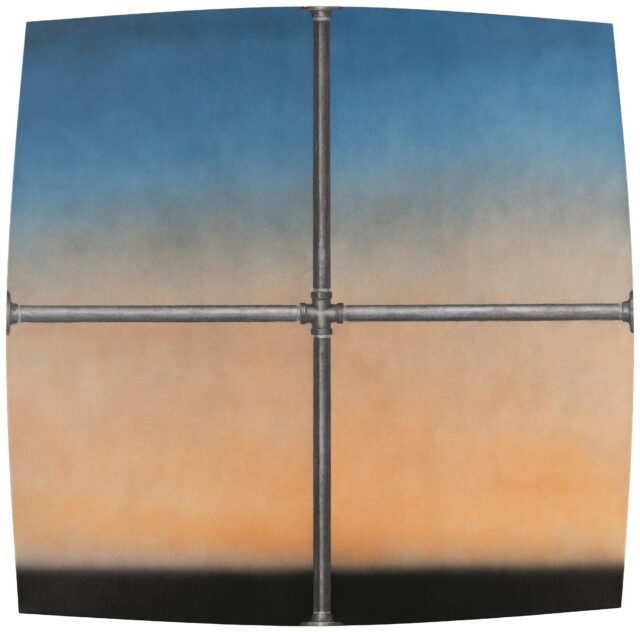
Ed Ruscha, Charles Atlas Landscape, acrylic, pencil, and ink on canvas, 2003 (collection of the artist / © 2023 Ed Ruscha / photo by Paul Ruscha)

ED RUSCHA / NOW THEN
MoMA, the Steven and Alexandra Cohen Center for Special Exhibitions, sixth floor
11 West Fifty-Third St. between Fifth & Sixth Aves.
Through January 13, $15-$28
www.moma.org

“I Dont Want No Retro Spective,” Omaha-born artist Ed Ruscha wrote in a pastel-on-paper work in 1979. Oof — well, he’s got one heckuva retrospective continuing at MoMA through January 13.

There are many joys to be experienced in MoMA’s revelatory “Ed Ruscha / Now Then,” the most comprehensive survey of his seven-decade career, featuring more than two hundred works, including painting, drawing, photography, printmaking, artist’s books, and installation. As eye-opening as the show is, what lifts it to another level for me is the audioguide, in which Ruscha, a longtime LA resident who turned eighty-six earlier this month, offers his personal perspective on thirteen of the pieces.

Talking about the 1962–63 OOF, a large canvas with the title word painted in a sans-serif yellow on a blue background, Ruscha explains, “My first paintings were of words that were monosyllabic, guttural utterings, like ‘oof’ and ‘smash.’ Words that had some kind of vocal power to them and also had a social discord. These words came out of sound investigation. It’s almost like you walk into a butcher store and ask for a pound of bacon and they take a pound of bacon and slam it down on the counter. It’s the slam that I was after.” His good friend, architect Frank Gehry, adds, “He’s very interested in the mundane and the stupid. A painting that says ‘OOF?’ It says everything about the place and time he was living in.”

“Ed Ruscha / Now Then” is filled with such slams, and not only in his word-based paintings, such as Boss, Won’t, and Honk, and such branding and product re-creations as Actual Size, a depiction of a can of Spam, and Annie, the logo for the comic strip Little Orphan Annie. Ruscha, who spent a lot of time on Route 66 and other highways, particularly in Oklahoma, Texas, and California, captures the heart and soul of America in such striking works as The Back of Hollywood (the other side of the Hollywood sign), Large Trademark with Eight Spotlights (the 20th Century Fox logo), and Standard Station, Amarillo, Texas, a spectacularly angled gas station in bold red, white, black, blue, and yellow).
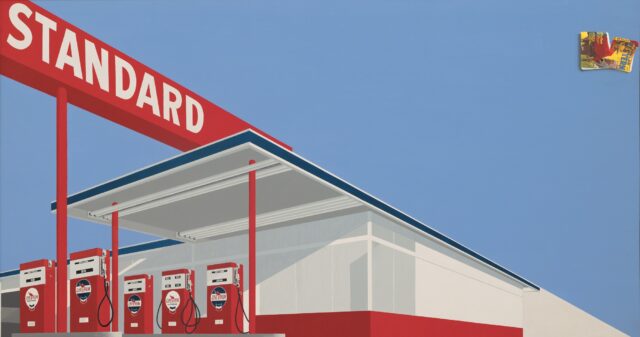
Ed Ruscha, Standard Station, Ten-Cent Western Being Torn in Half, oil on canvas, 1964 (private Collection / © 2023 Edward Ruscha / photo by Evie Marie Bishop, courtesy of the Modern Art Museum of Fort Worth)

Discussing the nearly six-feet-high 1963 oil-and-wax Noise, Pencil, Broken Pencil, Cheap Western, in which the word “Noise” is tucked into the upper right corner, Ruscha says, “The word ‘Noise’ and all words to me, they have really no size at all. You can see it a hundred feet high, you can see it in four-point type.”

In Los Angeles County Museum of Art on Fire (1965–68), flames are shooting out one side of LACMA. Ruscha notes, “About this time that I was painting this picture, I had some, oh, maybe personal gripes about the art world in general. And I felt like the museums were not really doing their jobs as far as opening their doors to contemporary art. I didn’t have a hatred for museums, but maybe, like, I had a healthy distrust for museums. And so I guess part of this painting grew out of that. I didn’t know how this painting would be perceived. The museum actually had a notion to possibly buy that painting, which really surprised me, and then didn’t surprise me so much when they didn’t.” The exhibit moves to LACMA in April 2024.

And Ruscha says about 2022’s Metro, Petro, Neuro, Psycho, in which the four title words are shown above one another in decreasing size against a background of tall grass, “And finally, it comes down to selecting things that sometimes lead you down strange roads, sometimes they’re nonsequiturs, sometimes they’re odd word combinations. But they have to have some sort of power or some strangeness to them for me to get on board.”
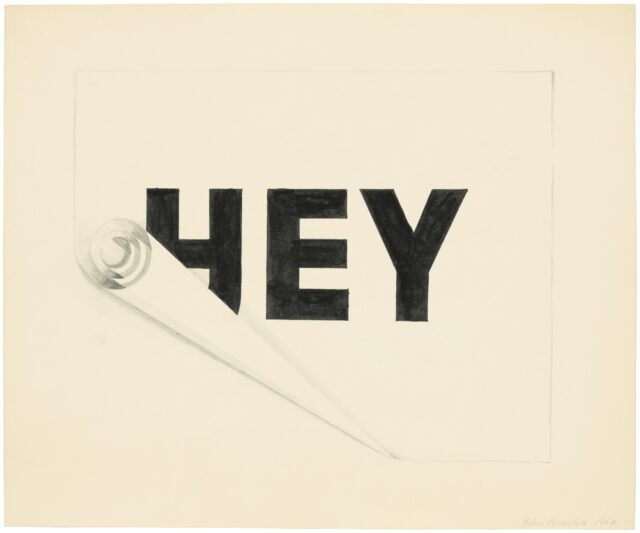
Ed Ruscha, Hey with Curled Edge, ink and powdered graphite on paper, 1964 (Museum of Modern Art, New York / Gift of the artist / © 2023 Edward Ruscha / photo by Robert Gerhardt)

It’s easy to get on board with Ruscha’s dazzling output; other highlights are his gunpowder drawings; Spread, a two-sided work made with tobacco stain; Our Flag, an acrylic painting of a disintegrating Old Glory; Evil, in which Ruscha used his own blood on satin; a trio of exceptional graphite and pencil drawings of LA residences; a series of canvases in which Ruscha replaces words with empty spaces or redaction, taking away people’s voices; and books such as Every Building on the Sunset Strip, Twentysix Gasoline Stations, Edward Ruscha (Ed-werd Rew-shay) Young Artist, and Flipping Kicking Howling Rolling Sitting Standing Climbing Telling.

In 1998, Ruscha told Tracy Bartly, “Seeing things age is a form of beauty.” Time is a constant element in Ruscha’s oeuvre, from changing landscapes to a painting of a segment of a clock, from a canvas that declares, “It’s Only Vanishing Cream” to a portfolio of liquid stains on paper. The walls of Chocolate Room are covered with decaying chocolate on paper, meaning it will look slightly different as the chocolate decays and accumulates bloom. Three large-scale horizontal paintings of LA industrial buildings from 1992 are paired with how Ruscha imagined, in 2003–5, they will look in the future; for example, the gray Blue Collar Trade School becomes the blue, white, and yellow The Old Trade School Building, now resembling a prison or hospital behind barbed wire, as if capitalism has failed.

The exhibit takes its name from a 1973 shellac on moiré rayon piece that melds past, present, and future, saying, “Now Then, as I Was About to Say . . .”

As long as Ruscha keeps talking, the world will continue to listen.

[Mark Rifkin is a Brooklyn-born, Manhattan-based writer and editor; you can follow him on Substack here.]
GEORGIA O’KEEFFE: TO SEE TAKES TIME

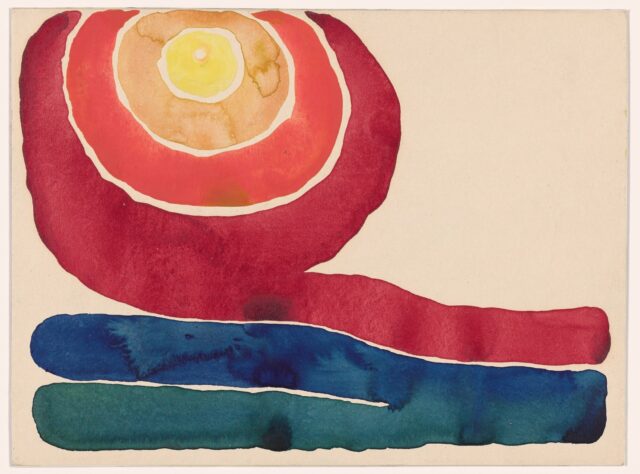
Georgia O’Keeffe, Evening Star No.III, watercolor on paper mounted on board, 1917 (Museum of Modern Art, New York. Mr. and Mrs. Donald B. Straus Fund, 1958. © 2022 Georgia O’Keeffe Museum / Artists Rights Society, New York)

GEORGIA O’KEEFFE: TO SEE TAKES TIME
MoMA, Museum of Modern Art
11 West 53rd St. between Fifth & Sixth Aves.
Through August 12, $14-$25 (sixteen and under free)
212-708-9400
www.moma.org

In the catalog for the 1950 exhibition “An American Place,” Georgia O’Keeffe wrote, “A flower is relatively small. Everyone has many associations with a flower — the idea of flowers. You put out your hand to touch the flower — lean forward to smell it — maybe touch it with your lips almost without thinking — or give it to someone to please them. Still — in a way — nobody sees a flower — really — it is so small — we haven’t time — and to see takes time, like to have a friend takes time. If I could paint the flower exactly as I see it no one would see what I see because I would paint it small like the flower is small.”

Appropriately born in a town called Sun Prairie in Wisconsin in 1887, O’Keeffe is beloved for her colorful paintings of flowers, animal skulls, and the desert. In the exhibition “To See Takes Time,” MoMA offers a rare look at her series of works in charcoal, pencil, watercolor, and pastel, with 90 of the more than 120 drawings and paintings dating from 1915 to 1926, before she moved to Santa Fe, where she died in 1986 at the age of 98. Organized by Samantha Friedman with Laura Neufeld and Emily Olek, the show introduces viewers to other, unexpected sides of O’Keeffe, steeped in abstraction.

The works range from the swirling, colorful 1915 pastel Special No. 33 and a trio of 1916 line drawings done in charcoal, watercolor, and watercolor and pencil, respectively, to fourteen 1959-60 pieces depicting similar shapes in nature, culminating in the 1964 oil painting On the River, the latest work in the show.

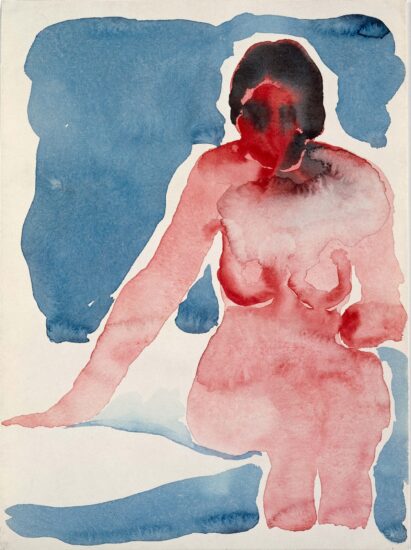
Georgia O’Keeffe, Seated Nude XI, watercolor on paper, 1917 (Metropolitan Museum of Art, New York. Purchase, Mr. and Mrs. Milton Petrie Gift, 1981. © 2023 Georgia O’Keeffe Museum / Artists Rights Society, New York)

The show features such other highlights as four 1916 works on paper of the inside of a tent, made when O’Keeffe was studying at the University of Virginia; 1916-17 pencil drawings of Palo Duro Canyon; all eight 1917 Evening Star watercolors; eight early nudes; charcoal drawings of New York City from 1926 and 1932; a quartet of portraits of artist Beauford Delaney from 1943; and a pair of exquisite pencil on paper drawings of a patio door that recalls the work of Danish painter Vilhelm Hammershøi.

And no need to worry; purists will also find a handful of banana flowers and canna lilies as well as an orchid and a few vaginal works.

In the 1950 catalog, O’Keeffe continued, “So I said to myself — I’ll paint what I see — what the flower is to me but I’ll paint it big and they will be surprised into taking time to look at it — I will make even busy New-Yorkers take time to see what I see of flowers.”

So, tourists and busy New-Yorkers, take your time once you get to MoMA, but get there soon, because the exhibition closes August 12.

[Mark Rifkin is a Brooklyn-born, Manhattan-based writer and editor; you can follow him on Substack here.]
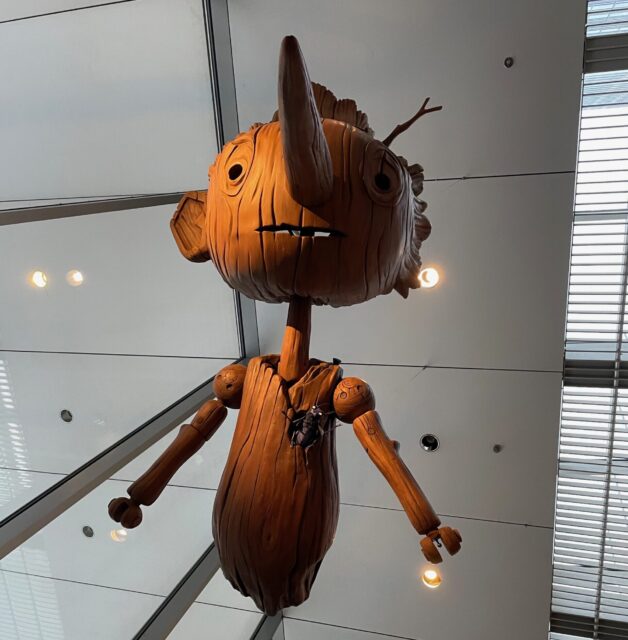
GUILLERMO DEL TORO: CRAFTING PINOCCHIO

A large-scale Pinocchio hovers over a MoMA hallway (photo by twi-ny/mdr)

GUILLERMO DEL TORO: CRAFTING PINOCCHIO
MoMA, Museum of Modern Art
The Debra and Leon Black Family Film Center
The Paul J. Sachs Galleries
11 West 53rd St. between Fifth & Sixth Aves.
Through April 15, $14-$25 (sixteen and under free)
212-708-9400
www.moma.org
crafting pinocchio slideshow

You don’t have to have seen Guillermo del Toro’s Oscar-winning stop-motion-animated Pinocchio or even liked it in order to appreciate the magical “Crafting Pinocchio” exhibition at MoMA, on view for just a few more days. Expect long lines to check out models, maquettes, drawings, dioramas, and video that goes behind the scenes of the making of the film, which started out as a chapter book illustrated by Gris Grimly.

“After the book was published, me and some friends started to develop how this could be a movie. And we came up with a list of directors, and Guillermo was top on the list,” Grimly explains on the audioguide. “Shortly after that, I got a call from a gallery that was selling my artwork, and they said that Guillermo came in and bought a piece of my Pinocchio artwork. And I said, ‘You’ve got to be kidding me!’ They called him up and we had lunch. And this was 2004, I think. It’s been a long time coming. This has been like twenty some years.”

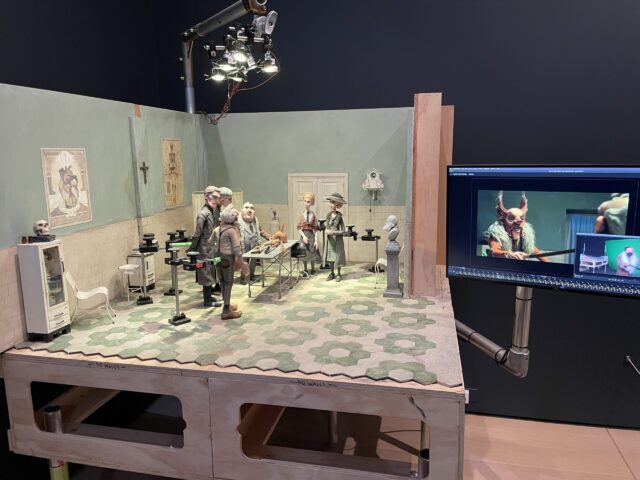
Doctors examine Pinocchio in scene from Oscar-winning film (photo by twi-ny/mdr)

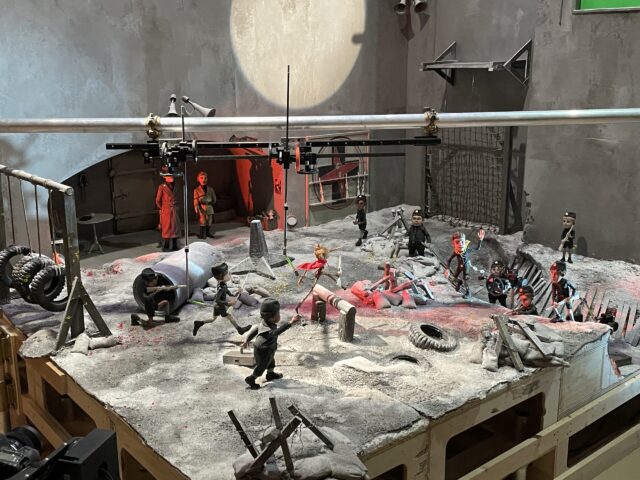
The exhibit is an enticing collection that will bring out the little kid in you. You’ll learn about the creation of such characters as Cricket (voiced by Ewan McGregor), Geppetto (David Bradley), Pinocchio (Gregory Mann), Podesta (Ron Perlman), Dottore (John Turturro), Candlewick (Finn Wolfhard), Spazzatura (Cate Blanchett), the Black Rabbits (Tim Blake Nelson), Count Volpe (Christoph Waltz), the Wood Sprite (Tilda Swinton), and Mussolini (Tom Kenny) and encounter scenes set in Geppetto’s home, the doctor’s office, the battlefield, and the circus where Pinocchio performs.

“This is a fable very close to my heart, and one that I think has lived in many incarnations,” del Toro says on the guide. “And I trust the one we’re offering to you is a particularly beautiful one. This is a tale about becoming who you are, not transforming yourself for others, which goes counter to the traditional take on Pinocchio.” The film itself will be screened at MoMA on April 14 and 15 at 3:00.

Exhibit goes behind the scenes of the making of Guillermo del Toro’s Pinocchio (photo by twi-ny/mdr)

In the film center downstairs are a number of old copies of Carlo Collodi’s story in multiple languages from around the world, an inside look at the music in del Toro’s movie, and clips and posters from Pinocchio and such other del Toro works as Nightmare Alley, The Shape of Water, Pan’s Labyrinth, Hellboy, and The Devil’s Backbone.

On the audioguide, del Toro adds, “We wanted to create a story about a world that behaves like a puppet and obeys everything they’re told, and a puppet that chooses to be disobedient and finds his own morality, his own soul, and his own humanity by that disobedience.” The MoMA show captures just how del Toro accomplished that.

MERET OPPENHEIM: MY EXHIBITION

Wide-ranging Meret Oppenheim continues at MoMA through March 4 (photo by Jonathan Muzikar)

MERET OPPENHEIM: MY EXHIBITION
MoMA, Museum of Modern Art
The Robert B. Menschel Galleries, 3 East
11 West 53rd St. between Fifth & Sixth Aves.
Through March 4, $14-$25 (sixteen and under free)
212-708-9400
www.moma.org

In a 2010 SWI video, Lisa Wenger, the niece of Meret Oppenheim, said of her aunt, the German-born Swiss artist who died in 1985 at the age of seventy-two, “Immediately bought by MoMA in New York, [Object] is the work that most people associate Meret Oppenheim with, in a way fantastic, because she was so young — she was, like, twenty-two or twenty-three when that happened — and on the other hand, it was her prison, and she very often would say, ‘Uch, god, this damn fur cup,’ when people reduced her as an artist to that work or wanted her to do just this type of work, but that fur-covered cup and saucer was certainly her trademark, and it still is an icon of surrealism.”

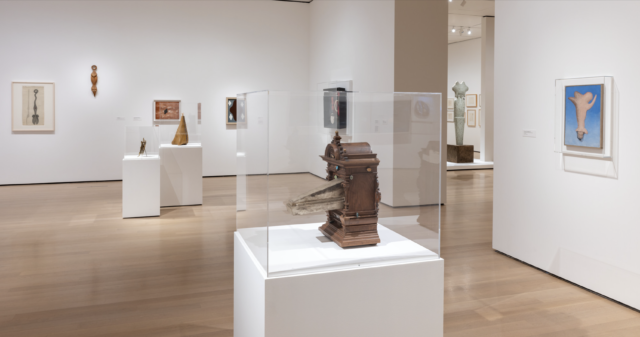
That “damn fur cup” is part of “Meret Oppenheim: My Exhibition,” which continues at MoMA through March 4, but it is not the centerpiece. It is merely one of nearly two hundred paintings, drawings, sculptures, films, assemblages, reliefs, collages, jewelry design, and more on display. The pieces are so wide-ranging that it would at first be easy to assume it was a group show, but it’s all by Oppenheim, a surrealist and conceptualist who played by her own set of rules. As detailed in cocurator Nina Zimmer’s catalog essay, Oppenheim told television journalist Frank A. Meyer in 1983, when asked about whether she specifically tried to be uncategorizable, “Not at all! I simply always did what I felt like doing; anything else wouldn’t agree with the way I work. Committing to a particular style would’ve bored me to death.”

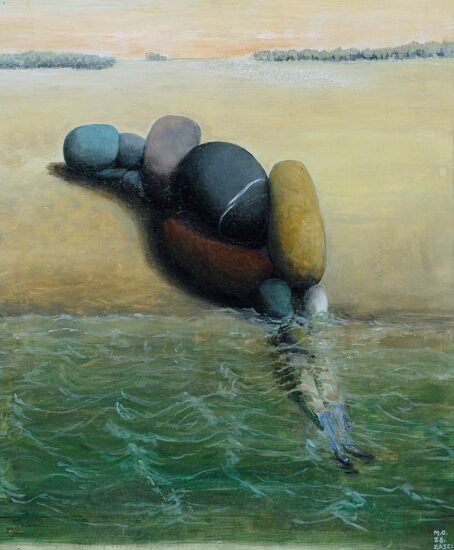
Meret Oppenheim, Stone Woman (Steinfrau), oil on cardboard, 1938 (private collection)

Oppenheim did help to shape her legacy through twelve pencil, colored pencil, and ballpoint pen drawings, collectively titled M.O.: My Exhibition, that essentially lay out plans for a retrospective of her work. The MoMA show also includes the dark Suicides’ Institute, an ink in which a young boy looks up at four hanged people; the cartoonish One-Eyed and Sitting Figure with Folded Hands; the Surrealist Little Ghost Eating Bread and The Night, Its Volume and What Endangers It; Ma gouvernante – My Nurse – Mein Kindermädchen, a pair of high-heeled shoes on a platter, with the heels wrapped like lamb chop booties; Fur Gloves with Wooden Fingers; the somewhat abstract gouache Three Murderers in the Woods; the small circular wall piece The House at the Bridge; the geometric oil Sun-Bedecked Fields; the transformed clock Animal-headed Demon; the gelatin silver print X-Ray of M.O.’s Skull; and a ten-minute clip from Desire Caught by the Tail, the Pablo Picasso play for which Oppenheim designed costumes and sets for a 1956 production.

“Meret Oppenheim: My Exhibition” celebrates legacy of German-born Swiss artist (photo by Jonathan Muzikar)

In a 1933 poem, Oppenheim wrote, “Finally! / Freedom!” The next year, in another poem, she declared, “Let the walls loose.”

That’s precisely the feeling one gets while experiencing “Meret Oppenheim: My Exhibition.”

BARBARA KRUGER: THINKING OF YOU. I MEAN ME. I MEAN YOU.

Barbara Kruger’s immersive atrium installation continues at MoMA through January 2 (photo by twi-ny/mdr)

BARBARA KRUGER: THINKING OF YOU. I MEAN ME. I MEAN YOU.
The Museum of Modern Art
Donald and Catherine Marron Family Atrium
11 West 53rd St. between Fifth & Sixth Aves.
Through January 2, $14-$25
www.moma.org
online slideshow

There’s one word that sticks out in Barbara Kruger’s text-based architectural installation Thinking of You. I Mean Me. I Mean You. in MoMA’s atrium, and it’s in the title twice: No, not Mean but You. Standing in the middle of the imposing space, you are surrounded by words, phrases, and sentences in black-and-white, arranged in horizontal grids and ovals on the floor, walls, and stanchions, that deal with personal and group identity, racial and class injustice, greed, war, consumer culture, and capitalism. These are themes the seventy-seven-year-old Newark native has been exploring throughout her five-decade career, in such pervious works as I Shop Therefore I Am, You Are Not Yourself, The Globe Shrinks, Untitled (Questions), and Whose Hopes? Whose Fears?

A block on the floor pronounces: “IF YOU WANT A / PICTURE OF THE / FUTURE, IMAGINE / A BOOT STAMPING / ON A HUMAN FACE, / FOREVER. / GEORGE ORWELL.”

On the upper south wall, Kruger explains: “THIS IS ABOUT THE YOU NOT I. / THIS IS ABOUT A WORLD OF HURT. / THIS IS ABOUT LOOKING FOR / THE MOMENT WHEN PRIDE / BECOMES CONTEMPT. ABOUT / WANTING ONE ANOTHER. / ABOUT FEARING ONE ANOTHER. / ABOUT TOUCHING ONE ANOTHER. / ABOUT THE WAR FOR ME TO BECOME YOU. I MEAN ME. I MEAN YOU.”

Among the other statements that emerge in this dizzying display are “MONEY TALKS,” “THIS IS ABOUT LOVING AND LONGING. ABOUT SHAMING AND HATING. . . . ABOUT WHO GETS WHAT AND WHO OWNS WHAT,” “YOU ARE HERE, LOOKING THROUGH THE LOOKING GLASS, DARKLY. / SEEING THE UNSEEN, THE INVISIBLE, THE BARELY THERE,” and “IN THE END, YOU DISAPPEAR / IN THE END, LIES PREVAIL / IN THE END, ANGER FADES / IN THE END, HOPE IS LOST.” In addition, a few playful emojis contribute their thoughts on it all.

“Barbara Kruger said architecture is one of the predominant orderings of social space,” curatorial assistant Margarita Lizcano Hernandez says in a MoMA ArtSpeaks video, continuing, “There’s this level of activation of the space that, just by entering it, you’ve become part of it.”

But even as the words, in Kruger’s trademark bold, sans serif font, predict loneliness and doom, hope is not lost; there is an innate joy in just seeing these words, in sharing them with the strangers around you undergoing the same experience. There’s a reason why “YOU” and “ME” are crossed out in the title, followed by a “YOU” that is not crossed out: It’s really about us; Kruger is pointing a finger at everyone.

MODERN MONDAYS: AN EVENING WITH ALFREDO JAAR

Alfredo Jaar explores healing, meditation, and death in Between the Heavens and Me

Who: Alfredo Jaar, Luis Pérez-Oramas
What: Film premiere and discussion
Where: MoMA, the Roy and Niuta Titus Theater 2, 11 West Fifty-Third St. between Fifth & Sixth Aves.
When: Monday, November 7, $8-$12, 7:00
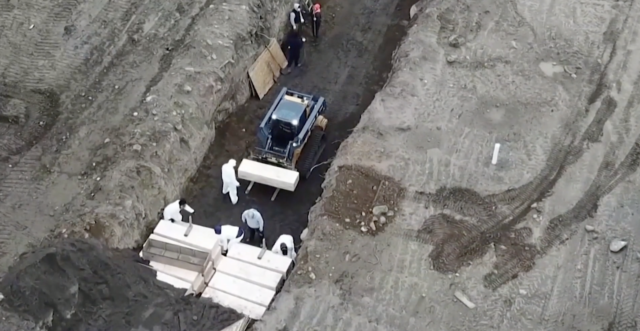
Why: During the pandemic, Chilean artist, architect, activist, and filmmaker Alfredo Jaar made the thirteen-minute video Between the Heavens and Me, which he calls “an exercise in healing, a meditation on the immense curing power of music, a philosophical essay on death, and a futile response to a moment of infinite sadness.” In the film, Jaar, whose Black Lives Matter installation 06.01.2020 18.39 had its own gallery at the Whitney Biennial, explores news footage of a mass grave on Hart Island for victims of Covid-19. “My brain cannot comprehend what my eyes are seeing,” he says in voice-over while watching the scene on his laptop. The haunting score features music by Iranian composer Kayhan Kalhor and Greek composer Eleni Karaindrou. The New York theatrical premiere takes place on November 7 at 7:00 as part of MoMA’s “Modern Mondays” series and will be followed by a discussion with Jaar and curator and art historian Luis Pérez-Oramas, who will examine the 2020 film as well as other projects by Jaar, including the recent Red Pavilion and The Power of an Idea.

MATISSE: THE RED STUDIO

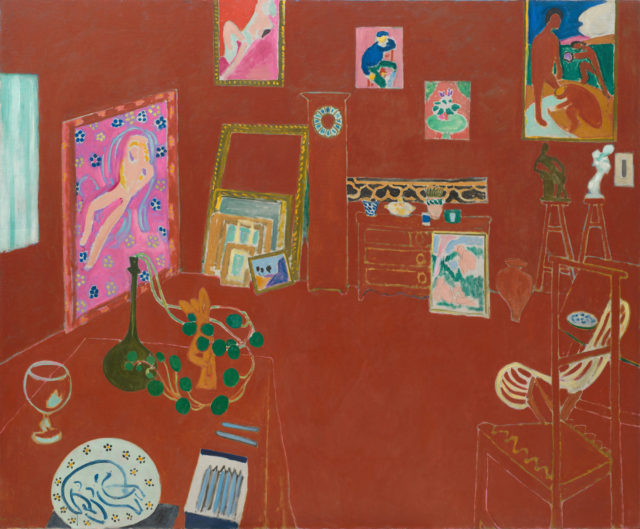
Henri Matisse, The Red Studio, oil on canvas, fall 1911 (Mrs. Simon Guggenheim Fund; © 2022 Succession H. Matisse / Artists Rights Society [ARS], New York)

MATISSE: THE RED STUDIO
MoMA, Museum of Modern Art
11 West 53rd St. between Fifth & Sixth Aves.
Through September 10, $14-$25 (sixteen and under free)
212-708-9400
www.moma.org

“It’s always been sort of a very mysterious painting,” MoMA senior paintings conservator Anny Aviram says in a short video (see below) about Henri Matisse’s The Red Studio. “He leaves clues, but at the same time he confuses you.” The 1911 masterpiece, a painting of the artist’s studio in the Parisian suburb of Issy-les-Moulineaux that includes miniature versions of other works and objects, is explored in extraordinary detail in “Matisse: The Red Studio,” on view at MoMA through September 10.

The exhibition is divided into two parts; one looks at the history behind the creation and presentation of the work, while the other gathers all the extant pieces that are depicted on the canvas. Thus, on one side, you’ll find detailed information about the construction of the studio itself; correspondence between Matisse and collector Sergei Shchukin, who is also seen in a charcoal sketch; photographs of Matisse and his family; a letter from David Tennant and Harry Rowan Walker to Matisse confirming their purchase of the painting for £806 for the Gargoyle Club; Roger Fry’s A Room at the Second Post-Impressionist Exhibition, in which a significant portion of The Red Studio can be seen on the back wall; Matisse’s lovely, claustrophobic The Studio under the Eaves; the marvelous The Studio, quai Saint-Michel, another interior with dramatic lines and canvases that mimic windows; and other ephemera.

In the other room, The Red Studio is surrounded by eleven of the works that appear in it, from paintings, sculpture, and a ceramic plate to drawings of one canvas that has been lost, in addition to tables, chairs, flowers, and design elements that can be found in works in the previous room. The painting wasn’t originally all Venetian red; as the above video reveals, tiny bits of the original colors are still visible, along with a few stray paintbrush bristles. Among the works are the bold sculpture Jeannette IV, the daring Nude with a White Scarf, the entrancing Le luxe (II), the intriguing Young Sailor II, and the rare Impressionistic landscape Corsica, the Old Mill. This is the first time the works have been together since they were in the studio when Matisse painted them, and the reunion is utterly thrilling.

Be sure to listen to the audioguide, which features commentary from curator Ann Temkin along with artists Faith Ringgold and Lisa Yuskavage, writers Siri Hustvedt and Claire Messud, and professor Mehammed Mack. “What we really wanted to do was bring visitors into Matisse’s world, first of all, into the studio that’s the subject of the painting, into the other artworks that are in the painting, and then into the events and artworks that relate to this work as it went on to live its life in the decades following its making,” Temkin explains. “The outrage caused by these images, their radicality when they were produced, is something that I think is good to recover,” Hustvedt explains. “That deconstruction of color, like disassociating color from the object, is a kind of revolutionary act,” Mack adds. “Matisse is so easy to think about as the maker of beautiful, relaxing pictures. We really wanted to try to re-create what extraordinary focus and effort and leaps of imagination and daring an artist goes through in making a work of radical innovation, like The Red Studio,” Temkin continues. “That, for me, is the fascination. It’s as if we have a glimpse inside his head,” Messud concludes. It’s quite a journey.