Tag Archives: MoMA

A SPECIAL ARTIST: RUTH ASAWA AT MoMA

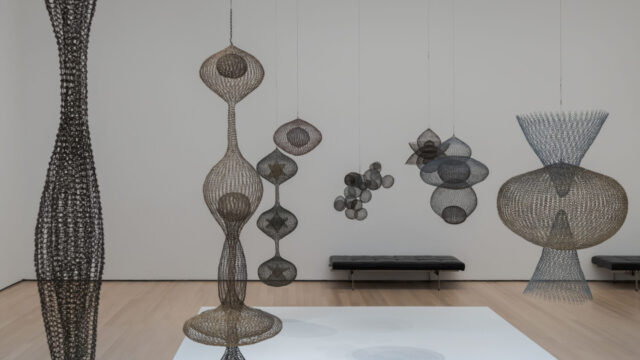
Installation view, “Ruth Asawa: A Retrospective” (digital Image © 2025 the Museum of Modern Art, New York / photo by Jonathan Dorado / artwork © 2025 Ruth Asawa Lanier, Inc. / courtesy David Zwirner)

RUTH ASAWA: A RETROSPECTIVE
Museum of Modern Art
The Steven and Alexandra Cohen Center for Special Exhibitions
11 West 53rd St. between Fifth & Sixth Aves.
Through February 7, $17-$30
www.moma.org
ruthasawa.com

“To watch you at work on a wire sculpture is to see how a single line is transformed into a network of interconnectedness. It’s an expression of the Heart Sutra: form is emptiness, and emptiness is form,” author, filmmaker, and Zen Buddhist priest Ruth Ozeki writes in a letter to the late Ruth Asawa in the catalog of the outstanding MoMA exhibition “Ruth Asawa: A Retrospective.” She continues, “It’s a performance of eternal and infinite nonduality, in which inside is out, and outside is in, and there is no start, no finish, and no separation between these continuous and continually related moments of being.”

“Let the medium express itself.”

On view through February 7, the show features approximately three hundred wire sculptures, bronze casts, drawings, paintings, prints, class notes, a Guggenheim fellowship application, a letter of patent, and public projects. Asawa was born in California in 1926, was sent to an internment camp in Arkansas in 1942 (her parents were Japanese immigrants), studied at Black Mountain College in North Carolina with Josef Albers, Jacob Lawrence, John Cage, Merce Cunningham, Willem de Kooning, and Buckminster Fuller, and helped create the San Francisco School of the Arts, which was renamed the Ruth Asawa San Francisco School of the Arts in 2010. That background led to a career making wide-ranging works that combine movement, architecture, color, and music into something wholly new. She died in 2013 at the age of eighty-seven.

“I hold no hostilities for what happened; I blame no one. Sometimes good comes through adversity. I would not be who I am today had it not been for the internment, and I like who I am.”
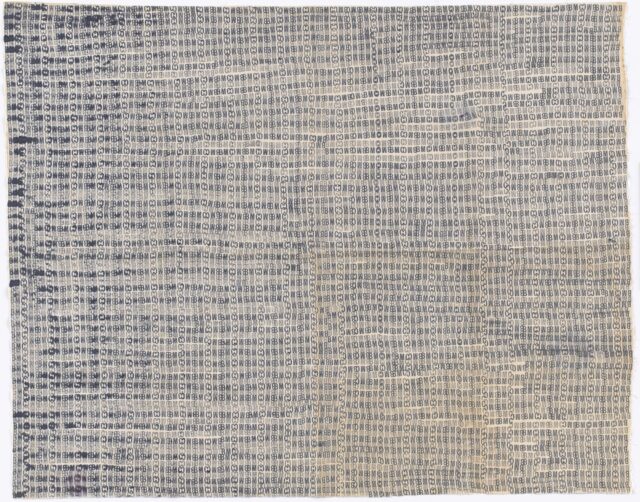
Ruth Asawa, Untitled (BMC.145, BMC Laundry Stamp), stamped ink on fabric sheeting, ca. 1948–49 (© 2025 Ruth Asawa Lanier, Inc. / courtesy David Zwirner)

Among the pieces to watch out for are the oil on masonite We Five and Fourteen, the ink and crayon on paper Untitled (MI.121, Chair with Straw Bottom), the ink on paper Untitled (PT.128, Plane Tree), clay life masks, a glazed ceramic plate and persimmon, gentle watercolors, carved doors, lithographs of children, the ceramic Untitled (S.806d, Everyone’s Favorite City: The Golden Gate Bridge, the Cable Car, and the San Francisco Victorian House), bronze body parts, a series of flower lithographs from 1965, index cards, sketchbooks, archival photographs, and a wedding ring made for Asawa by Fuller. There are also works by Albers, Hazel Larsen Archer, Elizabeth Jennerjahn, Imogen Cunningham, Ray Johnson, Merry Renk, and Marguerite Wildenhain.

“I am able to take a wire line and go into the air and define the air without stealing it from anyone. A line can enclose and define space while letting the air remain air.”
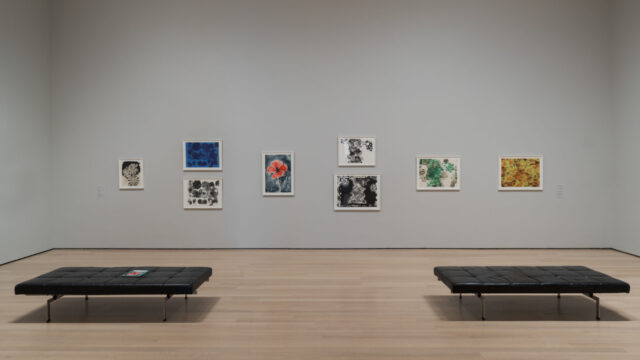
Installation view, “Ruth Asawa: A Retrospective” (digital Image © 2025 the Museum of Modern Art, New York / photo by Jonathan Dorado / artwork © 2025 Ruth Asawa Lanier, Inc. / courtesy David Zwirner)

But mostly there are Asawa’s dazzling wire sculptures, mounted on bases and walls and hanging from above, intricate constructions of interlocking spheres and continuous organic forms within forms based on nature. They cast shadows as you walk around them, and some spin ever so slowly, but they all nimbly dance between positive and negative space.

“An artist is not special. An artist is an ordinary person who can take ordinary things and make them special.”

[Mark Rifkin is a Brooklyn-born, Manhattan-based writer and editor; you can follow him on Substack here.]
THE VOICE OF A TEARDROP: ACTIVATING OTOBONG NKANGA’S CADENCE AT MoMA

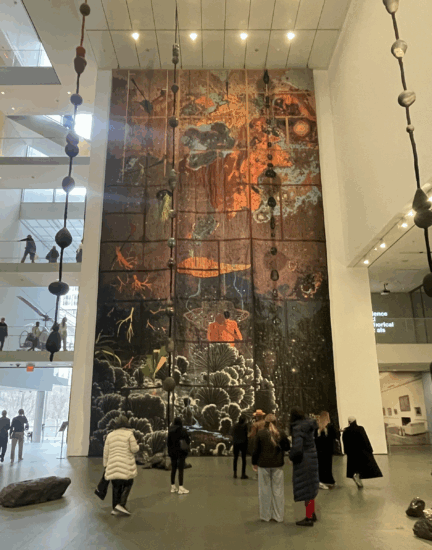
Artist Otobong Nkanga will be joined by six performers to activate Cadence installation on April 27 (photo by twi-ny/mdr)

Who: Otobong Nkanga and others
What: Installation activation
Where: Marron Family Atrium, MoMA, 11 West Fifty-Third St. between Fifth & Sixth Aves.
When: Sunday, April 27, free with museum admission, 10:30 am – 5:30 pm
Why: Describing her MoMA atrium commission Cadence, Nigeria-born, Belgium-based artist Otobong Nkanga notes, “Once I’d visited MoMA, I was interested in creating a tapestry work for the highest wall in the atrium, which would allow for a way of looking into the world from a different perspective. I wanted to create the notion of falling: a fall of things, a certain shift, a certain rhythm. The tapestry opens up to a more three-dimensional space, with sculptural pieces made of clay, smoked raku, and glass hanging from ropes and sitting on anthracite rocks, and a sound piece integrated in the sculpture that relates to the notion of teardrops, which is another kind of fall. . . . I wanted to make something that explores different rhythms of life. You might also feel that it’s a world that is beyond this one, like the universe somehow. It’s a mix of different worlds — from the underworld and the mining of minerals, to the surface and the soil, to the atmosphere and the heat of the sun, into outer space — all collapsing together in one place. That’s what creates the cadence of life. That’s what creates, actually, a world, because you cannot separate what is happening in the universe from what is happening underneath the soil in the core of the earth.”

On April 27 from 10:30 to 5:30, Nkanga and six other performers — Holland Andrews, Keishera, Muyassar Kurdi, Anaïs Maviel, Miss Olithea, and Samita Sinha, in costumes by Christian Joy — will activate the installation, incorporating sound and movement to interact with the piece. “What if a teardrop actually had a voice? What would it say? How would it say it? The work is really looking at that teardrop, and the emotions that go with it,” Nkanga says of the live performance, which is free with museum admission. Cadence is on view through July 27.

[Mark Rifkin is a Brooklyn-born, Manhattan-based writer and editor; you can follow him on Substack here.]
LILLIE P. BLISS AND BELLE DA COSTA GREENE: MAKING MoMA AND THE MORGAN

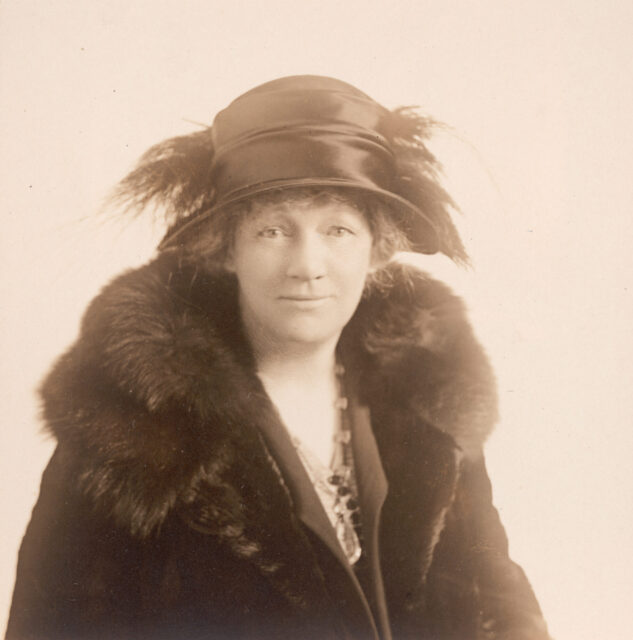
Lillie P. Bliss, seen here in a photo circa 1924, is subject of new MoMA exhibit (the Museum of Modern Art Archives, New York)

LILLIE P. BLISS AND THE BIRTH OF THE MODERN
MoMA, the Museum of Modern Art
11 West Fifty-Third St. between Fifth & Sixth Aves.
Through March 29, $17-$30
www.moma.org

“Dear Miss Bliss,” Bryson Burroughs, curator of paintings at the Metropolitan Museum of Art, began in a letter to Lillie Plummer Bliss upon her crucial support of the 1921 “Loan Exhibition of Impressionist and Post-Impressionist Art,” “I salute you as a benefactress of the human race!”

Born in Boston in 1864, Bliss cofounded the Museum of Modern Art in 1929 with Abby Aldrich Rockefeller and Mary Quinn Sullivan. She died in New York two years later, leaving her collection of approximately 120 works by late-nineteenth- and early-twentieth-century French artists to the institution, including paintings by Paul Cezanne, Pierre-Auguste Renoir, Edgar Degas, Georges Seurat, and Odilon Redon. She also encouraged the museum to sell pieces of her bequest as necessary to acquire other works, which led the museum to expand its collection with such masterpieces as Pablo Picasso’s Les Demoiselles d’Avignon and Vincent van Gogh’s The Starry Night.

Bliss is celebrated in the lovely MoMA exhibit “Lillie P. Bliss and the Birth of the Modern,” continuing through March 29. Organized by Ann Temkin and Romy Silver-Kohn, the show features such works as Cezanne’s The Bather, Seurat’s At the Concert Européen (Au Concert Européen), Marie Laurencin’s Girl’s Head, Amedeo Modigliani’s Anna Zborowska, Picasso’s Woman in White, and Henri Matisse’s Interior with a Violin Case.

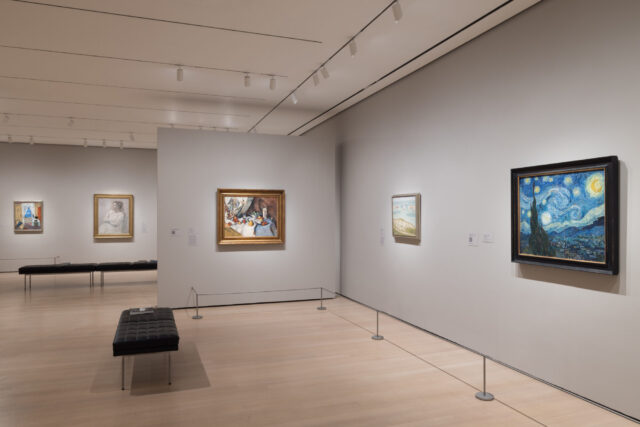
The centerpiece is The Starry Night, which, if you’re lucky, you will get to experience on your own, as it’s hanging in a different spot from its usual place, free of the usual mass of people in front of it, taking photos and videos, obstructing one another’s clear views and peaceful contemplation of one of the most famous canvases in the world.

Installation view, “Lillie P. Bliss and the Birth of the Modern” (photo by Emile Askey)

The show is supplemented with such ephemera as old catalogs, acquisition notices, pages from scrapbooks, photos of Bliss as a child, and a few rare letters, as Bliss requested that all her personal papers be destroyed shortly before her death in 1931 at the age of sixty-six. One key letter she sent to a National Academician is quoted in the MoMA book Inventing the Modern: Untold Stories of the Women Who Shaped The Museum of Modern Art, in which Bliss writes: “We are not so far apart as you seem to think in our ideas on art, for I yield to no one in my love, reverence, and admiration for the beautiful things which have already been created in painting, sculpture, and music. But you are an artist, absorbed in your own production, with scant leisure and inclination to examine patiently and judge fairly the work of the hosts of revolutionists, innovators, and modernists in this widespread movement through the whole domain of art or to discriminate between what is false and bad and what is sometimes crude, perhaps, but full of power and promise for the enrichment of the art which the majority of them serve with a devotion as pure and honest as your own. There are not yet many great men among them, but great men are scarce — even among academicians. The truth is you older men seem intolerant and supercilious, a state of mind incomprehensible to a philosopher who looks on and enjoys watching for and finding the new men in music, painting, and literature who have something to say worth saying and claim for themselves only the freedom to express it in their own way.”

Bliss did it her own way as well.

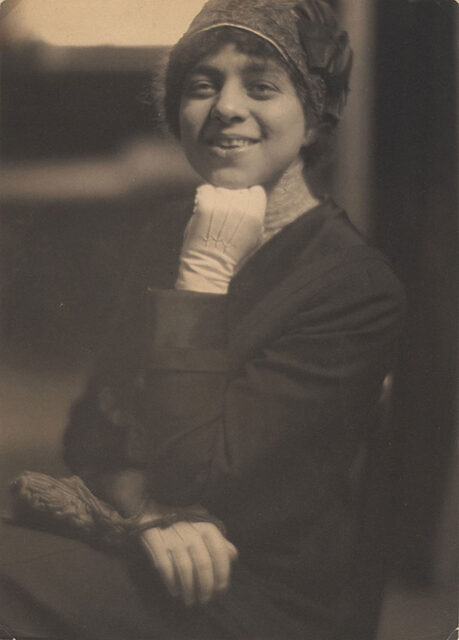
Clarence H. White, Belle da Costa Greene, platinum print, 1911 (courtesy the Clarence H. White Collection)

BELLE DA COSTA GREENE: A LIBRARIAN’S LEGACY
Morgan Library & Museum
225 Madison Ave. at 36th St.
Tuesday – Sunday through May 4, $13-$25
www.themorgan.org

“My friends in England suggest that I be called ‘Keeper of Printed Books and Manuscripts,’” Belle da Costa Greene told the New York Times in 1912. “But you know they have such long titles in London. I’m simply a librarian.”

Born Belle Marion Greener in 1879 in Washington, DC, Greene became the first director of the Morgan Library, specializing in the acquisition of rare books and manuscripts, a Black woman passing for white in a field dominated by men. Prior to her death in New York City in 1950 at the age of seventy, she destroyed all her diaries and private papers, but her correspondence with others paints a picture of an extraordinary woman breaking barriers personally and professionally as she came to be known as “the soul of the Morgan Library.”

Curated by Philip S. Palmer and Erica Ciallela, “Belle da Costa Greene: A Librarian’s Legacy” consists of nearly two hundred items, from letters, photographs, yearbooks, and board minutes to illuminated manuscripts, jewelry, furniture, and books by Charles Dickens, Oscar Wilde, Elizabeth Barrett Browning, William Butler Yeats, and Dante Alighieri in addition to canvases by Archibald J. Motley Jr., Rembrandt Harmenszoon van Rijn, Ḥabīb-Allāh Mashhadī, Albrecht Dürer, Henri Matisse, Jacques Louis David, and Thomas Gainsborough. Greene’s early holy grail was Thomas Malory’s Le Morte d’Arthur; she was prepared to pay up to $100,000 for the work, printed by William Caxton in 1485, but won it for $42,000 at a 1911 auction.

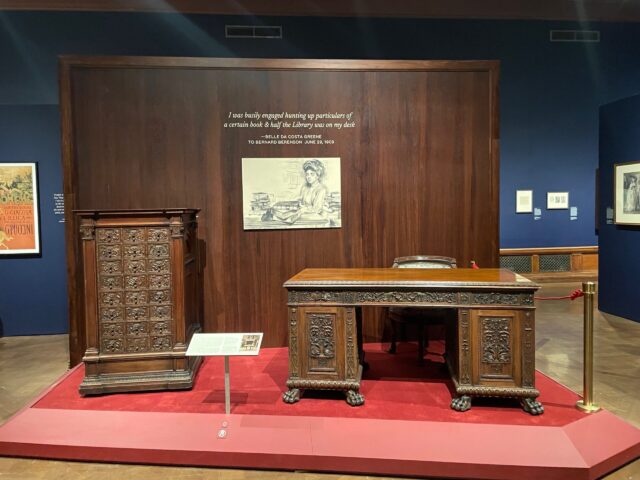
Re-creation of Belle da Costa Greene’s office is centerpiece of Morgan exhibit (photo by twi-ny/mdr)

Just as MoMA would not be what it is today without Lillie P. Bliss, the Morgan would not be the same without Greene. While at Princeton, she became friends with Morgan’s nephew Junius Spencer Morgan, who collected rare books and who recommended Greene to his uncle; J. P. Morgan hired her as a librarian in 1905, and she was appointed director in 1924. Her starting salary was $75 a month, but she was earning $10,000 a year by 1911.

The show is divided into sixteen sections, from “A Family Identity,” “An Empowering Education,” and “Questioning the Color Line” to “A Life of Her Own: Collector and Socialite,” “A Life of Her Own: Philanthropy and Politics,” and “Black Librarianship.” It details Greene’s childhood, her successful parents, her education, and her friendship with art historians Bernard and Mary Berenson; Greene had a long-term affair with Bernard, who had an open marriage with his wife. Following Morgan’s death in 1913, Greene worked closely with J.P.’s son, Jack, to expand the institution’s holdings. The centerpiece is a re-creation of Greene’s office, with her desk, swivel chair, and card catalog cabinet, all made by Cowtan & Sons, accompanied by a quote from a letter she wrote to Bernard in 1909: “I was busily engaged hunting up particulars of a certain book & half the Library was on my desk.”

One of the most heart-wrenching parts of the exhibit explores her relationship with her nephew and adopted son, Robert MacKenzie Leveridge, who died tragically in WWII.

The Morgan show is supplemented by three online sites that offer further information about Greene’s life and career: “Telling the Story of Belle da Costa Greene,” “Belle da Costa Greene and the Women of the Morgan,” and “Belle da Costa Greene’s Letters to Bernard Berenson.”

At the heart of it all is Greene’s dedication to her work. As she also told the Times in 1912, “I just have to accomplish what I set out to do, regardless of who or what is in my way.”

Like Bliss, Greene accomplished all that and more, in her own way.

[Mark Rifkin is a Brooklyn-born, Manhattan-based writer and editor; you can follow him on Substack here.]
GONE FISHING: ROB TREGENZA BRINGS UNIQUE WWII DRAMA TO MoMA

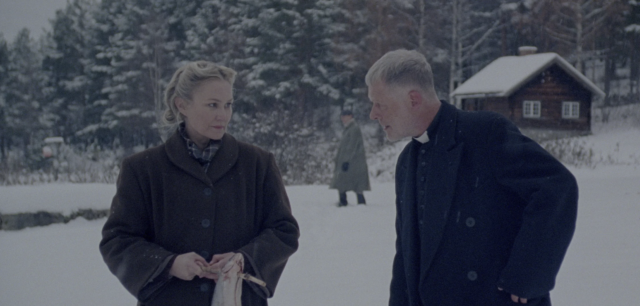
Anna Kristiansen (Ellen Dorrit Petersen) and Adam Honderich (Andreas Lust) are caught up in WWII intrigue in Rob Tregenza’s The Fishing Place (courtesy Cinema Parallel)

THE FISHING PLACE (Rob Tregenza, 2024)
MoMA, the Museum of Modern Art
The Debra and Leon Black Family Film Center
11 West Fifty-Third St. between Fifth & Sixth Aves.
February 6-12
www.moma.org

Rob Tregenza’s The Fishing Place is a tour de force of filmmaking, and the writer-director isn’t shy about making sure the audience knows it. The movie, divided into three sections that Tregenza refers to as “flows,” opens with a shot of a boat out at sea, shown in the negative, a ghostly white in a gray, gloomy seascape that slowly reverses into color over Earecka Tregenza and Jason Moody’s melancholic score. We are then introduced to the three protagonists via superimpositions and fades that point toward memory, as well as through mysterious, virtually impossible camera movements forward.

It’s 1945 in a small Norwegian town, and Anna Kristiansen (Ellen Dorrit Petersen) is a Nazi prisoner working as a housekeeper for Klaus (Eindride Eidsvold), a wealthy collaborator. Adam Honderich (Andreas Lust) is a newly arrived German Lutheran priest. Nazi officer Aksel Hansen (Frode Winther) orders Anna to work for Honderich for three days and spy on him, as it’s suspected that the priest is part of the resistance.

Anna becomes the focus in a stunning six-and-a-half-minute scene at a small party being thrown by Klaus for Aksel; Anna works with the cook (Lena Barth-Aarstad) and a maid (Ingvild Holthe Bygdnes), serving Klaus and Aksel in addition to Willie (Peder Herlofsen), a young man who would rather be reading his book; a man (Jonas Strand Gravli) trying to convince Klaus to invest in his electronic gadgets; the elegant, wheelchair-bound Margit (Gjertrud L. Jynge) and her doctor (Ola Otnes); among others. It’s intense and almost interminably slow-paced; every sound — a footstep, a glass being put on a tray, background music — feels as if we’re on a precipice, every element desperate to break free. The stunning sound design, also highlighted by boots in the snow, a crackling fire, and gunshots, is by Øyvind Rydland.

Soon after the party, Anna finds a frightened child named Ada (Ella Maren Alfsvåg Jørgensen) hiding out in a shack on Honderich’s property. Later, a local man visits Honderich, bringing him a fish that seems to be more of a threat than a gift, and comments on his priestly dress. Honderich says, “Unfortunately, I didn’t have much choice.” The man responds in an ominous tone, “We all have a choice, don’t we?”

Margit makes a surprising confession to the priest. The doctor takes Anna for a ride in his automobile and shares his suspicions of who she is and what she is doing there. In his church, which bursts with colors that stand out in the otherwise bleak but beautiful snowy winter landscape, Honderich suddenly is filled with fire and brimstone. As the camera circles an old fishing boat where Honderich and Aksel have cast out their lines, the colors morph into a hellish red. “Are you happy with yourself?” the priest asks. The Nazi officer replies, “No. And you know it.”

In another dazzling sequence, the camera goes down a horizontal row of characters who one at a time share brief thoughts and then appear again at the other end, with no cuts. “Don’t look back,” the priest prophetically warns us.

Later, after a fadeout, we can hear talking behind-the-scenes as a scene is readied; a man claps the slate and we see the cast and crew in action in a virtuosic twenty-minute crane shot that starts with indoor close-ups before heading outside and almost flying away. Tregenza is the cinematographer, but camera operators Pål Bugge Haagenrud and Art Eng deserve huge kudos, as does editor Elise Olavsen.

Kansas native Tregenza (Talking to Strangers, Gavagai) mixes in a little Ingmar Bergman and Jean-Luc Godard in The Fishing Place, which was partly inspired by the work of philosophers Henri Bergson and Gilles Deleuze. “The self is only a threshold, a door, a becoming between two multiplicities,” the latter wrote in A Thousand Plateaus: Capitalism and Schizophrenia, as well as “Bring something incomprehensible into the world!”

The Fishing Place is making its North American theatrical premiere February 6–12 at MoMA; Tregenza will be at the museum for a Q&A following the 6:30 show on opening night.

[Mark Rifkin is a Brooklyn-born, Manhattan-based writer and editor; you can follow him on Substack here.]
TIME KEEPS ON TICKING, TICKING, TICKING . . . INTO THE FUTURE — AND THE PAST — AT MoMA

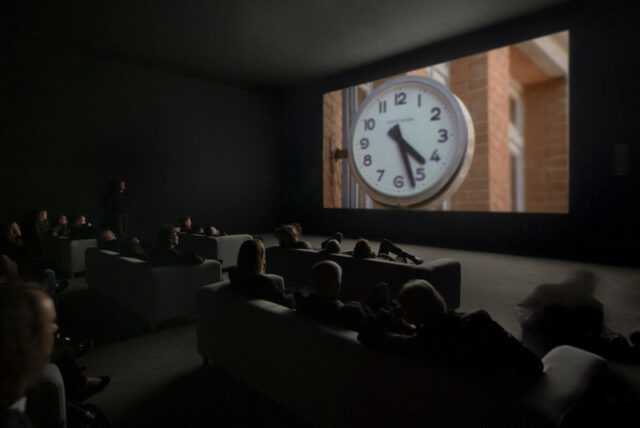
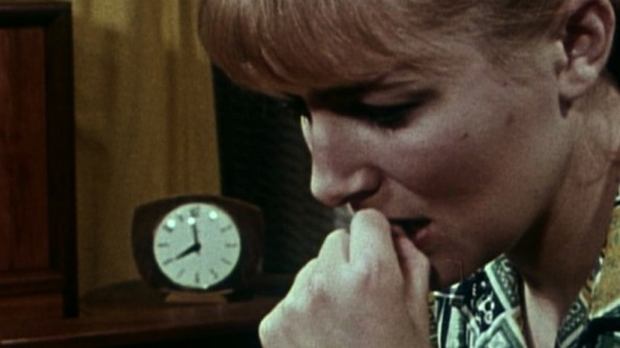
Christian Marclay’s twenty-four-hour masterpiece, The Clock, unfolds in real time (photo courtesy Paula Cooper Gallery and White Cube)

CHRISTIAN MARCLAY: THE CLOCK
MoMA, the Museum of Modern Art
11 West Fifty-Third St. between Fifth & Sixth Aves.
Through February 17, $17-$30
www.moma.org

In 2010, the Whitney presented “Festival,” a thrilling interactive retrospective of the work of Christian Marclay, featuring multiple multimedia site-specific installations and live performances. The New York–based multidisciplinary artist followed that up with a supreme work of utter brilliance, the captivating twenty-four-hour video The Clock, which premiered at White Cube in London, then won the Golden Lion at the Venice Biennale. Over the years in New York it has screened at the Paula Cooper Gallery, the David Rubenstein Atrium at Lincoln Center, and in 2012–13 at the Museum of Modern Art; it is now back at MoMA, where this must-see experience will be on view through February 19. “I can’t believe a decade has gone by since The Clock was last shown at MoMA,” Marclay said in a statement. “We’ve all aged except the actors on the screen, who never age. They may die but on the screen they live forever.”

Time is of the essence in Christian Marclay’s dazzling film The Clock (photo courtesy Paula Cooper Gallery and White Cube)

The film, always presented in a large, dark space with roomy, comfortable seats, unfolds in real time, composed of approximately twelve thousand clips from movies and television that feature all kinds of timepieces showing the minutes ticking away. Masterfully edited so that it creates its own fluid narrative, The Clock seamlessly cuts from romantic comedies with birds emerging from cuckoo clocks to action films in which protagonists synchronize their watches, from thrillers with characters battling it out in clock towers to dramas with convicted murderers facing execution and sci-fi programs with mad masterminds attempting to freeze time. Marclay mixes in iconic images with excerpts from little-known foreign works so audiences are kept on the edge of their seats, wondering what will come next, laughing knowingly at recognizable scenes and gawking at strange, unfamiliar bits.

Christian Marclay’s The Clock premiered at White Cube Mason’s Yard in London in 2010 (photo by Todd-White Photography)

Part of the beauty of The Clock is that while time is often central to many of the clips, it is merely incidental in others, someone casually checking their watch or a clock visible in the background, emphasizing how pervasive time is — both on-screen and in real life. Americans spend an enormous amount of time watching movies and television — and now addictively glued to social media platforms and videos on their phones — so The Clock is also a wry though loving commentary on what we choose to do with our leisure time as well.

The Clock is open during MoMA’s regular hours, with members getting priority. It is not necessarily meant to be viewed in one massive gulp, but it will be shown in its entirety on December 21 at 7:00, in conjunction with the Winter Solstice, and again on New Year’s Eve; ticketing will be announced soon. Since the film corresponds to the actual time, midnight should offer some fascinating moments, although you might be surprised how exciting even three o’clock in the morning can be. Expect huge crowds whenever you go — capacity is limited, on a first-come, first-served basis, and you can stay as long as you want — so be prepared to do something with all that valuable time spent on the digital line. But wait you should — it’s well worth every second.

[Mark Rifkin is a Brooklyn-born, Manhattan-based writer and editor; you can follow him on Substack here.]
PAULA MODERSOHN-BECKER: ICH BIN ICH / I AM ME

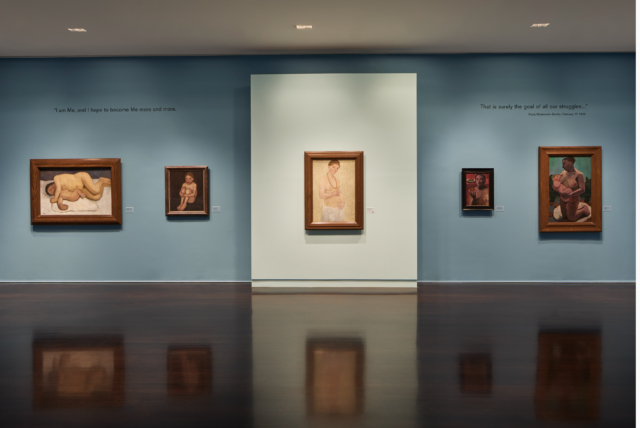
“Paula Modersohn-Becker: Ich bin Ich / I Am Me” is an intimate look at motherhood and identity (photo by Annie Schlechter / courtesy Neue Galerie New York)

ICH BIN ICH / I AM ME
Neue Galerie New York
1048 Fifth Ave. at 86th St.
Wednesday – Sunday through September 9, $15-$28
www.neuegalerie.org

Two of the most powerful shows of the year have featured works primarily about motherhood by two extraordinary, lesser-known artists. In the simply titled “Käthe Kollwitz” at MoMA, paintings, drawings, and sculptures by the Prussian-born artist (1867–1945) focused on motherhood, the female body, and death, with haunting self-portraits, heavily influenced by the loss of one of her sons in WWI.

In “Paula Modersohn-Becker: Ich Bin Ich / I Am Me,” at Neue Galerie through September 9, paintings and drawings by the German artist (1876–1907) center around pregnancy, the female body, and birth, along with what are believed to be the first nude self-portraits by a woman. Tragically, Modersohn-Becker, whose uncle had tried to assassinate King Wilhelm of Prussia in 1861, died at the age of thirty-one of a postpartum embolism, her infant daughter, Mathilde, in her arms, leaving behind a legacy of more than seven hundred paintings and fourteen hundred drawings.

The wonderfully curated exhibition by Jill Lloyd and Jay Clarke includes several quotes from Modersohn-Becker that puts her work in context. “I am more and more convinced that intimacy is the soul of all great art,” she wrote in 1903. In a letter to her close friend Rainer Maria Rilke, she explained, “And now I don’t know how to sign my name. I am not Modersohn and I am not Paula Becker anymore, I am Me, and hope to become that more and more.”

Among the highlights are Self-Portrait with Two Flowers in Her Raised Left Hand, Kneeling Girl with Stork, Girl Blowing a Flute in the Birch Forest, Otto Modersohn Sleeping, and Self-Portrait on Sixth Wedding (Anniversary) Day, the last one depicting the artist topless, a long necklace dangling between her breasts, her right hand above her pregnant belly, her left hand below, as she knowingly looks directly at the viewer.

“I was always very keen to establish Paula Modersohn-Becker’s place in the canons of art history because I think she richly deserves it,” Lloyd says in the above video tour. “We go with her on a kind of journey towards finding herself as an artist, finding herself as a woman, and finding herself as a human being.”

Modersohn-Becker richly deserves this first American museum retrospective, a journey that confirms her status as a key figure in German Expressionism and beyond.

[Mark Rifkin is a Brooklyn-born, Manhattan-based writer and editor; you can follow him on Substack here.]
KÄTHE KOLLWITZ

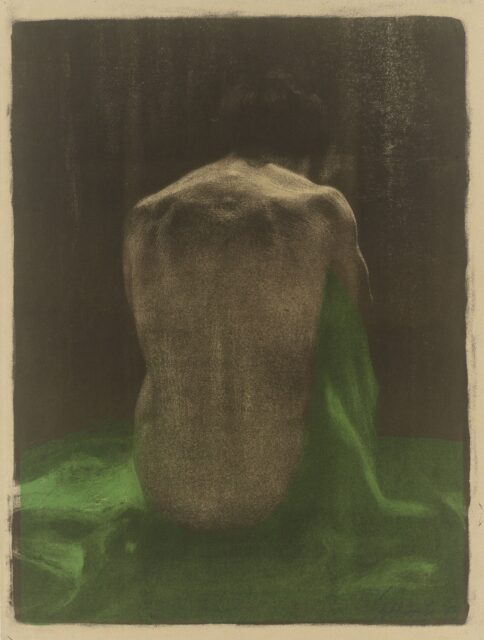
Käthe Kollwitz, Female Nude, from Behind, on Green Cloth (Weiblicher Rückenakt auf grünem Tuch), crayon and brush lithograph with scraping needle, printed in two colors on brown paper, 1903 (Kupferstich-Kabinett, Staatliche Kunstsammlungen Dresden / © Kupferstich-Kabinett, Staatliche Kunstsammlungen Dresden / photo by Herbert Boswank)

KÄTHE KOLLWITZ
MoMA, the Edward Steichen Galleries, third floor south
11 West Fifty-Third St. between Fifth & Sixth Aves.
Through July 20, $17-$30
www.moma.org

“My art serves a purpose. I want to exert an influence in my own time, in which human beings are so helpless and destitute,” artist Käthe Kollwitz said. The depiction of the helpless and destitute were central to Kollwitz, who was born in Prussia in 1867, spent almost fifty years based in Berlin, and died in Saxony in 1945, experiencing two world wars and a global depression. Kollwitz’s dark world view is on display in the poignant and powerful MoMA exhibition simply titled “Käthe Kollwitz,” consisting of approximately 120 prints, drawings, and sculptures that envelop museumgoers in a haunting atmosphere.

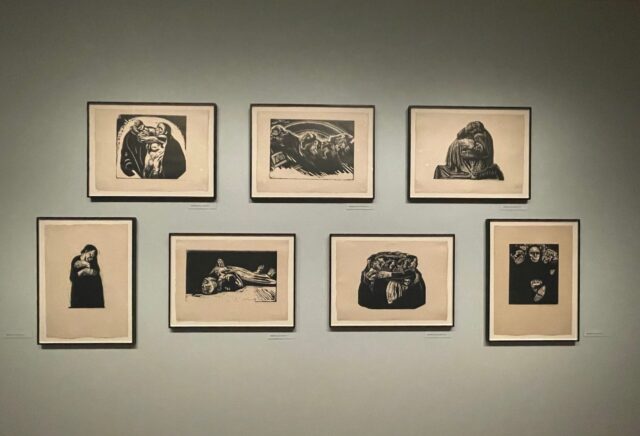
Käthe Kollwitz, War (Krieg), portfolio of seven woodcuts, 1922 (the Museum of Modern Art, New York / Gift of the Arnhold Family in memory of Sigrid Edwards / photo by twi-ny/mdr)

Divided into six sections, “Asserting Herself,” “Forging an Art of Social Purpose,” “Her Creative Process,” “Love and Grief,” “War and Its Aftermath,” and “Maternal Protection,” the show focuses on the struggles of the working class and mothers’ desperate attempts to safeguard their children. Kollwitz was married to a doctor who cared for the poor; they had two sons, one a soldier who was killed during WWI. Using charcoal, black ink, crayon, graphite, and chalk along with etchings, bronzes, woodcuts, and lithographs, she rendered the horrors of the “Peasants’ War,” unemployment, sacrifice, lamentation, and death. The titles alone tell only part of the story: Call of Death, Storming the Gate — Attack, The Downtrodden, Dance around the Guillotine, Death Seizes the Children, and multiple versions of Woman with Dead Child. Even works called Uprising, Charge, Inspiration, Love Scene, The Lovers, and The Survivors are bleak and ghostly.

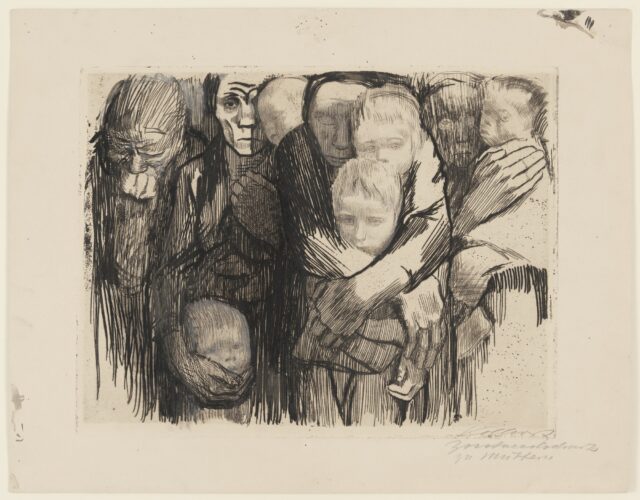
In the large bronze sculpture Mother with Two Children, a woman clutches her two kids as if in the midst of terrible danger. In The People, skeletal faces are barely visible in the blackness. In Home Worker, Asleep at the Table, a woman has draped her head on a table, overwhelmed with exhaustion, looking as if she never wants to get up again. In Love Scene I, a man and a woman hold tight to each other as if barely clinging to life. In The Mothers, a group of women are huddled in a circle, forming a kind of human shield. And in self-portraits dating from 1890 to 1934, Kollwitz looks directly at the viewer in an almost accusatory manner, demanding we take action; the portraits continue until she is old and forlorn, as if it’s too late.

Käthe Kollwitz, The Mothers (Mütter), line etching, sandpaper, needle bundle, and soft ground with the imprint of laid paper overworked with black ink, opaque white, charcoal, and pencil, 1918 (collection Ute Kahl, Cologne. Fuis Photographie)

“I have no right to withdraw from the responsibility of being an advocate,” Kollwitz wrote. “It is my duty to voice the sufferings of men, the never-ending sufferings heaped mountain-high.”

This stunning exhibition captures all that and more — and, sadly, serves today as a frightening warning.

[Mark Rifkin is a Brooklyn-born, Manhattan-based writer and editor; you can follow him on Substack here.]