Tag Archives: Michel Piccoli

CARAX: HOLY MOTORS

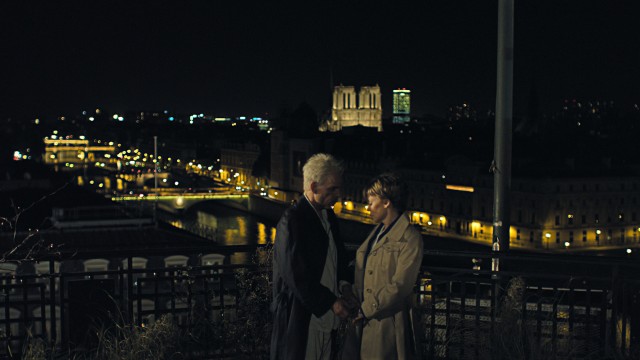
Léos Carax’s HOLY MOTORS is a dazzling tribute to Paris, cinema, and the art of storytelling

Léos Carax’s HOLY MOTORS is a dazzling tribute to Paris, cinema, and the art of storytelling

HOLY MOTORS (Léos Carax, 2012)
Film Forum
209 West Houston St.
August 15, 18, 21
Series runs August 15-21
212-727-8110
www.filmforum.org
www.holymotorsfilm.com

French writer-director Léos Carax (Boy Meets Girl, Mauvais Sang) has made only five feature films in his thirty-plus-year career, a sadly low output for such an innovative, talented director, but in 2012 he gave birth to his masterpiece, the endlessly intriguing, confusing, and exhilarating Holy Motors. His first film since 1999’s POLA X, the new work is a surreal tale of character and identity, spreading across multiple genres in a series of bizarre, entertaining, and often indecipherable set pieces. Holy Motors opens with Carax himself playing le Dormeur, a man who wakes up and walks through a hidden door in his room and into a movie theater where a packed house, watching King Vidor’s The Crowd, is fast asleep. The focus soon shifts to Carax alter ego Denis Lavant as Monsieur Oscar, a curious character who is being chauffeured around Paris in a white stretch limo driven by the elegant Céline (Édith Scob). Oscar has a list of assignments for the day that involve his putting on elaborate costumes — including revisiting his sewer character from Merde, Carax’s contribution to the 2009 omnibus Tokyo! that also included shorts by Michel Gondry and Bon Joon-ho — and becoming immersed in scenes that might or might not be staged, blurring the lines between fiction and reality within, of course, a completely fictional world to begin with. It is as if each scene is a separate little movie, and indeed, Carax, whose middle name is Oscar, has said that he made Holy Motors after several other projects fell through, so perhaps he has melded many of those ideas into this fabulously abstruse tale that constantly reinvents itself. The film is also a loving tribute to Paris, the cinema, and the art of storytelling, with direct and indirect references to Franz Kafka, E. T. A. Hoffman, Charlie Chaplin, Lon Chaney, Eadweard Muybridge, Georges Franju, and others. (Scob, who starred in Franju’s Eyes Without a Face, at one point even pulls out a mask similar to the one she wore in that classic thriller.) The outstanding cast also features Kylie Minogue, who does indeed get to sing; Eva Mendes as a robotic model; and Michel Piccoli as the mysterious Man with the Birthmark. Holy Motors is screening August 15, 18, and 21 at Film Forum in conjunction with the U.S. theatrical release of Tessa Louise-Salomé’s 2014 documentary, Mr. X: A Vision of Leos Carax; the week-long tribute to Carax includes the documentary as well as Carax’s other feature films, Pola X, Les Amants du Pont Neuf, and Mauvais Sang. (A restored version of Boy Meets Girl played Film Forum August 8-14.)
BUÑUEL: BELLE DE JOUR

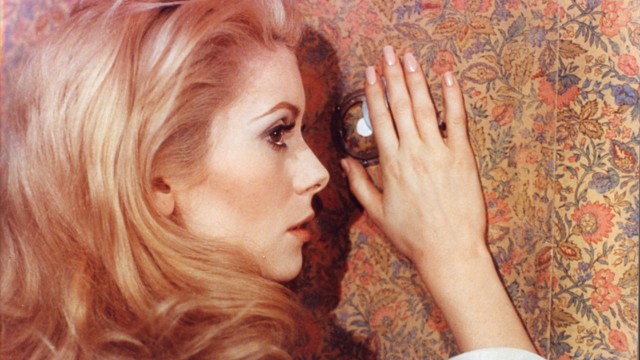
Catherine Deneuve can’t believe what she sees at first in BELLE DE JOUR

Catherine Deneuve can’t believe what she sees at first in BELLE DE JOUR

BELLE DE JOUR (Luis Buñuel, 1967)
BAMcinématek, BAM Rose Cinemas
30 Lafayette Ave. between Ashland Pl. & St. Felix St.
August 1-3, $14
Series runs through August 14
718-636-4100
www.bam.org

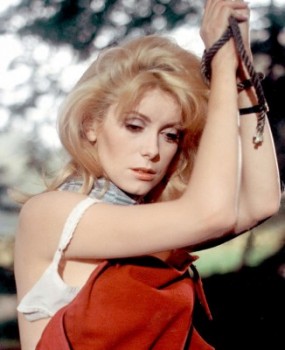
Luis Buñuel’s alluringly psychosexual masterpiece Belle de Jour caused a sensation when it was released in 1967 because of its heavy dose of sadomasochism mixed with tender love, and with good reason. The film stars the always elegant Catherine Deneuve as Séverine Serizy, a bored housewife who deeply loves her husband, Dr. Pierre Serizy (Jean Sorel), despite their nearly nonexistent sex life; they even sleep in separate beds in the same room. The twenty-three-year-old blonde beauty has intense daydreams of being tortured and raped, the lasting effects of perhaps having been abused as a child, so when she learns of a high-class Paris brothel, she decides to investigate, tantalized by the exciting possibilities. Soon she is known as Belle de jour, “lady of the afternoon,” as men come to lie down with her in the middle of the day, leaving her enough time to get home for her workaholic husband. At first Séverine is terrified of the job, but she is calmed down by Madame Anaïs (Geneviève Page) and eventually finds herself enjoying these secret trysts, so much so that the money doesn’t even matter, only the sensual pleasure she experiences. But when one of her clients, the unpredictable and dangerous thief Marcel (Pierre Clémenti), starts falling for her, her life turns more complicated than she’s ever imagined in all her dark yet playful fantasies.

A bored housewife (Catherine Deneuve) dreams of a very different sex life in BELLE DE JOUR

A bored housewife (Catherine Deneuve) dreams of a very different sex life in BELLE DE JOUR

Based on the 1928 novel by Joseph Kessel, whose L’armée des ombres was turned into Jean-Pierre Melville’s 1969 French Resistance drama Army of Shadows, Belle de Jour features a sizzling yet subdued performance by Deneuve, who would go on to star in Buñuel’s Tristana, which echoes this film in many ways (as does Roman Polanski’s Repulsion). Deneuve, wonderfully clad in Yves Saint Laurent, goes from hot to cold in an instant, her eyes regularly lost in faraway thought, distant and forlorn. Buñuel comments on class and society not only through Séverine and Pierre’s relationship but through several bordello customers with very specific fetishes, including Michel Piccoli as supposed ladies’ man Henri Husson, a role he reprised in Manoel de Oliveira’s ill-advised 2006 sequel, Belle Toujours. Buñuel won the Golden Lion at the Venice Film Festival for his erotically charged story that features a shocking surprise ending that offers new insights upon repeat viewings. Belle de Jour is screening August 1-3 as part of BAMcinématek’s five-week tribute to the master filmmaker, who passed away in 1983 at the age of eighty-three. The series continues through August 14 with such other Buñuel works as Diary of a Chambermaid, Mexican Bus Ride, The Great Madcap, That Obscure Object of Desire, The River and Death, and the superb twin pairing of The Exterminating Angel and Simon of the Desert.

REMASTERED AND RESTORED — TREASURES OF FRENCH CINEMA: UNE CHAMBRE EN VILLE

dark but colorful French musical

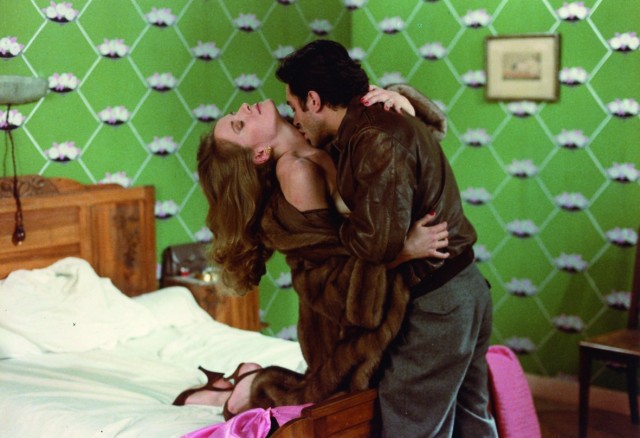
Edith (Dominique Sanda) and François (Richard Berry) find each other in Jacques Demy’s dark but colorful French musical

CINÉSALON: UNE CHAMBRE EN VILLE (A ROOM IN TOWN) (Jacques Demy, 1982)
French Institute Alliance Française, Florence Gould Hall
55 East 59th St. between Madison & Park Aves.
Tuesday, February 11, $13, 4:00 & 7:30
212-355-6100
www.fiaf.org

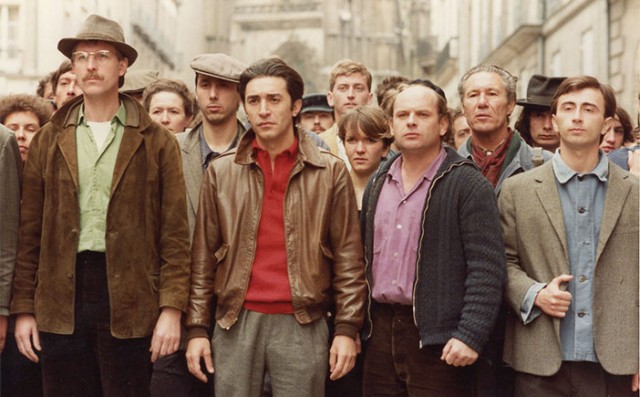
From the very opening of Une Chambre en Ville (A Room in Town), French New Wave director Jacques Demy announces that the 1982 musical melodrama is going to be something a little different. As a rising sun changes color over a construction site across the Loire River, what appear to be closing credits run up the screen, set to Michel Colombier’s romantic score, as if the film is ending. But Demy and cinematographer Jean Penzer are only getting started, shifting from black-and-white to color to black-and-white again as they cut to the hard streets of 1955 Nantes, where a shipyard strike is under way. Riot police are in a stand-off with hundreds of male and female strikers, characters on both sides singing instead of talking and shouting — in a scene that eerily evokes Tom Hooper’s Les Misérables, which came thirty years later. Soon the intricate plot unfolds, as the striking, and broke, François Guilbaud (Richard Berry), who is renting a room from former baroness Margot Langlois (Danielle Darrieux) and dating doe-eyed Violette Pelletier (Fabienne Guyon), instantly falls for femme fatale Edith Leroyer (Dominique Sanda), Mme. Langlois’s recently married daughter, who is already fed up with her impotent cheapskate of a husband, television salesman Edmond Leroyer (Michel Piccoli). The over-the-top drama plays out in wonderfully garish rooms of deep, intoxicating colors, which are echoed by Rosalie Varda’s (daughter of Demy and Agnès Varda) costumes, which even go so far as to have Violette wearing violet and Edith going bare beneath her luxurious fur coat, with no one changing clothes over the course of the two days in which the story takes place. As the strike continues, the main characters connect with one another in good and bad ways, especially when straight razors and guns are involved.

Striking workers are ready to fight the power in Jacques Demys UNE CHAMBRE EN VILLE

Striking workers are ready to fight for their rights in Jacques Demy’s UNE CHAMBRE EN VILLE

Writer-director Demy, who transformed the movie musical in the 1960s with The Umbrellas of Cherbourg and The Young Girls of Rochefort (the latter also featuring Darrieux), includes no Hollywood-like set pieces in Une Chambre en Ville, no dancing, no choruses — essentially, no real songs at all. Instead, all of the dialogue is sung by the actors (or dubbed in by someone else) as if in regular conversation. Inspired by a real shipyard strike in his hometown of Nantes in 1955, Demy takes on such concepts as wealth, class, authority, home, family, and, most of all, love — both real and imagined, unrequited and lustful — in the vastly underrated film, which is quite entertaining and very funny despite its dark themes. And be on the lookout for more echoes of Les Misérables throughout. A new digital restoration of Une Chambre en Ville is screening February 11 at 4:00 & 7:30 as part of the FIAF CinéSalon series “Remastered & Restored: Treasures of French Cinema”; the later screening will be presented by New Yorker writer Adam Gopnik, and both shows will be followed by a wine reception. The three-month festival continues with such other recently restored French classics as Max Ophüls’s Lola Montès (introduced by Lola Montes Schnabel), Claude Chabrol’s The Color of Lies (costar Jacques Gamblin will no longer introduce the film), and Jean-Pierre Melville’s Two Men in Manhattan.

CONTEMPT

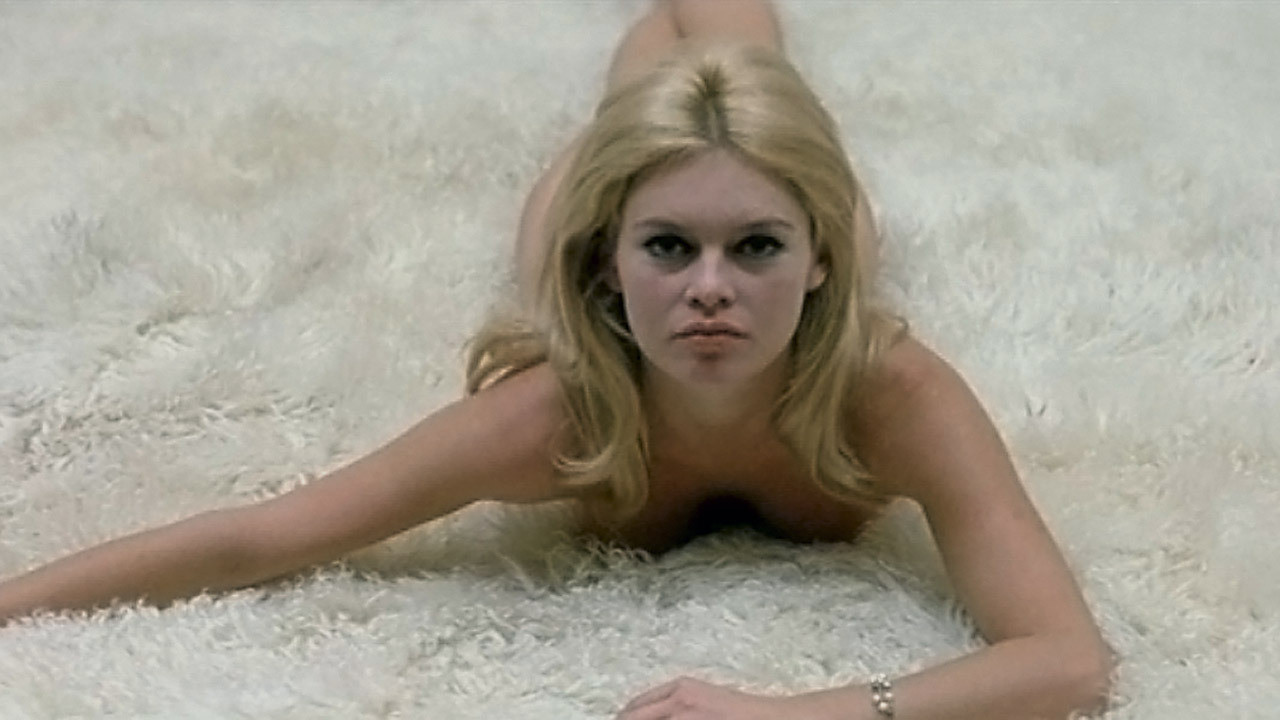
Brigitte Bardot shows off both her acting talent and beautiful body in Jean-Luc Godard’s CONTEMPT

CONTEMPT (LE MEPRIS) (Jean-Luc Godard, 1963)
Film Forum
209 West Houston St.
September 6-19
Series runs through September 5
212-727-8110
www.filmforum.org

French auteur Jean-Luc Godard doesn’t hold back any of his contempt for Hollywood cinema in his multilayered masterpiece Contempt, which is being shown September 6-19 in a fiftieth-anniversary restoration at Film Forum. Loosely based on Alberto Moravia’s Il Disprezzo, Contempt stars Michel Piccoli as Paul Javal, a French screenwriter called to Rome’s famed Cinecittà studios by American producer Jeremy Prokosch (Jack Palance ) to perform rewrites on Austrian director Fritz Lang’s (played by Lang himself) adaptation of The Odyssey by ancient Greek writer Homer. Paul brings along his young wife, the beautiful Camille (Brigitte Bardot), whom Prokosch takes an immediate liking to. With so many languages being spoken, Prokosch’s assistant, Francesca Vanini (Giorgia Moll), serves as translator, but getting the various characters to communicate with one another and say precisely what is on their mind grows more and more difficult as the story continues and Camille and Paul’s love starts to crumble. Contempt is a spectacularly made film, bathed in deep red, white, and blue, as Godard and cinematographer Raoul Coutard poke fun at the American way of life. (Both Godard and Coutard appear in the film, the former as Lang’s assistant director, the latter as Lang’s cameraman — as well as the cameraman who aims the lens right at the viewer at the start of the film.)

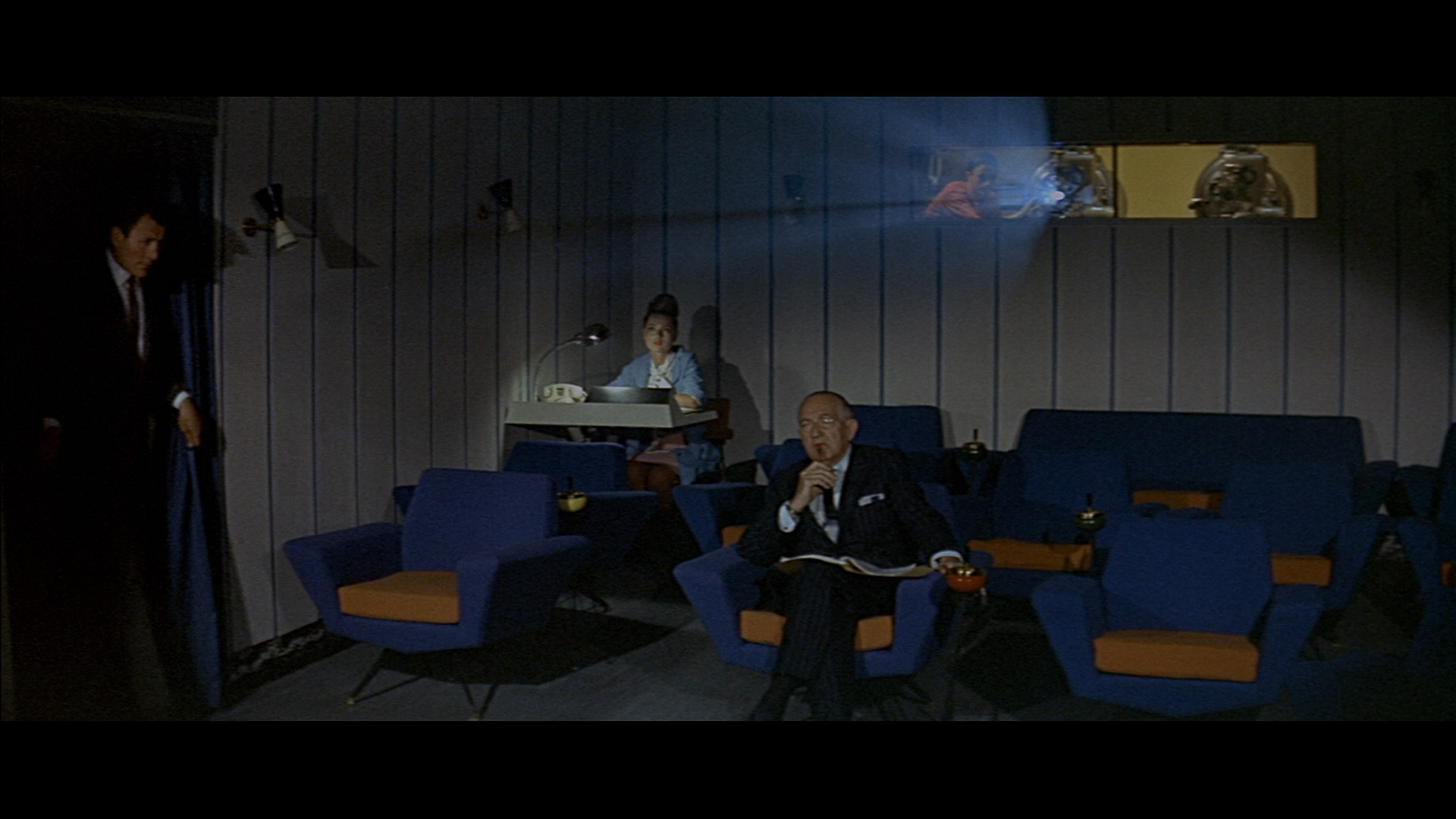
Producer Jeremy Prokosch (Jack Palance) doesn’t always have the kindest of words for director Fritz Lang in CONTEMPT

Bardot is sensational in one of her best roles, whether teasing Paul at a marvelously filmed sequence in their Rome apartment (watch for him opening and stepping through a door without any glass), lying naked on the bed, asking Paul what he thinks of various parts of her body (while Coutard changes the filter from a lurid red to a lush blue), or pouting when it appears that Paul is willing to pimp her out in order to get the writing job. Palance is a hoot as the big-time producer, regularly reading fortune-cookie-like quotes from an extremely little red book he carries around that couldn’t possibly hold so many words. And Lang, who left Germany in the mid-1930s for a career in Hollywood, has a ball playing a version of himself, an experienced veteran willing to put up with Prokosch’s crazy demands. Vastly entertaining from start to finish, Contempt is filled with a slew of inside jokes about the filmmaking industry and even Godard’s personal and professional life, along with some of the French director’s expected assortment of political statements and a string of small flourishes that are easy to miss but add to the immense fun, all set to a gorgeous romantic score by Georges Delerue.

AUTO-CINEMA: HOLY MOTORS

Léos Carax’s HOLY MOTORS is a dazzling tribute to Paris, cinema, and the art of storytelling

Léos Carax’s HOLY MOTORS is a dazzling tribute to Paris, cinema, and the art of storytelling

HOLY MOTORS (Léos Carax, 2012)
Anthology Film Archives
32 Second Ave. at Second St.
Saturday, June 22, 4:30, and Monday, June 24, 6:45
212-505-5181
www.anthologyfilmarchives.org
www.holymotorsfilm.com

French writer-director Léos Carax (Boy Meets Girl, Mauvais Sang) has made only five feature films in his thirty-plus-year career, a sadly low output for such an innovative, talented director, but he has now given birth to his masterpiece, the endlessly intriguing, confusing, and exhilarating Holy Motors. His first film since 1999’s POLA X, the new work is a surreal tale of character and identity, spreading across multiple genres in a series of bizarre, entertaining, and often indecipherable set pieces. Holy Motors opens with Carax himself playing le Dormeur, a man who wakes up and walks through a hidden door in his room and into a movie theater where a packed house, watching King Vidor’s The Crowd, is fast asleep. The focus soon shifts to Carax alter ego Denis Lavant as Monsieur Oscar, a curious character who is being chauffeured around Paris in a white stretch limo driven by the elegant Céline (Édith Scob). Oscar has a list of assignments for the day that involve his putting on elaborate costumes — including revisiting his sewer character from Merde, Carax’s contribution to the 2009 omnibus Tokyo! that also included shorts by Michel Gondry and Bon Joon-ho — and becoming immersed in scenes that might or might not be staged, blurring the lines between fiction and reality within, of course, a completely fictional world to begin with. It is as if each scene is a separate little movie, and indeed, Carax, whose middle name is Oscar, has said that he made Holy Motors after several other projects fell through, so perhaps he has melded many of those ideas into this fabulously abstruse tale that constantly reinvents itself. The film is also a loving tribute to Paris, the cinema, and the art of storytelling, with direct and indirect references to Franz Kafka, E. T. A. Hoffman, Charlie Chaplin, Lon Chaney, Eadweard Muybridge, Georges Franju, and others. (Scob, who starred in Franju’s Eyes Without a Face, at one point even pulls out a mask similar to the one she wore in that classic thriller.) The outstanding cast also features Kylie Minogue, who does indeed get to sing; Eva Mendes as a robotic model; and Michel Piccoli as the mysterious Man with the Birthmark. Holy Motors is screening June 22 & 24 as part of the Anthology Film Archives series “Auto-Cinema,” consisting of films that take place primarily inside cars, exploring human consciousness in ways that are less claustrophobic than one might imagine; the weeklong festival also includes Abbas Kiarostami’s Taste of Cherry and 10, David Cronenberg’s Cosmopolis and Crash, Saul Levine’s Driven (with Katha Washburn), and a shorts program with works by Alfred Leslie and Frank O’Hara, Bette Gordon and James Benning, Paul Kos and Marlene Kos, Morgan Fisher, and Andrew T. Betzer.

WAVERLY MIDNIGHTS: HOLY MOTORS

Léos Carax’s HOLY MOTORS is a dazzling tribute to Paris, cinema, and the art of storytelling

Léos Carax’s HOLY MOTORS is a dazzling tribute to Paris, cinema, and the art of storytelling

LATE-NIGHT FAVORITES: HOLY MOTORS (Léos Carax, 2012)
IFC Center
323 Sixth Ave. at West Third St.
Friday, April 26, and Saturday, April 27, 12:05 am
212-924-7771
www.ifccenter.com
www.holymotorsfilm.com

French writer-director Léos Carax (Boy Meets Girl, Mauvais Sang) has made only five feature films in his thirty-plus-year career, a sadly low output for such an innovative, talented director, but he has now given birth to his masterpiece, the endlessly intriguing, confusing, and exhilarating Holy Motors. His first film since 1999’s POLA X, the new work is a surreal tale of character and identity, spreading across multiple genres in a series of bizarre, entertaining, and often indecipherable set pieces. Holy Motors opens with Carax himself playing le Dormeur, a man who wakes up and walks through a hidden door in his room and into a movie theater where a packed house, watching King Vidor’s The Crowd, is fast asleep. The focus soon shifts to Carax alter ego Denis Lavant as Monsieur Oscar, a curious character who is being chauffeured around Paris in a white stretch limo driven by the elegant Céline (Édith Scob). Oscar has a list of assignments for the day that involve his putting on elaborate costumes — including revisiting his sewer character from Merde, Carax’s contribution to the 2009 omnibus Tokyo! that also included shorts by Michel Gondry and Bon Joon-ho — and becoming immersed in scenes that might or might not be staged, blurring the lines between fiction and reality within, of course, a completely fictional world to begin with. It is as if each scene is a separate little movie, and indeed, Carax, whose middle name is Oscar, has said that he made Holy Motors after several other projects fell through, so perhaps he has melded many of those ideas into this fabulously abstruse tale that constantly reinvents itself. The film is also a loving tribute to Paris, the cinema, and the art of storytelling, with direct and indirect references to Franz Kafka, E. T. A. Hoffman, Charlie Chaplin, Lon Chaney, Eadweard Muybridge, Georges Franju, and others. (Scob, who starred in Franju’s Eyes Without a Face, at one point even pulls out a mask similar to the one she wore in that classic thriller.) The outstanding cast also features Kylie Minogue, who does indeed get to sing; Eva Mendes as a robotic model; and Michel Piccoli as the mysterious Man with the Birthmark. Holy Motors returns for a pair of midnight screenings at the IFC Center following its four-month run there; catch it while you can on the big screen and prepare to be dazzled.

HOLY MOTORS

Léos Carax’s HOLY MOTORS is a dazzling tribute to Paris, cinema, and the art of storytelling

Léos Carax’s HOLY MOTORS is a dazzling tribute to Paris, cinema, and the art of storytelling

HOLY MOTORS (Léos Carax, 2012)
IFC Center
323 Sixth Ave. at West Third St.
Through Thursday, March 7
212-924-7771
www.ifccenter.com
www.holymotorsfilm.com

French writer-director Léos Carax (Boy Meets Girl, Mauvais Sang) has made only five feature films in his thirty-plus-year career, a sadly low output for such an innovative, talented director, but he has now given birth to his masterpiece, the endlessly intriguing, confusing, and exhilarating Holy Motors. His first film since 1999’s POLA X, the new work is a surreal tale of character and identity, spreading across multiple genres in a series of bizarre, entertaining, and often indecipherable set pieces. Holy Motors opens with Carax himself playing le Dormeur, a man who wakes up and walks through a hidden door in his room and into a movie theater where a packed house, watching King Vidor’s The Crowd, is fast asleep. The focus soon shifts to Carax alter ego Denis Lavant as Monsieur Oscar, a curious character who is being chauffeured around Paris in a white stretch limo driven by the elegant Céline (Édith Scob). Oscar has a list of assignments for the day that involve his putting on elaborate costumes — including revisiting his sewer character from Merde, Carax’s contribution to the 2009 omnibus Tokyo! that also included shorts by Michel Gondry and Bon Joon-ho — and becoming immersed in scenes that might or might not be staged, blurring the lines between fiction and reality within, of course, a completely fictional world to begin with. It is as if each scene is a separate little movie, and indeed, Carax, whose middle name is Oscar, has said that he made Holy Motors after several other projects fell through, so perhaps he has melded many of those ideas into this fabulously abstruse tale that constantly reinvents itself. The film is also a loving tribute to Paris, the cinema, and the art of storytelling, with direct and indirect references to Franz Kafka, E. T. A. Hoffman, Charlie Chaplin, Lon Chaney, Eadweard Muybridge, Georges Franju, and others. (Scob, who starred in Franju’s Eyes Without a Face, at one point even pulls out a mask similar to the one she wore in that classic thriller.) The outstanding cast also features Kylie Minogue, who does indeed get to sing; Eva Mendes as a robotic model; and Michel Piccoli as the mysterious Man with the Birthmark. Holy Motors is finishing up its nearly four-month-long run at the IFC Center on March 7; catch it while you can on the big screen and prepare to be dazzled.