Tag Archives: Matthew Saldivar

GETTING PAST THE DAM: THE RESERVOIR AT THE ATLANTIC

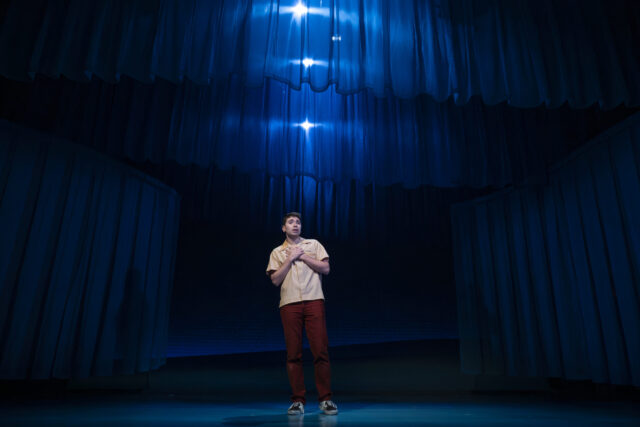
Noah Galvin displays an infectious charm as Josh in The Reservoir at the Atlantic (photo by Ahron R. Foster)

THE RESERVOIR
Atlantic Theater Company, Linda Gross Theater
336 West 20th St. between Eighth & Ninth Aves.
Tuesday – Sunday through March 22, $56.50-$131.50
atlantictheater.org

As the audience enters the Atlantic’s Linda Gross Theater to see Jake Brasch’s off-Broadway debut, The Reservoir, they are met by an unusual sight: An actor is flat on his back on the floor, as if dead. Next to him is wheeled luggage. There are two empty chairs on either side of the stage, in front of curtains, more of which hang high in the back, above a curving piece of scenery that represents water, as if the young man has washed onshore, perhaps having drowned. The night I went, most of the crowd paid little attention to the actor, instead checking their phones and engaging in conversation, as life goes on without him. It’s an apt metaphor for the play itself, which is an engaging and clever foray into family and addiction until it starts drowning in melodrama in the second half.

The young man is Josh (Noah Galvin), an alcoholic college student on leave because of his blackout benders and subsequent disappearances. After Josh awakes, appreciating the sunrise, a park ranger (Matthew Saldívar) tells him he can’t sleep there. Josh turns to the audience and says, “Focus on the cop, speak to the cop. But how did I get here? Did I get on a plane? A greyhound? Wouldn’t be the first time. One time I went to a club in Brooklyn and woke up three days later at a Chick-fil-a in West Virginia.”

A moment later he adds, “Okay. Focus. Morning. Bleeding. Suitcase. Denver. What’s the last thing I remember? The hot rehab worker breathalyzed me and drove me into Miami and then . . . Here we go. Here comes the sober. I hate this part, when the dam breaks and the questions come pouring in.”

He has mysteriously returned home, where his mother, Patricia (Heidi Armbruster), wants him back in rehab. He begs her for one last chance and she agrees to let him stay in his room if he promises to remain sober, take a job at the independent bookstore she owns, and go back to school in the fall.

For most of the play, the four chairs are occupied by Josh’s grandparents, the easygoing Catholic Irene (Mary Beth Peil) and Hank (Peter Maloney) on Patricia’s side, the talkative Jewish Beverly (Caroline Aaron) and Shrimpy (Chip Zien) on his father’s. Despite being surrounded by family and working for a mellow boss, Hugo (Saldívar), Josh can’t get his life in order, especially when Irene’s dementia gets worse. When she suddenly breaks into a lovely version of “O Come, All Ye Faithful,” he starts understanding that she is seriously ill, telling Beverly about it. Grandma Beverly is very different from Grandma Irene:

Beverly: So this was truly, completely out of nowhere?
Josh: Unprompted. It felt channeled. Like a spirit was moving through her or something.
Beverly: Christ.
Josh: Yeah, maybe, could have been him. I mean really though, it was actually kinda beautiful.
Beverly: Well, if I ever get like that, if I start randomly singing at lunch, you have to shoot me, understand?
Josh: What?
Beverly: I’m serious. It’s not hard. This is Colorado. Use my credit card, go to Walmart, buy a rifle.
Josh: Dark.
Beverly: I’ll tell you what’s dark: old age. That’s why you’ll help your granny when the time is right.
Josh: I won’t.
Beverly: If I’m all but three words into “O Come, All Ye Faithful” —
Josh: I doubt that would be your song of choice.
Beverly: “Mi Chamocha” whatever. Push me off a cliff.

Meanwhile, Shrimpy, long divorced from Beverly, is planning on having his second bar mitzvah, at the age of eighty-three, and wants Josh to help him prepare, but he has a tendency to speak a little too openly, particularly when it comes to sex. Acknowledging that Josh is gay, Shrimpy asks him whether he has ever had a threesome, then explains, “I’m straight. Mostly. But, you know, sometimes I look at dicks on my computer. What can I say? I do. I look at the dicks. Hey, what do you say you help me with my bar mitzvah prayers?”

Josh, who has no friends his own age and is not dating, joins Beverly at her senior aerobics class at the JCC taught by Lenni (Armbruster), who says things like “Okay, my beautiful Jewish women, let’s start with a step touch. . . . And five six seven eight . . . Goyim style!” He spends nearly all his free time with his grandparents, but when Irene takes a turn for the worse, Josh’s life once again spirals out of control.
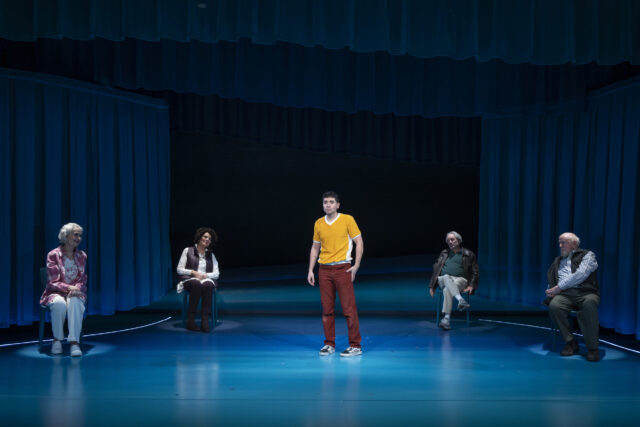
Josh (Noah Galvin) is surrounded by his grandparents in Jake Brasch’s The Reservoir (photo by Ahron R. Foster)

In my recent review of Jacob Perkins’s The Dinosaurs, which just ended its run at Playwrights Horizons, I wrote, “If I never see another play set entirely at an AA or grief counseling meeting consisting of a group of people sitting on folding chairs near some coffee and donuts, it will be too soon.”

A coproduction with Ensemble Studio Theatre and the Alfred P. Sloan Foundation, The Reservoir is not set entirely at an AA or grief counseling meeting, but much of the second half feels like it does as Josh battles to remain sober while all of his grandparents experience health declines. The first act had a sharp, very funny, and relatable tone and mood, but after intermission it all falls apart as Brasch heaps on the soapy melodrama, sucking the life out of the story and hamstringing each of the actors and characters, which also include Josh’s imaginary doctor, Yaakov Stern (Saldívar), a real neuroscientist who discusses the concept of cognitive reserve and offers such advice as “Listen, Joshua. Alcoholism and Alzheimer’s? Not the same thing. You can rebuild, they cannot,” as well as Rabbi Silver (Armbruster), who leads Josh and Shrimpy in a wholly improbable scene in a temple.

Director Shelley Butler (The Scarlet Letter, This Is Fiction) can’t rein in a narrative that gets lost at sea as various pieces of furniture and book carts are wheeled on- and offstage through the sheer curtains, which turn color based on Jiyoung Chang’s lighting shifts. (The set is by Takeshi Kata, with casual costumes by Sara Ryung Clement and sound and incidental music by Kate Marvin.)

Independent Spirit Award nominee Galvin (Waitress, Dear Evan Hansen) is a delight to watch, infusing Josh with a bittersweet complexity that makes you want to root for him in spite of his many serious mistakes. Helen Hayes Award nominee Aaron (A Kid Like Jake, Madwomen of the West) and three-time Drama Desk nominee Zien (Harmony, Caroline, or Change) nearly steal the show as the madcap Jewish relatives, while two-time Tony nominee and Obie winner Peil (Dying for It, Cornelia Street) and Drama Desk nominee Maloney (I’m Revolting, On the Shore of the Wide World) are touching as the gentle old goyim. Armbruster (Boy, Man from Nebraska) and Saldívar (Junk, The Wild Duck) do what they can with underwritten, overly clichéd roles.

Brasch, who describes themself as “a queer, sober, Jewish clown,” was inspired to write the play based on a year in his own recovery during which he reconnected with his grandparents. The Reservoir feels almost too personal, with too many plot holes and too many off-color jokes that start sounding repetitive as the protagonist faces ever-harder truths.

Talking about a metaphorical river, Josh says, “Nothing can get past the dam. And we’ll never know where the water was heading. We’ll never know what lurks beyond. Immense dryness. A great expanse. Terrifying. What do we remember? What have we forgotten? All of the things that we do not know that we do not know. That gnawing feeling that there’s something missing. Something small. Something minor. Or maybe something huge?”

The first half of The Reservoir is rich and free flowing, but there’s too much missing in the second half, preventing it from getting past that dam.

[Mark Rifkin is a Brooklyn-born, Manhattan-based writer; you can follow him on Substack here.]
NOTHING BUT THE TRUTH: THE WILD DUCK FLAPS ITS WINGS IN BROOKLYN

A family faces some hard truths in stellar revival of Henrik Ibsen’s The Wild Duck (photo by Gerry Goodstein)

THE WILD DUCK
Theatre for a New Audience, Polonsky Shakespeare Center
262 Ashland Pl. between Lafayette Ave. & Fulton St.
Tuesday – Sunday through September 28, $102-$132
www.tfana.org

“Men are the most peculiar creatures,” Gina (Melanie Field) says near the middle of Simon Godwin’s adaptation of David Eldridge’s 2005 translation of Henrik Ibsen’s The Wild Duck at the Polonsky Shakespeare Center.

That’s not the half of it.

Over the last fourteen years, Henrik Ibsen’s plays have been experiencing a renaissance, with productions of Ghosts at Lincoln Center, An Enemy of the People on Broadway and at Park Ave. Armory, The Master Builder and John Gabriel Borkman at BAM, and A Doll’s House and Lucas Hnath’s A Doll’s House, Part 2 on Broadway, along with Charles Busch’s Ibsen’s Ghost in midtown and Will Eno’s Peer Gynt reimagining, Gnit, at the Polonsky. It’s been a while since New York City has seen a major revival of Hedda Gabler and even longer of The Wild Duck, which is at last back in this exquisite rendering.

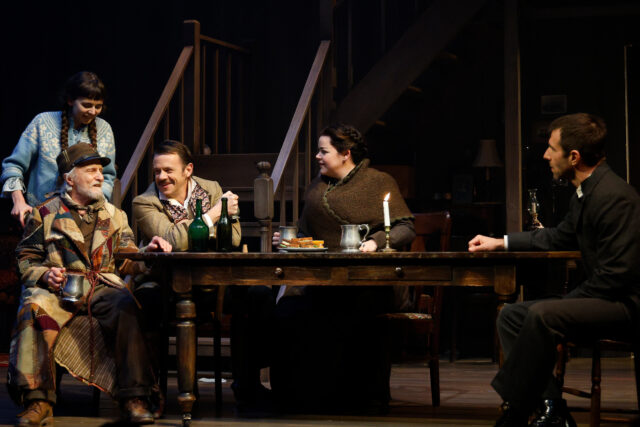
A dual presentation from Theatre for a New Audience and Shakespeare Theatre Company (STC), The Wild Duck is a complex tale of parents and children, money and power, truth-telling, and the ability to see what’s happening right in front of you. The story takes place in 1880s Norway, where wealthy mill owner Håkon Werle (Robert Stanton) is having a dinner party in honor of his son, Gregers (Alexander Hurt), who apparently would rather be anywhere else. Gregers has invited his old friend Hjalmar Ekdal (Nick Westrate), whom he has not seen in sixteen years; Hjalmar, who is not in the same class as the other guests, has reluctantly shown up and is embarrassed when his bedraggled father, Old Ekdal (David Patrick Kelly), a onetime war hero and partner of Håkon’s who spent several years in prison, walks through the party, muttering to himself, and accepts a bottle from Miss Pettersen (Katie Broad), the housekeeper.

Gregers and Hjalmar have a long conversation that leads to Gregers confronting his father, accusing Håkon of having had an affair and an ulterior motive in helping Hjalmar and his family. Håkon asks Gregers to become his partner, explaining, “I’m not as fit for work as I used to be. My eyes aren’t as good.” Gregers thinks his father, who is preparing to marry his current housekeeper, Mrs. Sørby (Mahira Kakkar), is up to something. “I know how you’re using me,” Gregers says. An angry Håkon replies, “I don’t think there’s a man in this world you could detest as much as you detest me.” A frightfully earnest Gregers retorts, “I’ve observed you too closely and for too long, Father.”

The narrative then switches to the Ekdals’ dusty, rustic studio, where Hjalmar and his wife, Gina, live with their bright, inquisitive fifteen-year-old daughter, Hedvig (Maaike Laanstra-Corn), and her grandfather, Old Ekdal, who was a well-regarded hunter. The old man now resigns himself to shooting animals in their loft, which is populated by birds, rabbits, chickens, and a wild duck that was winged by Håkon, was rescued in the sea by Håkon’s dog, and is now cared for by Hedvig, an avid reader who is losing her eyesight. (The impressive sets are by Andrew Boyce.) Hjalmar believes he will be able to lift up his family with an invention he is working on that will make them rich. For additional income, they have two boarders, Dr. Relling (Matthew Saldívar) and the unseen theologian Mr. Molvik. Gregers arrives to inquire if he can rent a vacant room; despite Gina’s misgivings, he moves in and almost immediately inserts himself into situations that drive wedges between just about everyone. Oh, and then there’s the Chekhovian gun. . . .

Hjalmar Ekdal (Nick Westrate) and his daughter, Hedvig (Maaike Laanstra-Corn), share a happy moment in The Wild Duck at TFANA’s Polonsky Shakespeare Center (photo by Gerry Goodstein)

The Wild Duck centers on the relationships between fathers and children: Håkon and Gregers, Old Ekdal and Hjalmar, and Hjalmar and Hedvig. Håkon blames Gregers’s distaste for him on his late wife; Hjalmar tells Gregers that he wants to save his aging, ailing father. And Hjalmar reevaluates his love for Hedvig after a secret is revealed.

It’s also focused on the concept of truth, particularly as it applies to Gregers, who believes in getting everything out into the open, no matter how much it might harm certain people. But he is not a master manipulator or self-righteous believer as much as he might be mad. “Damn it, can’t you see the man’s insane — He’s disturbed!” Dr. Relling shouts at one point. In addition, sight plays a major role, literally and figuratively, as some characters are losing their eyesight and others refuse to see the truth that’s staring them in the face.

Eldridge (Festen, Under the Blue Sky) and STC artistic director Godwin (Timon of Athens, Man and Superman) get right to the heart of Ibsen’s play with an exquisite rendering that grabs you and never lets go. It’s so on target, so alive and bursting with energy and intrigue, that you’ll wonder why you’ve never seen it before.

Westrate (Bernhardt/Hamlet, Casa Valentina) is a powder keg as Hjalmar, a tortured soul with pipe dreams who loves his family but seems powerless to take action; as a photographer, he takes pictures of others but never looks at himself. Field (The Phantom of the Opera, Uncle Vanya) is touching as Gina, a woman who is determined to move forward, intent on keeping the past behind her. Rising star Laanstra-Corn (Grief Camp, Homofermenters) steals every scene she’s in as Hedvig, an inelegant teenager who worships her father. Kelly (An Enemy of the People, Into the Woods) is affecting as Old Ekdal, a once proud man who has long lost his grip on reality. (He also wears a dazzling multi-patched coat; the fine period costumes are by Heather Freedman.) And Stanton (The Killer, Ink) is steely as the unyielding Håkon, who is unable to connect with his son.

Hurt (Continuity, Love, Love, Love) is an enigma as Gregers, a complex character whose motives are not always clear. The night I went, it was difficult to hear him; none of the actors use microphones, which is a special treat, but Hurt delivered his lines at a significantly lower decibel level. His body movement was also rather stiff and his eyes often distant, reminiscent of Jeremy Strong’s performance as Dr. Stockmann in Amy Herzog and Sam Gold’s recent adaptation of An Enemy of the People. Although the interpretation was generally successful, it called too much attention to itself in an otherwise stellar and memorable production.

And as far as the duck goes, it’s an extraordinarily salient metaphor not just for all the characters in the play but for the audience as well, a potent reminder of who we are, what we’ve done, and where we’re going.

[Mark Rifkin is a Brooklyn-born, Manhattan-based writer and editor; you can follow him on Substack here.]
SOUL SEARCHING: THE LIFE AND TIMES OF ARTEMISIA GENTILESCHI AND BABE

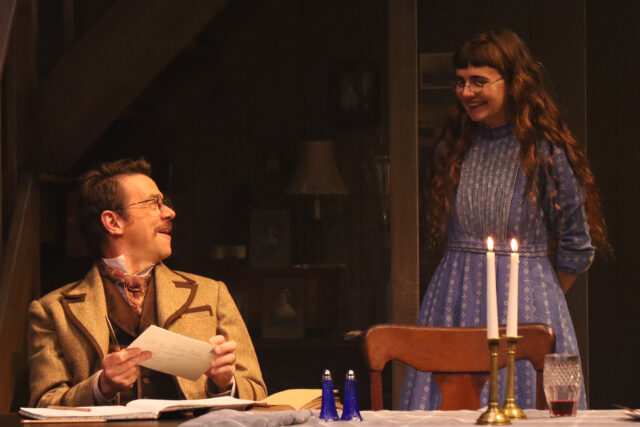
The Light and the Dark looks at the life and times of Italian painter Artemisia Gentileschi (photo by James Leynse)

THE LIGHT AND THE DARK (THE LIFE AND TIMES OF ARTEMISIA GENTILESCHI)
Primary Stages, 59E59 Theaters
59 East 59th St, between Park & Madison Aves.
Tuesday – Sunday through December 15, $66-$131
www.59e59.org

After seeing Kate Hamill’s The Light and the Dark (the life and times of Artemisia Gentileschi) and Jessica Goldberg’s Babe on the same day, I was hard-pressed to figure out why every woman doesn’t just go all Judith on their own Holofernes. While both plays explore misogyny, sexism, control of a woman’s body, and the dominant patriarchy in the arts, one does so much better than the other, although neither is ultimately successful.

At 59E59, Primary Stages is presenting The Light and the Dark, about Artemisia Gentileschi, the early Italian Baroque painter whose career was temporarily derailed by sexual assault and gender discrimination. Hamill’s previous feminist-driven works include stirring adaptations of Little Women, Pride and Prejudice, Sense and Sensibility, Vanity Fair, and Dracula. She has portrayed such characters as Becky Sharp, Elizabeth Bennet, Meg March, Renfield, and Marianne Dashwood; in The Light and the Dark she inhabits the title role with a tender ferociousness as Artemisia matures from a precocious seven-year-old girl to one of the most talented and important artists of her era, even as she’s held back by men and social mores every step of the way.

Artemisia knows what she wants from a young age. Her Tuscan-born father, Orazio (Wynn Harmon), is a naturalistic, technically skillful painter who delivers precisely what his patrons desire. Admitting he doesn’t know how to raise a girl on his own, he decides to send her to a nunnery for her education, telling his daughter, “Think, if I build a big enough fortune and you mark the sisters well enough, you may be a fine lady — the wife or the mother of the great artist of tomorrow!” Misia, as he calls her, responds, “I don’t want to be a lady! I am I, your Artemisia. And I want to be a painter!”

When she is nine, Orazio lets Misia begin working in his studio, and six years later she is allowed to start painting alongside Agostino Tassi (Matthew Saldívar) and Cosimo Quorli (Jason O’Connell), which could be considered scandalous, especially when Orazio brings in a nude model, a sex worker named Maria (Joey Parsons). Soon the arrogant Agostino takes a personal interest in Artemisia, who is proving to be an exceptional artist with a unique perspective on traditional biblical scenes, and scandal does indeed ensue, against Artemisia’s will.

Artemisia Gentileschi has been undergoing a renaissance of her own this century, a heroic figure for the current time, spurred on by the 2002 Met exhibit “Orazio and Artemisia Gentileschi: Father and Daughter Painters in Baroque Italy,” such books as Mary D. Garrard’s Artemisia Gentileschi and Feminism in Early Modern Europe and Gina Siciliano’s I Know What I Am: The Life and Times of Artemisia Gentileschi, and such plays as Sara Fellini’s NEC SPE / NEC METU and Howard Barker’s Scenes from an Execution. Artemisia often repeats “I, I, I” when talking about herself, trying to establish an identity that her father and his friends will not allow her to have because she is a woman, and she is prone to cursing like a sailor, dropping F-bombs again and again.

“Before Caravaggio, painters / Started with the light. / Blank canvas, blank fresco, / And painted layers upon that blankness — / But Caravaggio starts in the darkness / And carves his way out from the shadows,” she says in a way that refers to her own situation. She also declares, as if for all women, “Why should I suffer for nothing? / If I cannot undo it — and I cannot undo it. . . . / I can make it right. / I can control it.”

The show is visually beautiful, from Brittany Vasta’s alluring studio set to Jen Caprio’s lovely period costumes, Seth Reiser’s lighting, and Kylee Loera’s projections of such masterworks by Artemisia as Judith and Holofernes, Susanna and the Elders, The Allegory of Inclination, and Madonna and Child. The cast is effective, but Hamill and director Jade King Carroll too often get caught up in overly earnest monologues and preachy explications; Artemesia speaks at the audience instead of to them. Several didactic art lectures could have been cut or shortened — the play is too long at two and a half hours with intermission — in favor of the narrative itself, which can be compelling.

However, Carroll and Hamill do make The Light and the Dark feel relevant to what is happening today, particularly in the wake of the overturning of Roe v. Wade. Both female actors, Hamill as Artemisia and Parsons as Maria, ultimately take ownership of their bodies away from the men while subverting the male gaze; each gets fully nude, standing boldly onstage, not mere naked subjects to be depicted on canvas but real women shouting out their independence. They might not be holding daggers, preparing to cut off a perpetrator’s head, but you can see and feel their weapons nonetheless.

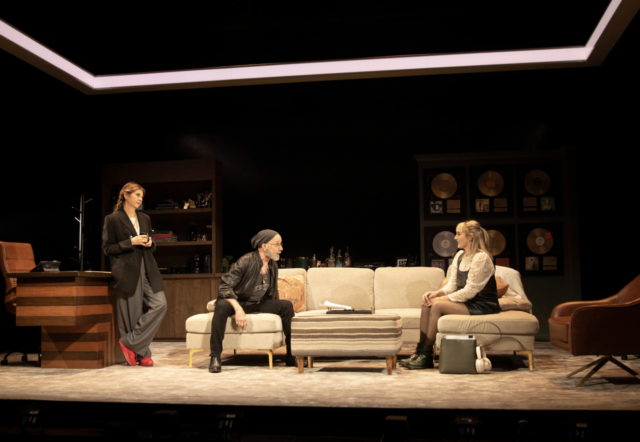
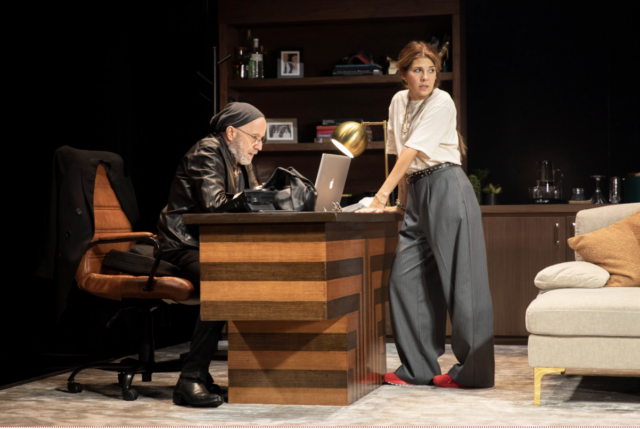
Gus (Arliss Howard) and Abby (Marisa Tomei) wonder about a new employee in Babe (photo by Monique Carboni)

BABE
The New Group at the Pershing Square Signature Center
The Alice Griffin Jewel Box Theatre
480 West 42nd St. between between Ninth & Tenth Aves.
Tuesday – Sunday through December 22, $99-$119
thenewgroup.org

Jessica Goldberg’s Babe has much in common with Kate Hamill’s The Light and the Dark (the life and times of Artemisia Gentileschi); instead of taking place in the world of Baroque painting, it is set in the contemporary music industry, where an old-school record producer, Gus (Arliss Howard), spews sexism and misogyny in his search for artists with a soul. He gives short shrift to his longtime right-hand person, Abby (Marisa Tomei), who discovered 1990s sensation Kat Wonder (Gracie McGraw) but has never received the recognition she deserves.

When a young Gen Z woman, Katherine Becker (McGraw), comes in for a job interview and ultimately gets hired, each character’s flaws become exposed, as well as their strengths, but it is hard to care in this lackluster story searching for its own purpose, never filling in the blank canvas it started with.

Comparisons abound between the two shows. “I don’t want to make people feel great, I want to destroy shit! I want the girls in the front, moshing the fuck out of each other!” Kat declares in a way Gentileschi never would have. Abby, who is gay, explains, “People think if you’re a certain age without a partner, you’re alone. But it’s not true,” evoking Artemisia saying, “I have no interest — in marrying,” but with less conviction. While Hamill empowers Artemisia, having her stand onstage naked, using her body as a model for the self-portrait Allegory of Inclination, Goldberg makes Abby sexless, having had a double mastectomy as a result of cancer. “So it doesn’t really make me feel —” she tells Katherine, implying she lacks physical and emotional desire and confidence. While The Light and the Dark references Caravaggio, Michelangelo, Donatelli, and Botticelli, Babe brings up Liz Phair, Bob Dylan, Joan Jett, and Kathleen Hannah.

At one point in The Light and the Dark, men assume that Artemisia did not actually paint anything, that a woman is incapable of creating high-quality art and that someone else must be behind it all, which is one of the reasons Artemisia signs her name on her canvases “in bold type . . . And wait for my accolades to roll in!” In Babe, a New Group production at the Pershing Square Signature Center, Abby eventually asserts, “I want my NAME. On the record.” As women in fields run by men, neither receives those accolades, but Abby has settled for compromising where Artemisia keeps up the fight.

Marisa Tomei, Arliss Howard, and Gracie McGraw star in the New Group’s Babe
(photo by Monique Carboni)

During the job interview, amid outdated questions that would drive a human resources department to drink, Gus asks Katherine, “Do you have a soul?” Unfortunately, it’s Babe itself that lacks heart and soul. Even at only eighty-five minutes it drags on, like side two of an old record that doesn’t live to up to the flip side.

Derek McLane’s office set is attractive and BETTY’s original music is fine, but the narrative and time shifts are bumpy; director Scott Elliott never gets a handle on the rhythm. Interestingly, although Gus has a disdain for groups, preferring solo artists performing songs written by others, he wears a Killers T-shirt, the Las Vegas band led by lead singer and chief songwriter Brandon Flowers. The costumes, which never change, are by Jeff Mahshie.

Whereas it is obvious why Hamill made The Light and the Dark, celebrating a woman who faced tremendous obstacles in order to express herself through her remarkable art, it is decidedly unclear what points Goldberg (Refuge, Good Thing) is trying to make in Babe; it’s like a concept album without a concept. It purports to be about “the American spirit of individualism,” as Abby says, as well as the resistance to the DEI movement, but it’s as flat as an LP that is not going to go gold or platinum anytime soon, instead gathering dust on a shelf.

[Mark Rifkin is a Brooklyn-born, Manhattan-based writer and editor; you can follow him on Substack here.]

BREAKING THE STORY

Bear (Louis Ozawa) and Marina (Maggie Siff) risk their lives to get to the truth in Breaking the Story (photo by Joan Marcus)

BREAKING THE STORY
Second Stage Theater
Tony Kiser Theater
305 West 43rd St. between Eighth & Ninth Aves.
Tuesday – Sunday through June 23, $42-$82
2st.com/shows

“If it bleeds, it leads,” William Randolph Hearst purportedly said in the 1890s, during the golden age of yellow journalism.

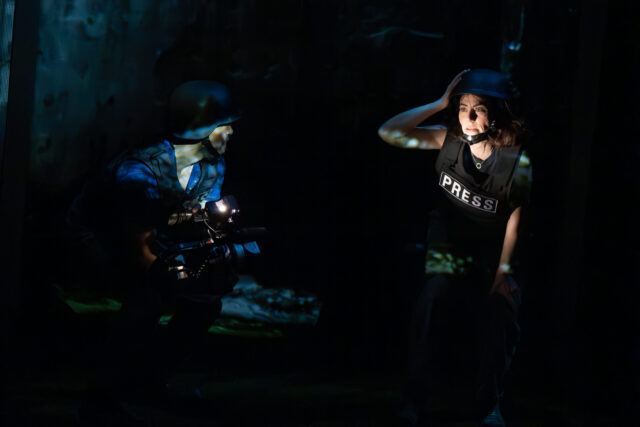
Foreign correspondent Marina Reyes (Maggie Siff) uses that phrase early on in the hard-hitting Breaking the Story, but in this case, the blood is her own. “I’m bleeding. I’m bleeding,” she says repeatedly throughout the eighty-five-minute play.

Marina is a popular television reporter who has suddenly decided to retire and announce her decision in her speech accepting the Distinguished Achievement in Conflict Journalism award. She has recently returned to the United States after nearly getting blown up covering a dangerous story in an undisclosed country; the headlines initially proclaimed, “American Journalist Missing, Presumed Dead.” She tells Bear (Louis Ozawa), her longtime cameraman, “Distinguished Achievement. It’s like they wanna give me a Lifetime Achievement Award in case I die out there next time, but they don’t want to be obvious about it. Anyway, joke’s on them ’cause there won’t be a next time.”

Her return begins a series of life-altering decisions: She buys a big house in an expensive suburb of Boston near her daughter Cruz’s (Gabrielle Policano) new college, Wellesley, and decides to marry Bear that weekend, at the new house, which is more of a vacation home.

Alexis Scheer’s Breaking the Story features a talented ensemble (photo by Joan Marcus)

The wedding brings together Marina’s best friend, socialite and philanthropist Sonia (Geneva Carr), who takes charge and designs a more elaborate affair than anyone seems to want; Marina’s freewheeling mother, Gummy (Julie Halston); Cruz, an aspiring pop star whose most recent song, “Yesterday’s Revolution,” has just gone viral; and Nikki (Tala Ashe), a young, Peabody-winning ladder climber who wants to interview Marina for her podcast even though Marina considers her to be her archenemy. Showing up later is her ex-husband, Fed (Matthew Saldívar), a reporter who now anchors his own show and wants to win Marina back.

New journalism and established reporting face off in Nikki and Marina’s exchanges: At one point Nikki accuses Marina of giving a platform to fascists and dictators, and Marina argues, “It’s our job to tell the whole story, Nikki! Not just the part of the story we agree with! . . .” Nikki responds, “Objectivity is a myth.” A perturbed Marina answers, “Of course it is! Objectivity has never been the point! We’re here to represent facts and ask questions so that people can make up their own mind. Balance. Fairness. Accuracy. All perspectives. The whole story.”

But even as she prepares for this new life, Marina is haunted by PTSD nightmares and the whole story of what happened at the Sapphire Hotel.

Bear (Louis Ozawa) and Marina (Maggie Siff) discuss their past and future in Breaking the Story (photo by Joan Marcus)

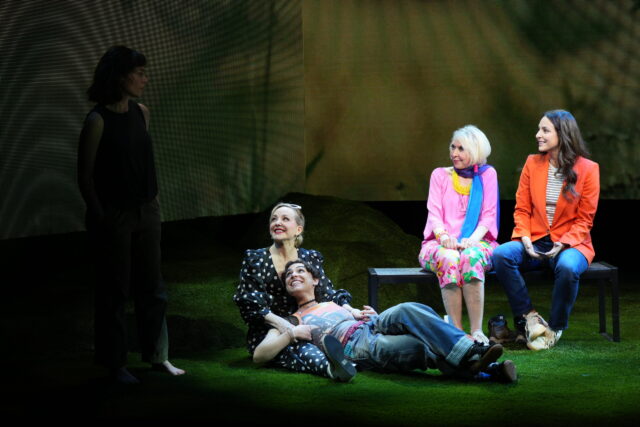
Myung Hee Cho’s set is an expanse of grass with miniature hills and a pair of silhouetted houses that serve as doorways; Elaine J. McCarthy’s projections of news reports and peaceful flowers fill several screens in the back. Darron L West’s sound shifts suddenly from conversation to explosions to live music written by Dan Ryan and performed by Policano, although it is difficult to make out all the lyrics.

Written by Alexis Scheer, whose previous works include Our Dear Dead Drug Lord, Christina, and the Broadway adaptation of the book of Andrew Lloyd Webber’s Bad Cinderella, and astutely directed by Obie winner Jo Bonney (Cost of Living Fucking A), Breaking the Story has some shaky scenes, including a surreal cake tasting, but they’re countered by touching moments of connection, highlighted by a moving heart-to-heart between Marina and Gummy, who makes a surprising confession.

Theater gem Halston (Hairspray, You Can’t Take It with You) sparkles as she quickly morphs from a troubled refugee who is looking for her daughter into the hilarious Gummy. Ozawa (The Tutors, Warrior Class) is cool and calm as Bear, eminently likable even when he considers working with Nikki.

But the show belongs to Siff (Curse of the Starving Class, The Ruby Sunrise). Whether out in the field in the middle of a bombing or walking around barefoot on the green grass of her new home, she is magnetic as Marina tries to balance and make sense of the disparate parts of her life. The choices she faces are ones we all must deal with in our relationships with parents and children, colleagues and rivals, friends and lovers, and career and retirement, except, in Marina’s situation, danger is front and center, a violent and bloody death an imminent possibility.

“You’re like this sacred artifact I’ve stolen from the temple and now this ancient monster curse has been unleashed until I put you back,” Bear tells Marina, who replies, “And you only have ’til the stroke of midnight until I disintegrate and the whole world turns to ash.” It’s not exactly a Cinderella story.

[Mark Rifkin is a Brooklyn-born, Manhattan-based writer and editor; you can follow him on Substack here.]
SORRY, WRONG NUMBER

Who: Marsha Mason, Heidi Armbruster, Chuck Cooper, Jasminn Johnson, Matt Saldivar, Lauren Molina, Marc delaCruz, Sarah Lynn Marion, Dan Domingues
What: All-star benefit reading of Sorry, Wrong Number
Where: Keen Company YouTube
When: Thursday, February 18, $25, 7:00 (available through February 21 at midnight)
Why: “Operator, I’ve been dialing Murray Hill four-oh-oh-nine-eight now for the last three quarters of an hour and the line is always busy. I don’t see how it could be busy that long. Will you try it for me, please?” Agnes asks at the beginning of Lucille Fletcher’s 1943 radio play, Sorry, Wrong Number. As the operator calls the number, Agnes adds, “I don’t see how it could be busy all this time. It’s my husband’s office; he’s working late tonight and I’m all alone here in the house. My health is very poor and I’ve been feeling so nervous all day.” But instead of getting her husband on the other end of the line, she overhears a murder plot, and she’s determined to do something about it, despite her condition. The noir thriller was adapted into a 1948 film by Fletcher, directed by Anatole Litvak and starring Barbara Stanwyck and Burt Lancaster; Agnes Moorehead had the lead role in the original May 1943 radio production.

The Drama Desk– and Obie-winning Keen Company is now adapting the play for an all-star benefit live presentation taking place February 18 at 7:00. (The link will be active through February 21 at midnight.) The cast features four-time Oscar, Grammy, and Emmy nominee Marsha Mason (The Goodbye Girl, Steel Magnolias), Tony winner Chuck Cooper (Choir Boy, The Life), Heidi Armbruster (Disgraced, Poor Behavior), Jasminn Johnson (Blues for an Alabama Sky, Seven Guitars), and Matthew Saldivar (Junk, Saint Joan). “Since the early days of the pandemic, I became increasingly fascinated with old-time radio and the ways these early pioneers inspired their audience to use their imagination in new ways,” company artistic director Jonathan Silverstein said in a statement. “One of the most popular of these dramas is Lucille Fletcher’s Sorry, Wrong Number, a taut thriller that set the bar for suspense on the radio. I look forward to welcoming patrons to this special fundraising event, which will make you think twice before making your next phone call.”

Fletcher was married to Bernard Herrmann, wrote the libretto for Herrmann’s opera Wuthering Heights, and penned the radio script for The Hitch-Hiker for Orson Welles’s Mercury Theatre of the Air; it was later adapted by Rod Serling for a classic Twilight Zone episode with Inger Stevens. Welles considered Sorry, Wrong Number “the greatest radio script ever written.” The reading is directed by Silverstein and includes live foley effects by Nick Abeel; it will be preceded by a musical preshow with Lauren Molina, Marc delaCruz, and Sarah Lynn Marion performing American standards, hosted by Dan Domingues, and will be followed by a live talkback with members of the cast and crew. All proceeds benefit Keen’s Hear/Now audio theater season and the Keen Playwrights Lab.

SPECIAL EVENT BENEFIT READING AND BULL SESSION: THE WOMAN HATER

Who: Red Bull Theater company
What: Benefit reading of The Woman Hater and live Q&A
Where: Red Bull Theater website and Facebook Live
When: Monday, January 25, free (suggested donation $25), 7:30 (available on demand through January 29); Bull Session on Thursday, January 28, free, 7:30
Why: For its previous livestream benefit reading, Red Bull Theater, known for its exquisite stagings of Jacobean plays — the company was named after an English playhouse that produced works between 1604 and 1642, not after an energy drink — dipped its toes into the contemporary era with Carlyle Brown’s The African Company Presents Richard III, which was written in 1994 and set in 1821. Red Bull heads to the turn of the eighteenth century with a benefit reading of Frances Burney’s rarely performed The Woman Hater, a protofeminist satire of romance, misogyny, and high society. “The discovery of Frances Burney’s stage plays is a wonderful revelation, and it is a joy for us to be able to share what just might be her funniest play with audiences online,” artistic director Jesse Berger said in a statement. Directed by Everett Quinton and featuring Bill Army, Arnie Burton, Veanne Cox, Rebecca S’Manga Frank, Cherie Corinne Rice, Matthew Saldivar, Jenne Vath, and Nick Westrate, with visual design by David M. Barber and costumes by Sara Jean Tosetti, the work will be performed live January 25 at 7:30 and will be available on demand through January 29.

David M. Barber designed the visual backdrops for Red Bull reading of The Woman Hater

In addition, Red Bull is hosting a Bull Session on January 28 at 7:30 with Quinton, members of the cast, and scholar Tara K. Menon, who in a statement explained, “Frances Burney wrote The Woman Hater between 1796 and 1801. Although the play was never performed in public, Burney drew a cast list of prominent actors from Drury Lane, including Sarah Siddons, the best known tragedienne of the day, as Eleonora. The play shares its title with the 1607 play by Francis Beaumont and John Fletcher, which also lampoons misogyny. Burney’s play first came to light in 1945 when the Berg Collection of the New York Public Library acquired a collection of her writing. Her plays were published for the first time in 1995. The Woman Hater is best characterized as a sentimental comedy, but it contains elements of several other genres including gothic drama, farce, and comedy of manners.” It also has echoes of Burney’s 1779 comedy, The Witlings. Tickets to both events are free, but there is a $25 suggested donation for the reading if you are able to contribute.

RED BULL THEATER: THE COURAGE TO RIGHT A WOMAN’S WRONGS (VALOR, AGAVIO, Y MUJER)

Red Bull Theater teams up with UCLA to present new translation of Spanish Golden Age comedy

Who: Red Bull Theater company
What: Livestreamed benefit reading of new translation of Ana Caro Mallén’s The Courage to Right a Woman’s Wrongs
Where: Red Bull Theater website and Facebook Live
When: Monday, November 16, free with RSVP (donations accepted), 7:30 (available on demand through November 20 at 7:00)
Why: For its latest livestreamed reading, Red Bull is teaming up with Diversifying the Classics | UCLA to present a brand-new translation of Spanish Golden Age poet and playwright Ana Caro’s The Courage to Right a Woman’s Wrongs (“Valor, agravio y mujer.”) Part of La Escena 2020, the second edition of Los Angeles’s Festival of Hispanic Classical Theater, the seventeenth-century comedy focuses on a woman’s boundary-crossing encounters with issues of society and gender, justice and honor, specifically related to her former lover, Don Juan. In their introduction to the new translation, Marta Albalá Pelegrín and Rafael Jaime write, “Through this stirring tale of a woman’s courage to right the wrongs she has suffered, the play holds up to scrutiny contemporary notions of masculine honor and offers in their place a vision that opens up space for women and their agency.”

The reading will be performed by Anita Castillo-Halvorssen, Helen Cespedes, Natascia Diaz, Carson Elrod, Anthony Michael Martinez, Sam Morales, Alfredo Narciso, Ryan Quinn, Luis Quintero, and Matthew Saldivar and is directed by Melia Bensussen; there will be a live, interactive Bull Session with some of the artists involved and UCLA professor of Spanish and English Barbara Fuchs and California State Polytechnic English and modern languages associate professor Pelegrín on November 19 at 7:30, also free with RSVP. The reading will be available on demand through November 20 at 7:00.