Tag Archives: Matthew Saldivar

DRACULA / FRANKENSTEIN

(photo by Joan Marcus)

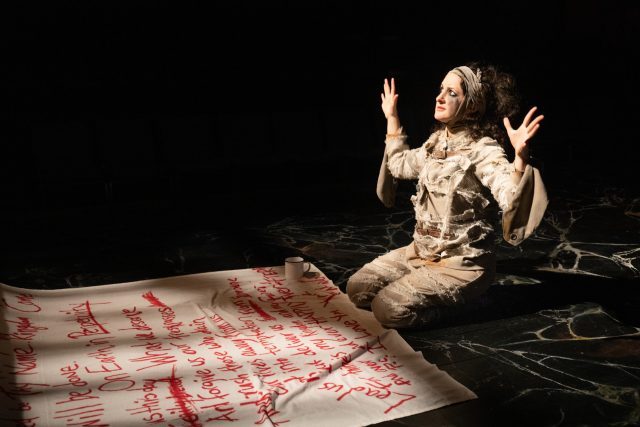
Kate Hamill wrote and stars in gender-flipping Dracula at Classic Stage, playing Renfield (photo by Joan Marcus)

Classic Stage Company, Lynn F. Angelson Theater
136 East 13th St. between Third & Fourth Aves.
Tuesday – Sunday through March 15, $82-$127
classicstage.org

In 1971, Al Adamson’s Dracula vs. Frankenstein movie pit the Transylvanian count against the lab-created Creature, both introduced to film audiences in 1931 in separate horror films that started long-running franchises. The pair of ghouls, along with the Wolf Man, also appeared together in Charles Barton’s 1948 comedy Abbott and Costello Meet Frankenstein. And now Dracula and Frankenstein’s Monster are not face-to-face but back-to-back in Classic Stage’s creepy double feature, new adaptations of each running in repertory through March 15.

Kate Hamill, whose previous literary adaptations include wonderfully imaginative versions of Little Women, Pride and Prejudice, Sense and Sensibility, and Vanity Fair, has had a helluva lotta fun with Bram Stoker’s 1897 Gothic horror novel. She calls it “a bit of a feminist revenge fantasy, really,” infusing it with a healthy dose of Buffy the Vampire Slayer and a somewhat Marxist view of class struggle while keeping the plot firmly in the bloodline of the original.

Dracula (Matthew Amendt) is put in the background of this version; in fact, all the men are secondary to the women. Hamill’s great invention is gender-switching the characters, beginning with the mad Renfield (Hamill) and most spectacularly with the vampire hunter Van Helsing (Jessica Frances Dukes); the first is now a husband-murdering woman in a lunatic asylum, the second a powerful, leather-clad female punk cowboy (think Faith from Buffy and Angel). The plot proceeds mostly according to Stoker, with a few condensations and sly alterations: Renfield is cared for by the boringly plain Doctor George Seward (Matthew Saldivar), who’s engaged to the mischievous Lucy Westenra (Jamie Ann Romero), whose BFF is the pregnant Mina Harker (Kelley Curran). Mina’s husband, solicitor Jonathan Harker (Michael Crane), has gone to Transylvania on business. The conversation sounds contemporary from the outset, albeit couched in semi-Victorian diction as when Lucy teases Mina that Jonathan probably has “some Bavarian hausfrau. Some Slovakian slattern. Some Czech chippy” there. “I cannot blame him, Mina. You have gone rather to seed,” Lucy says, poking at Mina’s belly. “That’s the baby, you cow,” Mina responds. “Excuses, excuses,” Lucy says. Mina: “I’ll remind you how amusing that is when you are in the same condition.” Lucy: “One step at a time, please.” Mina: “It happens faster than you think. One day, you’re a schoolgirl, the next —” Lucy: “A hideous bloated old broodmare —” Mina: “— condemned to a life with no greater excitement than visiting a horrible little trollop on the seaside!”
(photo by Joan Marcus)

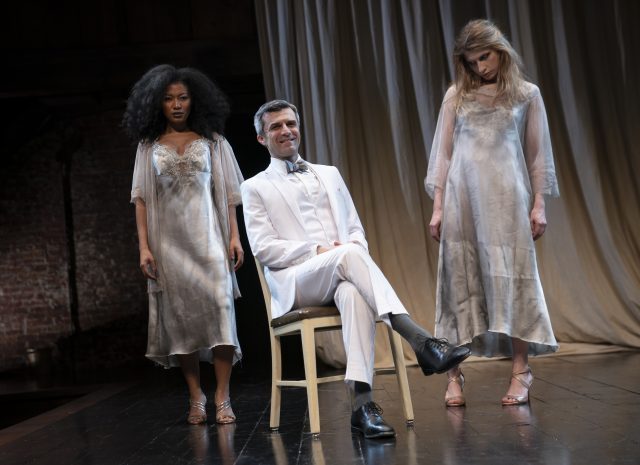
Jonathan Harker (Michael Crane) has no idea what’s in store for him from Drusilla (Laura Baranik) and Marilla (Lori Laing) in new Dracula adaptation (photo by Joan Marcus)

Dracula is essentially a minor character, dressed in white instead of the traditional black (the costumes are by Robert Perdziola), not as demonic as he is often depicted; rather, his strength is frankly sexual and class-based. He is protected by two henchwomen, the lustful vampires Drusilla (Laura Baranik), named after a Buffy character, and Marilla (Lori Laing), perhaps named after the spinster from Anne of Green Gables. As Dracula slowly turns Mina into the walking dead, Dr. Seward refuses to believe in any such nefarious doings, and intrepid vampire hunter Dr. Van Helsing arrives on the scene, ready to fight, quickly winning the formerly meek Mina to her side as they team up to rescue Jonathan and kill the count.

Directed by Sarna Lapine (Sunday in the Park with George, Little Women), this Dracula is a bit scattershot, all over the place as it investigates feminist themes from the Victorian era to today, as well as the emergence of working- and middle-class power versus the landed aristocracy. Renfield is a woman dealing with daddy issues, projecting her lust and religious zeal onto the unavailable Dracula, while the heroes are Mina, a twist on Buffy sweetly played by Curran (The Winter’s Tale, ‘Tis Pity She’s a Whore), and Dr. Van Helsing, portrayed with fearless panache by Dukes (By the Way, Meet Vera Stark, Yellowman). Classic Stage artistic director John Doyle’s sparse set is often empty except for when beds are rolled onstage, keeping the focus on the characters themselves.

Hamill’s sense of humor shines through as she toys with genre conventions across two hours and twenty minutes with intermission. When Jonathan first meets the count upon arriving at Dracula’s deserted mansion, he says, “I was beginning to think there wasn’t a soul in the place!” This Dracula also is more aware of class warfare than usual, telling Jonathan, “If control is shifting to the masses, than I must be of the masses. I must not rule from the castle on the hill anymore. Instead, I must become a common man, anonymous; — welcomed everywhere, and remembered nowhere. A man — rather — like you.” It’s a battle of the sexes in which men, whether supernatural or human, don’t stand a chance.
(photo by Joan Marcus)

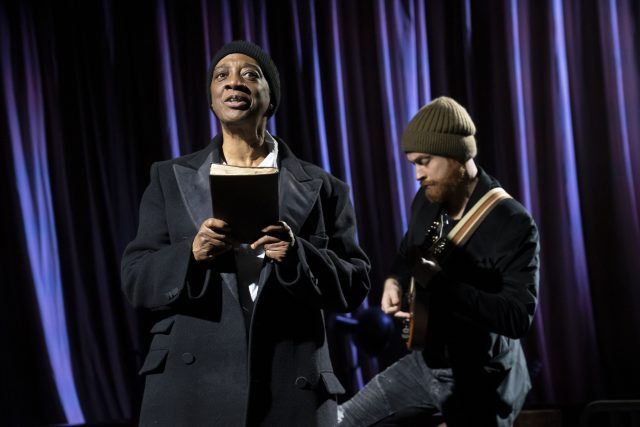
Stephanie Berry and Rob Morrison star in Tristan Bernays’s Frankenstein at Classic Stage (photo by Joan Marcus)

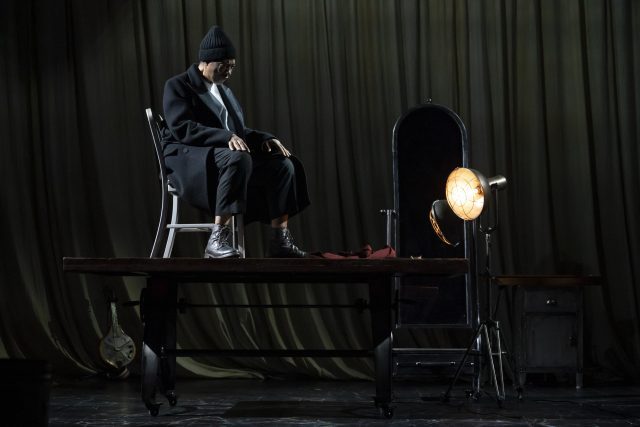
Tristan Bernays is far more faithful to the original story in his stark adaptation of Mary Wollstonecraft Shelley’s anonymously published 1818 epistolary novel Frankenstein; or, the Modern Prometheus. The streamlined production features two actors, Stephanie Berry as Victor Frankenstein and the Creature, and Rob Morrison singing songs, playing guitar, contributing sound effects, narrating sections, and moving around the furniture, which includes a long table, a large mirror, and several small pails. (This set also is designed by Doyle.) As with Hamill’s Dracula, Bernays’s Frankenstein plays with gender identity as it explores issues of God versus man as creator. Shortly after being brought to life, the Creature starts learning language and finding its place in the world, like a child quickly growing into adulthood. But the more it understands, the less it likes.
(photo by Joan Marcus)

The Creature (Stephanie Berry) grows more and more curious in Classic Stage adaptation of Gothic novel (photo by Joan Marcus)

The narration is taken directly from the source material, with added dialogue. “What if — What if I failed to speak to him in gentle tongue? What if though blind he sensed withal my horrid shape? What if his children came back swift and ruined all my plans? What if — What if —” the Creature says as he enters the home where a blind man lives. Shortly after leaving the house, the Creature looks up at the stars and screams out, “Why? Why did you mould me but for misery? Am I to never feel a friendly touch? A kindly look? Love? Compassion? Why did you make me so? Why?” The Creature ultimately confronts Dr. Frankenstein, his wife, Elizabeth, and their son, William, and declares his need for a companion, leading to a tragic conclusion.

Even at a mere eighty minutes, the play, directed by Timothy Douglas (Radio Golf, Etiquette of Vigilance), drags on. The scenes don’t flow easily into one another, feeling ragged and disjointed. Berry (Gem of the Ocean, For All the Women Who Thought They Were Mad) has some fine moments as the Creature, but the story and pace can get confusing, while Morrison (Avenue Q, Nevermore), clearly an excellent musician, seems mostly unnecessary. It ends up being more of a curiosity, which is not enough to sustain it, whether seen as a Gothic tale or a contemporary parable.
BERNHARDT/HAMLET

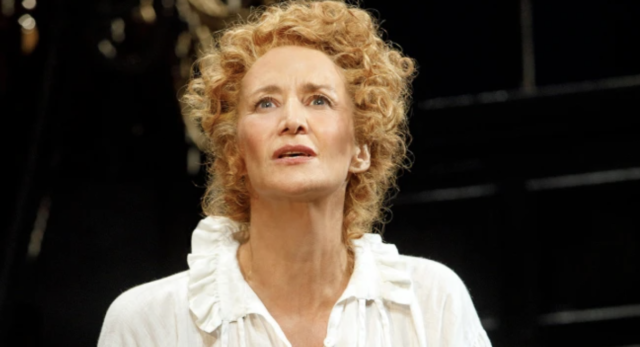
Janet McTeer stars as Sarah Bernhardt in new play by Theresa Rebeck (photo by Joan Marcus)

American Airlines Theatre
227 West 42nd St. between Broadway & Eighth Ave.
Tuesday – Sunday through November 18, $59-$159
212-719-1300
www.roundabouttheatre.org

When turn-of-the-twentieth-century theater superstar Sarah Bernhardt played the Melancholy Dane in Hamlet at the Adelphi in London, actress and writer Elizabeth Robins wrote in her December 1900 review: “Madame Bernhardt’s assumption of masculinity is so cleverly carried out that one loses sight of Hamlet in one’s admiration for the tour de force of the actress. This is not to say that she gives us a man, but rather Sarah Bernhardt playing, with amazing skill, a spirited boy; doing it with an impetuosity, a youthfulness, almost childish.” Much the same can be said of Tony-winning actress Janet McTeer, who plays Bernhardt playing Hamlet in Theresa Rebeck’s uneven though often exciting Bernhardt/Hamlet, a celebration not only of Bernhardt but of the collaborative process of theater. The Roundabout production, continuing at the American Airlines Theatre through November 18, is set in 1897 Paris, where Bernhardt has decided to play the male part and is rehearsing with Constant Coquelin (Dylan Baker), François (Triney Sandoval), Raoul (Aaron Costa Ganis), and Lysette (Brittany Bradford). Bernhardt’s lover, the married Edmond Rostand (Jason Butler Harner), is not fond of her decision. “You want to be a man,” he tells her. “I do not want to be a man,” she replies. “You crave a man’s power,” he accuses her. “No man has more power than I do,” she says. “Shakespeare does,” he retorts. But she has the last word, proclaiming, “I will not go back to playing flowers for you fools. Not because I am too old. But because I was never a flower, and no matter how much you loved how beautifully I might play the ingenue, it was always beneath me. It is beneath all women.”

(photo by Joan Marcus)

Edmond Rostand (Jason Butler Harner) watches Constant Coquelin (Dylan Baker) perform in Bernhardt/Hamlet at the American Airlines Theatre (photo by Joan Marcus)

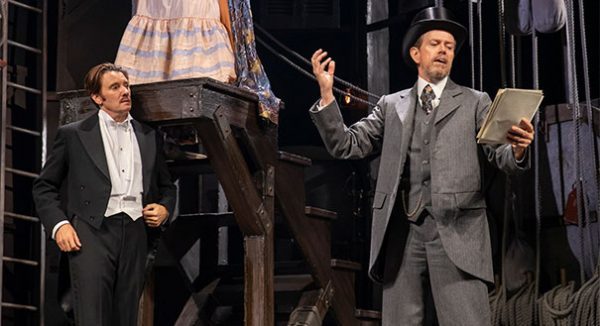
Bernhardt demands that Rostand rewrite Hamlet specifically for her, but soon he is working on another play, Cyrano de Bergerac, which also gets her juices flowing. The same cannot be said for Rostand’s rightly jealous wife, Rosamond (Ito Aghayere); Bernhardt’s teenage son, Maurice (Nick Westrate); and acerbic critic Louis (Tony Carlin), wielding his poisoned pen with undeserved power. Meanwhile, Czech artist Alphonse Mucha (Matthew Saldivar) hovers around, creating the poster for the controversial show; in Shakespeare’s time, men might have played all the parts, but in the late Victorian/Edwardian era, a woman portraying the title character in the Bard’s greatest work is practically theater — and gender — treason. “And now we come to your tragedy,” Edmond says to Sarah, who responds, “I am not a tragic figure.” Edmond explains, “You are Sarah Bernhardt. But Sarah Bernhardt is a woman. And people do not want to see a woman play Hamlet.” To which Sarah argues, “I do not play him as a woman! I play him as myself.

Directed by Moritz von Stuelpnagel (Present Laughter, Hand to God), Bernhardt/Hamlet works best when it sticks to its title, when McTeer plays Sarah Bernhardt playing Hamlet. A lot of the rest is detritus that only gets in the way. McTeer (Mary Stuart, God of Carnage) is a joy to watch as her character, complete with crazy hairstyle, questions Hamlet’s motives as well as Shakespeare’s, romping around Beowulf Borrit’s handsome sets, which include an outdoor Paris café, the Adelphi stage, and Bernhardt’s elegant dressing room. Rebeck’s (Seminar, Downstairs) plot meanders; it feels like she tries to squeeze too much in and doesn’t trust that the audience will get the shock factor of Bernhardt’s ambition, especially in this modern era in which so much casting is gender (and race) blind. For example, in 2016, McTeer starred as Petruchio in Phyllida Lloyd’s all-female adaptation of The Taming of the Shrew at the Delacorte. But then McTeer proclaims, “Oh what a rogue and peasant slave am I! / Is it not monstrous that this player here, / But in a fiction, in a dream of passion, / Could force his soul,” and all is right again.

SAINT JOAN

(photo by Joan Marcus)

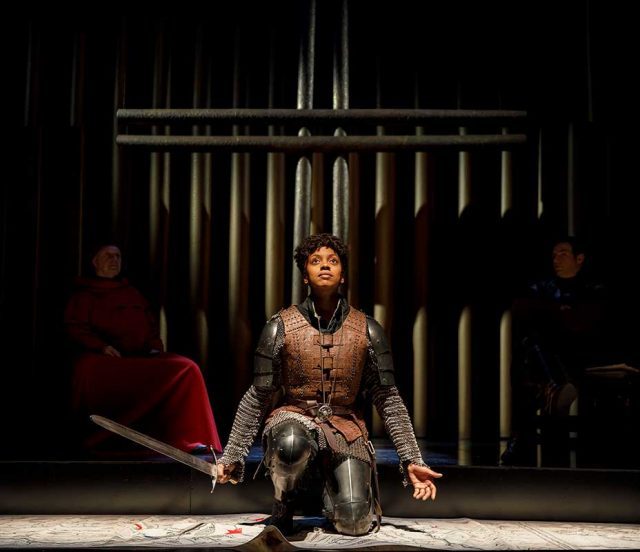
A teenage farm girl (Condola Rashad) is on a mission from God in Bernard Shaw’s Saint Joan (photo by Joan Marcus)

Manhattan Theatre Club at the Samuel J. Friedman Theatre
261 West 47th St. between Broadway & Eighth Aves.
Tuesday – Sunday through June 10, $65-$159
saintjoanbroadway.com
www.manhattantheatreclub.com

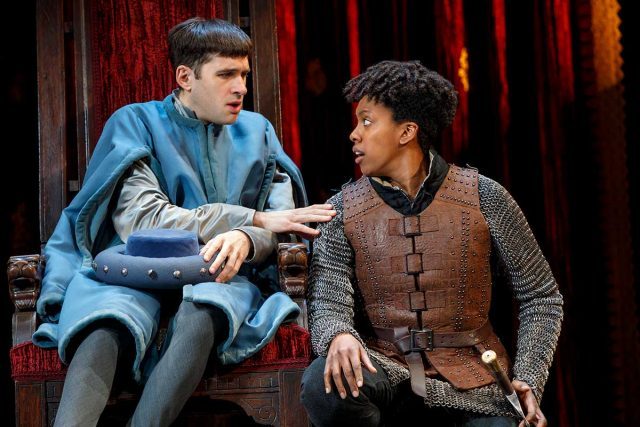
“There is something about her,” men say of Saint Joan, the title character in Bernard Shaw’s 1923 play. There is also something about Condola Rashad, who portrays Joan in the current Manhattan Theatre Club revival at the Samuel J. Friedman Theatre. Rashad has now appeared in five Broadway shows, earning four Tony nominations, for Stick Fly, The Trip to Bountiful, A Doll’s House, Part 2, and Saint Joan. (She was also nominated for a Drama Desk Award for her 2009 off-Broadway debut, Ruined, but got shut out as Juliet in a misbegotten Broadway revival of Romeo and Juliet in 2013.) The thirty-one-year-old Rashad is charming as Joan, a teenage farm girl in 1429 who claims that Saint Margaret and Saint Catherine speak to her and that God has commanded her to lead the French to victory in Orleans against the occupying English so the hapless Dauphin (Adam Chanler-Berat) can claim the throne as King Charles VII. She joins a luminous roster of actresses who have played Saint Joan, including Wendy Hiller, Uta Hagen, Joan Plowright, Jean Seberg, Imelda Staunton, Imogen Stubbs, Amy Irving, and Diana Sands, the only other black woman to portray Joan in a major production, at Lincoln Center in 1968. Rashad’s Joan is sweet-natured but determined, gentle yet forceful, a kind of hero just right for the #MeToo and #BlackLivesMatter generation. Joan goes about the world of men — Rashad is the only woman in the cast, among twelve actors, save for a brief appearance by Mandi Masden as the Duchess de la Trémouille — with an ease that emanates from her faith.

Military squires, royals, and religious leaders disparage Joan until they meet her, slowly falling under her captivating spell. Robert de Baudricourt (Patrick Page) brags about how he “burns witches and hangs thieves,” but Joan tells him, “They all say I am mad until I talk to them, squire. But you see that it is the will of God that you are to do what He has put into my mind,” and he does. Captain La Hire (Lou Sumrall) calls her “an angel dressed as a soldier.” Charles might not want to be king, but Joan is on a holy mission to see that he is crowned at Rheims Cathedral. “If the English win, it is they that will make the treaty: and then God help poor France!” she tells Charles. “You must fight, Charlie, whether you will or no. I will go first to hearten thee. We must take our courage in both hands: aye, and pray for it with both hands too.” But after she impossibly takes Orleans despite being massively outnumbered and then urges the campaign continue on to recapture Paris, the military, the church, and the monarchy realize her power and turn on her, trying her for sins that could get her burned at the stake.

(photo by Joan Marcus)

The Dauphin (Adam Chanler-Berat) finds a savior in Joan (Condola Rashad) in Manhattan Theatre Club Broadway revival (photo by Joan Marcus)

Scott Pask’s set is dominated by large gold pipes hanging from above, as if the entire play takes place inside a giant church organ, spreading Joan’s religious message. “It is in the bells I hear my voices,” Joan tells Jack Dunois (Daniel Sunjata), who ably fights by her side. “Not today, when they all rang: that was nothing but jangling. But here in this corner, where the bells come down from heaven, and the echoes linger, or in the fields, where they come from a distance through the quiet of the countryside, my voices are in them.” Shaw (who preferred not to use the first name George) famously said, “I’m an atheist and I thank God for it”; in writing the play, he was trying to neither convert anyone nor convince them to leave the fold, nor was he creating a biblical-style story of good versus evil. In a preface to the published edition, Shaw wrote, “There are no villains in the piece. . . . It is what men do at their best, with good intentions, and what normal men and women find that they must and will do in spite of their intentions, that really concern us.” Shaw, who also wrote such works as Pygmalion, Major Barbara and Man and Superman and won the Nobel Prize shortly after Saint Joan, does not include any superheroes either. “I am not a daredevil: I am a servant of God,” Joan says to Dunois. “My heart is full of courage, not of anger. I will lead; and your men will follow: that is all I can do. But I must do it: you shall not stop me.”

The exemplary cast also features Max Gordon Moore as Bluebeard, Walter Bobbie as the Bishop of Beauvais, John Glover as the Archbishop of Rheims, Matthew Saldivar as Bertrand de Poulengey, Robert Stanton as Baudricourt’s steward, Russell G. Jones as Monseigneur de la Trémouille, and Jack Davenport as the Earl of Warwick. Most of the actors play more than one role; Page is particularly impressive as Baudricourt and the Inquisitor. Daniel Sullivan’s (The Little Foxes, Proof) direction can get a little bumpy though there are several deft touches, and at nearly three hours, the show can be a little trying. Which brings us to the rather campy epilogue. Shaw wrote Saint Joan in 1923, three years after her canonization, something he deals with in the somewhat surreal, comic, and arguably out-of-place conclusion. “As to the epilogue, I could hardly be expected to stultify myself by implying that Joan’s history in the world ended unhappily with her execution, instead of beginning there,” Shaw wrote. “It was necessary by hook or crook to shew the canonized Joan as well as the incinerated one; for many a woman has got herself burnt by carelessly whisking a muslin skirt into the drawing-room fireplace, but getting canonized is a different matter, and a more important one. So I am afraid the epilogue must stand.” And so it does, for better or worse.

JUNK

(photo by T. Charles Erickson)

Ayad Akhtar and Doug Hughes shine a light on debt financing, leverage, disclosure violations, and the death of American manufacturing in Junk at Lincoln Center (photo by T. Charles Erickson)

Vivian Beaumont Theater at Lincoln Center Theater
150 West 65th St. between Broadway & Amsterdam Ave.
Tuesday – Saturday through January 7, $87-$147
212-362-7600
www.lct.org

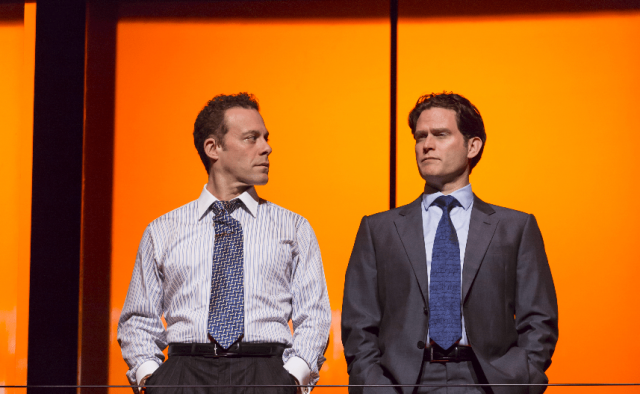
Just because I graduated from Wharton in the 1980s doesn’t mean I understand every intricacy in Ayad Akhtar’s complexly layered Junk, his sizzling-hot excoriation of greed and hostile takeovers, set in 1985. But Akhtar makes the key elements easy to follow, even for me, as a group of men fight it out for control of an Allegheny steel mill — but the last thing on their mind is actually steel, because in this world, it’s money that matters. Akhtar — who won the Pulitzer Prize for Disgraced, a sharp play about race, assimilation, ambition, and bigotry, and whose 2014 drama, The Invisible Hand, put capitalism and religion on trial in Pakistan — refers to Junk as “a ritual enactment of an origin myth,” in this case that of debt financing at the expense of American manufacturing. “When did money become the thing — the only thing?” journalist Judy Chen (Teresa Avia Lim) asks at the beginning. “It was like a new religion was being born.” It might not sound like a sexy topic, but it’s a scorcher in the hands of Tony-winning director Doug Hughes (The Father, Incognito), who orchestrates all the back-room dealings on John Lee Beatty’s dazzling multilevel set, strikingly lit by Ben Stanton. Sacker-Lowell junk bond trader Robert Merkin (Steven Pasquale) is the mastermind behind a hostile takeover of Everson Steel and United, a family-owned business on the Dow. Merkin, who believes that “debt is an asset,” and Sacker-Lowell lawyer Raül Rivera (Matthew Saldivar), who claims that “nothing makes money like money,” are working with corporate raider Israel Peterman (Matthew Rauch) to gain control of Everson Steel, owned by Thomas Everson Jr. (Rick Holmes), who desperately wants to hold on to the Allegheny-based firm founded by his father. Merkin turns to his wife, numbers whiz Amy (Miriam Silverman), for advice while luring in arbitrageur Boris Pronsky (Joey Slotnick) and investor Murray Lefkowitz (Ethan Phillips) to raise the necessary funds and manipulate the market. When old-time private equity magnate Leo Tresler (Michael Siberry) gets wind of Merkin’s plan, he decides to throw his hat in the ring as well. Meanwhile, US attorney Giuseppe Addesso (Charlie Semine) and assistant US attorney Kevin Walsh (Philip James Brannon) are operating behind the scenes, building a case against Merkin and others.

(photo by T. Charles Erickson)

Corporate raider Israel Peterman (Matthew Rauch) colludes with junk bond trader Robert Merkin (Steven Pasquale) in Broadway financial thriller (photo by T. Charles Erickson)

When Akhtar moved to New York City shortly after graduating from Brown, his father offered to pay his rent if he read the Wall Street Journal every day. He immersed himself in newspapers and magazines about business and came to believe that the players in this world were “not moral or immoral but amoral,” he tells co-executive editor John Guare in Lincoln Center Theater Review. In many ways Junk is like a Shakespearean history play about war, complete with lies, betrayal, spies, sex, and blood, where words and actions can be twisted to mean something else. Of course, Akhtar is not exactly the first person to write about how money became a kind of religion, with profit more important than product and people, humanity be damned, but he does so with a graceful style that turns clichés inside out while choosing no real heroes or villains. No one is safe from his skewer, but each man and woman gets to state his or her case free from editorial judgment. That doesn’t mean everyone is equal, that the audience can’t separate good from evil, or that viewers can’t feel sympathy for some characters and disdain for others. Akhtar reveals a socioeconomic level many of us will never be a part of, and most likely wouldn’t want to — although more than a few in the well-heeled Lincoln Center audience at the show we attended rustled uncomfortably in their seats. Talking about Merkin, Tresler tells Chen, “He’s a pawnbroker. And he’s got America in hock,” to which she replies, “Or he’s the new J. P. Morgan.” In many ways Akhtar has created an extremely extended dysfunctional family, with surrogate children, cousins, parents, and grandparents fighting over money, power, and values. “I don’t want to make you mad,” Lefkowitz tells Merkin, as if he doesn’t want to disappoint Daddy. Featuring a strong cast of twenty-three led by fine turns by Pasquale (The Bridges of Madison County, Rescue Me), Siberry (An Enemy of the People, Six Degrees of Separation), Phillips (My Favorite Year, Benson), Slotnick (Dying for It, Boston Public), and Holmes (The Visit, Matilda), Junk might be set thirty-two years ago, but it’s not out-of-date in the least, as income inequality grows around the world, President Trump has just signed a controversial overhaul of the US tax system, and cryptocurrency complicates the market and confuses the masses.