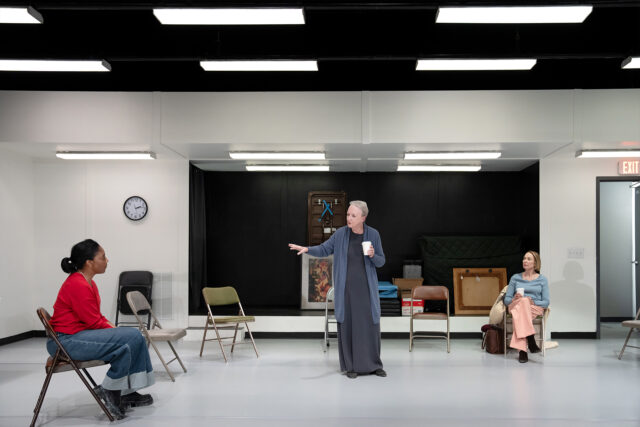
Jacob Perkins’s The Dinosaurs takes place at a basement AA meeting (photo by Julieta Cervantes)
THE DINOSAURS
Playwrights Horizons, the Judith O. Rubin Theater
416 West 42nd St. between Ninth & Tenth Aves.
Tuesday – Sunday through March 8, $83.50 – $103.50
www.playwrightshorizons.org
If I never see another play set entirely at an AA or grief counseling meeting consisting of a group of people sitting on folding chairs near some coffee and donuts, it will be too soon.
Now, it’s not that I’m unsympathetic or lack compassion for people facing real problems, but the format has just been worn down with too many similar shows, particularly since the pandemic.
The topic of addiction can be treated magnificently, as it was in Joe White’s recent Blackout Songs, a scintillating story about a man and a woman who fall in and out of love and lust after meeting at an AA gathering. And spit&vigor’s Anonymous, which is back for a well-deserved encore run in its tiny black-box space on Macdougal St., cleverly immerses the audience in its addictive tale of addiction held in a circle of chairs, some occupied by audience members. In addition, such works as Dave Malloy’s Octet and Bess Wohl’s Liberation practically reinvented the use of the physical arrangement, though neither was about alcoholism.
However, Jacob Perkins’s The Dinosaurs, making its world premiere at Playwrights Horizons through March 1, wastes a terrific cast in a stale, seemingly unfinished production about six women dealing with the disease.
The seventy-five-minute play begins as Jane (April Matthis) enters an empty white room, its black ceiling hung with rows of bright fluorescent lights, a dark alcove in the back with random items. As Jane stands deep in thought, a hesitant, uncomfortable-looking woman named Rayna but known as Buddy (Keilly McQuail) arrives and talks to Jane about how she spills the inside of donuts on her clothing but never gives up the sweet treat. “I guess we just can’t help ourselves,” Jane says. “We always keep on going back for more.” Buddy discusses the etymology of the word “cupcake,” then leaves, apparently not ready for this kind of meeting.
Jane starts bringing out folding chairs from a back room, arranging them in a semicircle. Joan (Elizabeth Marvel) comes in with the coffee and helps with the chairs and table. She checks that the milk has not reached its expiration date. Jane hears chirping that Joan doesn’t. There are numerous such pronouncements throughout that serve as supposed insight.
Next, eighty-year-old Jolly (Kathleen Chalfant) breezes in with a box of donuts and scones, which surprises Jane and Joan, who assumed Jolly would be late and/or forget the snacks. “It must’ve taken you a lifetime,” Joan says, to which Jolly replies, “‘It always takes the time / it needs to take,’” paraphrasing Pulitzer Prize winner Mary Oliver, a poet whose quotes are a favorite of recovering addicts.
They are soon joined by Joane (Maria Elena Ramirez), who gossips about a teenage boy at her son’s school who “bagged an older woman,” and they debate whether charges should be brought. While Jane tries to understand the loneliness that must have made the woman do what she did, Joan argues, “Empathy has its limits.”
At last, Janet (Mallory Portnoy) pops in and the Saturday Survivors meeting officially gets underway, as Jolly recites the preamble, which concludes, “Our primary purpose is to stay sober and help other alcoholics to achieve sobriety.”
The rest of the play awkwardly moves through time and space as the participants make shares that are abruptly cut off, unfinished; Buddy returns, questioning the existence of a higher power, but only Jane can see and hear her; Janet relates a dream she had that is overloaded with obvious symbolism; and Joan recounts in an unwieldy manner a series of sobriety dates she has experienced, a clunky way to point out how addicts can fall on and off the wagon.
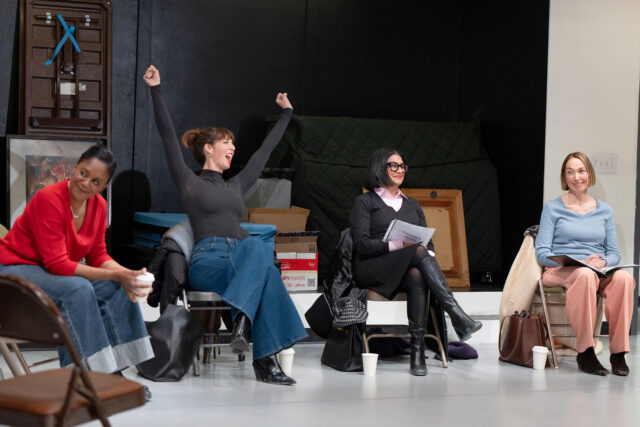
A small group of women gossip and share personal stories in The Dinosaurs (photo by Julieta Cervantes)
Each time one of the women says, “My name is [—] and I’m an alcoholic,” the others annoyingly shout out the name in unison. Perhaps that is linked to why the five regulars all have names that begin with the same letter, as if they are parts of the same person. (Or maybe not.) They also make plans for the following week’s fifty-second annual anniversary party, the theme of which is gratitude and will feature live performances by several group members.
Hovering over it all is a broken clock on the wall that is perpetually at 2:13, not only representing the importance of time when it comes to recovery but also, perhaps, referring to Bible verses about faith (Timothy 2:13, Philippians 2:13, Titus 2:13, Proverbs 2:13).
Perkins (The Gold Room, The Interview) is a writer, actor, and clinical mental health counselor and researcher who was inspired to write The Dinosaurs based on his own experiences “in a church basement on East 22nd Street on a Saturday morning” as well as by Giovanni Boccaccio’s The Decameron, spurred on by a biennial prize sponsored by the Clubbed Thumb theatrical company for works inspired by Boccaccio’s fourteenth-century epic about the Black Death. In his “Playwright’s Perspective” essay, he explains, “This is a play about an internal plague and the renaissance that came from a group of people telling each other stories; the kinds of stories that have saved my life again and again.”
Unfortunately, The Dinosaurs feels like a work-in-progress in need of more structure and balance. Tony-nominated, Obie-winning director Les Waters (The Thin Place, Grief Camp) can’t get a handle on the narrative, which is wobbly and uneven, and the actors occasionally seem lost in a fog.
The play also doesn’t succeed as an advertisement for AA, which it too often appears to aspire to; I don’t envision returning to it, nor can I recommend it to others.
There’s a case to be made that these kinds of plays should go extinct.
“Not everyone gets this,” Joan says at one point.
Count me among the confused.
[Mark Rifkin is a Brooklyn-born, Manhattan-based writer; you can follow him on Substack here.]