Tag Archives: Manhattan Theatre Club

FOOL FOR LOVE

(photo © 2015 Joan Marcus)

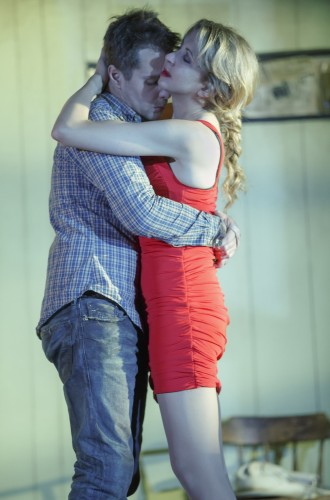
Eddie (Sam Rockwell) and May (Nina Arianda) are lovers with quite a past in FOOL FOR LOVE (photo © 2015 Joan Marcus)

Manhattan Theatre Club at the Samuel J. Friedman Theatre
261 West 47th St. between Broadway & Eighth Aves.
Tuesday – Sunday through December 13, $75-$150
foolforlovebroadway.com
www.manhattantheatreclub.com

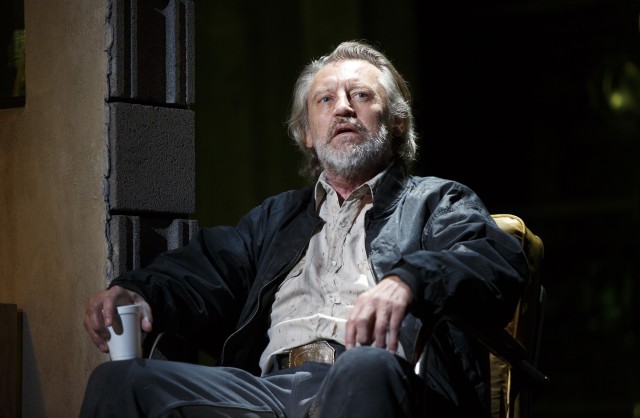
In the published script for Fool for Love, Sam Shepard explains, “This play is to be performed relentlessly, without a break.” And as with many of Shepard’s plays, it is indeed relentless. In a seedy motel room on the edge of the Mojave Desert, Eddie (Sam Rockwell), a former rodeo cowboy, reclines in a shaky chair against the back wall, while May (Nina Arianda), a tall blonde, is hunched statue-like on the end of the bed, her face covered by her long hair, looking toward the ground. At the front of the stage near the corner, an older man (Gordon Joseph Weiss) sits back in a sturdy chair, hands grasping the armrests like the slick hipster from the Maxell commercials. The Old Man and May remain stock-still as Eddie begins talking and makes his way over to May, showing a slight limp. “I’m not goin’ anywhere. See? I’m right here. I’m not gone,” he tells her, and she eventually reaches out and grabs his leg, holding on for dear life. That sequence sets the stage for this seventy-five-minute one-act play about two people who both attract and repel each other, for reasons that become more clear with a surprise revelation about halfway through. May and Eddie have known each other since high school, and they have been on-and-off lovers ever since. “You’re just guilty. Gutless and guilty,” she says shortly before promising to kill both Eddie and the Countess, a woman he might be seeing. “I’m gonna torture her first, though. Not you. I’m just gonna let you have it. Probably in the midst of a kiss. Right when you think everything’s been healed up. Right in the moment when you’re sure you’ve got me buffaloed. That’s when you’ll die.” The ever-confident Eddie is sure that May will ultimately choose to come away with him, despite May’s claims that she has started a new life, dating a normal man, Martin (Tom Pelphrey). Every once in a while, the Old Man chimes in briefly, like a Greek chorus all by himself. “I wanna show you somethin’. Somethin’ real, okay? Somethin’ actual,” he says to Eddie, referring to a nonexistent picture on the wall. A moment later, after the Old Man has settled back in his chair, once again soundless and immobile, May tells Eddie how much she can’t stand him. “No matter how much I’d like not to hate you, I hate you even more. It grows. I can’t even see you now. All I can see is a picture of you. You and her.” We only see what we want to see, remember what we want to remember, mixing fiction and reality in our memories, much like theater itself. For Eddie and May, there’s one thing they can never forget. “You know we’re connected, May,” Eddie says. “We’ll always be connected. That was decided a long time ago.” To Shepard, destiny is a bitch.
(photo © 2015 Joan Marcus)

The Old Man (Gordon Joseph Weiss) is a Greek chorus unto himself in Broadway debut of Sam Shepard’s Pulitzer-nominated FOOL FOR LOVE (photo © 2015 Joan Marcus)

Nominated for a Pulitzer Prize, Fool for Love is part of the series of plays, including the Family Trilogy, that Shepard wrote between 1978 and 1985, consisting of Curse of the Starving Class, Pulitzer winner Buried Child, Pulitzer nominee True West, and A Lie of the Mind. Partly inspired by his relationship with Jessica Lange, Fool for Love is a treat for actors; previous versions have featured such Eddie-May pairings as Ed Harris and Kathy Baker, Ian Charleson and Julie Walters, Martin Henderson and Juliette Lewis, Bruce Willis and Denise Simone, and, in the 1985 Robert Altman film, Shepard and Kim Basinger (with Harry Dean Stanton as the Old Man and Randy Quaid as Martin). The original 1983 production was directed by Shepard, who includes extremely specific stage cues in his script. For the play’s Broadway debut, Daniel Aukin (Bad Jews, 4,000 Miles) takes the reins. Tony winner Arianda (Venus in Fur, Born Yesterday) and Rockwell (A Behanding in Spokane, Moon) have a fiery energy together, but their back-and-forth rapport gets repetitive, and you can feel the hands of Shepard (and Aukin) manipulating your emotions too much, especially when Rockwell puts his lasso to interesting use, bringing a little S&M into the proceedings. The story bounces between the physical and the metaphysical, occasionally getting caught within both at the same time. Pelphrey (Guiding Light, As the World Turns) plays Martin with just the right amount of cluelessness, and Weiss is terrifically perverse as the Old Man; while the rest of the action is going on, you can’t help but cast glances over at him sitting in the darkness. Shepard is a man’s man, and Fool for Love is very much a masculine tale; May might get in her digs, but Eddie is really calling the shots as he cleans his rifle and swigs tequila straight from the bottle. Love ain’t easy, and destiny is a bitch, Shepard is telling us. Damn straight.
OF GOOD STOCK

(photo by Joan Marcus)

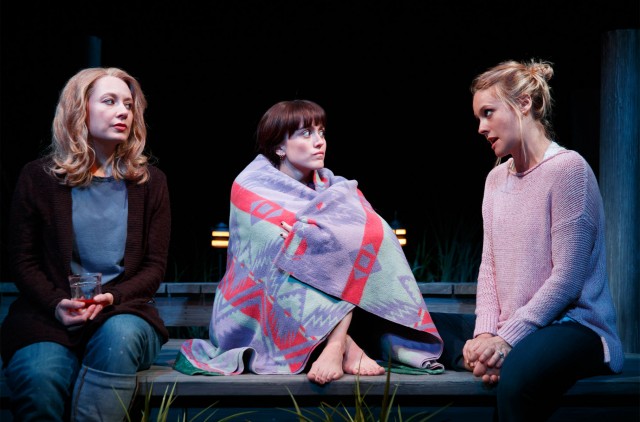
Jennifer Mudge, Heather Lind, and Alicia Silverstone star as three sisters reconnecting at their family home on Cape Cod in OF GOOD STOCK (photo by Joan Marcus)

Manhattan Theatre Club
New York City Center Stage 1
Tuesday – Sunday through July 26, $90
212-581-1212
ofgoodstockplay.com
www.nycitycenter.org

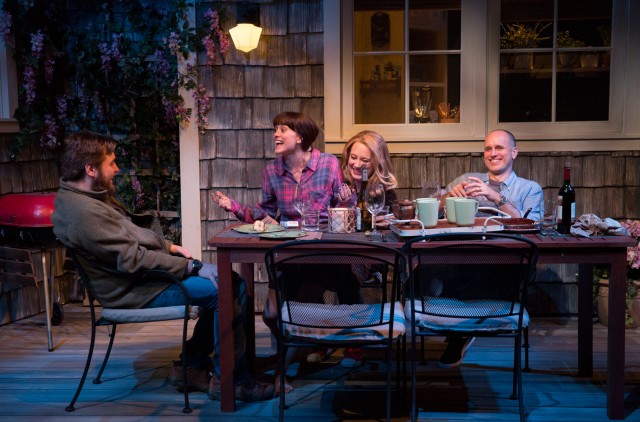
Having spent some time the past several summers in a house on Cape Cod rented by my in-laws, I was looking forward to Melissa Ross’s new play, Of Good Stock, which takes place on the popular peninsula. Entering the theater at City Center, I could practically smell the fresh saltwater air as soon as I saw Santo Loquasto’s open stage of beach grass and dune. And once the play started and the revolving set rotated to that all-too-familiar, overly comfy style of Cape Cod house, and then two of the characters went out to pick up something from Marion’s Pie Shop in Chatham, well, it was like I’d been transported to Massachusetts, where I will not be going this summer. Fortunately, however — or, perhaps, unfortunately — I had little cathartic identification with the fictional Stockton clan, a dysfunctional family of three sisters and their significant others, that who did not remind me of any real people I know but instead felt like escapees from worlds created by Wendy Wasserstein (The Sisters Rosensweig), Tracy Letts (August: Osage County), Beth Henley (Crimes of the Heart), and, of course, Anton Chekhov (Three Sisters), among others. Oldest sister Jess (Jennifer Mudge), middle sister Amy (Alicia Silverstone), and youngest sister Celia (Heather Lind) arrive at the Cape Cod house where they spent their childhood summers, seeking to take stock of their lives. The daughters of the late famous writer and master philanderer Micah Stockton, they each have relationship and daddy issues. Jess, the stalwart leader of the group who is battling cancer, married the much older, very dependable Fred (Kelly AuCoin), who used to work for Micah. Amy, a flighty drama queen given to histrionics and whining, is engaged to the already henpecked Josh (Greg Keller) and is obsessed with planning their destination wedding in Tahiti. And neurotic free spirit Celia has brought a new beau, Hunter (Nate Miller), a hirsute thirtysomething hipster from Montana who has still not finished college. While the men basically sit back and watch, the three women rehash old stories, purposefully push one another’s buttons, and argue over just about everything. But their problems are nothing to the easygoing, up-front Hunter, who says, “I’ve got twelve siblings. No offense to you guys but y’all are amateurs.”

(photo by Joan Marcus)

A rare moment of laughter is shared in new play about family dysfunction (photo by Joan Marcus)

Mudge (Into the Woods, Reckless) and AuCoin (The Wayside Motor Inn, House of Cards) are an excellent team as Jess and Fred, the heart and soul of the play, keeping it from teetering over the edge, bringing empathy and depth to every situation. AuCoin is particularly effective in a terrific scene with Keller (Wit, The Who and the What) as Fred and Josh discuss “manly men things.” Lind (Turn: Washington’s Spies, The Merchant of Venice) and Miller (Love and Information, Peter and the Starcatcher) are fun to watch, she a whirling dervish of energy, he an easygoing, content dude who prefers the truth to secrets. Silverstone (Clueless, The Graduate) isn’t given a whole lot to do with Amy except annoy, complain, and rush off in tears, which grows tiresome rather quickly. Directed by Lynne Meadow, Of Good Stock can get a bit too manic depressive, and its characters and plot twists offer little new on family dysfunction. Ross, whose Nice Girl was recently warmly received at LCT3, favors overlapping dialogue that sometimes gets confusing, and the narrative too often heads toward sitcom territory. The play, which premiered earlier this year in a different production at South Coast Repertory in California, was a late substitute after Manhattan Theater Club announced that Richard Greenberg’s previously scheduled The Swing of the Sea was being postponed “in order to give these artists more time to work on the production of the play.” Of Good Stock could probably have benefited from more tweaking as well. But it’s still a nice place to visit, even if you wouldn’t want to live there.

AIRLINE HIGHWAY

(photo © 2015 Joan Marcus)

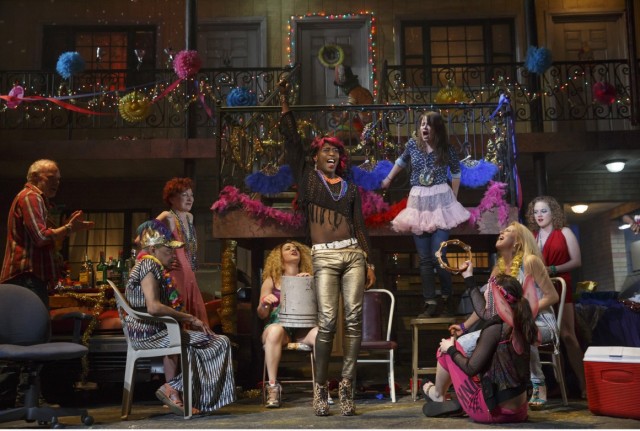
The residents of the down-on-its-luck Hummingbird Motel prepare for a funeral party in AIRLINE HIGHWAY (photo © 2015 Joan Marcus)

Manhattan Theatre Club at the Samuel J. Friedman Theatre
261 West 47th St. between Broadway & Eighth Aves.
Tuesday – Sunday through June 14, $50-$130
airlinehighwaybroadway.com
www.manhattantheatreclub.com

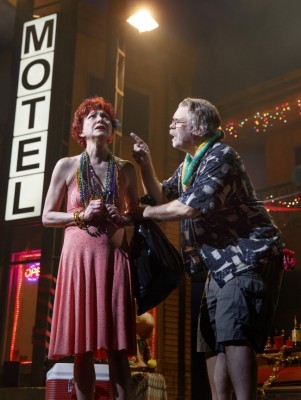
Pulitzer Prize finalist Lisa D’Amour (Detroit) channels her inner Tennessee Williams and Eugene O’Neill in Airline Highway, a rapturous tale about a group of lovable luckless losers coexisting in the run-down, dilapidated Hummingbird Motel on a slowly gentrifying Airline Highway in modern-day, post-Katrina New Orleans. It’s the spring of 2014, and the sad-sack denizens of the seedy motel are preparing for a funeral party in honor of their matriarch, Miss Ruby (Judith Roberts), a local burlesque legend who is on her deathbed but wants a big send-off while she’s still alive. Tanya (Julie White), an aging hooker with a heart of gold, is organizing the festivities, getting help from the loud, fun-loving transgender Sissy Na Na (K. Todd Freeman), moody stripper Krista (Caroline Neff), hippie leftover Francis (Ken Marks), jack of all trades, master of none Terry (Tim Edward Rhoze), and longtime motel manager and primary ne’er-do-well Wayne (Scott Jaeck). They all share a familial sense of camaraderie, ribbing one another about their sorry-ass lives, but only to show they really do care. “Why do we gotta wait until we’re in the coffin for people to say nice things about us?” Francis asks. “Yeah, like maybe if those people said those things earlier, we’d live longer,” Wayne adds, to which Krista responds, “Who wants to live longer.” Trouble soon shows up in the form of Bait Boy (Joe Tippett), an old Hummingbird resident who got out three years earlier and is trying to make a new life for himself, moving in with a cougar and her sixteen-year-old daughter, Zoe (Carolyn Braver), in Atlanta. Bait Boy — whose nickname has numerous debated derivations — had been in a long-term relationship with Krista, who is none too happy to see him again, especially since he has brought his stepdaughter; Zoe keeps asking everyone personal questions as part of a sociology paper she is doing for school. “I’m supposed to interview at least three people from the same subculture,” she explains. “Meaning, you live in a ‘culture,’ and you are coming down to us,” Sissy Na Na points out. Bait Boy’s return and Zoe’s presence set things in motion as the past comes back to haunt them all.

(photo © 2015 Joan Marcus)

Tanya (Julie White) isn’t so quick to accept advice from Wayne (Scott Jaeck) in Lisa D’Amour’s New Orleans–set drama (photo © 2015 Joan Marcus)

Two-time Tony winner Joe Mantello (Assassins, Take Me Out) directs this Steppenwolf production, presented by Manhattan Theatre Club, with an infectious giddiness that is echoed in David Zinn’s spot-on costumes and Scott Pask’s fab set, which turns the drab parking lot of the dilapidated, depressing Hummingbird into a space bursting with life despite the universal lack of hope displayed by the characters, all damaged goods who seem resigned to their fate. But that’s not going to stop them from dressing up and throwing one helluva party. The ensemble is superb, led by Tony winner White (The Little Dog Laughed,), who has been nominated for a Tony and a Drama Desk Award for her lovely, understated performance as Tanya, a street-smart woman who expected more out of life but is making due with the lot she’s been cast. Tony nominee Freeman (The Song of Jacob Zulu) is up for a Tony and Drama Desk Award for his poignant portrayal of Sissy, a caring soul who speaks her mind and loves to have a good time. In her Broadway debut, Neff (A Brief History of Helen of Troy) gives a beautiful, heartbreaking edge to Krista, who is ashamed of what’s become of her, while Rhoze is a riot as Terry, a layabout who should have done more with his life. The play is alive with the energy of New Orleans, as well as its music, highlighted by Fitz Patton’s original score, a fiery take on Nina Simone’s “Be My Husband,” and overlapping dialogue bursting with an intoxicating rhythm. Two late soliloquies are entirely unnecessary, overemphasizing what the story has already shown us about these very believable forgotten men and women living by their wits on the fringes of society. The play takes place during Jazz Fest, but only Francis has ever been to the annual New Orleans celebration, and he doesn’t even go to the main part. “The real fest is on the edges,” he says, just like their existence. There are various Native American legends about the hummingbird, a positive symbol that can represent peace, love, and happiness as well as beauty, harmony, and integrity. Airline Highway has all that and more.

CONSTELLATIONS

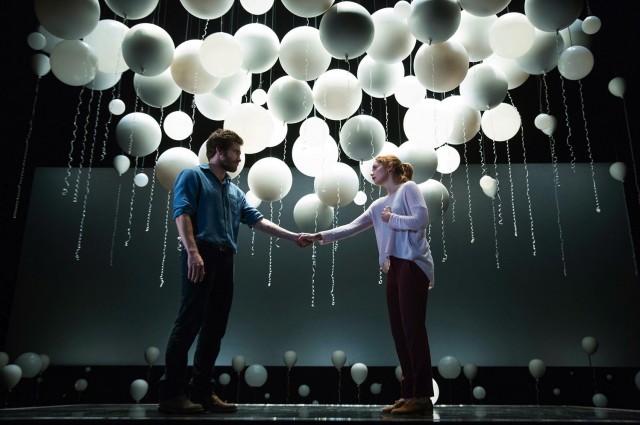
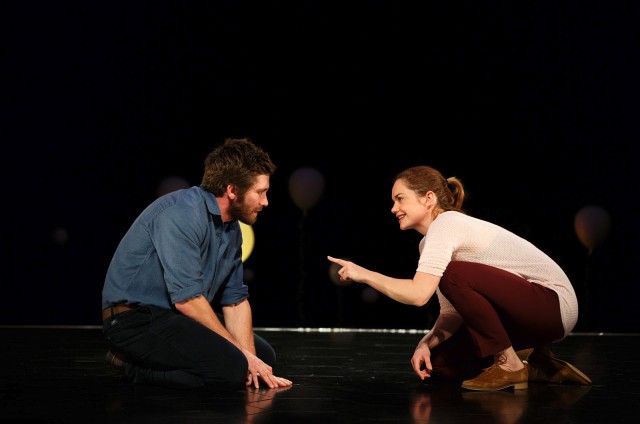
Beekeeper Roland (Jake Gyllenhaal) and cosmologist Marianne (Ruth Wilson) look at life and love from all sides in CONSTELLATIONS (photo © 2014 Joan Marcus)

Beekeeper Roland (Jake Gyllenhaal) and cosmologist Marianne (Ruth Wilson) look at life and love from all sides in CONSTELLATIONS (photo © 2014 Joan Marcus)

Manhattan Theatre Club at the Samuel J. Friedman Theatre
261 West 47th St. between Broadway & Eighth Aves.
Tuesday – Sunday through February 28, $67-$125
www.manhattantheatreclub.com
www.constellationsbroadway.com

It takes several minutes to get into the flow and rhythm of Nick Payne’s Constellations, a two-character play set in the quantum multiverse, in the “past, present, and future.” Beekeeper Roland (Jake Gyllenhaal) and cosmologist Marianne (Ruth Wilson) meet in a bar, have a brief chat, the lights go out, then they do it again, and again. But each time, something changes — the tone of their voice, the movement of their bodies, their positioning onstage, a word here and there. What at first seems like it might be just a tiresome theatrical exercise turns out to be a captivating, sophisticated exploration of the many roads a relationship (and storytelling itself) can take. Over the course of seventy minutes, there are more than fifty short scenes as Roland and Marianne go through repeated iterations of hooking up and not, discussing their careers, being faithful and unfaithful, and, ultimately, facing mortality square in the face. Once you fall under the spell of the drama’s intellectual conceit, a scene won’t even be over before you’re eagerly anticipating how the next one will be slightly different. Constellations is no mere Sliding Doors rehash in which the protagonists have two choices that will take their lives in alternate directions, nor is it as black and white as the Star Trek episode “The Enemy Within,” in which each character has a good and evil version; instead, it posits that there are parallel universes in which Roland and Marianne are interacting at the same time, each one similar but unique — and each one, ultimately, ending in death, something that never changes.

CONSTELLATIONS

Jake Gyllenhaal and Ruth Wilson both excel in their Broadway debuts in superb Nick Payne play (photo © 2014 Joan Marcus)

In writing Constellations, Payne — who previously tackled climate change in If There Is I Haven’t Found It Yet, in which Gyllenhaal made his New York theater debut — was inspired by the work of Columbia physics and mathematics professor Brian Greene, the superstring theorist and author of the highly influential book The Elegant Universe, giving an intriguing, well-researched scientific edge to the play. While Marianne’s job has her studying the origin of the universe, Roland is a rooftop beekeeper, caring for insects whose very existence might determine the future of the planet. In her Broadway debut, Wilson, whose star has risen dramatically in just a few short years — the thirty-three-year-old actress has won two Olivier Awards and had starring roles in such well-received television series as Luther and The Affair — is sensational as Marianne, combining an innate intelligence with just the right amount of vulnerability. And in his Broadway debut, the thirty-four-year-old Gyllenhaal — who is currently up for an Oscar for his performance in Nightcrawler and has starred in such other films as Zodiac, Brokeback Mountain, and Proof — is a worthy partner as he keeps his character beguilingly unpredictable under the sure hand of Michael Longhurst, who previously directed Gyllenhaal in the Roundabout production of If There Is I Haven’t Found It Yet and Wilson in Arthur Miller’s The Crucible, when the two were at the University of Nottingham together. The play, which originated in London with Rafe Spall (Life of Pi, Betrayal), who also originated the role Gyllenhaal played in If There Is, and Sally Hawkins (Happy-Go-Lucky, Blue Jasmine), features a fascinating set designed by Tom Scutt, with lighting by Lee Curran; the actors remain on a central rectangular platform that is surrounded on three sides and above by balloons that represent stars, with different orbs glowing on and off in each scene. Constellations is a challenging, intellectually stimulating and satisfying work, expertly written, directed, and acted, but even with all the thought-provoking science, when it comes right down to it, it’s really just a, er, universal love story, as boy meets girl, then boy meets girl, then boy meets girl….

LOST LAKE

(photo by Joan Marcus)

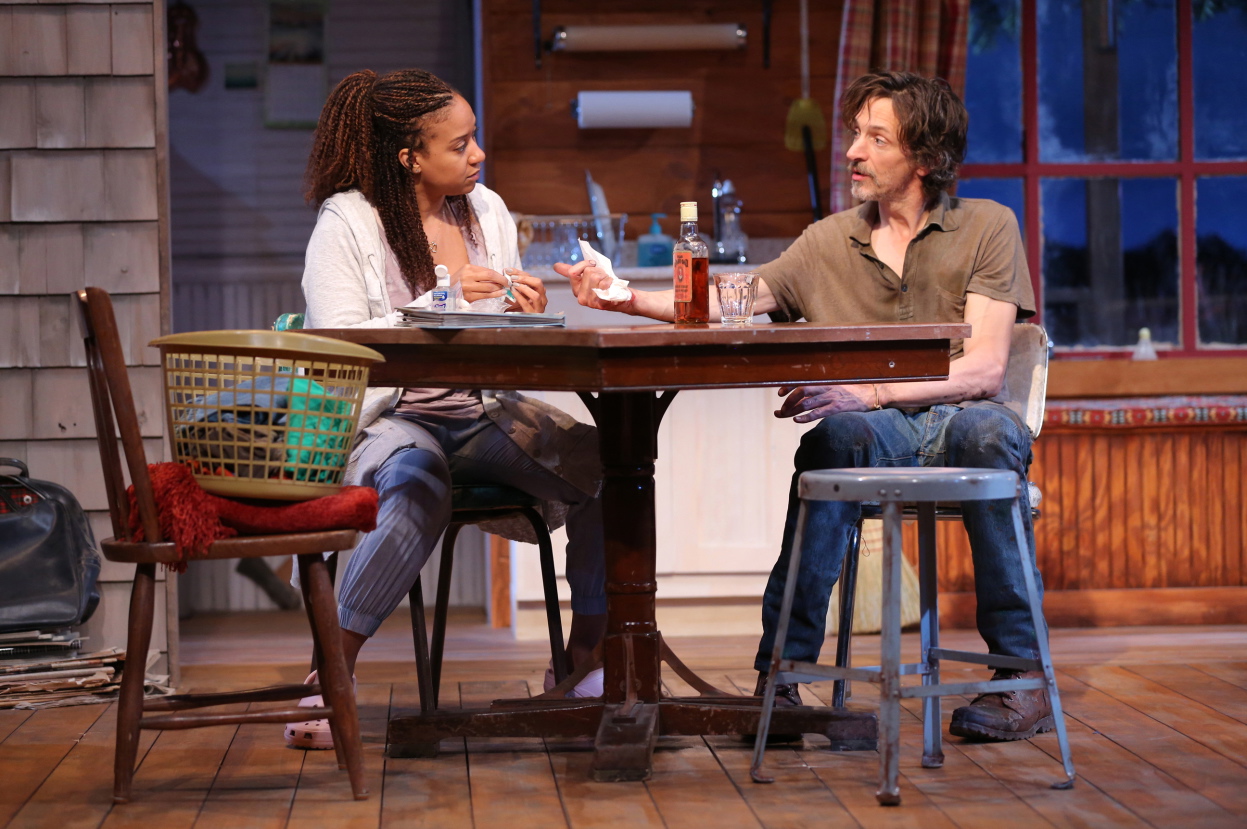
Veronica (Tracie Thoms) and Hogan (John Hawkes) are a pair of lost souls set adrift in new play by David Auburn (photo by Joan Marcus)

Manhattan Theatre Club
NY City Center Stage 1
131 West 55th St. between Sixth & Seventh Aves.
Tuesday – Saturday through December 21, $90
212-581-1212
www.lostlakemtc.com
www.nycitycenter.org

One of the best new plays of the fall season, David Auburn’s Lost Lake is a relatively simple yet compelling drama about two flawed souls trapped in worlds they can’t break out of. Veronica (Tracie Thoms) is a single mother looking to rent a cabin upstate for a week for her, her children, and one of their friends. Veronica goes up early to check out the cabin, which turns out to be as shoddy and ramshackle as its owner, Hogan (John Hawkes), a gaunt, grizzled, but well-meaning man who can’t seem to do anything right in his life. Both are repairers of a sort; Veronica is a nurse practitioner with aspirations to perhaps become a doctor, while Hogan purports to be a handyman who can fix just about anything, including the rotting swimming dock out on the lake behind the cabin. But neither can patch the gaping holes in their lives. As her supposed vacation progresses, Veronica gets caught up in Hogan’s family drama, as he lurks around the property, telling her about his problems with his ex-wife, his daughter, his brother, and, mostly, his despised sister-in-law, no matter how much Veronica just wants him to leave. But various events, both major and minor, keep bringing these two very different people together during a complicated period in which each is forced to take a long, hard look at the choices they’ve made while dealing with the hands they’ve been given.

Tony and Pulitzer Prize winner Auburn reteams with his Proof director, Daniel Sullivan, for this moving slice-of-life tale, which is highlighted by two superb performances. Thoms (Cold Case, Stick Fly) is careful and deliberate as Veronica, a troubled woman who does not like to let her wounds show. The Oscar-nominated Hawkes (Winter’s Bone, The Sessions) is riveting as Hogan, all herky-jerky and unpredictable as a man seemingly uncomfortable in his own skin. The back-and-forth banter between them is enhanced by the piercing yet vulnerable looks in their eyes, neither character happy with their lot in life but not sure how to turn things around. The script cleverly touches on such issues as race, the economic crisis, class, elitism, and gender roles while efficiently dismissing the one place you really don’t want it to go. J. Michael Griggs’s set is appropriately broken-down and dilapidated, echoing the protagonists’ inner demons. The ninety-minute Manhattan Theatre Club production follows the play’s debut earlier this year at the University of Illinois at Urbana-Champaign with Jake Weber and Opal Alladin as part of the Sullivan Project, a residency led by artistic director Daniel Sullivan, who has also helmed such shows as Rabbit Hole, Orphans, The Heidi Chronicles, and many Shakespeare in the Park presentations. Lost in the Lake is a fine fit for the intimate Stage I at City Center, where it is scheduled to run through December 21.

THE COUNTRY HOUSE

(photo by Joan Marcus)

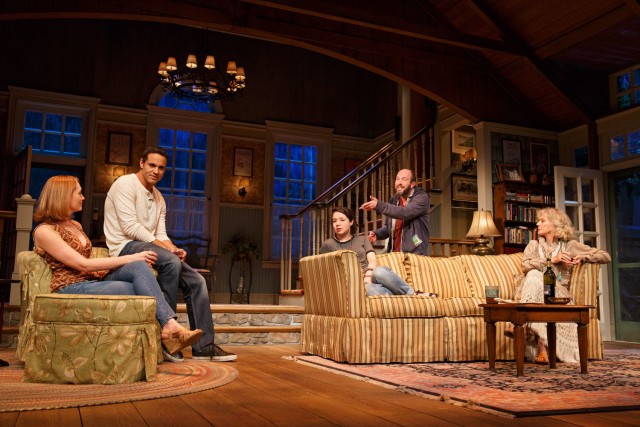
An acting family rips into itself in Donald Margulies’s THE COUNTRY HOUSE (photo by Joan Marcus)

Manhattan Theatre Club at the Samuel J. Friedman Theatre
261 West 47th St. between Broadway & Eighth Aves.
Tuesday – Sunday through November 23, $67-$125
www.manhattantheatreclub.com
www.thecountryhousebway.com

There’s something all too familiar about Pulitzer Prize winner Donald Margulies’s latest play, The Country House, which opened October 2 at the Manhattan Theatre Club’s Broadway home, the Samuel J. Friedman Theatre. The show, which deals with a close-knit group of friends and relatives gathering at a country house during the Williamstown Theatre Festival, resounds with echoes of such recent productions as the Tony-winning Vanya and Sonia and Masha and Spike, the underrated Ten Chimneys, the Public’s Nikolai and the Others, and MTC’s own The Snow Geese. It’s a year after the tragic death of Kathy, a beloved and successful actress and, by all accounts, one of the most amazing women ever to step foot on the planet. Her family is honoring her memory at their country house, led by her mother, stage diva Anna Patterson (Blythe Danner); Anna’s cynical, ne’er-do-well son, Elliot Cooper (Eric Lange); her former son-in-law, schlock director Walter Keegan (David Raasche), who was married to Kathy; and Susie (Sarah Steele), Walter and Kathy’s twentysomething daughter. Walter has arrived with his new fiancée, the much younger and very beautiful — as we are told over and over again — Nell McNally (Kate Jennings Bryant), a struggling actress, and Anna has also invited TV superstar and heartthrob Michael Astor (Daniel Sunjata), a longtime family friend who is slumming by appearing at the festival in Ferenc Molnár’s The Guardsman. Margulies (Time Stands Still, Dinner with Friends) channels Chekhov’s The Cherry Orchard and The Seagull as all the women flirt with Michael, the cynical Susie chooses not to get involved in the family business, and the condescending and contemptuous Elliott takes issue with just about everyone, writing a play that doesn’t exactly endear him to the others.

The Country House might not shed new light on this somewhat tired subject, but the production itself is excellent, fluidly directed by Daniel Sullivan, who has helmed many of Margulies’s previous plays. John Lee Beatty’s living-room set is charming and inviting, enhanced by Peter Kaczorowski’s splendid lighting, which smartly signals each next scene and is especially effective evoking a lightning storm. The acting is exemplary, led by the always engaging Danner (The Commons of Pensacola, Butterflies Are Free) as the still-feisty family matriarch rehearsing for Miss Warren’s Profession, and Steele (Slowgirl, Russian Transport), who is a star on the rise. Rasche (Speed-the-Plow, Sledge Hammer!) is particularly effective as Walter, a character with a lot more depth than originally presented, and TV veteran Lange (Lost, Victorious), in his first play in seven years, will have you wondering why he doesn’t take to the stage more often. Originally produced this past summer at the Geffen Playhouse in L.A. (where Danner, Steele, Rasche, and Lange originated their roles), The Country House has a lot to offer, but it’s a place that’s been visited far too often.

WHEN WE WERE YOUNG AND UNAFRAID

WHEN WE WERE YOUNG AND UNAFRAID

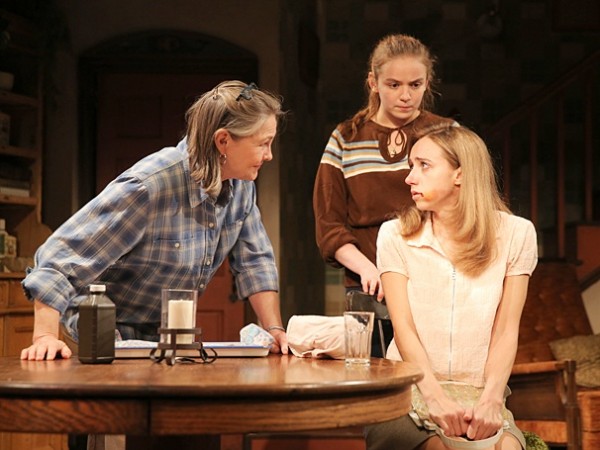
Cherry Jones, Morgan Saylor, and Zoe Kazan shine in world premiere by Sarah Treem (photo by Joan Marcus)

Manhattan Theatre Club
New York City Center Stage 1
Tuesday – Sunday through August 10, $89
212-581-1212
www.whenwewereyoungandunafraid.com
www.nycitycenter.org

Five-time Tony nominee Cherry Jones follows up her breathtaking performance as Amanda Wingfield in the Broadway revival of The Glass Menagerie with another powerful turn in Sarah Treem’s When We Were Young and Unafraid, but the two-time Tony winner (Doubt, The Heiress) ends up being much better than the play itself. Jones stars as Agnes, a determined woman running a bed and breakfast in 1972 on a small island off the coast of Seattle. In addition to serving vacationing guests, Agnes and her teenage daughter, Penny (Morgan Saylor), also secretly house and help battered women, protecting them from their abusers while nursing them back to physical and mental health. One day a terrified Mary Anne (Zoe Kazan) knocks on the door, her face beaten to a bloody pulp. Agnes offers her temporary asylum as long as she promises not to contact her husband, and soon Mary Anne and Penny, a bookish girl who wants to go to the prom with the captain of the football team, are bonding, discussing life and love. That part of the play works extremely well, treating a difficult subject with tenderness and humor.

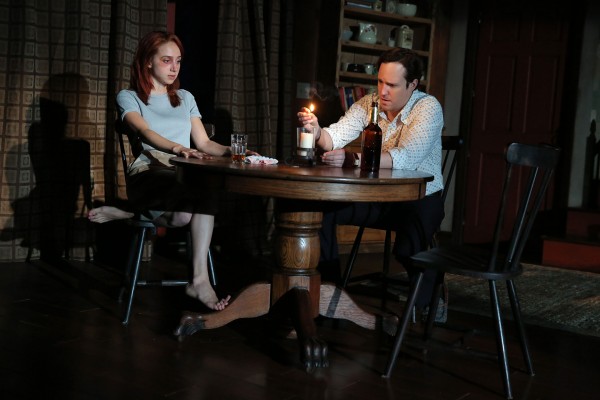
Too many hard-to-believe twists leave WHEN WE WERE YOUNG AND UNAFRAID in the dark (photo by Joan Marcus)

Too many hard-to-believe twists leave WHEN WE WERE YOUNG AND UNAFRAID in the dark (photo by Joan Marcus)

However, Treem, who has written such previous plays as A Feminine Ending and The How and the Why and for such television series as House of Cards and In Treatment, tries to do too much, losing focus, particularly by introducing the wholly unbelievable characters of Hannah (Cherise Boothe), a brash black lesbian spouting revolutionary platitudes, and Paul (Patch Darragh), a wimpy white singer-songwriter who is instantly attracted to Mary Anne. The Manhattan Theatre Club production, more than ably directed by Pam MacKinnon (Clybourne Park, Who’s Afraid of Virginia Woolf?), ultimately fails in attempting to examine the women’s rights movement from too many sides, getting lost in heavy didacticism and moralizing and losing its initial firm footing in reality. But Jones is still a marvel to watch, her every movement filled with nuance, eliciting solid support from Kazan (A Behanding in Spokane, The Exploding Girl) and Homeland regular Saylor in her affecting stage debut.