Tag Archives: Manhattan Theatre Club

CASA VALENTINA

CASA VALENTINA

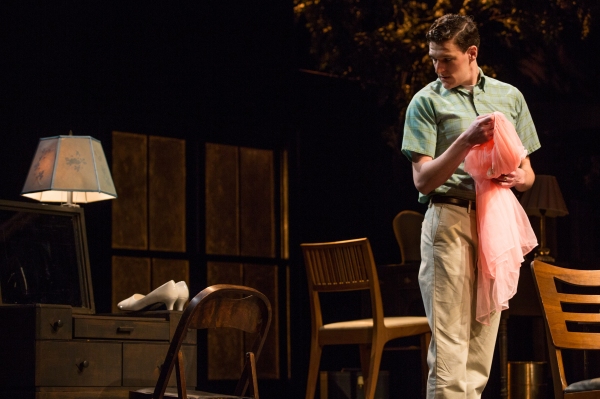
Jonathon (Gabriel Ebert) contemplates becoming Miranda in front of other people in CASA VALENTINA (photo by Matthew Murphy)

Manhattan Theatre Club at the Samuel J. Friedman Theatre
261 West 47th St. between Broadway & Eighth Aves.
Tuesday – Sunday through June 15, $67-$125
www.manhattantheatreclub.com
www.casavalentinabroadway.com

“Welcome to the Chevalier d’Eon Resort. Welcome to the world of self-made women,” Valentina (Patrick Page) announces in Harvey Fierstein’s sensitive and engaging, if occasionally didactic, new play, Casa Valentina. Fierstein’s first drama in more than a quarter century, following such hit musicals as Kinky Boots, Newsies, and La Cage aux Folles, Casa Valentina was inspired by the true story of a husband and wife who ran a Catskills bungalow in the 1960s where men would spends weekends cross-dressing and acting like women, a safe haven where they could celebrate their feminine side. The show takes place in June 1962 as Valentina, who spends her weekdays as George, and his wife, Rita (a wonderfully sensitive Mare Winningham), prepare for their latest arrivals. Among the attendees are Jonathon (Gabriel Ebert), a shy, nervous young man who will be making his first-ever appearance as Miranda; Bessie (Tom McGowan), a military veteran with a wife and kids who glories in the freedom Casa Valentina gives him; Gloria (Nick Westrate), a stylish woman who looks like she stepped out of an episode of Mad Men; Terry (John Cullum), a septuagenarian who tells Miranda, “You don’t get cleavage. You earn it”; and a respected judge (Larry Pine) who revels in becoming Amy away from his stressful regular life. The guest of honor for the weekend is Charlotte (Reed Birney), a radical cross-dresser who wants the others to join the Sorority, an organization that is attempting to change the public perception of and laws against transvestitism. “I firmly believe that once the world sees who we truly are, there will be no need for deception,” she says. However, membership includes signing an oath against homosexuality, something that makes the rest of the women more than a little uncomfortable.

CASA VALENTINA

Charlotte (Reed Birney) gets political at a Catskills bungalow in new Harvey Fierstein play (photo by Matthew Murphy)

Lovingly directed by two-time Tony winner Joe Mantello (Assassins, Take Me Out), Casa Valentina is at its best when it celebrates the joy these men experience by being accepted as women for a few treasured days. The show gets bogged down a bit when dealing with the oath, although it does bring up the critical point that the vast majority of cross-dressers — recent studies put the number around eighty percent — are heterosexual. Even with the growing acceptance of same-sex marriage in America, there are still gross misconceptions of homosexuality, transvestitism, and other so-called deviant or non-normative behavior, and Casa Valentina beautifully reveals how absurd it is for society to restrict and judge the predilections of others. The actors clearly have a blast in Rita Ryack’s lavish costumes and Jason P. Hayes’s glorious wigs and makeup (except for poor Winningham, allotted a frumpy pair of sensible pedal-pushers while the men get to wear fabulous dresses), while Scott Pask’s airy set immediately welcomes the audience into this little-known world. Cross-dressing might be somewhat de rigueur these days on Broadway (Kinky Boots, A Gentleman’s Guide to Love & Murder, Cabaret, Hedwig and the Angry Inch), but Fierstein, Mantello, and an extremely talented and beautiful cast offer a very different take on this misunderstood culture, treating it with humor, intelligence, honor, courage, and, perhaps most important, dignity.
TALES FROM RED VIENNA

(photo by Joan Marcus)

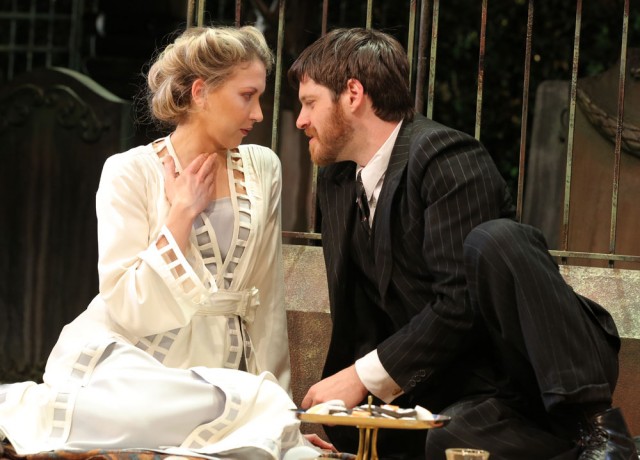
A war widow (Nina Arianda) and a Hungarian journalist (Michael Esper) consider a dangerous romance in TALES FROM RED VIENNA (photo by Joan Marcus)

Manhattan Theatre Club
New York City Center Stage 1
Through April 27, $89
212-581-1212
www.talesfromredvienna.com
www.nycitycenter.org

Inspired by the real-life story of desperate German war widows who turned to prostitution in the 1920s, David Grimm’s Tales from Red Vienna begins with a powerful scene: From behind a loose black curtain that evokes a widow’s veil, a gentleman enters a woman’s living room and promptly has sex with her against a table; he leaves money for her, but her distaste is clear. The curtain is then pulled back and we learn that she is Heléna (Nina Arianda), a formerly well-off married woman who has taken to extremes to earn money after her husband was killed in WWI. Instead of a mansion, she now lives in a small apartment but still manages to be served by her longtime housekeeper, the quick-witted and cynical Edda (Kathleen Chalfant). When Heléna’s best friend, society doyenne Mutzi von Fessendorf (Tina Benko), hatches a plan in which Heléna will join her on what is supposed to be a blind date but is really a way for the married Mutzi to meet with her potential lover, Heléna is shocked when the fix-up turns out to be her most recent customer. Hungarian journalist Béla Hoyos (Michael Esper) instantly takes a liking to Heléna, and her eventual reciprocation leads to major problems as the story takes an unexpected yet utterly clichéd and extremely disappointing turn.

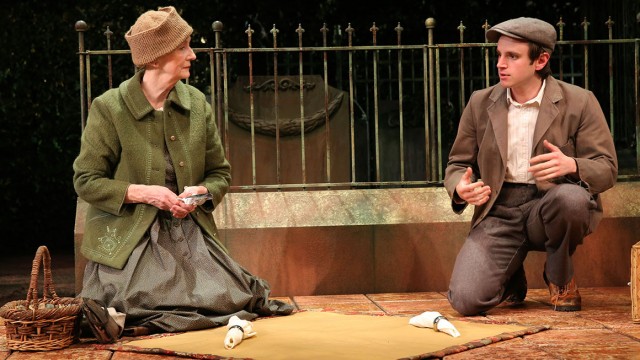
Kathleen Chalfant and Michael Goldsmith offer support in TALES FROM RED VIENNA (photo by Joan Marcus)

Kathleen Chalfant and Michael Goldsmith offer support in TALES FROM RED VIENNA (photo by Joan Marcus)

Directed by Kate Whoriskey (Ruined, Magdalena) with procedural attention across three acts with two intermissions, the Manhattan Theatre Club production at City Center is highlighted by John Lee Beatty’s (The Nance, Other Desert Cities) inventive sets, particularly the middle-section cemetery where Heléna and Bela have their secret rendezvous. But the promise of the first act slowly falls apart as predictable scenes mix with overacting (Benko, Hoyos) and underacting (Arianda, who was such a force in her Tony-winning role in Venus in Fur). Meanwhile, a subplot involving a Jewish grocer’s son (Michael Goldsmith) as a portent to the rise of Nazism essentially just fades away, emblematic of the play as a whole.

OUTSIDE MULLINGAR

(photo by Joan Marcus)

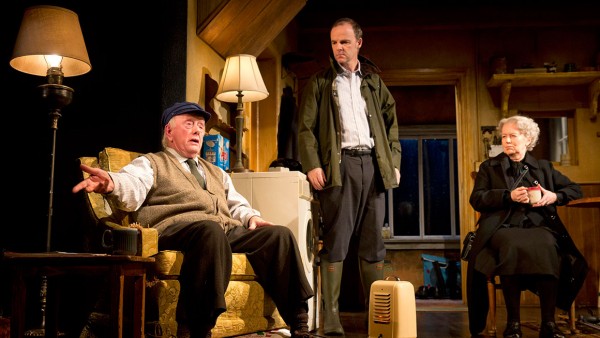
Tony Reilly (Peter Maloney) shares his questionable plans with son Anthony (Brían F. O’Byrne) and neighbor Aoife Muldoon (Dearbhla Molloy) in OUTSIDE MULLINGAR (photo by Joan Marcus)

Manhattan Theatre Club at the Samuel J. Friedman Theatre
261 West 47th St. between Broadway & Eighth Aves.
Tuesday – Sunday through March 16, $67-$135
www.manhattantheatreclub.com
www.outsidemullingarbroadway.com

Ten years ago, Manhattan Theatre Club presented Bronx-born playwright John Patrick Shanley’s Doubt, starring Brían F. O’Byrne, directed by Doug Hughes, and with scenic design by John Lee Beatty. That group has teamed up again for the world premiere of Outside Mullinger, a charming little tale that opened last week at the Samuel J. Friedman Theatre. A dark romantic comedy, Outside Mullingar takes place in County Westmeath in the home of Tony Reilly (a wonderful Peter Maloney) and his ne’er-do-well son, Anthony (five-time Tony nominee O’Byrne). An elderly widower, Tony tells his neighbor, Aoife Muldoon (Dearbhla Molloy), that he is considering selling his farm to his nephew in America rather than leave it to Anthony. Aoife, who has just buried her husband, Christopher, can’t believe Tony would do that to his son, who is distressed when he is told of the possibility that he might not get the family land he has worked on his whole life. Discussion also turns to a forty-meter strip of land on the Reilly property that is actually owned by the Muldoons because of an old loan. The strip divides the front of the Reilly home so Tony and Anthony have to walk through a pair of gates to get from the road to their front door. Now that Christopher Muldoon has died, the Reillys believe they can get that narrow bit of land back, but Muldoon’s daughter, Rosemary (Debra Messing), is not about to hand it over, as it holds a very special memory for her. As the two families bicker both playfully and seriously, attention soon turns to Anthony and Rosemary, two lonely, difficult people who clearly don’t know what’s best for them.

(photo by Joan Marcus)

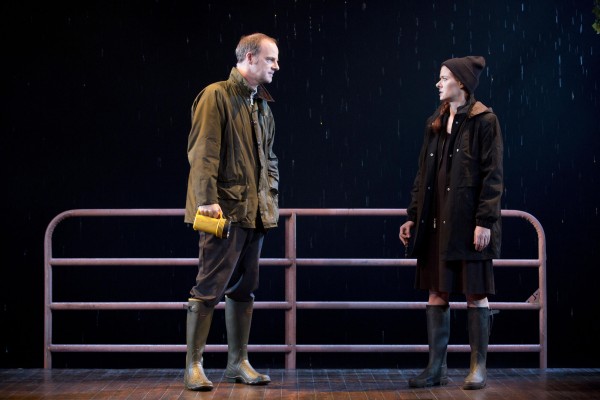
Anthony Reilly (Brían F. O’Byrne) and neighbor Rosemary Muldoon (Debra Messing) battle it out during a soft rainstorm in new John Patrick Shanley play (photo by Joan Marcus)

Shanley, who won a Tony and a Pulitzer for Doubt and an Oscar for his screenplay for Moonstruck, keeps things simple in Outside Mullingar, which works as a timeless character study, performed by an engaging cast. Maloney (To Be or Not to Be, Judgment at Nuremberg) nearly steals the show as the crotchety old man, while Molloy (Dancing at Lughnasa, The Cripple of Inishmaan) is stalwart as the widow dressed in black. One of the genuine treasures of the New York stage, O’Byrne (Frozen, The Beauty Queen of Leenane) plays the unpredictable Tony with just the right mix of ambiguity and crazy. And in her Broadway debut — although she has performed often off Broadway, including as Mary Louise Parker’s understudy in Shanley’s Four Dogs and a Bone — Emmy Award winner Messing (Will & Grace, Smash) is a delight, employing an Irish brogue as she battles with Tony both in his house and outdoors in a gentle rainstorm. Here’s hoping it’s not another ten years before this talented team works together again.

THE COMMONS OF PENSACOLA

THE COMMONS OF PENSACOLA

A family faces some hard, cold truths in THE COMMONS OF PENSACOLA (photo by Joan Marcus)

Manhattan Theatre Club
New York City Center Stage 1
Extended through February 9, $105
212-581-1212
www.thecommonsofpensacola.com
www.nycitycenter.org

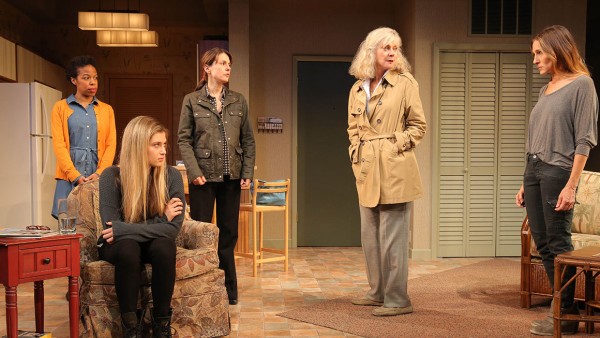
Earlier this year, Steven Levenson’s The Unavoidable Disappearance of Tom Durnin at the Roundabout examined the Bernie Madoff scandal through the eyes of a man returning from prison. Now Manhattan Theatre Club looks at the crisis from a very different point of view in Amanda Peet’s engaging and involving The Commons of Pensacola. Blythe Danner stars as Judith, a grandmother banished to live in shame in a low-rent Florida retirement community after her husband gets nailed by the Feds. With Thanksgiving approaching, Judith is visited by her forty-three-year-old daughter, Becca (Sarah Jessica Parker), and Becca’s twenty-nine-year-old boyfriend, Gabe (Michael Stahl-David). A fading actress, Becca wants to team up with Gabe, a photojournalist, to make a documentary series about Judith, focusing on her former extravagant lifestyle and what her days are like now, without any money or the luxury she grew to be so familiar and comfortable with. They are soon joined by Becca’s sixteen-year-old niece, Lizzy (Zoe Levin), who has snuck away to see her grandmother against her mother’s wishes. But soon Lizzy’s mom, Becca’s sister, Ali (Ali Marsh), who had sworn never to see their mother again, is there as well, and some damaging secrets and lies that have been bubbling just below the surface threaten to explode.

Lizzy (Zoe Levin) has a little too much in common with her aunt Becca (Sarah Jessica Parker) in Amanda Peets debut play (photo by Joan Marcus)

Lizzy (Zoe Levin) has a little too much in common with her aunt Becca (Sarah Jessica Parker) in Amanda Peet’s playwriting debut (photo by Joan Marcus)

Peet, who has appeared in such films as The Whole Nine Yards and Please Give and such television series as Studio 60 on the Sunset Strip and The Good Wife, makes a more than admirable debut as a playwright with The Commons of Pensacola. Despite a few questionable plot twists, the dialogue is sharp and the characters wholly believable, propelled by MTC artistic director Lynne Meadow’s noninvasive direction and Santo Loquasto’s clean and tidy set, which features a glass door to the outside that is jammed shut. Danner and Parker make a natural mother and daughter team, playing off each other with a friendly ease; they previously teamed up in A. R. Gurney’s Sylvia, a 1995 MTC production in which Danner played a married woman and Parker played the stray dog her husband (Charles Kimbrough) just picked up in the park. Levin, who was in The Way, Way Back with Peet, fits right in as the niece who emulates her rather kooky aunt. Nihala Sun (No Child…) does what she can with the relatively predictable role of the black maid, Marsh is somewhat annoying as the annoying Ali, and Stahl-David (Cloverfield) is fine as Gabe, who becomes much more than just an innocent observer of this newly destitute clan. Continuing through February 9 at City Center, The Commons of Pensacola, which clocks in at a smooth, uninterrupted eighty minutes, might not be particularly deep, but it does offer a good balance of comedy and drama while depicting another side of the Madoff madness.

THE SNOW GEESE

(photo by Joan Marcus)

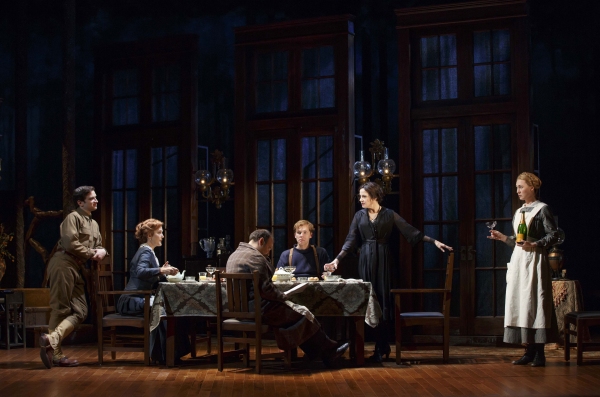
The Gaesling clan gathers at their upstate lodge for the start of hunting season (photo by Joan Marcus)

Manhattan Theatre Club at the Samuel J. Friedman Theatre
261 West 47th St. between Broadway & Eighth Aves.
Tuesday – Sunday through December 15, $67-$120
www.manhattantheatreclub.com
www.thesnowgeesebroadway.com

Late last year, Sharr White’s gripping The Other Place, a searing look inside the mind of a marketing executive lost in her own alternate reality, opened on Broadway after a 2011 run at MCC Theatre. White’s follow-up, The Snow Geese, another coproduction of Manhattan Theatre Club and MCC at the Samuel J. Friedman, is a dreary mashup of Alan Bridges’s 1985 film The Shooting Party and Chekhov’s The Cherry Orchard, a just-plain-dull WWI-era tale focusing on a woman having difficulty facing reality after the unexpected loss of her beloved husband. Despite the sudden death of Teddy, Elizabeth Gaesling (Mary-Louise Parker) thinks she is ready to go on with her life as the family comes together at their lodge in upstate New York for their traditional toast at the opening of snow goose season. Elizabeth is joined by her two sons: the patriotic, prodigal Duncan (Evan Jonigkeit), who goes to Princeton and has joined the war effort, and Arnold (Brian Cross), who has stayed home to take care of their mother and the family finances, which are not in very good shape.

(photo by Joan Marcus)

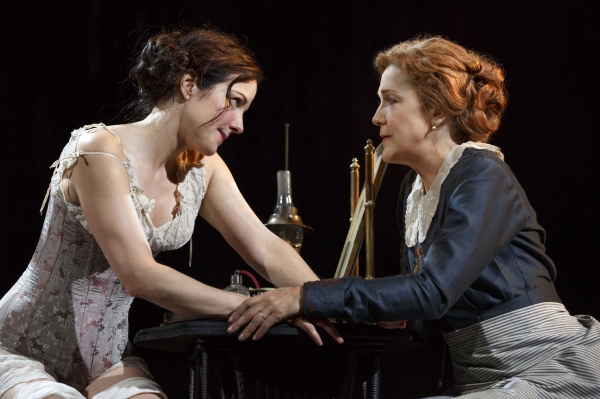
Two sisters (Mary-Louise Parker and Victoria Clark) try to get by in Sharr White’s new Broadway play (photo by Joan Marcus)

Also with them is Elizabeth’s sister, Clarissa (Victoria Clark), a very Christian woman who thinks that Elizabeth should still be in mourning, and her husband, Max (Danny Burstein), a German-born doctor with a thick accent who can no longer practice medicine because of anti-Axis sentiment, even though he has been an American for decades. Most of the meandering story plays out on John Lee Beatty’s stodgy dining-room set, with occasional boring scenes out in bare woods where Duncan and Arnold verbally spar while not shooting at snow geese, who fly by in a metaphorical gaggle of freedom. The most interesting figure in the play is the Gaeslings’ maid, Viktorya Gryaznoy (Jessica Love), a bright young woman from a wealthy family who escaped the Ukraine and has taken a job well below her; how she is treated by the others establishes not only her character but theirs as well. Director Daniel Sullivan (Proof, Orphans) is not able to do much with the material or the mediocre performances, surprising from such a talented cast. The Snow Geese takes aim at examining the human condition in a changing America during WWI but unfortunately ends up firing mostly blanks.

ALL THE FACES OF THE MOON

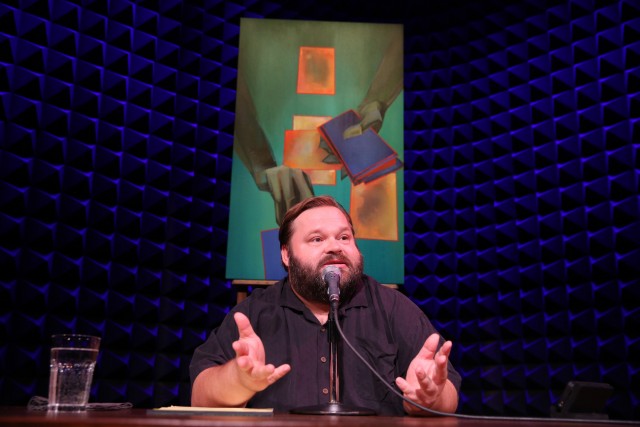
Mike Daisey mixes reality and fantasy in ambitious, epic twenty-nine-night tale at Joe’s Pub (photo by Joan Marcus)

Mike Daisey mixes reality and fantasy in ambitious, epic twenty-nine-night tale at Joe’s Pub (photo by Joan Marcus)

Joe’s Pub
425 Lafayette St.
Nightly through October 3, $26.50 ($20 with code DAISEY), no food or drink minimum, 7:00
212-967-7555
www.joespub.com
www.mikedaisey.blogspot.com

Monologist Mike Daisey is currently in the midst of an epic New York story at Joe’s Pub, a twenty-nine-consecutive-night “theatrical novel” that continues through October 3. Each evening, Daisey sits at a table for between sixty and seventy-five minutes, with a glass of water, a handkerchief to mop his perpetually sweaty face and brow, and a pad on which he has written an outline of what he is going to talk about. Behind him on an easel is a painting by Larissa Tokmakova (There There), who created a different canvas for each night. Daisey, whose last piece, The Agony and the Ecstasy of Steve Jobs, stirred up quite a controversy when it was revealed that not every word in his story of Chinese workers who make Apple products at the massive Foxconn facility in Shenzhen was true, this time very deliberately mixes fact and fiction, reality and fantasy. The first part of each show generally deals with Daisey’s personal and professional life, as he discusses his childhood in Maine, self-deprecatingly talks about his girth, cynically examines life in the American theater, relates his bout with suicidal thoughts, makes fun of the price of food audience members are eating (unlike most shows at Joe’s Pub, there is no food or drink minimum), and brings up the potential of having sex in strange places with his wife, Jean-Michele Gregory, who is also the director.

(photo by Sabrina Fonseca)

Mike Daisey and painter Larissa Tokmakova in the studio, preparing for ALL THE FACES OF THE MOON (photo by Sabrina Fonseca)

Working from an outline, Daisey veers off into riotous tangents, his inflections suddenly going from soft and gentle to loud and sharp as he rants, raves, and rages about Dungeons and Dragons, Bob Dole, McDonald’s, Apple, McSweeney’s, vampires, the First Church of Christ IKEA Redeemer, Manhattan Theatre Club, and, at the center of it all, a changing New York City. But then, about halfway through, Daisey shifts gears, delving into a fantastical, surreal world where parties go on for years, Death follows him, and a mysterious character known as the Big Guy hires an even more mysterious figure named Jack to kill him (the Big Guy). At first this transition is confusing, seemingly arriving out of nowhere, but it eventually all comes together, especially if you see or listen to multiple shows. (A podcast of each performance is posted online by noon the next day.) Daisey is an engaging performer who is not afraid to take risks, a master storyteller who puts it all out there, adapting to the situation as necessary, whether sensing a lull in the proceedings or making a reference that very few people get. There’s an immediacy and intimacy about his presentation that instantly grabs the audience, which is willing to forgive Daisey his past problems and join him on this wildly ambitious ride, which features such intriguing chapter titles as “The Naked Emperor Is Still Laughing,” “Jupiter Is a King Who Never Came Back,” “Saturn Is a Father Devouring His Children,” and “The World Is More Than We Will Ever Know.” As a bonus, ticket holders receive a special tarot card for that specific show, featuring the name of the chapter and a color image of Tokmakova’s painting for that night; the tarot cards are also available to those who write legitimate reviews of individual podcasts.

THE EXPLORERS CLUB

THE EXPLORERS CLUB

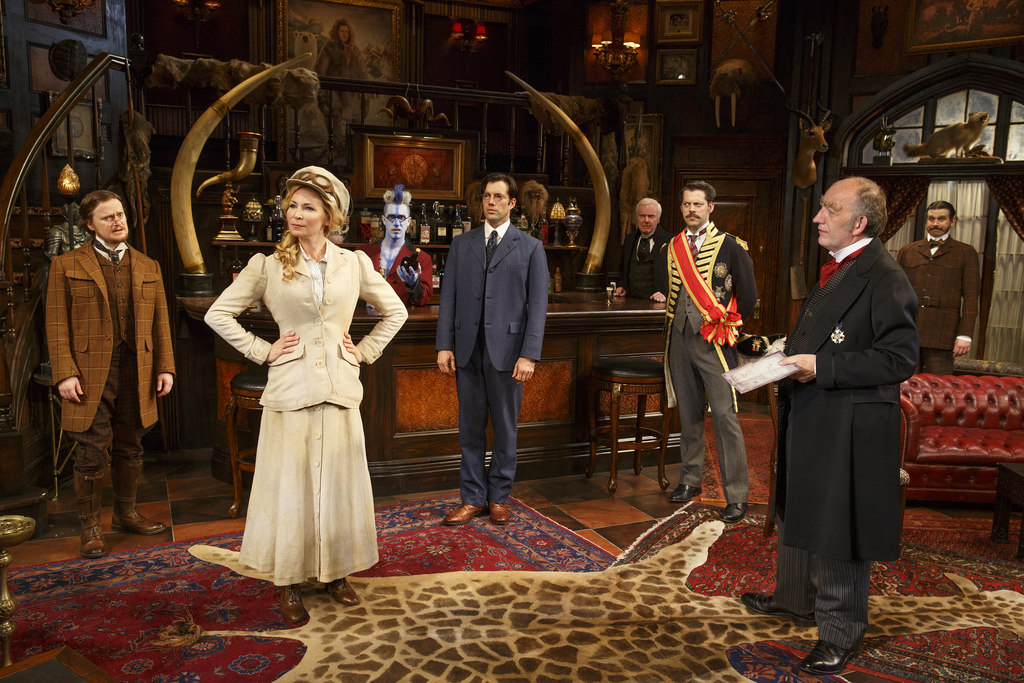
The set is the real star of the Manhattan Theatre Club world premiere of THE EXPLORERS CLUB (photo by Joan Marcus)

Manhattan Theatre Club
New York City Center Stage 1
Through July 21, $85
212-581-1212
www.theexplorersclubplay.com
www.nycitycenter.org

Evoking a number of classic Monty Python adventure skits (including the “Bruces” sketch and “The Lost World of Roiurama”), Nell Benjamin’s The Explorers Club is an immensely silly comedy set in Victorian-era England as a small gathering of explorers decide whether to accept its first female member. The wacky hijinks take place on Donyale Werle’s gorgeous set, featuring taxidermied animals hanging from the walls, a giraffe skin stretched across the floor, paintings of intrepid explorers, and a dazzling, fully stocked bar bookended by huge tusks; theatergoers are actually encouraged to snap photos of the stage and post them to social media sites before the show begins. Unfortunately, the set is the best thing about this goofy tale that regularly travels too far over the top. The Manhattan Theatre Club production stars Jennifer Westfeldt (Kissing Jessica Stein) as Phyllida Spotte-Hume, an explorer who is scheduled to present to the queen her latest finding, the very blue Luigi (Carson Elrod) from the NaKong tribe of the Lost City of Pahatlabong. But after events go terribly wrong at the palace, the queen’s envoy, Sir Bernard Humphries (Max Baker), arrives, needing important information so England can go to war with the NaKong. Meanwhile, the rather proper, shy Lucius Fretway (a sweetly innocent Lorenzo Pisoni) takes a liking to Phyllida, the bombastic Harry Percy (a very funny David Furr) boasts of his discovery of the East Pole, Professor Sloane (John McMartin) quotes from the Bible and claims that the Irish are the lost Hebrews, and Professors Walling (Steven Boyer) and Cope (Brian Avers) battle over rats and snakes. The Explorers Club — not to be confused with the actual Explorers Club on the Upper East Side — becomes tiresome and repetitive very quickly, as director Marc Bruni (Old Jews Telling Jokes) and Benjamin (Legally Blonde) continually tread the same territory, whether it be jokes about snakes and charades or mentions of the club’s chief competitor, the National Geographic Society. However, one repeated joke is nearly worth the price of admission itself; posing as a bartender, Luigi mixes drinks and serves them by sliding them across and off the bar, where they’re acrobatically caught by the cast in delightful displays of dexterity. Otherwise, The Explorers Club is a disappointing journey that fails to explore any new territory.