Tag Archives: Manhattan Theatre Club

THE PERPLEXED

(photo © Matthew Murphy, 2020)

Rival families try to find common ground in Richard Greenberg’s The Perplexed (photo © Matthew Murphy, 2020)

Manhattan Theatre Club
MTC at New York City Center – Stage I
Tuesday – Sunday through March 29, $99-$109
212-581-1212
perplexedplay.com

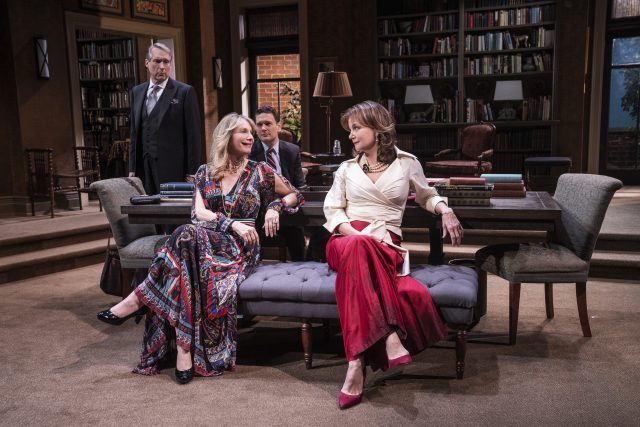
Succession meets Romeo and Juliet in Richard Greenberg’s The Perplexed, making its world premiere at City Center’s Stage I. The Manhattan Theatre Club production, which opened last night and runs through March 29, takes place in a stunning library in a Fifth Avenue mansion that has audience members gasping in delight (and jealousy) as they enter the space; the set, filled with books, austere furniture, and inviting nooks that disappear off into the wings, was designed by Santo Loquasto, who has won five Drama Desk Awards and four Tonys and has been nominated for three Oscars for his production design and costumes, most prominently for Woody Allen films. You are instantly sucked into this insulated sphere of the rich and the formerly rich, men and women dealing with who they were, not necessarily knowing who they are or who they will be.

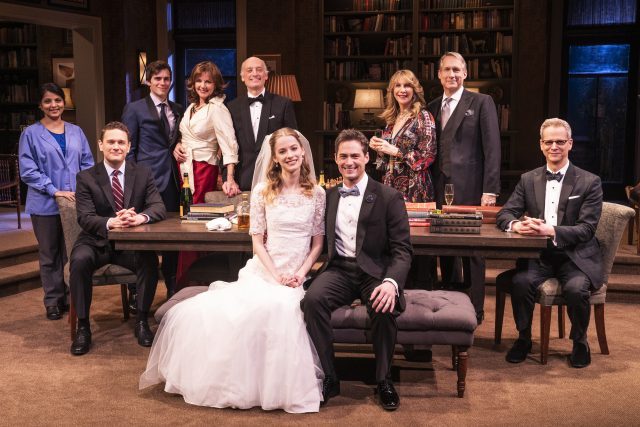
Isabelle Stahl (Tess Frazer) and Caleb Resnik (JD Taylor) are getting married in the massive town house owned by her grandfather, the unseen, ridiculously wealthy Berland, who nobody seems to care for very much. Isabelle and Caleb have been destined to be together since they were six years old, but a rift over money tore the families apart until the two millennials reconnected on a subway platform twenty years later — how gauche! — and fell in love. The controlling and manipulative Berland is the father of the somewhat addled Joseph Stahl (Frank Wood), who is married to the elegant Evy (Margaret Colin), a candidate for City Council speaker; her red dress is wet and dirty from a stop she made at the site of a water-main break on the way to the wedding, and throughout the action the stain creeps slowly up from the hem. Their son, Micah (Zane Pais), is in med school but has also added acting in online porn to his resume. So much for the bride’s side.
(photo © Matthew Murphy, 2020)

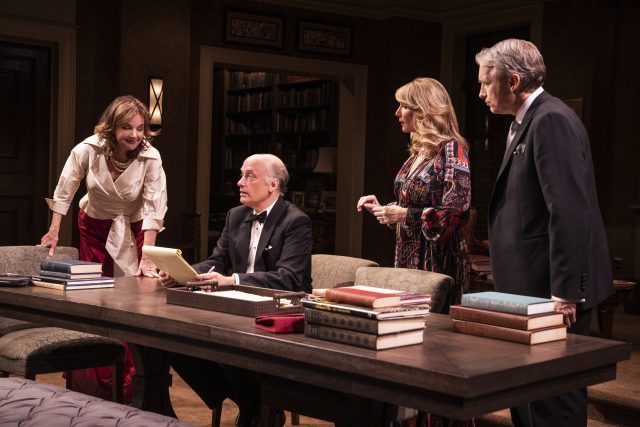
Margaret Colin, Frank Wood, Ilana Levine, and Gregg Edelman play in-laws-to-be in MTC world premiere (photo © Matthew Murphy, 2020)

Caleb’s mother, Natalie Hochberg-Resnik (Ilana Levine), is a would-be social justice warrior not above delivering verbal jabs and none-too-subtle innuendoes, while her husband, Ted Resnik (Gregg Edelman), appears to be a pleasant, understated gentleman. “Don’t our children look too beautiful? Doesn’t it positively make you want to kill yourself?” Natalie says, to which Evy responds, “That’s not what does.” A few moments later, Natalie offers, “We can maintain an entente cordiale. For the kids.” Evy replies, “There’s never been a real reason for the rupture. We hate the same things. And the kids are so great. It would be a pity to make this evening worse than it already is.”

Meanwhile, Evy’s brother, the sarcastic, wry writer James Arlen (Patrick Breen), adds erudite commentary to the goings-on as former rabbi Cyrus Bloom (Eric William Morris), who will be officiating the marriage, is preparing his words for the ceremony. “I think you’re slinging a whole lot of bullshit here, James,” Cyrus says early on. “If I am, it’s not original to me, it’s what’s been passed down — heirloom bullshit,” James answers. It is clear that no one wants to be there with Berland as former glories, current enmity, and the stratifications of wealth threaten to crack the smooth social veneer. As the midnight nuptials approach, surprising past relationships among various characters are revealed and blood is spilled.
(photo © Matthew Murphy, 2020)

Richard Greenberg’s The Perplexed is about wedding that brings together two formerly wealthy families (photo © Matthew Murphy, 2020)

In Greenberg’s 2013 Broadway play, The Assembled Parties, one character says, “God is bogus, and religion a scourge. Still, I believe in something, though I’m not sure what.” The same thing applies to The Perplexed, which several times invokes the Kabbalistic concept of the broken vessels, which involves God’s light, good and evil, and repairing a shattered universe. Several characters think Cyrus can just spit out a biblical parable and all will be well, but that’s not quite how it works. “My friends started pointing out that I was using the word God a lot and wasn’t I an official atheist and would I please cut it out?” Cyrus admits. It’s hard to know just what the Arlens and the Resniks believe in. Perhaps it is all summed up by Patricia Persaud (Anna Itty), Berland’s housekeeper. “When we are foolish, it’s good that things hurt a little,” she tells everyone.

Efficiently guided through extensive changes during previews — there was confusion the night I went about the running time, which is currently officially listed as two hours and fifteen minutes with one intermission — by MTC artistic director and three-time Tony nominee Lynne Meadow, who has previously helmed Greenberg’s Our Mother’s Brief Affair and the aforementioned The Assembled Parties, the superbly acted The Perplexed is a clever and witty drawing-room comedy that journeys into the world of a privileged class trying to hold on after much of that privilege has gone away.
MY NAME IS LUCY BARTON

(photo by Matthew Murphy)

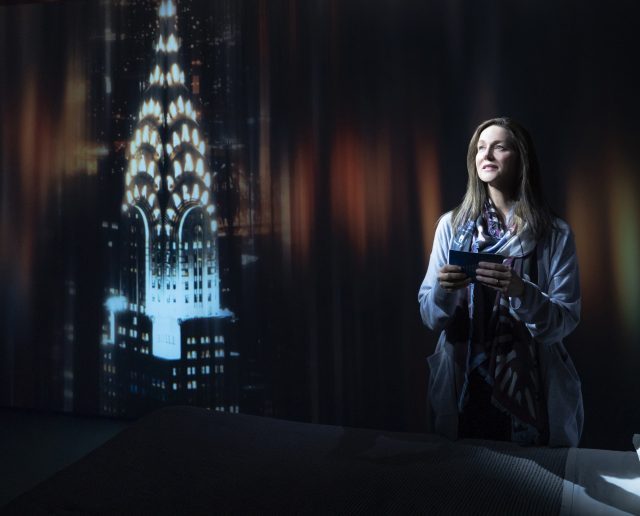
Lucy Barton (Laura Linney) recalls a significant time in her life in play based on Elizabeth Strout novel (photo by Matthew Murphy)

Manhattan Theatre Club at the Samuel J. Friedman Theatre
261 West 47th St. between Broadway & Eighth Aves.
Monday – Saturday through February 29, $70-$150
www.manhattantheatreclub.com
lucybartonplay.com

It’s always a pleasure watching the exquisite Laura Linney, whether on television, in film, or onstage. Nominated for three Oscars and four Tonys and winner of four Emmys, the Manhattan native has an instantly infectious appeal; you want to be in her luminous presence. She is terrific once again in her latest Broadway play, the one-woman show My Name Is Lucy Barton, which is based on Elizabeth Strout’s 2016 novel and continues at MTC’s Samuel J. Friedman Theatre through February 29. Under Richard Eyre’s expert direction, she flows between sharing her story with the audience and portraying her mother. So why isn’t it better?

Born and raised in the rural town of Amgash, Illinois, Lucy is now reflecting on a critical time in her life, when she spent nearly nine weeks in a New York City hospital. Her husband hates hospitals, so he refuses to visit her, instead choosing to care for their two young daughters. She is estranged from her parents and siblings but is shocked when her mother, who she hasn’t seen in many years, unexpectedly arrives and spends days and days sitting in a chair in Lucy’s hospital room, mostly gossiping about people from the old neighborhood, quite disinterested in Lucy and her family. While her mother is there, Lucy recalls the physical and psychological abuse she suffered at the hands of her parents and discusses the life she led as a child, with no television, no newspapers or magazines, no books, no friends, no sense of personal identity. “How do you even know what you look like if the only mirror in the house is a tiny one high above the kitchen sink?” she says.

(photo by Matthew Murphy)

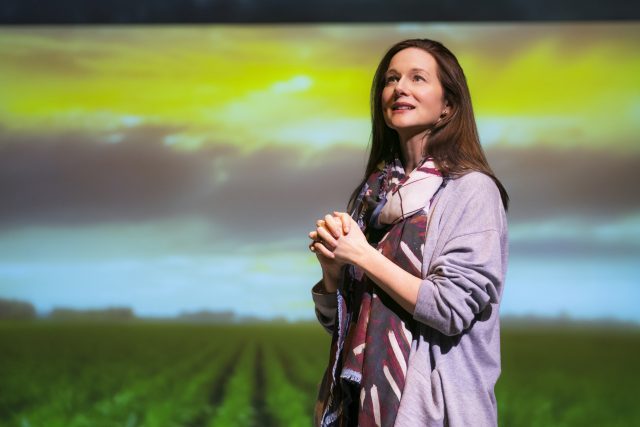
Laura Linney is once again exquisite in one-woman show on Broadway (photo by Matthew Murphy)

So she set out on a new course, moving to the big city but unable to shake a haunting loneliness. “I was lonely,” she explains. “Lonely was the first flavour I had tasted in my life, and it was always there, hidden inside the crevices of my mouth, reminding me.” It’s this loneliness that is at the center of the story, and primarily women’s loneliness. Her mother can’t stop talking about women like her friend Kathie Nicely and her cousin Harriet, who left their husbands or were left by them, and their often unsuccessful efforts to make new lives and establish their own identities.

But there’s also a lonely feeling watching the play; we wrap ourselves around Linney (The Little Foxes, The Big C, The Savages), not the narrative, which seems inconsequential for the most part, and the material lets down the rest of Eyre’s (Guys and Dolls, Notes on a Scandal) production, which is stellar. Bob Crowley’s pristine set consists of a chair and a hospital bed as well as three successively larger wall screens in the back on which video designer Luke Halls projects peaceful shots of corn and soybean fields in Illinois and the Chrysler Building and streets of New York City, with precise lighting by Peter Mumford as Linney shifts between characters.

Despite it being her story, Lucy is an unreliable narrator. She regularly says “I think,” not firm in what she is relating. At one point she says of her mother, “Maybe she didn’t say that. I don’t remember.” Later she admits, “I still am not sure it’s a true memory, except I do know it, I think. I mean: It is true.” It’s as if she’s doing a (wonderfully) staged reading of the book; Rona Munro’s (The James Plays, Bold Girls) adaptation sounds more like an audiobook you can listen to while driving. In fact, the play is presented “in association with” Penguin Random House Audio, which published the audiobook in 2016, read very differently by Kimberly Farr. But forgetting everything else, there is one main reason to see the play, and her name is Laura Linney.

BELLA BELLA / A WOMAN OF THE WORLD

(photo by Carol Rosegg)

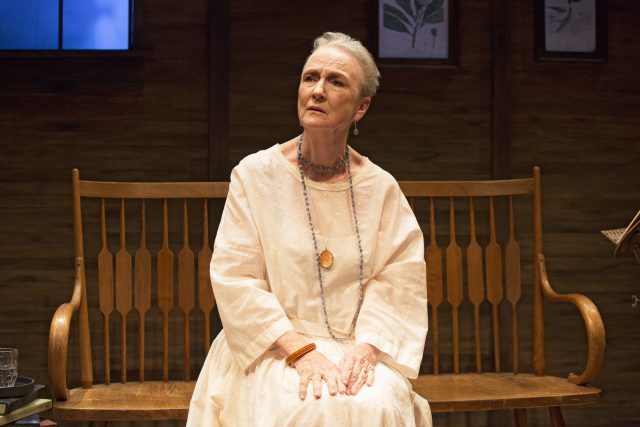
Kathleen Chalfant is radiant as Mabel Loomis Todd in A Woman of the World (photo by Carol Rosegg)

A WOMAN OF THE WORLD
59E59 Theaters
59 East 59th St. between Park & Madison Aves.
Tuesday – Sunday through November 17, $25-$35
212-279-4200
www.59e59.org

Currently two one-person shows about real women are running off Broadway, both with a feminist bent, both starring New York theater legends. Yet they could not be more different, one far superior to the other. At 59E59, five-time Obie winner Kathleen Chalfant is beautifully portraying Mabel Loomis Todd (1856–1932) in the Acting Company’s world premiere of Pulitzer Prize finalist Rebecca Gilman’s utterly delightful A Woman of the World. It’s 1931, and Todd is giving a lecture, “The Real Emily Dickinson,” at the Point Breeze Inn on Maine’s Hog Island. In the 1890s, Todd edited several collections of Dickinson’s poetry, published after the reclusive New England poet’s death in 1886 at the age of fifty-five, and Todd built a lucrative and unusual career around her association with Dickinson. Todd’s talk is supposed to be about Dickinson, but it ends up instead delving into Todd herself as she shares intimate stories about her own life, including her relationship with her husband, astronomer David Todd; her close friendship with Emily and her brother Austin; and her affection for Hog Island, much of which she owns.

(photo by Carol Rosegg)

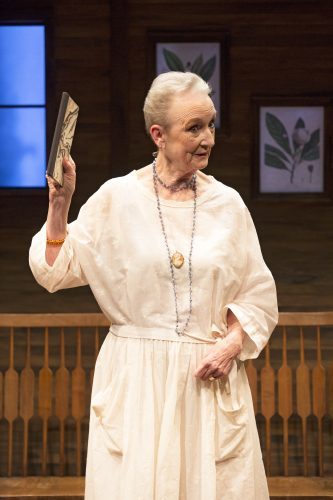
Mabel Loomis Todd (Kathleen Chalfant) details her relationship with Emily Dickinson and her family in A Woman of the World (photo by Carol Rosegg)

“If you haven’t already, do step outside tonight and look at the sky. It’s one of those clear nights on Hog Island when the stars are so close you feel like you could reach out and touch Polaris,” she says wistfully. “And while you’re out there, listen closely and you’ll hear — well, besides the wind in the trees — and the waves on the rocks — which together comprise the most peaceful sound I know. . .” Margaret Montagna’s sound design includes chirping birds that add to the allure. Todd continually turns to her unseen daughter, Mrs. Millicent Bingham, who is signaling her from the back, particularly as her mother gets distracted and goes off topic, letting her personal biases and vengeful character show through, as well as her extreme self-aggrandizement. “I confess to you, it’s been something of a burden to me over the years that men have always found me impossible to resist. And it’s not because of anything I actively do to attract them,” she boasts. “It’s because the average man is rarely exposed to someone of my natural talents, and singular charm. When I was young, I was renowned for my beauty. But more than that, I was an accomplished artist.” There’s seemingly nothing Todd couldn’t do, and she wants the audience to know about it all.

But soon after she notes that “like all families, the Dickinsons had their secrets,” it’s the Todd family secrets that come pouring out, one after another, offering myriad surprises and more than a few shocks. Chalfant (Wit, Talking Heads) fully embodies the elegant and graceful Todd, wearing an ankle-length off-white dress with a long necklace and short hair like a second skin. (The costume is by Candice Donnelly.) She is captivating and beguiling as she slowly glides around Cate McCrea’s tiny yet cozy set, featuring a wooden bench, a pair of carpets, and two stacks of books on the floor, with framed pictures of plants on the wall and a window revealing clouds and sky. Gilman (Soups, Stews, and Casseroles: 1976; The Glory of Living) and director Valentina Fratti (Williston, R.U.R.) turn the 2019 audience at 59E59 into the 1931 crowd in the parlor at the Point Breeze Inn as we hang on Todd’s every word and movement, enraptured by the house of cards she has so carefully constructed. Todd was clearly ahead of her time, in more ways than one.

(photo by Jeremy Daniel)

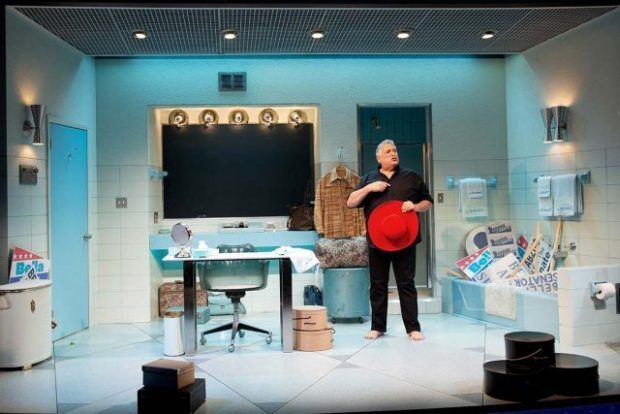
Harvey Fierstein plays firebrand Bella Abzug in Bella Bella (photo by Jeremy Daniel)

BELLA BELLA
Manhattan Theatre Club
MTC at New York City Center
130 West 56th St. between Sixth & Seventh Aves.
Tuesday – Sunday through December 1, $99-$139
212-581-1212
www.manhattantheatreclub.com
bellabellaplay.com

Four-time Tony winner Harvey Fierstein pays tribute to another woman ahead of her time, Bella Savitsky Abzug (1920-98), in Bella Bella, an MTC production making its world premiere at New York City Center. Fierstein wrote the play, based on Battling Bella’s own words, and stars as the Bronx-born firebrand, an antiwar social activist, feminist, and lawyer who spent three terms as a US Congresswoman. It’s September 15, 1976, and Abzug is cooped up in the cluttered bathroom of a room at the Summit Hotel on West Fifty-Seventh St. while awaiting the returns in her Senate primary race against Daniel Patrick Moynihan. Her husband, Martin; daughters, Eve and Liz; sister, Helene; press secretary, Harry Holzer; and famous friends Shirley, Lily, and Gloria are all gathered outside the bathroom, cheering on the outspoken Abzug, who spends the time regaling the audience with anecdotes from her personal and professional life, focusing on how she has never backed away from a challenge.

“When I started this whole senatorial campaign,” she explains, “a pollster handed me a survey and was surprised when I threw it back in his face. ‘Would you vote for a woman if she was qualified?’ Now why the hell does a woman have to be qualified when a man only has to be a man?” Further regarding woman politicians, she declares, “We are not all good any more than all men are bad. But to my grave I will defend the right of a woman to be an unqualified asshole and still become president just like a man.”

(photo by Jeremy Daniel)

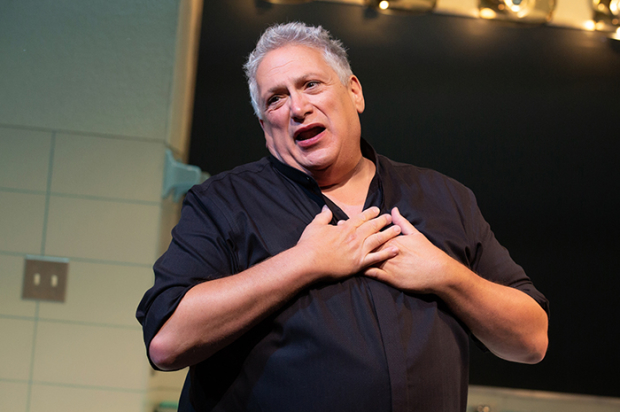
Harvey Fierstein wrote and stars in Bella Bella (photo by Jeremy Daniel)

The play is stuffed with such quotes, in addition to Yiddish phrases, and Fierstein (Torch Song Trilogy, Casa Valentina often mugs to the audience for extra laughs. It’s more like a series of gags than a compelling narrative. Fierstein first appears onstage silhouetted in the shower entrance, holding one of Abzug’s trademark large hats. The hat “kinda became my thing,” she later notes. “And the press, the only thing they wrote about was, ‘The hat. The hat. The hat.’ I finally said, ‘Anyone want to know what’s under the hat?’” But Fierstein puts away the hat after the beginning and chooses not to impersonate Abzug or her style; instead, he speaks like himself, and he wears a black shirt and pants, standing barefoot on the stage. (The costume is by Rita Ryack.) Thus, we’re all too well aware that we are watching Harvey Fierstein as Bella Abzug, a stark contrast to Kathleen Chalfant’s expert personification of Mabel Loomis Todd. Director Kimberly Senior (Disgraced, The Niceties) seems limited by John Lee Beatty’s busy set, which includes a stellar rendering of the facade of the Summit Hotel but nothing is done with it aside from a very brief, very tiny shadow of a person walking down the hall. Abzug was a central figure of life in New York City in the 1970s, a passionate leader and fighter, but Fierstein never grabs hold of the era or the woman, and neither do Caite Hevener’s period projections. We never get to know any more about what’s under the hat than we did when we came in, which is a shame, because there was no one else quite like Bella.

THE HEIGHT OF THE STORM

(photo by Joan Marcus)

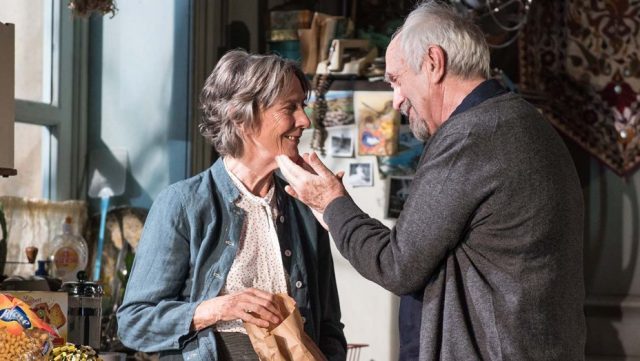
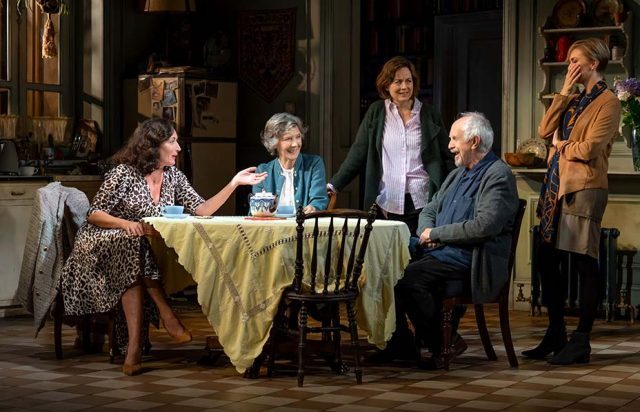
Eileen Atkins and Jonathan Pryce play a happy couple dealing with death in The Height of the Storm (photo by Joan Marcus)

Manhattan Theatre Club at the Samuel J. Friedman Theatre
261 West 47th St. between Broadway & Eighth Aves.
Tuesday – Sunday through November 24, $79-$169
heightofthestorm.com
www.manhattantheatreclub.com

Eileen Atkins and Jonathan Pryce are more than reason enough to see Florian Zeller’s latest intricate family drama, The Height of the Storm, although the play doesn’t quite live up to its lofty ambitions. The follow-up to Zeller’s trilogy of The Father, The Mother, and The Son, this new work shares themes with its predecessors, particularly The Father; as in that story, an elderly man named André (Pryce) with two daughters, Anne (Amanda Drew) and Élise (Lisa O’Hare), is having trouble with his memory. But in this case, there has been a death, but it’s not clear whether it’s André, an extremely successful writer, or his wife, Madeleine (Atkins). References to a recent bereavement are many, yet the two elderly married characters appear in scenes together that do not seem to be flashbacks. “There’s nothing to understand. People who try to understand things are morons,” an ornery André says, which is good advice to the audience as well, who shouldn’t try to think too hard to figure out what’s happening, whether we’re watching the present, the past, or the meanderings of a man suffering from dementia.

Anne is going through her father’s papers at the request of his editor to find more material to publish. Élise and her latest boyfriend, real estate agent Paul (James Hiller), are in from Paris, about to rush back for an important meeting. Madeleine is much calmer, walking through their vegetable garden and making her husband’s favorite mushroom dish. (The play takes place in Anthony Ward’s cozy, high-ceilinged kitchen set.) But when a woman (Lucy Coho) arrives claiming to be an old friend of André’s, his memory is tested yet again. “I had a life. I don’t deny it. But in the end, what’s left?” André opines. “A few faces? A few names lost in the fog? Here and there . . . Not much more. May as well forget everything.”

(photo by Joan Marcus)

A family gathering is interrupted by an unexpected guest in Florian Zeller’s The Height of the Storm (photo by Joan Marcus)

Pryce (Comedians, Miss Saigon), who has won two Tonys and two Olivier Awards, and three-time Olivier Award winner Atkins (Honour, A Room of One’s Own) are impeccable, delivering meticulous performances anchored by the fear that after fifty years of marriage, either André or Madeleine must go first, leaving the other one alone. Drew (Three Days in the Country, Enron), who played Anne in James Macdonald’s production of The Father at the Duke of York’s Theatre in 2016, is staunchly resolute as the daughter trying to keep everything from falling apart. The ninety-minute play features profound lighting by Hugh Vanstone, particularly as it relates to Pryce, who is sometimes cast in darkness while the others remain lit and talking. But director Jonathan Kent (Plenty, Naked) and translator Christopher Hampton (who did the same for the previous three related works) don’t always maneuver fluidly through the narrative; part of the intent is to set the viewer off balance, but too much manipulative confusion is not ideal, especially when accompanied by a clichéd twist. “What is my position? What is my position here? What is my position? My position! What is my position here? My position. Here. What is it? My position . . . what is it?” André frantically demands at one point. The audience is often not sure, which can be both hypnotic and aggravating.

CONTINUITY

(photo © Matthew Murphy)

Alex Hurt, Jasmine Batchelor, Megan Ketch play actors making an ecological disaster flick in Bess Wohl’s Continuity (photo © Matthew Murphy)

Manhattan Theatre Club
MTC at New York City Center
The Studio at Stage II
130 West 56th St. between Sixth & Seventh Aves.
Tuesday – Sunday through June 9, $69-$90
212-581-1212
continuityplay.com
www.manhattantheatreclub.com

At one point in Bess Wohl’s fiendishly clever Continuity, the Manhattan Theatre Club world premiere that opened last night at Stage II at City Center, the stage is empty for several minutes. The set, designed by Adam Rigg, is anchored by a white styrofoam ice floe with a wall of ice in the back, leaning ominously forward. It’s an uncomfortably funny moment, the barenness a warning of what just might happen if the world keeps on its current pace, because the play is as much about narrative continuity as the continuity of humanity itself. The show within a show is about global warming, as in real life politicians, scientists, environmentalists, artists, and lay people fiercely disagree on what to do about climate change and whether it’s already too late; the deserted stage predicts a time in the not-too-distant future when living beings no longer exist on our doomed planet. But Wohl and director Rachel Chavkin, who previously collaborated on the smash hit Small Mouth Sounds, are not just preaching to the choir or spewing grandiose melodramatic rhetoric. Continuity is a sublime one-hundred-minute journey into the glorious stupidity of humanity as it faces its possible demise.

(photo © Matthew Murphy)

Jake (Alex Hurt) and David (Darren Goldstein) watch some monkeys online in Manhattan Theatre Club world premiere at City Center (photo © Matthew Murphy)

A film crew is in the New Mexico desert making an ecological disaster epic. Director Maria (Rosal Colón), a Sundance Award–winning indie filmmaker, is helming her first studio picture, not wanting to screw up her big break, while needy Hollywood star Nicole (Megan Ketch), who is playing environmentalist Eve, is having some issues, creating maddening delays for the crew and her fellow actors, the good-looking Jake (Alex Hurt), who is playing George, an ecoterrorist, and earnest, underutilized Anna (Jasmine Batchelor), who portrays Lily, a climatologist who has been captured by a gun-wielding George. “The time for science is over,” the Keanu Reeves–like hunk declares. “It’s time for action.” When screenwriter David Caxton (Darren Goldstein) arrives unexpectedly, Maria worries that the studio has sent him to keep an eye on her. Soon Larry (Max Baker), the crotchety science adviser, is questioning plot points that will wreak havoc on the film’s narrative and drain the story of its special-effects-laden promises. Through it all, the loyal PA (Garcia) does whatever is asked of him, no matter how patently absurd.

(photo © Matthew Murphy)

Maria (Rosal Colón) and David (Darren Goldstein) find themselves at odds while on-set in New Mexico (photo © Matthew Murphy)

Continuity was partly inspired by Wohl’s experience writing the cancer movie Irreplaceable You, so the film shoot feels authentic. The title of the play comes not only from the technical term for maintaining consistent details in a movie but also from the idea of uninterrupted existence, which is in global danger because of climate change. Wohl (Barcelona, American Hero) explores carbon neutrality, recycling, hypocrisy, science, capitalism, and other concepts as she litters the dialogue with such silly puns and wonderfully chosen phrases as “Stop shifting the ground under my feet,” “Water under the bridge,” and “The pace is glacial.” She and Chavkin (Hadestown, Natasha, Pierre & the Great Comet of 1812) also probe race, gender, the #MeToo movement, and sexual orientation as Maria’s attempt to finish the scene before it gets dark mimics humankind’s not-so-concerted effort to save the Earth. “Please take care of our iceberg,” the offstage first assistant director tells everyone about a prop that people keep ruining, as if reminding all of us of the tenuousness of our situation. Lily and Jake watch a video on his phone of a monkey doing something amazing, as if evolution is being turned around. David is giving himself a fake tan, like a natural one is out of the question. It’s no coincidence that Maria won an award at Sundance, both because of the name of the festival itself as well as its relationship with seminal environmentalist Robert Redford. The stage production is doing what it can to not leave its own carbon footprint, reusing plastic bottles and other props and recycling cut-up paper into falling snow. Wohl calls Continuity “a play in six takes,” but we don’t have that many chances left to get it right.

INK

(photo © Joan Marcus 2019)

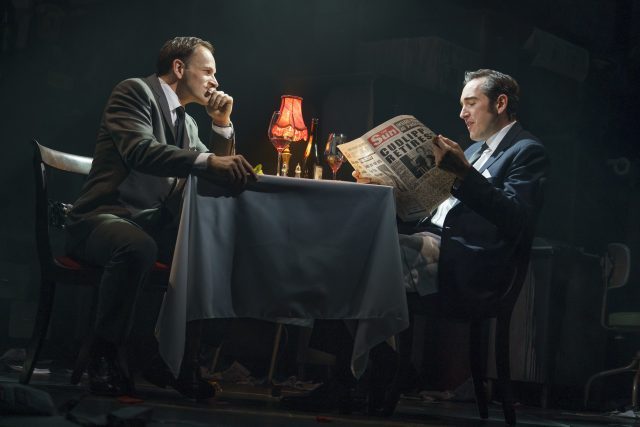
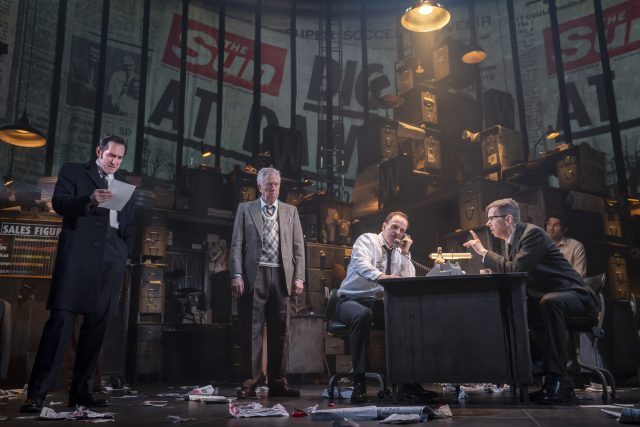
Editor Larry Lamb (Jonny Lee Miller) takes over Rupert Murdoch’s Sun in Ink (photo © Joan Marcus 2019)

Who: Bertie Carvel, Jonny Lee Miller, David Wilson Barnes, Bill Buell, Andrew Durand, Eden Marryshow, Colin McPhillamy, Erin Neufer, Kevin Pariseau, Rana Roy, Michael Siberry, Robert Stanton, and Tara Summers
What: Ink on Broadway
Where: Manhattan Theatre Club at the Samuel J. Friedman Theatre, 261 West 47th St. between Broadway & Eighth Aves.
When: Tuesday – Sunday through July 7, $79-$189
Why: At the beginning of James Graham’s Tony-nominated Ink, which takes place on Fleet Street in 1969–70, soon-to-be international media mogul Rupert Murdoch (Bertie Carvel) asks newspaper editor Larry Lamb (Jonny Lee Miller) what makes a good story. “Well, it’s the five ‘W’s, isn’t it,” he says, listing the first four — Who, What, Where, When — then hesitating before getting to the last one. “So what’s the fifth? The fifth ‘W’?” Murdoch implores. “Fifth ‘W’ I used to think was the most important, now I think it’s the least. Fifth ‘W’ is Why,” Lamb responds. Murdoch: “You think the least important question is ‘why’; I would have said that was the most important question.” Lamb: “Once you know ‘why’ something happened, the story’s over, it’s dead. Don’t answer why, a story can run and run, can run forever. And the other reason, actually, honestly, I think, is that there is no ‘Why?’ Most times. ‘Why’ suggests there’s a plan, that there is a point to things, when they happen and there’s not, there’s just not. Sometimes shit — just —happens. Only thing worth asking isn’t ‘why,’ it’s . . . ‘What next?’”

(photo © Joan Marcus 2019)

Larry Lamb (Jonny Lee Miller) and Rupert Murdoch (Bertie Carvel) check their progress in MTC newspaper tale (photo © Joan Marcus 2019)

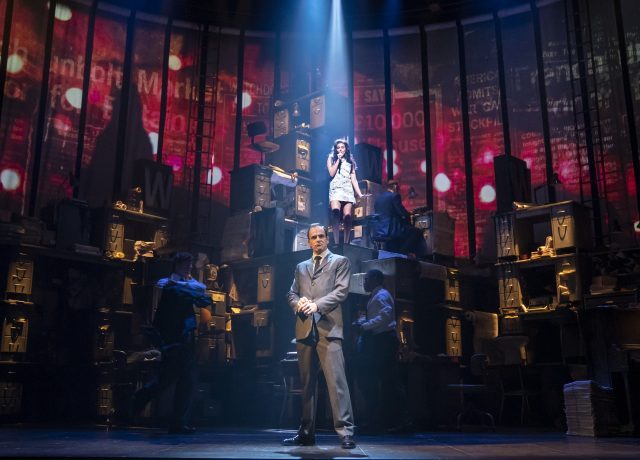
Graham (Labour of Love, Privacy) and director Rupert Goold (King Charles III, American Psycho) follow that advice in the sparkling Manhattan Theatre Club presentation of the award-winning Almeida Theatre production, running at the Samuel J. Friedman Theatre through July 7. The play dives right into the Who, What, Where, and When as Murdoch decides to buy the failing Sun newspaper from the company that publishes the Mirror and hires exiled editor Lamb to run it. It’s thrilling to watch Lamb put together a ragtag staff, including news editor Brian McConnell (David Wilson Barnes), chief sub Ray Mills (Eden Marryshow), sports editor Frank Nicklin (Bill Buell), woman’s editor Joyce Hopkirk (Tara Summers), persnickety deputy editor Bernard Shrimsley (Robert Stanton), and novice photographer Beverley Goodway (Andrew Durand), as they attempt to not only put out a newspaper immediately but, within one year, surpass the Mirror in circulation, a ridiculously absurd proposition — but one that drives Lamb, Murdoch, and his devoted deputy chairman, Sir Alick McKay (Colin McPhillamy), who are willing to do just about whatever it takes to make it happen, much to the consternation of Mirror chairman Hugh Cudlipp (Michael Siberry) and editor Lee Howard (Marryshow), who worry about the integrity of their industry.

(photo © Joan Marcus 2019)

Rupert Murdoch (Bertie Carvel) checks in on the Sun in Tony-nominated Ink (photo © Joan Marcus 2019)

Two-time Olivier winner Goold adds glitter and flash to the proceedings, with the sexy Stephanie Rahn (Rana Roy) occasionally breaking out into song and dance with various characters, turning Bunny Christie’s multilevel, dark-gray, crowded stage into a hopping nightclub, with fun choreography by Lynne Page. Tony nominee Carvel (Matilda the Musical, The Hairy Ape), employing a slight hunch and an overly affected interpretation of Murdoch’s voice, and Miller (Elementary, Frankenstein), bold and forthright as Lamb, make a dynamic duo; even though we know how it’s all going to turn out — particularly how tabloids would present so-called news to the public — we root for them to succeed against the stodgy old guys who actually care about truth and quality. Jon Driscoll’s projections add color to the proceedings, primarily the familiar red of the Sun logo. The serious proceedings, the repercussions of which are still being felt today, with Murdoch’s ownership of such papers as the New York Post and such television stations as Fox News, President Trump’s favorite channel, are infused with a wickedly dry sense of humor; even the insert telling audience members to turn off their cellphones is like the front page of the Sun, blaring the headline: “Cellphone Humiliates Playgoer.”

THE PROM / THE CAKE

(photo by Deen van Meer)

Broadway stars Dee Dee Allen (Beth Leavel) and Barry Glickman (Brooks Ashmanskas) find a common cause after their Eleanor Roosevelt musical gets panned in The Prom (photo by Deen van Meer)

THE PROM
Longacre Theatre
220 West 48th St. between Broadway & Eighth Ave.
Tuesday – Sunday through October 20, $49-$169
212-239-6200
theprommusical.com

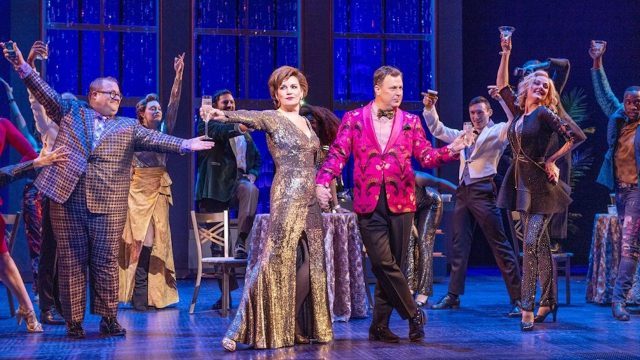
In 2012, Colorado baker Jack Phillips refused to make a wedding cake for a gay couple because of his religious beliefs, leading to a Supreme Court case and a battle with the Colorado Civil Rights Commission. In 2010, a Mississippi high school canceled its prom after being sued for barring a lesbian student from attending with her girlfriend. These two ripped-from-the-headlines situations have inspired a pair of shows currently running in the city that deal with issues of faith, prejudice, and LGBTQ rights in very different ways, both sparked by the struggle of gay couples to celebrate happy milestone events just like straight culture does. They also both explore the possibility of changing people’s minds, asking for tolerance of the intolerant. In The Prom, a musical comedy at the Longacre, the setup is theatrical: Great White Way veterans Dee Dee Allen (Beth Leavel) and Barry Glickman (Brooks Ashmanskas) are looking for a quick way to rebound from their instant flop Eleanor! — The Eleanor Roosevelt Musical by finding a cause they can support to get them some positive press attention. “People need to know it’s possible to change the world, whether you are a homely middle-aged first lady or a Broadway star,” Dee Dee, who played Eleanor, says. Barry adds, “The moment I first stepped into FDR’s shoes, and by shoes I mean wheelchair, I had an epiphany. I realized there is no difference between the president of the United States and a celebrity. We both have power. The power to change the world.”

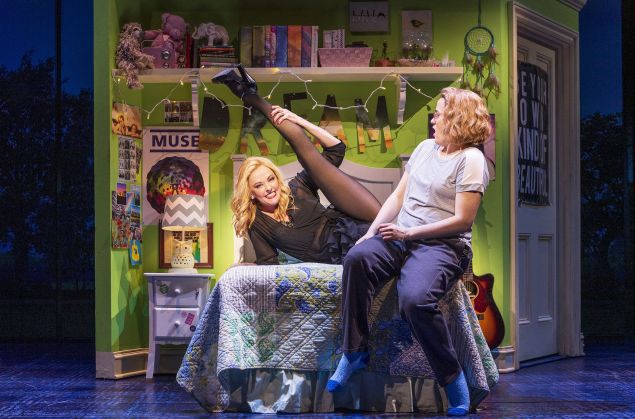
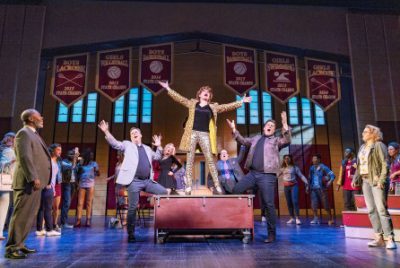
They are joined by lesser-known minor actors Trent Oliver (Christopher Sieber) and Angie (Angie Schworer) and producer Sheldon Saperstein (Josh Lamon) and decide their best opportunity is to head to Edgewater, Indiana, where high school student Emma (Caitlin Kinnunen) is being harassed by the other students because Mrs. Greene (Courtenay Collins), the head of the PTA, has canceled the prom since Emma was going to go with another girl. Little does Mrs. Greene know that Emma is dating her daughter, Alyssa (Isabelle McCalla), who is understandably terrified of coming out to her mother. As this self-centered crackpot Justice League demands equal rights (“We’re all lesbians!”), Dee Dee unexpectedly falls for the soft-hearted, clear-sighted principal, Mr. Hawkins (Michael Potts), who takes the case to the state attorney’s office. He’s also none too happy when he begins thinking that the city folk might be in it only for the publicity, not the cause.

(photo by Deen van Meer)

Angie (Angie Schworer) gets a leg up speaking with gay teen Emma Greene (Caitlin Kinnunen) (photo by Deen van Meer)

Directed and choreographed by Tony winner Casey Nicholaw (The Book of Mormon, Something Rotten!), The Prom features a book by Bob Martin and Chad Beguelin, with music by Matthew Sklar and lyrics by Beguielin, who have a blast skewering not only the concept of narcissistic celebrities but musical theater itself. It’s loaded with inside jokes; for example, when Barry says to Angie, “I thought you were in Chicago,” she replies, “I just quit. Twenty years in the chorus and they still wouldn’t let me play Roxie Hart.” Schworer played Go to Hell Kitty for three years in a tour of Chicago while also understudying the Hart role. At nearly two and a half hours, The Prom is too long and overly repetitive, and it’s pretty easy to see where it’s going as it uses a sledgehammer to bring home its sociological perspective.

(photo by Deen van Meer)

Dee Dee Allen (Beth Leavel) seeks good publicity in Indiana fighting for an inclusive prom (photo by Deen van Meer)

Before leaving for Indiana, the five New Yorkers sing, “We’re gonna teach them to be more P.C. / the minute our group arrives. That’s right! Those / fist pumping / Bible thumping / Spam eating / cousin humping / cow tipping / shoulder slumping / tea bagging / Jesus jumping / losers and their inbred wives / They’ll learn compassion / and better fashion / once we at last start changing lives!” Mrs. Greene sticks to her guns, declaring, “You and your friends know nothing about us, about our town, about our people. And yet, you feel justified in telling us what to do.” It’s the privileged elitists against the deplorables, each side proclaiming that the other is the villain. The show inadvertently shoots itself in the foot by having a multiracial, color-blind cast at the school; if the town is so bigoted against gays and lesbians, it’s unlikely to be so accepting of blacks, Latinx, and Asians, so the homosexual fear/hatred feels like a plot device, which it is. Of course, the producers would have taken a different kind of hit if they had indeed hired only white actors to portray the children and adults of Edgewater. The Prom can be wacky and poignant, but it also can be preachy and predictable, whether to liberal theatergoers from the blue states or conservative tourists from red states. Nobody loses!

(photo © Joan Marcus, 2019)

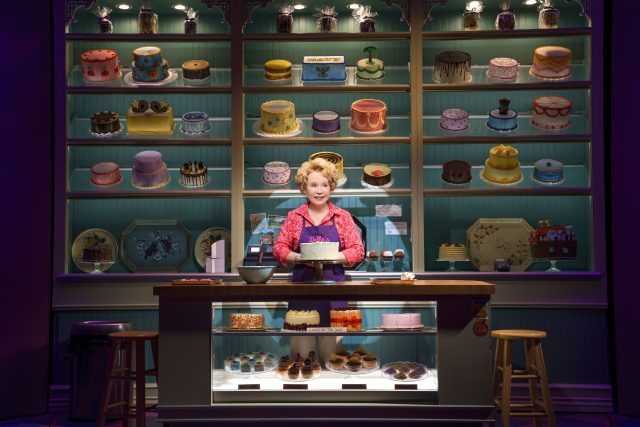
Della (Debra Jo Rupp) is a sweet baker who opts not to make a cake for a gay wedding in MTC production at City Center (photo © Joan Marcus, 2019)

THE CAKE
Manhattan Theatre Club
MTC at New York City Center – Stage I
Tuesday – Sunday through March 31, $89
212-581-1212
thecakeplay.com

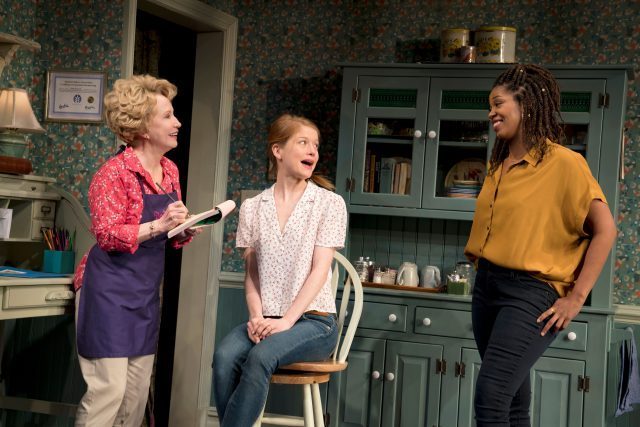
Meanwhile, Bekah Brunstetter’s The Cake, which opened this week at Manhattan Theatre Club’s Stage I at City Center, takes place in a small, tight-knit community in North Carolina, where the delightful Della (Debra Jo Rupp) runs a bakery specializing in extraordinary cakes for special occasions. Della, who is scheduled to be a contestant on The Great American Baking Show, is visited by Jen (Genevieve Angelson), the daughter of her late best friend, who has come to tell her that she is getting married and wants her to make the cake for the special event. But when Della finds out that Jen’s fiancée is Macy (Marinda Anderson), a black gluten-free Brooklynite, she changes her mind and claims that she is too busy to bake for her. While Macy is furious, Jen wants to give Della the benefit of the doubt.

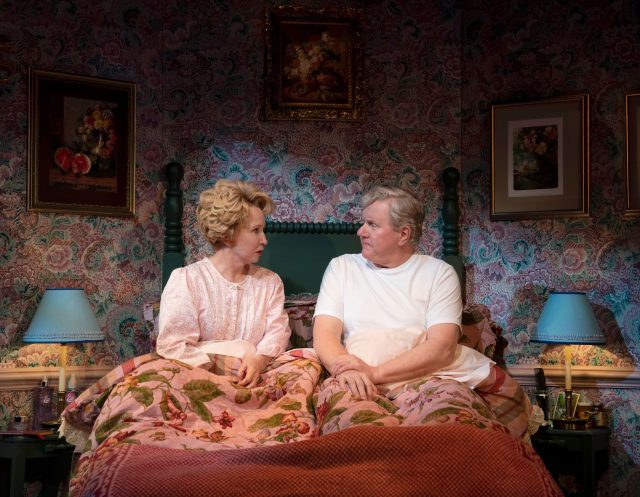
When it seems that Della might be rethinking her decision (which is based on sexual orientation, not race, as Bella notes, “I don’t see color”), her husband, Tim (Dan Daily), demands that she not bake the cake because of their religion. “We know we can’t pick and choose the Bible, honey,” he explains. “That’s when the edges start to blur. Fabric starts to fray. We can be sad for her, though. We can love her, still.” Later, he says, “It’s — it’s just not natural.” Della responds, “Well, neither is confectioner’s sugar!” Tim: “You’re not making that cake.” Della: “I’ll make it if I want to.” Tim: “What’s that?” Della: “Nothing.” Tim and Della are quite a couple; she bakes delicious items that go in people’s mouths, while he, a plumber, fixes problems involving what comes out the other end.

(photo © Joan Marcus, 2019)

Baker Della (Debra Jo Rupp) and plumber Tim (Dan Daily) discuss sex and religion in The Cake (photo © Joan Marcus, 2019)

Much like the Broadway elitists want to change the mind of Edgewater, Indiana, Macy feels that Jen can help Della avoid making the wrong choice. “You could change her,” Macy says. “Della? No thank you,” Jen replies. Macy: “But if you don’t push her to change, then they never will. “Jen: “They?” Macy: “All of them.” . . . Jen: All I ask is that you just try and be respectful of the people down here.” Macy: “I don’t respect these people.” Jen: “But I’m one of them.” Macy: “No you’re not.” Brunstetter, a writer and producer on the first three seasons of This Is Us who identifies as a straight white woman, was raised in a conservative North Carolina household; she loves and respects her family even though she disagrees with them on many social issues, and The Cake might her attempt to convince theatergoers who are not fond of bigots and homophobes to have more compassion and empathy for these down-home plain folk.

(photo © Joan Marcus, 2019)

Della (Debra Jo Rupp) is happy for Jen (Genevieve Angelson) and Macy (Marinda Anderson) despite her religious beliefs in Bekah Brunstetter play (photo © Joan Marcus, 2019)

But it’s not that easy; no matter how cute and adorable Della is — and she’s portrayed wonderfully by Rupp, the mother on That ’70s Show and Linda on This Is Us; in fact, all four actors are terrific — it’s a lot for Brunstetter to ask of the audience. At the beginning of the play, which is engagingly directed by three-time Tony nominee Lynne Meadow (The Assembled Parties, The Tale of the Allergist’s Wife) and boasts an attractive set by John Lee Beatty that consists of ever-shifting ingredients, Della says, “See, what you have to do is really, truly follow the directions. That’s what people don’t understand.” She’s talking not only about baking but about her religion, following kitchen directions like she follows the Bible. Della also occasionally speaks with a disembodied voice from The Great American Baking Show, booming down from above as if God himself, judging if she’s worthy of being on the program. Each of the characters gets at least a little bit woke about something, resulting in a story that has tasty icing but too much fluff. “Ambivalence is just as evil as violence,” Macy argues after Della says she is not a political person, as if that excuses her from addressing the hot-button topics of the day. It’s also an excuse for Brunstetter to try to get us to accept her own family’s insensitivity to certain types of people. But being tolerant of the intolerant is not going to change things the way they need to be changed.