Tag Archives: Manhattan Theatre Club

BALANCING THE BALUSTRADE: A BRILLIANT NEW BROADWAY COMEDY

A series of meetings of the Vernon Point Neighborhood Association opens up old and new wounds in The Balusters (photo by Jeremy Daniel)

THE BALUSTERS
Samuel J. Friedman Theatre
261 West Forty-Seventh St. between Broadway & Eighth Ave.
Tuesday – Sunday through May 24, $58-$347
www.manhattantheatreclub.com

Yesterday afternoon I bumped into Richard Thomas on the Upper East Side. I told him how fabulous I thought The Balusters, the new Broadway play he’s starring in, is and what a great cast he’s working with. But as much fun as I had at the show, it appears that he is having even more, if that’s possible, gushing about David Lindsay-Abaire’s script and the entire ensemble. His smile was even bigger than mine.

Making its world premiere at MTC’s Samuel J. Friedman Theatre, The Balusters takes on a kitchen sink of contemporary issues, from homophobia, racism, classism, and corruption to toxic masculinity, privilege, bigotry, and furniture. And it does so in hilarious ways; I can’t remember the last time I laughed so long and hard during a play or clapped so often after side-splitting, sparkling lines of dialogue.

The hundred-minute comedy is set at several meetings of the Vernon Point Neighborhood Association, where a group of nine people regularly gather to discuss the state of their beloved community, a peaceful, old-fashioned enclave steeped in history, boasting well-manicured lawns, comfortable, attractive porches, and an overall flavor of Victorian elegance. The host is the newest member, Kyra Marshall (Anika Noni Rose), who has recently moved from Baltimore with her husband and their twin daughters. She lives in a beautifully designed home with fashionable chairs and couches, fancy china, and paintings of and by distinguished Blacks on the walls, as if overseeing the coming shenanigans, including, in the foyer, a print of George DeBaptiste’s 1978 portrait of Toussaint L’Ouverture, who was born a slave and went on to be a leader of the Haitian Revolution, and, above the fireplace, a flower-laden portrait of a Black feminist that evokes the work of contemporary Black American artists Harmonia Rosales and Kehinde Wiley. (The elegant set is by two-time Tony and two-time Emmy winner Derek McLane.)

The gavel-wielding president of the association is Elliot Emerson (Thomas), a fuddy-duddy real-estate broker intent on protecting the legacy of Vernon Point. The other members are Latino contractor Isaac Rosario (Ricardo Chavira); the acerbic, antagonistic Jewish treasurer, Ruth Ackerman (Margaret Colin); Willow Gibbons (Kayli Carter), a young, white vegan who sees microaggressions everywhere; Brooks Duncan (Carl Clemons-Hopkins), a gay Black travel writer who is married and has a son; the somewhat hapless Alan Kirby (Michael Esper), a white man in his fifties who considers himself an ally and doesn’t understand why he is so often ignored; Melissa Han (Jeena Yi), an ambitious Asian American lesbian and lawyer who is the vice president; and Penny Buell (Marylouise Burke), the elderly white secretary who used to work for Elliot and is not nearly as doddering as she might let on, surprising everyone with sharply focused acerbic quips. Also present is Luz Baccay (Maria-Christina Oliveras), Kyra’s ultra-efficient Filipino housekeeper who left the Emersons’ employ for unstated reasons.
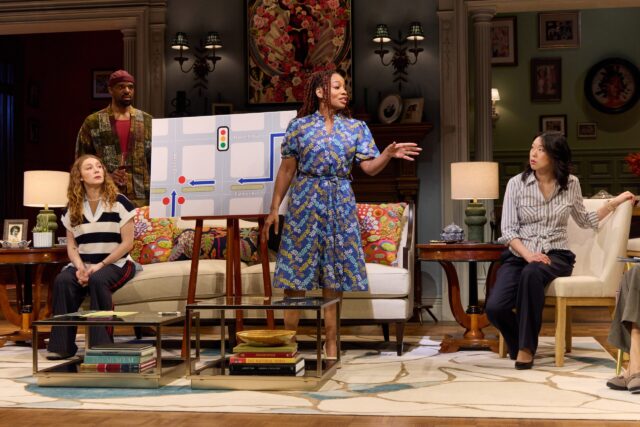
New resident Kyra Marshall (Anika Noni Rose) has no idea what she’s in for after joining group (photo by Jeremy Daniel)

Among the topics of discussion are expanding the hours of the safety van to catch porch pirates, how to handle kids who don’t live in Vernon Point but hang out there, and the plain, ahistorical balusters the Crawfords may be installing, which insult Elliot and lead to the following exchange, which helps define the characters while establishing the play’s central metaphor.

Elliot: Farmhouse balusters aren’t true to the period or style of the original railing. They’d look ridiculous on that Queen Anne.
Melissa: But we don’t police our neighbors.
Elliot: It’s not policing. If you live here, you’ve agreed to certain guidelines.
Kyra: I hate to ask, but what exactly are balusters?
Elliot: I’m sorry, Kyra. We should’ve started with that.
Isaac: They’re the posts that support a railing. They’re like spindles but with footings.
Kyra: Okay, I’m gonna nod and pretend I know what that means.
Melissa: You’re gonna learn so much useless information here.
Elliot: It’s not useless. The balusters are important. They hold everything up. A porch’ll fall to pieces without the right support.
Ruth: As riveting as this is, may we move on?

When Kyra suggests that the group request stop signs for a corner where numerous accidents have occurred, heated arguments ensue, eventually becoming personal over the course of several meetings and leaving no one unscathed, their biases revealed via revenge, gossip, and carelessness.
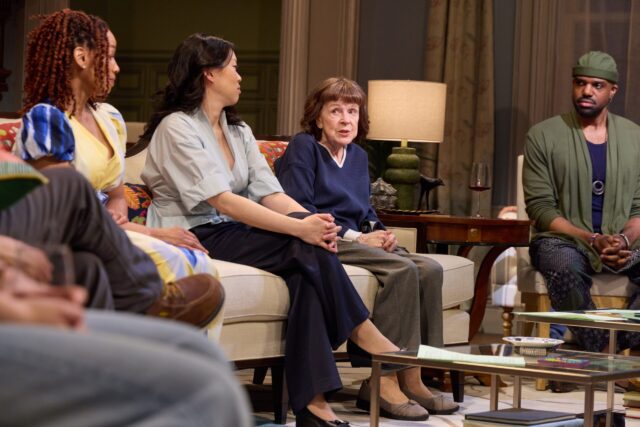
Penny Buell (Marylouise Burke) is deceptively clever and prescient in brilliant new Broadway comedy (photo by Jeremy Daniel)

The Balusters is brilliantly written by Tony and Pulitzer winner Lindsay-Abaire (Rabbit Hole, Kimberly Akimbo) and expertly directed with a wry sense of humor by Tony winner Kenny Leon (Purlie Victorious: A Non-Confederate Romp Through the Cotton Patch, Home). It is reminiscent of both Bruce Norris’s Tony- and Pulitzer-winning Clybourne Park and Jonathan Spector’s Tony-winning Eureka Day, two plays that explore what can go wrong when small groups of people think they can decide what’s right and wrong for others. It will also likely remind New Yorkers of why they don’t want to be on their coop board.

Five-time Tony nominee Emilio Sosa’s costumes are impeccable, and four-time Tony nominee Allen Lee Hughes’s lighting and six-time Tony nominee Dan Moses Schreier’s sound — he also composed the excellent interstitial music, which features a rap bent — are in sync throughout, especially when thunder and lightning strike at just the right instances.

The terrific ensemble forms an outrageously funny extended family, led by Emmy winner Thomas (Our Town, The Little Foxes) as an older man seeing his carefully curated life slip away and Tony winner Rose (Caroline, or Change, A Raisin in the Sun) as a younger woman who is not afraid to get in Elliot’s way, but theater treasure Burke (Ripcord, Infinite Life), in her seventh collaboration with Lindsay-Abaire, steals the show as Penny, who always knows just what to say.

“I’d just like to remind us that everyone in this room is a decent person,” Penny interjects at one point when things are threatening to get out of hand. “We wouldn’t be here if we didn’t care about our neighbors. At the same time, no one is perfect, and sometimes people make mistakes.”

Now, where’s my gavel?

[Mark Rifkin is a Brooklyn-born, Manhattan-based writer; you can follow him on Substack here.]
THE QUEENS OF QUEENS: IN SEARCH OF THE AMERICAN DREAM

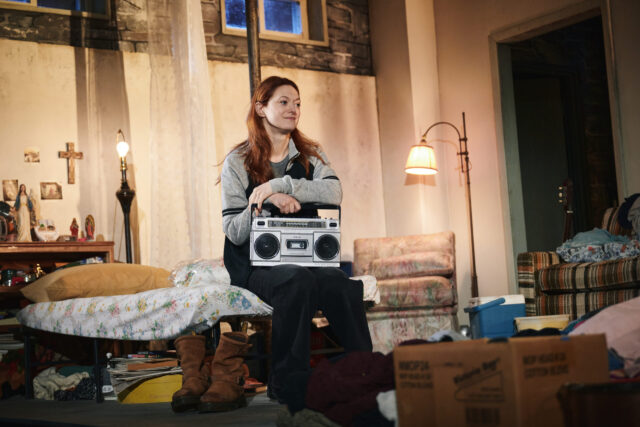
Polish immigrant Renia (Marin Ireland) dreams of a better life in Martyna Majok’s reimagined Queens (photo by Valerie Terranova)

QUEENS
MTC at New York City Center – Stage I
131 West Fifty-Fifth St. between Sixth & Seventh Aves.
Tuesday – Sunday through December 7, $109-$139
www.manhattantheatreclub.com
www.nycitycenter.org

Polish-born American playwright Martyna Majok tells stories that challenge the audience, taking risks as she explores the lives of the disenfranchised, the disabled, the underrepresented, and undocumented immigrants in search of the unreachable American dream. In Cost of Living, which earned her the Pulitzer Prize, it all came together without compromise; I wrote of the Broadway version, “The separate storylines merge at the end in an uneasy finale that acknowledges that we all encounter tremendously painful issues in life, regardless of our physical or psychological situations, which is further established during the curtain call.”

Her three other plays were not quite as successful despite intriguing setups and intricate narratives. About Ironbound, I noted, “The rest of the cast play their roles well, but their characters and tales are nowhere near as interesting and compelling as Darja’s, and they become somewhat quaint and repetitive as the show goes on and overdoes the obvious distinctions between rich and poor.” And I wrote that Sanctuary City “takes a head-scratching turn as the ending approaches, detracting from everything that came before it, which was powerful and moving.”

Queens, which originally ran at LCT3 in 2018 and is now at MTC’s New York City Center – Stage I through December 7 in a newly reimagined version, displays too many of the same issues; the play features characters and situations that you want to embrace and understand, but Martok and director Trip Cullman (Cult of Love, Six Degrees of Separation) are unable to weave their way through a web of fascinating ideas that don’t quite mesh. As with Ironbound and Sanctuary City, there’s a strong play in there that refuses to emerge.

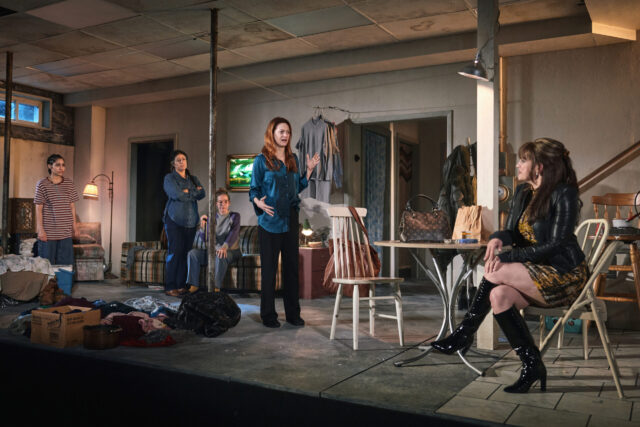
A group of women seek common ground in MTC production at City Center Stage I (photo by Valerie Terranova)

Over the course of sixteen years, seven immigrant women move in and out of a crowded basement apartment in Queens, desperate to find a better life in America: the Belarusian Pelagiya (Brooke Bloom), the Polish Agata (Anna Chlumsky), the Polish Renia (Marin Ireland), the Ukrainian Inna (Julia Lester), the Afghan Aamani (Nadine Malouf), the Ukrainian Lera (Andrea Syglowski), and the Honduran Isabela (Nicole Villamil).

“Any regrets? In your life? In this building?” Inna asks Renia. Although she doesn’t want to admit it, Renia has plenty, having made choices that did not necessarily work out the way she expected. Inna punches her in the face before going inside and renting a room.

The basement is cluttered with clothing, a guitar, and other objects that are memories of those who came before, haunting Renia. (The effective set is by Marsha Ginsberg.) “What is your reason?” the memory of Pelagiya asks her. Aamani adds, “The reason you are here. Looking to live someplace away from the rest of your kind of people. What happened.”

The narrative then shifts to December 2001, when Renia has arrived in New York with little money in her pocket. Pelagiya wants to know what brought her there. “It’s no story,” Renia says. “It’s always story,” Pelagiya insists. Renia responds, “I need place I can stay. I come here. End of story.” Of course, it’s only the beginning of what turns out to be a dark, painful story. Even a somewhat pathetic party the women hold is tinged with fear and sadness. The appearance of the Honduran American Glenys (Sharlene Cruz) injects a burst of youthful energy, but it’s not enough to sustain the play’s 135 minutes (with intermission).

Queens does serve as a fascinating counterpoint to Bess Wohl’s dazzling Liberation, the current Broadway transfer about six diverse women who meet regularly in a rec center basement in Ohio in the 1970s to discuss the role of women in society, how it impacts their lives individually and what they can do to help change the status quo publicly; both shows delve into the relationships among women as well as mothers and daughters. The Queens women, however, have a different kind of baggage — obviously, they lack the relative privilege of the characters in Liberation, and face colossal odds stacked against them, coming from countries where women are still in search of freedom, fifty years after the Liberation women began changing America. Still, women’s search for the most basic of freedoms is the motor that drives Queens, even if the ride is bumpy and the destination uncertain.

[Mark Rifkin is a Brooklyn-born, Manhattan-based writer and editor; you can follow him on Substack here.]
JUST ONE PUNCH: HARROWING PLAY EXITS BROADWAY RING

Will Harrison leads an excellent cast in harrowing true story (photo by Matthew Murphy)

PUNCH
Samuel J. Friedman Theatre
261 West Forty-Seventh St. between Broadway & Eighth Ave.
Through November 2, $94-$235.50
www.manhattantheatreclub.com

Will Harrison makes an electrifying Broadway debut as a young Nottingham man whose life changes forever on a wild night in James Graham’s Punch, continuing at the Samuel J. Friedman Theatre through November 2 though deserving of a longer run. However, the final shows can be livestreamed with a twenty-four-hour replay for $75.

Harrison stars as Jacob in the true story, based on the memoir Right from Wrong by Jacob Dunne, which explores bullying, drugs, class, and restorative justice. One night, Jacob and his large gang of friends are out drinking and snorting as they barhop through Nottingham, Jacob in search of some action.

“This is the problem, no one likes to admit . . . Doing bad things . . . creates good feelings. It just does,” Jacob tells the audience. “Because there is no other high in the world, forget your fuckin’ skunk or spice or smack or scratch, none of it can beat the buzz that comes with beatin’ up a slippin’ bastard in defence of a mate. The look in their eyes when they’re impressed, grateful, respectful . . . and even a bit fuckin’ scared of you now too . . . Barrelling back to someone’s house, covered in blood and validation. . . . Being chased and chasing highs, rushing round, scoring drugs and doing deals, seeking out parties and pulling girls. People dancing, trance like, getting high, snogging. Problem for someone like me is that cause I’d lived on the outskirts, coz mum had kept our heads down . . . not a lot of people knew us. And thriving and surviving in this world is all about your reputation, who you are . . . Which means I . . . have to always go farther, drink faster, walk taller. And most importantly . . . fight. Fight harder. Harder than anyone else.”

Chasing those highs, nineteen-year-old Jacob unleashes a massive punch on a random stranger just for kicks, but when the young man, twenty-eight-year-old James Hodgkinson, dies as a result of the altercation, Jacob is sent to prison while James’s parents, David Hodgkinson (Sam Robards) and Joan Scourfield (Victoria Clark), deal with the tragic loss of their son and contemplate whether they should forgive Jacob.

The energetic, fast-paced first act shifts between the punch and its immediate aftermath and a group therapy session led by Sandra (Lucy Taylor, who also plays Jacob’s mother and a probation officer), where Jacob shares his story with others. Sandra describes it as a place for “talking and listening. Difficult conversations.” Those conversations center on restorative justice, as Jacob, Joan, and David decide if they are going to meet face-to-face.

Victoria Clark and Sam Robards star as parents facing a horrific tragedy in Punch (photo by Matthew Murphy)

The first half of Punch unfolds like a thrilling boxing match, with aggressive, breathtaking movement by Leanne Pinder as Jacob and his friends make their way across and under set and costume designer Anna Fleischle’s reimagining of Trent Bridge in Nottingham, propelled by Alexandra Faye Braithwaite’s scorching original music and sound design. Robbie Butler’s lighting is like a character unto itself, a large, nearly complete circle hovering above the stage, consisting of rows of chasing lights that change color; it made me think of a boxing ring even though it isn’t square.

Graham (Ink, Dear England) and first-time Broadway director Adam Penford slow things down after intermission, as if the fighters have tired out, their tanks running out. Yes, it’s based on what actually happened, but it involves a whole lot of sitting around and talking, falling short of the knockout blow. Two-time Tony winner Clark (Kimberly Akimbo, The Light in the Piazza) and Robards (The 39 Steps, Absurd Person Singular) are powerful as James’s parents, tenderly dealing with a situation that is every mother and father’s nightmare.

But the play belongs to Harrison, who was born in Ithaca and raised in Massachusetts. He fully inhabits the British Jacob, physically and psychologically; you can’t take your eyes off him. Harrison made an impressive off-Broadway debut in 2023 as a young navy medic in Keith Bunin’s The Coast Starlight at Lincoln Center and has followed that up with this Tony-worthy performance; he is a rising star with a bright future.

[Mark Rifkin is a Brooklyn-born, Manhattan-based writer and editor; you can follow him on Substack here.]
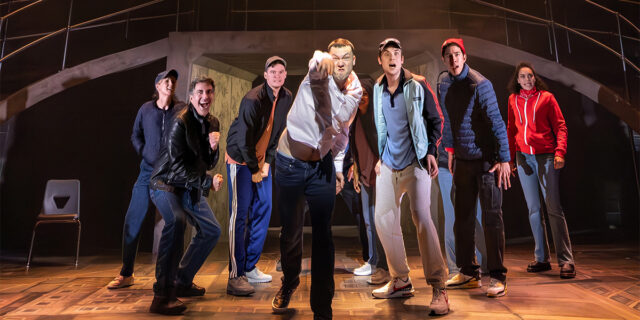
EVERYTHING’S NOT COMING UP ROSES: OLD FRIENDS ON BROADWAY

Stephen Sondheim’s Old Friends honors the theater legend on Broadway (photo by Matthew Murphy)

OLD FRIENDS
Samuel J. Friedman Theatre
261 West Forty-Seventh St. between Broadway & Eighth Ave.
Tuesday – Sunday through June 15, $110-$422
www.manhattantheatreclub.com

During intermission of Stephen Sondheim’s Old Friends at the Samuel J. Friedman Theatre, I thought about how much the surprisingly underwhelming MTC production felt more like a gala fundraiser than a fully fledged musical — especially one that bills itself as “a great big Broadway show.”

When I got home, I discovered that was precisely the case: It started out as a one-night-only concert presented on May 3, 2022, in London’s West End, a collaboration between Stephen Sondheim and producer Cameron Mackintosh to celebrate their long friendship. Sondheim had died on November 26, 2021, but the show went on, and the concert turned into a tribute to the eight-time Tony winner and New York City native. It was then adapted for a run at the Gielgud Theatre in London on its way to the Great White Way.

Old Friends is two and a half hours (with intermission) of Sondheim songs, performed by an ensemble of nineteen actors, highlighted by two-time Tony winner and four-time Emmy and Grammy nominee Bernadette Peters, who has appeared in five Sondheim shows, and Tony winner and two-time Grammy nominee Lea Salonga, whose only previous Sondheim credit is a 2019 Manila production of Sweeney Todd in which she played Mrs. Lovett. Peters and Salonga introduce the show to uproarious applause but neither is the standout, as a few others steal the spotlight.

The show consists of forty-two songs from fourteen musicals, mostly staged in front of a glittery raised bandstand where the fourteen-piece orchestra performs. The singers and dancers come out for each number in different costumes by Jill Parker, often inspired by the original production, and range from classy to silly. Matt Kinley’s set also features two sliding towers on either side; George Reeve adds projections of the New York City skyline, a forest, and other locations on the back brick wall and on small screens that descend from the ceiling.

Director Matthew Bourne and choreographer Stephen Mear are never able to achieve any kind of flow in the proceedings, primarily because the members of the cast all have distinct styles, vocal ranges, and physical abilities. In addition, the numbers just don’t stand up on their own; Peters tries to bring heft to “Children Will Listen” (Into the Woods), “Send in the Clowns” (A Little Night Music), and “Losing My Mind” (Follies) and Salonga belts out “Everything’s Coming Up Roses” (Gypsy), but it feels more like a cabaret revue with syrupy arrangements.

Faring much better are understudy Paige Faure, who is hilarious as the disgruntled bride-to-be in “Getting Married Today” from Company, Bonnie Langford, who nails “I’m Still Here” as Carlotta Campion from Follies, and Tony winner Beth Leavel, who knocks it out of the park as Joanne in “The Ladies Who Lunch” from Company.

The men, led by Gavin Lee (“Live Alone and Like It” from Dick Tracy), Jason Pennycooke (“Buddy’s Blues” from Follies), Jeremy Secomb (“My Friends” from Sweeney Todd), and Kyle Selig (“Everybody Ought to Have a Maid” from A Funny Thing Happened on the Way to the Forum with Lee and Secomb), all overplay their hand, trying too hard.

Songs from West Side Story, Sweeney Todd, Into the Woods, and Sunday in the Park with George receive more detailed stagings but get lost in the shuffle. There are also tunes from Anyone Can Whistle, Passion, Merrily We Roll Along, Bounce, and The Mad Show with such other performers as Jacob Dickey, Kevin Earley, Jasmine Forsberg, Kate Jennings Grant, Bonnie Langford, Joanna Riding, Maria Wirries, and Daniel Yearwood.

There’s an adorable clip of Sondheim at the piano with Andrew Lloyd Webber from the two-day June 1998 concert Hey, Mr. Producer!, which lauded Mackintosh’s career, but it also reinforces how bumpy and uneven the evening is and how much better it could have been. There’s a reason why Old Friends received no Tony nominations and only one Drama Desk nod, for Mick Potter’s sound design; I can confirm that the show sounds terrific.

[Mark Rifkin is a Brooklyn-born, Manhattan-based writer and editor; you can follow him on Substack here.]

ALL ABOUT MY MOTHER: THREE PLAYS ABOUT DEAR OLD MOM

Five actors portray multiple characters in Neena Beber’s Brecht adaptation at BAC (photo by Maria Baranova)

A MOTHER
Baryshnikov Arts Center, Jerome Robbins Theater
450 West 37th St. between Ninth & Tenth Aves.
March 29 – April 13, $59-$79
www.bacnyc.org

There was already a palpable buzz at the Baryshnikov Arts Center on April 7, opening night of Neena Beber’s Brecht adaptation, A Mother, before several Jessicas arrived: Jessica Hecht, who co-conceived the show and was about to step onstage in her starring role as Pelagea Vlassova, and a resplendent Jessica Lange in the audience, who raised the event’s already high-glamour quotient. Lange, who has won three Emmys, two Oscars, and a Tony, has portrayed several memorable mothers onstage during her long career, including Phyllis in Paula Vogel’s Mother Play last year and Mary Tyrone in Jonathan Kent’s 2016 production of Eugene O’Neill’s Long Day’s Journey into Night, was there not just as a fan of Brechtian epic theater but also because Shura Baryshnikov, her daughter with BAC founding artistic director Mikhail Baryshnikov, is the show’s choreographer.

Brecht’s 1932 play, the full title of which is The Mother: The Life of the Revolutionary Pelagea Vlassova from Tver, is based on Maxim Gorky’s 1906 novel known alternately as The Mother and, more simply, Mother. Beber and her co-creator, Emmy and Tony nominee Jessica Hecht, have changed the title to A Mother, which gives it more of a universal feel. They have also updated the setting; the action takes place in 1917 Russia, 1979 Miami, and the present.

In Russia, the widow Pelagea Vlassova (Hecht) is worried that her son, Pavel (Fergie Philippe), has fallen in with dangerous revolutionaries Ivan (Portia) and Anton (Zane Pais), who are protesting the treatment of factory workers and are threatening to strike. In Miami, fifteen-year-old Jess (Hecht) is having a blast at JD’s Disco on the beach, where she dances with seventeen-year-old Daryl (Philippe), who she hopes will be her first true love. In the present, she looks back at her life, including the summer she spent at Camp Shalom Aleichem in Barkhamstead, Connecticut, where she learned about Brecht from counselor Michelle (Delilah Napier), who was determined to inject plenty of Brecht into the campers’ production of Lerner and Loewe’s 1951 musical, Paint Your Wagon.

Michelle is wrapped up in her own Brechtian world view. “Who cares what you see yourself as? Identification is the lowest form of appreciation!” she tells one camper. She advises another, “Play the opposite. Think the opposite. Do the opposite.” And she declares, “Everything artificial is less artificial if you acknowledge that it’s artificial. The best way to be real when you are doing a play is to be fake.”

That’s precisely how Beber, director Maria Mileaf, set designer Neil Patel, costumer Katherine Roth, choreographer Shura Baryshnikov, lighting designer Matthew Richards, and the cast of five approach A Mother. Their production regularly reminds us that we are in a theater watching a fictional show in 2025, from their use of Brecht curtains to Jess’s interactions with the audience and clever dialogue.

“I don’t care what they say, disco is never gonna die,” Daryl insists. One of the other clubgoers (Napier) explains, “Born in the clubs frequented primarily by gay and African-American and Latino fans in opposition to the dominant social structures!” Social structures involving race and injustice come to the fore when the narrative shifts to the real-life murder of Black insurance salesman and Marine Arthur Lee McDuffie at the hands of police officers, leading to the 1980 Miami riots. In one of the most poignant moments of the play, Arthur’s mother, Eula Bell McDuffie (Portia), sings the elegiac African American spiritual “Wade in the Water” (the tune of which Jess transforms into the Mourner’s Kaddish).

As per Brecht’s instructions for this “learning play,” music is a key contributor, with songs ranging from Lipps Inc.’s “Funkytown” and “Wade in the Water” to compositions by Mustapha Khan, William Kenneth Vaughan, and Norman (Skip) Burns. Among the new tunes are “Time to Fight” (“Take it to the street”), “Our Spot Is Desperate” (“Things can’t go on this way”), and “Let’s Make It Strange” (“You can melt gold to re-form / into shapes not quite born / with the fire of dialectical materiality”). As Michelle points out, “Think about that Brecht said: ‘Will there be singing in dark times? Yes, there will be singing, about the dark times.’”

Slyly referencing the Brecht-Gorky connection, the facade of the house at the back of the set features the number 775, a reference to Brecht’s 775th poem, “Stormbird,” which was inspired by Gorky’s “The Song of the Stormy Petrel.”

A Mother is a fun, thoroughly entertaining hundred-minute romp that maybe would have had even Brecht disco dancing at the end. “The aim was to teach certain forms of political struggle to the audience,” Brecht wrote in 1933 about the show. At the end of this production, Jess relates how copies of Brecht’s play were burned by the Nazis, then strolls through pieces of history on her way to today.

“I thought things would be different by now but dark times, dark times keep coming,” she says before reminding everyone about the hope — and revolutionary struggle — that is at the heart of epic theater.

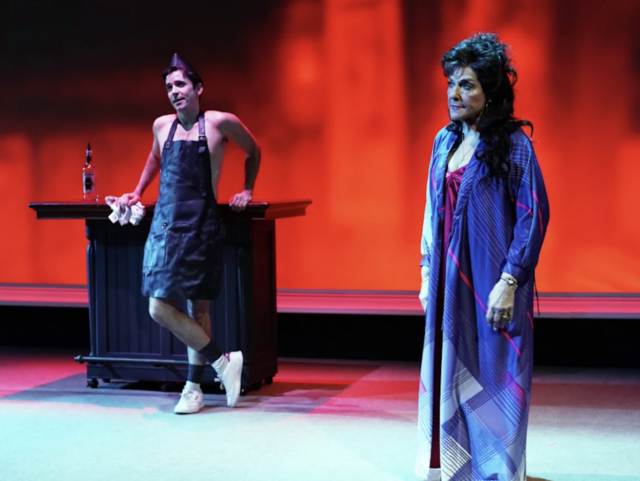
Matt Doyle and Caroline Aaron star as son and mother in semiautobiographical play (photo by Carol Rosegg)

CONVERSATIONS WITH MOTHER
Theatre 555
555 West Forty-Second St. between Tenth & Eleventh Aves.
Wednesday – Monday through April 21, $67-$169
conversationsplay.com

Matthew Lombardo’s Conversations with Mother began life about a decade ago as a series of Facebook posts detailing verbatim phone calls the playwright had with his mother. He eventually decided to turn the daily talks into the semiautobiographical show, which closes April 21 at Theatre 555. (It had been scheduled to run through May 11.)

The play traces the relationship between Maria Collavechio (Caroline Aaron) and her son, Bobby (Matt Doyle), starting in Connecticut in 1966, when she is thirty-seven and he is eight. Bobby desperately wants to come home from sleepaway camp, and Maria says absolutely not — until he writes to her, “Dear Mom: One of the camp counselors asked me to stay with him in his van overnight. He has strawberry Charleston Chews, clicker clackers, and eyeglasses that have real X-ray vision. Can I stay with him some night? Love, Bobby.”

For the next forty years, Bobby keeps getting into trouble, refusing to follow his mother’s sage advice, as he moves to New York and falls in love with an abusive man. Often when admitting his bad choices to her, he asks if she’s mad, and when she says no, he adds, “Good. Cause there’s more.” The strong-willed Maria is not angry as much as disappointed that the tender and insecure Bobby cannot find himself a better life; she believes he is wasting his youth and his chances; he deserves more but won’t believe that. The problem never was that Bobby is gay — Maria embraces that from when he first comes out to her — but that Bobby keeps screwing up, both personally and professionally. And it gets tiring, for her and, unfortunately, the audience.

The play is told in such chapters as “Tell Me The Truth and I Won’t Get Mad,” “Why Can’t You Ever Meet a Nice Boy?,” and “If Your Phone Doesn’t Ring, It’s Me,” as Maria and Bobby go through good times and bad. Even as Bobby starts his career as a playwright, he is unable to enjoy it. He explains, “I’m just so tired. I don’t want to be hurt. I don’t want to be happy. I don’t want to be sad. I don’t want to be sorry. I don’t want to think. I don’t want to know. I just want to be numb.” Maria responds, “I don’t know what to do with you, Bobby. I really don’t know what else to do. I gave you everything. More than all the other kids combined. I gave you things in me I didn’t even know I had. And for what? So you can bitch about your shitty life? No one has a better life than you!”

The narrative takes a turn when Maria becomes ill, leading to a head-scratchingly melodramatic ending that seems to come out of nowhere.

Directed by Noah Himmelstein (The Lucky Star, Los Otros), Conversations with Mother takes place on Wilson Chin’s framed set, where various chairs, bars, and tables are wheeled on and off and props are hidden in the walls. Ryan Park outfits Aaron in fanciful dresses while Doyle wears camp T-shirts with a silly hat, a revealing apron with a silly hat, a hoodie, and eventually more grown-up clothing.

Aaron (Madwomen of the West, A Kid Like Jake) and Tony winner Doyle (Company, A Clockwork Orange) never quite connect; the characters feel like caricatures trapped in a repetitive circle that is hard for the audience to become engaged in. Lombardo, whose previous plays include Tea at Five about Katharine Hepburn and Looped about Tallulah Bankhead, doesn’t develop enough depth; perhaps he’s too close to the material.

At the conclusion of the eighty-five-minute play, you’re likely to think, thank goodness there’s not more.

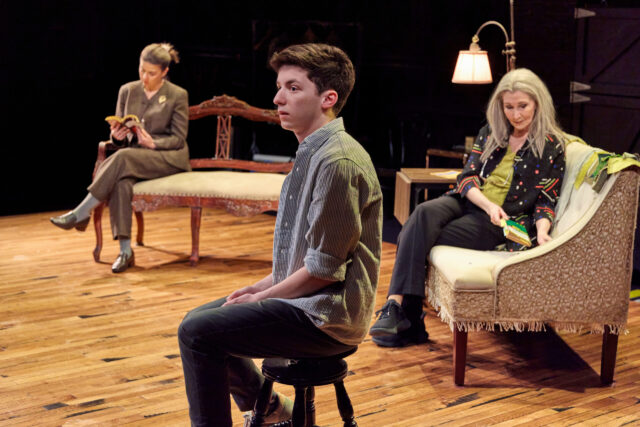
Jeanine Serralles, Andrew Barth Feldman, and Joanna Gleason star as three generations of a Jewish family in New York in We Had a World (photo by Jeremy Daniel)

WE HAD A WORLD
New York City Center Stage II
131 West Fifty-Fifth St. between Sixth & Seventh Aves.
Tuesday – Sunday through May 11, 4160
www.manhattantheatreclub.com
www.nycitycenter.org

New York City native Joshua Harmon is a master at writing about families, specifically Jewish ones, as evidenced by such works as Bad Jews, Skintight, and the epic Prayer for the French Republic. He turns his focus on his own clan in the beautifully told We Had a World, exploring his relationship with his mother and grandmother — and their complicated relationship with each other.

The hundred-minute play begins with Joshua (Andrew Barth Feldman) receiving a phone call from his grandmother, Renee (Joanna Gleason), whom he calls Nana, telling him that his next play should be about the estrangement between his mother, Ellen (Jeanine Serralles), and his aunt, the unseen Susan, focusing on a problematic Passover Seder — and that it should be called Battle of the Titans.

“I have — always wanted to write about our family; I didn’t know if — I had your permission?” he says. She gives him her blessing while making him promise that it will be “as bitter and vitriolic as possible. . . . You can even make your grandmother a real Medea. It ought to be a real humdinger.”

We Had a World is indeed bitter and vitriolic, and a real humdinger, but not in the way the fictionalized Joshua imagined; it is also sweetly innocent, tender-hearted, and almost too honest.

The story ranges from 1988, when Joshua is five, to 2018, when ninety-four-year-old Renee is sick. During his early years, Renee introduces Joshua to the arts, taking him to the R-rated Dances with Wolves, a Robert Mapplethorpe show, an exhibit featuring Tom Friedman’s Soap (which has a pubic hair on it), and the 1994 Broadway production of Medea starring Diana Rigg, an adaptation of the Greek tragedy in which a mother brutally murders her children.

“I don’t think my Mom would ever kill me,” Josh wonders.

“No, I don’t suppose she would,” Renee answers.

“Would you ever kill your children?” he asks.

“It would depend on the situation,” she responds.

Among the other cultural references are E. L. Konigsburg’s From the Mixed-Up Files of Mrs. Basil E. Frankweiler, Anthony Minghella’s The English Patient, and Alan Paton’s Cry, the Beloved Country.

Over time, however, Joshua learns some hard truths about his grandmother while coming to understand his mother in a much more profound way.

Tony-nominated director Trip Cullman (Cult of Love, Significant Other) artfully guides the action on John Lee Beatty’s open set, the audience on three sides, practically in the characters’ laps; you’ll want to try out Renee’s two Parisian high-backed love seats covered in pale green silk, an important plot point, but don’t.

In her return to the stage after a self-imposed twelve-year absence, Tony winner Gleason (Into the Woods, Dirty Rotten Scoundrels) is luminous as Renee, who is not quite the heroic figure Joshua initially thought she was, while two-time Drama Desk nominee Serralles (Dying for It, Gloria) vividly captures the complexities of the more heroic Ellen.

The immensely likable Feldman (Dear Evan Hansen, Little Shop of Horrors) ably navigates between eras as he also serves as the narrator, sharing information directly with the audience. “Before I can take you to Nana’s apartment, you probably want to know a few things. Like why my aunt and mother don’t want to be in the same room. But giving you the sixty-five-year blow by blow of that relationship would . . . we only have one play, so . . . just take my word,” he says near the beginning. “But first — a small family drama? There’s going to be enough ugly stuff.”

Given Harmon’s track record, it’s easy to take his word, especially if there are more wonderfully intricate family dramas in his and our future. (Meanwhile, Passover is right around the corner.)

[Mark Rifkin is a Brooklyn-born, Manhattan-based writer and editor; you can follow him on Substack here.]
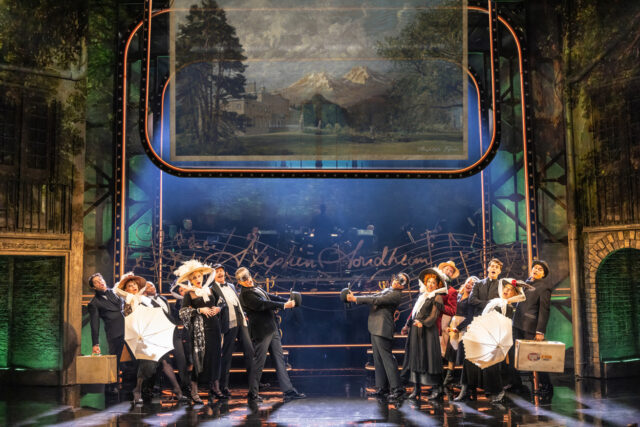
DAKAR NOIR: PLAYING CHARADES AROUND Y2K

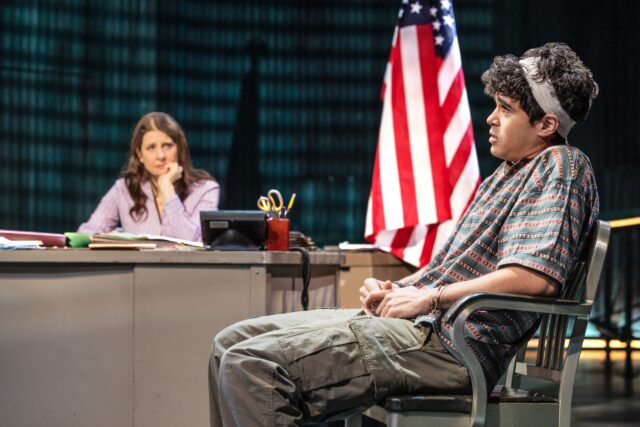
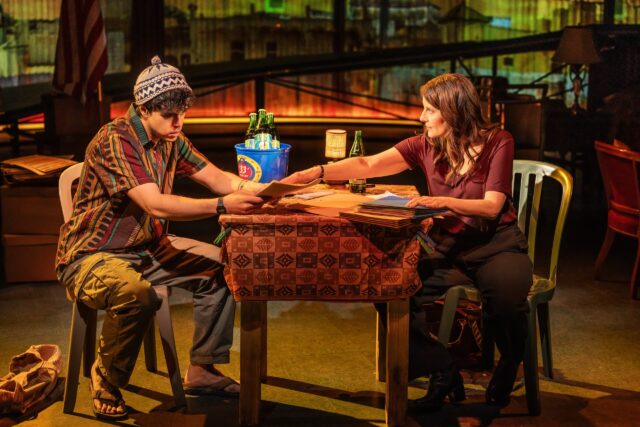
Dina Stevens (Mia Barron) involves Boubs (Abubakr Ali) in a complicated government plot as Y2K approaches (photo by Matthew Murphy)

DAKAR 2000
Manhattan Theatre Club
New York City Center Stage 1
Tuesday – Sunday through March 23, $79-$99
www.manhattantheatreclub.com
www.nycitycenter.org

“If we both describe the same thing at the same time, will one of our descriptions be more true than the other?” Isaac says to Nikolai in Rajiv Joseph’s 2017 time-leaping play Describe the Night. Later, Feliks tells Mariya, “You love to make up stories that are more interesting than what the truth is.”

The concept of “the truth” is also central to Joseph’s latest work, Dakar 2000, a gripping cat-and-mouse contemporary noir presented by Manhattan Theatre Club at New York City Center’s Stage 1 through March 23.

It’s December 31, 2024, and a fifty-year-old man (Abubakr Ali) walks onstage and delivers a monologue detailing a series of life-altering events that happened to him twenty-five years earlier, during the last few days leading up to Y2K, when some people thought the world might end.

Standing on a swirling ramp, he begins, “This is a story within a story, about a person within a person, in a time within another time. In a galaxy far, far away. All of it . . . is true. Or most of it, anyway. Names have been changed. Some of the places have been changed. Some of the boring parts snipped away. Some other stuff has been added to make it . . . theoretically more interesting. But otherwise all of it is almost entirely true.”

After telling us about a secret job he had that has taken him across the globe, he concludes, “The truth — the dumb, boring truth — is that this is mostly the story of a kid who just wanted to make a difference. And the truth is . . . he didn’t. I mean, I didn’t. Or I hadn’t . . . I hadn’t done much of any consequence, ever. Until I flipped my truck, just before the millennium . . . And met a woman who worked at the State Department.”

The narrative shifts to late December 1999, and Boubacar (Ali), known as Boubs (pronounced “boobs”), is a Peace Corps volunteer in Senegal, stationed in Kaolack and building a fenced-in community garden in the nearby village of Thiadiaye. Sporting a bandage around his injured head following the accident, he has been called in to meet with Dina Stevens (Mia Barron), who identifies herself as the Deputy Regional Supervisor of Safety & Security for Sub-Saharan Africa. Dina watches Boubs carefully as he shares the details of what led to the crash; she then starts asking pointed questions that tear holes in his story. He keeps up what turns out to be a ruse until she accuses him of lying about his situation, and he ultimately admits to repurposing materials that were meant for other projects.

Threatening to send him back home to America, Dina, who is hell bent on avenging the murder of several of her friends in the 1998 embassy bombing in Tanzania, offers Boubs the option of performing an odd task for her instead, which leads to another task, and another, each one more mysterious and perilous — and bringing Boubs and Dina closer and closer. As Y2K approaches, Boubs doesn’t know what to believe, and neither does the audience.

Boubs (Abubakr Ali) and Dina Stevens (Mia Barron) grow close working together in Rajiv Joseph’s Dakar 2000 (photo by Matthew Murphy)

Dakar 2000 is a riveting thriller reminiscent of Stanley Donen’s 1963 Hitchcockian favorite Charade, in which Audrey Hepburn stars as an American expat unexpectedly caught up in a dangerous spy drama in Paris after her husband is killed and she is pursued by multiple men, one of whom (Cary Grant) claims he is trying to help her even though she catches him in lie after lie. Which is not to say that Barron and Ali have the same kind of chemistry as Hepburn and Grant, but the quirky relationship between Dina and Boubs is appealing. At one point, when they’re on Boubs’s roof, face-to-face, you want them to kiss but also want them not to, as neither one is ultimately trustworthy.

Two-time Obie winner Rajiv Joseph (Bengal Tiger at the Baghdad Zoo, King James) and director May Adrales (Vietgone, Poor Yella Rednecks) keep us guessing all the way to the finale. Tim Mackabee’s turntable set moves from Dina’s office and a restaurant to the roof and a hotel bedroom, with small props occasionally surreptitiously added when it rotates from scene to scene. Shawn Duan’s projections range from a starry sky and outdoor African locations to text that establishes the precise time and location. A metaphor linking the 1997 Hale Bopp Comet to fate is confusing, but the choice of Culture Club’s 1983 hit “Karma Chameleon” as the song connecting Boubs with his ex-girlfriend is inspired, with Boy George singing, “There’s a loving in your eyes all the way / If I listen to your lies, would you say / I’m a man without conviction / I’m a man who doesn’t know / How to sell a contradiction / You come and go, you come and go.”

Ever-dependable Obie winner Barron (The Coast Starlight, Dying for It) effectively captures Dina’s enigmatic nature, representing an unethical government that holds all the cards. Ali (Toros) portrays Boubs’s younger self with a tender vulnerability that makes his actions understandable, although his overall characterization is ultimately a bit uneven, his voice too often switching pitches, his youth making him less than convincing as the modern-day Boubs.

Joseph has noted that Dina and Ali are based on actual people, but that doesn’t mean Dakar 2000 is a documentary play, particularly as words such as truth and lie show up over and over again. During the course of the work’s brisk eighty minutes, Dina tells Boubs, “You’re a good liar,” “Trust me, I wouldn’t lie to you about this,” and “Do you ever wonder if it’s all a big lie?” Meanwhile, Boubs wonders, “How could it be a lie?” when Dina questions humanity’s general consciousness.

Theater by its very definition presents a fictional version of reality, no matter how factual it might be. But in the case of Dakar 2000 and other plays by Joseph, we should be grateful that he “loves to make up stories that are more interesting than what the truth is.”

[Mark Rifkin is a Brooklyn-born, Manhattan-based writer and editor; you can follow him on Substack here.]
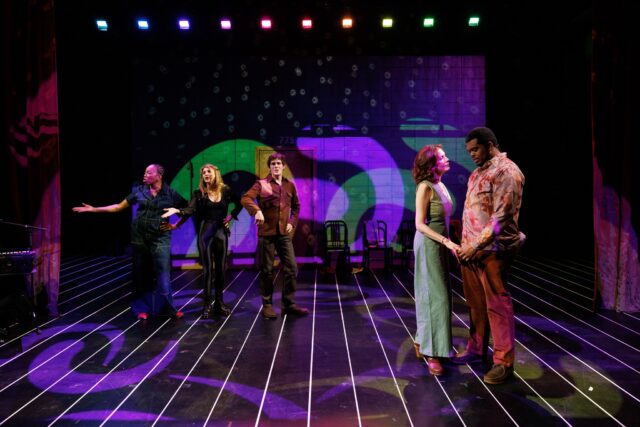
EUREKA! STRIKING GOLD ON BROADWAY

The executive committee at Eureka Day School has its work cut out for it (photo by Jeremy Daniel)

EUREKA DAY
Samuel J. Friedman Theatre
261 West Forty-Seventh St. between Broadway & Eighth Ave.
Tuesday – Sunday through February 16, $48-$321
www.manhattantheatreclub.com

Jonathan Spector’s Eureka Day is the funniest play of the year.

Five years ago, I called Colt Coeur’s East Coast premiere of Eureka Day at walkerspace an “uproarious satire.” It’s even better in the Broadway debut of the Manhattan Theatre Club production at the Samuel J. Friedman, succeeding where a similarly themed show, Larissa FastHorse’s The Thanksgiving Play, about a woke quartet of grown-ups trying to put on an acceptable, PC holiday show for young schoolchildren, failed. The fall 2018 iteration of The Thanksgiving Play at Playwrights Horizons was fresh and original and utterly hilarious; its 2023 Broadway version was stale and outdated, like dried-out leftovers.

That doesn’t happen with Eureka Day, which strikes gold for the second time.

The story takes place in the fall of 2018 in the library of the Eureka Day School in Berkeley, California. The executive committee is meeting, and the opening dialogue sets the stage for what’s to come.

Meiko: Personally no / I don’t find it offensive / the term itself is not offensive.
Eli: It’s descriptive.
Suzanne: I think she’s saying / I’m not putting words in your mouth / she’s saying it’s not offensive / but when you contextualize it in that way. . . .
Meiko: I find / the best way not to put words in someone’s mouth? / is not to put words in their mouth.
Don: Okay okay.
Suzanne: Sorry sorry.
Meiko: It’s fine / what I meant was / that we’d want to make it absolutely clear that it’s optional / that it’s not / Either / Or.
Suzanne: Right / and also / that the inclusion of the term on this list at all is / I think / inappropriate? / and that some people may / With Good Reason / find its inclusion offensive.
Eli: No no yeah / I just wonder though / by leaving it off / is it possible some people would find its absence offensive?
Don: You’re concerned / that it could be a sort of / erasure / of people’s experience?
Eli: Right / if our Core Operating Principle here is that everyone should / Feel Seen / by this community.
Suzanne: There’s no benefit in Feeling Seen if you’re simultaneously Being Othered / right?
Meiko: Well / no yeah.
Don: Carina, did you want to / do you want to / offer anything?
Carina: Oh, I / I’m happy to defer / I don’t know that I’ve really formed a strong [opinion.]
Don: That’s perfectly all right / even just your gut instinct is [welcomed] / this is an Open Room / we welcome your unique perspective.

The discussion is about what to include in the school’s online dropdown menu where parents are supposed to click off their kid’s race/ethnicity/heritage, but it could deal with so many other subjects that are part of the committee’s efforts to be as inclusive as possible in any and all situations.

“Sounds like there’s a lot to unpack here,” Don says, but there’s a lot to unpack everywhere in this outrageously hilarious satire.

The white, childless Don (Bill Irwin) is the head of the committee and prefers not to take sides, ending each meeting with a quote from the thirteenth-century Sufi poet Rumi. The well-off, white Suzanne (Jessica Hecht) is a longtime board member who has put each of her six children through Eureka Day and regularly supplies the library with books. The white, Jewish Eli (Thomas Middleditch) is a wealthy tech bro with an open marriage and one son in the school. He is secretly dating the half-Japanese Meiko (Chelsea Yakura-Kurtz), who has a daughter in the school and spends much of her time knitting rather than actively participating in the committee’s proceedings. And the biracial Carina (Amber Gray) is filling the spot saved for the new member, hesitant to share her views until she can’t stop herself as it all becomes ridiculously absurd.

When a student contracts the mumps and the health department sends an official notice explaining that nonvaccinated children will be barred from attending school until they get their shot, the committee calls for a hybrid Community Activated Conversation, with parents commenting from home on the chat, which delves into vaccination efficacy, conspiracy theories, personal and public responsibility, and plenty of vicious name-calling.

Christian Burns: Wait. HALF the school is antivaxxers? Seriously????
Sandra Blaise: “Anti-vaxxer” is not really a term I’m comfortable with. It’s actually something said out of IGNORANCE.
Karen Sapp: Exactly! Protect your children by EDUCATING YOURSELVES.
Tyler Coppins: OR, Protect your children by VACCINATING THEM.
Courtney Riley: Wait what???? Why should we be forced to keep our kids home because you CHOOSE to endanger yours?
Doug Wong: Okay here’s another idea: what if we made the quarantine days OPTIONAL.
Orson Mankel: Doug, that’s idiotic. If the “problem” is that we won’t have enough kids in class, why make the problem worse???
Christian Burns: TRUE FACTS: Moonlanding wasn’t faked. 9/11 wasn’t an inside job. Global Warming is real. Vaccines Don’t Cause Autism.
Karen Stacin: Mock all you want, but I saw so many bad things as a nurse. That’s why I decided I would NEVER subject my children to Western Medicine of any kind.
Christian Burns: Remember that time I got crippled from polio? Oh, no, wait. I didn’t. Cause I got FUCKING VACCINATED.

Things only devolve from there in side-splitting ways that are even funnier — and more frightening — now that President-elect Donald Trump has nominated the controversial Robert F. Kennedy Jr. to run the Department of Health and Human Services.

Community Activated Conversation at Eureka Day goes terribly wrong in hilarious Broadway play (photo by Jeremy Daniel)

Ancient Greek polymath Archimedes is often credited with coining the exclamation Eureka! upon discovering what became known as the Archimedes Principle, a scientific theory about buoyancy. So it makes sense that Spector has named the woke school in question Eureka Day. Todd Rosenthal’s set features blue chairs, red, orange, and yellow trapezoid tables that are rearranged into geometric shapes, posters of Ruth Bader Ginsburg, Albert Einstein, Maya Angelou, Sandra Day O’Connor, and Michelle Obama, and a sign that reads “Social Justice” under a placard that proclaims, “Berkeley Stands United Against Hate.” Clint Ramos’s naturalistic suburban costumes are highlighted by the long, fussy frocks worn by Suzanne.

Tony winner Anna D. Shapiro (August: Osage County, This Is Our Youth) directs with a sweet glee, while sound designers Rob Milburn and Michael Bodeen know just when the laughs are coming, particularly during the Community Activated Conversation, when David Bengali’s projections take over and the characters’ discussion fades into the background.

The ensemble is outstanding: Tony nominee Gray (Natasha, Pierre, and the Great Comet of 1812, Hadestown) is cool and collected as the determined Carina, who can’t believe what the board is doing; two-time Tony nominee Hecht (Summer, 1976, Fiddler on the Roof) is delightful as the nervous, jittery Suzanne, punctuating her dialogue with wonderful sighs and grunts; Tony winner Irwin (Who’s Afraid of Virginia Woolf?, On Beckett) is tender as the mild-mannered, oblivious Don; Emmy nominee Middleditch (Silicon Valley) adds humanity to the selfish Eli; and Chelsea Yakura-Kurtz (How the Light Gets In, Unrivaled) beautifully captures Meiko’s evolving value system as she reconsiders being part of the team.

As funny as Eureka Day is, it tackles some hard-hitting subjects, from race and income inequality to religion and health care; the executive committee is so wrapped up in DEI that they miss what is right in front of them, stirring up more trouble with their inability to follow old-fashioned rules and face the truth of what is really happening in their school, to the students.

At one point, the other members of the committee explain to Carina how there was controversy over a recent eighth-grade production of Peter Pan. “I don’t know what they were thinking,” Suzanne recalls. “We came to what I thought was a very [good agreement] / we set the production in Outer Space / and that really solved the [problem],” Don says. “So then all the kids got to fly,” Eli adds, as if that were the only solution, while Carina can barely accept what she has gotten herself into.

Fortunately, Eureka Day does not have to worry about any such controversies, as it gets it all right, flying high from start to finish.

[Mark Rifkin is a Brooklyn-born, Manhattan-based writer and editor; you can follow him on Substack here.]