Tag Archives: LuEsther Hall

SOMETHING VERY GOOD IS ABOUT TO HAPPEN: GUS BIRNEY ON SEAGULL, NEW NETFLIX SERIES, AND HAILING FROM ACTING ROYALTY

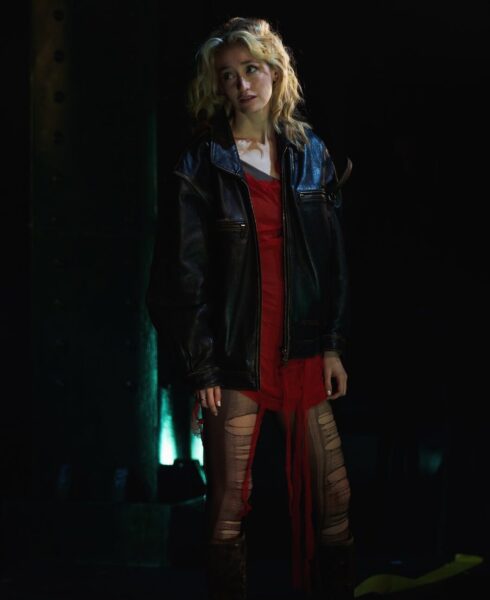
Gus Birney stars as Nico in Eli Rarey and Sasha Molochinikov’s Seagull: True Story at the Public Theater (photo by Kir Simakov)

SEAGULL: TRUE STORY
LuEsther Hall, the Public Theater
425 Lafayette St. at Astor Pl.
Tuesday – Sunday through May 3, $109
publictheater.org

In Seagull: True Story, Eli Rarey and Alexander Molochnikov’s dark comedy about a Russian troupe trying to stage Anton Chekhov’s 1896 classic tragicomedy in the midst of Russia’s invasion of Ukraine, Masha, portraying Nina in the play-within-a-play, asks, “Why is it so dark?” The part is played by Gus Birney, and, for her, the future is nothing but bright.

At the age of twenty-six, Birney is a rising star, and not just because she was named one by Porter magazine. Best known for her roles as Jane Humphrey in Dickinson and Gaynor Phelps in Shining Vale, she is now creeping out horror fans as Portia in the Netflix series Something Very Bad Is Going to Happen. She excelled as a call girl in Anne Kaufman’s revival of Lorraine Hansberry’s The Sign in Sidney Brustein’s Window at BAM and on Broadway, was heartbreaking as Dora, a Russian Jew who dreams of becoming a movie star, in Igor Golyak’s brilliant Our Class at BAM. then played Jessica, Shylock’s daughter, in Golyak’s wild and woolly adaptation of Shakespeare’s The Merchant of Venice at Classic Stage.

Birney hails from acting royalty; her father is Tony and Drama Desk Award winner Reed Birney (The Humans, House of Cards), her mother is SAG Award nominee Constance Shulman (Orange Is the New Black, Well, I’ll Let You Go), and her older brother, Ephraim (Chester Bailey), is a writer and actor as well.

In The Seagull, Nina Zarechnaya is an ingenue who falls for writer Boris Trigorin while wannabe playwright and director Konstantin Treplev, the son of once-beloved actress Irina Arkadina, is desperately in love with her. A dreamer, Konstantin declares, “I am increasingly convinced that it’s not about old or new forms, but about the fact that what a person writes, not thinking about forms at all, they write because it flies freely from their soul!” That is the same attitude Rarey and Molochnikov bring to Seagull: True Story, a vastly entertaining, thrillingly unpredictable, and insightful exploration of theater, family, and war, running at the Public though May 3, inspired by real events that happened to Molochnikov. Birney shines as Masha and Nico, offering two different interpretations of Nina, opposite Eric Tabach as Kon, Zuzanna Szadkowski as Kon’s mother, Elan Zafir as the dramaturg Anton, and a “fantastic” Andrey Burkovskiy as the MC and other roles. (On April 12, Molochnikov will play Kon, his onstage alter ego, and participate in a postshow Q&A.) At one point, Nico, as Nina, says, “I’m the seagull. No, that’s not right, I’m an actress.”

An actress ready, willing, and able to take chances, Birney recently Zoomed with me from her parents’ New York City apartment, discussing Russian theater, her latest streaming venture, family, pets, and acting.

twi-ny: How are things? Because you’re really busy right now, aren’t you?

gus birney: Oh my gosh, I know! It’s been a really cool period of time, because I have this TV show that just came out right alongside doing this play. It’s been so exciting. This is like an alternate reality of my life where, Oh, there’s a lot going on, but it’s nice to be in a high for a second.

twi-ny: I wanted to start by delving right into Seagull: True Story. I remember speaking with you last May at the opening at La MaMa. It was an all-star opening; Igor Golyak was there, Mikhail Baryshnikov, and various Russian dignitaries. What were your thoughts about the play when you saw it that night? Did you have any inkling that you were going to be in it later?

gb: Well, to answer your first question, when I saw it I was incredibly jealous that I was not in it. I was like, this is so cool. Everyone up there looks like they’re having so much fun. It just felt like an explosion of color and life and passion. I think I hadn’t finished Our Class. I can’t remember if I was still doing it. It had finished, but Our Class was in that same world, but it was so heavy and depressing and dark.

And so it felt like the lighter version of Our Class where it was the same kind of colorfulness, but just so much dance and music, even though this play explores very heavy subjects as well. I had auditioned for a workshop of it with Sasha, and we kept having conversations about me doing it, but the timing never worked out for either of us.

And I saw Stella [Baker] do it and she’s fantastic in the show. And I thought, this is so great. I’m jealous that I’m not in it. And then, about a month ago, they called me and said Stella has a conflict, would you be willing to jump in? It was around the time that Something Very Bad was going to come out. So I knew I’d be limited on timing. And they were incredible because they made it work. I had seven days of rehearsal; I’d never done anything like that — it was so fast. But it’s been a blast. I really have had such a good time; I love it.

Gus Birney takes a break during rehearsals for The Merchant of Venice at Classic Stage (photo by twi-ny/mdr)

twi-ny: The rehearsal process sounds like the play itself, sort of all over the place, in a good way, fast and furious, nonstop.

gb: Yes, definitely.

twi-ny: Have you ever done Chekhov before?

gb: No, I’ve never done it, and now I’ve read The Seagull and I’m dying to be in the Chekhov Seagull; I would love to play Nina. But I do feel like this is great because I get a little touch of that and I’m exploring it in a totally different way.

twi-ny: In a November 2022 essay in Rolling Stone, Sasha wrote, “The world loves Russian theater.” It seems right now that Russian theater loves you. You’ve previously appeared in Igor’s Our Class and The Merchant of Venice. Both directors have unique visions of classic plays and how to adapt them to today’s world. I’m thinking also of Dmitry Krymov, another Russian émigré who’s doing a Vanya adaptation at La MaMa, which I don’t know if you’ll get to see because they’re running at the same time as Seagull. You’re of Polish descent, as we’ve talked about before, but how did you come to fit into this Russian theater niche in New York?

gb: You tell me; I don’t know what happened. Two and a half years ago, I got the audition for Our Class and had no idea what to expect. I read it. I thought it was a beautiful piece, but on paper, it is a completely different experience than what the outcome ended up being. I feel like that’s the same with Sasha’s Seagull. On paper, it looks like one thing, but then you see the finished product and it’s, like, whoa.

Honestly, I don’t know. I feel like I walked into this magical world that I had never thought I would be entering into and that now I never want to leave. I did Sidney Brustein right before I did Our Class, and I learned so much. I was also so terrified and felt way over my head with what I was doing because I didn’t go to acting school, and I felt I was, like, Oh my gosh, I’m entering into this world blind, and I felt like there was this right way and wrong way to do things.

Then I did Our Class and there was no such thing as a mistake. There was no such thing as a wrong move. What I love so much about this Russian world is that mess is right. Mistakes are correct. As someone who’s a very anxious performer, it’s given me this whole new sense of freedom. Like, Oh my gosh, the things you don’t like about yourself and the days that you’re, like, I was bad, or I screwed up this, or I said this line instead of this. No, that’s interesting. It’s different. It’s exciting. And it’s given me this whole newfound confidence in myself.

twi-ny: That’s a great way to put it, because being in the audience for these shows feels the same way. You’re from New York City acting royalty. You’ve been acting since you were three, when you were an elephant in a parade.

gb: Oh my gosh, you know this? Did I tell you this?

twi-ny: You did not tell me this, but I leave no stone unturned. By ten, you’re in Thoroughly Modern Millie, singing “Jimmy.” Your father is Reed Birney, your mother is Constance Shulman; I’ve seen them both many times onstage. I loved your mother in a play called Shhhh. I don’t know if you saw it.

gb: I loved her in that too! It’s one of my favorites!

twi-ny: I love that show. And I’ve also seen them many times in the audience. So when they’re not onstage or filming a movie or television series, they’re going to the theater. And your brother is also a terrific actor. Here’s something that you wrote a few years ago:

“The least interesting thing about my parents is the fact that they’re actors. They’re multifaceted, complicated, curious, hilarious, full of life human beings who also sometimes yell at me to be less self-involved.”

So what is the most interesting thing about your family, and what’s the most important lesson you’ve learned from them?

gb: Oh, wow.

twi-ny: Is that too big a question?

gb: No. I’m going to answer with a cliché answer, but my parents are genuinely extraordinarily kind human beings. And they really instilled that in us. Not to pat myself on the back, but I do think that, in my head, kindness and respect, from top to bottom on a set for whoever’s there, was always the number one priority in their heads. We’re an incredibly close family. I’m literally at their apartment right now, and I have my own, but I stay here almost every night. Yeah, we’re all best friends. My mom used to say, Treat every person in a conversation like they’re the only person in a room. And I hope and strive to do that. They do that constantly. Whether they quit acting tomorrow or they continue, it doesn’t matter. It’s about being a kind human being in this world, which I don’t think we have enough of sometimes.
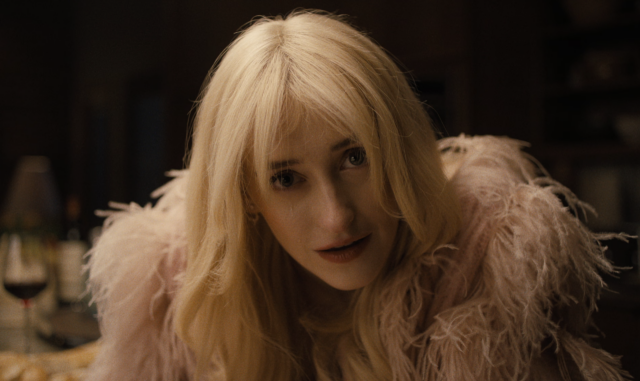
Gus Birney stars as Portia in Haley Z. Boston’s Something Very Bad Is Going to Happen (photo courtesy Netflix)

twi-ny: Definitely. The last time I spoke with you, you said that your father was considering retirement. Maybe it was after Lunar Eclipse.

gb: You know, he’s always saying that. I’m sure if you see him, he would be saying that to you, but he’s not going to.

twi-ny: Good. I’ve seen him and your brother, Ephraim, in Chester Bailey. Although I didn’t see it in Williamstown, you’ve acted with your mother in The Rose Tattoo. Which brings me to a favorite cult film of mine, Strawberry Mansion. Your cousin Albert makes this film and all the Birneys are in it except for you. Where are you?

gb: I don’t know! Why wasn’t I there! There wasn’t a part for me, I guess.

twi-ny: It’s a crazy movie.

gb: Yeah, it is crazy. Albert’s insane. He’s amazing, but he lives in his own crazy world.

twi-ny: Well, you’re in so many other things. At sixteen, you start doing TV, theater, and films. You’ve already amassed more than forty credits in ten years. So you’re incredibly busy. Now you’ve got Something Very Bad Is Going to Happen. What’s it like going from these three different media, at such a fast pace?

gb: Yes, yes. You know, I learn something through each medium. I have such a respect for theater because that’s how I was raised. I feel like it’s the best way to start out as an actor because it just rounds you in your body and your voice. I feel so lucky to be able to dive into each of these specific worlds of what it is to be an actor. They all feel so different.

I don’t know, you said forty credits and in my head I’m like, Really, have I done that much? But no, it’s so cool. I’m twenty-six now and I still feel like I’m thirteen so much of the time. But it’s good to have moments where I’m really proud of myself.

The show that just came out yesterday is one of the most exciting jobs I’ve ever had. I had such a good time doing it. I’m so happy that the world can see it now. And I feel a little protective over it, because who knows how it’s going to do? Who knows? It’s so crazy what catches on and what doesn’t. And I’m kind of just like, it doesn’t matter what happens with it. I’m so proud of the show. And I’m so happy that it’s out in the zeitgeist and anyone can see it.

twi-ny: Do you have a dream role?

gb: Oh, wow. I don’t know. Someone asked me the other day and I had such a strange answer. They asked, What role would you want adapted to screen from a book? And I said I’d want to play Sally in the live-action version of The Nightmare Before Christmas, because something I get a lot is that I look like a Tim Burton character. And so I would love to play a Tim Burton character. But in a play, definitely right now, the Nina thing is kind of forefront in my head; I would love to play this part and do my little spin on it.

I love The Glass Menagerie; I always talk about that play. I would love to be Laura in that. I did a reading of Who’s Afraid of Virginia Woolf? recently; I would love to be Honey. So we’ll see. There’s so many things I want to do.
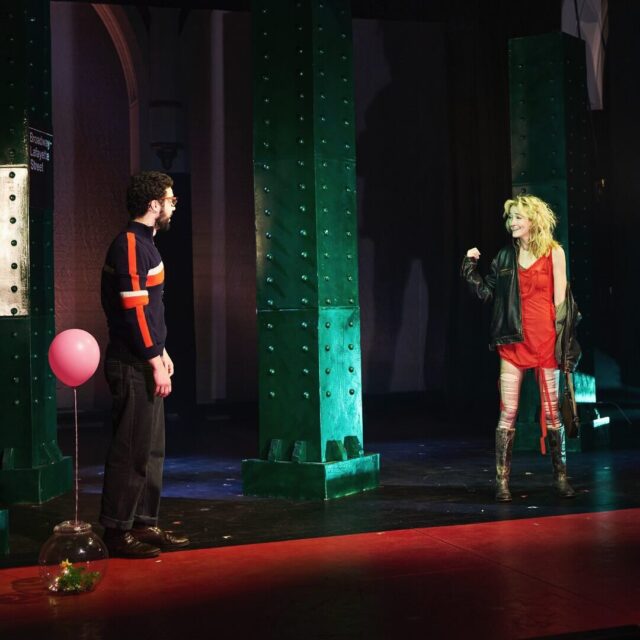
Kon (Eric Tabach) and Nico (Gus Birney) meet cute in Seagull: True Story (photo by Kir Simakov)

twi-ny: You’ve mentioned how anxious you get as an actress, but I have a feeling maybe a little bit in real life as well, and you used to describe yourself as shy and strange, particularly when thinking back on your childhood. Today, with all these things going on, can I ask how you feel about yourself, particularly about the confidence you’re building with each performance?

gb: Yeah! Definitely still shy and strange. I did an interview this morning on New York Live and I rewatched it before talking to you and I was, like, Oh my gosh, Gus, you’re so strange. But no, I think what’s happened is I am shy and strange and I also feel such confidence in what I am now.

Oh my gosh, who is this?

twi-ny: This is our kitty, Tuki. She gets in on every Zoom call.

gb: I’m so glad; she can stay for the rest of it. She’s the cutest. I feel like the world is trying to tell me to get an animal because I saw these puppies this morning and now I see this little sweetie and it’s like I just need to.

twi-ny: New York City apartments are not the same without an animal, but you’re not spending enough time in your own apartment to have an animal, a pet.

gb: It’s true. Yeah, that’s what will force me to grow up. Yes, but anyway, I feel like I have a whole other level of confidence in whatever I am at this point in my life, so yes.

twi-ny: One last thing. Having met you several times, seeing you onstage and television, and watching some of your interviews, I can’t help but notice that one of the words that comes up over and over again is fun. You just look like you are having the most fun time. Being in your presence brings happiness. That seems to be your approach to life.

gb: Yes, I think so. I try. I am definitely anxious. We’ve talked about this, but I do think I’m a really positive, optimistic person, and I really love that about myself. Yeah, like how cool is my job — or our job, because you’re also in this artistic crazy world.

You know, it is terrifying what is going on at this point in history, so let’s enjoy the moments where it’s light. In this play I get to dance, I get to sing, I get to run around, and it’s the coolest thing to just compartmentalize for two hours out of your day and just be free. So yes, I appreciate you saying that. That’s what I would strive to be: happy.

[Mark Rifkin is a Brooklyn-born, Manhattan-based writer; you can follow him on Substack here.]
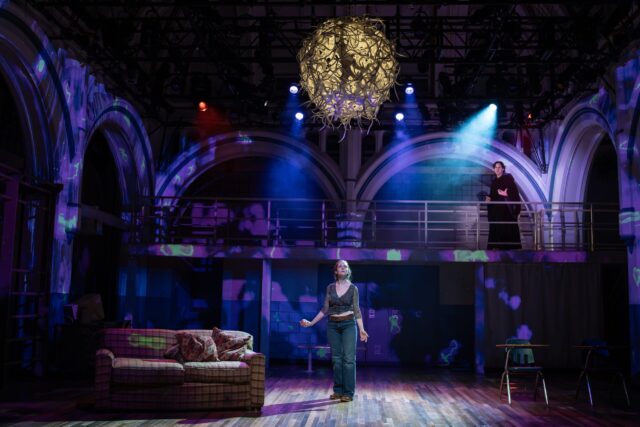
TAKING THE INTITIATIVE: A MORE-THAN-WORTHWHILE FIVE-HOUR THEATRICAL EXPERIENCE

Else Went’s Initiative unfolds over more than five hours at the Public Theater (photo by Joan Marcus)

INITIATIVE
LuEsther Hall, the Public Theater
425 Lafayette St. at Astor Pl.
Tuesday – Sunday through December 7, $109
publictheater.org

“Do you think we’ll do anything worthwhile with our lives? Is it even possible?” Clara (Olivia Rose Barresi) asks Riley (Greg Cuellar) about halfway through Else Went’s Initiative.

Experiencing the play is worthwhile, whether it’s the five-plus-hour performance, with three ninety-minute acts and two intermissions, or the six-and-a-half-hour one, with an added dinner break.

The show is set in “Coastal Podunk, California,” where a group of high school classmates explore first love, traumatic loss, and just about everything in between at the dawn of the new millennium as they begin to try to seek their place in an ever-more complex universe. In the early aughts, just after Y2K has not destroyed society, seven teenagers navigate adolescence, essentially without adults, on their own; we occasionally hear the garbled offstage shouting of two brothers’ unbalanced mother and the disembodied voices of Mr. Stone, a somewhat comforting English teacher, and Ms. May, a sensitive guidance counselor (both voiced by Brandon Burk). The tech age is upon the teens as they obsess over Super Nintendo and instant messaging on the internet — but only when they’re home at their computers. “The world is . . . tumultuous right now, and taking in too much information . . . can actually be dangerous,” Ms. May tells Clara, who responds, “It’s just that this is, like, the world, right? That I’m gonna inherit. Everyone’s always like ‘you’re the leaders of tomorrow,’ that sort of thing, but at the same time nobody wants to explain yesterday.”

Clara has returned to the classroom after several years of home-schooling by her religious parents. She is in love with Riley (Greg Cuellar), who admits to her he is gay but wants to remain her best friend. Clara seeks solace in Lo (Carson Higgins), a selfish, callous kid who is a star pitcher hiding something that happened between him and Riley at summer camp. Lo’s younger brother, Em (Christopher Dylan White), is a loner addicted to video games and unsure of how to return the affections of the sexy Kendall (Andrea Lopez Alvarez), the most progressive of the gang. Tony (Jamie Sanders), the least refined of them, has a crush on Kendall but becomes more of a bully after she doesn’t go for him and she becomes good friends with a shy, reserved new student, Ty (Harrison Densmore).

Over the course of four years, the teens discover things about themselves and each other as college approaches. Oh, and they spend a whole lotta time playing Dungeons and Dragons. Really. And it’s a blast to watch.

A continuing game of Dungeons and Dragons provides an exhilarating break during five-hour play (photo by Joan Marcus)

Initiative shouldn’t be compared to such other time behemoths as The Iceman Cometh, Strange Interlude, and the grandmaster of them all, Gatz. Written by Else Went and directed by Emma Rosa Went, who are married millennials who met in high school, the play, loosely inspired by their real lives, is performed by actors who are also millennials, which lends them an understanding of what their characters are going through; they might not look fourteen or fifteen, but they act it in a very empathetic, understanding way. In addition, several of them have been with the project since its start nearly ten years ago, giving them the opportunity to develop their portrayals.

Mikiko Suzuki MacAdams’s large, open set features a row of lockers, two swings, a glowing abstract orb that represents a popular local tree (as well as the end of innocence), a bridge in the back, and a series of arches that evoke Greek drama; desks, beds, chairs, tables, benches, and other furniture are wheeled on- and offstage, and a hot tub emerges from beneath. S. Katy Tucker’s projections focus on stars, the galaxy of opportunities awaiting the teenagers — as well as the challenges they will face. Noticing shooting stars out the window, Lo says to Riley early on, “You ever think about dying?”

The cast is extraordinary, holding our attention for five hours, making us care what happens to each character, even during the D&D scenes, which allow them, and the audience, to temporarily break free of their inner turmoil. Christopher Akerlind’s lighting and Angela Baughman’s sound further engage us in the proceedings, along with Kindall Almond’s period costumes.

The play is about fifteen minutes too long, and the Wents seem unsure how to end it; I noticed three times I thought it should conclude and was sorry to see it continue, and there’s a coda that feels unnecessary, explaining elements we are already aware of that were better left unsaid. But it all flows with a tender naturalism before that — and is sure to make you remember moments from your own high school years, the good ones and the bad.

Initiative is a warm and engaging coming-of-age epic filled with universal truths about then and now. In a script note, Else Went writes, “This play is the letter to my younger self that I cannot receive. . . . It is apology and forgiveness, to myself, to my first friends, my first loves.”

It’s a letter that the audience is happy she sent.

[Mark Rifkin is a Brooklyn-born, Manhattan-based writer and editor; you can follow him on Substack here.]
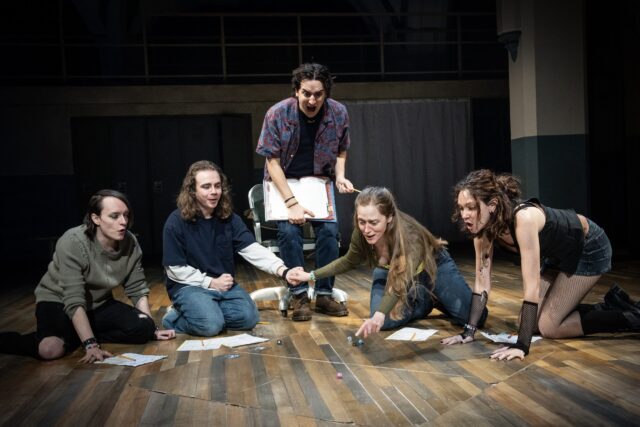
RACE AND GENDER DISCRIMINATION ONSTAGE: JORDANS / SALLY & TOM / SUFFS

Naomi Lorrain and Toby Onwumere both play characters named Jordan in Ife Olujobi’s new play at the Public (photo by Joan Marcus)

JORDANS
LuEsther Hall, the Public Theater
425 Lafayette St. at Astor Pl.
Tuesday – Sunday through May 19, $65-$170
publictheater.org

“A reckoning is coming and the likes of you will be crushed by the likes of me!” the enslaved James tells his owner, Thomas Jefferson, in Sally & Tom, one of three current shows with ties to the Public Theater that deal with race and gender discrimination — and a coming reckoning.

At the Public’s LuEsther Hall, Ife Olujobi’s Jordans is set at a modern-day photo studio called Atlas, where some heavy lifting has to be done. The small company is run by the white, domineering Hailey (Kate Walsh), whose staff consists of the white Emma (Brontë England-Nelson), Fletcher (Brian Muller), Tyler (Matthew Russell), Ryan (Ryan Spahn), and Maggie (Meg Steedle) as well as a Black woman named Jordan (Naomi Lorrain), who they all treat, well, like an enslaved woman. While the others bandy about ridiculous ideas regarding Atlas’s future, Jordan has coffee purposefully spilled on her, is told to clean up vomit and human waste, gets garbage thrown at her, and is essentially ignored when she’s not being harassed.

When a photographer (Spahn) is snapping pictures during a photo shoot, he calls out to the model (England-Nelson), “Tell me, who is this woman? What does she want?” It’s a question no one asks Jordan.

Concerned that the company is becoming “vibeless” because their personnel lacks diversity, Hailey hires a Black man also named Jordan (Toby Onwumere) as their first director of culture. When 1.Jordan, as he’s referred to in the script, arrives for his first day, he asks Jordan, “What’s a brotha need to know?” And she tells him: “Well . . . the way I see it is, I work in an office owned by an evil succubus, staffed by little L-train demons, and I spend all day trying not to fall into their death traps. Sometimes it feels kinda like a video game: me running around, dodging flying objects, trying to save my lives for future battles. But then I remember this is my actual life, and I only have one. So.”

Hailey enters and runs her hands over 1.Jordan’s body as if she were evaluating a slave she has just purchased. Maggie demands to know where he is from — and she does not mean where he was born and raised, which happens to be in America. Fletcher, Emma, Tyler, and Ryan bombard him with questions about why his father was not around and was such a deadbeat. The stereotypes keep coming, but 1.Jordan stands firm, even as Hailey asserts to him when they are alone, “I am the owner of this studio.” He has been hired to be the (Black)face of the company and to do whatever he is told. Did I mention that 1.Jordan’s last name is Savage?

Outside the office, the two Jordans disagree on how to “play the game.” Jordan advises 1.Jordan to keep his head down, follow the rules, and not to show off his accomplishments. “You have to let them think that they own you,” she says. But 1.Jordan is determined to be a success on his terms, not theirs, arguing, “I want the freedom to do what I want without having to beg.”

Soon the Jordans become interchangeable, their roles and responsibilities merging and veering off in strange ways, each seeing the white world they inhabit from a new viewpoint. “Who are you?” Jordan asks. 1.Jordan replies, “Who am I?!” Meanwhile, the racist clichés ramp up even more.

Ife Olujobi’s Jordans is set at a modern-day branding studio (photo by Joan Marcus)

In her 2021 pandemic book No Play, in which Olujobi interviewed hundreds of theater people about the state of the industry as impacted by current events — I was among the participants — she asks in the chapter “the end of all things as we understand them”: “In the context of the racial and social justice movements reinvigorated by last year’s uprisings in response to the police killings of Black people, and in the simplest and most literal terms possible, what does ‘doing the work’ mean to you?”

Jordans — the title instantly makes one think of Michael Jordan’s heavily marketed and branded sneakers — is about doing the work, no matter your race or gender. Olujobi, in her first off-Broadway play, and director Whitney White (Jaja’s African Hair Braiding, On Sugarland) don’t back away from harsh language and brutal situations to make their points about where we have to go as a nation, when to take action, and when to sit back and listen. At a talkback after Donja R. Love’s Soft in 2022, White, who directed the show, told the audience that white people were not allowed to take part in the discussion. It was a sobering experience that has remained with me.

Lorrain (Daphne, La Race) and Onwumere (Macbeth, The Liar) are superb as the two Jordans, who get under each other’s skin both literally and figuratively. In an intimate and potent sex scene, only Lorrain’s vulva is exposed, not for titillation, but to declare that power and success do not require a penis. Walsh (If I Forget, Dusk Rings a Bell) excels as Hailey, who represents white leaders of all kinds.

The narrative has a series of confusing moments, and it’s too long at 140 minutes (with intermission); the scene with influencer Kyle Price (Russell) feels particularly extraneous, draining the story of its thrust. But the finale makes a powerful statement that won’t be easy to forget.

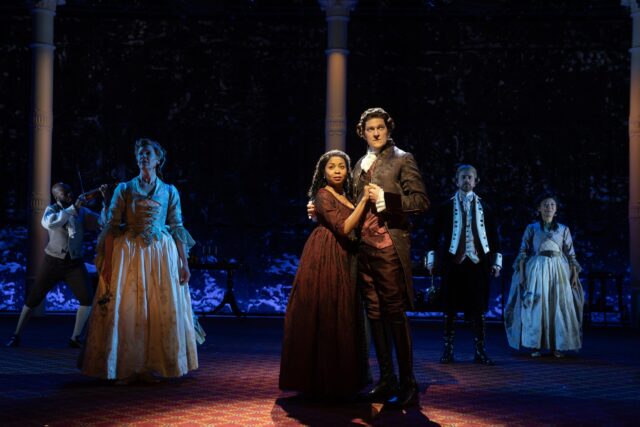
Sally Hemings (Sheria Irving) and Thomas Jefferson (Gabriel Ebert) pause at a dance in Suzan-Lori Parks’s new play at the Public (photo by Joan Marcus)

SALLY & TOM
Martinson Hall, the Public Theater
425 Lafayette St. at Astor Pl.
Tuesday – Sunday through June 2, $65-$170
publictheater.org

Pulitzer Prize winner Suzan-Lori Parks pulls no punches in her sharp and clever Sally & Tom, continuing at the Public’s Martinson Hall through June 2. It’s a meta-tale about different kinds of enslavement, from the start of America to the present day.

An independent, diverse theater troupe called Good Company is rehearsing its latest socially conscious play, The Pursuit of Happiness, the follow-up to Patriarchy on Parade and Listen Up, Whitey, Cause It’s All Your Fault. It’s set in Monticello, Virginia, in 1790, at the plantation home of Thomas Jefferson, who is in the midst of a sexual “relationship” with Sally Hemings, one of his slaves; he first started having sex with her when she was fourteen and he was forty-four. The show-within-the-show is written by Luce (Sheria Irving), a Black woman who plays Sally; her partner, the white Mike (Gabriel Ebert), is the director and portrays Tom. Dramaturg and choreographer Ginger (Kate Nowlin) is Patsy, one of Tom’s daughters; stage manager and dance captain Scout (Sun Mee Chomet) is Polly, Tom’s other daughter; publicist and fight director Maggie (Kristolyn Lloyd) is Mary, Sally’s sister; music, sound, and lighting designer Devon (Leland Fowler) is Nathan, Mary’s husband; Kwame (Alano Miller), who is looking to break out into film, is James, Sally’s older brother; and set and costume designer Geoff (Daniel Petzold) plays multiple small roles.

The opening scene between Sally and Tom sets the stage.

Tom: Miss Hemings?
Sally: Mr. Jefferson?
Tom: What do you see?
Sally: I see the future, Mr. Jefferson.
Tom: And it’s a fine future, is it not?
Sally: God willing, Mr. Jefferson.
Tom: Do you think we will make it?
Sally: Meaning you and I?
Tom: Meaning you and I, of course, and, meaning our entire Nation as well. Do you think we’ll make it?
Sally: God willing, Mr. Jefferson. God and Man willing. And Woman too.

While Tom is keeping his relationship with Sally secret, Mike and Luce do not hide theirs, although Luce is suspicious of Mike’s ex. Art imitates life as what happens in the play is mimicked by what is occurring to the company members. When Luce points out, “This is not a love story,” she might be talking about not only Sally and Tom but her and Mike. When unseen producer Teddy demands that a key speech by Kwame, aka K-Dubb, be cut and threatens to pull his funding, the company has some important decisions to make that evoke choices that Sally and Tom are facing. Jefferson admits to owning six hundred enslaved people, including Sally and her family, while Luce declares, “Teddy don’t own me.” And just as the company was depending on the money promised by Teddy, Sally and James are quick to prod Tom of his vow to eventually free them. “We build our castle on a foundation of your promises,” Sally tells Tom.

“Handing me a book while you keep me on a leash,” James says to Tom. “Do you want me to remind myself of how kind you are? Kinder than other Masters, hoping that I will rejoice every day that you keep me enslaved? Let me proclaim my Liberty: You are not on the Throne! I stand with all Enslaved People who rise up and revolt! I say ‘Yes’ to the Revolutions that explode and that will continue to explode all over this country. I condemn the ‘breeding farms’ not more than a day’s ride from here. I acknowledge all the Horrors and the Revolutions that you dare not think on, and that we dare not speak of in your presence. What would we do if we were to wake up out of our ‘tranquility’? The wrongs done upon us would be avenged. And the world order would be upended!”

As Tom decides whether he should go to New York City at the behest of the president and who he will bring with him, Luce and Mike have to reconsider the future of the play, and their partnership.

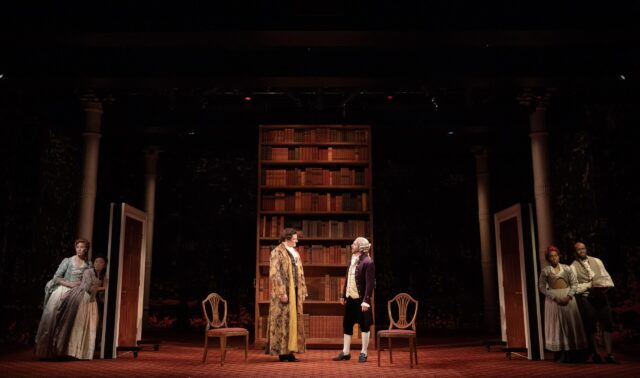
Sally & Tom is about a small theater company putting on historical drama (photo by Joan Marcus)

Presented in association with the Guthrie Theater, Sally & Tom might not be top-shelf Parks — that illustrious group includes Topdog/Underdog, Father Comes Home from the Wars (Parts 1, 2 & 3), In the Blood and Fucking A, and Porgy and Bess — but it’s yet another splendidly conceived work from one of America’s finest playwrights. Parks and director Steve H. Broadnax III (Sunset Baby, The Hot Wing King) breathe new life into a familiar topic, which has previously been explored in film and opera as well as television, music, and literature.

Irving (Romeo and Juliet, Parks’s White Noise) and Tony winner Ebert (Matilda, Pass Over) are terrific as the real couple from the past and the fictional contemporary characters, their lives becoming practically interchangeable on Riccardo Hernández’s set, which contains Monticello-style pillars, the actors dressed in Rodrigo Muñoz’s period costumes. The score was written by Parks with Dan Moses Schreier; Parks, an accomplished musician, composed and played the songs for her intimate 2022–23 Plays for the Plague Year, and on April 29 she appeared at Joe’s Pub with her band, Sula & the Joyful Noise.

“You will be ashamed that you were proud to father a country where some are free and others are enslaved! Where some have plenty and others only have the dream of plenty!” Kwame proclaims to Tom. “All them pretty words you write, Mr. Jefferson, they’re all lies! You’ll soon be ashamed by the lies that this country was built on, Mr. Jefferson! Ashamed by the lies on which we were founded, and on which we were fed, and on which we grew fat!”

As Jordans and Sally & Tom reveal, those lies are still with us, more than two hundred and thirty years later.

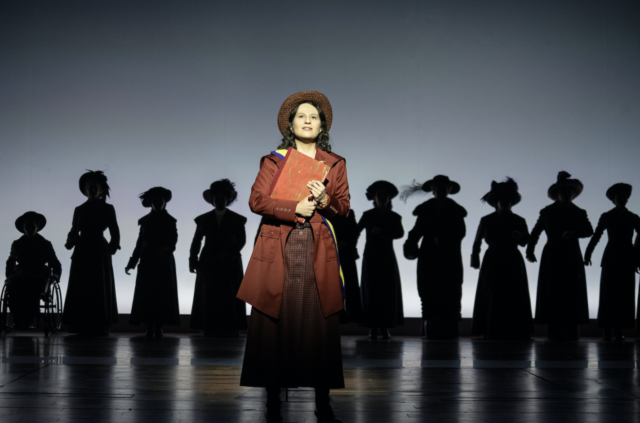
Shaina Taub wrote the book, music, and lyrics and stars in Suffs on Broadway (photo by Joan Marcus)

SUFFS
Music Box Theatre
239 West 45th St. between Broadway & Eighth Aves.
Wednesday – Sunday through January 5, $69 – $279
suffsmusical.com

The reckoning forges ahead at Suffs, Shaina Taub’s hit musical that began at the Public’s Newman Theater in 2022 and has now transferred to the Music Box on Broadway in a rearranged and improved version.

Most Americans are familiar with such names as Elizabeth Cady Stanton and Susan B. Anthony, but Taub focuses on the next generation of women who fought for the passage of the Nineteenth Amendment in the second decade of the twentieth century: Alice Paul (Taub), Inez Milholland (Hannah Cruz), Doris Stevens (Nadia Dandashi), Lucy Burns (Ally Bonino), and Ruza Wenclawska (Kim Blanck).

The musical focuses on generational conflict and disagreements about strategy that have characterized all sorts of progressive movements in the United States; an older, more sedate crowd wants to work within the system, while young radicals want to bust it open with outright aggression.

In Suffs, the youngsters decide to take on the powerful National American Woman Suffrage Association (NAWSA), led by Carrie Chapman Catt (Jenn Colella) and Mollie Hay (Jaygee Macapugay), a group that does not want to ruffle any feathers. While Carrie sings, “Let mother vote / We raised you after all / Won’t you thank the lady you have loved since you were small? / We reared you, cheered you, helped you when you fell / With your blessing, we could help America as well,” Alice declares, “I don’t want to have to compromise / I don’t want to have to beg for crumbs / from a country that doesn’t care what I say / I don’t want to follow in old footsteps / I don’t want to be a meek little pawn in the games they play / I want to march in the street / I want to hold up a sign / with millions of women with passion like mine / I want to shout it out loud / in the wide open light.”

While Carrie is content to set up pleasant meetings with President Woodrow Wilson (Grace McLean) that are either nonproductive or canceled, Alice has no patience, demanding that action happen immediately. After seeing Ruza give a rousing speech at a workers rally, Alice asks her to join their movement. “Look, I want no part of your polite little suffragette parlor games,” Ruza says. Alice responds, “Well, that’s perfect, because when we take on a tyrant, we burn him down.”

One of the most troubling aspect of the fight for twentieth-century women’s suffrage is its relationship with Black-led racial justice and civil rights movements. Suffs does not ignore the issue and instead makes it a major plot point. When Black journalist and activist Ida B. Wells’s (Nikki M. James) offers to bring her group to join the march, Alice initially rejects her, fearing that southern white donors will pull their funding, but Ida won’t take no for an answer.

“I’m not only here for the march,” Ida tells Alice and the others. “My club has also come to agitate for laws against lynching; my people cannot vote if they are hanging from trees.” She also proclaims in the showstopper “Wait My Turn”: “You want me to wait my turn? / To simply put my sex before my race / Oh! Why don’t I leave my skin at home and powder up my face? / Guess who always waits her turn? / Who always ends up in the back? / Us lucky ones born both female and black.”

Despite the march’s surprising success, the suffragists still have their work cut out for them if they are going to convince the powers that be that women deserve the right to vote.

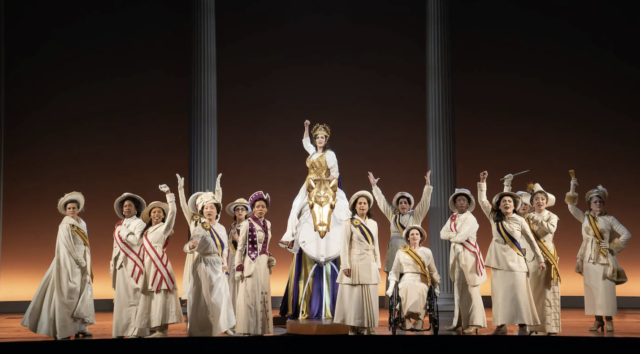
Inez Milholland (Hannah Cruz) leads the charge for women’s right to vote in Suffs (photo by Joan Marcus)

Taub’s (Twelfth Night, As You Like It) lively score, with wonderful orchestrations by Michael Starobin, and sharp lyrics keep the show moving at a fast pace, matching Alice’s determination to break down political malaise by getting things done ASAP. Tony nominee Leigh Silverman (Merry Me, Grand Horizons) directs with a stately hand that never lets the energy slow down.

Taub fully embodies Alice, a fierce, driven fighter you would want on your side no matter the issue. Tony nominee Colella (Come from Away, Urban Cowboy) is a terrific foil as Carrie; their battles are reminiscent of those between Gloria Steinem and Phyllis Schlafly over the ERA in the 1970s — which Alice also was a part of. Tony winner James (The Book of Mormon, A Bright Room Called Day) brings down the house with “Wait My Turn,” and, in their Broadway debuts, Bonino is lovable as Lucy, Blanck (Octet, Alice by Heart) is a force as Ruza, Cruz rides high as Inez, Dandashi is sweet as the nerdy Doris, and Tsilala Brock adds a sly touch as Dudley Malone, President Wilson’s chief of staff.

As in Jordans and Sally & Tom, Taub’s Suffs explores various aspects of race- and gender-based discrimination, and each offers a very different conclusion.

[Mark Rifkin is a Brooklyn-born, Manhattan-based writer and editor; you can follow him on Substack here.]

AIN’T NO MO’ / WHITE NOISE

(photo by Joan Marcus)

Pastor Freeman says goodbye to Brother Righttocomplain’ in Jordan E. Cooper’s Ain’t No Mo’ (photo by Joan Marcus)

AIN’T NO MO’
The Public Theater, LuEsther Hall
425 Lafayette St. by Astor Pl.
Tuesday – Sunday through May 5
212-967-7555
www.publictheater.org

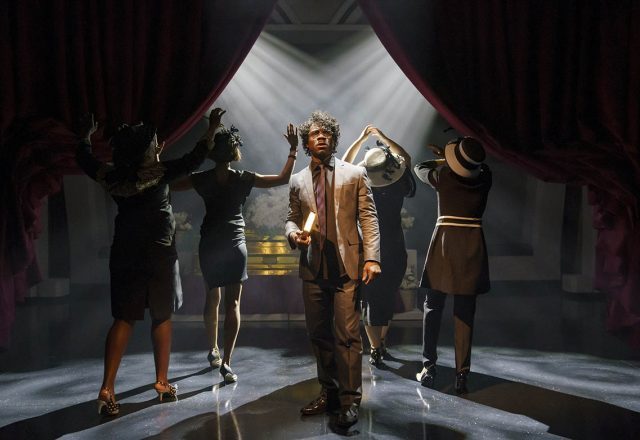
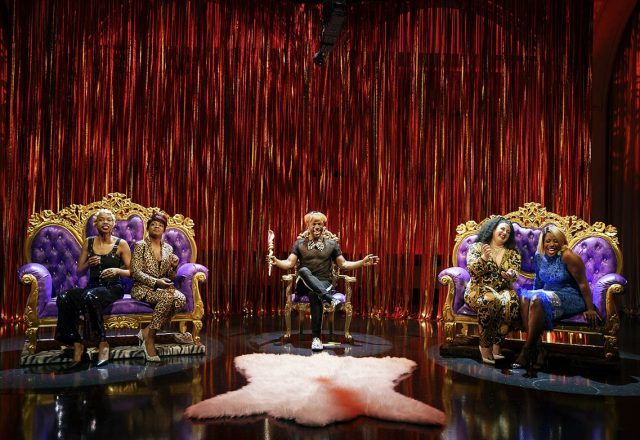
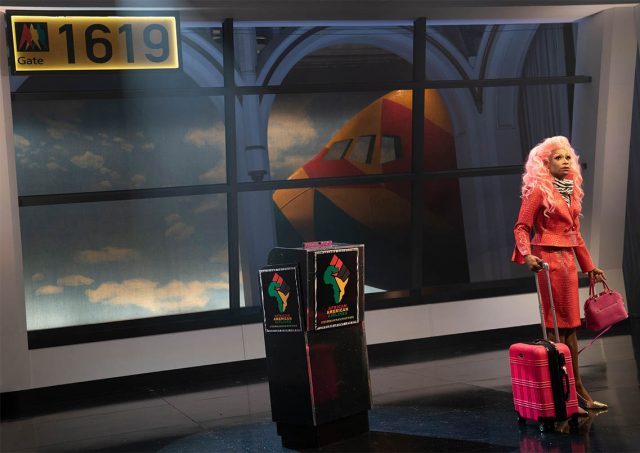
The Public Theater is currently presenting two very different new plays that tackle America’s shameful legacy of slavery and systemic racism head-on, incorporating uncomfortable humor into angry works that pull no punches. Actor and playwright Jordan E. Cooper’s Ain’t No Mo’ consists of a series of hit-or-miss comic vignettes — mostly the former — built around the premise that the United States of America is sending all the black people in the country back to Africa on free flights. The stairway leading up to LuEsther Hall is lined with stenciled signs that announce, “Welcome to African-American Airlines . . . where if you broke & black we got yo back! . . . Fasten your seatbelts, it’s going to be a fast & furious ride.” It is indeed a fast and furious ride, performed by the talented cast of Marchánt Davis, Fedna Jacquet, Crystal Lucas-Perry, Ebony Marshall-Oliver, Simone Recasner, Hermon Whaley Jr., and Cooper like they are on a live variety show.

(photo by Joan Marcus)

“Real Baby Mamas of the South Side” is one of several wild vignettes in play at the Public Theater (photo by Joan Marcus)

The first scene takes place on November 4, 2008, the night that Barack Obama was elected the first black president of the nation. Pastor Freeman is delivering a fiery eulogy for the dear departed Brother Righttocomplain’, declaring that with a black man in the White House, black people can no longer criticize and blame society for any woes they experience. “Because the president is a n-gga there ain’t no mo’ discrimination, ain’t no mo’ holleration, ain’t gone be NO more haterration in this dancerie, do you hear me what I say? I say it ain’t no mo’,” he preaches to his devoted flock. He demands that the audience shout out, “The president is my n-gga,” but none of the white people in the theater take him up on it. In the next scene, “reparations flight” stewardess Peaches (played in fab drag by Cooper) explains on the phone, “Well, bitch, I don’t know what to tell you ’cause if you stay here, you only got two choices for guaranteed housing and that’s either a cell or a coffin. After this flight, there will be no more black folk left in this country, and I know ya’ll don’t wanna be the only ones left behind because them muthafuckas will try to put you in a museum or make you do watermelon shows at SeaWorld and shit. Hurry up or I will give your seat to some of the Latinos on stand-by.”

(photo by Joan Marcus)

Peaches (playwright Jordan E. Cooper) helps all the African Americans leave the country in Ain’t No Mo’ (photo by Joan Marcus)

Other scenes in the two-hour intermissionless play are set in an abortion clinic where millions of black women are terrified of bringing a son into this dangerous racist world, a television reality show in which a white woman is transitioning into becoming black, and a mansion where a wealthy black family is keeping a black slave in the basement, hiding not only him but also their own identities. Kudos are due Kimie Nishikawa’s goofy, imaginative sets, Montana Levi Blanco’s flashy costumes, and Cookie Jordan’s hysterical hair, wig, and makeup design. Cooper gets right to the point when a woman at the clinic tells a reporter, “The problem is we’re racing against a people who have never had to compete, and people who have never had to compete are fearful of competition and they will annihilate any being that challenges their birth-given promise of a victory.” As wildly funny, if occasionally over the top and too scattershot, as Ain’t No Mo’ can be, it’s also a bitter pill to swallow. At the end of the show, a large American flag unfurls from above and the cast stands in front of it, arms folded, staring accusingly at the audience; there are no smiles or bows, but there is raucous applause from the seats.

(photo by Joan Marcus)

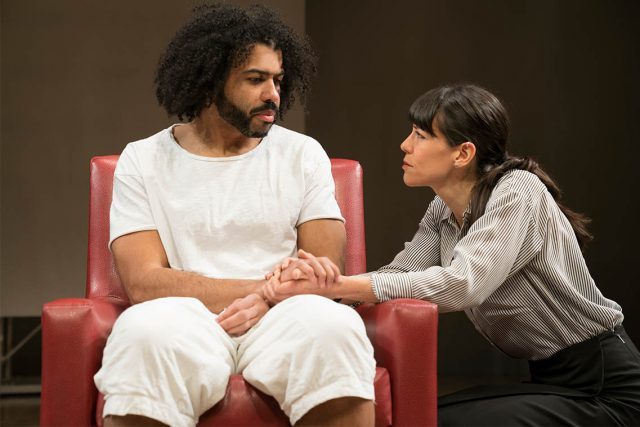
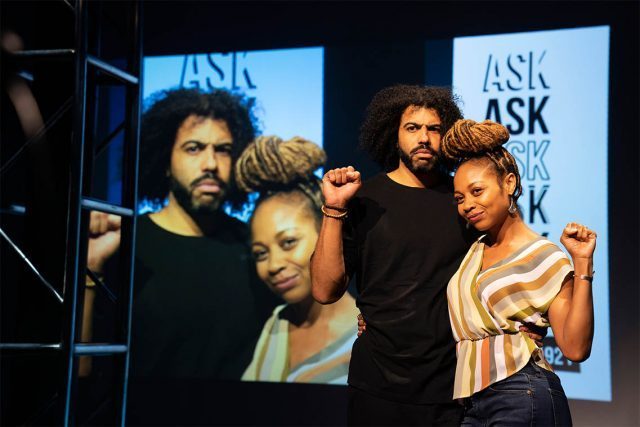
Dawn (Zoë Winters) tries to help Leo (Daveed Diggs) through a traumatic event in Suzan-Lori Parks’s White Noise (photo by Joan Marcus)

WHITE NOISE
The Public Theater, Anspacher Theater
425 Lafayette St. by Astor Pl.
Tuesday – Sunday through May 5
212-967-7555
www.publictheater.org

Suzan-Lori Parks’s White Noise explores many of the same themes as Ain’t No Mo’, but the Pulitzer Prize winner does so in a far more controlled environment, a compelling and surprising work that will hit you in the gut even as it makes you laugh. Directed by Public Theater head Oskar Eustis, White Noise begins with a long monologue beautifully delivered by Daveed Diggs as Leo, sitting in a red chair, discussing his inability to sleep, which began at the age of five when a woman in a church basement told him, “Leo, I know you know how the sun shines up above. But do you also know that, one day, the sun is going to die? You know that, don’t you? One day the sun is going to die, and everything in the whole world is gonna go all black.” He explains that he is going to tell us about “me and Dawn and Misha and Ralph” (a sly reference to Christopher Durang’s Chekhov takeoff Vanya and Sonia and Masha and Spike as well as Paul Mazursky’s 1969 romantic comedy Bob & Carol & Ted & Alice?), four friends who went to college together and now, in their thirties, are trying to settle down and figure out what to do with their lives.

(photo by Joan Marcus)

Four college friends go bowling in world premiere at the Public (photo by Joan Marcus)

Leo is a self-described “fractured and angry and edgy black visual artist” who has been unable to create and has recently been brutalized by the police while out on a walk because of his insomnia. “I thought they were going to shoot me. I thought, I’m going to be one of those guys that they shoot,” he says. He is living with Dawn (Zoë Winters), a white social justice lawyer on an important, sensitive case involving a teenager. Leo used to be with Misha (Sheria Irving), a black woman who hosts an internet call-in show titled Ask a Black and is now living with Ralph (Thomas Sadoski), Dawn’s previous lover, a white teacher from a wealthy family who is up for a prestigious tenured position at his college. The four talk about life, love, careers, their brief band, and more while bowling, a sport the men lettered in at school. But Leo shocks them when he announces he has an outrageous, completely controversial forty-day plan to protect himself from the racist powers that be. “Should They stop me next time, I will have something to say. Something that would give Them pause. Make Them think. Make Them leave me be. Make Them leave me the fuck alone,” he tells his friends, who think he is nuts, and even more so when Ralph agrees to take part in it. “Like the brother said, ‘Nothing can be changed until it’s faced,’” Leo says, quoting James Baldwin. “The pain and rage need to get worked out of my system. I’ll take myself to the lowest place and know for ever after that if I can bear it, then I can bear anything. And my mind will be free.”

(photo by Joan Marcus)

Leo (Daveed Diggs) and Misha (Sheria Irving) fight the power in White Noise (photo by Joan Marcus)

White Noise is superbly presented by Eustis (Julius Caesar, Compulsion), who directs with a sharp understanding of the complex material. Clint Ramos’s set is centered by a bowling lane where the characters roll their balls that disappear under the audience and then return to the back of the stage. Is it too simplistic to suggest that balls of multiple colors knocking down white pins is a metaphor? It’s also dramatic and entertaining, the sound of the ball hitting the lane and rolling out of sight echoing through the theater. (The cool sound design is by Dan Moses Schreier.) Diggs (Hamilton, Blindspotting), Winters (An Octoroon, Love and Information), Sadoski (Other Desert Cities, reasons to be pretty), and Irving (Crowndation, While I Yet Live) are a bright, youthful ensemble who skillfully navigate plot twists that shake their characters’ foundations. Parks’s (Topdog/Underdog, Fucking A) potent dialogue, well-drawn characters, and daring situations make the play’s three hours and fifteen minutes pass gracefully. Some of the scene changes are accompanied by music from Parks’s band, which has played at the Public and other venues. (In addition, Parks, the institution’s first Master Writer Chair, is performing the free Watch Me Work in the lobby mezzanine on select Mondays at 5:00, a “play with an action and dialogue” that is “also a meta-theatrical free writing class.”) White Noise and Ain’t No Mo’ are a bold one-two punch, the former from a playwright at the top of her craft, the latter from a fearless up-and-comer filled with promise.

CYPRUS AVENUE

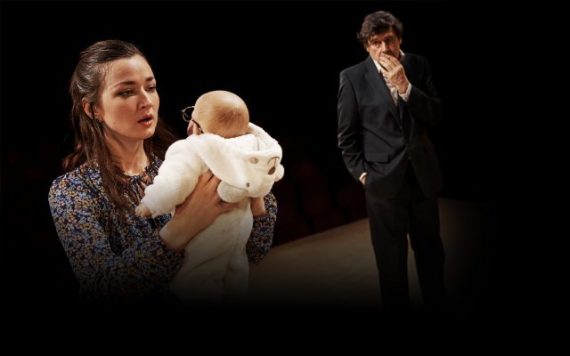
Julie (Amy Molloy) can’t believe what her father (Stephen Rea) has done in Cyprus Avenue (photo by Ros Kavanagh)

Julie (Amy Molloy) can’t believe what her father (Stephen Rea) has done in Cyprus Avenue (photo by Ros Kavanagh)

The Public Theater, LuEsther Hall
425 Lafayette St. by Astor Pl.
Tuesday – Sunday through July 29, $85
212-967-7555
www.publictheater.org

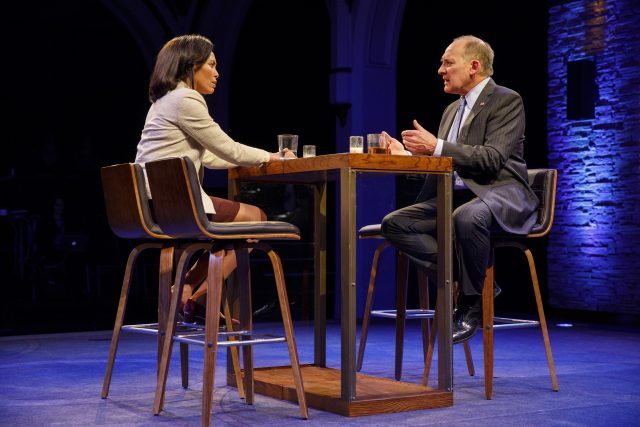
Stephen Rea is riveting as a bigot who snaps in David Ireland’s incendiary, darkest of dark comedies, Cyprus Avenue. A coproduction of the Abbey Theatre and the Royal Court Theatre running at the Public through July 29, the play is a difficult one to recommend; it’s a testament to the audience’s psychological pain threshold that, the night I saw it, no one left LuEsther Hall during the show’s brutal one hundred intermissionless minutes. Rea is Eric Miller, a Belfast Loyalist who is undergoing treatment with a counselor, Bridget (Ronkẹ Adékoluẹjo), in an unidentified facility. He is a prickly, uncomfortable, precise man who can no longer find his place in a society that has passed him by. “Everything is upside down. Nothing is what it claims to be,” he says. “Chaos is majesty. Love is degradation. And the world has become a travesty.” He calmly calls Bridget, who is black, the n-word, then gets supremely insulted when she assumes he is Irish. “The last thing I am is Irish,” he declares. “I am anything but Irish. I am British. I am exclusively and non-negotiably British. I am not nor never have been nor never will be Irish.”

(photo by Ros Kavanagh)

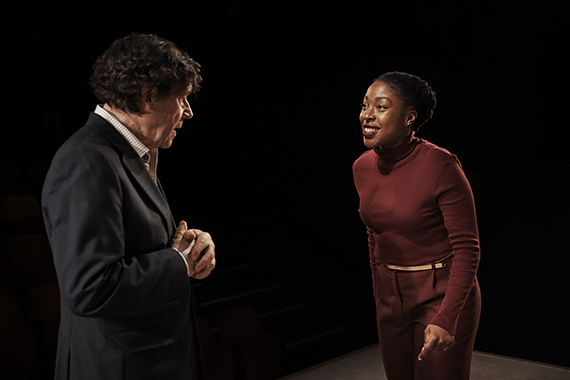
Bridget (Ronkẹ Adékoluẹjo) tries to help Eric Miller (Stephen Rea) make sense of his actions in David Ireland play at the Public (photo by Ros Kavanagh)

As they continue their talk, the narrative cuts to flashbacks, revealing what Eric did that led to his current situation. It all started when his daughter, Julie (Amy Molloy), had a baby that he refused to say anything nice about. “What is wrong with you?” his wife, Bernie (Andrea Irvine), asks incredulously. He calls Julie the c-word, then complains about his sad past: “Resentments. Disappointments. Failed expectations. Ruined dreams. Entanglements. Despair. That which could have been. And that which is.” The trouble reaches a new level once Eric decides that the newborn not only looks like but actually is Gerry Adams, the longtime head of the Sinn Féin, the controversial left-wing Irish republican political party. He shares his dislike of Catholics, who comprise the Sinn Féin, with Bridget, referring to them in derogatory terms. But Eric really breaks when he hires a mysterious balaclava-clad man named Slim (Chris Corrigan) to carry out a heinous plot.

The weight of the world comes crashing down on Eric Miller (Stephen Rea) in David Ireland’s Cyprus Avenue (photo by Ros Kavanagh)

The weight of the world comes crashing down on Eric Miller (Stephen Rea) in David Ireland’s Cyprus Avenue (photo by Ros Kavanagh)

Directed by Vicky Featherstone, who helmed the 2016 original — which also featured Rea, Molloy, and Corrigan — Cyprus Avenue is meant to shock, and it does. As Belfast native Van Morrison sings in his gorgeous 1968 song of the same name, “And my inside shakes just like a leaf on a tree.” The audience sits on either horizontal side of the stage, the action happening in between on Lizzie Clachan’s relatively spare set. So when something particularly frightful occurs, you can see people on the other side cover their mouths in horror just as you do the same. Ireland (Everything Between Us, What the Animals Say) and Featherstone (Our Ladies of Perpetual Succour, Victory Condition) hold nothing back as Eric, seemingly in total control, calmly goes about his business in a way that is terrifying; Cyprus Avenue is not quite as farfetched as you might first imagine, particularly here in America, where hatred, misogyny, racism, anti-Semitism, and harsh partisanship seem so commonplace today that individuals are snapping all the time. However, most of us don’t get to see that enacted, even if fictionally, at such close quarters. But what we do get to see right in front of us is a spectacular performance by Oscar and Tony nominee Rea (The Crying Game, Someone Who’ll Watch Over Me), who has previously shown a fondness for blood and violence on the New York stage in Sam Shepard’s A Particle of Dread (Oedipus Variations) at the Signature in 2014. Rea moves slowly throughout, carefully monitoring each step and every breath, completely at a loss to thoroughly understand what he is doing. “I don’t know anything anymore,” he tells Bridget. And it’s meant to be scary that he’s not the only who feels that way.

KINGS

(photo by Joan Marcus)

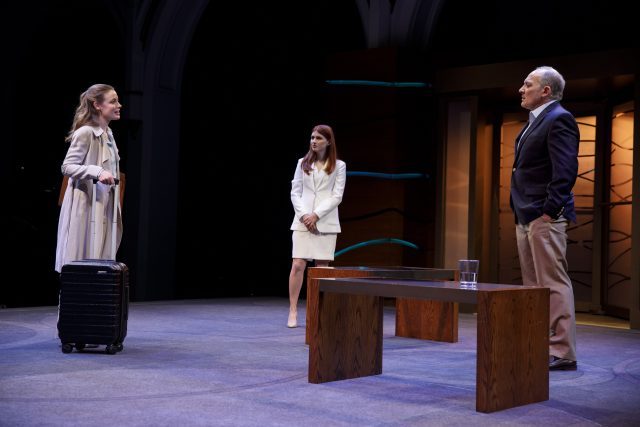
Gillian Jacobs, Aya Cash, and Zach Grenier star in Kings at the Public Theater (photo by Joan Marcus)

The Public Theater, LuEsther Hall
425 Lafayette St. by Astor Pl.
Tuesday – Sunday through April 1, $75 – $150
212-967-7555
www.publictheater.org

In the spring of 2016, playwright Sarah Burgess and director Thomas Kail teamed up at the Public Theater on Dry Powder, Burgess’s first professionally produced work, managing to make a story about leverage buyouts and dividend recaps tense and involving. Unfortunately, lightning doesn’t strike twice in their Public follow-up, Kings, a surprisingly dry tale of Washington lobbyists. Eisa Davis stars as Rep. Sydney Millsap, a Dallas single mother and former oil and gas company accountant elected to Congress without any political experience. She is quickly set upon by a pair of vulturous thirtysomething lobbyists, Lauren (Aya Cash) and Kate (Gillian Jacobs), both of whom believe they are more important to the system than Millsap is. Kate is pushing absurd legislation for podiatrists, while Lauren, who is married to the chair of the SEC, is hyping a tax-code bill on carried interest (snooze). Neither is very happy to receive short shrift from Millsap. “Good luck getting reelected if you’re going to insult every lobbyist you come into contact with,” Kate tells her. “Maybe you should change careers,” Lauren suggests to Millsap. When Millsap’s party, led by the powerful Sen. McDowell (Zach Grenier), is unhappy with her vote on the tax bill, the senator himself, who has eyes on the White House, offers Millsap a lucrative deal if she decides not to run again, but instead she makes a decision that is nearly as absurd as the legislation the podiatrists want.

(photo by Joan Marcus)

Rep. Sydney Millsap (Eisa Davis) gets some political advice from Sen. McDowell (Zach Grenier) in new Sarah Burgess play (photo by Joan Marcus)

Kings is a slow-moving retread of Dry Powder, mixed with a little Mr. Smith Goes to Washington, lending nothing new on the critical issue of lobbyists and campaign financing. Even Kail’s (Hamilton, Tiny Beautiful Things) direction mimics that of his previous collaboration with Burgess, with furniture being rearranged into chairs and tables and colored lights flashing with loud music in between scenes. For no apparent reason, the audience sits on two sides of Anna Louizos’s set, facing each other, with the action taking place in the middle. Similarly, when Millsap meets other characters at her favorite restaurant, Chili’s, their table revolves. Grenier (Talk Radio, Describe the Night) is rock-solid as McDowell, a proud man who long ago decided to play the game in order to gain power, and Davis (Passing Strange, Julius Caesar) is fresh and exciting as Millsap, a woman who believes she can really make a difference (and she looks sharp in Paul Tazewell’s costumes), but Cash (You’re the Worst, The Other Place) and Jacobs (Don’t Think Twice, Community) are annoying as the lobbyists; their characters are not supposed to be likable, and their shrill performances ensure that. The American electoral system is in chaos, and lobbyists have a lot to do with that, but Kings fails to get at the heart of the situation, offering only clichéd platitudes, like a politician’s empty campaign promises.

MEASURE FOR MEASURE

(photo by Richard Termine)

Shakespeare’s words fly by in a fury in Elevator Repair Service’s frenetic Measure for Measure (photo by Richard Termine)

The Public Theater, LuEsther Hall
425 Lafayette St. by Astor Pl.
Tuesday – Sunday through November 12, $75
212-967-7555
www.publictheater.org

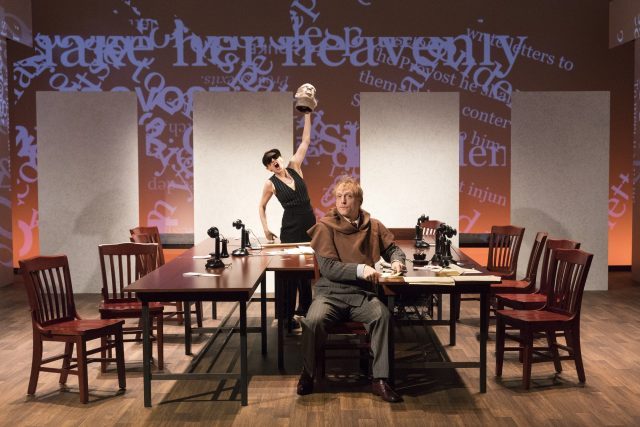
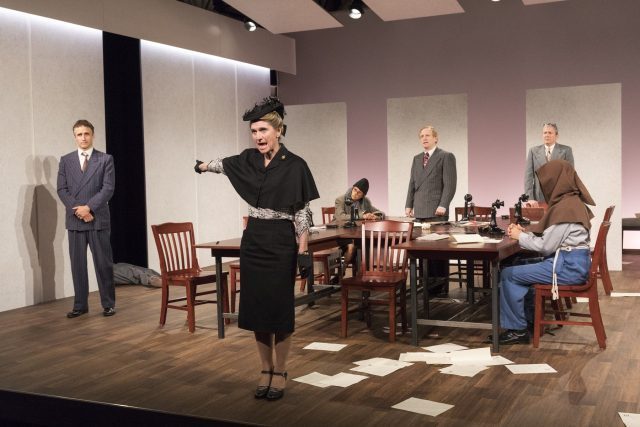
There’s a frenetic, anarchic pace to Elevator Repair Service’s Indy 500 version of Measure for Measure, running at the Public Theater’s LuEsther Hall through November 12. It’s like Howard Hawks’s His Girl Friday on speed, the dialogue whizzing by, in sound and images, as the characters, in a bizarre array of costumes ranging from contemporary suits to hippy outfits to strange fake underpants worn over clothing, engage in corny but funny slapstick and often converse using antique Candlestick telephones even when they are sitting right across the H-shaped table from one another. The play includes every single word of Shakespeare’s script, which is occasionally projected in large letters all across the stage, but it still scrolls past so quickly there is not enough time to read it all. To maintain the verbal madness, which slows down only for one key scene, there is a Teleprompter behind the audience that guides the actors primarily for speed, employing software designed by ERS member Scott Shepherd, who also plays the Duke. (Shepherd and ERS founding artistic director John Collins, the director of Measure for Measure, are veterans of the Wooster Group, which also incorporates unique visuals using monitors in their shows.) You might not clearly understand everything everyone says, but you’ll be able to follow the general shenanigans as the Bard takes on sex, mortality, morality, fidelity, virtue, virginity, marriage, religion, pregnancy, prison, and capital punishment.

In Vienna, the Duke is about to head out of town for a while, leaving his deputy, Angelo (Pete Simpson), in charge. However, the Duke hovers around, disguised as a friar, as the story unfolds, involving Juliet (Lindsay Hockaday), who is having a child with Claudio (Greig Sargeant); brothel manager Mistress Overdone (Susie Sokol); Claudio’s sister, Isabella (Rinne Groff), a religious novice; the nun Mariana (April Matthis); the young nobleman and lowlife Lucio (Mike Iveson); the Provost (Maggie Hoffman), who runs the prison; aged adviser Escalus (Vin Knight); constable Elbow (Gavin Price, who also is the sound designer); and various other characters of ill and not-so-ill repute. The plot centers on Angelo’s arrest of Claudio for impregnating Juliet out of wedlock and the deputy’s offer to release him from prison only if Isabella will sleep with him. It’s quite a moral dilemma — especially as more and more men in positions of power in America today are discovered to be sexual predators — and one that is not resolved very easily. “Death is a fearful thing,” Claudio tells Isabella, who responds, “And shamed life a hateful.”

(photo by Richard Termine)

Brothel manager Mistress Overdone (Susie Sokol) has something to say in ERS adaptation of Measure for Measure (photo by Richard Termine)

At a talkback following the October 18 performance, the audience was asked if it was anyone’s first time at the Public, and no hands went up. They were next asked if it was anyone’s first time seeing Shakespeare, and a few hands went up. They were then asked if it was anyone’s first time seeing Measure for Measure, and more than half the hands went up. It is also ERS’s first time doing the Bard, following well-received, original adaptations of F. Scott Fitzgerald’s The Great Gatsby (Gatz), William Faulkner’s The Sound and the Fury, and Ernest Hemingway’s The Sun Also Rises (The Select), among other presentations. Founded in 1991 by artistic director John Collins, ERS leans heavily toward the experimental over the traditional, and that is as evident as ever in this exciting version of one of Shakespeare’s seldom-performed problem plays.

Director Collins and ERS have chosen to make the ribald shenanigans take a backseat to the staging, which is filled with delightful contradictions and decisions that go from the sublime to the ridiculous. “I’ve come to appreciate that Shakespeare’s densely layered metaphors and dizzying grammatical constructions can’t possibly be thoroughly understood and processed in real-time by any but the Elizabethan scholar. But maybe that doesn’t matter,” Collins writes in a program note. It might have been very different if he had chosen to do a more familiar Shakespeare play, in which much of the audience might already know the main aspects of the plot, so selecting Measure for Measure, which zooms by in an intermissionless 135 minutes, is a curious decision. Of course, opera is not exactly plot-friendly to those who don’t know the story either. In preparing for the show, Collins had the cast and crew watch Howard Hawks’s His Girl Friday along with Hands on a Hardbody and the Marx Brothers, elements of which help propel this version to another level that Shakespeare purists might wag a finger at but more adventurous theatergoers will end up clapping wildly at.