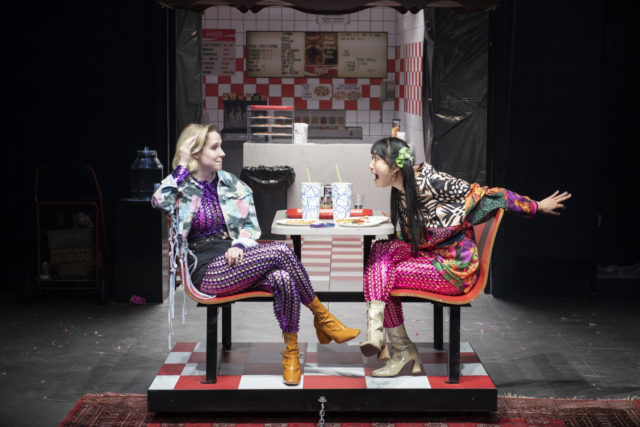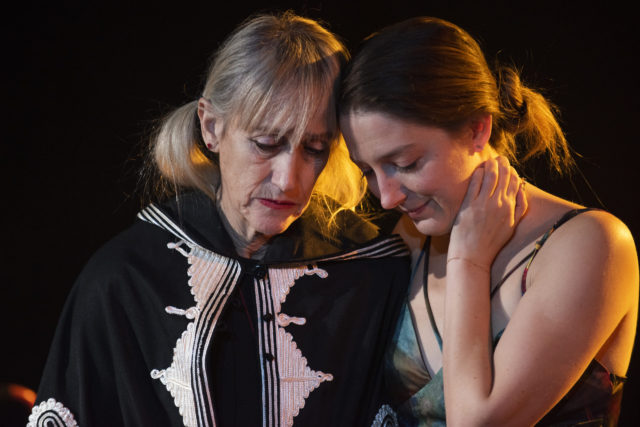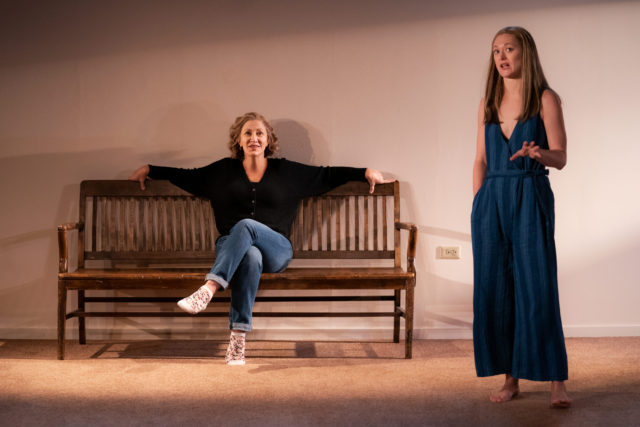
Tag Archives: Kaye Voyce

MORNING SUN

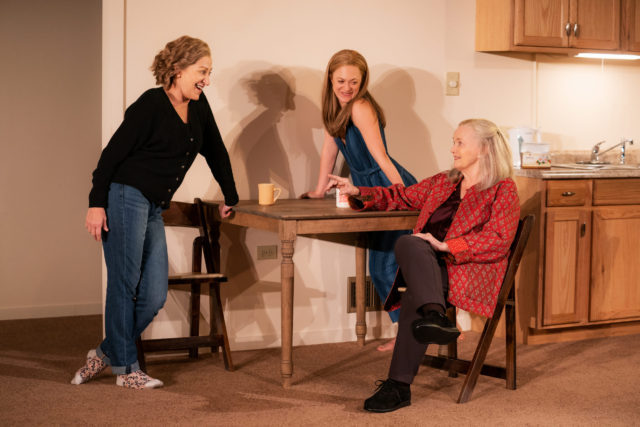
Edie Falco, Marin Ireland, and Blair Brown are extraordinary as three generations of one family in Morning Sun (photo © Matthew Murphy 2021)

MORNING SUN
Manhattan Theatre Club
MTC at New York City Center – Stage I
131 West 55th St. between Sixth & Seventh Aves.
Tuesday – Sunday through December 19, $99-$109
212-581-1212
www.manhattantheatreclub.com

Tony winner Simon Stephens’s Morning Sun opened tonight at New York City Center’s Stage I, starring three sensational actresses: Tony winner and Emmy nominee Blair Brown, Emmy winner and Tony nominee Edie Falco, and Tony nominee Marin Ireland. They play three generations of women in the McBride clan: Falco is Charley McBride, Brown is her mother, Claudette, and Ireland is Charley’s daughter, Tessa. The script identifies them as 1, 2, and 3, respectively; while Falco is Charley throughout the hundred-minute Manhattan Theatre Club production, Brown and Ireland also portray numerous other characters, including friends, relatives, and lovers, reenacting moments from the past without changing costumes and altering their demeanor only slightly if at all. It sometimes takes a few lines for the audience to figure out one of these transitions, to discern who is speaking, but that’s part of the play’s attraction.

The structure can’t help but call to mind Edward Albee’s 1991 Pulitzer Prize–winning play, Three Tall Women, in which a trio of sensational actresses — most recently Glenda Jackson, Laurie Metcalf, and Alison Pill in the show’s 2018 Broadway debut — portrayed three generations of unnamed women who the script identifies as A, B, and C. From the very start of Morning Sun, however, Stephens references not only Edward Albee but also artist Edward Hopper, and it’s clear that these women live in a different social class than the triad of Three Tall Women and that Stephens’s project is very different from Albee’s.

The show begins with an obtuse conversation that sets the mood and signals what is to come next:

Charley: Am I safe?
Tessa: You ask yourself.
Claudette: And I can’t really understand your question.
Charley: I want to know if I’m safe.
Claudette: Please be quiet.
Charley: I’m very scared. I’m very confused it’s very bright here please just tell me whether or not I am safe.
Claudette: I don’t understand what you’re trying to tell me.
Tessa: Here. Hold her carefully.
Claudette: The way your face scrunches up and the noise that you make and how I know I’m supposed to feel and the difference between that and how I actually do feel —
Charley: Just tell me.
Claudette: Here. Come here. Come here.
Charley: Am I safe? That’s all I’m asking. It’s not a very difficult question to understand, is it? Is it? It’s not. No. It isn’t.

Charley McBride (Edie Falco) and Brian (Marin Ireland) discuss Edward Hopper in Manhattan Theatre Club world premiere Morning Sun (photo © Matthew Murphy 2021)

In chronological order, Claudette, Charley, and Tessa discuss seminal moments in their lives, reflecting on their successes and failures, as one character often narrates what is happening to the other in the second person. Tessa tells her grandmother, “One morning at the end of summer you take a train to Penn Station walk two blocks up Seventh and get a job in the Macy’s haberdashery department. That night you find a rent controlled fifth floor walk-up on Eleventh Street in the West Village. Two bedrooms. A railroad apartment with a tub in the kitchen and a view of the courtyard to the south side of the building. And if you crane your neck you can see the Hudson.” Claudette says, “I love it completely. . . . And I never live anywhere else. . . . For the rest of my life.”

The women introduce us to Claudette’s brother-in-law, Stanley; her husband, Harold; Charley’s best friend, Casey; an airplane pilot in a bar; a museum guard named Brian; and others, looking back as if they are all ghosts. Indeed, the play takes place in a nonspecific time, a kind of way station, where some of the characters have already passed away. At one point, Uncle Stanley tells Charley that the Cherry Lane Theatre is haunted. “There’s no such thing as ghosts,” Charley says. “Don’t you think?” he responds. “No I don’t. And there’s no way of making me think otherwise. So don’t try,” she says. “If there’s no such thing as ghosts, then why do they need a ghost light?” he asks. Charley: “What’s a ghost light?” Stanley: “It’s a light they keep on in the theater all night to keep the ghosts away.” A moment later, Stanley adds, “A ghost is an interruption,” which evokes the eighteen months of the pandemic lockdown, when theaters were empty, ghost lights on.

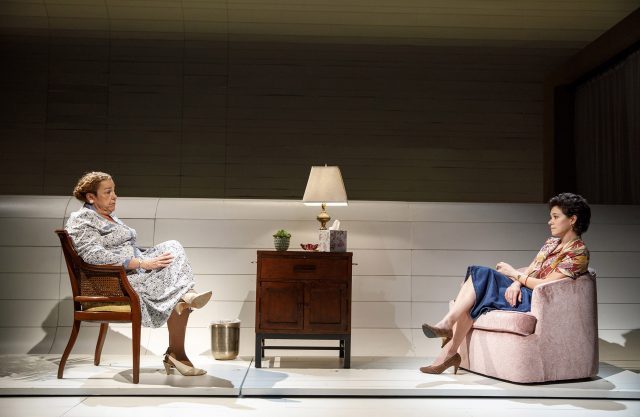
Place is essential to the play, which is set in Claudette’s West Village apartment. To the left is a clothes closet, to the right a piano and a working kitchen with running water and electricity, and in the center is a large, open area with a couch, a chair, and a bench, backed by half a dozen high-set windows. (The set is by dots, with lighting by Lap Chi Chu, sound by Lee Kinney and Daniel Kluger, and costumes by Kaye Voyce.) The characters move about the space almost like ghosts, occasionally appearing like they’re in a Hopper painting. The show is named after Hopper’s 1952 canvas Morning Sun, in which a lonely woman (the model is Hopper’s wife, painter Jo Nivison, the only female who ever posed for him) sits on a bed facing an open window, her hands gripping her legs, feet in front of her, the light forming an ominous rectangle on the wall. She peers outside as if there’s something she’s lost, something she can’t get back. It’s reminiscent of such other Hopper works as Cape Cod Morning, Western Motel, Eleven A.M., Morning in a City, and A Woman in the Sun, which all feature women seemingly trapped in an isolation they can’t escape.

Claudette was born and raised in Nyack, Hopper’s hometown in Rockland County. The titular painting plays a key role in the narrative, such as when Charley meets Brian, the museum guard, while looking at it. Charley tells him, “I like finding Edward Hopper paintings and thinking this is where I came from. Morning Sun. I like the strange expression on the woman’s face and wondering what she’s staring at and if she’s thinking about what she’s staring at or if her face is just kind of frozen because she’s gone to somewhere in her head that she can’t ever talk about.” Referring to the edifice that can be seen through the window, Brian points out, “I like trying to figure out what that building is.” Charley offers, “It could be a prison.”

Impeccably directed by Lila Neugebauer (The Wolves, Edward Albee’s At Home at the Zoo, The Waverly Gallery), the show also made me think of Hopper’s New York Movie, in which a woman, bathed in light, hand on chin, stands just outside the seating area of a theater, perhaps contemplating whether she wants to sit down and join the crowd, be part of something. In the age of Covid, it now evokes the pandemic lockdown and the tentative return of audiences to theaters, but it also relates to the loneliness that Claudette, Charley, and Tessa experience in their daily lives; they might have one another in this surreal conversation happening onstage, but they each harbor fears of being alone.

Marin Ireland is extraordinary playing Tessa McBride and several other characters in latest Simon Stephens play (photo © Matthew Murphy 2021)

They rejoice in New York City — among the locations mentioned are the White Horse Tavern, Peter McManus, Shea Stadium, the old Penn Station, Wollman Rink, Washington Square Park the New School, and the High Line — but they bond to Joni Mitchell’s “Song to a Seagull,” in which Mitchell sings, “I came to the city / And lived like old Crusoe / On an island of noise / In a cobblestone sea / And the beaches were concrete / And the stars paid a light bill / And the blossoms hung false / On their store window trees.” The three women are together, but they are alone.

Brown (Copenhagen, Arcadia, Mary Page Marlowe), Falco (The True, Frankie and Johnny in the Clair de Lune), and Ireland (Reasons to Be Pretty, Blue Ridge, On the Exhale) are exquisite, portraying their complex characters with a gentle ease that is intoxicating, as if we’re spending quality time in front of a great painting. The drama leisurely but compellingly proceeds at a calm pace as the characters move about the stage, sometimes gathering at the small table in the kitchen, other times sitting so far apart it is as if they are in separate canvases, hung nearby on a wall.

Stephens is a writer with breathtaking skill, whether penning a charming two-character drama about a pair of loners who meet at a London Tube station (Heisenberg), a major spectacle about the murder of a pooch (The Curious Incident of the Dog in the Night-Time), an intimate one-man show dealing with horrific tragedy (Sea Wall), a postapocalyptic nightmare told with blindfolds and through headphones (Blindness), or a profound exploration into the lives of three generations of New York women. Morning Sun is a masterful artistic rendering of three ordinary, intertwined lives continually trying to find their unique path while battling solitude, like an Edward Hopper painting come to life, the subjects ever peering out the window, considering what is, what was, and what could have been.

Talking with Casey about Tessa, Charley says, “I want her to look back on me when she’s an adult and know that I did my best for her and that I always tried even if sometimes I let her down.” Casey replies, “We all let each other down,” to which Charley responds, “But that I did my very, very best.” What more can we ask of each other, in life and in art?

ANATOMY OF A SUICIDE

(photo by Ahron R. Foster)

Alice Birch’s Anatomy of a Suicide takes place in three concurrent time periods (photo by Ahron R. Foster)

Atlantic Theater Company
Linda Gross Theater
336 West 20th St. between Eighth & Ninth Aves.
Tuesday – Sunday through March 15, $51-$91.50
866-811-4111
atlantictheater.org

The beginning of the Atlantic’s US premiere of Alice Birch’s Anatomy of a Suicide is a chaotic cacophony of words and images, barreling at the audience in three parts at the same time. You’ll find yourself shifting your eyes and ears constantly, struggling to understand what exactly is happening. But stick with it; in the hands of director Lileana Blain-Cruz, the play slowly takes shape and you’ll fall into the unique and compelling rhythm of its multiple, interconnected narratives.

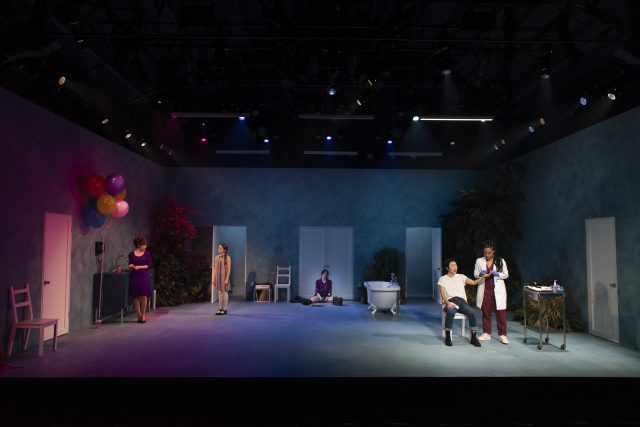
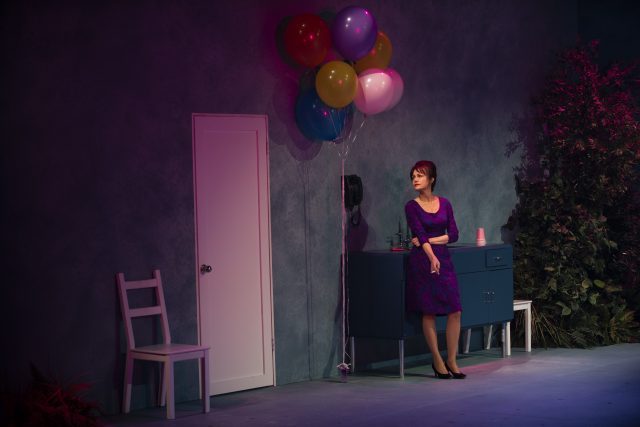
Mariana Sanchez’s open set is divided into three sections by invisible barriers, signaled by several doors at the back and Jiyoun Chang’s poignant lighting. There is a cast-iron tub in the middle and two more doors at the sides, through which chairs, tables, and other props are brought. Hannah Wasileski’s projections subtly change the texture of the walls in soft shades of blue, referencing changes in time. Stage right, Carol (Carla Gugino) has just attempted to kill herself, much to the dismay of her caring husband, John (Richard Topol). “It was just an accident,” she coldly claims. “You slit your fucking wrists,” he responds. In the center, a drugged-out Anna (Celeste Arias) is debating semantics with an upset doctor (Vince Nappo). “I sound like I’m trying — is the point though isn’t it cos the veracity of the whole thing lies in how likely it is I’d say what you’re claiming I said,” she argues. “Veracity — you can’t stand up straight but you can say veracity,” he says. And at stage left, another doctor, the very serious Bonnie (Gabby Beans), is being hit on by a bleeding patient, Jo (Jo Mei). “Do you want to grab a drink,” Jo asks as Bonnie tends to her wounded hand, not answering. “That is an incredibly long pause to follow that question,” Jo says, to which Bonnie replies, “You’ve had a lot of painkillers. You shouldn’t drink anything for a while.” Those three interactions establish the main characters in what becomes a gripping drama about the psychological legacies parents leave their children and the biology that determines depression.

(photo by Ahron R. Foster)

Carla Gugino stars as a wife and mother battling depression in US premiere at the Atlantic (photo by Ahron R. Foster)

You’ll probably guess the relationship between Carol, John, and Anna fairly quickly, but the connection between Anna, Bonnie, and Jamie (Julian Elijah Martinez) will take a little longer, offering a clever surprise. Most of the excellent cast portray multiple characters, with Jason Babinsky, Miriam Silverman, Nappo, and Mei playing various friends, relatives, and coworkers and Ava Briglia taking on all the child roles. It can get confusing at times, but Birch (Lady Macbeth, Revolt. She Said. Revolt.), who won the prestigious Susan Smith Blackburn Prize for Anatomy, and Obie winner Blain-Cruz, who has guided such complex, experimental works as Fefu and Her Friends, Marys Seacole, and The Death of the Last Black Man in the Whole Entire World AKA the Negro Book of the Dead, eventually circle back with telling reveals and small shocks, making sure we feel the power of the story even if we can’t grasp hold of every word. Gugino (A Kid Like Jake, The Road to Mecca), Arias (Uncle Vanya), and Topol (Indecent, The Dance of Death) lead an exemplary ensemble (Gugino and Arias look particularly resplendent in Kaye Voyce’s lovely costumes), the actors hitting their marks like clockwork amid the overlapping turmoil, characters from each time period occasionally spouting key lines of dialogue in unison.

It’s like we’re in the mind of a depressed, suicidal person, experiencing what they’re experiencing as they battle a world filled with demons, an unrelenting barrage that they may not break free of. The sparkling white tub, which is never moved, is a constant reminder of what Carol, Anna, and Bonnie are facing as those around them seek to protect and love them, which doesn’t always make a difference. Performed without an intermission, it’s a tense and gripping hundred-minute journey into the legacies of mental illness, especially in women’s experiences. It’s not an easy play to watch, but you won’t be able to turn away.

QUEENS ROW

(photo © Paula Court)

Nazira Hanna delivers the first of three monologues in Richard Maxwell’s Queens Row (photo © Paula Court)

The Kitchen
512 West 19th St. between Tenth & Eleventh Aves.
Wednesday – Saturday through January 25, $20-$25
212-255-5793 ext11
thekitchen.org
www.nycplayers.org

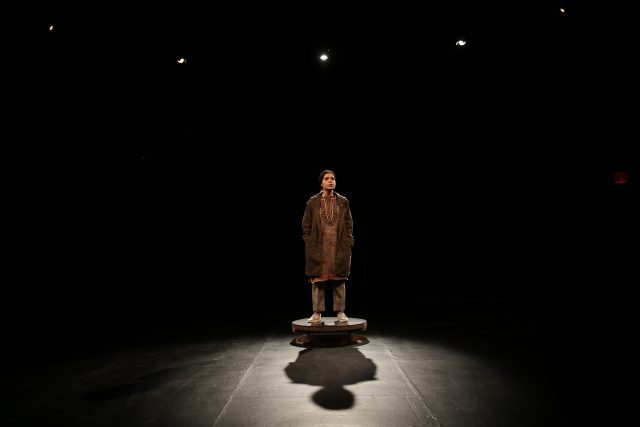
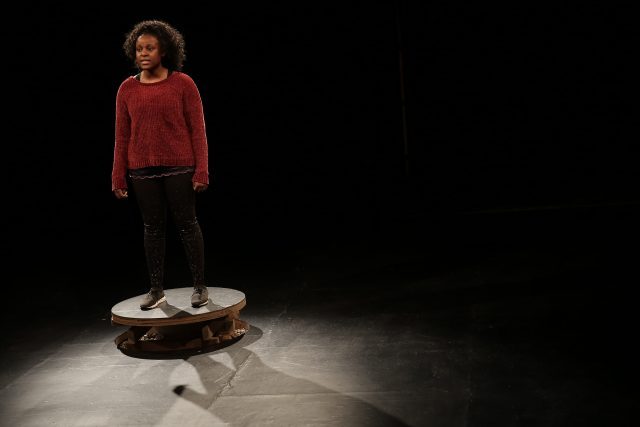
Experimental theater master Richard Maxwell’s Queens Row is a poetic meditation on loneliness in a postapocalyptic world. Continuing at the Kitchen through January 25, the sixty-minute show takes place in the Chelsea institution’s empty upstairs gallery space, a black box with an exposed sink area and a small balcony. The play consists of three monologues delivered by a trio of nonprofessional actors, sharing their characters’ deeply personal stories surrounding a shooting death, each woman somewhat more physical and emotional than the one before. First up is a woman (mixed-media artist Nazira Hanna) in a Native American-style top who is from the fictional town of Queens Row, Massachusetts; she stands stock-still on a small circular platform carved right out of the floor and lifted slightly by blocks of wood. Her words are cold and direct, her body rigid, as she announces, “I am a woman who had a child. I don’t have a name. I don’t have ID, and I never did, if you can imagine. There is no record of my fingertips or my eyeballs. . . . I was born and no one could stop that from happening. I had a child, and no one could stop that from happening. My son was killed, and no one could stop that from happening. And I exist in this place, asserting a certain right to exist, and to speak, and just like you, hopelessly existing.” She talks of a civil war, of riots “fueled by racism, xenophobia, foreign influence, class anger, and a simmering paranoia, hysteria on all sides.” The play was inspired by a dystopian dream Maxwell had, and her tale is like a nightmare, tinged with reality.

(photo © Paula Court)

Soraya Nabipour picks up the story of the impact of loss in NYC Players production at the Kitchen (photo © Paula Court)

When she is done, she walks offstage through a door and is replaced by a second, younger woman (theater maker, facilitator, and PhD researcher Soraya Nabipour) from Odessa, Texas, wearing sneakers, black leggings, and a red sweater. She addresses a person no longer with us, bringing up seemingly random incidents from their past. “I string together memories as though it were some kind of lifeline,” she says. “Is it that we’re so much the same or that we need each other. We horrify each other but we’d die without each other, you know this, and you can’t stand it. Love is the thing you do when there’s nothing left to do. Love is the thing to do beyond words.” She is slightly more active although still appears confined, her past haunting her.

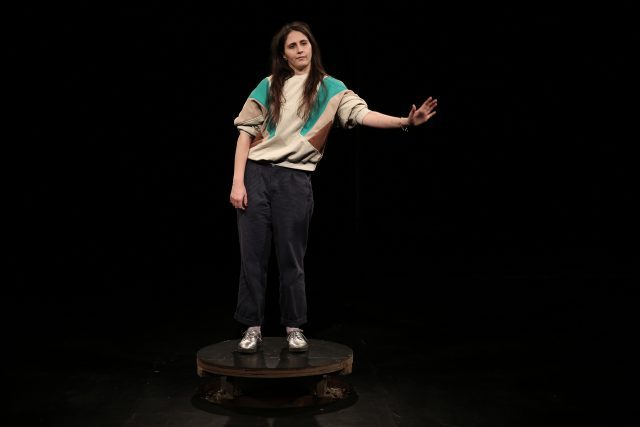
She is followed by a third woman (musician Antonia Summer, who recently trained at the National Youth Theatre in London) in a colorful shirt and long hair. She is from Las Cruces, New Mexico, and moves her body in herky-jerky ways that match her awkward speech patterns; she speaks as if she is learning language right in front of us. “t 6 d 5 6 s 5 6 e r r t s…………………… ient to fine a ja e, msrtik talking to …. pl this is right mao i, r;lorm r p & u.p.i. I,” she says before becoming understandable. “I get electrified with excitement when the towers which dot the horizon light up and connect together aligning that curve that arcs into me blasting my insides with light I am the offspring orphaned by fate and fatality My.” She talks of a father and a mother, of pain and desire, and asks, “whut is progeny?”

(photo © Paula Court)

Antonia Summer is the liveliest of three connected women in Richard Maxwell’s postapocalyptic Queens Row (photo © Paula Court)

Written and directed by Maxwell, who previously presented The Evening, Natural Hero, and The End of Reality at the Kitchen with his NYC Players company, Queens Row is a gripping fantasy of a frightening near-future. Each character is circled above by a dozen lights, casting dramatic, often eerie shadows across the floor. (The set and lighting design is by Sascha van Riel, with costumes by Kaye Voyce.) The show isn’t so much a warning shot as an alternate reality that hovers just outside our purview; Maxwell includes several ghostly moments that are as scary as they are disconcerting. Hanna, Nabipour, and Summer — perhaps not uncoincidentally brown, black, and white — are each effective in her own right, the three of them interrelated by absence, implying how we all are connected in this dangerous universe, where dire actions have far-reaching consequences. As always with NYC Players, it is a challenging experience, told in uniquely Maxwellian style.

SHAKESPEARE IN THE PARK: CORIOLANUS

(photo by Joan Marcus)

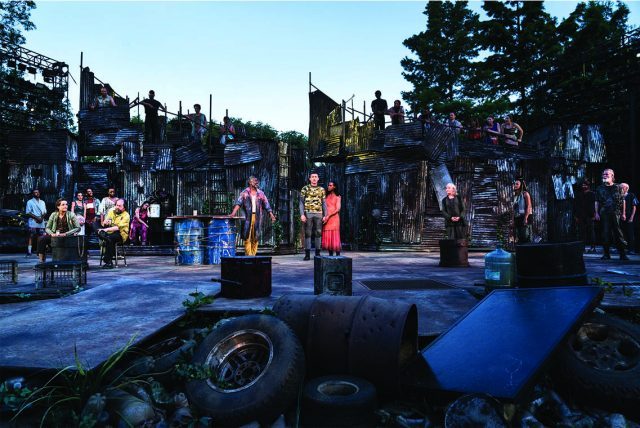
Coriolanus comes to Shakespeare in the Park for the first time in forty years (photo by Joan Marcus)

Central Park
Delacorte Theater
Tuesday – Sunday through August 11, free, 8:00
shakespeareinthepark.org

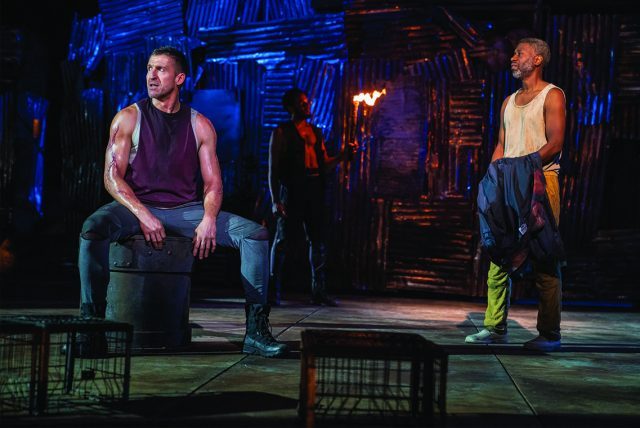
Jonathan Cake portrays Shakespeare’s brash antihero, Coriolanus, like a mix between superstar New England Patriots quarterback Tom Brady and Keanu Reeves in Bill & Ted’s Excellent Adventure in Daniel Sullivan’s riveting version, which opened tonight at the Public’s Delacorte Theater. The first Shakespeare in the Park production of the 1607 play since Wilford Leach’s staging in 1979 with Morgan Freeman — James Earl Jones starred as the title character in the only other Delacorte presentation of the work, Gladys Vaughn’s 1965 adaptation — Sullivan sets the play in a contemporary junkyard strewn with old tires, a burned-out car, random detritus, and a rickety steel gate. (The postapocalyptic design is by Tony winner Beowulf Boritt.)

(photo by Joan Marcus)

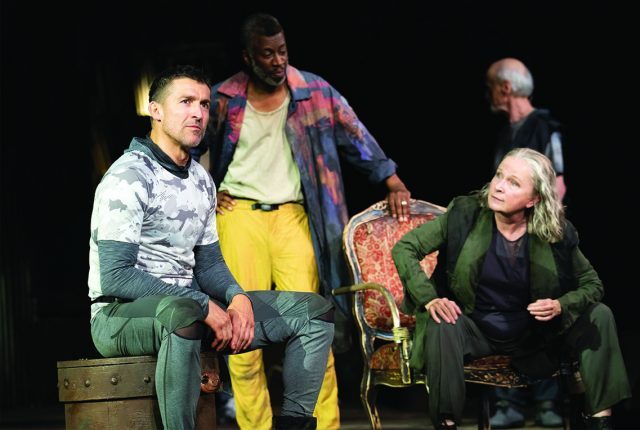
Martius (Jonathan Cake) gets a talking-to from his mother (Kate Burton) in Daniel Sullivan’s latest Shakespeare adaptation (photo by Joan Marcus)

Caius Martius (Cake) has returned to Rome after singlehandedly defeating the Volscians, who are led by his longtime nemesis, General Tullus Aufidius (Louis Cancelmi). Rechristened Coriolanus after his victory, Martius has nothing but disdain for the common folk, who are starving, scavenging for food on the streets. The conquering hero is soon the centerpiece of a power struggle in pre-imperial Rome, championed by the upper classes as their savior against the rabble. While his patrician supporters, including Senator Menenius Agrippa (Teagle F. Bougere), army commander Cominius (Tom Nelis), and General Titus Lartius (Chris Ghaffari), want him to run for consul to gain political power over the “beastly plebians,” the people’s tribunes Junius Brutus (Enid Graham) and Sicinius Velutus (Jonathan Hadary) are suspicious of him and so attempt to turn the starving mob against him in the upcoming election. Martius, who is married to the pregnant Virgilia (Nneka Okafor), father to Young Martius (Emeka Guindo), and son to the forceful, determined Volumnia (Kate Burton), is a fiery, insolent, and almost monstrously arrogant character, and he can’t keep his mouth shut; all too soon he comes up with a dangerous plan of revenge that threatens everything, and everyone, he loves.

(photo by Joan Marcus)

Martius (Jonathan Cake) and Menenius (Teagle F. Bougere) have a tense moment in Shakespeare in the Park presentation (photo by Joan Marcus)

At more than two and a half hours (with intermission), Coriolanus is long and drawn out, with a compelling main storyline but mundane, barely there subplots, perhaps because this tale is entirely fictional, not based on actual historical events. The play has never been brought to Broadway, and it is rarely revived; Michael Sexton’s 2016 Red Bull production found a way in by setting it during the Occupy movement and placing the audience in the center of the action. However, on a more conventional stage, it can prove significantly problematic, although Sullivan does a good job navigating through the bumps. The acting is inconsistent, although Public Theater mainstay Bougere (Cymbeline, Is God Is) is excellent as Martius’s right-hand man, Nelis (Girl from the North Country, Indecent) is a fine Cominius, and three-time Tony nominee Burton (The Elephant Man, The Constant Wife) is brilliant as Martius’s strong-willed mother. Tony winner Sullivan (Proof, The Comedy of Errors) makes the most of Volumnia’s line about her son being a man-child; the warrior Martius often turns into a little boy when speaking to his mommy, eliciting major laughs. It’s a stark counterpoint to his bravery in battle and his burgeoning frenemy bromance with Aufidius. It’s also a keen look at the voting process, particularly now that election season is under way in the United States, as the people and the pundits debate over who’s worthy and who’s not, who’s genuine and who is a power-hungry, mean-spirited liar.

MARY PAGE MARLOWE

(photo by Joan Marcus)

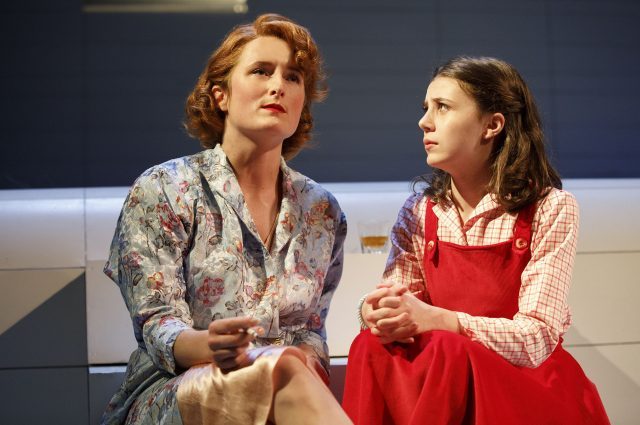
Twelve-year-old Mary Page (Mia Sinclair Jenness) looks up to her mother (Grace Gummer) in extraordinary Tracy Letts play (photo by Joan Marcus)

2econd Stage Theater
Tony Kiser Theater
305 West 43rd St. between Eighth & Ninth Aves.
Tuesday – Sunday through August 19, $30-$89
2st.com/shows

“I am unexceptional,” the title character tells her shrink in Mary Page Marlowe, Pulitzer Prize winner Tracy Letts’s exceptional play, which opened tonight at 2econd Stage’s Tony Kiser Theater. The best play I’ve ever seen about the life and times of a woman written by a man, Mary Page Marlowe follows the protagonist, born in 1946, through eleven nonchronological stages of her rather ordinary existence, portrayed by six terrifically talented actresses and one doll (as the infant). Each scene reveals small but significant details about the character as she goes about her days as a daughter, a wife, a mother, a patient, an employee, and a retiree, trying to find her identity as her relationships — and her name — change. Whether she ever finds her true self — if there even is such a thing — is the question of the play. Mary Page is wonderfully performed by Mia Sinclair Jenness at twelve, Emma Geer at nineteen, Tatiana Maslany (in her New York stage debut) at twenty-seven and thirty-six, Susan Pourfar at forty and forty-four, Kellie Overbey at fifty, and Blair Brown at fifty-nine, sixty-three, and sixty-nine. The nonlinear time shifts are indicated primarily by the character’s clothing (the simple but effective costumes are by Kaye Voyce) and hairstyle as such basic props as beds, tables, couches, and chairs slide on and off Laura Jellinek’s intimate two-level set, making it clear this is about one woman’s interior and exterior changes, not about a changing America.

(photo by Joan Marcus)

Fifty-nine-year-old Mary Page (Blair Brown) gets some bad news as Ray (Brian Kerwin) looks on in masterful production at 2econd Stage (photo by Joan Marcus)

From childhood to senior citizenship, Mary Page faces illness, divorce, alcoholism, infidelity, displacement, and more, all with the same attitude, as if various key moments in her life are no different from the rest of her days; sometimes the choices aren’t hers, but even when they are, she is often a spectator, much like the audience. “What do you want?” her teenage daughter, Wendy (Kayli Carter), asks at a Denny’s as her younger brother, Louis (Ryan Foust), plays with a map. “Why can’t you just say what you want?” Wendy repeats when her mother avoids the question. Throughout the ninety-minute intermissionless play, Mary Page says “I don’t know” two dozen times, although she also does provide some answers. When her shrink (Marcia DeBonis) asks her why she hasn’t brought up what she believes to be a certain important issue previously, Mary Page says, “Because it’s not relevant, that’s what I’m telling you, it feels like a different person who was going through that,” eliciting a laugh from the audience since each Mary Page is played by a different actress. She then adds, “I still live life even when you’re not watching me,” as if reminding the audience that there is even more to Mary Page than what is revealed onstage, just as there is more to any woman we see in real life. But even when she does — or doesn’t — take action for her own benefit, she shows a resilience to persist, a well-earned survival instinct that keeps her going despite what are sometimes formidable odds.

(photo by Joan Marcus)

Thirty-six-year-old Mary Page (Tatiana Maslany) faces off against her shrink (Marcia DeBonis) in dazzling New York premiere (photo by Joan Marcus)

Letts (August: Osage County, Superior Donuts) and director Lila Neugebauer, who has excelled helming such ensemble pieces as The Antipodes, Everybody, The Wolves, and The Wayside Motor Inn, do a beautiful job moving from scene to scene; even though events happen out of order, Mary Page is in a constant state of progression. We might not ever see them together (at least not until the curtain call), but the six amazing women who play Mary Page flow into one another seamlessly, helping make her one person with many distinct aspects. The large cast also includes Grace Gummer as Mary Page’s mother and Nick Dillenburg as her father; Audrey Corsa and Tess Frazer as her high school friends, Connie and Lorna; David Aaron Baker and Brian Kerwin as significant others Ray and Andy; Maria Elena Ramirez as her nurse; Gary Wilmes as one of her lovers; and Elliot Villar as her dry cleaner, who wraps everything up as they talk about fixing a quilt in which “different women would sew the different panels and then stitch them all together,” just as Letts, Neugebauer, and the cast have so remarkably done in this extraordinary work.

NYC PLAYERS: PARADISO

The New York City Players are performing Paradiso for free at Greene Naftali in Chelsea through February 10

The New York City Players are performing Paradiso for free at Greene Naftali in Chelsea through February 10

Greene Naftali Gallery
508 West 26th St. between Tenth & Eleventh Aves., ground floor
Wednesday – Saturday through February 10, free with advance RSVP, 718-622-0330, 7:00
www.greenenaftaligallery.com
www.nycplayers.org

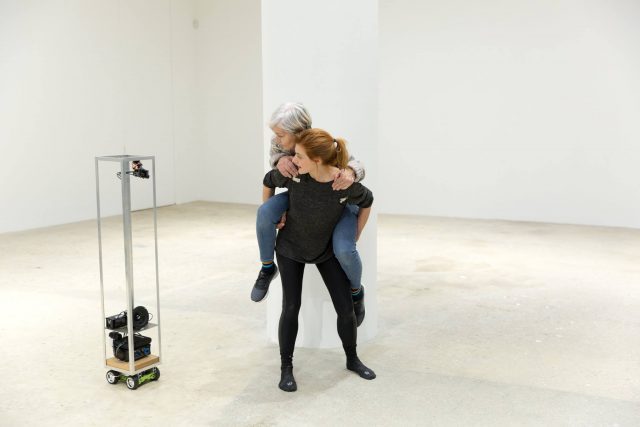
Richard Maxwell’s New York City Players don’t just put on plays; the Brooklyn-based experimental company creates innovative works of art that defy convention. In such recent presentations as Isolde, The Evening, Samara, and their first-ever revival, Good Samaritans, they challenge theatrical standards in the way they tell stories, from basic narrative flow to the use of props and sets to how the actors deliver their lines. So it is fitting that their new show, Paradiso, is taking place at the Greene Naftali Gallery in Chelsea, which just copublished the first monograph of Maxwell’s plays, The Theater Years. Maxwell’s final response to Dante’s Divine Comedy — following The Evening and Samara — the sixty-minute Paradiso explores family, god, and country. The cast consists of Elaine Davis, Jessica Gallucci, Carina Goebelbecker, and Charles Reina, with production design by Sascha van Riel and costumes by Kaye Voyce. Admission is free, but you have to act fast to snag a reservation; there will also be a waitlist at every show.

THE ANTIPODES

(photo by Joan Marcus)

A group of men and women gathers around a table telling stories in Annie Baker’s The Antipodes (photo by Joan Marcus)

The Pershing Square Signature Center
The Romulus Linney Courtyard Theatre
480 West 42nd St. between Tenth & Eleventh Aves.
Tuesday – Sunday through June 11, $30 through May 14, $90 after
212-244-7529
www.signaturetheatre.org

Near the beginning of Annie Baker’s first play for her Residency Five program at the Signature Theatre, John, a character declares, “Tell me a story.” Baker takes that conceit to a whole new level in her follow-up, The Antipodes, which has been extended at the Signature through June 11. The set-up is essentially fairly simple: a group of coworkers sit in ergonomic chairs around a table in an office, where they spend their days sharing deeply personal tales that might or might not lead to the one that their boss, Sandy (Will Patton), needs as he seeks material for a successor to their biggest hit, Heathens. The audience, sitting on two sides of Laura Jellinek’s pristine set, never learns what kind of company the seven men and two women work for — but it’s apparently at least somewhat bureaucratic and corporate, as Josh (Josh Hamilton) has to fill out forms over and over in an ongoing effort to try to get his ID. The tale they seek involves monsters, but no dwarves, elves, or trolls; they could be making movies, video games, apps, or an animated television series, although it doesn’t really matter, because it’s all about the stories themselves. “There are seven types of stories in the world,” Dave (Josh Charles) says, while Danny M1 (Danny Mastrogiorgio) claims there are thirty-six, Josh ten, and Brian (Brian Miskell) eighteen. They share intimate sexual episodes, moments that shaped their lives, and random tales that go nowhere. Josh philosophizes about the nature of time, Eleanor (Emily Cass McDonnell) doesn’t understand why she can’t use her cell phone, Danny M2 (Danny McCarthy) is hesitant to contribute, and Adam (Phillip James Brannon) remembers being hit by lightning. Scenes often end in the middle of a discussion, then pick up in the midst of a new topic, with no clear delineation of the time change except when Sarah (Nicole Rodenburg), Sandy’s assistant — who knows more than she’s letting on — arrives to take lunch orders, wearing a different chic outfit each time, courtesy of costume designer Kaye Voyce. While it doesn’t appear that they are accomplishing anything, Sandy, a straight shooter who is having some issues at home, pushes them to keep going. “I just wanted to remind all of you that what you’re doing is important. We need stories. As a culture. It’s what we live for. These are dark times. Stories are a little bit of light that we can cup in our palms like votive candles to show us the way out of the forest.” Even Brian, the note-taker and researcher, gets in on the action. But the team starts getting nervous when Sandy suddenly doesn’t show up one day.

(photo by Joan Marcus)

Dave (Josh Charles) and Adam (Phillip James Brannon) listen to others’ stories in latest exceptional work by Annie Baker (photo by Joan Marcus)

The Antipodes, which sounds like a mythical monster but actually means “contrary” or “the exact opposite,” has all the makings of a pretentious play about the art of playwrighting, a work about the writer’s struggle to come up with a good idea, but Pulitzer Prize winner Baker (The Flick, Circle Mirror Transformation), who wrote the two-hour show specifically for the Romulus Linney Courtyard Theatre, proves that it’s not that obvious. Instead, it’s a carefully crafted existential take on everyday existence, on the things humans do to get by, from eating and drinking to having sex, from going to work and communicating with others to dealing with life’s little problems. “We can do anything,” Sandy points out, as if he’s speaking for Baker the playwright, who is firmly in control. The show is also about the concept of time, which in a play can be manipulated by the writer. “There are two kinds of time. Vertical and horizontal. And if something happens in horizontal time, it can be . . . it’s not permanent,” Josh explains. “You can reverse it. Like one of them is the time that we think of when we think of normal time that’s moving forward and you can’t go back. But then there’s another kind of time and if you do something in that kind of time you can . . . uh . . . it’s more flexible.” Director Lila Neugebauer, who has done an extraordinary job navigating through time and space in such complex multicharacter dramas as The Wayside Motor Inn, The Wolves, and Everybody, makes every movement count, never allowing the narrative flow to drag, whether by way of a bit of magic about where lunch comes from or Adam lying on the floor to tell “the first story ever told.” The actors form an utterly believable group, fellow employees with unique personalities, some of whom bond while others remain outsiders, just as in real life. “The stories we create teach people what it’s like to be someone else on a visceral level,” Sandy tells his crew. “As storytellers we know how to shift perspective and inhabit different viewpoints. Imagine what would happen if everyone in the world could do every once in a while what we already do on a daily basis. It would be revolutionary.” The Antipodes is another exceptional play from one of the theater’s finest minds, a writer who is never afraid of going for the revolutionary in her work.