Tag Archives: Kaye Voyce

STAFF MEAL

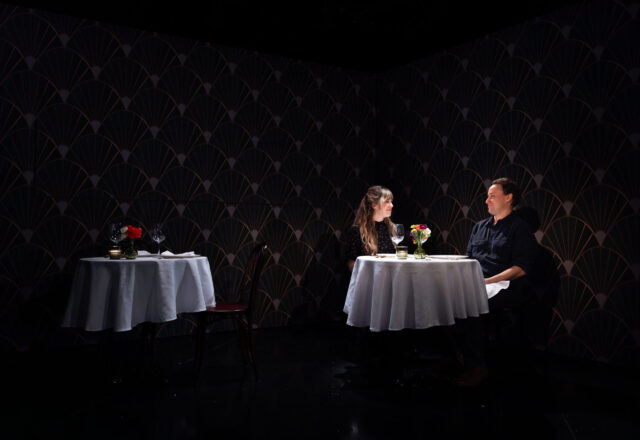
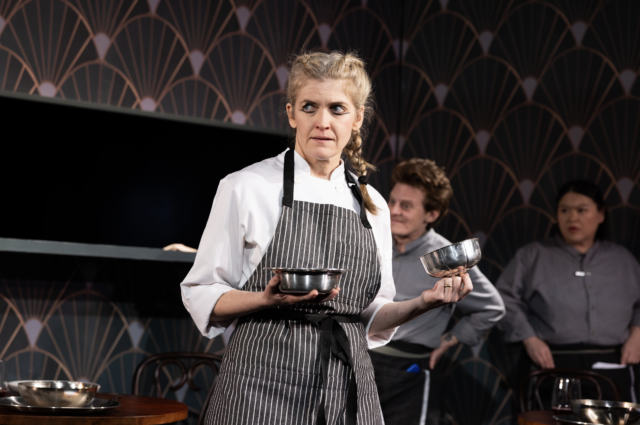
Mina (Susannah Flood) and Ben (Greg Keller) explore a possible relationship as doomsday approaches in Staff Meal (photo by Chelcie Parry)

STAFF MEAL
Playwrights Horizons, Peter Jay Sharp Theater
416 West 42nd St. between Ninth & Tenth Aves.
Tuesday – Sunday through May 24, $71-$91
www.playwrightshorizons.org

Abe Koogler’s Staff Meal kicks off with a tasty amuse bouche, continues with a delicious appetizer, then serves up a tantalizing main course before getting off track with a few awkward sides and an erratic dessert. But that doesn’t mean it ultimately isn’t a meal worth savoring.

Written between January and April 2020, just as the pandemic was starting to take hold of the world, Staff Meal is set in an absurdist time and place where lonely people are desperate for connection. Mina (Susannah Flood) and Ben (Greg Keller) meet-cute in a coffee shop, where they slowly begin speaking with each other while working on their laptops. The first day, Ben says, “Hey,” and Mina answers, “Hey.” The second day, Ben says, “Hey!” and Mina answers, “Hey!” The third day, Ben says, “Hey,” and Mina answers, “Oh hey!,” adding, “All’s well?”

Their less-than-scintillating conversation — Ben: “We had a dog who I used to throw the ball to a lot.” Mina: “Hey, I had a dog too! We used to throw the ball to him too.” — gets a little longer each day until Ben doesn’t show up, which worries Mina. On a trip to the bathroom, she asks an audience member to keep an eye on her computer. A nattily dressed vagrant (Erin Markey) appears from the theater aisle and tries to snatch the laptop just as Mina returns and stops her, shooting the audience member/guard a nasty look. The fourth wall has been broken — and will be again and again — in a nontraditional play overstuffed with convention-defying moments that range from brilliant and hilarious to baffling and confusing.

Ben and Mina decide to grab a bite and wander into a strange restaurant where no one comes to take their order as they delve deeper into who they are. Discussing past lives, Ben says he believes he was a passenger on a ship like the Titanic, but definitely not the Titanic, that sunk around the same time, while Mina thinks she was the rat in the animated film Ratatouille. The waiter (Hampton Fluker) eventually shows up, but only to deliver a monologue to the audience about the restaurant’s mysterious owner, Gary Robinson, and the expansive wine cellar, which is far away in a kind of hellish basement dungeon.

The action then shifts into the past, to the waiter’s first day, when he sat down with two other servers (Jess Barbagallo and Carmen M. Herlihy) to have a staff meal made specially by the chef, Christina (Markey). They rave poetically about the fabulous spread, even though it is clearly only green grapes.

The servers give the waiter advice on how to do his job, including not offending Christina — oops, too late — while the waiter wants to know why everything takes so long to happen in the restaurant, especially the journey to the wine cellar. The servers explain that the establishment is based on Flights of Fancy followed by Acts of Service dedicated to making connections, clear metaphors for life itself with indirect references to the Bible. Gary Robinson is referred to as a “legend” no one ever sees, like a supreme being, with Christina — it’s unlikely the first six letters of her name are mere coincidence — as the earthbound figure precisely following the recipes in his books.

In fact, the servers call out iterations of “Oh god” four times while partaking of the duck, which is actually grapes, the biblical fruit about which Jeremiah said, “But every one shall die for his own iniquity; every man who eats the sour grapes, his teeth shall be set on edge.” It also evokes how the public can lift a chef to godlike status and their restaurant to a kind of holy space, complete with scallop shell wallpaper, the emblem of St. James that relates to the physical and spiritual aspects of the human condition.

In case you’re getting lost at this point, Rita (Stephanie Berry) declares, “I’m sorry, WHAT IS THIS PLAY ABOUT???????!?!?!?!?!”

Things only get more bizarre and existential as the characters seek “sweet relief” in a city endangered by e-commerce, empty streets, and the breakdown of the social contract as everything literally falls apart around them.

Chef Christina (Erin Markey) serves up a meal of biblical proportions in Playwrights Horizons production (photo by Chelcie Parry)

Early on, Ben asks Mina if she eats out a lot. She responds in a way that captures how so many people feel all the time about going out anywhere — to a restaurant or even the theater itself — and not just during a pandemic: “I do!” she says. “I mean, no not really; it’s often hard to hear, and the food is often overpriced, and I often feel disappointed, and a big part of me honestly wishes we were just at someone’s house being hosted warmly by someone who was making us all different kinds of food and there was sort of a fire and wine was passed around to the sound of laughter and I was sort of sandwiched on the couch after dinner between two close friends and there was a third kneeling in front of me who I could rustle their hair.”

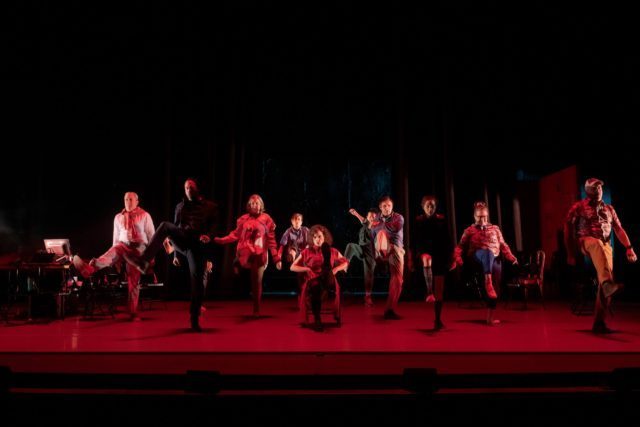
Jian Jung’s set morphs from the spare coffee shop to the fancy restaurant to an apocalyptic scenario as Masha Tsimring’s lighting grows ever darker and Tei Blow’s sound becomes more ominous, with illusions by Steve Cuiffo. Kaye Voyce’s costumes include everyday casual wear, restaurant uniforms, and the vagrant’s ratty clothing.

Koogler (Deep Blue Sound, Fulfillment Center) and director Morgan Green (School Pictures, Minor Character) keep the audience on its proverbial toes for most of the hundred-minute show before going haywire in the end, overfilling the plate with an abundance of effluvia. When Rita asks, “Do you ever get this feeling with young writers, or early writers, writers who are developing . . . do you ever wonder: When will they develop?” Koogler is an established playwright, but Staff Meal could benefit from some further development.

Keller (The Thanksgiving Play, Shhhh) and Flood (Make Believe, The Comeuppance) are adorable as the young couple who may be falling in love, while Barbagallo (The Trees, Help) and Herlihy (The Apiary, Scene Partners) are cryptic and charming as the servers, Markey (Dr. Ride’s American Beach House, A Ride on the Irish Cream) chews up the scenery in her two roles, Berry (On Sugarland, Sugar in Our Wounds) devours her soliloquy, and Fluker (All My Sons, Esai’s Table) is cool and calm as the waiter, who is a stand-in for the audience’s psyche.

Although dealing with issues that were exacerbated during the coronavirus crisis, Staff Meal is not a pandemic play. It’s a funny and frightening satire about attempting to make connection and build community even when the planet might be in a doom-spiral, about humans needing nourishment by being with others, in coffee shops, restaurants, or a theater. Like life, it’s not perfect, with its ups and downs, but it provides fine fare that may not go down easy but feeds the soul in these harried times.

[Mark Rifkin is a Brooklyn-born, Manhattan-based writer and editor; you can follow him on Substack here.]
DAEL ORLANDERSMITH: SPIRITUS/VIRGIL’S DANCE

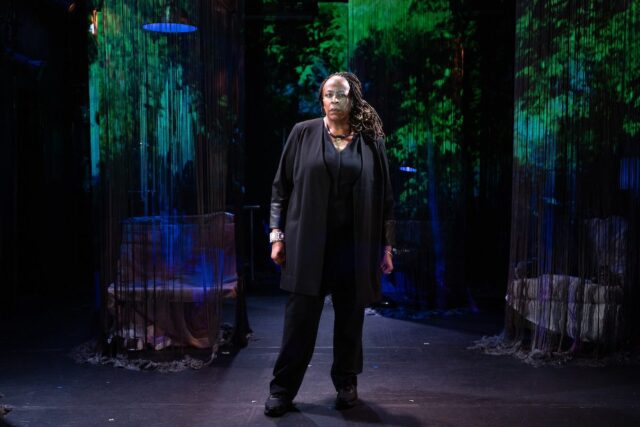
Dael Orlandersmith’s Spiritus/Virgil’s Dance is a multimedia journey into fate and destiny (photo © HanJie Chow)

SPIRITUS/VIRGIL’S DANCE
Rattlestick Playwrights Theater
224 Waverly Pl.
Through March 9, $50, 7:00
www.rattlestick.org

In Dante Alighieri’s fourteenth-century epic The Divine Comedy, Publius Virgilius Maro, better known simply as Virgil, shepherds the Italian poet through the “Inferno” and “Purgatory,” two of the three realms of the dead. “Thou follow me, and I will be thy guide, / And lead thee hence through the eternal place, / Where thou shalt hear the desperate lamentations, / Shalt see the ancient spirits disconsolate, / Who cry out each one for the second death,” Virgil, who represents human reason, says to Dante. Virgil (70–19 BCE) was the author of The Aeneid, which tells the story of Trojan War hero and refugee Aeneas’s journey toward his fate and destiny.

In Spiritus/Virgil’s Dance, solo show master Dael Orlandersmith portrays a fictional character named Virgil who takes the audience at the Rattlestick Theater on a sixty-minute multimedia odyssey into death and destiny, fate and fulfillment.

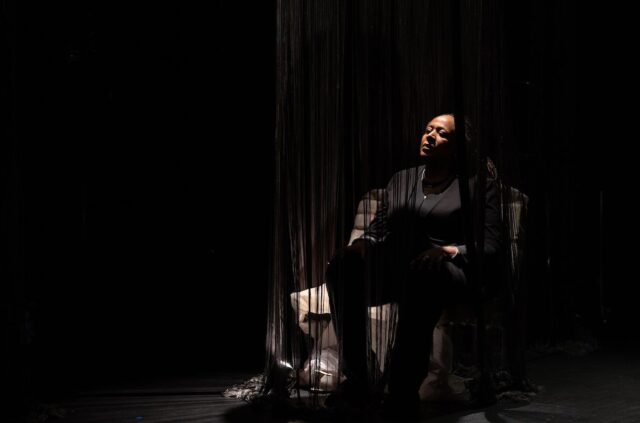
The mood is set early, with such songs as Johnny Cash’s Nine Inch Nails cover “Hurt” and Mavis Staples’s “See That My Grave Is Kept Clean” playing as the crowd enters the space, giving it a holy feel. Takeshi Kata’s set features six floor-to-ceiling string-curtained cylinders containing furniture: a chair, a table, a lamp on a stand. We soon learn that each one symbolizes a chapter in Virgil’s own epic narrative as they try to find their place in a world complicated by loss and loneliness.

“Have I done it right?” Virgil asks. “Have I used time — my time — right?” Have any of us?

Virgil wanders from cylinder to cylinder, sharing moments from their past. They grew up in the Bronx, hanging out at Woodlawn Cemetery and going to St. Barnabas. Their parents’ love of music led Virgil to become a deejay at a pirate radio station in the East Village. As the years pass, Virgil realizes they need something more. “I make a decision to make more money / Move to another part of downtown / Because / That must be the answer / Me / Thinking the money / Another place / Has got to be the answer,” they explain, but it takes their mother’s unexpected death and their father’s sudden illness for Virgil to take a long look at their life, significantly influenced by their friendship with funeral director Jimmy McHugh and hospice nurse Peggy Callahan.

Dael Orlandersmith looks at her past and future in beautiful one-person show at Rattlestick (photo © HanJie Chow)

Born in East Harlem, Orlandersmith has been staging one-person dramas, some semiautobiographical, most featuring the playwright performing multiple characters, since 1995’s Beauty’s Daughter, which earned her an Obie. She won the prestigious Susan Smith Blackburn Prize in 2003 for Yellowman. More recently, Forever was a deeply intimate show about the severely dysfunctional relationship between a daughter and her alcoholic mother, while Until the Flood explored the tragic story of the killing of Michael Brown at the hands of police officer Darren Wilson in Ferguson, Missouri, on August 9, 2014.

Orlandersmith is masterful in Spiritus/Virgil’s Dance, a beautifully rendered production lovingly directed by Neel Keller, who has been working with Orlandersmith for four decades. As Orlandersmith says at one point in the play, it’s a “celebration of life and death.” She doesn’t make major shifts in tone or body as she switches among the characters, always wearing the same all-black outfit (the costume is by Kaye Voyce) as she walks slowly around the cylinders, which have a heavenly glow (the sensitive lighting is by Mary Louise Geiger), the people they represent prepared for the great beyond. Nicholas Hussong’s projections include leaves blowing in the wind and the subway speeding by, accompanied by Lindsay Jones’s tender original music and sound.

As Virgil discovers their true vocation, it’s like they have been given a giant hug from the universe, something we all seek — and something we all receive from Orlandersmith in this gently, enveloping experience. You’ll leave the theater thinking of the words Peggy shared with Virgil: “Live your life / Live it fully / Do not leave here regretfully.”

Spiritus/Virgil’s Dance continues at Rattlestick through March 9; the March 6 performance will be followed by the discussion “Music Lives On” with Javier Arau, Felice Rosser, Elliot Sharp, and Matt Stapleton.

[Mark Rifkin is a Brooklyn-born, Manhattan-based writer and editor; you can follow him on Substack here.]
JONAH

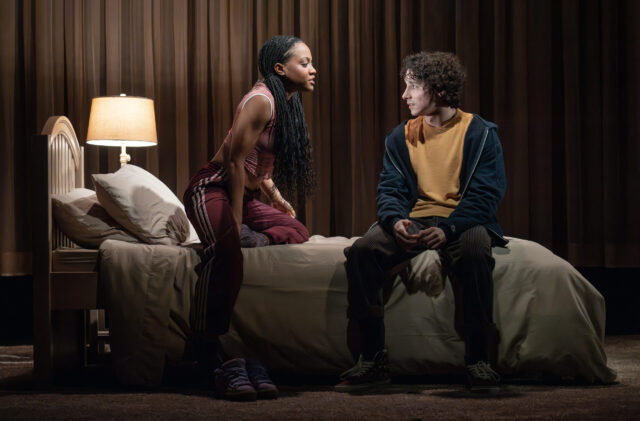
Teens Ana (Gabby Beans) and Jonah (Hagan Oliveras) explore their burgeoning sexuality in Roundabout world premiere (photo by Joan Marcus)

JONAH
Laura Pels Theatre
Harold and Miriam Steinberg Center for Theatre
111 West 46th St. between Sixth & Seventh Aves.
Tuesday – Sunday through March 10, $76-$138
212-719-1300
www.roundabouttheatre.org

“Why are you fixated on me?” Ana (Gabby Beans) asks two of three guys who are fixated on her in the world premiere of Rachel Bonds’s Jonah, continuing at Roundabout’s Laura Pels Theatre through March 10. It’s easy to become fixated on Ana, and on Beans, in the meticulously rendered production, which follows a woman through approximately three decades as she faces tragedy and trauma and wrestles with her faith.

The hundred-minute play takes place in Ana’s bedroom at three distinct times in her life. Wilson Chin’s set features a bed to the left, a small table where Ana works to the right, and a door in the middle where the men come and go but Ana never goes through, as if she is trapped. All the characters are damaged, but the men find solace in their relationship with Ana, fiercely dedicated to survival and her own solace.

In the first scene, the sixteen-year-old Ana meets the seventeen-year-old Jonah (Hagan Oliveras), who has a major crush on her. They both go to the same boarding school, and they both are virgins, soon sharing their sexual fantasies with each other.

Like the biblical figure, Jonah is questioning the existence of a higher power. Jonah asks Ana if she still believes in God, but she’s not sure. They might not believe in God, but Ana, who is Catholic, and Jonah, who is not, pepper their speech with references to God and Jesus, in frustration, anger, and joy as they contend with different types of pain.

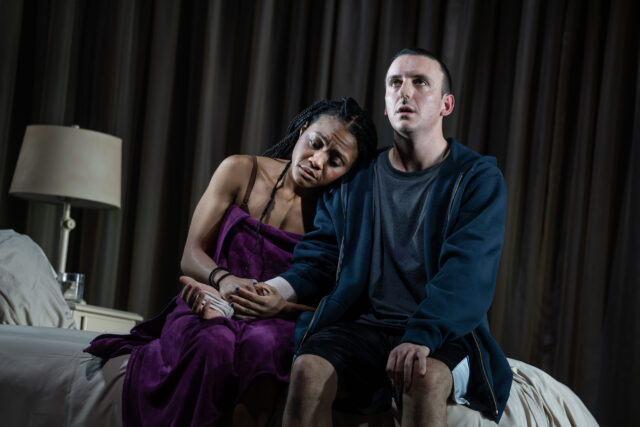
Step-siblings Ana (Gabby Beans) and Danny (Samuel Henry Levine) try to cope with an abusive father in Rachel Bonds’s Jonah (photo by Joan Marcus)

The next male who shows up in Ana’s room is her protective stepbrother, Danny (Samuel Henry Levine), who is being physically and psychologically abused by his father. Whereas Ana is studying hard and wants to become a writer, Danny is a gruff dude who has no interest in books or school. Ana tells him that her “American dream” is “getting into college and getting the fuck out of here,” but Danny is just trying to survive day to day and doesn’t want Ana to leave. “Don’t you want to stay together?” he says, then asks her to hold him to help calm him down, perhaps a little too close.

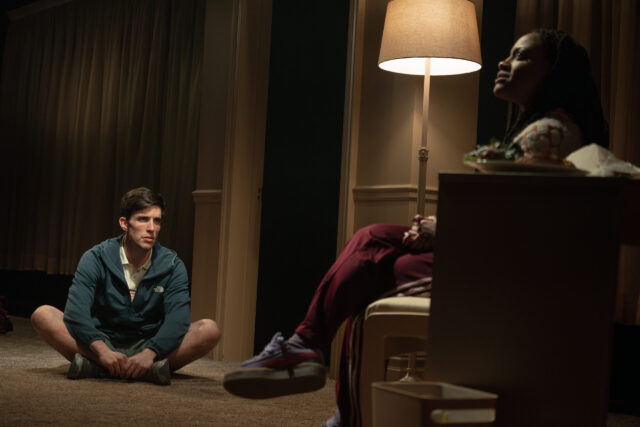
Years later, at a writer’s retreat, Ana meets Steven (John Zdrojeski), a former Mormon who brings her food and can’t stop talking about his various physical ailments. Like Jonah, he asks her, “Do you still believe in God?” Steven has a unique perspective on religion, as well as on sex. “Can you still fantasize?” she asks him, and he admits, “There’s definitely still shame lurking around some corners, but —.”

A twist at the end not only furthers the links between Jonah, Danny, and Steven but explains the name of the play.

Bonds (Five Mile Lake, Sundown, Yellow Moon) writes sharp, incisive dialogue that crackles, sparks, and surprises. Director Danya Taymor (Pass Over, “Daddy”) expertly guides the play through its multiple time periods despite the set and Kaye Voyce’s costumes never changing. Amith Chandrashaker’s lighting and Kate Marvin’s sound reverberate to announce narrative shifts.

Steven (John Zdrojeski) is one of three young men obsessed with Ana (Gabby Beans) in Jonah at the Laura Pels Theatre (photo by Joan Marcus)

Zdrojeski (Heroes of the Fourth Turning, Before We’re Gone) channels Jimmy Stewart as the goofy Steven, Levine (The Inheritance, Kill Floor) gives just the right heft to Danny, and gamer and actor Oliveras is sweetly innocent as the tender-hearted Jonah.

But it’s Tony nominee Beans’s (I’m Revolting, Anatomy of a Suicide) show all the way. She’s extraordinary as Ana, onstage the entire show; you won’t be able to take your eyes off her as Ana deals with the lousy hand she’s been dealt.

Early on, she tells Jonah, “I don’t have to do anything. I do what I want,” and that’s the mantra she lives by. She’s not looking for sympathy, nor is she blaming anyone else for what has happened in her life. She keeps on fighting, even as she starts to realize that opening up and depending on someone else is not necessarily a bad thing. Beans captures these emotions with a powerful determination while also displaying the softer side that Ana hides.

Whether you believe in a supreme being or not, you’ll come away from Jonah believing in Ana, and in Beans.

[Mark Rifkin is a Brooklyn-born, Manhattan-based writer and editor; you can follow him on Substack here.]
LUCY

Ashling (Lynn Collins) and Mary (Brooke Bloom) share a fun moment in Lucy (photo by Joan Marcus)

LUCY
Audible Theater’s Minetta Lane Theatre
18 Minetta Lane between Sixth Ave. and MacDougal St.
Monday – Saturday through February 25, $57-$97
www.audible.com

Writer-director Erica Schmidt’s latest work, Lucy, is one of the best plays of the season, a gorgeously rendered story about a single mother, a nanny, and a young girl. Her Mac Beth, a stirring adaptation of the Shakespeare classic reimagined with an all-female cast set at a girls school, was one of the best productions of 2019, and equally feminist. Schmidt now moves from the bloody battles of medieval Scotland to twenty-first-century upscale urban domesticity, but Lucy nevertheless references classic themes.

The nanny is a staple of literature, theater, and film, from Mary Poppins, Mrs. Doubtfire, Maria Reiner (The Sound of Music), and Becky Sharp to Nanny McPhee, Nanny Schuester (The Nanny Diaries), Anna Leonowens (The King and I), and Mrs. Baylock (The Omen). In the 1965 Hammer horror flick The Nanny, Bette Davis starred as the thoroughly wicked title character who remains unnamed; just calling her Nanny is frightening enough.

Lucy, which continues through February 25 at Audible’s Minetta Lane Theatre, opens with pregnant fortysomething Mary (Brooke Bloom) interviewing Ashling (Lynn Collins) to take care of Mary’s six-year-old daughter, Lucy (Charlotte Surak), and soon-to-be-born son, Max. Mary is desperate; she’s a radiologist with a complicated work schedule and is due to give birth in a week. Mary wants to find the right fit, but she overlooks a few possible warning signs during her meeting with Ashling. Both the character and the audience do a double take at several things Ashling says, but nothing seems too ominous.

“I get it. You need a coparent,” Ashling declares after Mary describes her hours. “Someone who is here when you’re at work.” Mary responds, “Who I pay to be here. A nanny,” asserting that she is the mother.

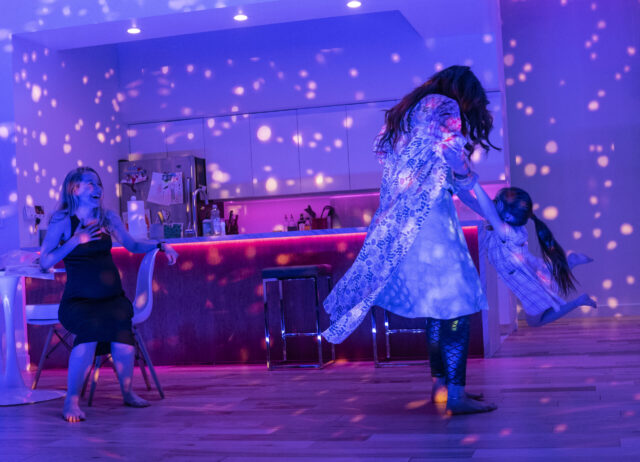
Mary hires Ashling — who is fifty-eight but looks at least two decades younger, and acts even younger than that — and at first everything appears to be great. The nanny goes above and beyond the call of duty, especially with Lucy, who immediately adores her. At one point Ashling is swinging Lucy around as they both sing to Taylor Swift’s “Anti-Hero,” belting out, “I should not be left to my own devices / They come with prices and vices / I end up in crisis (tale as old as time) / I wake up screaming from dreaming / One day I’ll watch as you’re leaving / ’Cause you got tired of my scheming / (For the last time) / It’s me, hi / I’m the problem, it’s me / At teatime, everybody agrees / I’ll stare directly at the sun, but never in the mirror / It must be exhausting always rooting for the anti-hero.”

Mary (Brooke Bloom) watches as Ashling (Lynn Collins) and Lucy (Charlotte Surak) dance to Taylor Swift (photo by Joan Marcus)

As time passes, there are more cracks in the mirror as Mary begins noticing some curious behavior by Ashling, who has a feasible explanation for everything. Is Ashling gaslighting Mary? Is Mary so overworked and stressed that her imagination is getting the best of her? It all comes to a head, leading to an utterly thrilling finale.

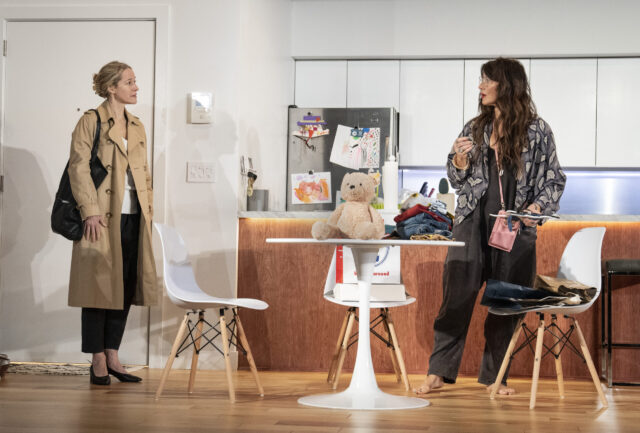
Lucy takes place in Mary’s kitchen/dining room/living room, with shelves filled with books, cabinets with dishes and bottles of wine, and a comfy couch and chair. There is no television anywhere — “I don’t do screens,” Mary tells Ashling. Mary’s bedroom is off stage right, while a hallway at the center back leads to Lucy’s and Max’s rooms. (The clean, mostly white, instantly Instagrammable set is by Amy Rubin.) Mary primarily wears tastefully minimal but obviously expensive black and cream outfits, while the tattooed Ashling is draped in layers of swirly boho prints, every arm and finger sporting inexpensive arty silver jewelry, courtesy costume designer Kaye Voyce.

The creepier the plot gets, the more Cha See’s lighting casts long, eerie shadows, while Justin Ellington’s sound includes plenty of crying and screaming.

(photo by Joan Marcus)

Mary (Brooke Bloom) and Ashling (Lynn Collins) face off in Audible production at the Minetta Lane (photo by Joan Marcus)

Schmidt (Cyrano, All the Fine Boys) has her finger on the pulse of the relationships between Ashling and Mary, Mary and Lucy, and Lucy and Ashling, letting each play out in its own way. The underlying fear Mary has about having hired the wrong nanny is palpable; at least at the start, most mothers are terrified of leaving their children with a complete stranger, references or not.

Bloom (Everybody, Cloud Nine) embodies that fear, evoking the young mother in Rosemary’s Baby, who thinks the devil is after her infant. Collins (Hamlet, The Merchant of Venice) exquisitely captures the many mysteries of Ashling, who harbors plenty of secrets. Schmidt exploits our misgivings by imbuing Ashling with some tantalizing witchlike tendencies. When Mary asks her what she likes most about child care, Ashling proclaims, “It keeps me young!” and it’s an easy leap to the age-old idea that she is somehow sucking the youth from her charges. (Mary responds, “That’s funny. My daughter is definitely making me old. Fast.”)

When Mary asks if she ever wanted her own kids, Ashling replies, “I have kids!” There’s also a perfume that could be a magic potion, a curious substance around Max’s crib, and other subtle touches that make us question whether Ashling is really up to something or if it’s Mary’s paranoia. Mary might be a radiologist who peers inside people’s bodies, but that doesn’t mean she can assess what’s going on in Ashling’s head.

Most of Schmidt’s work has a strong feminist undercurrent, and Lucy is no exception, with Mary a doctor who cannot easily afford a nanny and who gets only four weeks’ maternity leave, which she has chosen not to fight in order to keep her job.

Finally, it’s intriguing that the play is named after the six-year-old girl, who is splendidly portrayed by Surak (Waitress) but has the least amount of stage time. It’s as if Schmidt is telling us that Lucy is the future while also hearkening back to the first fossil skeleton of a human ancestor ever discovered, which archaeologists named Lucy.

In the five years it has been producing plays at the Minetta Lane, Audible has concentrated primarily on one-person shows starring women, including Carey Mulligan in Dennis Kelly’s Girls & Boys, Lili Taylor in Wallace Shawn’s The Fever, Jade Anouka’s Heart, Faith Salie’s Approval Junkie, and DeLanna Studi’s And So We Walked: An Artist’s Journey Along the Trail of Tears. (Men have been represented by Aasif Mandvi’s Sakina’s Restaurant and Billy Crudup in David Cale’s Harry Clarke.) In addition, Laurie Gunderson’s two-character The Half-Life of Marie Curie told the inspiring story of Madame Curie and her friendship with fellow physicist Hertha Ayrton.

Lucy, which passes the Bechdel test with flying colors, follows in that tradition while also reaching the next level. As Swift sings in “Midnights”: “Ladies always rise above.”

UNDER THE RADAR: FIELD OF MARS

Richard Maxwell’s Field of Mars explores the history of human existence from an Applebee’s in Chapel Hill, North Carolina (photo by Whitney Browne)

NEW YORK CITY PLAYERS: FIELD OF MARS
NYU Skirball
566 LaGuardia Pl.
January 19-22, 24-29, $60
publictheater.org
nyuskirball.org

“OMG.”

That three-letter digital exclamation is said throughout Richard Maxwell’s new play, Field of Mars, stated plainly by several characters as if it is just another article or preposition. As has been Maxwell’s style since he started his company, New York City Players, in 1999, all words are given similar treatment, delivered dryly, sans any deep emotion, all of equal weight and meaning. omg.

Named after an ancient term for a large public space or military parade ground, Field of Mars is about the beginning and the end of everything on Earth, with God himself portrayed by Phil Moore, who, with equal weight and meaning, also plays a manager at an Applebee’s in Chapel Hill, North Carolina, which serves as a kind of way station for humanity.

The audience sits on four rows of rafters onstage, facing the actors, in the otherwise empty NYU Skirball Center, which commissioned the piece for the Public’s Under the Radar Festival. The nonlinear story takes place on lighting designer Sascha van Riel’s relaxing set, a relatively featureless restaurant booth on one side, a bar/hostess station on the other, where Gillian Walsh is an alternate version of St. Peter at the gates of heaven, more concerned with her cover band and her BF than the future of the planet. The set is reminiscent of the one van Riel built and gets torn down in Maxwell’s The Evening, identified in that 2015 work as “a garbagey void” in “a lonely corner of the universe.”

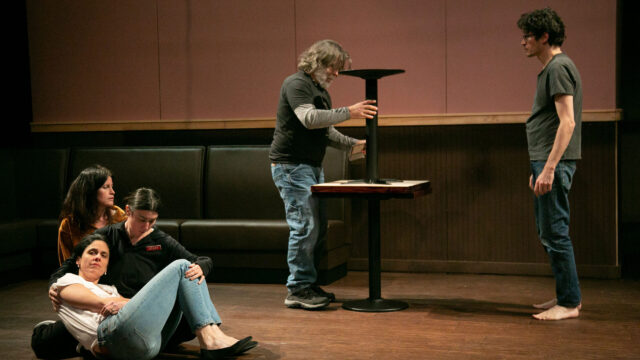
Brian Mendes and Jim Fletcher rehearse for NYCP’s Field of Mars (photo courtesy New York City Players)

The show opens with Adam (Brian Mendes) and Eve (Walsh) in the Garden of Eden, disguised as a popular American chain eatery, and moves through various bizarre, seemingly unconnected scenarios involving music, invisible food, both evolution and creationism, and one hell of an orgy.

In the lengthiest segment, an early version of which I saw at the Clemente and is now more fully formed, two older musicians (Jim Fletcher and Mendes, the latter in his trademark Jerry Garcia T) are pitching their new song to a pair of younger producers (Nicholas Elliott and James Moore), one of whom is, well, an asshole who claims that punk rock never existed. The men’s long, Don DeLillo–like list of cool bands could have used some shortening — the play is too long at two and a half hours, with intermission — but Maxwell (The Vessel, Isolde, Paradiso) is not in a hurry here.

Characters in Kaye Voyce’s everyday costumes walk and squiggle slowly, the narrator (Tory Vazquez) has an extensive phone conversation about pigments with what sounds like a chatbot, early humans (Elliott, James Moore, Eleanor Hutchins, and Paige Martin) evolve, and three of the musicians, after discussing what their songs are really about, lamely “jam” on electric guitars, which are not plugged into amps, as life goes on around them. Meanwhile, the Applebee’s employees (Walsh, Moore, Martin, Lakpa Bhutia) wear masks around their chins as if understanding there’s a health crisis but not worrying about it.

So, what is Field of Mars really about? As one character notes, “Sometimes the confusion is part of it.” Perhaps we’re sitting onstage because we’re all part of this confusion, part of the problem as we potentially face the end times, masks around our chins.

There’s no program, just a glossy one-sheet with only the most basic of information, along with a free souvenir paper poster that features a drawing of a stick figure in a doorway on one side and advises on the other, “I promise I will not look to the natural world to make up for my lack of spirituality ever again.”

OMG. It all makes perfect sense to me.

ELEVATOR REPAIR SERVICE: SEAGULL

Elevator Repair Service puts its unique spin on Anton Chekhov’s The Seagull (photo by Ian Douglas)

SEAGULL
NYU Skirball Center for the Performing Arts
566 La Guardia Pl. between Third & Fourth Sts.
Through July 31, $50-$60 (use code FB25 for $25 tickets)
212-945-2600
nyuskirball.org
www.elevator.org

I’m beginning to think I might never see another traditional production of Anton Chekhov’s 1895–96 classic, The Seagull. Perhaps more than any other playwright, Chekhov’s works almost demand reinvention for the stage in the twenty-first century. His tragicomic take on human relationships and society’s ills invite modern, often extensive reinterpretation and experimentation.

As often as Shakespeare’s plays are reimagined, they almost always still contain the Bard’s original dialogue; it’s the staging that changes. The same is not necessarily true about Chekhov, as evidenced by such recent successes as Arlekin Players Theatre’s hybrid The Orchard (The Cherry Orchard), Aaron Posner’s Life Sucks. (Uncle Vanya), and Halley Feiffer’s Moscow Moscow Moscow Moscow Moscow Moscow (Three Sisters).

As far as The Seagull goes, over the last ten years I’ve seen Posner’s Stupid Fucking Bird at the Pearl in 2016, a deliriously chaotic yet controlled rave-up sticking to the main plot but told with an intoxicating irreverence; Jeffrey Hatcher’s Ten Chimneys, at St. Clement’s in 2012, which goes behind the scenes of an upcoming Broadway revival of The Seagull starring Alfred Lunt and Lynne Fontanne; and Christopher Durang’s Vanya and Sonia and Masha and Spike, a delightful all-star mashup of The Seagull, Three Sisters, and Uncle Vanya that ran on and off Broadway in 2013.

Elevator Repair Service, the downtown company whose literary adaptations include William Faulkner’s The Sound and the Fury, Shakespeare’s Measure for Measure, James Joyce’s Ulysses, and F. Scott Fitzgerald’s The Great Gatsby — the much-admired eight-hour Gatz — now turns its unusual techniques on Chekhov with Seagull, continuing at NYU Skirball through July 31. Nearly three hours with one intermission, the play self-referentially refers to itself regularly, with actors occasionally speaking to the audience as themselves, not as their characters. It begins with a long monologue by company member Pete Simpson, who talks about the Skirball space itself. “One of these two corkscrew, fluted, gold leaf columns is structural and holds up the building above us. The other is hollow, insubstantial, and does nothing but sit there and look pretty in an attempt to make things look symmetrical.”

When he said that under each chair are three flags, a red one that “will tell us you feel physically threatened or uncomfortable,” a checkered one to use if you just “wanna talk,” and a third to order food, I saw the woman sitting across the aisle from me reach below her seat to see if the flags were really there. (They’re not.) But it signals that this production is going to veer wildly between the real and the imagined, although all of it turns out to be Chekhovian in one way or another, even if, as Simpson, who also plays the teacher Semyon, explains, “95% of tonight’s text both original and adapted has been written by our company’s own Gavin Price,” who portrays wannabe playwright Konstantin.

Director John Collins leaves the central plot intact: The twentysomething Konstantin has invited friends and family over to a lovely lake house to watch his latest play, to be performed by Nina (Maggie Hoffman), a nervous actress he is desperately in love with. Konstantin is hoping to prove to his mother, famous actress Irina (Kate Benson), that he has talent and a purpose in life; Irina, who chastises him regularly in front of everyone, has arrived with her new beau, well-respected and successful writer Boris Trigorin (Robert M. Johanson), who takes a liking to Nina.

Also at the presentation are Patricia (Laurena Allan), Irina’s ailing sister; farmer Ilya (Julian Fleisher), who is a big fan of Irina’s, and his wife, Paulina (Lindsay Hockaday); Masha (Susie Sokol), the farmers’ daughter who is in love with Konstantin but might be married off to Semyon; Yakov (John Gasper), who works at the lake house; and Gene (Vin Knight), a doctor who has an innate charm that lures the ladies, including Paulina.

In the middle of the play-within-a-play, Irina asks, “Is this supposed to be symbolic?” A moment later, she says, “Something smells. Is that part of the effect?” A disgusted Konstantin eventually has to stop the show because of his mother’s interruptions.

Shortly after Patricia has an asthma attack, Benson, Hoffman, and Susie have a discussion as themselves, commenting on how much they enjoyed the previous scene and what Chekhov’s play is about. The play resumes as Konstantin presents Nina with a seagull he just shot.

Masha (Susie Sokol) leads the characters in a strange game in Seagull (photo by Ian Douglas)

Following intermission, Sokol points out how long she has been with ERS, explains the set design, and expresses her disappointment that one of Masha’s key lines has been cut: “I’m in mourning for my life.” Soon various characters consider leaving the lake house, Irina insists she has no money to help anyone, and Konstantin sports a bloody bandage wrapped around his head. “You . . . Symbolist!” Irina again accuses her son. “Miser!” he replies. “You amateur!” she declares. It all goes downhill from there.

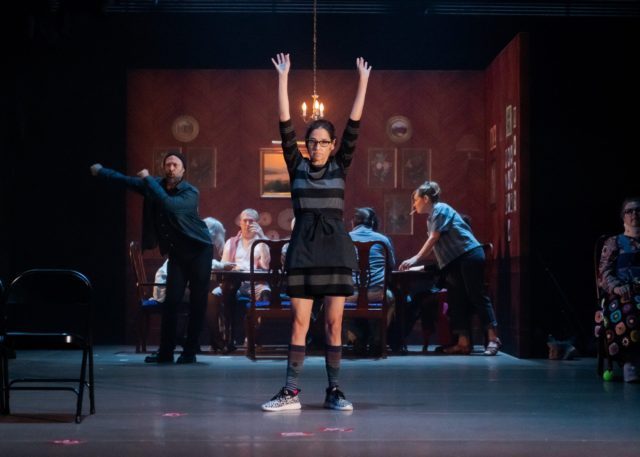
The set by dots, so ably described by Sokol, features a row of folding chairs in the front that the characters move about depending on the action. Downstage right is a table with electronic equipment, while upstage left is a cozy dinner table with pictures on the wall. The lighting is by Marika Kent, with sound by Price and Gasper and purposely mismatched costumes by Kaye Voyce, ranging from Nina’s elegant red dress to Irina’s short skirt, heels, and tights.

Collins’s direction may appear disordered as the fictional plot battles it out with the actors’ thoughts and some events happen either offstage or in the background — as when several characters sit down to eat but we can’t make out exactly what they are saying to one another, although it does turn into a terrific bingo-style dance number. But there is a method to his madness, even if it’s not necessarily always clear what he’s up to; numerous pieces of dialogue reflect back on the play we’re watching, as if ironically commenting on what is happening in Seagull at Skirball.

“It’s not easy, you know, acting in your play. There aren’t any ordinary people in it,” Nina tells Konstantin, who responds, “Ordinary people! We have to show life not the way it is, or the way it should be, but the way it is in dreams!” Nina retorts, “But nothing happens in your play! It’s all one long speech. And I think a play ought to have a love story.” Meanwhile, Collins emphasizes Chekhov’s Hamlet references, with Konstantin echoing the young prince, Irina a different kind of Gertrude, Boris representing Claudius, and Nina an embellished Ophelia.

“It was a strange play, wasn’t it?” Nina asks Boris about Konstantin’s show. Boris replies, “I’m afraid I didn’t understand a thing. But it was interesting to watch. You were wonderful. And of course, the set was magnificent!” Most people in the audience seemed to agree with that analysis of ERS’s production, although a handful walked out during the first act and others did not return after intermission; however, those who stayed, the vast majority of the crowd, gave the performers a standing ovation at the end.

Seagull is not for everyone’s taste. It is long — 173 minutes, as Simpson tells us — it is confusing, it is pedantic, and it can be self-referential to a fault, particularly as the cast passes around a microphone and cord, going in and out of character. And don’t get me started on the awful noise made when Patricia is pushed around in a chair. But it all continues founding artistic director Collins’s thirty-plus-year mission of experimenting with new theatrical forms, in original works and unique adaptations.

Hamlet asked himself, “To be or not to be.” In Seagull, Patricia answers, “Just go on living, whether you feel like it or not.” The same can be said for theater itself.

SHHHH

Shareen (Clare Barron) and Kyle (Greg Keller) have an unusual relationship in Shhhh (photo by Ahron R. Foster)

SHHHH
Atlantic Stage 2
330 West 16th St. between Eighth & Ninth Aves.
Tuesday – Sunday through February 13 (extended through February 20), $61.50-$81.50
atlantictheater.org

ASMR meets S&M in Clare Barron’s latest dark comedy, Shhhh, which opened tonight at Atlantic Stage 2 for a woefully limited run through February 13 (now extended to February 20). The semiautobiographical play touches on all five senses, beginning with a physical and metaphorical cleansing that concludes with ASMR podcaster Sally, aka Witchy Witch (Constance Shulman), whispering to her listeners, “Indulge yourself. . . . You deserve it.” And for the next ninety minutes, that’s exactly what the six characters do, indulging themselves amid sex, spit, sperm, snot, STDs, and shit as Barron, who wrote and directed the work and stars as Shareen, explores pain, power, penetration, and privilege along with consent, condoms, communication, and control. It’s a feminist reversal of stories by such authors as Charles Bukowski, Henry Miller, and Ernest Hemingway, putting women in charge of an unexpected narrative that goes places where primarily only men have gone before, diving headfirst (or, in one case, toe first) into sex, sadism, and blood and guts.

Shareen is a thirtysomething writer who is sick with an undiagnosed illness. “It’s like the inside of my mouth is one of those fast-forward flowers from the movie Planet Earth?” she tells Kyle (Greg Keller), a neighbor and former lover as she brushes her teeth and he sits on the toilet. “Except instead of flowers. I’m blossoming snot. And then I just swallow.” Kyle isn’t the only one in the theater who lets out an “ew.” It’s a terrific scene that lets the audience know that they are in store for something more than a little bit different.

All the characters speak frankly about bodily functions, about things entering and leaving their various orifices, incorporating pain and pleasure, often at the same time. Sally, a postal worker who is considering transferring to the forensics department — just the word “forensics” makes one think of cop shows in which the forensics unit is usually tasked with investigating the brutal murders of women — takes her date, a gender-fluid dog walker named Penny (Janice Amaya), to the Morbid Anatomy Museum, which includes an encased, full-size anatomical Venus, complete with death mask and innards sticking out. Sally offers Penny the chance to try out an electric device with her that can either “tickle or hurt.”

Francis (Nina Grollman) and Sandra (Annie Fang) talk about sex in graphic detail in Atlantic world premiere (photo by Ahron R. Foster)

Greg uses a graphic description of a horrific accident as foreplay to a perhaps unwanted intrusion. Shareen discusses the hairs on her chin and her inability to orgasm. Two young women in gloriously kinky glittering finery, Francis (Nina Grollman) and Sandra (Annie Fang), eat pizza while delving into their numerous sexual partners and the men’s insistence on not using protection.

Francis admits, “Sometimes I think if someone were to give me a button and say: If you push this button you could kill all the heterosexual men in the world, I would be ethically obligated to push that button. . . . But then here I am, a very privileged white woman. So maybe someone would be obligated to push the button for me as well.” Meanwhile, Sandra says about herself, “Wow. You are so happy You have never been so alone,” considering that she doesn’t necessarily need to be with a man to be satisfied.

Arnulfo Maldonado’s set is a kind of gothic museum, from mattresses strewn on the floor (one of which audience members can sit on) and glass jars of creepy items to a dingy bathroom and a barely visible kitchen in the entryway. The eerie lighting is by Jen Schriever, with sound by Sinan Zafar; Unkle Dave’s Fight House provides intimacy and fight direction.

Shhhh is extremely satisfying, alternating myriad laughs with an abundance of winces and cringes. Its inherent feminism comes equipped with a whip ready to do battle and draw blood, but it also has an innate charm that makes you welcome the thrashing. Every scene takes the complex narrative to another level where the audience better be ready for anything, because the play is wholly unpredictable from start to finish. Every time you think, no, it’s not gonna go there, it does, and then goes even further. Kudos to the brave actors who aren’t afraid of the journey.

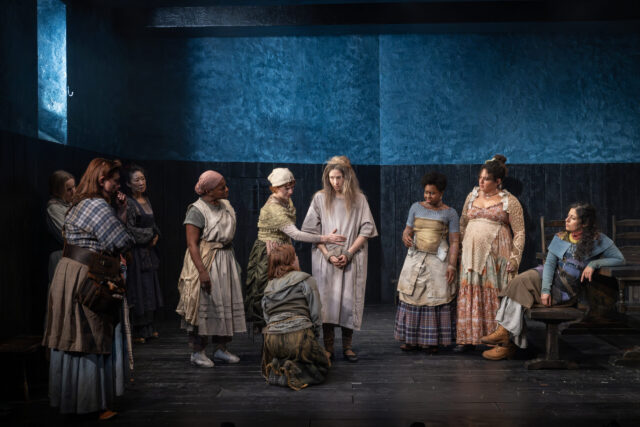
Constance Shulman and playwright-director Clare Barron star as sisters in Shhhh (photo by Ahron R. Foster)

Shareen, wearing a tiny, shiny summer slip dress — the superb costumes are by Kaye Voyce — is tired of having to make decisions for herself. “I just want somebody to tell me when and where I can go to the bathroom,” she says. It’s a strong moment, especially when taken in the context of Barron’s personal and professional life. In “Not Writing,” a revealing piece she posted in August 2020 in the inaugural issue of Playwrights Horizons’ online “Almanac: Pasts, Nows, Futures,” she discussed her early success, mental breakdown, and struggle with bipolar disorder.

Alongside pictures of her cats and messy apartment, she explained, “The American Theater gets a real hard-on for a twenty-seven-year-old debut, and it’s impossible to separate the art from this world-premiere fanfare. I’ve played with this whole sexualized image of youth my whole career. It is authentically who I am, but I’m also using it because I know that as a young, white woman in America, this is one reliable way in which I can have power. My youth, my whiteness, my thinness, my Yale degree have all given me permission and protection to talk about whatever the fuck I want and still be taken seriously. These aspects of my identity have gotten me attention, gotten me jobs . . . They’ve made me palatable to people in power.”

More than merely palatable, Barron has been duly praised for her previous work, winning an Obie for 2015’s You Got Older and the prestigious Susan Smith Blackburn Prize for Dance Nation, which was also a Pulitzer finalist. Shhhh was written in 2016 but is only now having its world premiere at the Atlantic.

Barron indeed talks about whatever the fuck she wants in this world-premiere production. One of the most critical lines in the play is when Francis, talking about how men judge women’s bodies, says, “I don’t fucking dissect his body into fucking pieces like a fucking dead animal.” It’s made even more effective with the anatomical Venus hovering just behind her.

In “Not Writing,” Barron also opines, “I haven’t written a play in four years. I don’t know if I’ll write a play ever again. Who cares.” A whole lot of people do.