Tag Archives: Kaye Voyce

THIS DAY FORWARD

(photo by Carol Rosegg)

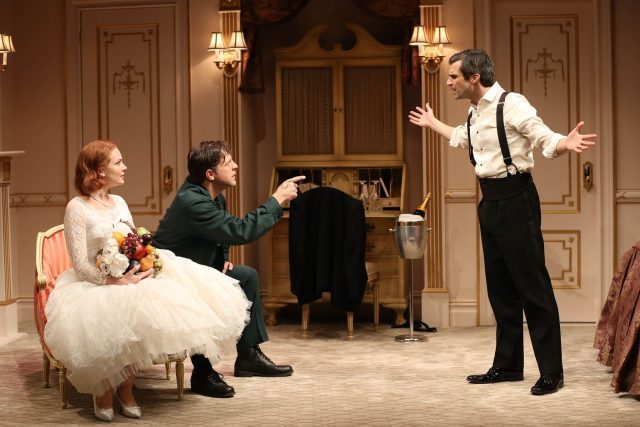
Martin (Michael Crane) doesn’t quite understand Emil’s (Joe Tippett) relationship with Irene (Holley Fain) in THIS DAY FORWARD (photo by Carol Rosegg)

Vineyard Theatre
108 East 15th St. at Irving Pl.
Tuesday – Sunday through December 18, $79-$100
212-353-0303
www.vineyardtheatre.org

Philadelphia-born New York City-based playwright Nicky Silver again explores the craziness of a dysfunctional family, and especially its matriarch, in his latest work, This Day Forward, continuing at the Vineyard through December 18. The first act takes place in 1958 in a room at the St. Regis, where the erudite Martin (Michael Crane) is excited about consummating his marriage to the seemingly beautiful, proper, and ditzy Irene (Holley Fain). However, Irene has a secret that she is frightened to reveal to Martin. “Irene, listen to me. I’m your husband and I love you. You can tell me anything. I’m your safe place. Your harbor,” the kind and caring Martin says. “Whatever it is you want to tell me, whatever you’ve done, or haven’t done, whatever it is, you can tell me. You can trust me. Always. You can tell me. Tell me.” She finally tells him, and it’s not a secret that makes him very happy, as it involves a gas station worker named Emil (Joe Tippett). Soon the maid, Melka (June Gable), and the bellboy, Donald (Andrew Burnap), get implicated in the madness and mayhem as Irene, Martin, and Emil try to figure out what happens next. The second act jumps ahead to 2004 to an oh-so-contemporary tasteful apartment in New York City, where Noah (Crane) is living with the younger Leo (Burnap). A film director considering working in television, Noah is awaiting the arrival of his sister, Sheila (Francesca Faridany), a loud, fast-talking woman who lets him know that their mother (Gable) has been growing more and more confused and disappearing. When at last everyone is together, some hard truths emerge as the results of decades of dysfunction strike deep.

(photo by Carol Rosegg)

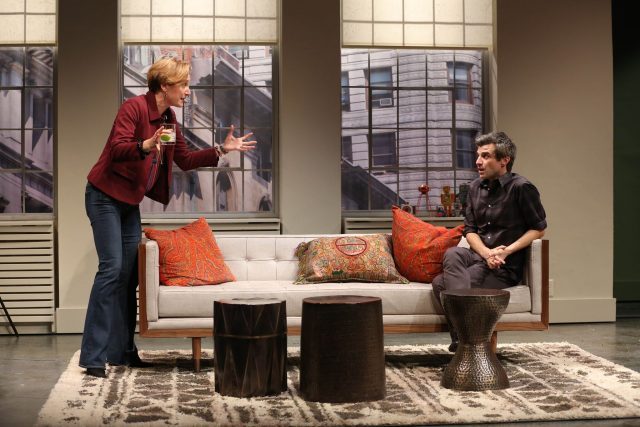
Siblings Sheila (Francesca Faridany) and (Michael Crane) fight over what to do with their aging mother in new Nicky Silver play at the Vineyard (photo by Carol Rosegg)

Silver (Pterodactyls, The Food Chain), whose terrific The Lyons started at the Vineyard before transferring to Broadway in 2012, is unlikely to make the same trip with This Day Forward, which, like The Lyons, is directed by Mark Brokaw (How I Learned to Drive, Heisenberg). There are funny and poignant moments, particularly in the much better second act, but the play as a whole feels unfinished, as if it is still being workshopped. Allen Moyer’s sets are lovely — the posters on Noah’s walls of robot movies give quick insight into his character — and Kaye Voyce’s costumes, especially Irene’s wedding dress and Emil’s grease monkey outfit, are right on target, but the story languishes in too many places. The cast is strong up and down the line, although Melka as written is too cartoonish (but well played by Gable, who is outstanding as the mother in 2004). It’s still an enjoyable play, one that cleverly deals with the choices we all make and how that impacts future generations, but a few nips and tucks could help tighten what could have been a much more insightful and entertaining drama.

SIGNATURE PLAYS

(photo by Monique Carboni)

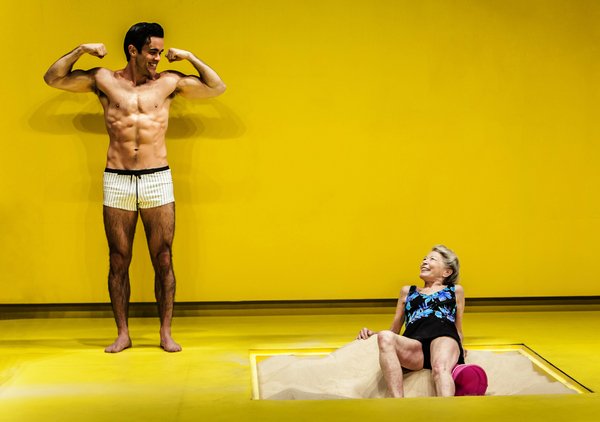
A muscleman (Ryan-James Hatanaka) shows off his wares to Grandma (Phyllis Somerville) in Edward Albee’s THE SANDBOX (photo by Monique Carboni)

The Pershing Square Signature Center
The Alice Griffin Jewel Box Theatre
480 West 42nd St. between Tenth & Eleventh Aves.
Tuesday – Sunday through June 19, $25-$65
212-244-7529
www.signaturetheatre.org

As part of its twenty-fifth anniversary celebration, the Signature Theatre has put together an evening of compellingly strange one-acts that were previously presented by the company as part of their authors’ Playwright-in-Residence seasons all of which involve unique looks at death. In Edward Albee’s 1959 The Sandbox, first mounted at the Signature in 1994 directed by Albee himself, a WASPy couple who refer to each other as Mommy (Alison Fraser) and Daddy (Frank Wood) relax on lounge chairs after having an impressively toned muscleman in a bathing suit (Ryan-James Hatanaka) deposit Grandma (Phyllis Somerville) in a child’s sandbox on a nearly blindingly yellow set (by Mimi Lien). While Melody Giron plays the cello, the man continues his calisthenics, slowly flapping his arms while standing firmly on the ground, Mommy and Daddy find that they have little to talk about it, and Grandma marvels at the young man’s body while expressing her dismay at her situation. “Honestly! What a way to treat an old woman! Drag her out of the house . . . stick her in a car . . . bring her out here from the city . . . dump her in a pile of sand . . . and leave her here to set. I’m eighty-six years old!” she tells the audience. All of the characters are aware that they are in a play, making comments about the music, the lighting, and the script, but only Grandma, who embodies the entire life cycle, from baby to sexual being to mother to old woman on her last legs, speaks like a real person; the others are more like clichéd stock characters reciting their lines with the sparest of genuine emotion. Director Lila Neugebauer keeps it all bright and cheery as the end nears, in more ways than one.

(photo by Monique Carboni)

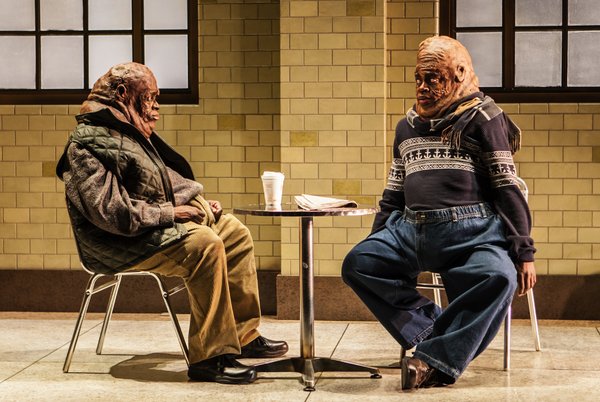
Roe (Sahr Ngaujah) teaches Pea (Mikéah Ernest Jennings) about life in María Irene Fornés’s DROWNING (photo by Monique Carboni)

María Irene Fornés’s 1986 Drowning, initially presented at the Signature in 1999, when John Simon declared in New York magazine that it was “the worst play I have seen all year,” was originally part of Orchards, in which seven contemporary playwrights (among them Wendy Wasserstein, David Mamet, and John Guare) wrote a one-act play inspired by a short story by Anton Chekhov. Cuban-American playwright Fornés chose “Drowning,” although her avant-garde approach was more than a little unusual. In a cafeteria, Pea (Mikéah Ernest Jennings) and Roe (Sahr Ngaujah), a pair of giant potato-like creatures (Kaye Voyce’s elaborate costumes are a certifiable riot), talk ever-so-slowly, almost like a Butoh dance, as the latter teaches the former about newspapers, snow, and flesh. Fornés evokes Beckett as Roe and Pea wait for Stephen (Wood), who actually does show up, and the immature, childlike Pea learns about love and pain. “He is very kind and he could not do harm to anyone,” Stephen says about Roe, who responds, “Yes. And I don’t want any harm to come to him either because he’s good.” Drowning is a bizarre yet captivating journey into what makes us human.

(photo by Monique Carboni)

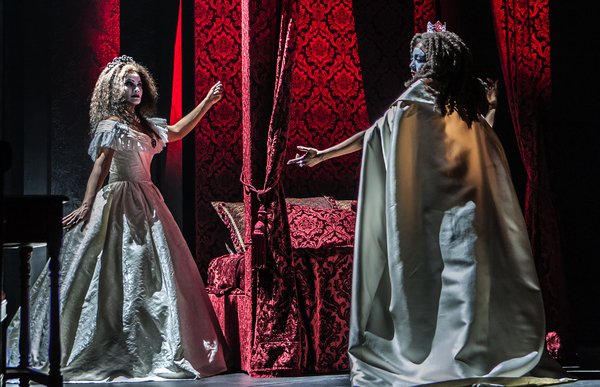
Adrienne Kennedy’s FUNNYHOUSE OF A NEGRO takes place inside of the mind of young woman facing a harsh reality (photo by Monique Carboni)

The Legacy Program evening concludes with Adrienne Kennedy’s Obie-winning 1964 Funnyhouse of a Negro, which was staged at the Signature in 1995. A complex exploration of slavery, racism, colonialism, and heritage, the entire story takes place inside the mind of Negro-Sarah (Crystal Dickinson) as she encounters Queen Victoria Regina (April Matthis), the Duchess of Hapsburg (January LaVoy), Patrice Lumumba (Ngaujah), and Jesus (Jennings) in addition to her roommate, Raymond (Nicholas Bruder), her landlady (Fraser), and the Mother (Pia Glenn). “My mother was the light. She was the lightest one. She looked like a white woman,” Victoria says. “Black man, black man, I never should have let a black man put his hands on me. The wild black beast raped me and now my skull is shining,” the Mother states. Negro (Sarah) adds, “As for myself I long to become even a more pallid Negro than I am now; pallid like Negroes on the covers of American Negro magazines; soulless, educated, and irreligious. I want to possess no moral value, particularly value as to my being. I want not to be. I ask nothing except anonymity.” And Sarah explains, “The rooms are my rooms; a Hapsburg chamber, a chamber in a Victorian castle, the hotel where I killed my father, the jungle. These are the places myselves exist in. I know no places. That is, I cannot believe in places. To believe in places is to know hope and to know the emotion of hope is to know beauty. It links us across a horizon and connects us to the world. I find there are no places only my funnyhouse.” Each scene takes place in a different, exquisitely designed set by Lien amid darkness and Voyce’s extravagant costumes. Like The Sandbox and Drowning, Funnyhouse of a Negro is a highly stylized, absurdist drama about death, and the death of the American dream, only this time with more overt targets and explicit, at times shocking action. It’s unfortunately still relevant a half century after its debut during the civil rights movement. It’s also a fitting finale to this Signature hat trick that looks back while also peering into the future.

FOREVER

(photo by Joan Marcus)

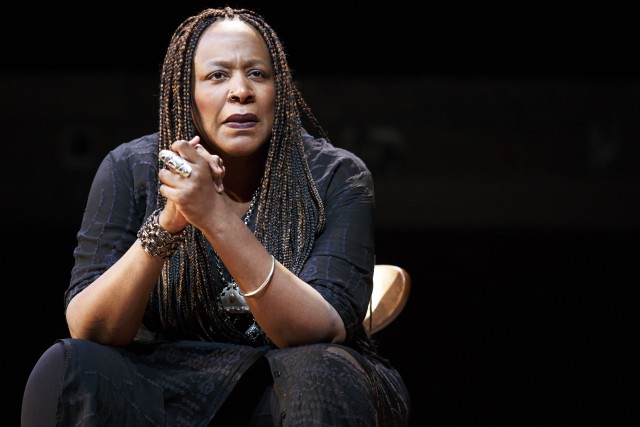
Dael Orlandersmith shares intimate details of her dysfunctional childhood in FOREVER (photo by Joan Marcus)

New York Theatre Workshop
79 East Fourth St. between Second & Third Aves.
Tuesday – Sunday through May 31, $75
nytw.org

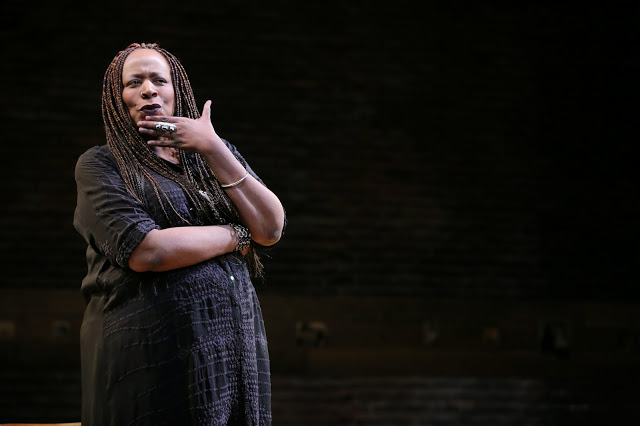
Pulitzer Prize finalist Dael Orlandersmith returns to New York Theatre Workshop with the searing Forever, a harrowing, deeply intimate one-woman show about the severely dysfunctional relationship between a daughter and her alcoholic mother. In the semiautobiographical work, Orlandersmith (Yellowman, Monster, The Gimmick) spends a gripping eighty minutes discussing her artistic influences while looking back at damaging scenes from her past as she walks through Pere Lachaise Cemetery in Paris, paying tribute to Jim Morrison, Edith Piaf, Richard Wright, and other writers and musicians who helped her survive a brutal childhood in Harlem. “All of us have come / All of us who are seeking / have come to be with these people here in Pere Lachaise — who beyond our parents helped us give birth to ourselves,” she says. Statuesque and elegant in a long black dress, her braided hair falling over her shoulders and reaching toward her hips, she recalls a broken friendship with a local tomboy, being beaten by her mother over math homework, and how she felt when her mother tells her she is “fat / hateful / disgusting.” She shares her physical and psychological pain with the audience, making direct, lingering eye contact that is both soothing and uncomfortable. “I can’t believe I still can feel her slap. She’s been gone / dead / over twenty years but I can still see / feel / hear her laughing,” she says. Orlandersmith tells the story with a lyrical, poetic rhythm that is captivating and unique. She describes her Caesarian birth thusly: “October 29, 1959 / I was torn from blood/guts/water / Spanked into consciousness / Spanked into living.” Later she adds, “A scar I made a long time ago coming through you / I stare at it / Wondering how I could have been born from it / How I could have been born from you.”

(photo by Joan Marcus)

Dael Orlandersmith’s tale of her relationship with her mother is both harrowing and uplifting (photo by Joan Marcus)

About midway through Forever, which is calmly directed by Neel Keller, with excellent lighting by Mary Louise Geiger and sound by Adam Phalen, Orlandersmith relates a long, agonizing episode from her childhood in nerve-racking detail, one of the most powerful and frightening things you’re ever likely to experience from a show; it’s difficult to watch, but you won’t be able to avert your eyes from hers, finalizing an unbreakable bond between performer and audience that will stay with you long after you leave the theater. Ultimately, she tries to find closure as she revisits her mother’s death. Forever is both heartbreaking and uplifting, a shocking, poetic exploration of family, memory, and the ties that bind; it was particularly poignant the night we saw it, on the eve of Mother’s Day. Before and after the show, people are invited to write their own tributes to those they’ve lost on notecards they can tape to the long, narrow bulletin boards lining the side walls, and following the show, attendees can walk around Takeshi Kata’s central staging area and check out dozens of Orlandersmith’s family photographs on similar boards around the set. The notecards and photographs are a brilliant touch, a physical evocation of how the past embraces and surrounds both the audience and the performer’s emotional experience, providing yet more intimacy and reminding you of your own relationships. (The May 20 show will be followed by a discussion with photographers James and Karla Murray and NYU adjunct professor Cynthia Copeland, moderated by Alexander Santiago-Jirau, who will also lead a Shop Talk after the May 27 show.)

THE REAL THING

(photo by Joan Marcus)

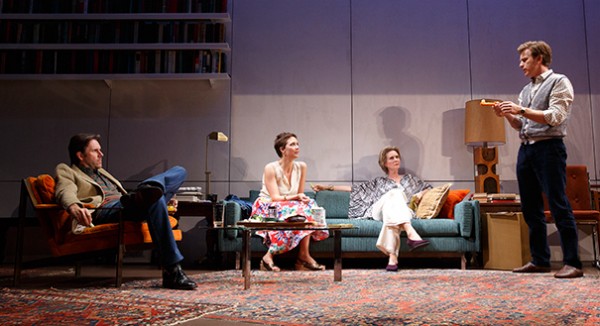
An all-star cast revive Tom Stoppard’s THE REAL THING on Broadway (photo by Joan Marcus)

American Airlines Theatre
227 West 42nd St. between Broadway & Eighth Ave.
Tuesday – Sunday through January 4, $67-$142
212-719-1300
www.roundabouttheatre.org

In 1984, Tom Stoppard’s The Real Thing won the Tony for Best Play, with stars Glenn Close, Jeremy Irons, and Christine Baranski taking home Antoinette Perry statues as well. In 2000, the story of love and infidelity was named Best Revival of a Play, with Jennifer Ehle and Stephen Dillane also honored for their roles. Lightning is unlikely to strike thrice in the latest Broadway revival of The Real Thing, a strangely cold and dispassionate version running at the American Airlines Theatre. In their Great White Way debuts, Ewan McGregor and Maggie Gyllenhaal never catch fire together, while Josh Hamilton and Cynthia Nixon don’t warm up either in this play about playwrights and actors. Henry (McGregor) is a successful scribe married to hoity actress Charlotte (Nixon), but he has the hots for another actress, the more earthbound Annie (Gyllenhaal), married to Max (Hamilton), who is suspicious of his wife’s possible infidelity. The tale alternates between real life and scenes from Henry’s plays with overlapping story lines and self-referential banter that sometimes makes it hard to differentiate between the two. In between scenes, members of the cast happily sing pop tunes out of character, as if they’re gathered around a campfire sharing wine and roasting marshmallows. But then it’s right back to Stoppard’s innately clever, refreshingly adult dialogue, which unfortunately falls flat under Sam Gold’s rather standard direction on David Zinn’s icy set. Madeline Weinstein adds some life as Debbie, Henry and Charlotte’s daughter — a role originated on Broadway by Nixon, who at the time was also appearing in David Rabe’s Tony-nominated Hurlyburly, dashing between the Ethel Barrymore Theatre and the Plymouth — but no sparks ignite as Annie’s costar, Billy (Ronan Raftery), and daft playwright Brodie (Alex Breaux) enter the fray. A well-known soda company once had a jingle that proclaimed, “There ain’t nothing like the real thing, baby”; in the case of this Broadway revival, that’s unfortunately not quite true.

TRISHA BROWN DANCE COMPANY

(photo by Laurent Philippe)

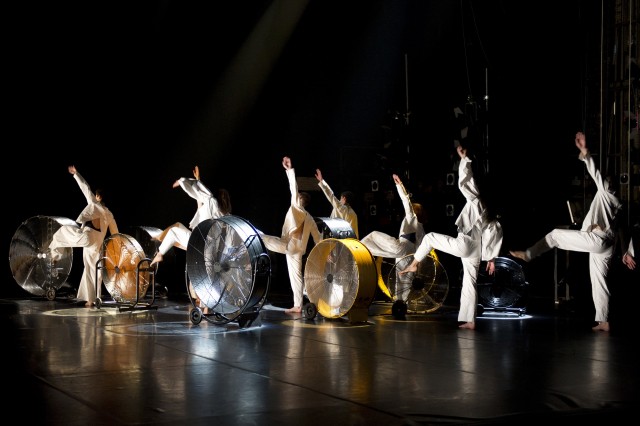
New York premiere of “I’m going to toss my arms—if you catch them they’re yours” is part of Trisha Brown Dance Company program at BAM (photo by Laurent Philippe)

BAM Howard Gilman Opera House
30 Lafayette Ave. between Ashland Pl. & St. Felix St.
January 30 – February 2, $20-$70, 7:30
718-636-4100
www.bam.org
www.trishabrowncompany.org

This past fall, BAM bid farewell to Pina Bausch as Tanztheater Wuppertal presented the final work by the legendary German choreographer, “…como el musguito en la piedra, ay si, si, si…” (Like moss on a stone), who died in 2009 at the age of sixty-nine. Now BAM is saying goodbye to another dance master as Trisha Brown brings her last two pieces to the Howard Gilman Opera House from January 30 to February 2. Now seventy-six, the Washington State-born Brown has been presenting dance at BAM since January 1976. How to describe her eclectic style? In fall 1993, influential multimedia artist and choreographer Yvonne Rainer wrote in BOMB magazine, “The task of describing Trisha Brown’s unique form of dancing is daunting. Its inscrutable blend of zaniness, athleticism, delicacy, and logic, always evading mimetic clichés, similarly eludes language, like a half-forgotten word or phrase that can’t quite roll off the tip of the tongue.” The Trisha Brown Dance Company will be performing two programs at BAM. The first (January 30, February 1-2) consists of 1987’s Newark (Niweweorce), featuring audiovisual elements by minimalist Donald Judd and Peter Zummo and lighting by Ken Tabachnick; the New York premiere of Les Yeux et l’âme, set to music by William Christie and Les Arts Florissants from Jean-Philippe Rameau’s Pygmalion, with lighting by Jennifer Tipton and costumes by Elizabeth Cannon; the New York premiere of I’m going to toss my arms—if you catch them they’re yours, with video by Burt Barr, costumes by Kaye Voyce, and lighting by John Torres, set to Alvin Curran’s “Toss and Find”; and 1966’s Homemade, a solo danced by Vicky Shick, with an original film by theatrical happenings mainstay Robert Whitman. The second program (January 31) comprises Newark (Niweweorce), I’m going to toss my arms—if you catch them they’re yours, Homemade, and the thirtieth-anniversary presentation of the 1983 BAM commission Set and Reset, a collaboration with Laurie Anderson, Robert Rauschenberg, and Beverly Emmons. The company features Neal Beasley, Cecily Campbell, Tara Lorenzen, Megan Madorin, Leah Morrison, Tamara Riewe, Jamie Scott, Stuart Shugg, Nicholas Strafaccia, and Samuel Wentz. In conjunction with the performances, John Rockwell, Wendy Perron, and Stephen Petronio will participate in an “Iconic Artist Talk: On Trisha Brown” on February 2 at 5:00 at the BAM Fisher Fishman Space.