Tag Archives: Kaye Voyce

BY THE SKIN OF OUR TEETH: THE SEAT OF OUR PANTS SETS WILDER TO MUSIC

The Antrobus family faces the weight of the world in The Seat of Our Pants at the Public (photo by Joan Marcus)

THE SEAT OF OUR PANTS
Newman Theater, the Public Theater
425 Lafayette St. at Astor Pl.
Tuesday – Sunday through December 7, $125
publictheater.org

Just because The Skin of Our Teeth won Wisconsin native Thornton Wilder his third Pulitzer Prize doesn’t mean the 1942 work isn’t a slog, dense with metaphor, festooned with oddball characters and bizarre scenarios, and obsessed with strange time-shifting interventions. I’ve seen two recent productions, an overstuffed mess at Lincoln Center in 2022 and an exemplary revival from TFANA in 2017, but even the latter required significant attention from the audience to sift through Wilder’s complex storytelling as he essentially shares a tale that is nothing less than an encapsulation of the survival of living creatures on this planet.

The quartet of Leonard Bernstein, Jerome Robbins, Betty Comden, and Adolph Green attempted to turn The Skin of Our Teeth into a musical but eventually abandoned the project, as did the trio of John Kander, Fred Ebb, and Joseph Stein. But now Obie-winning composer, bandleader, playwright, and librettist Ethan Lipton has taken on the challenge and delivered an exciting and fun, if still problematic, musical adaptation called The Seat of Our Pants, continuing at the Public’s Newman Theater through December 7.

The 160-minute show (with intermission) is divided into The Skin of Our Teeth’s usual three acts, the first during the Ice Age in Excelsior, New Jersey, complete with dinosaurs and humans getting along well; the second on the boardwalk in Atlantic City at a convention of the Ancient and Honorable Order of Mammals, Subdivision Humans; and the third back in Excelsior following a devastating war. Each act is introduced by an announcer (Andy Grotelueschen), singing with a mic stand and asking the audience to join in. He advises at the very beginning, “I want to tell you that the news is good / I want to shout it out in every neighborhood / But I can’t lie to you — although I had assumed I would / The world is ending, the world is ending.”

At the center of everything is the Antrobus family: the father (Shuler Hensley), a successful and important businessman; his wife (Ruthie Ann Miles), a kind and practical woman; and their two children, the promising Gladys (Amina Faye) and the less-than-promising Henry (Damon Daunno). Holding it all together is their maid, Lily Sabina (Micaela Diamond), who often addresses the stage manager and the audience directly, complaining about the play itself. When someone apparently misses a cue, Sabina repeats a key line, “Don’t forget — we made it through the recession-pandemic-wildfire-oligarchy by the seat of our pants. One more crisis like that and then where will we be?” Fitz, the stage manager, tells her to stretch it out because of technical issues, but Sabina is having none of it.

“I will not invent words for this show,” she argues. “I hate this show and every line in it. I don’t understand a word of it anyway — all about the troubles of the human race? Now there’s a subject for you. Besides, the author hasn’t decided whether it’s set back in the caves or in New Jersey today. And now some other guy’s added songs. Songs! Because that’s what it was missing.”

Humans and animals interact in New Jersey in inventive musical based on Thornton Wilder play (photo by Joan Marcus)

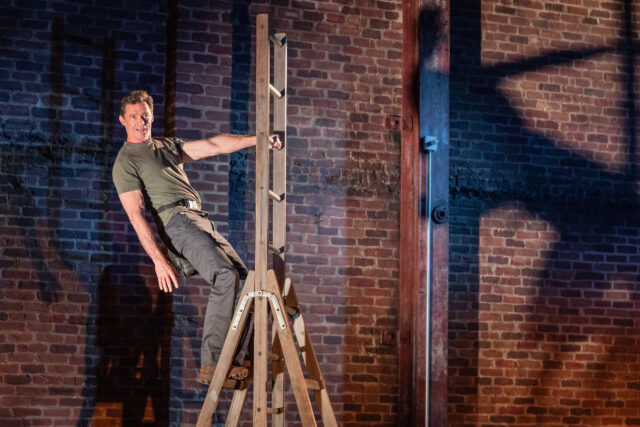
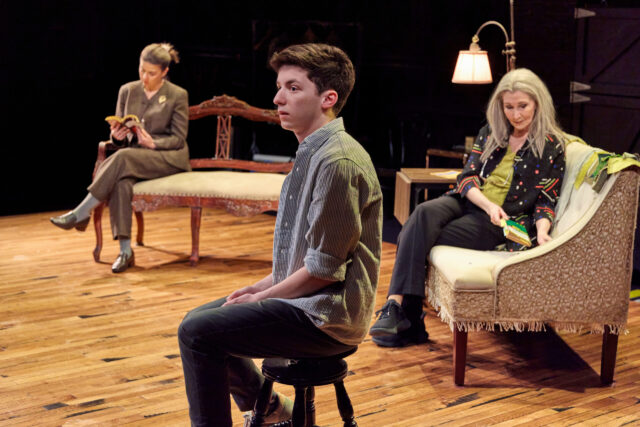
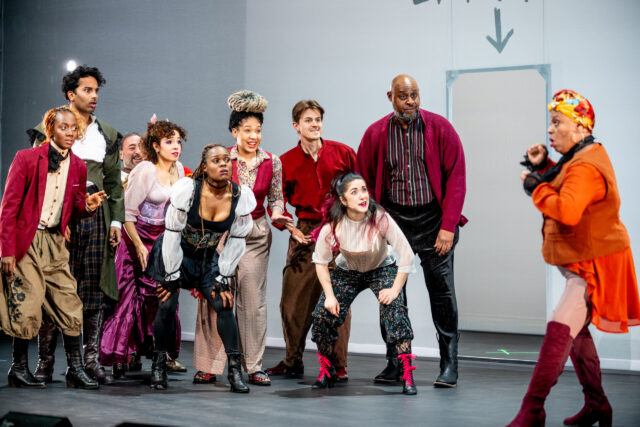
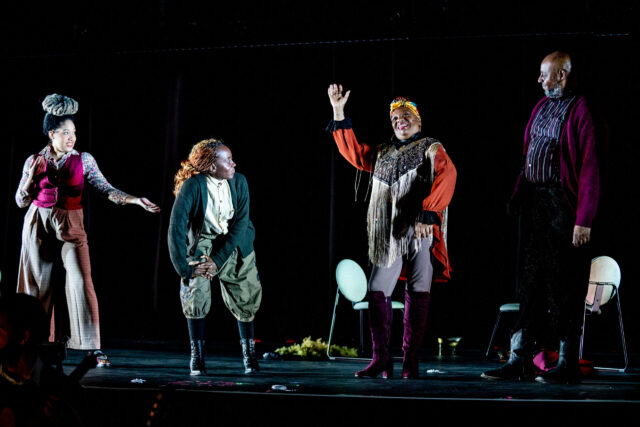
But it turns out that many of the songs, including “The World Is Ending,” “Sabina’s Suite,” “Stuff It Down Inside,” and “Ordinary Girl,” inject life into the narrative, accompanied by clever staging by director Leigh Silverman (Yellow Face, Grand Horizons), boisterous choreography by Sunny Min-Sook Hitt, witty orchestrations and arrangements by Daniel Kluger, Lee Jellinek’s gleeful, open set with the audience on two sides facing each other and the band on the other two sides, and costumes (by Kaye Voyce) that range from suburban casual to convention uniforms to a talking mammoth (Geena Quintos) and turkey (Bill Buell) duo to band outfits that match the flowery yellow wallpaper. The attention to detail in the costumes and the set changes are hilarious.

But, as Sabina repeated, “Don’t forget —” that this is based on The Skin of Our Teeth, so not everything makes sense, scenes go on too long, and there are too many songs. But watching the cast, led by wonderful performances by Grotelueschen (Into the Woods, Pericles) and Diamond (Parade, The Cher Show), having so much fun — even band member Allison Ann Kelly gets in on the action — is infectious.

I’m thinking that The Skin of Our Teeth is back in favor because of the current state of the country and the world amid wars, the immigration crisis, economic instability, political dysfunction, climate change, polarization, and general havoc and maelstrom. So why not turn it into a charming musical? Obie winner and Guggenheim fellow Lipton (We Are Your Robots, The Outer Space) has done just that.

“I am skin and bones, and I have escaped only by the skin of my teeth,” Job says in the Old Testament. With The Seat of Our Pants, we escape with much more.

[Mark Rifkin is a Brooklyn-born, Manhattan-based writer and editor; you can follow him on Substack here.]

FINDING BEAUTY: HAGIOGRAPHIC HOUSE OF McQUEEN SEEKS BALANCE BETWEEN ART AND COMMERCE

Alexander McQueen (Luke Newton) and his sister Janet (Jonina Thorsteinsdottir) face adversity in House of McQueen (photo by Thomas Hodges)

HOUSE OF McQUEEN
The Mansion at Hudson Yards
508 West 37th St. between 10th & 11th Aves.
Tuesday – Sunday through October 19, $40-$185.05
www.thehouseofmcqueen.com

“Find beauty in everything. People perceive what they are most afraid of as ugliness. I find beauty in what we fear,” Lee Alexander McQueen (Luke Newton) says halfway through the world premiere of House of McQueen. “The tragedy of it is, fashion isn’t going to cure your nightmares, or child abuse, or cancer — or anything else for that matter. At the end of the day, it’s just clothes.”

Of course, it’s not just clothes, as the play, which opened last night at the newly constructed Mansion at Hudson Yards, chaotically tells the audience over and over again. The show attempts to capture the fierce energy of a McQueen runway extravaganza but instead gets mired in overuse of technology, a narrative that offers little sense of time and place, and characters that don’t grow or develop across two hours (plus intermission).

Lee was born in 1969 in the East End of London, the youngest of six children; his father, Ron (Denis Lambert), was a taxi driver and his mother, Joyce (Emily Skinner), a teacher. While Joyce and his oldest sister, Janet (Jonina Thorsteinsdottir), encourage his artistic abilities — Janet even gives him her old album of paper dolls — his father worries about his future, particularly when it comes to his son’s apparent sexual orientation. “When are you going to listen to me? You’re gonna get hurt doin’ this!” his father argues, referring to both class and homophobia. When the teenage Lee expresses his desire to become a tailor on Savile Row, Ron declares, “Even if they hired you, they’d let you go soon enough. Those Savile Road types don’t want someone like you. And they never will. They’ll break your heart. Don’t try to be somethin’ you’re not.”

At sixteen, the ambitious and determined Lee quits school and heads to Savile Row with a garbage bag filled with samples of his work. “I want to learn everything, everything, everything,” he says. He lands a job as a tailor, which kickstarts a career that will take him around the world as he attends the prestigious Central Saint Martins university, creates designs for Gigli, Givenchy, and Gucci, and is taken under the wing of magazine editor and well-connected fashionista Isabella “Issie” Blow (Catherine LeFrere), who buys out his entire first collection, which surprises his mother and sister.

“Oh, dear, how are we gonna tell him? It was gruesome!” Joyce says to Janet, who replies, “All that blood! How could he do that? It was awful!” Issie jumps in, proclaiming, “It was perfect! I’ve never seen anything so perfect in my life.” She didn’t think his name, Lee, was perfect, advising him to go by his middle name, Alexander, professionally, although his close friends and family continued to call him Lee.

The press (Margaret Odette) agrees with Joyce and Janet, making such statements as “McQueen’s debut was a horror show” and “McQueen’s brand of misogynistic absurdity gives fashion a bad name.” But he contends, “I just want women to fight back!”

Explaining to a professor (Odette) where he gets his ideas, he comments, “Grew up East End. Same neighborhood as Jack the Ripper. Inspired by viscera, slashings, streams of blood. Happy childhood, loving parents. Tons of encouragement. Dreams of becoming the next Yves St. Laurent. Yadayadayada . . .”

But the fame and notoriety he achieves as l’enfant terrible of the fashion industry come with a price as sex, drugs, partying, and the desperate desire to remain on top take over his life.

Alexander McQueen’s fashions are on display in world premiere play at Mansion at Hudson Yards (photo by Thomas Hodges)

House of McQueen is written by Darrah Cloud (Sabina, Turning) and directed by Sam Helfrich (Owned, Tape), in collaboration with Gary James McQueen, a textile designer and creative director who is Alexander’s nephew; several of his lenticular skulls are on view in the extensive lobby gift shop at the entrance to the theater. The nonlinear story feels stitched together somewhat randomly, then splattered with various bells and whistles to inject much-needed drama. A dance competition referencing McQueen’s collection inspired by Sydney Pollack’s 1969 film They Shoot Horses, Don’t They? falls flat, and surreal scenes in which the young Lee wears a diving helmet — the sea is a leitmotif, for good and bad — feels frivolous.

It’s not always clear when and where things are happening; Alexander is always in the same white T-shirt and plain pants, although he adds an unbuttoned shirt later. The costumes, which include re-creations of some of McQueen’s designs, are by Robert Wierzel, but you can check out the real deals in the exhibition “The Company of Melancholiacs,” which is open before and after the performance as well as during intermission, a kind of miniature version of the Met’s smash 2011 “Savage Beauty,” held the year after McQueen’s death at the age of forty.

Brad Peterson’s videos and projections create a nearly nonstop barrage of images on a wall of monitors and overhead screen, from crackling static to clips from actual runway shows (Highland Rape, Plato’s Atlantis, La Dame Bleue, Deliverance), pseudo-fashion reports, and seemingly endless live scenes of Joyce asking Alexander questions for a BBC program, based on a print interview mother and son did for the Guardian. Jason Ardizzone-West’s set features a pair of platforms that rise and lower; G Clausen’s sound and Robert Wierzel’s lighting don’t add to the mayhem.

Newton (The Shape of Things, The Book of Mormon), best known as Colin Bridgerton in Bridgerton, does what he can but is hampered by the uneven narrative and such aspirational and overwrought dialogue as “I’m a tailor, not a fighter,” “I’ve got to show them how wrong they are,” and “I need people to understand me!” Tony nominee Skinner (Suffs, Side Show) battles through the maelstrom as McQueen’s devoted mother, and LeFrere (Confessions of a Young Character Actress, The Green Knight) munches on the scenery as Issie. The cast includes Tim Creavin, Fady Demian, and Joe Joseph as some of McQueen’s many boyfriends; Joseph also plays Terence, Janet’s then-boyfriend and later husband who was physically abusive to her, which is in the play, but also sexually abusive to the young McQueen, which is not. (The play never mentions McQueen’s other siblings.)

In addition, the hagiographic, superficial House of McQueen depicts Alexander as a modern-day Joan of Arc, the misunderstood French military hero who fought against England and was tried and executed for blasphemy and wearing men’s clothes. McQueen’s Voss collection was influenced by Joan of Arc’s chainmail, primarily the outfit that Issie dons near the end of the show, and close-ups of Renée Falconetti in Carl Theodor Dreyer’s 1928 silent film The Passion of Joan of Arc are projected on the monitors, making McQueen both saint and demon as he searches for balance between art and commerce.

The concept of the play is credited to filmmaker Seth Koch and executive producer Rick Lazes; Lazes and Gary James McQueen are also behind Provocateur, an immersive multimedia McQueen experience, written by Cloud, that is scheduled to open October 1 in Los Angeles. In a program note, Lazes writes that “House of McQueen is flamboyant, unflinching, and achingly human — a requiem for a man who turned beauty into a weapon and fashion into art.”

McQueen said that one of his goals was to “find beauty in everything,” but it’s hard to do so with this show, which feels a lot more like commerce than art. It’s even a stretch to call the theater the Mansion at Hudson Yards, since Hudson Yards, which is anchored by a high-end shopping mall, does not technically extend to Thirty-Seventh St.

[Mark Rifkin is a Brooklyn-born, Manhattan-based writer and editor; you can follow him on Substack here.]
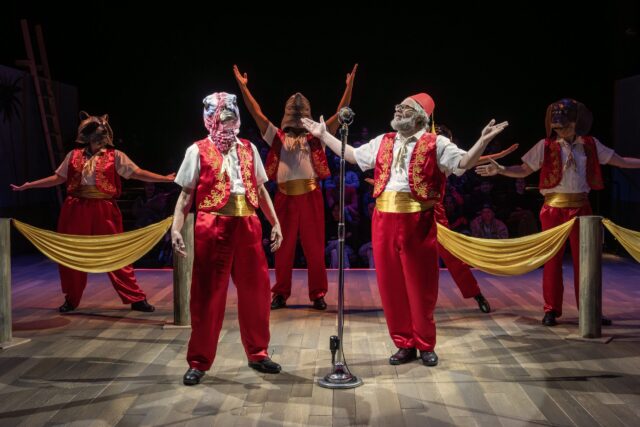
ALL ABOUT MY MOTHER: THREE PLAYS ABOUT DEAR OLD MOM

Five actors portray multiple characters in Neena Beber’s Brecht adaptation at BAC (photo by Maria Baranova)

A MOTHER
Baryshnikov Arts Center, Jerome Robbins Theater
450 West 37th St. between Ninth & Tenth Aves.
March 29 – April 13, $59-$79
www.bacnyc.org

There was already a palpable buzz at the Baryshnikov Arts Center on April 7, opening night of Neena Beber’s Brecht adaptation, A Mother, before several Jessicas arrived: Jessica Hecht, who co-conceived the show and was about to step onstage in her starring role as Pelagea Vlassova, and a resplendent Jessica Lange in the audience, who raised the event’s already high-glamour quotient. Lange, who has won three Emmys, two Oscars, and a Tony, has portrayed several memorable mothers onstage during her long career, including Phyllis in Paula Vogel’s Mother Play last year and Mary Tyrone in Jonathan Kent’s 2016 production of Eugene O’Neill’s Long Day’s Journey into Night, was there not just as a fan of Brechtian epic theater but also because Shura Baryshnikov, her daughter with BAC founding artistic director Mikhail Baryshnikov, is the show’s choreographer.

Brecht’s 1932 play, the full title of which is The Mother: The Life of the Revolutionary Pelagea Vlassova from Tver, is based on Maxim Gorky’s 1906 novel known alternately as The Mother and, more simply, Mother. Beber and her co-creator, Emmy and Tony nominee Jessica Hecht, have changed the title to A Mother, which gives it more of a universal feel. They have also updated the setting; the action takes place in 1917 Russia, 1979 Miami, and the present.

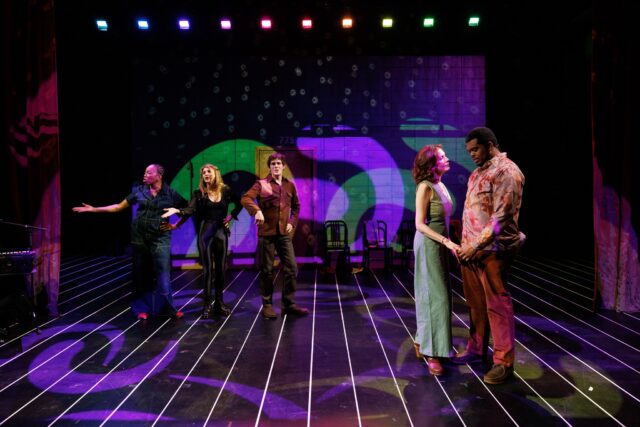
In Russia, the widow Pelagea Vlassova (Hecht) is worried that her son, Pavel (Fergie Philippe), has fallen in with dangerous revolutionaries Ivan (Portia) and Anton (Zane Pais), who are protesting the treatment of factory workers and are threatening to strike. In Miami, fifteen-year-old Jess (Hecht) is having a blast at JD’s Disco on the beach, where she dances with seventeen-year-old Daryl (Philippe), who she hopes will be her first true love. In the present, she looks back at her life, including the summer she spent at Camp Shalom Aleichem in Barkhamstead, Connecticut, where she learned about Brecht from counselor Michelle (Delilah Napier), who was determined to inject plenty of Brecht into the campers’ production of Lerner and Loewe’s 1951 musical, Paint Your Wagon.

Michelle is wrapped up in her own Brechtian world view. “Who cares what you see yourself as? Identification is the lowest form of appreciation!” she tells one camper. She advises another, “Play the opposite. Think the opposite. Do the opposite.” And she declares, “Everything artificial is less artificial if you acknowledge that it’s artificial. The best way to be real when you are doing a play is to be fake.”

That’s precisely how Beber, director Maria Mileaf, set designer Neil Patel, costumer Katherine Roth, choreographer Shura Baryshnikov, lighting designer Matthew Richards, and the cast of five approach A Mother. Their production regularly reminds us that we are in a theater watching a fictional show in 2025, from their use of Brecht curtains to Jess’s interactions with the audience and clever dialogue.

“I don’t care what they say, disco is never gonna die,” Daryl insists. One of the other clubgoers (Napier) explains, “Born in the clubs frequented primarily by gay and African-American and Latino fans in opposition to the dominant social structures!” Social structures involving race and injustice come to the fore when the narrative shifts to the real-life murder of Black insurance salesman and Marine Arthur Lee McDuffie at the hands of police officers, leading to the 1980 Miami riots. In one of the most poignant moments of the play, Arthur’s mother, Eula Bell McDuffie (Portia), sings the elegiac African American spiritual “Wade in the Water” (the tune of which Jess transforms into the Mourner’s Kaddish).

As per Brecht’s instructions for this “learning play,” music is a key contributor, with songs ranging from Lipps Inc.’s “Funkytown” and “Wade in the Water” to compositions by Mustapha Khan, William Kenneth Vaughan, and Norman (Skip) Burns. Among the new tunes are “Time to Fight” (“Take it to the street”), “Our Spot Is Desperate” (“Things can’t go on this way”), and “Let’s Make It Strange” (“You can melt gold to re-form / into shapes not quite born / with the fire of dialectical materiality”). As Michelle points out, “Think about that Brecht said: ‘Will there be singing in dark times? Yes, there will be singing, about the dark times.’”

Slyly referencing the Brecht-Gorky connection, the facade of the house at the back of the set features the number 775, a reference to Brecht’s 775th poem, “Stormbird,” which was inspired by Gorky’s “The Song of the Stormy Petrel.”

A Mother is a fun, thoroughly entertaining hundred-minute romp that maybe would have had even Brecht disco dancing at the end. “The aim was to teach certain forms of political struggle to the audience,” Brecht wrote in 1933 about the show. At the end of this production, Jess relates how copies of Brecht’s play were burned by the Nazis, then strolls through pieces of history on her way to today.

“I thought things would be different by now but dark times, dark times keep coming,” she says before reminding everyone about the hope — and revolutionary struggle — that is at the heart of epic theater.

Matt Doyle and Caroline Aaron star as son and mother in semiautobiographical play (photo by Carol Rosegg)

CONVERSATIONS WITH MOTHER
Theatre 555
555 West Forty-Second St. between Tenth & Eleventh Aves.
Wednesday – Monday through April 21, $67-$169
conversationsplay.com

Matthew Lombardo’s Conversations with Mother began life about a decade ago as a series of Facebook posts detailing verbatim phone calls the playwright had with his mother. He eventually decided to turn the daily talks into the semiautobiographical show, which closes April 21 at Theatre 555. (It had been scheduled to run through May 11.)

The play traces the relationship between Maria Collavechio (Caroline Aaron) and her son, Bobby (Matt Doyle), starting in Connecticut in 1966, when she is thirty-seven and he is eight. Bobby desperately wants to come home from sleepaway camp, and Maria says absolutely not — until he writes to her, “Dear Mom: One of the camp counselors asked me to stay with him in his van overnight. He has strawberry Charleston Chews, clicker clackers, and eyeglasses that have real X-ray vision. Can I stay with him some night? Love, Bobby.”

For the next forty years, Bobby keeps getting into trouble, refusing to follow his mother’s sage advice, as he moves to New York and falls in love with an abusive man. Often when admitting his bad choices to her, he asks if she’s mad, and when she says no, he adds, “Good. Cause there’s more.” The strong-willed Maria is not angry as much as disappointed that the tender and insecure Bobby cannot find himself a better life; she believes he is wasting his youth and his chances; he deserves more but won’t believe that. The problem never was that Bobby is gay — Maria embraces that from when he first comes out to her — but that Bobby keeps screwing up, both personally and professionally. And it gets tiring, for her and, unfortunately, the audience.

The play is told in such chapters as “Tell Me The Truth and I Won’t Get Mad,” “Why Can’t You Ever Meet a Nice Boy?,” and “If Your Phone Doesn’t Ring, It’s Me,” as Maria and Bobby go through good times and bad. Even as Bobby starts his career as a playwright, he is unable to enjoy it. He explains, “I’m just so tired. I don’t want to be hurt. I don’t want to be happy. I don’t want to be sad. I don’t want to be sorry. I don’t want to think. I don’t want to know. I just want to be numb.” Maria responds, “I don’t know what to do with you, Bobby. I really don’t know what else to do. I gave you everything. More than all the other kids combined. I gave you things in me I didn’t even know I had. And for what? So you can bitch about your shitty life? No one has a better life than you!”

The narrative takes a turn when Maria becomes ill, leading to a head-scratchingly melodramatic ending that seems to come out of nowhere.

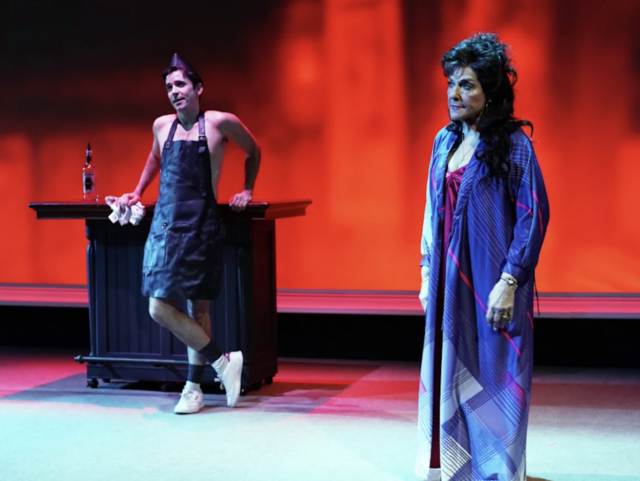
Directed by Noah Himmelstein (The Lucky Star, Los Otros), Conversations with Mother takes place on Wilson Chin’s framed set, where various chairs, bars, and tables are wheeled on and off and props are hidden in the walls. Ryan Park outfits Aaron in fanciful dresses while Doyle wears camp T-shirts with a silly hat, a revealing apron with a silly hat, a hoodie, and eventually more grown-up clothing.

Aaron (Madwomen of the West, A Kid Like Jake) and Tony winner Doyle (Company, A Clockwork Orange) never quite connect; the characters feel like caricatures trapped in a repetitive circle that is hard for the audience to become engaged in. Lombardo, whose previous plays include Tea at Five about Katharine Hepburn and Looped about Tallulah Bankhead, doesn’t develop enough depth; perhaps he’s too close to the material.

At the conclusion of the eighty-five-minute play, you’re likely to think, thank goodness there’s not more.

Jeanine Serralles, Andrew Barth Feldman, and Joanna Gleason star as three generations of a Jewish family in New York in We Had a World (photo by Jeremy Daniel)

WE HAD A WORLD
New York City Center Stage II
131 West Fifty-Fifth St. between Sixth & Seventh Aves.
Tuesday – Sunday through May 11, 4160
www.manhattantheatreclub.com
www.nycitycenter.org

New York City native Joshua Harmon is a master at writing about families, specifically Jewish ones, as evidenced by such works as Bad Jews, Skintight, and the epic Prayer for the French Republic. He turns his focus on his own clan in the beautifully told We Had a World, exploring his relationship with his mother and grandmother — and their complicated relationship with each other.

The hundred-minute play begins with Joshua (Andrew Barth Feldman) receiving a phone call from his grandmother, Renee (Joanna Gleason), whom he calls Nana, telling him that his next play should be about the estrangement between his mother, Ellen (Jeanine Serralles), and his aunt, the unseen Susan, focusing on a problematic Passover Seder — and that it should be called Battle of the Titans.

“I have — always wanted to write about our family; I didn’t know if — I had your permission?” he says. She gives him her blessing while making him promise that it will be “as bitter and vitriolic as possible. . . . You can even make your grandmother a real Medea. It ought to be a real humdinger.”

We Had a World is indeed bitter and vitriolic, and a real humdinger, but not in the way the fictionalized Joshua imagined; it is also sweetly innocent, tender-hearted, and almost too honest.

The story ranges from 1988, when Joshua is five, to 2018, when ninety-four-year-old Renee is sick. During his early years, Renee introduces Joshua to the arts, taking him to the R-rated Dances with Wolves, a Robert Mapplethorpe show, an exhibit featuring Tom Friedman’s Soap (which has a pubic hair on it), and the 1994 Broadway production of Medea starring Diana Rigg, an adaptation of the Greek tragedy in which a mother brutally murders her children.

“I don’t think my Mom would ever kill me,” Josh wonders.

“No, I don’t suppose she would,” Renee answers.

“Would you ever kill your children?” he asks.

“It would depend on the situation,” she responds.

Among the other cultural references are E. L. Konigsburg’s From the Mixed-Up Files of Mrs. Basil E. Frankweiler, Anthony Minghella’s The English Patient, and Alan Paton’s Cry, the Beloved Country.

Over time, however, Joshua learns some hard truths about his grandmother while coming to understand his mother in a much more profound way.

Tony-nominated director Trip Cullman (Cult of Love, Significant Other) artfully guides the action on John Lee Beatty’s open set, the audience on three sides, practically in the characters’ laps; you’ll want to try out Renee’s two Parisian high-backed love seats covered in pale green silk, an important plot point, but don’t.

In her return to the stage after a self-imposed twelve-year absence, Tony winner Gleason (Into the Woods, Dirty Rotten Scoundrels) is luminous as Renee, who is not quite the heroic figure Joshua initially thought she was, while two-time Drama Desk nominee Serralles (Dying for It, Gloria) vividly captures the complexities of the more heroic Ellen.

The immensely likable Feldman (Dear Evan Hansen, Little Shop of Horrors) ably navigates between eras as he also serves as the narrator, sharing information directly with the audience. “Before I can take you to Nana’s apartment, you probably want to know a few things. Like why my aunt and mother don’t want to be in the same room. But giving you the sixty-five-year blow by blow of that relationship would . . . we only have one play, so . . . just take my word,” he says near the beginning. “But first — a small family drama? There’s going to be enough ugly stuff.”

Given Harmon’s track record, it’s easy to take his word, especially if there are more wonderfully intricate family dramas in his and our future. (Meanwhile, Passover is right around the corner.)

[Mark Rifkin is a Brooklyn-born, Manhattan-based writer and editor; you can follow him on Substack here.]
A SINKING SHIP: SHOW BOAT / A RIVER AT NYU SKIRBALL

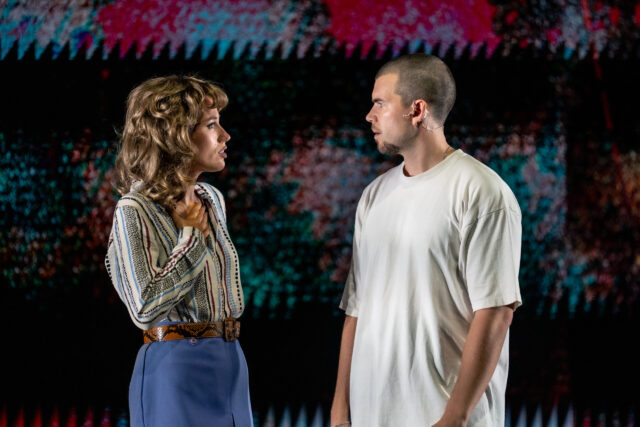
Target Margin Theater’s adaptation of Show Boat continues at NYU Skirball through January 26 (photo by Greg Kessler)

SHOW/BOAT: A RIVER
NYU Skirball Center for the Performing Arts
566 La Guardia Pl.
Through January 26, $60
nyuskirball.org

In 1927, Jerome Kern and Oscar Hammerstein II’s Show Boat revolutionized musical theater, taking on such tough topics as racism and addiction while making the narrative central to the production. Hammerstein called it a “musical play,” and Richard Rodgers announced that it was “trailblazing.”

You wouldn’t know any of that from Target Margin Theater’s head-scratching adaptation, renamed Show/Boat: A River, that is confusing audiences at NYU Skirball through January 26 as part of the Under the Radar festival.

There’s something off from the very first moments. The lights are on throughout the theater as several actors take the spare stage, the only design a large white cloth in the back with two doorways cut out, one marked “White,” the other “Black,” seen backward, meaning we are inside, not outside, but of what there is no telling. They begin singing “Cotton Blossom,” explaining, “Listen / N-word — work on de Mississippi / Black people work while de white folks play — / Loadin’ up boats wid the bales of cotton, / Gittin’ no rest till the Judgment day.”

The use of “N-word” is like nails on a chalkboard, and the first act doesn’t get any better. Each cast member wears a beauty-pageant-like sash that identifies their character as either white or black, and since some actors play multiple roles without costume changes, it’s impossible to know who’s who; one character is even portrayed by two people at the same time. I tried to make sense of it all by reading Target Margin Theater founding artistic director David Herskovits’s script after seeing the show, but it refers to the speakers and singers by their real first names, not the characters’. I initially was trying to figure out who Ruby is, as she’s not listed in the program as a performer and is not the name of any character, major or minor, but realized that it refers to the woman playing Magnolia; my first guess was they changed actors but didn’t update the script, although it now looks like Ruby is the nickname for the actor.

The plot, or what I could make of it, does follow the original story line, based on Edna Ferber’s 1926 novel. It’s the late 1880s, and Capt. Andy Hawks (Steven Rattazzi) owns and operates the Cotton Blossom, a riverboat docked in Natchez, Mississippi, whose star entertainer is Julie LaVerne (Stephanie Weeks), who is married to leading man Steve Baker (Edwin Joseph). Julie is half Black but passing as white. Capt. Andy and his unpleasant wife, Parthy (J Molière), have a daughter, Magnolia (Rebbekah “Ruby Reb” Vega-Romero), who is a burgeoning star. Known as Nola, she hooks up with smarmy gambler Gaylord Ravenal (Philip Themio Stoddard). Villain Frank Schultz (Tẹmídayọ Amay) and his wife, Ellie May Chipley (Caitlin Nasema Cassidy), the toast of Cairo, Illinois, are supporting actors in the troupe. Joe (Alvin Crawford) is a dockworker whose wife, Queenie (Suzanne Darrell), is the ship’s cook.

Pete (Stoddard), an engineer, has the hots for Julie and had given her a brooch that she then gifted to Queenie. The jewelry becomes a key symbol, bringing up issues of race, infidelity, and ownership — of things and people.

“That’s hell of a thing to do — givin’ my presents to a n—,” Pete tells her. She responds, “Pete — if Steve ever knew about you sending me that brooch, I declare he’d just about beat you to death.” Pete then threatens, “Well, he better not try, and you better be pretty nice to me — or you’ll be mighty sorry.”

A few moments later, Frank asks Queenie, “Where you get that brooch you got on?” She answers simply, “It was given to me.” Gaylord demands, “Who give it to you?” and she says, “Ax me no questions ‘n’ ah’ll tell y’no lies!”

It’s often difficult to tell who’s who and what’s what in Show/Boat: A River (photo by Greg Kessler)

Show Boat debuted on Broadway in 1927, with revivals in 1932, 1948, 1983, and, most recently, 1994, with Rebecca Luker, Lonette McKee, Robert Morse, Elaine Stritch, John McMartin, and Cloris Leachman. The musical was made into a film in 1936 by James Whale, with Irene Dunne as Magnolia, Hattie McDaniel as Queenie, Helen Morgan as Julie, and Robeson, who was not in the original Broadway cast, as Joe; George Sidney’s 1951 movie, starring Kathryn Grayson, Ava Gardner, Howard Keel, Joe E. Brown, Marge and Gower Champion, and Agnes Moorehead, earned Oscar nods for Best Color Cinematography and Best Scoring of a Musical Picture.

The first act of Herskovits’s two-and-a-half-hour Show/Boat: A River feels like an open rehearsal that still needs a lot of work. Early on, the “Show Boat parade” celebrates the upcoming performances on board the Cotton Blossom; during intermission, a very different kind of parade occurred, as dozens of audience members abandoned ship and left the theater. They did not return.

The second act is significantly better, although not necessarily anything to sing about. The sashes have been replaced by circular buttons, Kaye Voyce’s set adds numerous elements, Dina El-Aziz’s costumes get to shine, and Cha See’s lighting is not always annoyingly on, all combining to finally achieve important character and plot development. Perhaps more important, the score by musical directors Dionne McClain-Freeney (also vocal arranger) and Dan Schlosberg (also orchestrator) settles into a groove, performed by Nan-Cheng Chen on cello, Nicole DeMaio and Kristina Teuschler on reeds, Thomas Flippin on guitar, and Sam Zagnit on bass, the band visible in the pit where the actors occasionally take rests.

Among the highlights of Kern’s music and Hammerstein’s lyrics (he also wrote the book) are such songs as “Make Believe,” a duet between Stoddard and Vega-Romero; “Can’t Help Lovin’ Dat Man,” which becomes Nola’s dazzling audition number; “In Dahomey,” a racist tune at the World’s Fair; the moving “Bill,” achingly delivered by Weeks; and the show’s standard-bearer and underlying theme, “Ol’ Man River,” made famous by Paul Robeson as Joe and here boldly performed by Crawford: “Dere’s an ol’ man called de Mississippi; / Dat’s de ol’ man dat I’d like to be! / What does he care if de world’s got troubles? / What does he care if de land ain’t free?” he asks, bellowing, “Ol’ Man River / Dat Ol’ Man River, / He mus’ know sumpin’ / But don’t say nuthin’, / He jes’ keeps rollin’, /
He keeps on rollin’ along. . . . Ah gits weary / An’ sick of tryin’, / Ah’m tired of livin’ / An’ scared of dyin’, / But ol’ Man River, / He jes’ keeps rollin’ along.”

Oh, and don’t wait for “After the Ball,” because it’s been left on the cutting-room floor.

It all adds up to too little, too late by a beloved Brooklyn-based company that has been staging unique versions of classic and new works for four decades. Sometimes, as in this case, the ship just sinks.

[Mark Rifkin is a Brooklyn-born, Manhattan-based writer and editor; you can follow him on Substack here.]
FREE RETURNS FROM MONICA BILL BARNES AT PLAYWRIGHTS HORIZONS

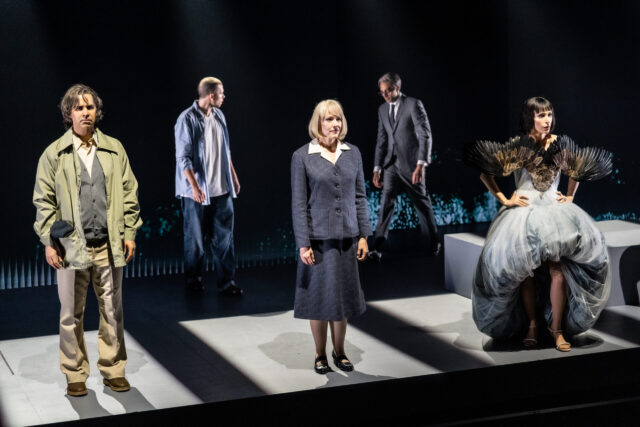
Monica Bill Barnes and Robbie Saenz de Viteri bring Many Happy Returns to Playwrights Horizons next month (photo by Paula Lobo)

Who: Monica Bill Barnes & Company
What: Hybrid scripted and improvised work
Where: Playwrights Horizons, Peter Jay Sharp Theater, 416 West Forty-Second St. between Ninth & Tenth Aves.
When: January 9-25, free with advance registration
Why: On its website, Monica Bill Barnes & Company announces, “Bringing dance where it doesn’t belong.” In the summer of 2021, the troupe, founded in New York City in 1997, staged Many Happy Returns, a dance-theater work that was devised as a one-time-only event commissioned by WP Theater to celebrate the return of in-person shows, reuniting performer and audience in the same space. From January 9 to 18, they will be happily presenting an expanded version of the show at Playwrights Horizons, a venue not usually associated with dance. Admission to all ten performances is free with advance registration.

In the show, which deals with memory and solace, co-artistic directors Monica Bill Barnes and Robbie Saenz de Viteri portray Barnes as a middle-age woman, with Barnes as the body and Saenz de Viteri the voice. Many Happy Returns combines scripted material with improvisation, as Saenz de Viteri types out new moments on the spot, inspired by the audience.

“So much is changing about what it means to be making live work now. That ever-shifting ground is pretty unsettling for a lot of us, in a lot of ways,” Barnes said in a statement. “Robbie and I felt like, ‘You know what? We want to make our own ever-shifting landscape to live in.’ It’s this joyful thing that’s also terrifying as a classically trained dancer; it’s an actor’s nightmare that I keep saying, enthusiastically, yes to.”

Saenz de Viteri noted, “Monica and I have no similarity in terms of training, but we laugh at the same things, and we get upset about a lot of the same things. In a crowded place, we find ourselves noticing a lot of the same things. Those overlaps became the grounds, many years ago, for starting to make things together. In Many Happy Returns, we’re taking all the pieces that make up a ‘character’ onstage — a story, a background, a specific way of moving, a specific way of talking — and breaking them all apart from each other. This fragmentary character of ‘Monica’ has allowed us both to channel some really vulnerable aspects of ourselves and share them in a different way than we ever have in our work — to ask how we make ourselves, out in the world, on a day to day basis.”

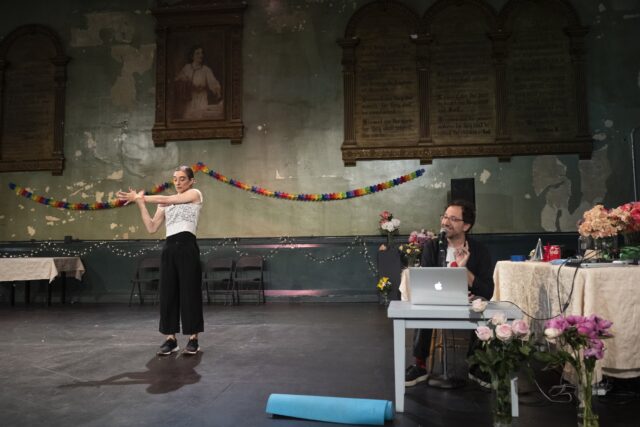
The piece is choreographed by Barnes, written by Saenz de Viteri, and performed by them along with Flannery Gregg, Mykel Marai Nairne, and Indah Mariana or Hsiao-Jou Tang; the directing consultant is three-time Obie winner Anne Kauffman (The Thugs, Mary Jane), with lighting and set design by Barbara Samuels and costumes by Kaye Voyce.

“Live performance feels like it needs a revolution right now, and not a revolution that involved burning everything down — but rather picking up the pieces and making new forms,” Kauffman said. “As a director, I love it — Monica and Robbie are stretching their brains and trying to conceive something that feels like it doesn’t exist yet. Playwrights Horizons and [artistic director] Adam Greenfield are always thinking in that way; in the rubble of theater postpandemic, he’s been putting words to actions in his programming. As a theater artist of over thirty-five years, watching Monica and Robbie and knowing Playwrights is the next presenter of Many Happy Returns, I feel so excited, like something new is bubbling up.”

Greenfield added, “Historically, Playwrights Horizons’ programming has excluded playwrights who create new work via interdisciplinary, non-literary methods (e.g., ensemble-devised work, improvisation, physical theater), and — in continuation of this theater’s longtime dedication to advancing playwrights — I want to think expansively about what that word means. From the moment I was first introduced to Many Happy Returns last year, I became eager to include these artists in our programming, not only because it affirms experimentation in the field of new plays, but because — in its very conception — this play embodies powerfully the inclusive, galvanizing potential of theater, as an art form and as a civic act.”

Act fast to get your free tickets — and be ready for the lack of a price to be incorporated into the relationship between performer, audience, and their respective expectations in Playwrights Horizons’ Peter Jay Sharp Theater.

[Mark Rifkin is a Brooklyn-born, Manhattan-based writer and editor; you can follow him on Substack here.]
A TALE OF TWO ACTORS: STEVE CARELL AND MICHAEL STUHLBARG ON BROADWAY

Steve Carell did not receive a Tony nod for his Broadway debut in Uncle Vanya (photo by Marc J. Franklin)

UNCLE VANYA
Vivian Beaumont Theater at Lincoln Center Theater
150 West 65th St. between Broadway & Amsterdam Ave.
Tuesday – Saturday through June 16, $104-$348
212-362-7600
www.lct.org

PATRIOTS
Ethel Barrymore Theatre
243 West Forty-Seventh St. between Broadway & Eighth Ave.
Tuesday – Sunday through June 23, $49–$294
patriotsbroadway.com

When the 2024 Tony nominations were announced on April 30, there were several notable names missing, particularly that of Steve Carell. The Massachusetts-born Carell, sixty-one, is currently finishing up his Broadway debut as the title character in Heidi Schreck’s muddled new translation of Anton Chekhov’s Uncle Vanya, running at the Vivian Beaumont through June 16. The show received a single nomination, for Carell’s costar William Jackson Harper as Best Actor in a Play, for his portrayal of Dr. Astrov; Schreck and director Lila Neugebauer focus so much on the doctor that the play ought to be renamed Dr. Astrov.

Carell, who cut his comic chops at Second City in Chicago and on The Daily Show with Jon Stewart, has been nominated for an Emmy eleven times for his role as Michael Scott on The Office, and he received a Best Actor Oscar nod for his portrayal of the real-life multimillionaire and murderer John Eleuthère du Pont in Foxcatcher. Carell has also appeared in such films and television series as The 40-Year-Old Virgin, Little Miss Sunshine, The Big Short, and The Morning Show as well as the very dark limited series The Patient.

One name that might have been a surprise was that of Michael Stuhlbarg. The California-born Stuhlbarg, fifty-five, is currently finishing up his role as the real-life Russian oligarch Boris Berezovsky in Peter Morgan’s bumpy but ultimately satisfying Patriots, running at the Ethel Barrymore through June 23. The nomination was the only one for the play, which is directed by Rupert Goold.

All five of the nominees are known for their work on television; in addition to theater veteran Harper, who played Danny Rebus on the reboot of The Electric Company and Chidi Anagonye on The Good Place, the nominees include Emmy winner Jeremy Strong of Succession for An Enemy of the People, nine-time Emmy nominee and Tony winner Liev Schreiber of Ray Donovan for Doubt: A Parable, and Tony and Grammy winner and Emmy and Oscar nominee Leslie Odom Jr. of Smash for Purlie Victorious (A Non-Confederate Romp through the Cotton Patch).

A two-time Emmy and Tony nominee and Obie and Drama Desk winner, Stuhlbarg has appeared in such films as A Serious Man, Call Me by Your Name, and The Shape of Water; has portrayed such villains on TV as Arnold Rothstein in Boardwalk Empire, Jimmy Baxter in Your Honor, and Richard Sackler in Dopesick; and has seven Shakespeare plays on his resume in addition to Cabaret, The Pillowman, and The Invention of Love on Broadway.

Michael Stuhlbarg received his second Tony nomination for his role as Boris Berezovsky in Patriots (photo by Matthew Murphy)

Uncle Vanya and Patriots are both set in Russia after the fall of the Berlin Wall, around the time of Mikhail Gorbachev’s perestroika program, although the exact time of Schreck’s narrative is never specifically stated. Vanya has sacrificed happiness in order to manage the family estate with Sonia (Alison Pill), his niece. When professor Alexander (Alfred Molina) — who was married to Vanya’s late sister, Sonia’s mother — and his younger, sexy wife Elena (Anika Noni Rose), arrive at the estate with plans to sell it, Vanya, who is in love with Elena and is not a terrific businessman, is forced to take stock of his life, and he doesn’t like what he sees.

Boris of Patriots is a stark contrast: He seeks out the many pleasures the world has to offer, determined, since childhood, to be a success with power and influence, unconcerned with the bodies he leaves in his wake. Cutting a deal with Alexander Stalyevich Voloshin (Jeff Biehl), Boris assures the politician that he is going to be a rich man. “No good being rich if I’m dead,” Voloshin says, to which Boris responds, “It’s always good being rich.” Boris believes he is in control of Russia when he chooses to groom a minor functionary as president, intending to make him his puppet, but the man, Vladimir Putin (Will Keen), ultimately has other ideas and soon becomes Boris’s hated enemy.

Carell hovers in the background of Uncle Vanya, giving the stage over to the other characters, similar to how Vanya has surrendered taking action in his life. He often sits and mopes on a couch in the back, fading into the shadows; even when he pulls out a gun, he is too meek and mild. For the play to work, the audience needs to connect emotionally with Vanya, but Carell can’t quite carry off the key moments.

Stuhlbarg leaps across Miriam Buether’s multilevel stage with boundless energy in Patriots as Boris battles Putin over the heart and soul of Russia. Boris has no fear, until he realizes that Putin is a lot more than he ever bargained for. “I will make sure the Russian people learn to love our little puppet,” Boris says, but it’s too late. “The fact is I am president,” Putin declares. Boris responds, “And I put you there!!!!!” To which Putin replies, “That’s opinion. Not fact.”

Carell may be more of a household name than Stuhlbarg, but the latter gained notoriety when, on March 31, a homeless man struck him with a rock near Central Park, and Stuhlbarg, much like Boris most likely would have done, chased after him until the police caught up with the attacker outside of the Russian consulate on East Ninety-First. The consulate was a fitting location for the two-time Tony nominee.

[Mark Rifkin is a Brooklyn-born, Manhattan-based writer and editor; you can follow him on Substack here.]
THE WELKIN

A jury of matrons must decide the fate of a convicted woman in Lucy Kirkwood’s The Welkin (photo by Ahron R. Foster)

THE WELKIN
Atlantic Theater Company
Linda Gross Theater
336 West 20th St. between Eighth & Ninth Aves.
Tuesday – Sunday through July 7, $56.50-$121.50
atlantictheater.org

Twelve Angry Men meets The Crucible by way of horrormeister Peter Straub and George Cukor’s The Women in Lucy Kirkwood’s gripping and intense, if messy and overlong, The Welkin, running at the Atlantic’s Linda Gross Theater through July 7.

Kirkwood’s previous works include Chimerica, in which a Chinese dissident and an American photojournalist attempt to find the Tank Man, who became an international symbol of resistance during the 1989 Tiananmen Square protest, and The Children, which takes place shortly after a devastating nuclear accident on the East Coast of Britain. In The Welkin, Kirkwood contemplates female autonomy — the right of a woman to control her body — directly and indirectly bringing up such issues as capital punishment, abortion, gender identity, and sexuality while celebrating individuality over groupthink stereotypes. It’s set in March 1759 on the border of Norfolk and Suffolk in England, but it relates all too closely to what is occurring in America today in the wake of the overturning of Roe v. Wade.

The play opens with a harrowing scene, cast in shadowy darkness in front of the curtain. After an absence of four months, Sally Poppy (Haley Wong) has returned home to her laborer husband, Frederick (Danny Wolohan); she is naked and bloodied, soon pulling out a hammer. We instinctively assume something awful has happened to her, but it turns out that she has apparently done something awful herself: She tells Frederick that the blood is not hers but that of Alice Wax, a young girl her lover brutally murdered and she helped dismember and stuff up a fireplace. She demands ten shillings from her cuckolded husband to pay the midwife for the baby she claims she is carrying, which she coldly says is not his. Her lack of guilt or remorse is disconcerting — as well as rife with sociocultural complications.

The curtain then rises on widowed midwife Lizzie Luke (Sandra Oh) churning butter when bailiff Billy Coombes (Glenn Fitzgerald) arrives, informing her that the judge wants Lizzie to serve on the twelve-woman jury to determine whether the convicted Sally is truly with child, in which case she cannot be hanged for her crime and would instead be transported to Australia. Lizzie shows no immediate concern about the murder. “Expect that is the closest a Wax child ever got to sweeping a chimney,” she says.

The married Mr. Coombes flirts with Lizzie — it appears that they might have an undefined thing for each other — who first refuses to participate on the jury but eventually acquiesces, leaving her daughter, Katy (MacKenzie Mercer), to churn the butter, passing female responsibilities to the next generation, who might actually want more out of life.

The jurors, each doing some kind of traditional women’s work, are sworn in one by one, sharing an aspect of their personal story before kissing “the book.” It’s a ponderous scene, but we learn that Mary Middleton (Susannah Perkins) has five children and a haunted tankard in her home. Ann Lavender (Jennifer Nikki Kidwell) is married to a poet and is raising their four daughters in “peasant honesty.” The eighty-three-year-old Sarah Smith (Dale Soules) has twenty-one children with three husbands and until recently could do a handstand for one minute. Helen Ludlow (Emily Cass McDonnell) has had twelve miscarriages in eight years. Peg Carter (Simone Recasner) is married to the third-generation gardener for the family whose child was murdered and has “this thing he is able to do with his tongue which I find very amenable.” And Charlotte Cary (Mary McCann) is a stranger in town who has a dinner engagement at five that she would prefer not to miss.

Sally Poppy (Haley Wong) must prove she is pregnant to save herself from the gallows in 1759 England (photo by Ahron R. Foster)

The rest of the two-and-a-half-hour play (with intermission) unfolds in a dungeonlike room where the dozen women have been sequestered until they reach a verdict on Sally’s supposed pregnancy. At stage left is a fireplace, serving as a constant reminder of what Sally and her lover did to Alice; at stage right is a narrow window through which a sliver of at times heavenly light peeks in. When the window is opened, the sound of the unruly mob gathered outside to await Sally’s execution comes pouring in. Sally is there to be poked and examined, her hands bound by rope. Mr. Coombes is present to “keep this jury of matrons without meat, drink, fire, and candle” and to speak only when asking if the matrons have reached a verdict.

The women take sides, chastise one another, divulge secrets, and make accusations as they debate how to determine whether Sally is pregnant. Sally does herself no favors by being nasty and difficult. “Shut up Helen what are you even doing here everyone knows you’re barren,” she barks at the intimidated Helen. Meanwhile, Sarah Hollis (Hannah Cabell) is unable to contribute much because she hasn’t spoken in twenty years, since her son was born; Kitty Givens (Tilly Botsford) and Hannah Rusted (Paige Gilbert) believe Halley’s Comet might have something to do with all the strange goings-on; Judith Brewer (Ann Harada) is a nosy gossiper; and Emma Jenkins (Nadine Malouf) is clamoring for Sally to swing.

Being a midwife, Lizzie often finds herself in the middle of it all and has a unique perspective on the matter, determined to give Sally the benefit of the doubt, explaining in a monologue that is as relevant today as it was 265 years ago: “Because she has been sentenced to hang on the word of a cuckolded husband. Because every card dealt to her today and for many years before has been an unkind one, because she has been sentenced by men pretending to be certain of things of which they are entirely ignorant, and now we sit here imitating them, trying to make an ungovernable thing governable, I do not ask you to like her. I ask you to hope for her, so that she might know she is worth hoping for. And if you cannot do that for her sake, think instead of the women who will be in this room when that comet comes round again, and how brittle they will think our spirits, how ashamed they will be, that we were given our own dominion and we made it look exactly like the one down there,” referring to the courtroom.

“Please. This whole affair is a farce. We are cold, hungry, tired, thirsty women and all of us’ve had our housework interrupted. . . . It is a poor apparatus for justice. But it is what we have. This room. The sky outside that window and our own dignity beneath it. Mary’s view is as important as Charlotte’s, and together we must speak in one voice. It is almost impossible we should make the right decision.”

A shocking event at the end of act one leads to a riveting, wildly unpredictable second act that threatens to go off the rails at any moment.

A welkin is defined as the vault of the sky, the firmament separating heaven and earth. Genesis states, “And God said, ‘Let there be lights in the vault of the sky to separate the day from the night, and let them serve as signs to mark sacred times, and days and years.’” In Act 5, Scene 5 of Shakespeare’s King John, Lewis, the dauphin, says, “The sun of heaven methought was loath to set, / But stay’d and made the western welkin blush.” Light is one of several themes underlying the play. The women are not allowed to use a candle or light the fireplace, but when Dr. Willis (Wolohan) comes to examine Sally and asks to use a candle, Mr. Coombes looks the other way.

The role of women is emphasized throughout, focusing on how they are essentially needed only for cooking, cleaning, mending, and having babies. “A woman is not a laundry list!” Lizzie declares. The only sexual pleasure mentioned in the filthy room is Mary’s enjoyment when Lizzie rubs her “down . . . there.”

The men are inept, incompetent, insensitive fools: Frederick initially wants to whip Sally; one of Mr. Coombes’s arms is in a sling and he has only one testicle, as if he has been castrated; and Dr. Willis has invented a speculumlike metal instrument to insert into Sally to examine her. When Sally says that her supposed pregnancy was not intended, that “the gentleman did not withdraw when I told him to,” Judith responds, “That’s not a method you can rely on; they’re senseless at the last post. With Mr. Brewer I always kept a piece of brick in a handkerchief under the bed; if you time your strike right you can save yourself a lot of trouble in the long run.”

Religion and truth are also on the docket as the characters argue over God’s authority. Frederick, explaining how he had to cover up Sally’s absence, admits, “At church I had to make out you’d gone to mind a sick cousin in Stowmarket. A lie, I told, in the house of God.” Later, Lizzie, discussing how twelve fetuses under her care have not survived in the past year, says, “I am the very first person they blame, God? No, they don’t blame God. Nobody blames God when there is a woman can be blamed instead.”

As the jurors continue their deliberations, Lizzie offers, “You cannot mean to ignore the truth simply cos that’s inconvenient to you.” And when Lizzie doesn’t understand why the other matrons won’t listen to her and want the male doctor to look at Sally, Sally says, “Are you dense? You have no authority here. If they must hear the truth from someone a foot taller with a deep voice, then let them.”

The always inventive director Sarah Benson, who has helmed such wide-ranging shows as Teeth, Fairview, Samara, In the Blood, and An Octoroon, throws too much at the wall in The Welkin, resulting in a choppy narrative in need of editing. In fact, at one point the women scrub the walls after the aforementioned shocking event. Now, I realize that this opinion is coming from a male member of the human species, but I hope it’s not interpreted as mansplaining.

The appropriately claustrophobic set is by dots, with splendid period costumes by Kaye Voyce, stark lighting by Stacey Derosier, creepy sound by Palmer Hefferan, and eerie special effects by Jeremy Chernick. The diverse ensemble cast is outstanding, led by Oh (Office Hour, Satellites), in a welcome return to the New York stage after eighteen years; her portrayal of Lizzie is dense and complex, instantly relatable to the modern era. Wong (Mary Gets Hers, John Proctor Is the Villain) is a force as Sally, Harada (Into the Woods, Avenue Q) offers comic relief (for a while) as Judith, Malouf (Grief Hotel, The School for Scandal) is vividly spirited as Emma, and the ever-dependable Soules (I Remember Mama, Hair) is as dependable as ever.

One of the most bizarre moments of the play occurs when the women start singing a contemporary pop song that deals with the drudgery of work and the release of sex. In the British premiere of The Welkin, it was Kate Bush’s “Running Up That Hill (A Deal with God),” but here they sing a cheerful tune that was written by a man of musical royalty but performed by an all-female group, maintaining the idea that the women are speaking out and the men are remaining quiet. There’s a lot to be said for that.

The next perihelion of Halley’s Comet is expected on July 28, 2061, so be ready.

Oh, I’ll shut up now.

[Mark Rifkin is a Brooklyn-born, Manhattan-based writer and editor; you can follow him on Substack here.]