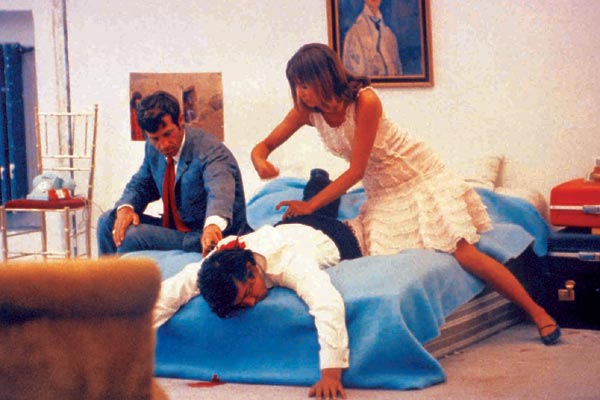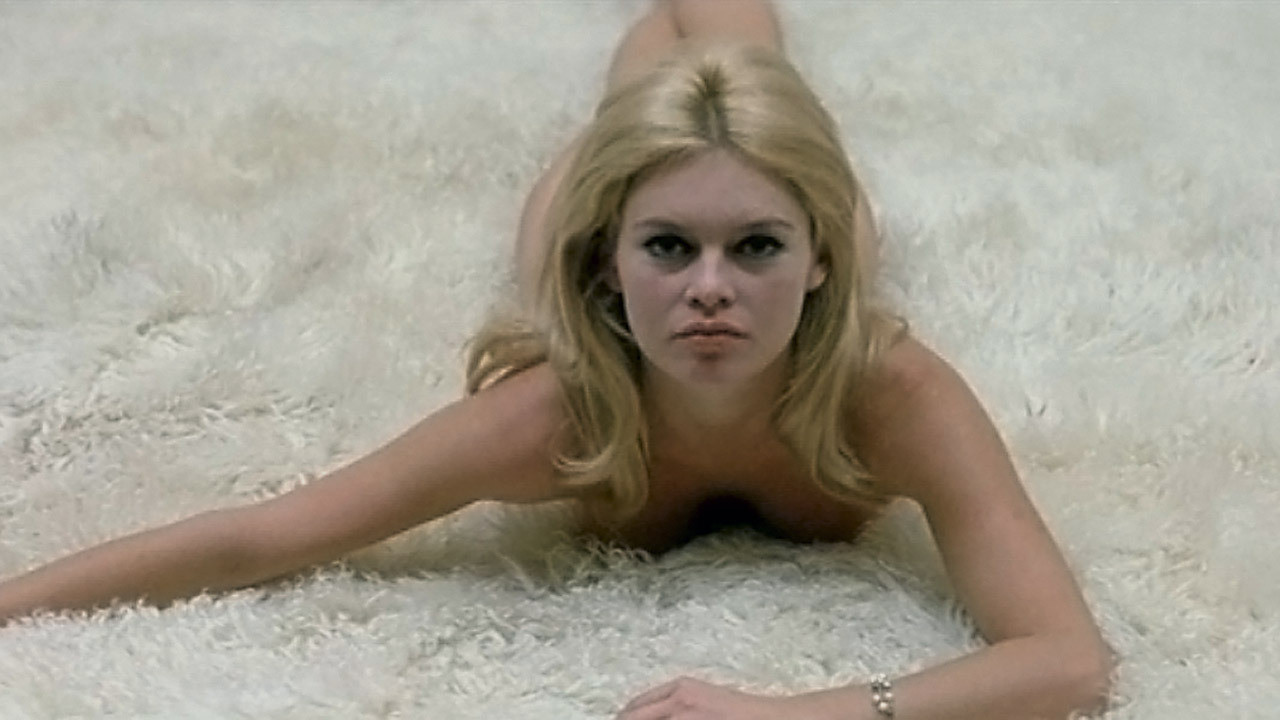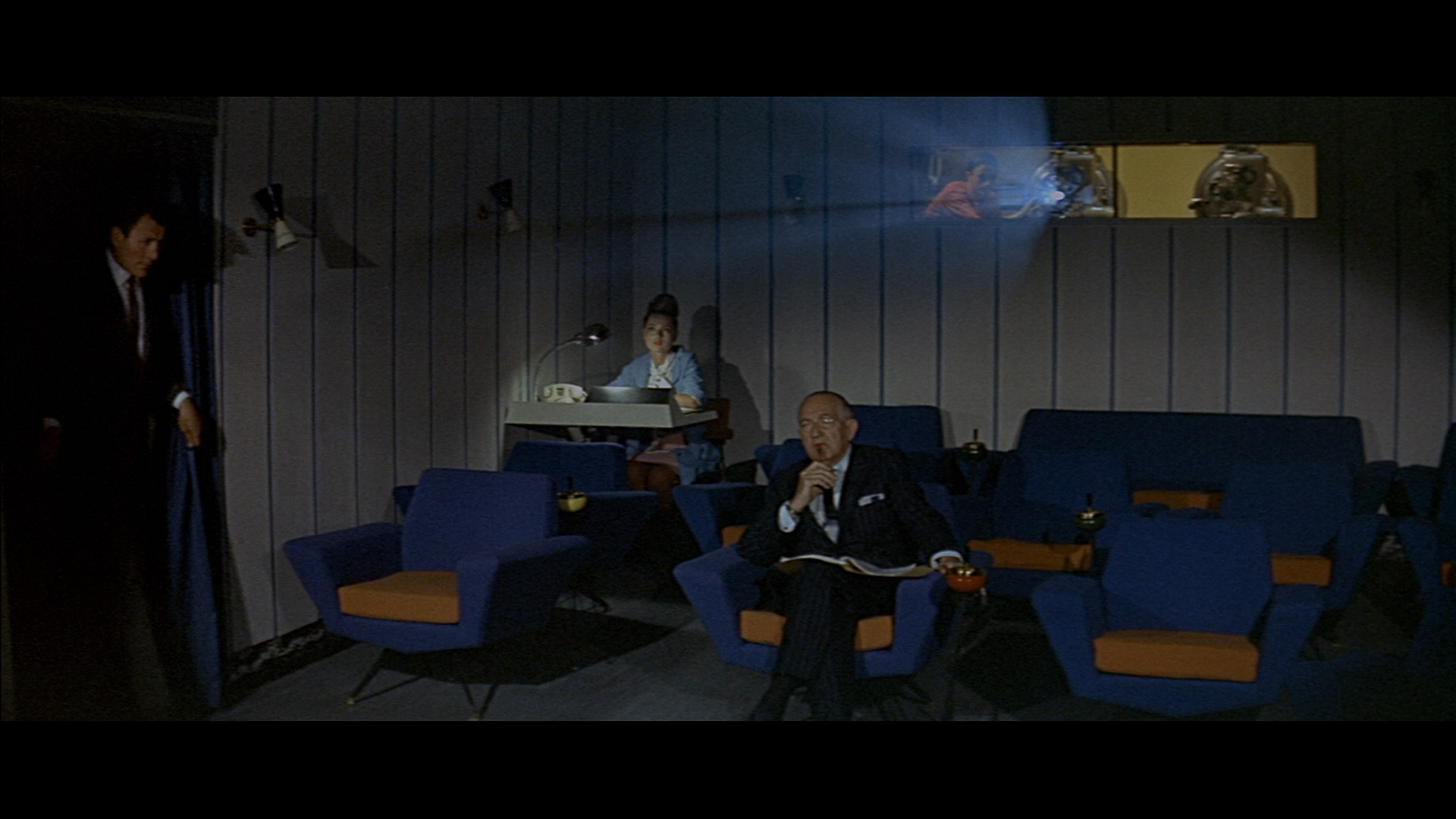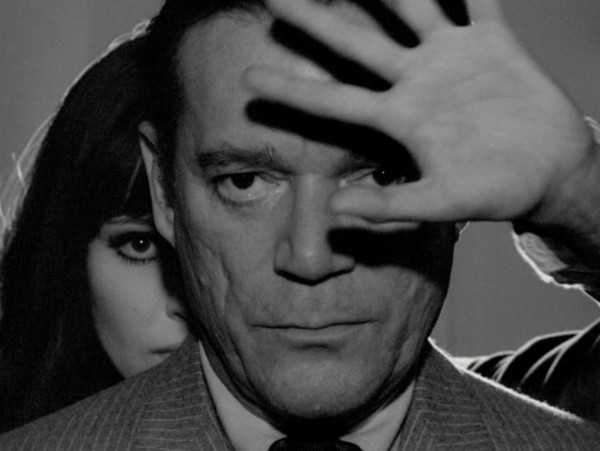
Lemmy Caution (Eddie Constantine) seeks help from Natasha Vonbraun (Anna Karina) in Jean-Luc Godard’s masterful ALPHAVILLE
ALPHAVILLE: A STRANGE ADVENTURE OF LEMMY CAUTION (ALPHAVILLE: UNE ÉTRANGE AVENTURE DE LEMMY CAUTION) (Jean-Luc Godard, 1965)
Film Forum
209 West Houston St.
February 7-13
212-727-8110
www.filmforum.org
 “Sometimes, reality is too complex for oral communication. But legend embodies it in a form which enables it to spread all over the world,” a growly, disembodied, mechanical-like voice says at the beginning of Jean-Luc Godard’s futuristic sci-fi noir thriller, Alphaville: Une étrange aventure de Lemmy Caution. Godard’s 1965 black-and-white masterpiece takes place in an unidentified time period in a dark, unadorned, special-effects-free Paris. A tough-as-nails man in hat and trench coat named Lemmy Caution (Eddie Constantine) has arrived in Alphaville from the Outlands, claiming to be journalist Ivan Johnson, on assignment from the Figaro-Pravda newspaper. But his real mission is to first find fellow agent Henry Dickson (Akim Tamiroff), then capture or kill Alphaville leader and death-ray inventor Professor Vonbraun (Howard Vernon), the former Leonard Nosferatu. A Guadalcanal veteran who drives a Ford Galaxie, Caution — a character Constantine played in a series of films based on the novels of Peter Cheyney, including This Man Is Dangerous, Dames Get Along, and Your Turn, Darling — is a no-nonsense guy who takes nothing for granted. “All things weird are normal in this whore of cities,” he tells a blond seductress third class, who apparently comes with his hotel room. Documenting everything he sees with an Instamatic flash camera, Caution (perhaps a stand-in for Godard himself?) is soon visited by Natasha Vonbraun (Anna Karina), the professor’s daughter, setting off on an Orwellian journey through a grim city where poetry and emotion, and such words as “love,” “why,” and “conscience,” are banned in favor of “because” and “Silence. Logic. Security. Prudence,” where the hotel Bible is actually an ever-changing dictionary and enemies of the state are killed in swimming pools and pulled out by clones of Esther Williams, all overseen by a computer known as Alpha 60 (whose text, based on writings by Jorge Luis Borges, is eerily spoken by a man without a larynx, using a mechanized voice box).
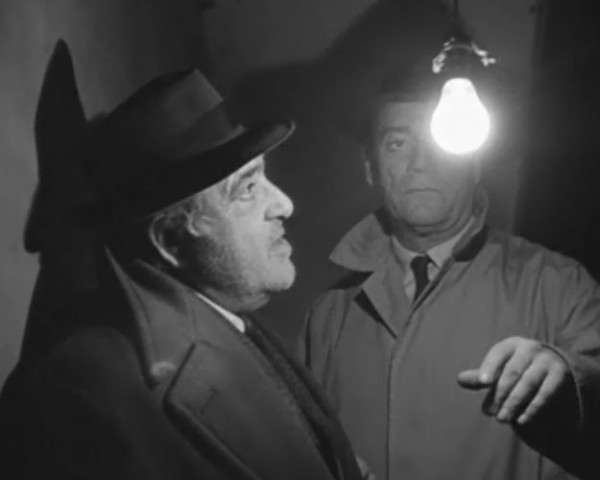
Henry Dickson (Akim Tamiroff) attempts to shed light on a grim situation in intellectual sci-fi film noir
Meanwhile, Caution travels everywhere with his paperback copy of Paul Éluard’s Capital of Pain, which includes such short poems as “To Be Caught in the Trap,” “In the Cylinder of Tribulations,” and “The Big Uninhabitable House.” Paul Misraki’s relentless noir score fits right in with Raoul Coutard’s bleakly beautiful cinematography, which often shows Caution through glass doors and windows and in enclosed spaces. Godard infuses Alphaville with cinematic flourishes, inside jokes, political statements, and intellectual references, directly and indirectly evoking Jean Cocteau’s Orpheus, Orson Welles’s Mr. Arkadin, Chris Marker’s La Jetée, American cartoons (a pair of white-coated professors who announce a memory problem with 183 Omega Minus are named Eckel and Jeckel, played by Cahiers du cinema’s Jean-Louis Comolli and Jean-André Fieschi), and even his own films, with Jean-Pierre Léaud making a very brief cameo as a waiter. But one of the myriad pleasures of Alphaville — which won the Golden Bear at Berlin and at one time had the working title Tarzan vs. IBM — is that it can be enjoyed on many different levels, as dystopian warning, fascist parable, cinema about cinema, individual vs. the state thriller, or, quite simply, classic French noir. A digital restoration of Alphaville, with a new translation and subtitles by Lenny Borger and Cynthia Schoch, is screening February 7-13 at Film Forum.
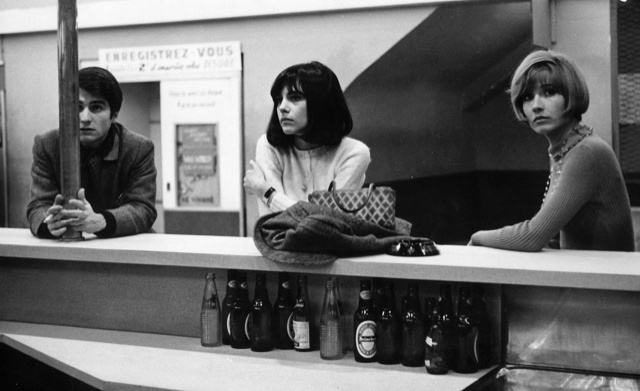
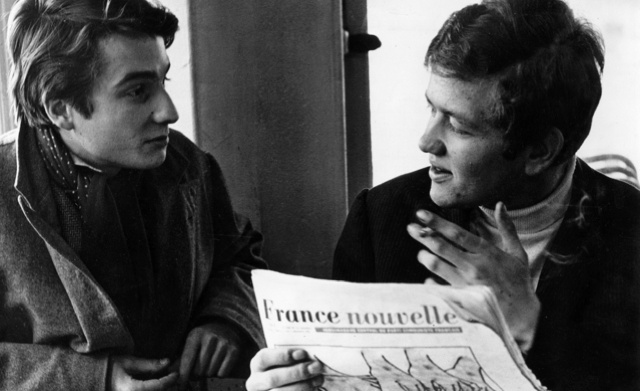

 When a pair of disaffected Parisians, Arthur (Claude Brasseur) and Franz (Sami Frey), meet an adorable young woman, Odile (Anna Karina), in English class, they decide to team up and steal a ton of money from a man living in Odile’s aunt’s house. As they meander through the streets of cinematographer Raoul Coutard’s black-and-white Paris, they talk about English and wealth, dance in a cafe while director Jean-Luc Godard breaks in with voice-over narration about their character, run through the Louvre in record time, and pause for a near-moment of pure silence. Godard throws in plenty of commentary on politics, the cinema, and the bourgeoisie in the midst of some genuinely funny scenes. Band of Outsiders is no ordinary heist movie; based on Dolores Hitchens’s novel Fool’s Gold, it is the story of three offbeat individuals who just happen to decide to attempt a robbery while living their strange existence, as if they were outside from the rest of the world. The trio of ne’er-do-wells might remind Jim Jarmusch fans of the main threesome from Stranger Than Paradise (1984), except Godard’s characters are more aggressively persistent. One of Godard’s most accessible films, Band of Outsiders is screening October 18 at the Francesca Beale Theater as part of the expansive Film Society of Lincoln Center series “Jean-Luc Godard — The Spirit of the Forms,” which continues through October 31 with such other Godard works as Les Carabiniers, La Chinoise, Contempt, Film Socialisme, King Lear, Nôtre musique, and many more.
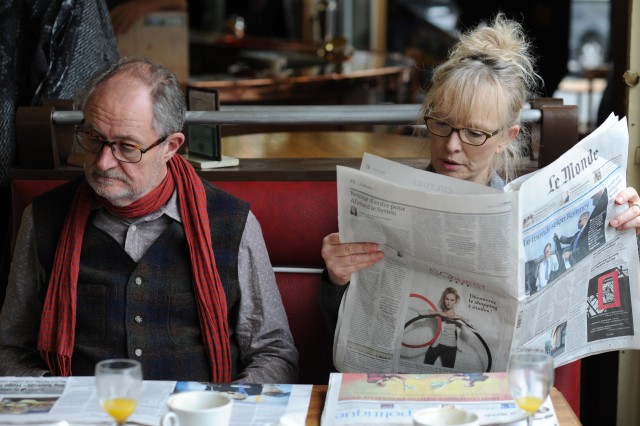
 Mike Nichols’s Who’s Afraid of Virginia Woolf? meets Richard Linklater’s “Before” series in Roger Michell’s bittersweet romantic black comedy, Le Week-end. Professor Nick Burrows (Jim Broadbent) and teacher Meg Burrows (Lindsay Duncan) are celebrating their thirtieth wedding anniversary by returning to Paris, where they spent their honeymoon. But whereas their first visit was filled with love, hope, and dreams of a bright future, they have come to the realization that their life together didn’t quite turn out as planned. While Nick still seems to be in love with his wife, Meg is reevaluating their relationship, continually lashing into him and spending what little money they have with reckless abandon. When they unexpectedly bump into an old colleague of Nick’s, the self-absorbed chatterbox Morgan (Jeff Goldblum), they are invited and go to a party where they imagine what could have been, forcing them to face some brutal truths.