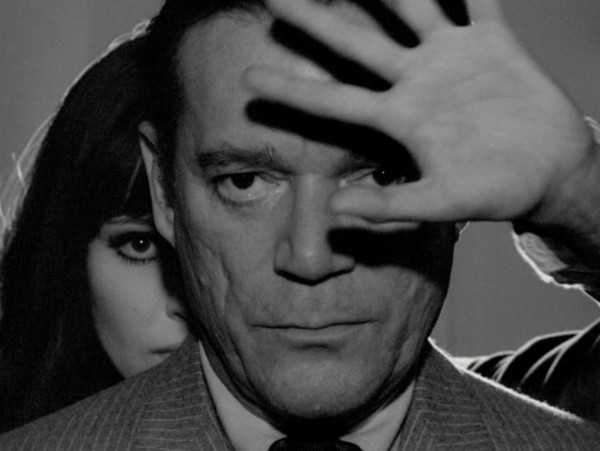
Lemmy Caution (Eddie Constantine) seeks help from Natasha Vonbraun (Anna Karina) in Jean-Luc Godard’s masterful ALPHAVILLE
ALPHAVILLE: A STRANGE ADVENTURE OF LEMMY CAUTION (ALPHAVILLE: UNE ÉTRANGE AVENTURE DE LEMMY CAUTION) (Jean-Luc Godard, 1965)
Rubin Museum of Art
150 West 17th St. at Seventh Ave.
Friday, October 16, $10, 9:30
212-620-5000
rubinmuseum.org
 “Sometimes, reality is too complex for oral communication. But legend embodies it in a form which enables it to spread all over the world,” a growly, disembodied, mechanical-like voice says at the beginning of Jean-Luc Godard’s futuristic sci-fi noir thriller, Alphaville: Une étrange aventure de Lemmy Caution. Godard’s 1965 black-and-white masterpiece takes place in an unidentified time period in a dark, unadorned, special-effects-free Paris. A tough-as-nails man in hat and trench coat named Lemmy Caution (Eddie Constantine) has arrived in Alphaville from the Outlands, claiming to be journalist Ivan Johnson, on assignment from the Figaro-Pravda newspaper. But his real mission is to first find fellow agent Henry Dickson (Akim Tamiroff), then capture or kill Alphaville leader and death-ray inventor Professor Vonbraun (Howard Vernon), the former Leonard Nosferatu. A Guadalcanal veteran who drives a Ford Galaxie, Caution — a character Constantine played in a series of films based on the novels of Peter Cheyney, including This Man Is Dangerous, Dames Get Along, and Your Turn, Darling — is a no-nonsense guy who takes nothing for granted. “All things weird are normal in this whore of cities,” he tells a blond seductress third class, who apparently comes with his hotel room. Documenting everything he sees with an Instamatic flash camera, Caution (perhaps a stand-in for Godard himself?) is soon visited by Natasha Vonbraun (Anna Karina), the professor’s daughter, setting off on an Orwellian journey through a grim city where poetry and emotion, and such words as “love,” “why,” and “conscience,” are banned in favor of “because” and “Silence. Logic. Security. Prudence,” where the hotel Bible is actually an ever-changing dictionary and enemies of the state are killed in swimming pools and pulled out by clones of Esther Williams, all overseen by a computer known as Alpha 60 (whose text, based on writings by Jorge Luis Borges, is eerily spoken by a man without a larynx, using a mechanized voice box).
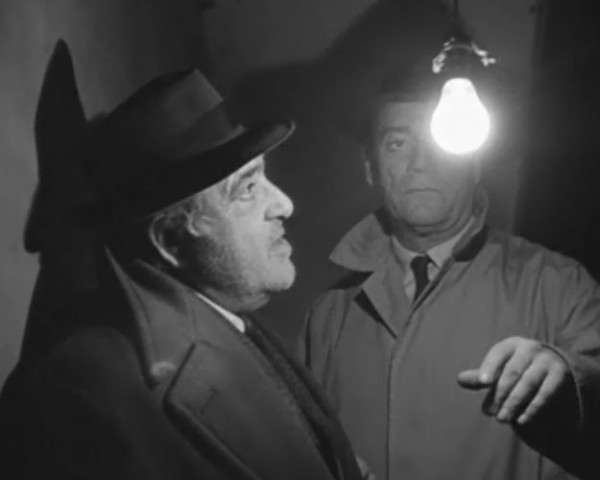
Henry Dickson (Akim Tamiroff) attempts to shed light on a grim situation in intellectual sci-fi film noir
Meanwhile, Caution travels everywhere with his paperback copy of Paul Éluard’s Capital of Pain, which includes such short poems as “To Be Caught in the Trap,” “In the Cylinder of Tribulations,” and “The Big Uninhabitable House.” Paul Misraki’s relentless noir score fits right in with Raoul Coutard’s bleakly beautiful cinematography, which often shows Caution through glass doors and windows and in enclosed spaces. Godard infuses Alphaville with cinematic flourishes, inside jokes, political statements, and intellectual references, directly and indirectly evoking Jean Cocteau’s Orpheus, Orson Welles’s Mr. Arkadin, Chris Marker’s La Jetée, American cartoons (a pair of white-coated professors who announce a memory problem with 183 Omega Minus are named Eckel and Jeckel, played by Cahiers du cinema’s Jean-Louis Comolli and Jean-André Fieschi), and even his own films, with Jean-Pierre Léaud making a very brief cameo as a waiter. But one of the myriad pleasures of Alphaville — which won the Golden Bear at Berlin and at one time had the working title Tarzan vs. IBM — is that it can be enjoyed on many different levels, as dystopian warning, fascist parable, cinema about cinema, individual vs. the state thriller, or, quite simply, classic French noir. Recently digitally restored with a new translation and subtitles by Lenny Borger and Cynthia Schoch, Alphaville is screening October 16 in the Rubin Museum Cabaret Cinema series “Consequences” and will be introduced by Buddhist studies professor Christopher Kelley. “All is linked, all is consequence,” a scientist tells Caution in the film. The series is being held in conjunction with “Karma: Cause, Effect and the Illusion of Fate,” which continues through December 30 with conversations (David Eagleman + Whoopi Goldberg, Noah Hutton + Jonathan Demme, Gary Indiana + Tracey Emin, Ian Somerhalder + Carol Anne Clayson) and such other karma-related films as George Romero’s Night of the Living Dead, Ken Russell’s Altered States, Josef von Sternberg’s The Blue Angel, and Sherwood Hu’s Prince of the Himalayas.
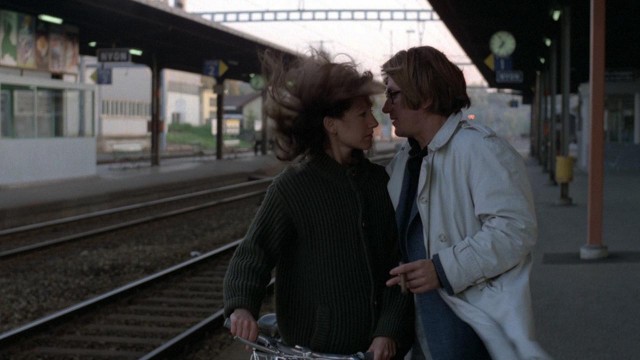
 In 1980, Jean-Luc Godard told journalist Jonathan Cott, “When you have a first love, a first experience, a first movie, once you’ve done it, you can’t repeat it,” the French auteur said about his latest film, Every Man for Himself, which he considered his “second first” film. “If it’s bad, it’s a repetition; if it’s good, it’s a spiral. It’s like when you return home — to mountains and lakes, in my case — you have a feeling of childhood, of beginning again. But in films, it’s very seldom that you have the opportunity to make your first film for the second time.” For Godard, whose real first film was 1960’s Breathless and who went on to make such other avant-garde masterworks as Contempt, Pierrot le Fou, Masculine Feminine, and Two or Three Things I Know About Her, Every Man for Himself might have been somewhat of a return to narrative, but only as Godard can do it. He still plays with form and various technological aspects, including a fascination with slow motion and an unusual, often very funny use of incidental music, and his manner of episodic storytelling would not exactly be called traditional. Sometimes it’s good, and sometimes it’s bad. Jacques Dutronc stars as mean-spirited, self-obsessed Swiss television director Paul Godard, who has recently broken up with his girlfriend, Denise Rimbaud (Nathalie Baye), who wants to leave their apartment in the city for the idyllic greenery of the country. (Yes, the characters have such names as Godard and Rimbaud, and the voice of Marguerite Duras shows up.) Paul then meets a prostitute, Isabelle Rivière (Isabelle Huppert), who is interested in Paul and Denise’s apartment, planning on bettering her life even as she still must submit to the whims of her clients, including a businessman who orchestrates a strange orgy that would make Secretary’s James Spader proud.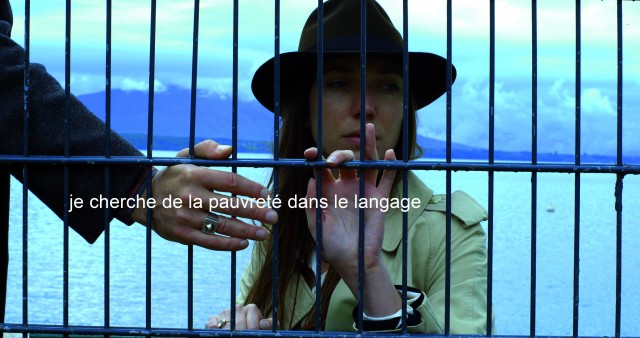
 After the New York Film Festival advance press screening of Jean-Luc Godard’s 3D Goodbye to Language, a colleague turned to me and said, “If this was Godard’s first film, he would never have had a career.” While I don’t know whether that might be true, I do know that Goodbye to Language is the 3D flick Godard was born to make, a 3D movie that couldn’t have come from anyone else. What’s it about? I have no idea. Well, that’s not exactly right. It’s about everything, and it’s about nothing. It’s about the art of filmmaking. It’s about the authority of the state and freedom. It’s about extramarital affairs. It’s about seventy minutes long. It’s about communication in the digital age. (Surprise! Godard does not appear to be a fan of the cell phone and Yahoo!) And it’s about a cute dog (which happens to be his own mutt, Miéville, named after his longtime partner, Anne-Marie Miéville). In the purposefully abstruse press notes, Godard, now eighty-three, describes it thusly: “the idea is simple / a married woman and a single man meet / they love, they argue, fists fly / a dog strays between town and country / the seasons pass / the man and woman meet again / the dog finds itself between them / the other is in one / the one is in the other / and they are three / the former husband shatters everything / a second film begins / the same as the first / and yet not / from the human race we pass to metaphor / this ends in barking / and a baby’s cries.” Yes, it’s all as simple as that. Or maybe not.

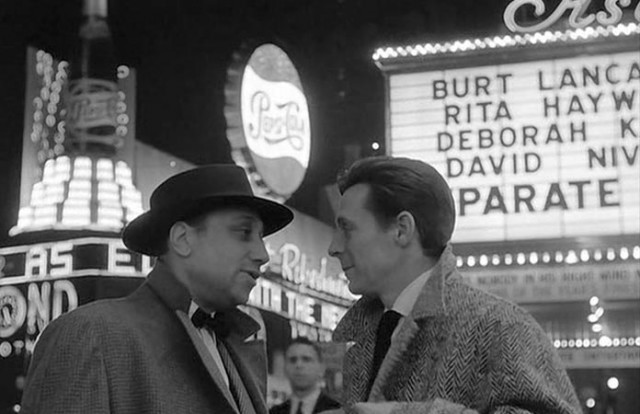
 When French U.N. delegate Fèvre-Berthier goes missing in director Jean-Pierre Melville’s 1959 noir, Two Men in Manhattan, reporter Moreau (Melville) of the French Press Agency and freelance photographer Pierre Delmas (Pierre Grasset) go out on the town, trying to find out what happened. While Moreau is seeking the truth, Delmas is after a sensationalist photograph he can sell to the highest bidder. They meet up with several women who knew the married diplomat — some much better than others — including his secretary, Françoise Bonnot (Colette Fleury), actress Judith Nelson (Ginger Hall), stripper Bessie Reid (Michèle Bailly), and jazz singer Virginia Graham (Glenda Leigh). As the men make their way through Rockefeller Plaza, Times Square, Greenwich Village, Broadway, the subway, and the United Nations, Marial Solal’s and Christian Chevallier’s jazzy score dominates the outdoor scenes, soaking the viewer in the New York at night atmosphere. And all the while, the reporter and photographer are trailed by someone in a mysterious car. As they get closer to their destination, they are faced with some serious ethical choices, not just about journalism, but about life itself. Nearly fifty-five years after its release, Two Men in Manhattan feels as stiff and dated as Melville’s (Bob le Flambeur, Le Doulos, Le Samouraï) lead performance, his only starring role and his sole appearance in one of his own films. It’s difficult to tell if Two Men in Manhattan is a serious procedural, an homage to classic noirs, a tribute to New York City, or a sly genre parody — perhaps it’s all of them, but far too many of the twists and turns are hard to swallow, especially when it comes to Delmas’s selfish decisions and Moreau’s often absurd brainstorms that seem to exist just to quicken the plot despite their incredulity. Still, it’s beautifully shot in shadowy darkness by Nicholas Hayer, and it was proclaimed by Jean-Luc Godard to be the second best film of the year. A digitally remastered version of Two Men in Manhattan is screening March 4 at 4:00 & 7:30 as part of the FIAF CinéSalon series “Remastered & Restored: Treasures of French Cinema”; the later screening will be presented by Phillip Lopate, and both shows will be followed by a wine reception. The three-month festival continues March 11 with Claire Denis’s Chocolat, introduced by African Film Festival founder Mahen Bonetti, before concluding March 18 with Henri-Georges Clouzot’s The Truth.