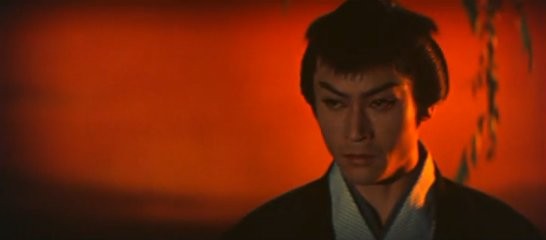
Penniless samurai Iemon Tamiya (Shigeru Amachi) plots a murderous path to success in GHOST STORY OF YOTSUYA
GLOBUS FILM SERIES 2013: GHOST STORY OF YOTSUYA (TOKAIDO YOTSUYA KAIDAN (Hirokazu Kore-eda, 2009)
Japan Society
333 East 47th St. at First Ave.
Wednesday, February 27, $12, 8:00
Series runs February 27 – March 10
212-715-1258
www.japansociety.org
 Last year, Japan Society’s Globus Film Series, “Love Will Tear Us Apart,” featured contemporary films from Japan and Korea that explored love, sex, fetishism, and violence in unusual ways. This year Globus focuses its attention on the Japanese film studio Shintoho, which broke off from the famous Toho Company during a strike and went on to make more than five hundred movies during the 1950s and 1960s, many becoming low-budget cult classics. Curated by Mark Schilling, “Into the Shintoho Mind War: Girls, Guns & Ghosts from the Second Golden Age of Japanese Film” kicks off February 27 with Nobuo Nakagawa’s Ghost Story of Yotsuya (Tokaido Yotsuya Kaidan), an oft-told Macbeth-like tale based on an 1825 kabuki play written by Tsuruya Nanboku IV. Filled with ambition and no moral code, penniless samurai Iemon Tamiya (Shigeru Amachi) and his servant, Naosuke (Shuntarô Emi), decide to murder their way up the ladder to success. First they meet the innocent sisters Iwa (Katsuko Wakasugi) and Sode (Noriko Kitazawa), but they have to get rid of Iwa’s fiancée, Yomoshichi (Ryûzaburô Nakamura), if Iemon is to marry her and then Naosuke is to take Sode. Once Iemon and Iwa wed and have a child, he starts eyeing Ume Itô (Junko Ikeuchi), whose wealthy father could lift his still-low standing, but that means Iemon would have to dispose of Iwa and her loyal friend, Takuetsu (Jun Ôtomo). However, as Iemon soon finds out, death does not necessarily deny vengeance. Shot in lurid reds and greens by Tadashi Nishimoto, Ghost Story of Yotsuya takes quite a while to get going, spending far too much time establishing Iemon and Naosuke as evil characters with no conscience, but once it delves into the horror realm, it becomes wickedly good fun, including fantastic makeup and genuine chills, along with plenty of strangeness. Much of the film doesn’t make sense, and some of it is downright monotonous, but the ending is quite a memorable one. The screening at Japan Society will be followed by the Enka Ecstasy party, with attendees encouraged to wear black-and-white clothing with two color accessories (we suggest red and green, of course); Neo Blues Maki will perform. The series, with all films being New York premieres, continues through March 10 with Teruo Ishii’s Flesh Pier and Yellow Line, Yoshiro Ishikawa’s Ghost Cat of Otama Pond, Michiyoshi Doi’s The Horizon Glitters, Toshio Shimura’s Revenge of the Pearl Queen, Kyotaro Namiki’s Vampire Bride, and Nakagawa’s Death Row Woman.
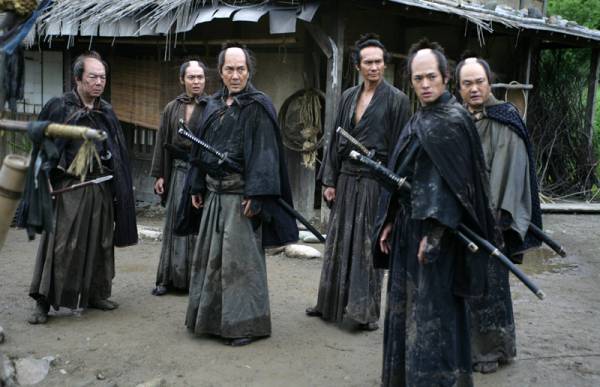
 Japanese director Takashi Miike’s first foray into the samurai epic is a nearly flawless film, perhaps his most accomplished work. Evoking such classics as Kurosawa’s Seven Samurai, Mizoguchi’s 47 Ronin, Aldrich’s The Dirty Dozen, and Eastwood’s High Plains Drifter, 13 Assassins is a thrilling tale of honor and revenge, inspired by a true story. In mid-nineteenth-century feudal Japan, during a time of peace just prior to the Meiji Restoration, Lord Naritsugu (Gorô Inagaki), the son of the former shogun and half-brother to the current one, is abusing his power, raping and killing at will, even using his servants and their families as target practice with a bow and arrow. Because of his connections, he is officially untouchable, but Sir Doi (Mikijiro Hira) secretly hires Shinzaemon Shimada (Kôji Yakusho) to gather a small team and put an end to Naritsugu’s brutal tyranny. But the lord’s protector, Hanbei (Masachika Ichimura), a former nemesis of Shinzaemon’s, has vowed to defend his master to the death, even though he despises Naritsugu’s actions. As the thirteen samurai make a plan to get to Naritsugu, they are eager to finally break out their long-unused swords and do what they were born to do. “He who values his life dies a dog’s death,” Shinzaemon proclaims, knowing that the task is virtually impossible but willing to die for a just cause. Although there are occasional flashes of extreme gore in the first part of the film, Miike keeps the audience waiting until he unleashes the gripping battle, an extended scene of blood and violence that highlights death before dishonor. Selected for the 2009 Cannes Film Festival and nominated for the Silver Lion at the 2010 Venice Film Festival, 13 Assassins is one of Miike’s best-crafted tales; nominated for ten Japanese Academy Prizes, including Best Picture, Best Director, Best Screenplay (Daisuke Tengan), Best Editing (Kenji Yamashita), Best Original Score (Koji Endo), and Best Actor (Yakusho), it won awards for cinematography (Nobuyasu Kita), lighting direction (Yoshiya Watanabe), art direction (Yuji Hayashida), and sound recording (Jun Nakamura). 13 Assassins is screening at Japan Society on July 21 at 8:20 as part of the Japan Cuts sidebar “Focus on Kôji Yakusho” and will be introduced by the actor; the July 20-21 mini-festival also includes such other Yakusho vehicles as his directorial debut, Toad’s Oil, as well as Shuichi Okita’s The Woodsman and the Rain, the New York premiere of Masato Harada’s Chronicle of My Mother, Kiyoshi Kurosawa’s Cure, and Masayuki Suo’s original Shall We Dance?