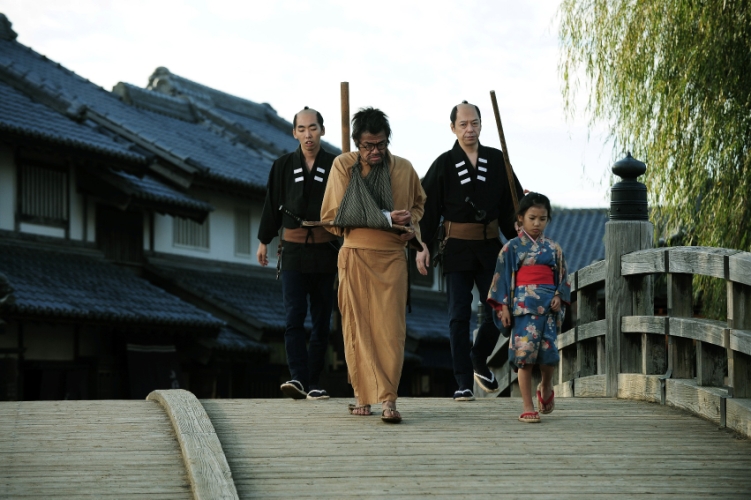
Nomi faces a daunting task in Hitoshi Matsumoto’s SCABBARD SAMURAI
SCABBARD SAMURAI (SAYA ZAMURAI) (Hitoshi Matsumoto, 2011)
Friday, July 6, Film Society of Lincoln Center, Walter Reade Theater, 165 West 65th St. at Amsterdam Ave., 212-875-5601, 3:30
Saturday, July 14, Japan Society, 333 East 47th St. at First Ave., 212-715-1258, 1:00
www.subwaycinema.com/nyaff12
 Having given up on life following the death of his wife, wayward samurai Nomi Kanjuro (first-time actor Takaaki Nomi) roams nineteenth-century Japan with an empty scabbard, running away from confrontation while accepting the verbal wrath of his extremely embarrassed nine-year-old daughter, Tae (Sea Kumada). After surviving three fanciful and fantastical — and far too silly and stylized — attacks by a trio of oddball bounty hunters (Ryo, Rolly, and Zennosuke Fukkin), Nomi is arrested and brought to a castle where the boy prince has not cracked even the hint of a smile since the recent death of his mother. Nomi is faced with the 30-Day Feat — every day for a month, he has the opportunity to try to make the prince smile. If Nomi fails, he must commit a very public seppuku. And so begins a comic series of events in which the dour Nomi, who barely ever speaks, turns into a kind of dark clown, but it’s clear that it’s going to take something very special to end the prince’s dilemma. Written and directed by Hitoshi Matsumoto (Big Man Japan, Symbol), Scabbard Samurai is an offbeat, charming black comedy about going on with life after experiencing tragic loss. Nomi is forced to try to make the boy prince smile, yet Nomi does not smile himself, rejecting his future even through the taunts of his daughter, who is very much alive and wants a more satisfying life. The inclusion of the three bounty hunters, who form a kind of Greek chorus, is unnecessary and detracts from the story’s otherwise more serious themes, but Scabbard Samurai is still an entertaining film that continually takes surprising twists and turns. Scabbard Samurai is screening July 6 at the Film Society of Lincoln Center and July 14 at Japan Society, a copresentation of the New York Asian Film Festival and Japan Cuts.

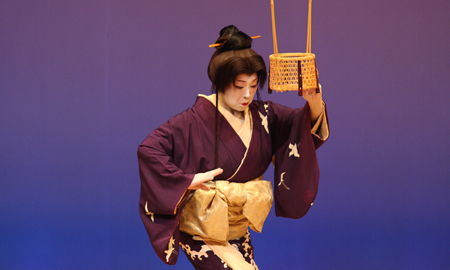
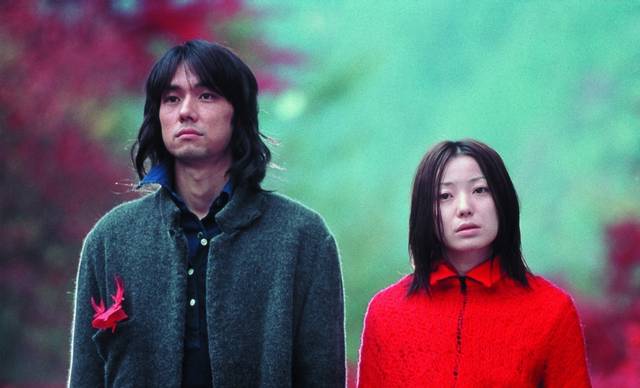
 Takeshi Kitano, who is best known for such violent films as Sonatine, Brother, and Zatoichi, has also made family dramas and romances as well (Kikujiro, A Scene at the Sea), and Dolls might be his most emotional, introspective picture to date. Dolls opens with a Bunraku puppet theater excerpt from Monzaemon Chikamatsu’s The Courier for Hell before delving into the dark story of Matsumoto (Hidetoshi Nishijima) and Sawako (Miho Kanno). Matsumoto dumps Sawako so he can marry the boss’s daughter, but when Sawako tries to kill herself and ends up in a mental hospital, Mastumoto decides to take care of the speechless, frightened shell of a woman she has become. He leads her through the seasons, tied to her by a red cord, a pair of bound beggars. Two subplots, which we’re not sure were absolutely necessary, also deal with love and loss, obsession and desire. Joe Hisaishi’s music is gorgeous, as is Katsumi Yanagijima’s cinematography. Kitano, who wrote, directed, and edited Dolls, mixes in sensational colors to balance out black-and-white tuxedos or long patches of snow: You’ll be mesmerized by the red rope, a purple-and-black butterfly, Sawako’s pink child’s toy, a glowing blue bridge, Matsumoto’s bright yellow car, a green public phone, a blue drink, twirling pinwheels, a shockingly blue umbrella, a park filled with cherry blossoms, and Yohji Yamamoto’s sparkling costumes. The film is bleak, slow-paced, and heart-tuggingly pure, a rewarding experience that will stay with you for a long time. Dolls is screening March 23 as part of Japan Society’s “Sakura — Spring Renews, Beauty Blooms” festival, which also includes such films as Nagisa Oshima’s Taboo, Hirokazu Kore-eda’s Hana: The Tale of a Reluctant Samurai, and Hiroshi Inagaki’s The 47 Loyal Ronin.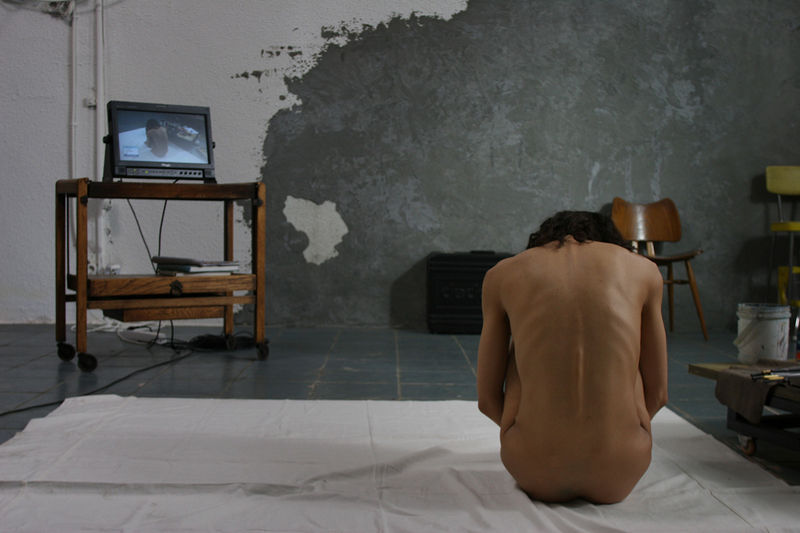

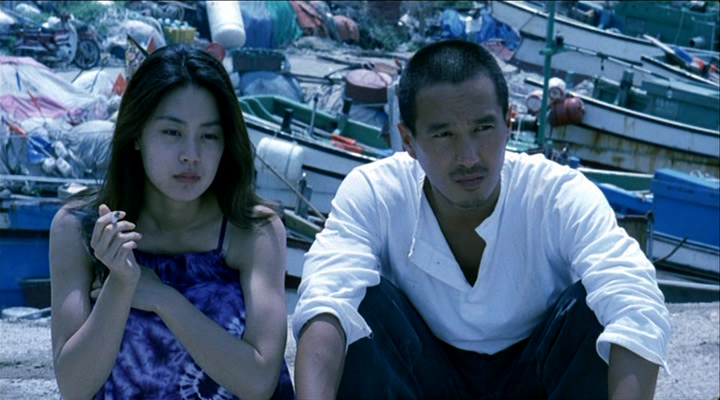
 Kim Ki-duk has made a number of excellent films, but Bad Guy is not one of them. Instead, it’s a preposterous, painfully puerile, and deeply misogynistic movie that is insulting from start to finish. Although it’s only a hundred minutes long, it feels like a thousand. Won Seo stars as Sun-hwa, a college girl who gets conned by Han-ki (Cho Je-hyun) into becoming a prostitute to pay off a false debt. He watches her transformation through a two-way mirror while one of his henchmen, Myung-soo (Choi Duk-moon), thinks he has fallen in love with her himself. Lots of sex and violence ensue, most of which makes no sense and is as unbelievable as the premise. The evening concludes at 7:30 with Kim’s 2008 Dream, a tale in which two people’s dreams intersect.