Tag Archives: Isabella Byrd

GEOFF SOBELLE: FOOD

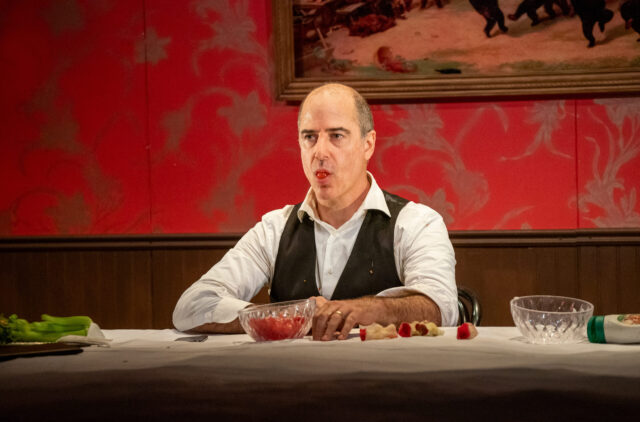
Geoff Sobelle enjoys quite a meal in Food (photo by Stephanie Berger)

FOOD
BAM Fisher, Fishman Space
321 Ashland Pl.
November 2-18, $20
718-636-4100
www.bam.org
www.geoffsobelle.com

In his 1825 book Physiology of Taste or Meditations on Transcendental Gastronomy, French lawyer and culinary expert Jean Anthelme Brillat-Savarin wrote, “Tell me what you eat and I shall tell you what you are,” which eventually morphed into the simpler, more familiar phrase “You are what you eat.”

If that is true, I have genuine concerns for theater artist Geoff Sobelle.

The Brooklyn-based Sobelle is back at BAM’s appropriately named Fishman Space — yes, seafood is on the menu — with Food, his latest foray into magical storytelling that includes HOME and The Object Lesson. But getting a ticket might be harder than reserving a table at one of the city’s hottest restaurants.

The eighty-minute piece might feed your hunger for unique and unusual entertainment, but it won’t satisfy your stomach; no food or drink is served, although it will be seen, sniffed, and touched. But Sobelle will satiate your appetite for pure, unadulterated pleasure with the show, in which he reimagines the concept of “farm to table” as he explores humanity’s overconsumption and preference for capitalism at the expense of the natural environment.

Sobelle is an ingenious storyteller, incorporating unexpected props, analog technology, and audience participation into his presentations. Food unfurls around a large dinner table with fancy place settings, evoking both Judy Chicago and Luis Buñuel; ten audience members are seated on each of three sides, with several rows of traditional rafters behind them. Above the table is a large chandelier made of recycled plastic kitchen items, including bottles, cups, knives, spoons, and containers.
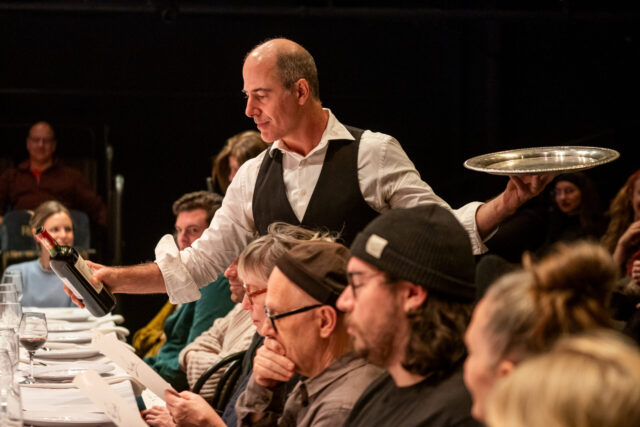
Geoff Sobelle pours wine in ingenious solo show Food (photo by Stephanie Berger)

Sobelle appears about fifteen minutes before the official start time, speaking with the ushers and scouting the crowd for potential contributors. He begins the evening with a meditative session asking the audience to close their eyes and imagine themselves back in the primordial ooze from which life emerged, all the way through to the current age, where human greed is on the verge of destroying the planet.

He then pours wine for those sitting at the table and gives several people menus; he brings each a plate with a microphone on it and takes their orders. The menus contain prompts that kick off food-related shtick that is very funny while also making salient points about where our food comes from and how and where we eat it. For example, when the person next to me ordered a baked potato, Sobelle planted seed pieces in dirt and then pulled the potato from the mound, wrapped it in aluminum foil, held a lit match under it, and had our side of the table pass the “hot potato” to the expectant orderer.

Some of the prompts ask the audience member to describe a favorite meal and how to make it, leading to some exquisitely detailed recipes related off the cuff. As I hungrily listened to these descriptions, my mind raced, wondering what I would say if Sobelle brought the microphone to me.

A significant portion of the enjoyment of the show relies on the improvisatory skills of the audience, which will of course change every night. Judging from photos I’ve seen of what Sobelle has eaten at other performances — I don’t want to give anything away, but he does devour a rather unique meal, one that is beyond awe-inspiring and far from mouthwatering — his menu changes each evening as well, a commentary on gluttony of all sorts, not just comestibles.

Sobelle accomplishes various tricks and sleight-of-hand with frequent collaborator Steve Cuiffo, an illusionist who revealed his lifelong relationship with magic in Lucas Hnath’s A Simulacrum. Also contributing to the warm and intimate atmosphere of fun and fascination are lighting designer Isabella Byrd and sound designer Tei Blow. Sobelle codirects the show with Lee Sunday Evans, who has helmed such unique theater pieces as Dance Nation, Intractable Woman: A Theatrical Memo on Anna Politkovskaya, and Sobelle’s HOME, in which dancers and designers build a house onstage and move in.

A chandelier of recycled plastic hangs over an immense dinner table in Food at BAM (photo by twi-ny/mdr)

Once Sobelle is finished with his “meal,” he transforms the table into something else entirely and takes off on another narrative into the past, with a series of surprises that are simply dazzling and filled with amazement. Again, I don’t want to spoil it, but I do have to admit that one particular object, a well-known holiday toy, took me back to my childhood, as did a discussion of diners. Suddenly I was ten years old, ordering the twin-cheeseburger platter and asking my father if, like him, my “potato and vegetable” side dishes could be French fries and French fries. Sobelle’s show goes from the macro to the micro, revealing the who, what, where, when, and how behind the cultivation, acquisition, consumption, and cost of food and other items, making us question their impact on the health, and wealth, of our nation.

But a final word of caution: You are probably better off eating before the show than after, as the environmental cost of food will have a deep-seated effect on your appetite.

[Mark Rifkin is a Brooklyn-born, Manhattan-based writer and editor; you can follow him on Substack here.]


INFINITE LIFE

Annie Baker’s Infinite Life takes place at a pain clinic in Northern California (photo by Ahron R. Foster)

INFINITE LIFE
Atlantic Theater Company
Linda Gross Theater
336 West 20th St. between Eighth & Ninth Aves.
Tuesday – Sunday through October 14, $50-$127
atlantictheater.org

“This is agony in its purest form,” Eileen (Marylouise Burke) says in Pulitzer Prize winner Annie Baker’s exquisite new play, Infinite Life, which opened this week at the Atlantic. “A minute of this is an infinity.”

It is never agony watching anything by Baker, whose previous wide-ranging and insightful works include The Flick, Circle Mirror Transformation, The Antipodes, John, and The Aliens. She made her off-Broadway debut at the Atlantic in 2008 with Body Awareness, about which she told the New York Times, “My goal for the play is to not judge anyone, to get at that point where everyone is equally right and equally wrong, so the humor comes from that.” The same can be said for Infinite Life, about six characters who are deeply aware of their bodies, riddled with pain.

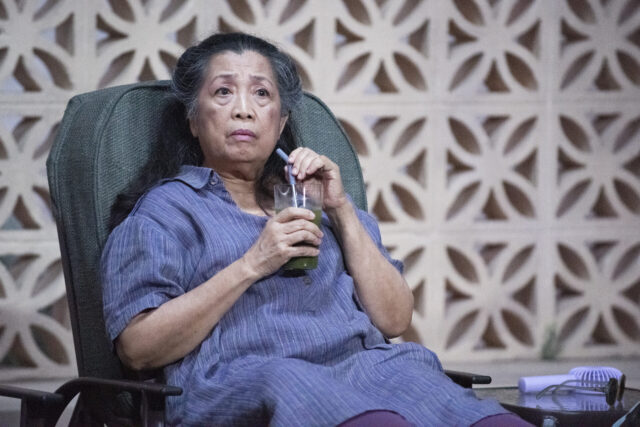
The play takes place in 2019 at a Northern California clinic run by an unseen man named Erkin, who treats chronic pain sufferers, mainly women, with water or juice fasts for days or weeks at a time. Eileen, Yvette (Mia Katigbak), Ginnie (Kristine Nielsen), and Elaine (Brenda Pressley) spend most of their time lying on deck chairs and gossiping, but this is no day at the beach. When they are joined by younger newcomer Sofi (Christina Kirk), they are intrigued and pepper her with questions; at first Sofi doesn’t want to share too much but soon reveals more, which tickles the other women’s curiosity. She is reading George Eliot’s final novel, Daniel Deronda, which deals with culture and identity, class and morality, centered by a seemingly heroic male figure and written by a woman who had to pretend she was a man in order to get published.

Eileen (Marylouise Burke) and Sofi (Christina Kirk) discuss life in Atlantic world premiere (photo by Ahron R. Foster)

Ginnie is a flight attendant from the local area who has “auto-immune thyroid stuff,” vertigo, and no filter, freely discussing pornography, carbonation, cantaloupes, rape, and how many sphincters humans have. Elaine, from New Hampshire, is a grandmother who has chronic Lyme disease and likes to draw. Yvette is a Michigander who is in surprisingly good spirits given her severe bladder issues and other health problems. Eileen, the oldest, is a Christian from Wichita who doesn’t appreciate cursing and walks very slowly, her constant pain palpable.

The women are thrown off balance when Nelson (Pete Simpson) arrives, a hunk of a fortysomething man, barefoot and bare-chested, surrounded by an air of mystery. “Who’s Daniel Deronda?” he asks Sofi. “Yeah, I think he’s actually the main character — we met him at the very beginning of the book — but he hasn’t reappeared yet so I don’t know that much about him.” The two of them build a flirtatious relationship that somewhat echoes Eliot’s book as each of the characters delve deeper into their personal situations.

A coproduction with London’s National Theatre, Infinite Life is not just about pain; it specifically focuses on the psychological, emotional, and physical pain inflicted on women by society. When Nelson ultimately shares his illness with Sofi and describes his most painful night, he explains, “I don’t know if you’ve been through childbirth but I met this lady who had the same thing happen to her and she said it was way worse than childbirth.” Sofi, who does not have children, replies, “You don’t actually know if your level of pain that night was worse than my level of pain on my worst night. It’s like impossible to know.” It’s also insulting for a man to compare his pain to a woman’s; Sofi later tells Eileen, “You know, I always feel like I’m lying when I say I’m in pain,” as if it’s just part of her existence that she has to accept. But Eileen counters, “The pain is an error. . . . We have to resist pain because resisting pain is resisting what isn’t true. The only true thing is the Infinite Idea, forever repeating itself.”

Earlier, in one of the many voice messages Sofi leaves for her silent husband, she says, “You must think I’m a monster. Maybe I am a monster. My body is monstrous. My mind is monstrous. So I’m a monster. Congratulations. You married a monster.” In Daniel Deronda, the protagonist, Gwendolen Harleth, argues, “People talk of their motives in a cut and dried way. Every woman is supposed to have the same set of motives, or else to be a monster. I am not a monster, but I have not felt exactly what other women feel — or say they feel, for fear of being thought unlike others.” Eliot’s novel might be set in Victorian England, but the sentiments still ring true today regarding societal expectations of women.

Yvette (Mia Katigbak) shares her astounding health history in Infinite Life (photo by Ahron R. Foster)

Director James Macdonald (Cloud Nine, The Children, Escaped Alone) masterfully guides each scene with with an intoxicating confidence that illuminates every moment. The comfy set by dots features seven chaises longues, ensuring that at least one is always empty, leading audience members to wonder what it would like to occupy one. Ásta Bennie Hostetter’s costumes are casual but not relaxed; only Ginnie and Nelson are dressed as if they are poolside, while the others are fully clothed and wear shoes. Isabella Byrd’s sharp lighting delineates the time of day, with Sofi calling out the shifts: “Twenty minutes later,” “Five hours later,” “Two days later. Maybe three days later?” Bray Poor’s sound includes crickets in the background, as if no one is listening to the women’s problems.

The fantastic cast is led by Kirk (Clybourne Park, Knickerbocker), who mixes sadness with a certain sex appeal, and Burke (Ripcord, True West), whose character offers a moving epiphany at the end. Katigbak (Out of Time, Awake and Sing!) and Nielsen (Gary: A Sequel to Titus Andronicus, Vanya and Sonia and Masha and Spike) give their characters a poignant warmth and charm, while Pressley (The Lyons, Dreamgirls) brings a strong practicality to Elaine. Simpson (Is This a Room, Measure for Measure) clearly relishes his role as the easygoing object of desire.

“I had to accept being in pain all the time,” Yvette says early on, as if speaking for all women. That acceptance, passed on from generation to generation, is questioned by Baker in the gorgeous finale, which, if it doesn’t promise relief, at least promises a more generous way to hold our human suffering.

[Mark Rifkin is a Brooklyn-born, Manhattan-based writer and editor; you can follow him on Substack here.]
PRIMARY TRUST

Kenneth (William Jackson Harper) has difficulty facing reality in Eboni Booth’s Primary Trust (photo by Joan Marcus)

PRIMARY TRUST
Roundabout at Laura Pels Theatre
Harold and Miriam Steinberg Center for Theatre
111 West 46th St. between Sixth & Seventh Aves.
Tuesday – Sunday through July 2, $56-$147
212-719-1300
www.roundabouttheatre.org

Eboni Booth’s sensational Primary Trust is an Our Town — or, more accurately, a My Town — for this very moment in time, in the twenty-first century. It beautifully captures the feelings of longing and loneliness so many of us experience in this digital age, especially coming out of a global pandemic permeated by isolation. Instantly a Best Play of the Year favorite, the ninety-five-minute show is anchored by a gorgeous performance by William Jackson Harper as Kenneth, our thirty-eight-year-old unreliable narrator and protagonist.

Primary Trust unfolds in the fictional community of Cranberry, New York, forty miles east of Rochester. Marsha Ginsberg’s lovely set is a miniature version of the town, with a bank, a tiki bar, a vacant shoe store, and a church; it is essentially Anywhere, USA. As the audience enters the theater, Chicago-born singer-songwriter and actor Luke Wygodny, is onstage, playing guitar. He later moves to keyboards off stage left, where he serves as the piano player at Wally’s and adds incidental music throughout.

The play begins with Kenneth addressing the audience. “This is what happened,” he says tentatively but with immense charm. “This is the story of how if you had asked me six months ago if I was lonely, I would have said . . . This is the story of a friendship. Of how I got a new job. A story of love and balance and time. And the smallest of chances.”

It’s clear from the start that Kenneth has social issues and is not well educated. He is haunted by the death of his mother, who died when he was only ten years old; he was raised in an orphanage and several foster homes. But instead of being angry or looking for excuses for his relative lack of success — he doesn’t see himself as a failure, seemingly enjoying his simple life — he is a gentle soul with a tender view of the world, or at least Cranberry, which is his entire world.

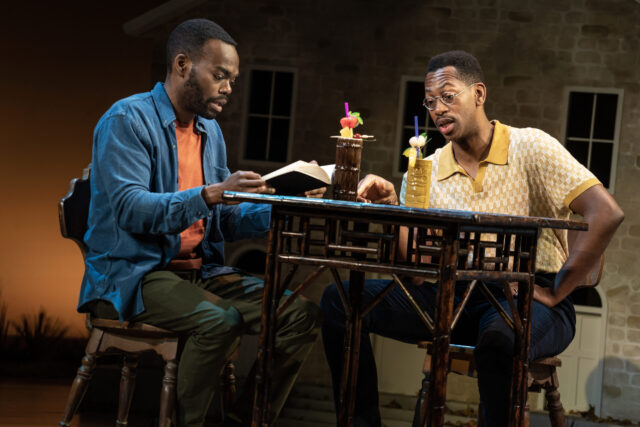
He’s been working as a clerk at a bookshop on Main St. for twenty years; his boss, Sam (Jay O. Sanders), treats him well. Every night, Kenneth goes to Wally’s, a tiki hut where he drinks mai tai after mai tai until the bar closes. He orders for two; he is always there with Bert (Eric Berryman), a married man with two daughters. Kenneth is not religious, but he explains, “I don’t really believe in God or heaven or hell, but I do believe in friends, and Bert is the best friend around.” They do just about everything together, but there’s one problem.

Kenneth (William Jackson Harper) spends most of his nights in a tiki bar with his best friend, Bert (Eric Berryman) (photo by Joan Marcus)

Bert is imaginary, and Kenneth knows it.

“He exists only in my head,” Kenneth reveals. “But that doesn’t make him any less real. He has arms and legs. A face, a heart — a good heart.”

Kenneth is generally an easygoing guy, but he becomes distressed when Sam tells him that he and his wife have sold the bookstore and are moving to Arizona. Desperate to find a job, he learns from Corinna (April Matthis), a waitress at Wally’s, that there’s an open position at the Primary Trust bank; Kenneth is interested because his mother used to work at Mutual Loan. Kenneth has trouble making important decisions without Bert, so he brings him along on the interview with Clay (Sanders), a good-natured bear of a man who takes a shine to Kenneth, as we all do, wanting him to succeed. “I have a brother,” Clay tells him. “Got into a car accident in high school, hit his head pretty bad. You remind me of him.”

Kenneth gets the job, but when he has one awful day, he’s not sure he’ll ever get over it as the careful life he’s created in his head is suddenly thrown off-kilter.

Kenneth’s (William Jackson Harper) life takes a new turn when he meets Corinna (April Matthis) (photo by Joan Marcus)

The Bronx-born Booth, who worked in bars and restaurants and has spoken about having a drinking problem, appeared in the terrific Dance Nation and Fulfillment Center, and her previous play, Paris, was set in a superstore in the fictional Paris, Vermont; she writes in a clear, familiar style that sucks you right in, offering a sweet affection for small-town living. In Primary Trust, she takes great care in every detail; even the names of the banks offer insight into Kenneth’s situation: His mother worked at Mutual Loan, evoking his need to be with her and not be alone, while he gets a job at Primary Trust, where he has to build confidence that he can handle life on his own and trust others.

Director Knud Adams, who helmed Paris and such other ensemble pieces as Sanaz Toossi’s Pulitzer Prize–winning English and Gracie Gardner’s hard-hitting I’m Revolting, guides the narrative with a touching and warmhearted hand that will have even the most cynical city dwellers feel sentimental about small town life, at least for an hour and a half. Qween Jean’s costumes, Isabella Byrd’s lighting, and Mikaal Sulaiman’s sound further immerse you into the bittersweet ups and downs of Cranberry.

Berryman (Toni Stone, The B-Side: Negro Folklore from Texas State Prisons) plays the kind of imaginary friend anyone would be lucky to have, even as we learn about where he came from. The always stalwart Sanders (Uncle Vanya, King Lear) is superb as Sam and Clay, two understanding father figures to Kenneth, as well as a funny garçon. Matthis (Help, Toni Stone) is a whirlwind playing multiple Wally’s waitresses and bank customers. Wygodny gets bonus time by occasionally interacting with Kenneth.

Harper (After the Blast, All the Way) is unforgettable as Kenneth, instilling in him a childlike sense of wonder and innocence; in many ways Kenneth is still that ten-year-old boy even as he realizes that he needs to start becoming an adult and accept his own responsibilities. Harper was nominated for an Emmy for his role on The Good Place portraying Chidi Anagonye, a moral philosopher and bundle of neuroses unable to make a decision; Kenneth feels like a natural progression for him. Kenneth is such a nice, well-meaning guy that you’ll want to be by his side, go with him to Wally’s and gulp a few mai tais, then comfort him when his loneliness overtakes him. You don’t have to have lost a parent, a job, or a best friend in order to relate to the isolation that envelops him. You just have to have empathy and compassion for other human beings, as well as yourself. There’s a reason why this town’s motto is “Welcome, Friend, You’re Right on Time!”

THE GOOD JOHN PROCTOR

Betty Parris (Sharlene Cruz), Abigail Williams (Susannah Perkins), and Mercy Lewis (Tavi Gevinson) get ready for another day of drudgery in The Good John Proctor (photo by Ashley Garrett)

THE GOOD JOHN PROCTOR
Connelly Theater
220 East Fourth St. between Aves. A & B
Tuesday – Saturday through April 1, $55-$85
bedlam.org

Arthur Miller’s 1953 The Crucible, the semifictionalized story of the 1692–93 Salem witch trials that was also an allegory about the House Un-American Activities Committee hearings and the McCarthyism of the late 1940s and early 1950s, centers around what happened after a group of young girls are spied dancing naked in the woods of a Puritan town. Among those involved were John Proctor, a prominent landowner who was ultimately accused of witchcraft, along with his third wife. Court records referred to him as “Goodman Proctor,” while a local petition testified that “they lived [a] Christian life in their family and were ever ready to help such as stood in need of their help.”

Talene Monahon’s The Good John Proctor, which opened this afternoon at the Connelly Theater on the Lower East Side from the city-based Bedlam company, is a decidedly feminist exploration of what might have occurred leading up to that evening in the woods, ultimately resulting in the witch trials and the death of twenty-five people. It’s telling that despite the title, John Proctor never appears in the play, and that irony grows when it is revealed just what Proctor did.

The Good John Proctor begins with nine-year old Betty Parris (Sharlene Cruz) and eleven-year-old Abigail Williams (Susannah Perkins) in their shared makeshift wooden bed. Betty, whose father is a minister, tells her best friend and cousin about a dream she had in which she flew over the forbidden woods. Abby advises that she should keep that dream a secret for fear of what others might think. “I wasn’t on a pole or a stick or anything or a broom!” Betty argues. “Did you feel wicked?” Abby asks. “I felt amazing,” Betty responds.

The world of the play is exclusively the world of the girls, described in their language (complete with some purposeful anachronisms). Neither adults nor men appear, yet the narrative is utterly convincing. References to both class and gender are subtle, clear, or sly, never heavy-handed. The cousins like to play-act as king and peasant, emphasizing the hierarchical division in the town. Foul-mouthed fourteen-year-old Mercy Lewis (Tavi Gevinson) stops by to gossip, drink cider, and rail against sin and Satan; her words are the window into the social and religious constructs of Salem. “There is wickedness everywhere,” Mercy, who is a servant for George Borroughs, another minister, proclaims. “I actually can’t believe how wicked this town has become.”

Betty Parris (Sharlene Cruz) is frightened by Mary Warren (Brittany K. Allen) in Bedlam production at the Connelly (photo by Ashley Garrett)

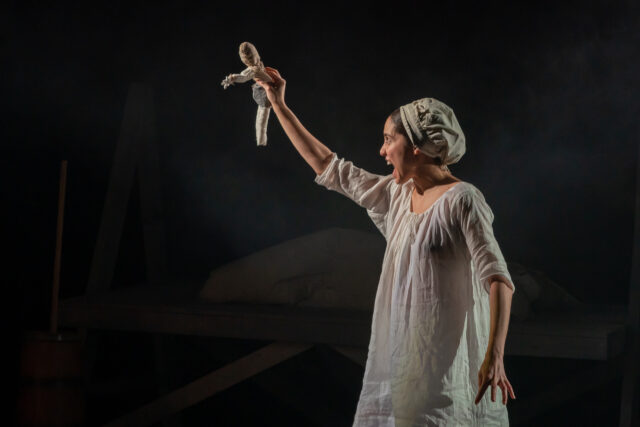
Soon Abby is at work serving John Proctor, while Betty plays with her rag doll, an alter ego that she has named Bangwell Put. Betty is surprised when a stranger, eighteen-year-old Mary Warren (Brittany K. Allen), shows up, listening to the birds sing, talking about looking for “something beautiful,” and wanting to fly through the woods.

The girls seem almost feral; mothers are dead or too depressed to care. Shortly after menstruating for the first time — she has no idea why she has bled, having never been taught about what a period is — Abby gets promoted, spending more time with John Proctor, much to the dismay of his jealous wife, Elizabeth. Meanwhile, Mercy continues to spread rumors and Mary gets closer to Betty as the girls consider taking their chances and heading into the woods.

Miller wrote in his notebook, “It has got to be basically Proctor’s story.” While Monahon (Jane Anger, or . . . , How to Load a Musket) fills the play with references to such other historically documented figures as the Putnams, Giles Corey, and the Goodwin sisters, we only meet the four “afflicted” girls. But The Good John Proctor is not just about this quartet; while Miller’s play was a parable about McCarthy’s obsession with the Red Scare, Monahon’s is about the plight of women from biblical times to the present day.

Betty, Abby, Mercy, and Mary are uneducated children whose feminine desires are considered sinful and blasphemous. Blood flows throughout the play, almost exclusively related to childbirth, from Betty’s horrific memories of her mother’s miscarriage (she has no idea what it actually was) to Abby’s menstruation, from Mary miming cutting the umbilical cord when they pretend Betty has given birth to Bangwell Put to Betty getting whipped for saying a bad word. “You might wake up one day and everything is red,” Mercy tells Abby, which recalls the game Abby played with Betty when Abby showed off her nonexistent royal robe. “It’s so big and red!” Betty shouted with glee. “Yes, yes it is red. The reddest robe in all the land,” Abby proudly declared.

The name Bangwell Put itself is a reference to a real rag doll a relative made for five-year-old blind girl Clarissa Field in 1770 in Northampton, Massachusetts. Clarissa kept the doll until her death in her eighties; it is believed to be the oldest extant rag doll in America, so it represents the struggle and survival of women over the centuries.

Betty (Sharlene Cruz) holds Bangwell Put aloft in The Good John Proctor (photo by Ashley Garrett)

In a sly comment on the dominance of men in the Bible, the name of Betty’s goat is Abraham, the father of Judaism; Betty wants to use the goat as a donkey she rides into town on, evoking how Jesus entered Jerusalem.

The cast is exceptional, with Perkins (The Low Road, The Wolves) portraying Abby with a delightful sense of wonder; Cruz (Sanctuary City, Mac Beth) appealing as the serious Betty; Gevinson (This Is Our Youth, Moscow Moscow Moscow Moscow Moscow Moscow), who played Mary in Ivo van Hove’s 2016 Broadway adaptation of The Crucible, appropriately dour as the ever-suspicious Mercy, and Allen (Human Resources, Redwood) infusing Mary with a captivating mystery. As a unit, they conjure various stages of a young girl on her way through adolescence to womanhood.

Directed by Caitlin Sullivan (Ohio, Panopticon) with a sure hand, the play does get a bit repetitive, even at only ninety-five minutes, but the staging, with dark, atmospheric lighting by Isabella Byrd, eerie sound by Lee Kinney, and effective period costumes by Phuong Nguyen, puts you right in the middle of 1691 Salem, especially when the girls finally enter the woods. Bedlam has previously put its mark on plays based on Jane Austen’s Persuasion and Sense and Sensibility in addition to George Bernard Shaw’s Saint Joan and Pygmalion, Henrik Ibsen’s Hedda Gabler, and the Chekhov-Shakespeare mashup Uncle Romeo Vanya Juliet; in 2019 the troupe presented its version of The Crucible. With The Good John Proctor, they have successfully silenced the men, taking back the story from Miller and McCarthy, letting us hear the female voices that have so long been muted, to better understand what witchery is really about.

PUBLIC WORKS: AS YOU LIKE IT

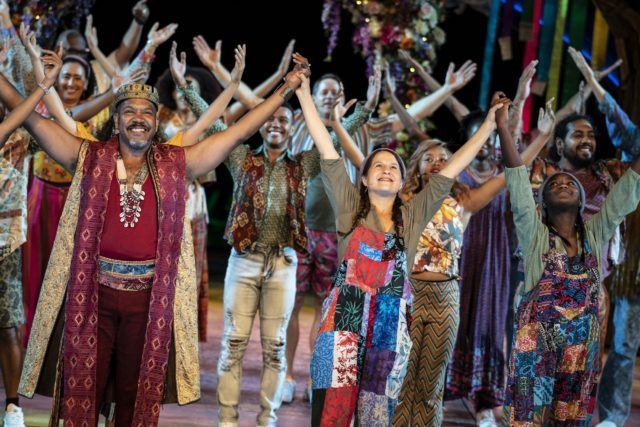
A diverse cast of amateurs and pros comes together in As You Like It at the Delacorte (photo by Joan Marcus)

AS YOU LIKE IT
Central Park, Delacorte Theater
Tuesday – Sunday through September 11, free, 8:00
publictheater.org

In celebration of the sixtieth anniversary of the Delacorte Theater and the tenth anniversary of the Public Theater’s Public Works program, which brings together professional artists and community members in short-run, large-scale productions, Shakespeare in the Park has brought back Public Theater artist-in-residence Shaina Taub and Public Works director Laurie Woolery’s 2017 adaptation of the Bard’s pastoral comedy favorite, As You Like It. Continuing in Central Park through September 11, the musical is a delightful take on the story of hidden identity, family dysfunction, and true love, set in and around the forest of Arden and given a decidedly twenty-first-century twist while often referencing the show.

“All the world’s a stage / and everybody’s in the show / Nobody’s a pro / All the world’s a stage / and every day, we play our part / acting out our heart / Year by year, we grow / learning as we go / trying to tell a story we can feel / How do you make the magic real?” Taub, as the melancholy Jaques, sings as a form of introduction, words that relate to the musical, to Public Works, and life itself.

Later, Duke Senior (usually portrayed by Darius de Haas but I saw Amar Atkins), who has been exiled by his younger brother, Duke Frederick (Eric Pierre), and leads a poor but tight-knit community in Arden, declares, “I will not be free / until we are all free / Under the greenwood tree / you shall see no enemy / Do not fear / All / All are welcome here,” letting everyone onstage and in the audience know that this is an inclusive experience. The cast of 127 features performers from ages 7 to 82, mostly amateurs, from partner organizations across the five boroughs: Brownsville Recreation Center, Casita Maria Center for Arts and Education, Center for Family Life in Sunset Park, Children’s Aid, DreamYard, Domestic Workers United, the Fortune Society, and Military Resilience Foundation. Each participant is listed in the program and gets to make a personal statement.

Taub, who wrote the music and lyrics, and Woolery, who directs, have created a multiethnic spectacle with key gender swaps, which deliver added depth to the narrative. Tired of being persecuted by his older brother Oliver (Renrick Palmer), orphaned gentleman Orlando (Ato Blankson-Wood, Trevor McGhie) believes he can prove his worth by winning a wrestling tournament. The bouts are hilariously choreographed in a ring that rises from below the stage; the competitors range from the masked and massive Bronco to Frankie Flow and a wiry and vicious caveman (actual lucha libre wrestlers from the Bronx Wrestling Federation).

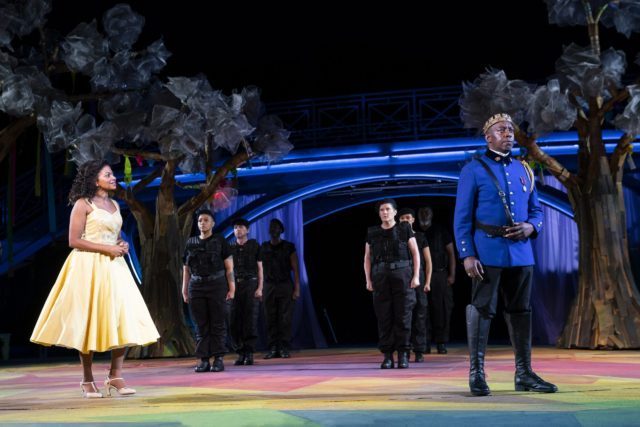
Rosalind (Rebecca Naomi Jones) is banished by her uncle, Duke Frederick (Eric Pierre), in Shakespeare adaptation (photo by Joan Marcus)

After pulling out a surprise victory, Orlando falls instantly in love with Rosalind (Rebecca Naomi Jones), the daughter of Duke Senior, and is subsequently banished by her uncle. Rosalind, accompanied by her best friend, Celia (Idania Quezada), Duke Frederick’s daughter, disguise themselves as Ganymede and Aliena, respectively, and head out into the forest joined by their loyal fool, Touchstone (Christopher M. Ramirez). Orlando flees the court and goes to Arden as well, seeking out his sweetheart.

Soon Orlando, not recognizing that Ganymede is in fact Rosalind, is befriended by his disguised love, who teaches him the art of wooing. Celia develops a liking for Oliver. Touchstone becomes desperate to hook up with farmhand Andy (Jonathan Jordan), who might have a thing for farmer William (Damion Allen). And shepherdess Silvia (Brianna Cabrera; Claudia Yanez) is mad for shepherdess Phoebe (Bianca Edwards), who wants nothing to do with her and instead develops a taste for Ganymede.

Distressed by Phoebe’s spurning, Silvia sings, “You Phoebe me / Why you gotta Phoebe me?” Phoebe cruelly retorts, “You say my glance is lethal / but girl, I know you’re lying / cause I’m giving you a death stare / and I don’t see you dying!” To “Phoebe” someone becomes a joke throughout the rest of the play.

Meanwhile, whenever Orlando bursts out into a solo, he is joined by a riotous backup group dressed in gleaming all-white, De Boys band dancers (Tristan André, Pierre Harmony Graves, Bobby Moody, Edwin Rivera), who groove with him seamlessly to the immense delight of the audience.

But trouble awaits when Duke Frederick decides to invade the forest and put an end to all the romantic shenanigans.

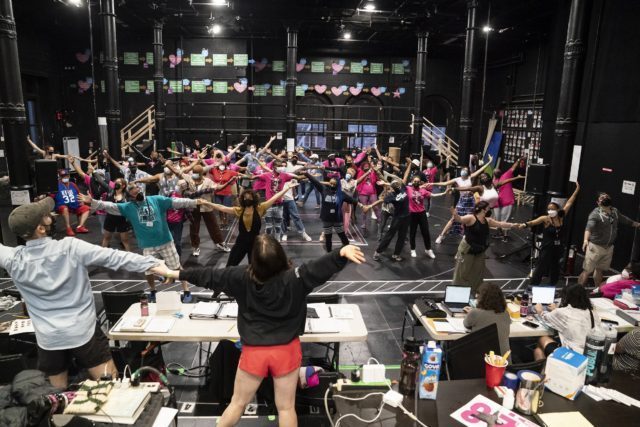
The large cast rehearses indoors for As You Like It (photo by Joan Marcus)

Taub, who previously adapted Twelfth Night for Public Works, serves as a kind of narrator as Jaques, appearing now and then to offer such warnings as “We shall make the same mistakes and never learn!,” “The worst fault you have is to be in love,” and “Give me leave to speak my mind and I will through and through cleanse the infected world, if they will patiently receive my medicine!” Of course, the medicine she and Woolery (Manahatta, Eureka) deliver is more than just a panacea but at the very least a temporary cure for whatever ails you.

The songs run the gamut from pop to R&B to rap and romantic ballads, with wonderful orchestrations by Mike Brun and original choreography by Sonya Tayeh, playfully restaged with additions by Billy Griffin. Duke Frederick’s entrances and exits are particularly memorable, accompanied by a royal guard that proclaims, “All hail Duke Frederick” to a melody that recalls the evil Imperial March theme from Star Wars, while the De Boys boy band brings down the house each time they put on the moves.

The set, anchored by a rear bridge and three trees on a revolving center, is by Myung Hee Cho, with lavish costumes by Emilio Sosa, lighting by Isabella Byrd, and sound by Sun Hee Kil. The animal puppets are by James Ortiz, the designer behind the remarkable puppets in The Skin of Our Teeth and Into the Woods.

The cast is a delight, from the leads to the bit players; in the program, the actors are listed alphabetically and each gets the same amount of space, three or four lines, whether it’s Taub, Jones, Blankson-Wood, or Ramirez or Vivian Jett Brown as Miss Amiens, Tommy Williams or Jason Asher as the referee, or Monica Patricia Davis or Alfreda Small as Ada.

The show was written in response to the 2016 presidential election and how it has torn apart the nation. It returns at a time when we all need healing and a way to come together despite our differences. In As You Like It, Jaques calls it “a miserable world,” but it’s significantly better with musicals like this in it.

EPIPHANY

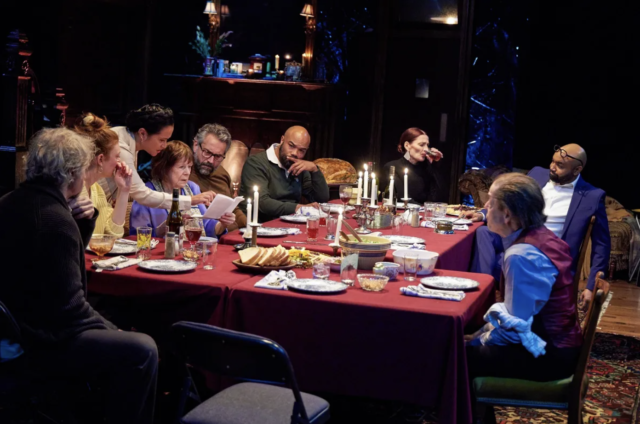
Brian Watkins’s Epiphany takes place at an awkward dinner party (photo by Jeremy Daniel)

EPIPHANY
Lincoln Center Theater at the Mitzi E. Newhouse
150 West 65th St. between Broadway & Amsterdam Ave.
Tuesday – Sunday through July 24, $92
212-362-7600
www.lct.org

In Brian Watkins’s Epiphany, continuing at Lincoln Center’s Mitzi E. Newhouse Theater through July 24, Aran (Carmen Zilles) reads from a letter to guests at a dinner party, “‘A new generation is growing up in our midst, a generation actuated by new ideas and new principles. But we are living in a special . . . ’ — sorry — “‘we are living in a skeptical and, if I may use the phrase, a thought-tormented age: and sometimes I fear that this new generation, educated as it is, will lack those qualities of humanity, of hospitality, of kindly humour which belonged to an older day. It seems to me, I must confess, that we were living in a less spacious age.’ No, that’s not right: ‘that we are living in a less spacious age.’ Well, I can’t tell if it says are or were.

The quote is taken nearly verbatim from James Joyce’s 1914 short story “The Dead,” which served as inspiration for Watkins’s play. But Watkins and director Tyne Rafaeli transport the tale, which also takes place at a dinner party, to modern times; in fact, though it premiered in 2019 in Ireland, the plot has been tweaked to comment on how the Covid-19 pandemic impacted the way humans relate to one another in what may or may not be a less spacious age.

Morkan (a sensational Marylouise Burke) is a woman of a certain age who has invited a diverse group of people to a dinner party celebrating the epiphany: Freddy (C. J. Wilson), a disheveled math teacher whom Morkan is afraid might drink too much; Sam (Omar Metwally), a well-respected psychiatrist, and his partner, the younger Taylor (David Ryan Smith), who is in marketing; a second couple, lawyer Charlie (Francois Battiste) and pianist Kelly (Heather Burns); Ames (Jonathan Hadary), one of Morkan’s oldest and dearest friends; and Gabriel, Morkan’s nephew and a famous writer who has promised to present a new work and is the main reason everyone has trudged through a snowstorm to come to the party at Morkan’s large country house outside an unidentified major city. Morkan has asked the twentysomething Loren (Colby Minifie) to help her with the food and drinks.

While they’re waiting for Gabriel, Morkan tells them that they have to surrender their phones — she refers to them as “thingamajigs” — and puts them in a box that is tantalizingly close. The guests, none of whom is well acquainted with anyone other than Morkan and the person they came with, are instantly rattled, acting as if a part of their body has been temporarily removed. They feel even more uncomfortable after it becomes evident that no one read any of the attachments Morkan included with the invitation, so they’re not prepared for all the activities she has planned, and they don’t know how to tell her. In addition, no one, including Morkan, knows what the word epiphany means or refers to.

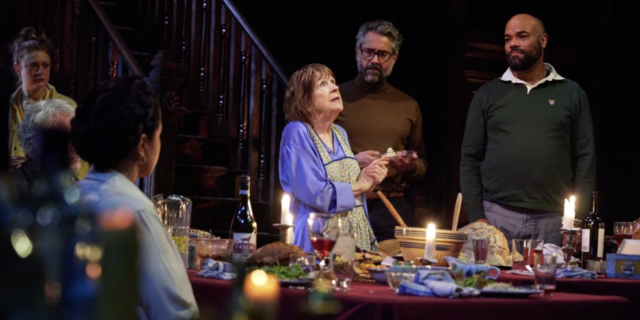
Marylouise Burke is sensational as a dinner party host forced to improvise (photo by Jeremy Daniel)

Charlie: Where did the whole celebration idea come from anyway?
Morkan: Well, that’s the question! I actually have very little idea of what epiphany actually is.
Loren: Oh. I thought this was part of your religion or something.
Morkan: Oh no no no, not at all, it’s just sort of a new curiosity, because . . . well, it’s been an odd twelve months. . . . I’m really so forgetful these days, which is why Gabriel is going to do a whole . . . overview thingy and give a speech with the history and all the answers to the whole yadda yadda.
Taylor: Of course he is.
Kelly: Fucking . . . brilliant man.
Morkan: But so, ok, show of hands, who has celebrated Epiphany?
Kelly: Like the idea? The idea I guess, privately, yes — the what? Oh no.
Morkan: The holiday. The holiday. Show of hands for the holiday.

No one raises their hand.

Morkan: Alright so, before I sent you all the stuff with the invitation . . . who knew what epiphany was?
Kelly: The idea or the holiday?
Morkan: The holiday of Epiphany.
Taylor: The general concept or —
Morkan: The holiday.
Taylor: Oh. No.
Freddy: Not me!
Morkan: Ok. Well. I have no idea what Epiphany is. We have no idea what Epiphany is. But the thing that struck my head was, ya know like . . . creating a tradition . . . How does that work?! Or even just creating a reason, to ya know, get together in a terrible month like January to celebrate life!

As if that weren’t enough, Aran, Gabriel’s partner, soon shows up to explain that Gabriel will not be coming after all, which adds further disappointment and awkwardness. But Morkan is determined to soldier on with music, poetry, intellectual conversation, and the goose she has cooked, leading to some prickly physical and verbal exchanges as the snow keeps falling.

At nearly two hours without intermission, Epiphany is too long, and some of the awkwardness onstage leaks into the audience; at times you might feel like you’re at a dinner party that is going nowhere but you can’t leave. In addition to Joyce, it’s got a bit of Luis Buñuel’s The Discreet Charm of the Bourgeoisie mixed in with Samuel Beckett’s Waiting for Godot, Agatha Christie’s And Then There Were None (without the murders), and the disastrous parties Mary Richards used to throw on The Mary Tyler Moore Show, all of which play with the idea of expectations.

A lot of those expectations have changed significantly since the pandemic lockdown, as people wrestle with who to gather with and where. Gabriel chooses not to go because of a deep depression; it’s not a stretch to think that it may have been caused, at least in part, by the coronavirus crisis and a fear of meeting up with people. I have great friends who still refuse to go to gatherings, whether indoors or outdoors. It can be hard to know when to hug, when to shake hands, when to kiss, and when to bump elbows, which is addressed in Epiphany.

The show also plays with the idea of time, something that was difficult to keep track of during the lockdown and still today, when many of us are working from home. Although the story appears to unfold in something close to real time, Morkan makes several confusing references near the end about how much time has passed that will leave you scratching your head and wondering whether her statements are plain mistakes or have another, not immediately clear meaning.

You’re unlikely to reach any epiphanies while at the Newhouse, but it’s not so bad when you’re spending time with such a terrific cast, comprising some of the city’s finest character actors. Drama Desk winner Burke (Ripcord, Fuddy Meers), in the starring role, is phenomenal, short of stature but long on doddering charm and effervescence, her creaky voice reaching poetic heights. Tony nominee and Obie winner Hadary (Gypsy, As Is) excels as Ames, especially after suffering what could be a serious injury that is handled with slapstick humor. Tony nominee and Obie winner Metwally (Sixteen Wounded, Guards at the Taj) is smooth as silk as the curious neuroscientist. And Minifie (The Boys, Punk Rock), dressed in a yellow outfit that just might have been the old color of the dining room, is wonderful as Loren, who has no idea what she has gotten herself into. (The costumes are by Montana Levi Blanco.)

John Lee Beatty’s set has a gothic charm to it, bar carts and tables hovering close to the audience seated in the first row, who could reach out and grab a drink or snack (but shouldn’t). The snow can be seen through two large windows; mysterious stairs go down to the front door and up to the bedrooms and bathroom, lending the house a ghostly atmosphere. Isabella Byrd’s moody lighting reminds everyone that the storm might knock out the electricity at any second, while Daniel Kluger’s sound often adds a chill to the air.

“Life has just felt so wobbly, so even though I’ve lived here over forty years I feel . . . dislocated . . . exiled, I suppose . . . And I’m not sure why,” Morkan says, essentially speaking for many in the theater. “But maybe that’s the world, I dunno . . . I feel like I’m not making any sense.” Perhaps the same can be said of our “thought-tormented age” itself.

CORSICANA

Justice (Deirdre O’Connell), Christopher (Will Dagger), and Ginny (Jamie Brewer) watch Mariah Carey in Glitter in Corsicana (photo by Julieta Cervantes)

CORSICANA
Playwrights Horizons, Mainstage Theater
416 West 42nd St. between Ninth & Tenth Aves.
Tuesday – Sunday through July 17, $35-$99
www.playwrightshorizons.org

In her acceptance speech for winning the Tony for Best Actress for her performance in Dana H., Deirdre O’Connell said, “I would love this little prize to be a token for every person who is wondering, ‘Should I be trying to make something that could work on Broadway or that could win me a Tony Award? Or should I be making the weird art that is haunting me, that frightens me, that I don’t know how to make, that I don’t know if anyone in the whole world will understand?’ Please let me standing here be a little sign to you from the universe to make the weird art.”

O’Connell has followed up Dana H., in which she never speaks but instead remarkably conveys a prerecorded true story told by playwright Lucas Hnath’s mother, with Will Arbery’s Corsicana, which has its fair share of weird, starting with the word itself, which is spoken two dozen times by the four characters, each of whom lives in their own reality.

Corsicana takes place in the Texas town named after the island of Corsica. Thirty-three-year-old Christopher (Will Dagger) is a teacher and an aspiring filmmaker who lives with his thirty-four-year-old half sister, Ginny (Jamie Brewer), in the family’s ranch house. They are often visited by the sixtysomething Justice (Deirdre O’Connell), who was best friends with their recently deceased mother.

After her mom’s death, Ginny, who has Down syndrome, is looking for something new to do. She doesn’t want to go back to her job at the nursing home or rejoin the choir because she feels she doesn’t belong. “I’m worried. I can’t find my heart,” she tells her brother.

Ginny had suggested that Ginny meet her friend Lot (Harold Surratt), a sixtysomething reclusive artist and musician who has just been “discovered” via a magazine article; Christopher thinks it might be good for Ginny to write a song with Lot, who previously played an original song for Christopher called “Weird.” (The original music is by singer-songwriter and visual artist Joanna Sternberg.)

A self-taught outsider artist, Lot is a loner who has trouble communicating directly with others, speaking in a sharp, straightforward manner, using few words and prone to non sequiturs; he has no phone or computer. He doesn’t want to interact with either the virtual or real world. And although he believes he may be neurodivergent, he is not about to be a babysitter for a woman with special needs.

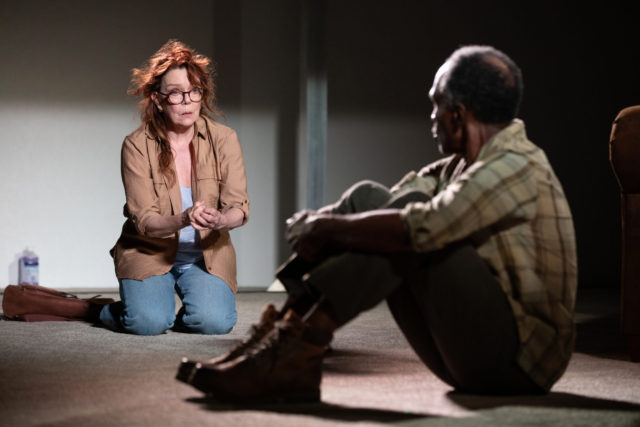
Justice (Deirdre O’Connell) pleads with Lot (Harold Surratt) in new Will Arbery play (photo by Julieta Cervantes)

He tells Christopher: “Yeah, I know ‘special needs.’ Why’d you come here? I know the place in the high school. The hallway in the high school. You know I’m not one of them, right?” Christopher replies, “What?” Lot: “I’m not special needs.” Christopher: “Oh — I didn’t think you were. I assumed the opposite.” Lot: “What’s the opposite? I was only a couple years in that hallway. And they knew I didn’t belong. Got a graduate degree in my forties. So don’t worry about me.” Christopher: “Oh, cool. In what?” Lot: “Experimental mathematics. I proved the existence of God.” Christopher: “Are you serious? Can I see?” Lot: “I threw it away. Art’s a better delivery system.”

Art may be a better delivery system, but Lot prefers not to show anyone his work or exhibit in a gallery, or to even sell it. When Justice, who believes she is being trailed by a ghost, asks to see his latest sculpture, he declares, “No, it’s not ready! You’re not allowed to look back there.” The audience is not allowed to look either; none of Lot’s work is ever revealed. He later compares capitalism and consumption as a “prison . . . a man-made evil.” He also claims that they are all surrounded by dinosaur ghosts.

As the characters continue to interact with one another, Lot is fearful about becoming part of something. “You trying to get me to believe in community?” he asks Justice, who replies, “No. I have no agenda.” Lot: “Uh-huh.” Justice: “What do you have against community?” Lot: “I don’t have to have all the same opinions as you,” as if choosing to spend time with people is an opinion.

But he does find common ground with Ginny, explaining that the two of them are “so complicated, people don’t want to think about it. So they make us more simple. In their brains. They don’t think about it, and they call us simple. And everything is about our needs. All our little needs. Our special needs. Everyone around us becoming burdened by our constant need. And if there’s something that we want? Well, it’s for them to decide if we really need it.”

Over the course of the play, all the characters find some form of commonality with the others while also maintaining barriers, particularly when it comes to physical contact of any kind. “People have to understand touch, and ask for permission, and respect boundaries,” Ginny tells Lot. “Touch can cause problems.”

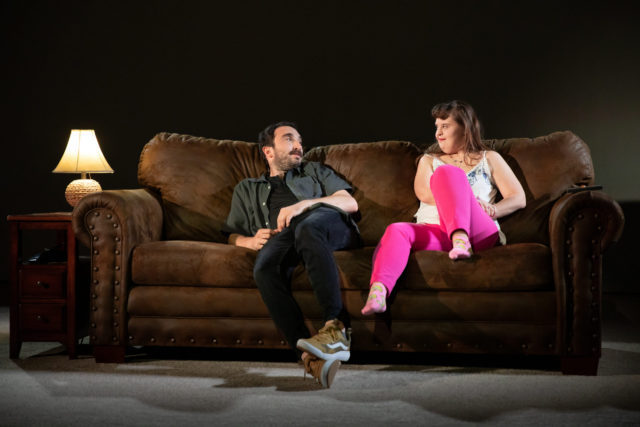
Obie- and Tony-winning director Sam Gold, who has helmed such marvelously inventive productions as Fun Home, John, and A Doll’s House, Part 2 in addition to critically lambasted versions of King Lear, Hamlet, and Macbeth, injects Corsicana with, well, a weird edge throughout. Laura Jellinek and Cate McCrea’s stage consists of a pair of rotating brown couches set against a white backdrop and ceiling, but Justice and Lot spend time sitting on the floor. Often, when two characters are interacting, one or both of the other actors watch from the far corners. Several times, two of the actors push poles to move part of the set toward the audience in order to change Isabella Byrd’s canopy lighting. Meanwhile, the long, horizontal, slanted back white wall serves as the entrance to Lot’s studio, which he often locks to keep people out of his space — and head.

Christopher (Will Dagger) and Ginny (Jamie Brewer) seek connections in Corsicana (photo by Julieta Cervantes)

There is a lot of repetition in the play, which could use a significant amount of trimming from its two-and-a-half-hour length (including intermission). The terrific cast is led by Surratt’s (Familiar, Serious Money) powerful performance as the antisocial Lot — evoking the biblical figure who lived in Sodom, “a righteous man who was tormented in his soul by the wickedness he saw and heard day after day” — primarily standing stiffly upright when talking as he, Justice, Christopher, and Ginny form a kind of found family. Arbery (Pulitzer finalist Heroes of the Fourth Turning, Plano), who is from Texas and Wyoming, based Christopher and Ginny on himself and one of his seven sisters, who has Down syndrome. He also knows about unique families, having served as executive consultant on the third season of Succession.

Brewer (American Horror Story, Amy and the Orphans) brings an unfettered honesty to Ginny, Dagger (Among the Dead, The Antelope Party) is appropriately offbeat as Christopher, and O’Connell (Circle Mirror Transformation, In the Wake) is just the right kind of quirky as the, um, weird Justice, who is writing a book that echoes the subject of Arbery’s play. She explains to Christopher:

“Well, it’s about anarchism and gifts. About the belief that humans are fundamentally generous, or at least cooperative. That in our hearts, most of us really do want the good. It’s about the evils of centralized power, specially in a country as massive as the USA, let alone a state as big as Texas. It’s about an unforgiving land. It’s about unrealized utopias. It’s about how failing is the point. It’s about surrender. It’s about small groups. It’s about community. It’s about the right to well-being. It’s about family. It’s about the dead. It’s about ghosts. It’s about gentle chaos. It’s about contracts of the heart. And the belief that when a part of the self is given away, is surrendered to the needs of a particular time, in a particular place, then community forms. From the ghosts of the parts of ourselves we’ve given away. A new particular body. Born of our own ghosts. I don’t know. It’s about Texas.”

And there’s nothing weird about that. (Is there?)