Tag Archives: Isabella Byrd

CABIN FEVER: FACING GRIEF AT SUMMER CAMP

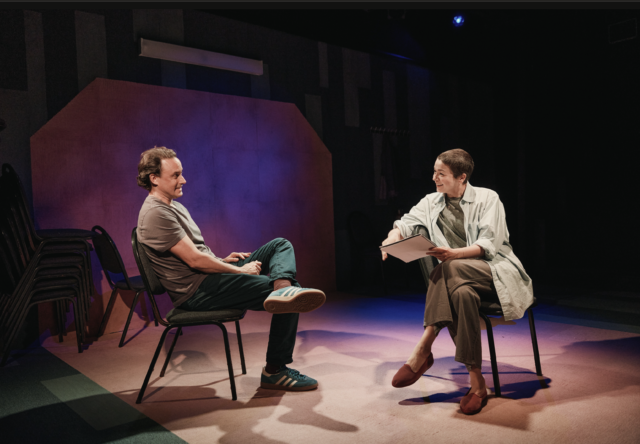
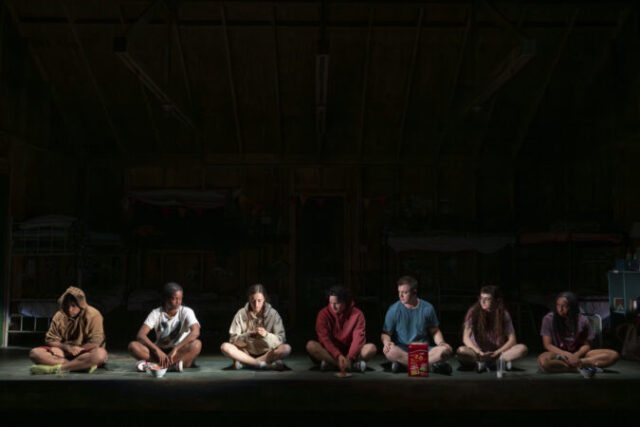
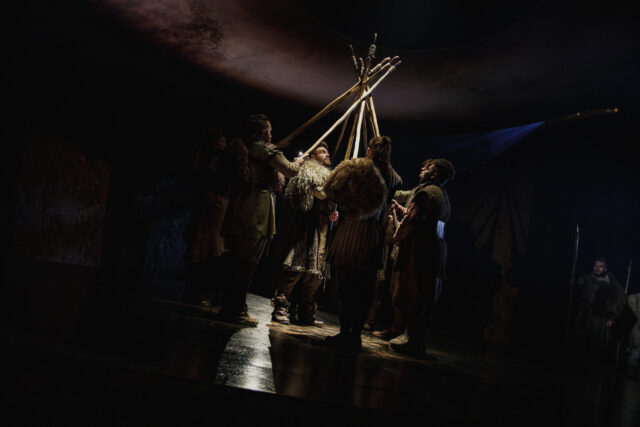
Six campers and a counselor search for healing in Grief Camp (photo by Ahron R. Foster)

GRIEF CAMP
Atlantic Theater Company, Linda Gross Theater
336 West 20th St. between Eighth & Ninth Aves.
Tuesday – Sunday through May 11, $56.50-$111.50
866-811-4111
atlantictheater.org

There has been a surfeit of plays about grief the last few years, most of them involving children and/or adults sitting around in circles in group or family therapy, sharing their personal stories. In her off-Broadway debut, twenty-seven-year-old Eliya Smith, who is in her final semester in the University of Texas at Austin’s MFA playwriting program, takes a different approach in the fiendishly clever Grief Camp, continuing at the Atlantic through May 11.

Bereavement camps have been popping up all over, offering healing for those who have lost loved ones; they have such names as Camp Good Grief, Comfort Zone Camp, and Camp Hope. Smith sets her tale at an unnamed summer camp in the real town of Hurt, Virginia. (It was named for a local landowner and attorney, not the pain of loss.)

Louisa Thompson’s set is a large, somewhat disheveled cabin with four double bunk beds, two electric box fans on the floor, a bathroom in the back, and a small porch with a swing chair outside. On the natural wood walls are pages torn out of magazines, postcards, and a string of colored pennants.

It is home to six campers and one counselor: Bard (Arjun Athalye), who is addicted to Duolingo; Luna (Grace Brennan), a Los Angeles vegetarian who wants to be an artist; Blue (Maaike Laanstra-Corn), who is writing the rather strange musical untitled mansion island purple house project for her high school; Gideon (Dominic Gross), a cool dude who can’t swim and is worried about his missing green dinosaur; Olivia (Renée-Nicole Powell), who doesn’t look forward to any of the scheduled activities; her younger sister, Ester (Lark White), who hates grief camp; and Cade (Jack DiFalco), a former camper who is now a counselor, living and working with the others in the cabin.
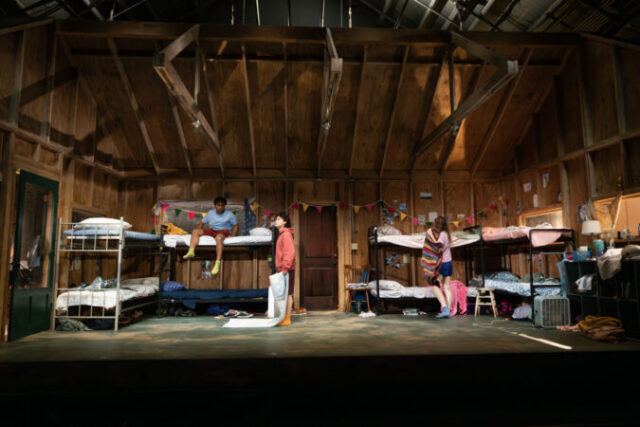
Grief Camp continues at the Atlantic through May 11 (photo by Ahron R. Foster)

Each morning, everyone is woken up by the camp’s founder, the never-seen Rocky, who blows a terrible reveille on the trumpet, makes announcements, gives the weather report, and advises some form of “Rise and shine, kids! Welcome to another perfect day from which to begin the rest of your lives.” It’s not the most encouraging or original bromide.

Over the course of about ten days — the script calls it a “time soup” — the campers bond, argue, battle with the counselors, and avoid getting caught up in woe-is-me self-pity. Esther is afraid she is a terrible person and confides in Luna. Blue holds readings of her ever-morphing musical. Campers are sick of chores, pray to the toenail god, and fight over the bathroom. A guitarist sits in the swing chair and sings Debbie Friedman’s rendition of “Mi Shebeirach,” the Jewish prayer for healing. The campers don’t mope around in mourning or compare one another’s tragedies, although there is a palpable feeling of grief permeating the atmosphere.

In a one-on-one with Olivia, Cade tells her to take out her journal and address the following prompt: “Sometimes, in our grief, we invent guilt in order to feel control over a situation. Sound familiar? Of course it does. So go ahead. Address that guilt head on. Apologize to the person to whom you feel guilt. Explain how you would —”

Olivia cuts him off, wanting to just talk instead. They discuss college, flirting, and Olivia’s different-colored eyes. Olivia asks Cade why he keeps coming back to the camp; he replies, “This place saved my life.” A moment later, Olivia says, “If I had to come back here I suspect I would kill myself.”
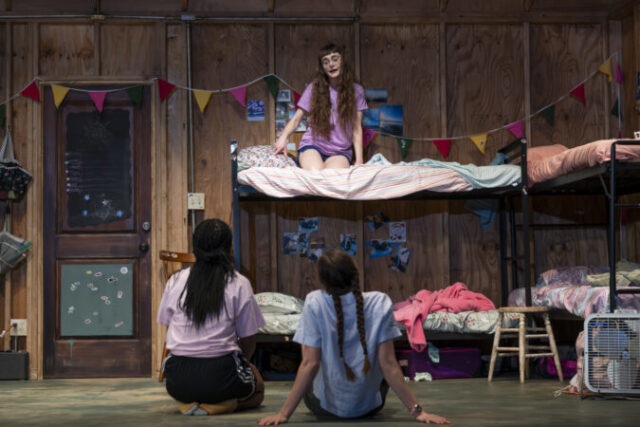
Blue (Maaike Laanstra-Corn) discusses the high school musical she’s writing in Eliya Smith’s off-Broadway debut at the Atlantic (photo by Ahron R. Foster)

In another scene, Cade strongly advises, “At some point, Olivia, you’re gonna have to stop acting like you’re broken.” That line serves as the centerpiece of the ninety-minute play. Smith and Tony-nominated director Les Waters (Dana H., Big Love) carefully avoid any lapses into sentimentality or solipsism, treating Cade and the campers like unique characters in their own right and not as plot points to rhapsodize about grief. In fact, we don’t even learn the specific loss that each camper experienced, only some of them. In addition, Blue’s oddball musical slowly twists into focus but without becoming obviously metaphorical.

The ensemble, several of whom are making their off-Broadway debut, engagingly portray complex characters about to move on with their lives but not yet ready to face the world. The realistic costumes are by Oana Botez, with sharp lighting by Isabella Byrd and terrific sound design by Bray Poor, from rainstorms to Rocky’s staticky announcements to Luna singing into a floor fan.

Early on, Luna encourages Bard to curl up in the fetal position. He is tentative at first, but when he eventually tries it, he declares he is the biblical Moses in a basket on a river. “Why can’t you just be like a regular baby,” Luna says. Smith explains in the script, “The children are not precocious wunderkind iconoclasts or tiny prophets. They are not special. Something extraordinarily bad happened to each of them. They are ordinary.”

In other words, just like the rest of us.

[Mark Rifkin is a Brooklyn-born, Manhattan-based writer and editor; you can follow him on Substack here.]
ROMEO + JULIET ON BROADWAY CONQUERS KING LEAR AT THE SHED

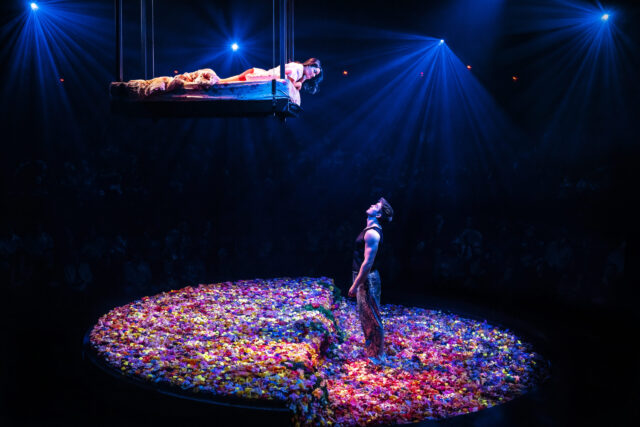
Sam Gold’s Romeo + Juliet is made for Gen Z but can be enjoyed by all (photo by Matthew Murphy and Evan Zimmerman)

ROMEO + JULIET
Circle in the Square Theatre
1633 Broadway at 50th St.
Tuesday – Sunday through February 16, $159-$1002
romeoandjulietnyc.com

Last fall, when I saw Sam Gold’s Romeo + Juliet at Circle in the Square and Kenneth Branagh’s King Lear at the Shed, I was not anticipating being charmed by the former and disappointed in the latter.

Tony and Obie winner Gold has had decidedly mixed results with controversial and often confusing star-driven adaptations of such Shakespeare plays as Macbeth and King Lear on Broadway, Othello at New York Theatre Workshop, and Hamlet at the Public.

Meanwhile, Branagh is widely considered the finest interpreter of the Bard since Laurence Olivier, both onstage, such as his immersive version of Macbeth at Park Ave. Armory and his 1987 and 2016 takes on Romeo and Juliet, and his well-received cinematic adaptations of Henry V and Much Ado About Nothing.

Lear is a personal favorite of mine; Branagh’s is the eighth major production I’ve seen in the last twenty years. I have not had as much luck with R&J, from David Leveaux’s flat 2013 Broadway revival to Hansol Jung’s profoundly perplexing 2023 effort at the Lynn Angelson, although I adored Michael Mayer’s & Juliet, a musical imagining of what might have happened if Juliet had survived.

Closing February 16, Gold’s Romeo + Juliet is a plush and lively, radical AMSR presentation tailored for Gen Z, complete with an Insta-friendly plethora of stuffed teddy bears onstage and in the lobby. When the audience enters the theater in the round, the actors are already hanging out, talking, dancing, and dissing with each other, pushing around a shopping cart of stuffed animals, skateboarding, and lounging on plastic furniture. They wear sneakers, hoodies, and a Hello Kitty backpack. On one side, a giant pink teddy bear watches in silence while across the space a DJ spins Jack Antonoff’s thumping music.

The youthful cast features the hot Rachel Zegler as Juliet and the even hotter Kit Connor as Romeo, with Tony nominee Gabby Beans as Mercutio and the friar, Sola Fadiran as both Capulet and Lady Capulet, Taheen Modak as Benvolio, Tommy Dorfman as the nurse and Tybalt, and Gían Pérez as Samson, Paris, and Peter. The doubling and tripling often makes it hard to know who is who, and some actors do better with the tweaked dialogue than others. Two songs are completely unnecessary, and the use of a handheld microphone is baffling, as is the handling of a poison jug.

But much of the staging is dazzling, from Juliet’s bed, which drops slowly from the rafters, to a colorful expanse of flowers that emerges from the floor. Yes, the F-bomb appears twice, but surprises await those who fully invest themselves in this contemporary tale made for this moment in time.

Kenneth Branagh’s ritualistic King Lear goes astray early (photo by Marc J. Franklin / courtesy the Shed)

Unfortunately, Branagh, codirecting with Rob Ashford and Lucy Skilbeck, struggles with his streamlined adaptation, which, at a rushed two hours without intermission, has cut several key scenes and famous lines, and without the proper character development it’s often hard to differentiate among the minor characters, who are played by recent graduates of the Royal Academy of Dramatic Arts and look like survivors from Game of Thrones. Branagh, who is sixty-four, does not portray Lear as an aged, failing man but as a younger warrior, which alters the plot’s narrative center.

Like Gold’s R+J, Branagh’s staging involves a large sphere, in this case an imposing UFO-like disc that hovers over the action, occasionally moving and tilting, onto which ominous weather patterns are projected. (The script identifies the setting as “outer space.”) It also leaves in one of the songs, which feels extraneous given the show’s shortened length.

Thus, my initial thoughts that Gold would pale in comparison to Branagh were misbegotten.

“O teach me how I should forget to think!” Romeo tells Benvolio.

Who woulda thunk it?

[Mark Rifkin is a Brooklyn-born, Manhattan-based writer and editor; you can follow him on Substack here.]
OPEN THROAT

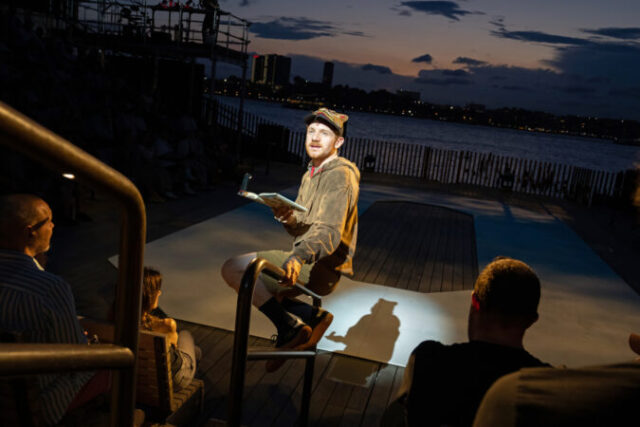
Chris Perfetti is one of three actors who portray a queer mountain lion in Open Throat on Little Island (photo by Julieta Cervantes)

OPEN THROAT
The Amph at Little Island
Pier 55, Hudson River Park at West Thirteenth St.
July 10-14, $25, 8:30
littleisland.org

In the theater, an actor is said to be “on book” if they are using the script onstage. Most often this occurs in previews because they are still working on their lines. A performer can also be on book if they are a last-minute replacement or, as in the case of the protagonist in Marin Ireland’s current Pre-Existing Condition, as a directorial choice relating to the character’s state of mind.

The full cast is on book — literally — in Henry Hoke’s expert adaptation of his highly acclaimed 2023 novel, Open Throat. Throughout the eighty-minute play, the actors read from either the hardcover or paperback edition as they walk across the spare set at the Amph on Little Island, the 687-seat open-air theater that borders the Hudson River. Because of rights issues, and probably also because there are only five performances of the piece, which was commissioned for the space, it had to be a staged reading with scripts in hand, but director Caitlin Ryan O’Connell uses that to her advantage, as the play becomes a celebration of the written word as well as clever stagecraft.

The story is narrated by a queer mountain lion (portrayed first by Chris Perfetti, then Calvin Leon Smith and Jo Lampert) living under the Hollywood sign in the Los Angeles hills, avoiding confrontations with humans, unwilling to be the hunter or the hunted, instead surviving on bats and small animals. “I’ve never eaten a person but today I might,” the lion says early on. The lion, who was inspired by P-22, a puma who lived for ten years in Griffith Park in LA, has no name; a young man in a homeless tent city calls the lion “fucker cat,” “shitfuck cat,” or “goddamn fuck cat.” His mother gave him a name he cannot share and people would be unable to pronounce, while his father gave him a name he won’t repeat. It’s all part of his search for his identity and his place in a foreign world he is trying to understand.

As the lion ventures closer to humans and vice versa, impeding on each other’s territory, the lion encounters a scary man who cracks a whip, a gay couple having sex in a cave, a woman yapping away on a phone, and various hikers and tourists. The lion listens as the people discuss capitalism, therapy, veganism, and dating. But the lion’s life changes dramatically when taken in by a young woman named slaughter who has domestication on her mind.

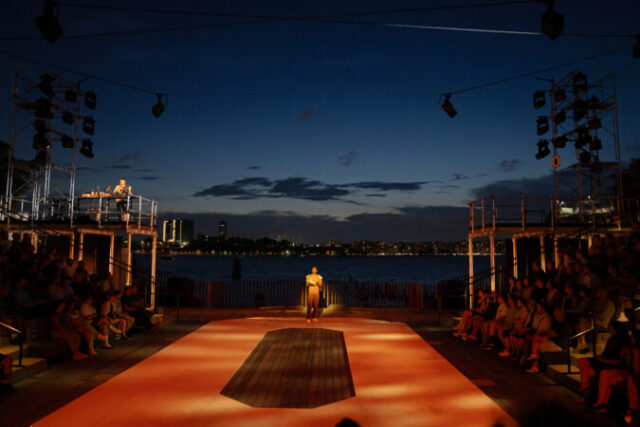
Henry Hoke’s Open Throat begins just as the sun sets over the Hudson River (photo by Julieta Cervantes)

Open Throat is a beguiling parable about personal identity, family, language, and being part of a community. It feels right at home in the Amph, surrounded by grassy hills, wind whipping through trees, and, on the west side, a beckoning river. At one point, just when the lion is describing how a young man in town refers to machines flying in the sky as “fucking helicopters,” a helicopter actually flew over the water. Unfortunately, many more did, creating loud distractions. The lion often refers to the “long death,” which is a busy street where many animals have met their end, being hit by cars; it’s hard not to compare that to the West Side Highway, which must be crossed in order to enter Little Island. And there are numerous mentions of “a deep forest on the edge of the water,” which is an apt description of the environment encircling the Amph.

Noah Mease’s set features a large, octagonal “O” on the floor; the missing center is represented twice as an object on which Steven Wendt makes shadow puppets with his hands, depicting moments from the lion’s past with his parents, including a poignant kill. Wendt also makes ingenious analog sound effects from atop a scaffold balcony. Perfetti, Smith, and Lampert each brings a different flavor to the lion, involving gender, color, and sexuality, as if any one of us could be the crafty animal. The rest of the characters are played by Marinda Anderson, Alex Hernandez, Layla Khoshnoudi, Ryan King, and Susannah Perkins, moving from the wings to the aisle steps to a balcony; rising star Perkins — she’s excelled in such plays as Grief Hotel, The Welkin, The Wolves, The Low Road, and The Good John Proctor — is particularly effective as the young slaughter, adding depth and nuance while having clearly memorized many of her lines.

Mease also designed the props and masks — each lion portrayer has a small costume element that identifies them as a cat — although they are kept to a minimum. Most of the props are imaginary, and cast members’ appearances do not change in order to match the text. The superb lighting, which emerges as the sun sets, is by 2024 special Drama Desk Award winner Isabella Byrd, with playful choreography by Lisa Fagan and immersive sound and music by Michael Costagliola. O’Connell (King Philip’s Head Is Still on That Pike Just Down the Road, Twin Size Beds) directs with a sure hand, whether depicting a tragic fire, an animal fight, an earthquake, or a road trip; a Disney dream sequence is the only scene that felt out of place. Even the actors using the script becomes organic to the tale.

Not only is the Amph itself a kind of character in the narrative but so is New York City. “they talk about new york a lot in ellay / in new york you don’t need a car,” the lion says. (The book contains no punctuation, and only the pronoun “I” is capitalized, furthering the idea of establishing one’s identity.)

“is new york where I have to go,” the lion asks. The answer is a resounding yes, as Open Throat could not have happened quite like this anywhere else.

[Mark Rifkin is a Brooklyn-born, Manhattan-based writer and editor; you can follow him on Substack here.]
LITTLE ISLAND: OPEN THROAT

OPEN THROAT
The Amph at Little Island
Pier 55, Hudson River Park at West Thirteenth St.
July 10-14, $25, 8:30
littleisland.org

“I’ve never eaten a person but today I might,” the narrator states at the beginning of Henry Hoke’s award-winning 2023 novel, Open Throat. “I wake up in the thicket to the sound of whipcracks and look out and see a bulky man in a brown leather jacket and brown hat swinging the whip toward two other people a man and a woman / the woman holds a phone up and says you look just like him oh my god / the man with the whip smiles and cracks it again and I feel something in the bottom of my stomach that’s not hunger / I also feel hunger.”

The narrative unfolds in stream-of-consciousness verse in short paragraphs with no punctuation and only the pronoun I capitalized throughout.

Hoke, whose other books include The Groundhog Forever and The Book of Endless Sleepovers, has now adapted Open Throat into a play that will premiere July 10-14 at the Amph on Little Island. The story follows a queer mountain lion who must leave his home in the hills by the Hollywood sign and face what humanity is doing to the planet.

Directed by Caitlin Ryan O’Connell (King Philip’s Head Is Still on That Pike Just Down the Road, Twin Size Beds), the play features a promising cast; Marinda Anderson, Alex Hernandez, Layla Khoshnoudi, Ryan King, Jo Lampert, Chris Perfetti, Susannah Perkins, Calvin Leon Smith, and Steven Wendt, who also designed the shadow puppets.

The piece was commissioned for the outdoor Amph on Little Island, which rests on the edge of the Hudson River amid trees, so the location should fit right in. The choreography is by Lisa Fagan, with set, props, and masks by Noah Mease, lighting by 2024 special Drama Desk Award winner Isabella Byrd, and sound and music by Michael Costagliola. Tickets are only $25 and gain you access to specific sections.

[Mark Rifkin is a Brooklyn-born, Manhattan-based writer and editor; you can follow him on Substack here.]

PRE-EXISTING CONDITION

C (Sarah Steele) and A (Tatiana Maslany) discuss a difficult situation in Pre-Existing Condition (photo by Emilio Madrid)

PRE-EXISTING CONDITION
Connelly Theater Upstairs
220 East Fourth St. between Aves. A & B
Monday – Saturday through August 3, $49-$125
preexistingconditionplay.com
www.connellytheater.org

Don’t worry that the protagonist in Marin Ireland’s gripping and powerful major playwriting debut, Pre-Existing Condition, holds what appears to be a spiral-bound copy of the script throughout the play’s sleek and steady seventy-five minutes, sometimes glancing at the words, other times clutching it to her chest like Linus’s blanket in Peanuts. Known only as A, the character never lets go of the script, not because the actor has not yet learned all of the lines, but because it’s a constant reminder of a horrific, life-altering event in the character’s recent past. Over the show’s two-month run, A will be played by Emmy winner Tatiana Maslany (who I saw), Tony nominee and director Maria Dizzia, Tavi Gevinson, Tony winner Deirdre O’Connell, and Julia Chan — and each will hold that script.

It’s been seven months since A was brutally struck by her partner. No longer with the man, she speaks with an attorney, a psychiatrist, a few close friends, her parents, an old acquaintance, her parents, and others, but no one is able to help, instead only adding to her torment and confusion by subtly blaming her for first provoking the attack and then refusing to take her lover back.

She tries to date, but she’s clearly not ready, especially when the men she meets cannot, or will not, understand her situation. (All the men and A’s mother are played by Greg Keller, although I saw his understudy, Gregory Connors; the rest of the women are portrayed by Sarah Steele and Dael Orlandersmith.)

A finds some respite in group therapy run by two caring women who have developed a support program; during those sessions, the two facilitators talk directly to the audience, as if we are all part of this community, because when it comes down to it, we are; domestic violence can occur at any moment, in any family.

In one exchange with B, A questions her own responsibility.

B: do you still feel like it’s your fault?
A: yeah.
B: it’s not.
A: well.
B: you couldn’t have known.
A: but . . . couldn’t I? I mean, I’m not that stupid, right? I mean. I guess I’m realizing something kind of horrible about myself which is that I always thought that like women who got hit by their boyfriends were like . . . they were like . . .
B: (long pause) they were like what?
A: trash. They were like trash. (pause)
B: mmhm.
A: and the thing is that’s exactly what I felt like. Feel like. (pause) Trash. (pause) (pause) And there are days when I feel like maybe I always was trash and this experience just made me see that finally. Clearly. And it has really nothing to do with the, like, huge shame or guilt or any of that, anything even directly relating to this incident, it just starts to feel like a very very deep truth. That I’m trash. And I always was.
B: you believe that still? Right now at this moment?
A: Oh yeah yeah, of course. Sure. No, that hasn’t ever gone away since it started. It’s almost a peaceful thought, which I guess is what makes it feel like it must be true?

Dael Orlandersmith plays multiple roles in new play by Marin Ireland (photo by Emilio Madrid)

Later, A explores another aspect of her feelings that no one seems to get. “I’m so fucking exhausted by all of this. All of this. All of the taking it seriously and the. All of it,” she tells B. “I don’t — okay. I don’t want the big task of my life now to be ‘dealing with this.’ It’s fucking eating up everything.”

When a friend (C) mentions the possibility of her offering forgiveness, A states, “I don’t want to. Forgive. I don’t want to forget it. . . . I don’t want to also be guilty of forgetting it.”

As the healing process — whatever it encompasses — continues, the audience empathizes more and more with A, realizing that her pain and trauma could be anyone’s pain and trauma, that any one of us could be sitting in that chair in the middle of the room, being consumed by some type of tragedy.

The California-born, Obie-winning Ireland is one of New York’s finest actors, having appeared in such powerful plays as On the Exhale, Ironbound, Marie Antoinette, the intimate Uncle Vanya that took place in a Flatiron loft, and reasons to be pretty, which earned her a Tony nomination.

She was busy during the pandemic, acting in short virtual works for charity and conceiving “Lessons in Survival” at the Vineyard Theatre with Peter Mark Kendall, Tyler Thomas, and Reggie D. White, in which a company known as the Commissary reenacted historic speeches, interviews, and conversations by activists and artists from revolutionary times (including James Baldwin, Nina Simone, Angela Davis, Maya Angelou, Nikki Giovanni, Bobby Seale, and Muhammad Ali). Pre-Existing Condition is its own kind of lesson in survival, a deeply personal one.

Julia Chan, seen here with Greg Keller, is one of five rotating actors portraying the protagonist in gripping play (photo by Emilio Madrid)

In 2012, Ireland and her boyfriend at the time, Scott Shepherd, were in London, starring as the leads in the Wooster Group’s Cry, Trojans!, an adaptation of Shakespeare’s Troilus & Cressida. One day she came to rehearsal with a black eye after Shepherd viciously hit her; he did not deny doing it. How Ireland was treated by the company and others following the event led her to lobby for systemic change in the theater.

“I continue to wonder where responsibility and accountability should be for what happened,” Ireland told the New York Times in 2015. “Many actors don’t know what to do when behavior — physical, sexual, harassment, bullying — crosses a line.”

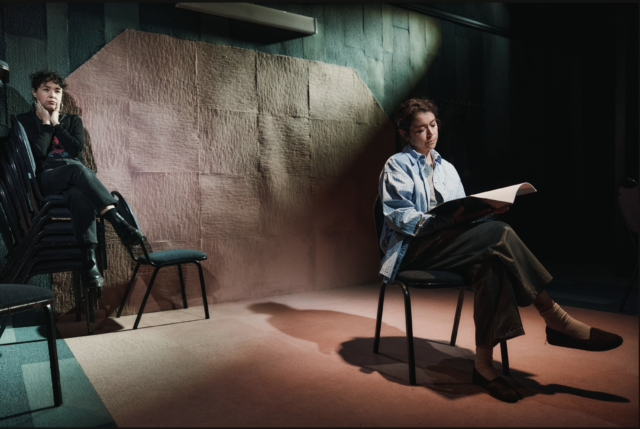
Pre-Existing Condition is not a revenge drama, nor is it a self-help guide. It’s a brutally honest and provocative look at the psychological and bodily wounds that humans inflict and receive. Director Dizzia, an actor who has appeared in more than seventy movies and TV shows and theatrical productions, earning a Tony nomination for Best Performance by a Featured Actress for In the Next Room (or The Vibrator Play), allows Ireland’s story to unfold at a modest pace, luring the audience at the Connelly’s tiny upstairs theater into its many intricacies. Louisa Thompson’s spare set consists of a handful of chairs that match those the people in the first row sit in, implicating all of us; the actors switch chairs, but some are left empty, evoking ghosts who cannot be there. In the back are piles of more chairs, representing other survivors to come.

Drama Desk winner Steele (The Humans, I Can Get It for You Wholesale) is charming in multiple roles, wearing a Patti Smith T-shirt and jeans as she engages with A from multiple points of view. Solo specialist Orlandersmith (Spiritus/Virgil’s Dance, Forever) is wonderfully gentle as various therapists. Understudy Connors (The Poisoner, The Sign in Sidney Brustein’s Window), taking over this night for the always terrific Keller (Dig, Shhhh), is stalwart as the men in A’s life, the good and the bad.

Maslany (Grey House, Mary Page Marlowe) is sensational as the tormented A, searching for a way out of her lonely predicament. The Canadian actor’s expressive facial gestures and meticulous body movements, filled with uncomfortable pauses, are mesmerizing, daring us to try to find the way forward for A; in fact, it is not until the closing moments that Maslany makes any eye contact with the audience, bringing us further into her world, and concluding with an extraordinary coda.

A’s personal answers may not be in the pages she’s clinging to as if some kind of life line, but Ireland’s play does offer a fascinating blueprint of what we all should be paying a lot more attention to.

[Mark Rifkin is a Brooklyn-born, Manhattan-based writer and editor; you can follow him on Substack here.]
DRAMA DESK AWARDS 2024: CELEBRATING ARTISTIC ABUNDANCE

Aaron Tveit and Sutton Foster will cohost Drama Desk Awards on June 10 (© 2024 Justin “Squigs” Robertson)

DRAMA DESK AWARDS
NYU Skirball Center for the Performing Arts
566 La Guardia Pl.
Monday, June 10, $105-$205, 6:15
nyuskirball.org
dramadeskaward.com

Balcony tickets are still available for the sixty-ninth annual Drama Desk Awards, honoring the best of theater June 10 at the Skirball Center. Founded in 1949, the Drama Desk (of which I am a voting member) does not differentiate between Broadway, off Broadway, and off off Broadway; all shows that meet the minimum requirements are eligible. Thus, splashy, celebrity-driven productions can find themselves nominated against experimental shows that took place in an East Village elevator or Chelsea loft. But that doesn’t mean there won’t be plenty of star power at the awards presentation.

Sutton Foster and Aaron Tveit will cohost the event; among the nominees this year are Jessica Lange for Mother Play, Patrick Page for All the Devils Are Here: How Shakespeare Invented the Villain, Rachel McAdams for Mary Jane, Leslie Odom Jr. for Purlie Victorious: A Non-Confederate Romp Through the Cotton Patch, Sarah Paulson for Appropriate, Brian d’Arcy James and Kelli O’Hara for Days of Wine and Roses, Bebe Neuwirth for Cabaret at the Kit Kat Club, Dorian Harewood for The Notebook, and Michael Stuhlbarg for Patriots. The Drama Desk also does not distinguish between male and female; the acting categories have ten nominees each, regardless of gender, with two winners. Thus, d’Arcy James is competing against his costar, O’Hara, for the same prize, although they both could take home the award.

Brian d’Arcy James and Kelli O’Hara are both nominated for Days of Wine and Roses and will participate in the 2024 Drama Desk Awards (photo by Joan Marcus)

Among this year’s presenters are Laura Benanti, Matthew Broderick, Montego Glover, Lena Hall, James Lapine, Debra Messing, Ruthie Ann Miles, Andrew Rannells, Brooke Shields, Seth Rudetsky, Shoshana Bean, Corbin Bleu, James Monroe Iglehart, and Steven Pasquale. O’Hara will perform a special tribute to William Wolf Award honoree André Bishop, Foster and Nikki M. James will both sing, and Nathan Lane will receive the Harold S. Prince Award for Lifetime Achievement. Others being honored are the How to Dance in Ohio Authentic Autistic Representation Team, lighting designer Isabella Byrd, and press agent Lady Irene Gandy.

[Mark Rifkin is a Brooklyn-born, Manhattan-based writer and editor; you can follow him on Substack here.]
AN ENEMY OF THE PEOPLE

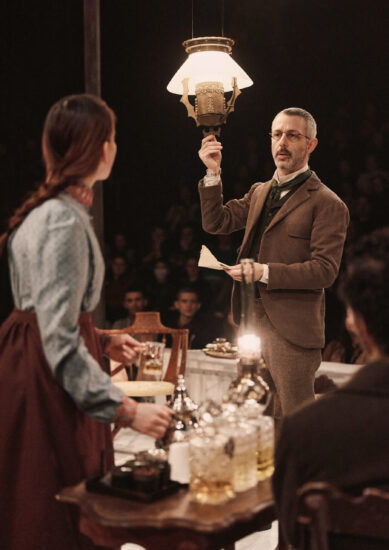
Jeremy Strong stars in new translation of Henrik Ibsen’s cautionary An Enemy of the People (photo by Emilio Madrid)

AN ENEMY OF THE PEOPLE
Circle in the Square Theatre
1633 Broadway at 50th St.
Tuesday – Sunday through June 23, $99 – $499
anenemyofthepeopleplay.com

What price truth?

That is the question that drives Henrik Ibsen’s 1882 drama An Enemy of the People, which can currently be seen in an intense new translation by Obie winner and Tony nominee Amy Herzog, directed by her husband, Tony and two-time Obie winner Sam Gold, at Circle in the Square; this is the first time the couple has worked together, and hopefully not the last.

The story takes place in the late nineteenth century in a small Norwegian town in late winter, but it could also be set anytime, anywhere, including America in 2024. The fortysomething Dr. Thomas Stockmann (Jeremy Strong), a widower, lives a quiet life with his daughter, Petra (Victoria Pedretti), a schoolteacher in her early twenties. They have an open house, welcoming friends and colleagues to stop by for a drink, a smoke, a meal, or stimulating conversation.

The play opens with Petra and the family maid serving dinner to an eager Billing (Matthew August Jeffers). When Petra points out how hard it can be teaching her class of sixteen boys “anything of value,” Billing replies, “So take a load off, sit with me. Teach me something, I’m very ignorant, it’s a real shame.” Value, ignorance, and shame will become key themes to the show.

Billing’s boss, Hovstad (Caleb Eberhardt), arrives, followed by Peter Stockmann (Michael Imperioli); the former is the editor of the local paper, the People’s Messenger, while the latter is the mayor and Thomas’s older brother.

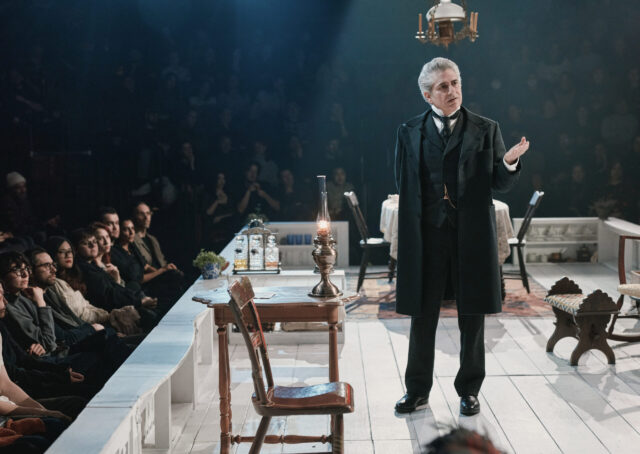
Town mayor Peter Stockmann (Michael Imperioli) doesn’t like what he hears in Broadway revival (photo by Emilio Madrid)

The town’s future has been built on the success of the Baths, the main attraction at the new spa resort. The local economy is about to boom as spring and summer approach, but Thomas has some bad news. “The water at the Baths is rife with bacteria, tiny micro-organisms that cause disease. It’s completely unsafe,” he tells Petra, Billing, Hovstad, and Captain Horster (Alan Trong). Petra says, “Thank goodness you discovered it in time.” They toast Thomas as a local hero, but Petra’s response is not necessarily shared by the rest of the town, including her maternal grandfather, Morten Kiil (David Patrick Kelly), who owns a tannery that might be contributing to the water pollution.

Hovstad is excited “to expose these clowns” by publishing Thomas’s article about the poisonous water and what it will take to save the spa. The printer, Aslaksen (Thomas Jay Ryan), who is also the chair of the Property Owners’ Association and a temperance leader, offers Thomas his full support but suggests he proceed carefully, in moderation.
But when Peter finds out what it will take to make the Baths safe, Thomas goes from hero to villain as he’s publicly declared an Enemy of the People.

Herzog, whose 4000 Miles was a Pulitzer Prize finalist and whose Mary Jane begins Broadway previews April 2, last year adapted Ibsen’s 1879 masterpiece, A Doll’s House, earning six Tony nominations, including Best Revival of a Play. Gold, who won an Obie and a Tony for directing Fun Home at the Public and Circle in the Square, respectively, and another Obie for Annie Baker’s Circle Mirror Transformation, was also nominated for a Tony for helming Lucas Hnath’s A Doll’s House, Part 2. You can expect a boatload of Tony nods for their inaugural collaboration.

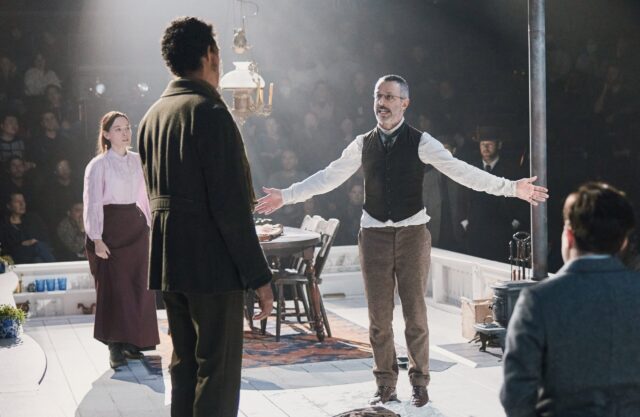
The audience sits on three sides of the narrow rectangular stage, which runs down the middle. Thomas’s home is plainly furnished, with simple tables and chairs; small changes are made when the scene moves to the printing press and a large meeting room. A white building facade surrounds the space at the top, seemingly unnecessary except to hide a surprise that arrives at intermission. The set is by dots, with tender lighting, featuring several gas lamps, by Isabella Byrd, sound by Mikaal Sulaiman that incorporates dialogue and musical performances, and fine period costumes by David Zinn.

Dr. Thomas Stockmann (Jeremy Strong) is afraid everything will all fall apart unless local town listens to him (photo by Emilio Madrid)

Taking a page out of Daniel Fish’s 2019 Tony-winning revival of Oklahoma! at Circle in the Square, which invited the audience onto the stage during intermission for cornbread and a cup of chili, An Enemy of the People offers shots of a prominently featured Nordic liqueur while several ensemble members (Katie Broad, Bill Buell, David Mattar Merten, Max Roll, Kelly) sing Norwegian folk songs. After intermission, more than a dozen audience members remain onstage, becoming citizens at the town meeting where the mayor maneuvers to silence his brother, along with the rest of the audience, as the speakers address all of us directly with the lights on, each person in the theater involved in the controversy.

Emmy winner Strong (A Man for All Seasons, The Great God Pan), best known for his role as Kendall Roy on Succession, gives a profoundly measured performance as Thomas, a gentle, considerate, if somewhat elusive man, at the edge of exploding, whose life turns upside down when he becomes a whistleblower, standing nearly alone as he staunchly refuses to surrender his principles; it’s a cautionary tale that’s ripe for the modern age, given the spread of fake news over social media and the rejection of truth in favor of money and power by politicians and corporations.

In his Broadway debut, Emmy winner Imperioli (The Sopranos, The White Lotus) is a fine foil as Peter, an arch-conservative to his liberal brother. The ever-dependable Ryan (Dance Nation, The Nap) is phenomenal as Aslaksen, whose belief in freedom of the press goes only so far.

All that said, Herzog is not able to solve some of the play’s inherent problems, a significant reason why it is performed relatively rarely. Arthur Miller’s adaptation debuted on Broadway in 1950 with Fredric March as Thomas and Morris Carnovsky as Peter and was turned into a 1978 film with Steve McQueen and Charles Durning; a 2012 revival with Boyd Gaines and Richard Thomas as the brothers was disappointingly trite. Unfortunately, Robert Ickes’s inventive, interactive 2021 solo version starring Ann Dowd at the Park Ave. Armory was cut short when Dowd had to leave for unstated personal reasons.

Herzog excises the doctor’s wife, and we never see their two sons, making Thomas more of a lone wolf. The town hall scene gets a bit ludicrous at the end with the addition of awkward props. And there is far too much editorializing as the narrative reaches its overly simplistic resolution.

But the play’s relevancy still hits home in 2024, amid domestic and international crises that continue to shake the stability of the world as we realize it will take a lot more than just one brave man to save us from our destiny.

[Mark Rifkin is a Brooklyn-born, Manhattan-based writer and editor; you can follow him on Substack here.]