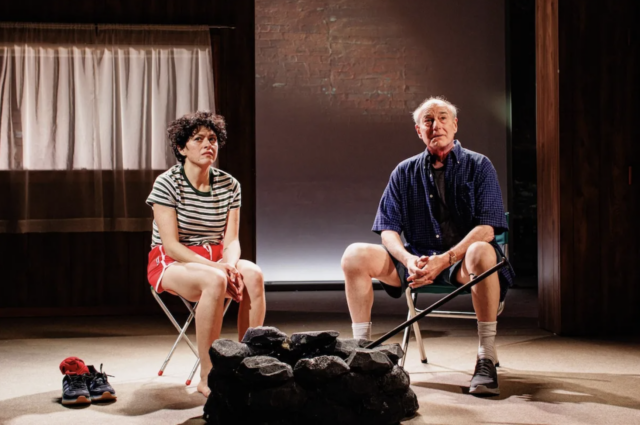
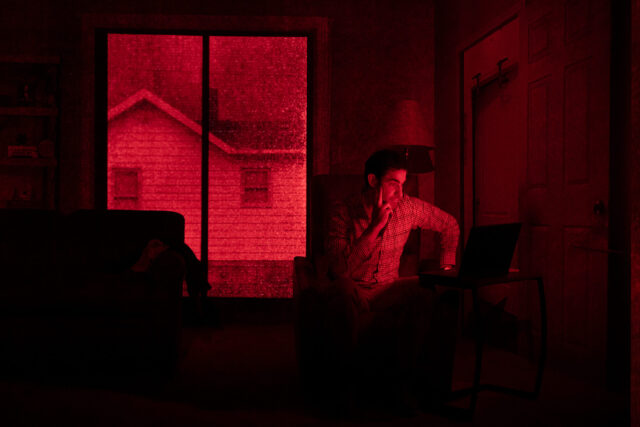
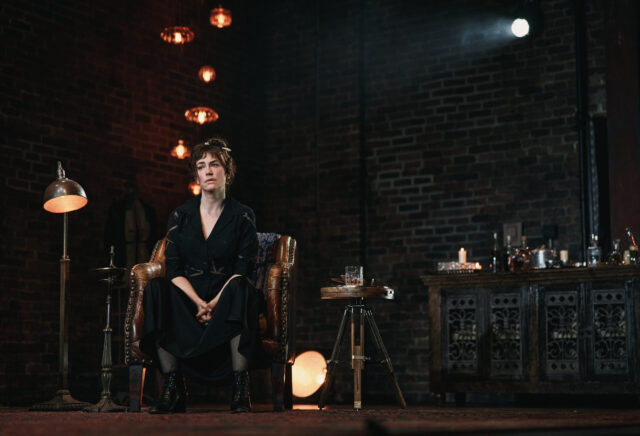
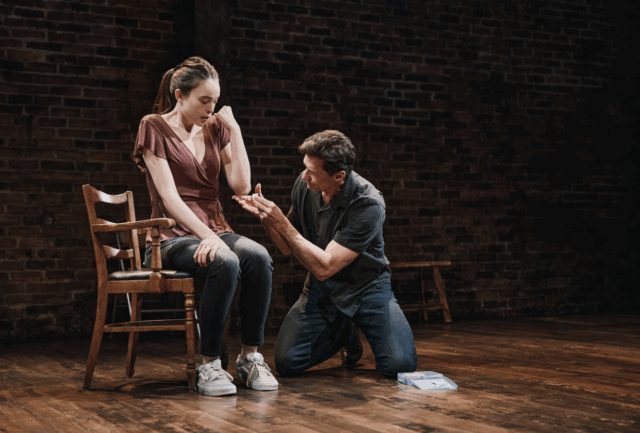
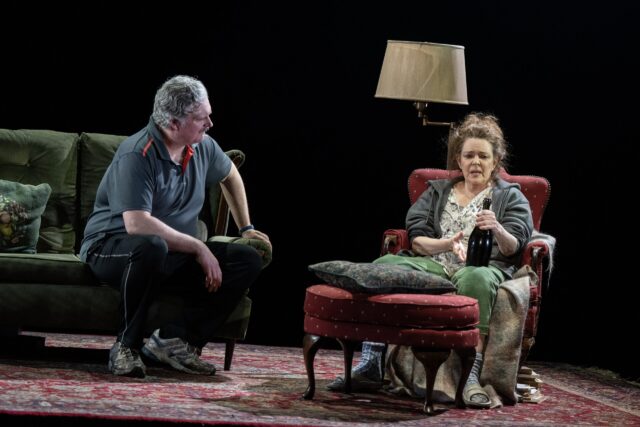
Alia Shawkat and Peter Friedman star as a daughter and father who reconnect in Clare Barron’s You Got Older (photo by Marc J. Franklin)
YOU GOT OLDER
Cherry Lane Theatre
38 Commerce St.
Tuesday – Sunday through May 3, $89-$189 www.cherrylanetheatre.org
Alia Shawkat makes an exciting theatrical stage debut as a single woman having “like the second worst moment of my life so far” in the stirring revival of Clare Barron’s You Got Older at the Cherry Lane.
After losing her job and her boyfriend at the same time — she was sleeping with her boss — the thirty-two-year-old Mae, a Minneapolis lawyer, has returned to the family home in a small agricultural town in eastern Washington State. Not only does she need a respite, but her father (Peter Friedman) has cancer of the larynx, so she can help out at least for a while.
Nearly everyone in their circle seems to be having issues with physical bodies. In addition to their father’s illness, Mae, who no longer has health insurance, has a lump in her throat and a large, ugly rash that requires special ointment; her sister Jenny (Nina White) has a pericardial cyst and can’t eat meat or gluten; her sister Hannah’s (Nadine Malouf) ex-boyfriend died of a rare blood cancer, and she thinks she may be passing bad skin, cancer, Alzheimer’s, Parkinson’s, and male pattern baldness to her son; her brother, Matthew (Misha Brooks), might have a weird penis; her old schoolmate Mac (Caleb Joshua Eberhardt) admits to liking pus, scabs, and flaky skin; Mae’s fantasy lover, Luke the Canadian Cowboy (Paul Cooper), has weeping lesions from his neck to his groin; and the entire Hardy family suffers from acidic mouths and body odor.
Mae wants to move forward but inner and outer forces seem hell-bent on preventing that. In addition to having to move back to the house where she grew up, she has been told by her dentist that she should use a child-size toothbrush, she’s horny like she way when she was in high school, and she sneaks Mac into her bedroom to hide him from her father. She also has a cat named, appropriately enough, Murphy, hinting that everything that could go wrong just might.
Mae (Alia Shawkat) and Mac (Caleb Joshua Eberhardt) share their likes and dislikes in revival at the Cherry Lane (photo by Marc J. Franklin)
“I hate it when I feel helpless,” she tells her father, who doesn’t mind occasionally not being in control. “I love it when you just get to lie back and let people take care of you,” he says to Mae, who can’t understand that.
When the whole family is finally together, Jenny proclaims, “It’s like we’re on a picnic.”
Not quite.
Barron (Shhhh,Dance Nation), who won an Obie for the play, wrote You Got Older after her father was diagnosed with cancer and she went through a breakup. In a program note, she writes, “This play was written and finished in the middle of a personal crisis — before anything was resolved. And so, for me it remains a kind of play without perspective. The characters are so far inside of something that they don’t know how to explain what’s happening to them. The result is a lot of avoidance.”
While there is plenty of psychological avoidance — most of the characters exist in their own private space — the act of physically touching occurs over and over again, whether it is the application of ointment, hugging a stranger who may be crying, or having sex. The father is the only one who likes to get his hands dirty, as evidenced by the garden he has started where he grows peppers and other plants.
Anne Kaufman (Mary Jane,The Nether) helmed the 2014 premiere, which included Obie winners Brooke Bloom and William Jackson Harper and Tony winners Reed Birney and Miriam Silverman, and she directs the revival as well, keeping things dark and mysterious, alternating between fantasy and reality as Mae tries to find her way in a world that’s letting her down but she can’t get back on track. The transitions between scenes on Arnulfo Maldonado’s ever-morphing set can be as bumpy as some of the subplots, but the challenging narrative makes it all worthwhile.
Shawkat (Arrested Development,Search Party) is alluring as a woman who is as unpredictable as she is appealing. Friedman (Job,The Nether) once again is masterful as a sweet man who remains upbeat as he faces the end, exemplified by the theme song he has chosen for himself, Regina Spektor’s “Firewood,” in which she sings, “Rise from your cold hospital bed / I’ll tell you, you’re not dying / Everyone knows you’re going to live / So you might as well start trying.”
Even as we get older, it’s never time to stop trying.
[Mark Rifkin is a Brooklyn-born, Manhattan-based writer; you can follow him on Substack here.]
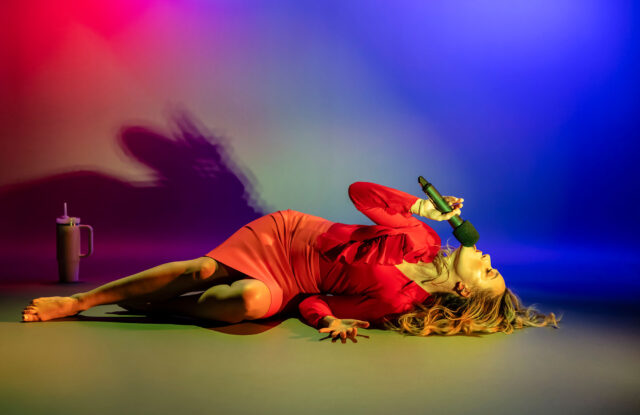
Julia McDermott plays a TV meteorologist on the edge in Weather Girl (photo by Emilio Madrid)
WEATHER GIRL
St. Ann’s Warehouse
45 Water St.
Through October 12 stannswarehouse.org
Julia McDermott is mesmerizing as a Fresno morning show meteorologist desperate to find shelter from the storm in Brian Watkins’s Weather Girl, continuing at St. Ann’s Warehouse through October 12.
“People always said I was destined to become a weather girl . . . That I always ‘had that look.’ I think it might’ve been more that I had a crippling fear of being killed by an act of god,” KCRON’s Stacey Gross (McDermott) says as the solo show begins. She talks about how she has to get up at 4:00 for her job, a time at which, someone once told her, according to the Bible, “sin enters the world. . . . And at a quarter past four you feel all the destroyed things swimming around in the dark and when you do the weather here in California you can sometimes feel the devil’s breath right at your earlobe.”
Standing in a cramped TV-studio green-screen setup with lights and microphones, dressed in a low-cut red blouse, supertight pink skirt, and heels (the costume is by Rachel Dainer-Best), Stacey explains the reason why she thinks we are all here: “to bring the inside outside.” And for the next seventy minutes, she spills her guts, literally and figuratively, in hilarious and heart-wrenching ways.
In her cheery on-air disposition, she reports from the field on the Coalinga wildfire, focusing on a specific house burning in a cul-de-sac, noting that the “wildfire hopped the freeway at 4 am.” Lifting up her ever-present Stanley Quencher, she declares to the anchors in the studio, “They need a few more of these out here!” But it’s not water in the giant cup; she’s drinking Prosecco.
She’s devastated when she learns the next day that a family of five and their two dogs perished in that house fire; moments later, Jerry, the station manager, tells her she is being promoted to the Phoenix gig, a move she is not happy about. “Fuck you, Jerry,” she responds several times, although she is not sure if she actually said it out loud. As her colleagues congratulate her, she says/thinks, “Fuck you guys I’m gonna murder you guys.”
Stacey explains to the audience that the reason she does the weather is because “there’s some things you can’t change,” referring primarily to her difficult childhood with foster parents because her mother, Magdalena, preferred drugs to a house, but also alluding to global warming and environmental disaster. She hasn’t seen her mom, who is homeless, in a while, but wonders how she is doing, “if she’s out there somewhere dying of thirst and heat and smoke.” The California drought serves as a constant metaphor for her life, which is devoid of family, friends, or a significant other. Instead, she has cheap sex with a man she meets online, never bothering to learn his name while getting loaded on wine during a wild night that does not end well.
She does find her mother, who asks her, “Have you said things you didn’t intend to say? Are you always thirsty?” letting her know that she likely has inherited a magical power from her as Magdalena talks about Moses parting the Red Sea and Jesus performing miracles involving water.
But when Stacey asks her mother to teach her, things start getting really weird.
Weather girl Stacey Gross (McDermott) is concerned about climate change and more at St. Ann’s Warehouse (photo by Emilio Madrid)
Winner of a Fringe First Award in Edinburgh, Weather Girl is directed with a fiery fury by Tyne Rafaeli (Becoming Eve,The Coast Starlight), occasionally going over the top as Watkins’s (Epiphany,Evergreens) otherwise tight script goes too far a few times, especially in an overwrought on-air confession. Isabella Byrd’s set and lighting keep it all intimate; curiously, the sound, by Kieran Lucas, features Stacey at the same vocal level whether she uses a microphone or doesn’t.
McDermott (Heroes of the Fourth Turning,Orpheus Descending) expertly portrays the pathos and bathos of Stacey and her mixed-up life, turning the stereotype of the beautiful blond ditzy weather girl on its head. Stacey is a complex woman whose insides are drying out as her exterior continues to be celebrated on its slick surface, even as she falls apart.
But at the center is the miracle of water, which makes up between sixty and seventy percent of the human body and about seventy-one percent of the planet; without water, everything would die.
“Water does not resist. Water flows. When you plunge your hand into it, all you feel is a caress,” Margaret Atwood writes in The Penelopiad. “Water is not a solid wall, it will not stop you. But water always goes where it wants to go, and nothing in the end can stand against it. Water is patient. Dripping water wears away a stone. Remember that, my child. Remember you are half water. If you can’t go through an obstacle, go around it. Water does.”
Words to live by, for Stacey and the rest of us as we watch the world burn.
[Mark Rifkin is a Brooklyn-born, Manhattan-based writer and editor; you can follow him on Substack here.]
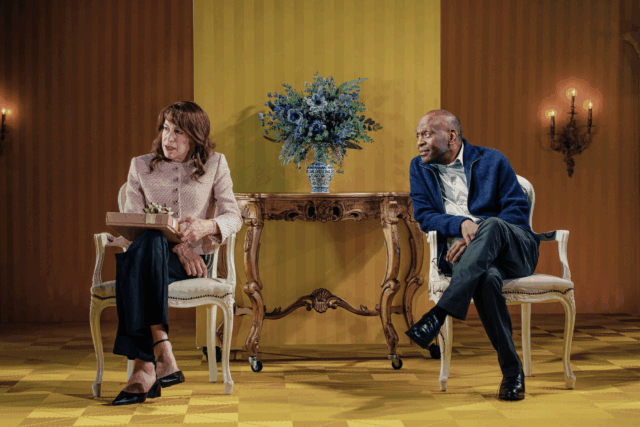
Royal siblings Charlitte (N’yomi Allure Stewart) and George (John McCrea) toast to their future in Prince Faggot (photo by Marc J. Franklin)
PRINCE FAGGOT
Playwrights Horizons, the Peter Jay Sharp Theater
416 West 42nd St. between Ninth & Tenth Aves.
Tuesday-Sunday through July 27, $68.50 – $103.50 www.playwrightshorizons.org
Studio Seaview
305 West 43rd St. between Eighth & Ninth Aves.
September 11 – December 13, $69-$249 studioseaview.com
The central image accompanying Jordan Tannahill’s new play, Prince Faggot, is Salman Toor’s 2022 ink and gouache Fag Puddle with Crown and Wire, on the program cover and on view in the fourth-floor lobby of Playwrights Horizons, where the show, coproduced with Soho Rep, runs through July 27. [ed note: The production will move to Studio Seaview for an extension September 11 – December 13.] The drawing depicts assorted body parts, a candle, a crown, a wig, and other items, commenting on, among other things, colonialism and queer identity. Toor told the New Yorker, speaking of his artistic approach, “I wanted to have parts of the painting that responded to my need for realism, and other parts that were deliberately sketchlike and a bit irreverent.”
Both descriptions can be applied to Prince Faggot, which feels like two separate plays that don’t quite merge; one is more realistic, and far more engaging; the other irreverent, and far less cohesive.
The play opens with the six actors sharing anecdotes about how their queerness impacted their childhood; five stories include a photo of the performer as a child. The first one, told by Mihir Kumar, and the last, which concludes the show, from N’yomi Allure Stewart, are based on their lives; the other four narratives, related by Rachel Crowl, K. Todd Freeman, David Greenspan, and John McCrea, are fictional creations of the playwright. (The six are listed as Performer #1, Performer #2, etc., in the program, but I will refer to them by their last names here for simplification when not in royal character.)
Prince Faggot feeds off a 2017 photograph of Prince George of Cambridge, the son of William and Kate, the prince and princess of Wales. The picture of the four-year-old in blue shorts, hands on his chin, went viral; Kumar notes, “I remember literally hundreds of people on social media sharing this photo and calling George a ‘gay icon’ for his adorably fey pose.” Freeman takes offense, declaring, “Sexualising a young child like that is disgusting.” But Kumar defends the discussion, peering into the audience and explaining, “Look, the queers in the audience — and I’m assuming that’s most of you, let’s be honest — we know one of our own when we see one because we ourselves were once queer children. We can locate our younger selves in photos of George’s poses and prancing because the world taught us to notice, and isolate, and suppress these affects — or suffer the consequences.”
Kate (Rachel Crowl) and William (K. Todd Freeman) face some trouble at home in Jordan Tannahill play (photo by Marc J. Franklin)
The play soon proceeds into what McCrea calls “an act of queer prognostication”: Tannahill builds a gay fantasia in which Prince George (McCrea), now eighteen, is indeed gay, ready to introduce his boyfriend, Dev Chatterjee (Kumar), to his parents (Freeman and Crowl) at their country estate at Anmer Hall. William and Kate bring in communications director Jaqueline Davies (Greenspan) to train George and Dev — who has been outspoken about what he thinks of the British imperial past — on how to deal with the public furor that will come with the revelation of their relationship. George is close with his sister, Charlotte (Stewart), and also gets personal advice from the gay palace butler, Andrew Farmer (Greenspan), who has a unique bond with him, always ready to cover up for George when drugs, alcohol, and strange men enter the mix.
As the story travels from 2032 to 2044, including the possibility of a gay royal wedding, George continually has trouble navigating a challenging life that requires him to balance what he wants with what the monarchy demands, tropes and themes familiar to any avid romance reader.
Several times, Prince Faggot breaks the fourth wall as performers deliver first-person monologues in what appear to be actual private confessions about their lives or the play itself but are actually fictional tales. Crowl, who is trans, discusses how a specific scene in the play made her angry, giving her an “overwhelming feeling of having been denied the experience of being a trans girl.” McCrea recalls being insulted by a teacher for his effeminacy while rehearsing Henry V in college. Legendary downtown performance artist Greenspan delves into gay history — primarily, fisting during the AIDS crisis.
While each of these sidebars is poignant and moving, the interventions disrupt the play in awkward fashion. Tannahill (Botticelli in the Fire,Is My Microphone On?) is squeezing in too much, generating confusion while exploring and celebrating queer characters and performers. It’s difficult to relate to George; Tannahill might be attempting to make George’s issues with his sexuality representative of many people’s experiences, but not everyone’s parents and grandparents are kings and queens and princes and princesses. However, the play does an excellent job of examining childhood queerness and young adult rebellion — a gay royal bildungsroman.
David Zinn’s set consists of two dressing rooms in the back, a central platform stage, and chairs in the wings where the actors sometimes sit and watch when they are not part of the action; a diagonal curtain is pulled across for set changes. Montana Levi Blanco’s costumes go from contemporary casual and regal finery to comic and, well, nothing during one extremely graphic sex scene. (UnkleDave’s Fight-House is the intimacy coordinator, and they have their hands full.) Obie-winning director Shayok Misha Chowdhury (Public Obscenities,Rheology) can’t quite merge the various elements, which also feature an interminable exchange in the rain and more than a glimpse of some BDSM. (Audience members are required to put their phones in a Yondr pouch so they can’t sneak any photos.)
The ensemble is led by standout performances from two-time Tony nominee Freeman (Downstate,Airline Highway), who imbues William with a gentle understanding, six-time Obie winner Greenspan (The Patsy,I’m Assuming You Know David Greenspan), who is touching as Farmer and hilarious as Davies, and, in his off-Broadway debut, Kumar, who portrays Dev with a deep sense of honesty.
“I was very, very femme growing up, and I often felt intimidated and ostracized,” the Pakistani-born, Brooklyn-based Toor also told the New Yorker. Tannahill probes these feelings in a fresh and unexpected setting in Prince Faggot, with some clever twists, but his romantic fantasy, built around the classic tropes of a shocking love between prince and commoner and the conflict between desire and duty, all too often can’t quite bear the weight of what he seeks to achieve.
[Mark Rifkin is a Brooklyn-born, Manhattan-based writer and editor; you can follow him on Substack here.]
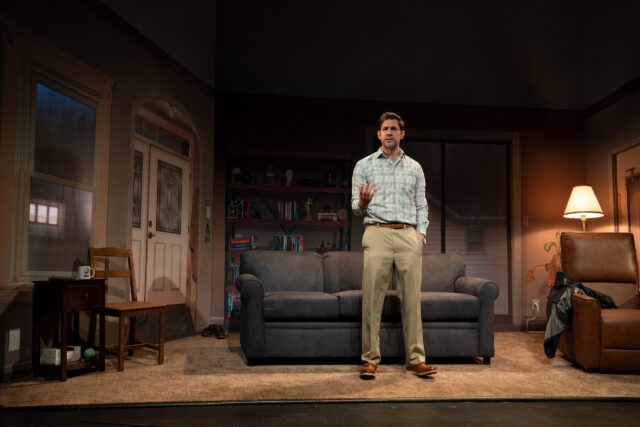
John Krasinski stars as a man descending into an internet rabbit hole in Angry Alan (photo by Jonny Cournoyer)
ANGRY ALAN
Studio Seaview
305 West 43rd St. between Eighth & Ninth Aves.
Through August 3, $69-$249 studioseaview.com
Angry Alan makes me angry. More on that later.
John Krasinski has made a career of playing likable characters. From Jim Halpert on The Office to Jack Ryan,A Quiet Place, and the web series Some Good News, Krasinski portrays amiable, trustworthy, and sensible men who are easy to identify with and root for.
That’s why he’s such a great choice to star as Roger in Penelope Skinner’s Angry Alan, the inaugural production at Studio Seaview in the former West Forty-Third St. home of Second Stage. Originally performed at the 2018 Edinburgh Fringe by cocreator Donald Sage Mackay as a one-hour solo show, Angry Alan has been expanded to eighty-five minutes and now has a second actor. More on that later.
On social media and various conspiracy sites, the terms “red-pilling” and “blue-pilling,” derived from the 1999 film The Matrix, refer to radicalization as a result of a sudden revelation of a hidden reality that is obscured by various elements of society that seek to repress or hold down humanity. Red pills are associated with conspiracy theorists and men, in particular. In the movie, Morpheus (Laurence Fishburne) offers Neo (Keanu Reeves) a choice: “You take the blue pill . . . the story ends, you wake up in your bed, and believe whatever you want to believe,” he says. “You take the red pill . . . I show you how deep the rabbit hole goes.”
A divorced father who lives with his girlfriend and rarely sees his teenage son, Roger essentially chooses the red pill after he loses his prestigious job at AT&T, becomes the dairy manager in the Walnut Creek Kroger, and goes down the rabbit hole of the internet, becoming obsessed with YouTube posts by a man who goes by the moniker Angry Alan. He tells his story directly to the audience in such a gentle and easygoing manner, it’s not difficult to give him the benefit of the doubt, even as we worry about where this might be heading.
“I’m considering exercising when I fall into your average google vortex: and I’m just about to discover which nut will burn all my belly fat when before I know it I’m watching an uplifting video about great men throughout history, created by a guy who calls himself Angry Alan,” Roger explains from his man cave, a living room with a sofa bed, a reclining chair, a few tables, and a fake backdrop of windows, bookshelves, and doors. (The cozy set is by dots.) “And it feels kinda cool, you know, to be reminded of all the amazing discoveries and achievements we’ve made over the centuries. To hear something positive for a change. And Alan goes on to say that despite what you hear on the news, most men are intrinsically good. So many men are strong, loving fathers, working hard to provide for their families. And I’m watching this thinking, yeah. Wow. Right? So I get to the end and the next video starts playing and this one’s about gender roles and that links me to an article about modern American women and this time instead of forty minutes of pointless swiping I spend five hours reading and watching videos, five hours nonstop reading Alan’s articles and watching Alan’s videos all about how modern men are in crisis.”
He details scenes from his life, talking about his girlfriend, Courtney, who has started taking a community college art class in which she draws from live nude models; his ex-wife, Suzanne; their son, Joe; and his buddy Dave, who got canceled for telling a joke at a Christmas party. The more Roger listens to Alan, the more he gets swept into the men’s rights movement, convinced that cis white males are being mistreated in today’s society — and need to fight back to regain their former power and dominance.
“If you’ve taken the blue pill, then you believe the propaganda as presented to you by our corrupt and biased mainstream media and by the feminist agenda . . . that men run the world and women are the victims of male domination,” he declares. “Once you take the red pill, you realize that in a nutshell: Since feminism was so successful, things have gone too far the other way. We’re living in a ‘Gynocentric Society’ and now, now it’s like Beyoncé says: Who runs the world? Women. Women run the world.”
A “red pill glitch video moment” accompanies certain revelations in mostly one-person show at Studio Seaview (photo by Jonny Cournoyer)
Soon he is reevaluating his past, present, and future through Alan’s lens, and he doesn’t like what he sees. And when Suzanne lets him know that Joe has to speak to him about something, Roger is ready to pass his new world view on to his son as well.
But when Roger goes to Detroit to attend a men’s rights conference sponsored by Alan, the character and the narrative take a severe shift in tone, to the play’s detriment.
Angry Alan works best when it’s just Roger in his man cave, telling us about his life. Lucy MacKinnon’s projections include photographs of some of the people Roger brings up, adding a bit of context. A handful of times, when Roger is energized by an aha! revelation, loud, screeching noise and accompanying red static lights blare out, what Roger ecstatically calls “my red pill moment!”
It’s likely that most audience members have friends or relatives who have gone down similar rabbit holes, and they want them to come back to reality; that’s why we still root for Roger to find his way back — and because Krasinski (Dry Powder) is so charming. He is gently hypnotic in the role, even as Roger descends deeper into the dark side.
But Skinner (Linda,The Village Bike) and Obie- and Tony-winning director Sam Gold (Fun Home,Circle Mirror Transformation) upend the play by first having Roger attend the conference, complete with set change, then having Joe (one of two actors, neither listed in the program but on a board in the lobby) come to stay with Roger for a few days, hence my anger.
The show loses its flow and sophisticated messaging; the situation Joe shares with his father is extremely disappointing and utterly predictable. It might have been far preferable if Roger told us about the conference and his son the way he had described his thoughts and actions the rest of the play, relating it from his room, where his loneliness grows as fast as his plunge into toxic masculinity.
And it has nothing to do with Roger’s no longer being so gracious and affable — there are many Americans who would support his transition and agree with his beliefs. It just feels like a deus ex machina, a lackluster answer leading to a pat conclusion to what had been a gripping story, one that’s still worth seeing, as enough of it is “intrinsically good.” It just could have been so much more.
[Mark Rifkin is a Brooklyn-born, Manhattan-based writer and editor; you can follow him on Substack here.]
Gustav (Liev Schreiber) is a master manipulator in Jen Silverman’s adaptation of August Strindberg’s Creditors(photo by Emilio Madrid)
CREDITORS
Audible’s Minetta Lane Theatre
18 Minetta Lane between Sixth Ave. and MacDougal St.
Through June 18, $35-$298.50 www.audible.com
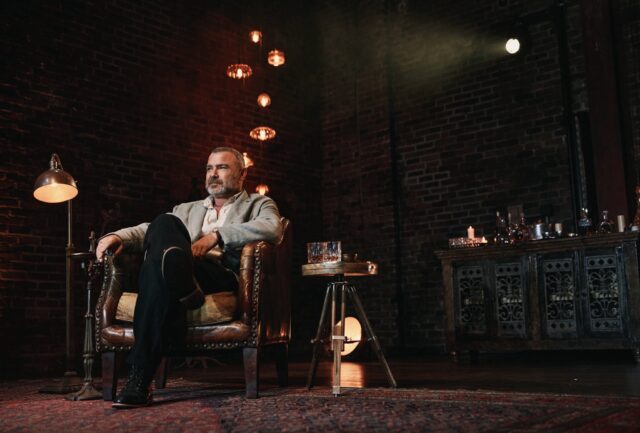
“Would you rather be the parasite or the host?” Gustav (Liev Schreiber) asks Adi (Justice Smith) in Jen Silverman’s superb modernization of August Strindberg’s 1889 drama, Creditors. It’s a question that lies at the heart of the seldom-performed play, currently running in repertory through June 18 with Hannah Moscovitch’s Sexual Misconduct of the Middle Classes at Audible’s Minetta Lane Theatre, kicking off Together, a new company founded by Hugh Jackman and Sonia Friedman to “offer audiences a chance to experience theater in a fresh and engaging way.”
The ninety-minute play takes place at a seaside resort at an unidentified time, though before cell phones. Adi is there with his wife, Tekla (Maggie Siff), who is riding high on the success of her debut novel, a roman à clef about her first marriage. While she is off at readings, signings, and parties, the younger Adi is examining his career as an artist.
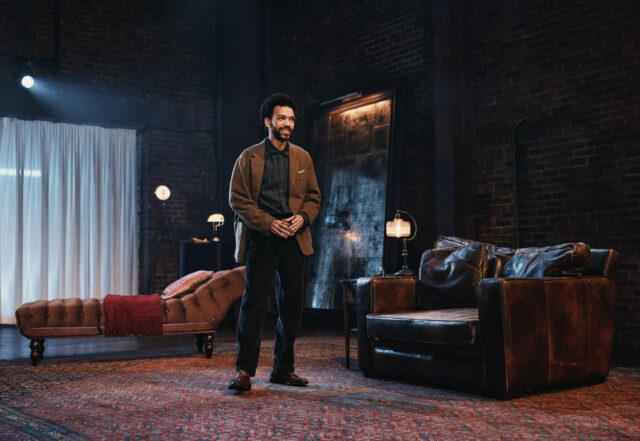
Brett J. Banakis and Christine Jones’s set features a small bar stage left, a comfortable chair and night table, a two-person couch, a fancy chaise longue, an old floor mirror against the bare brick back wall, and a glass door with a large white curtain stage right. When the show begins, Adi is in the parlor with an older, serious gentleman, Gustav (Liev Schreiber), who sips Scotch as they talk about art, love, and loyalty. Gustav looks and acts like a psychiatrist, asking penetrating questions that intrigue Adi — until Gustav, acting concerned about Tekla’s flirtatious behavior when she’s not with her husband, pounces.
Tekla (Maggie Siff) is caught between the past and the present in Together/Audible revival at Minetta Lane (photo by Emilio Madrid)
Gustav: You don’t get bored? Adi: Oh, it’s impossible to get bored when you’re with her. You’ll see! I’m excited for you two to meet — she’s one of a kind. Gustav: She must be. [lifts his glass] To young love! Adi: I’ve loved your company this week. I mean what you were saying yesterday — about sculpture instead of painting, how sculpture is the only real way to grasp — I could feel my whole soul wake up. Gustav: You don’t wonder who she’s with? Adi: I’m sorry? Gustav: When she’s out all night. Adi: She’s giving a reading. Gustav: Sure, but maybe there was a dinner before, or drinks after . . . Adi: I’m not a jealous man. Gustav: Maybe you should work on that.
Adi is like wet clay in Gustav’s formidable hands; as he manipulates Adi into questioning Tekla’s faithfulness and the control she has over him, it becomes apparent just who Gustav is: Tekla’s ex, the man she has written so vividly and openly about in her novel. However, Adi does not catch on, making him easy prey.
In the second scene, Adi confronts Tekla, who is shocked by his sudden change. She had been worried that she would end up losing Adi to a younger woman as his stature in the art world grew, but this is not the Adi she married. She wants to know who Adi has been talking to, sure that someone has put these ideas into his head. “You’re desperately loyal, Adi,” she tells him. “But where you are not loyal is to your own convictions. Your thoughts are so easily taken and shaped and handed back to you, and you accept them as if they’re still yours.”
In the third scene, Gustav reveals his devious scheme to Tekla and exposes himself like never before.
Adi (Justice Smith) is like a lump of clay in Creditors (photo by Emilio Madrid)
Creditors is seldom produced, and you’re likely to wonder why after seeing this excellent version. In 1977, the Public staged it with Rip Torn directing and playing Gustav to Geraldine Page’s Tekla and John Heard’s Adolf; Classic Stage presented it in 1992, with Caroline Lagerfelt, Nestor Serrano, and Zach Grenier, and Alan Rickman directed an adaptation in 2010 at BAM with Anna Chancellor, Owen Teale, and Tom Burke.
Creditors is not about money or finance; there is no talk of business deals. Instead, it’s about the physical, emotional, and psychological burdens that come with romantic relationships, male friendship, and artistic endeavors, particularly trust and jealousy.
In describing to Adi how Tekla might be unfaithful, Gustav says, “So then there’s the husband. The husband must be told — eventually, but not yet, after all he’s so far away! And yet . . . he’s right here. He takes on form and substance, the idea of him I mean, he enters every room you’re both in. He sits between you in a third empty chair, he eats the breakfast out of your bowl, he lies in the same bed the two of you now share. Oh, he doesn’t say anything, he doesn’t stop you. But he spreads poison. You owe him your happiness after all. Sooner or later, he’ll show up to collect the debt. And even if he never does, he’s still always there in the back of both of your minds.”
Later, Gustav explains to Tekla, “There is no out. Even if I weren’t here, Adi would live his life wondering if we still have an old debt between us, wondering if he can live with the uncertainty, wondering — is that my shadow, between you two? And these questions, Tekla. They will eat him like acid.”
The Swedish Strindberg, who was also a novelist and a painter, named the two male characters after Gustav II Adolf, the king who led Sweden during the Thirty Years’ War, a reference to the ongoing battle between men, in this case over a woman; Strindberg would shortly write the history play Gustaf Adolf. Meanwhile the female character is named for Saint Tekla, the virgin martyr and role model who fought off male aggression and preached chastity, honored by the church as “the glory of women and guide for the suffering, opening up the way through every torment.”
As he does with Sexual Misconduct of the Middle Classes, director Ian Rickson makes full use of the stage, the pace a kind of cat-and-mouse game among three complex characters. Mikaal Sulaiman’s sound design is highlighted by an undercurrent of drone music at key points, upping the suspense. Ásta Bennie Hostetter’s costumes firmly establish the trio, from the paint splatters on Adi’s pants to Gustav’s professorial demeanor and Tekla’s free spirit.
Silverman (Collective Rage: A Play in 5 Betties,Spain) has made several important cuts and changes to Strindberg’s original. There are no epileptic fits, Tekla drops a few F-bombs, and the ending is completely different, but Silverman’s dialogue is clear and concise for this moment in time. Smith (Yen,The Mother) portrays Adi with a tender sensitivity, suddenly unsure of the world that he is now a part of. Siff (Breaking the Story,Curse of the Starving Class) ably balances Tekla’s lust for life with an unexpected vulnerability. And Tony winner and nine-time Emmy nominee Schreiber (Doubt, Glengarry Glen Ross) is mesmerizing as Gustav, an intense operator who knows just what to say to get under everyone’s skin; I would be terrified to sit opposite him, afraid I would fall for his machinations. Schreiber is so good in the part that even when, in the second scene, he had to call out for the next line — quickly supplied by a stage manager — he handled it without breaking character or interrupting the flow, a sign of just how professional and talented he is.
Creditors and Sexual Misconduct of the Middle Classes get the Together/Audible collaboration to a flying start, led by a pair of marvel-ous superheroes (Jackman/Wolverine, Schreiber/Sabretooth) reveling in playing contemporary men, flaws and all.
[Mark Rifkin is a Brooklyn-born, Manhattan-based writer and editor; you can follow him on Substack here.]
Author and professor Jon (Hugh Jackman) tends to student and fan Annie (Ella Beatty) in Sexual Misconduct of the Middle Classes (photo by Emilio Madrid)
SEXUAL MISCONDUCT OF THE MIDDLE CLASSES
Audible’s Minetta Lane Theatre
18 Minetta Lane between Sixth Ave. and MacDougal St.
Through June 18, $35-$298.50 www.audible.com
Sexual Misconduct of the Middle Classes might not quite be the story of the Big Bad Wolverine and Little Red Riding Hood, but it is an intriguing and thought-provoking adult fairy tale with a marvelous final twist and purposely ambiguous moral.
Hugh Jackman makes a curious choice for his off-Broadway debut and the inaugural show from his new company, Together, a collaboration with Audible, but it is an alluring and tantalizing success.
Cofounded by the Emmy–, Grammy–, and Tony–winning and Oscar-nominated Jackman with megaproducer Sonia Friedman, Together is “dedicated to live theater that is intimate and accessible . . . driven by a commitment to offering audiences a chance to experience theater in a fresh and engaging way” — including making half of the tickets available for free or $35. That’s precisely what happens with the New York premiere of Canadian playwright Hannah Moscovitch’s 2020 Sexual Misconduct of the Middle Classes, a pre-#metoo story about a relationship between a hunky college professor and a nineteen-year-old student that offers new insights on a familiar subject.
As audience members are still taking their seats, a young woman (Ella Beatty) moves around furniture on Brett J Banakis and Christine Jones’s long, narrow, and relatively sparse set, consisting of a few chairs and tables, a desk, and a floor lamp that morph from an office to a porch to a hotel room. She’s not part of the crew, and why she is arranging the set will become clear later. Jon Macklem (Jackman), a professor and famous novelist, enters and starts speaking in the third person, addressing the audience directly while Annie sits off to the side, watching closely but dispassionately. We soon find out that she is Annie, a shy, somewhat awkward teenager who did not enjoy high school and is hoping college will bring her more confidence and freedom.
As he narrates, Jon surveys the audience, making eye contact with as many people as he can, in the orchestra and the balcony. A real charmer, he reacts in a friendly manner when he hears a particularly loud laugh, gasp, or titter. At one point he sits over the lip of the stage, his feet dangling mere inches from people in the first row. Isabella Byrd keeps the lights only slightly dimmed during his monologues, then lowers them to a more accustomed level when Jon interacts with Annie.
Jon (Hugh Jackman) and Annie (Ella Beatty) begin a complex relationship in Hannah Moscovitch play (photo by Emilio Madrid)
“Well, he was agitated: he didn’t know why, nothing came to him” are his first words. He wonders, “Could it be a fragment of . . . ? His publishers were waiting on a novel about turn-of-the-century lumberjacks, so hopefully this girl was a part of that, or . . . could be shoehorned into it? Because also: come on, a girl, a young girl? Wasn’t there something deadly about the ‘young girl’ as an object of fiction? Wasn’t it where writers went to expose their mediocrity? Because wasn’t it so often the ‘young girl’ who was grossly underwritten, a cipher, a sex object, reduced to a cliché by lust-addled men?”
He knows precisely why he’s agitated, and it has everything to do with the young girl as opposed to the third divorce he’s going through. He adds, sounding like the literature professor he is, “He was on the side of the Greeks: learning is a seduction. . . . The erotics of pedagogy . . . That was the sort of thing you couldn’t say out loud without getting fired.”
Annie sits in the front row of his class and lives right across the street from Jon. He is surprised when he sees her standing at his house while he mows the lawn, but another day he writes outside on his porch, hoping she stops by. With a hesitating naivete, she tells him she loves his work, that it means a lot to her that someone else in the world thinks like she does.
When she suffers an injury, he asks her inside so he can patch her up, making “an ashamed, apologetic face” at the audience. He knows where this might lead, understanding that it is wrong and feeling panic. “Well, this, he recognized, was very bad,” he admits to us, trying to find a way to “get her the fuck out of his house.” But instead, he is soon locked in her embrace.
Jackman (A Steady Rain,The Music Man) is terrific as Jon; the actor is so handsome, so charming — so physically close — and Jon is so aware of what he is doing that we don’t want to see him as a villain, instead giving him the benefit of the doubt whenever we possibly can, despite, as he is well aware, “the horrible predictability of it all.” (In addition, Jackman is performing his Live from New York with Love concert twice a month through October.)
In her third play, following the recent Appropriate and Ghosts, Beatty, whose parents are Warren Beatty and Annette Bening, brings to Annie a nearly impenetrable quality, never giving away just how innocent she may or may not be, whether she is predator or prey, victim or ingénue, or whether a nineteen-year-old student can ever take responsibility for an affair with her college professor. When Jon is addressing the audience in third person, Annie sits in one of the chairs at stage left, with her ever-present red coat — the only burst of color in Ásta Bennie Hostetter’s otherwise subdued, naturalistic costumes — watching Jon, her eyes riveted but not in the same way ours are.
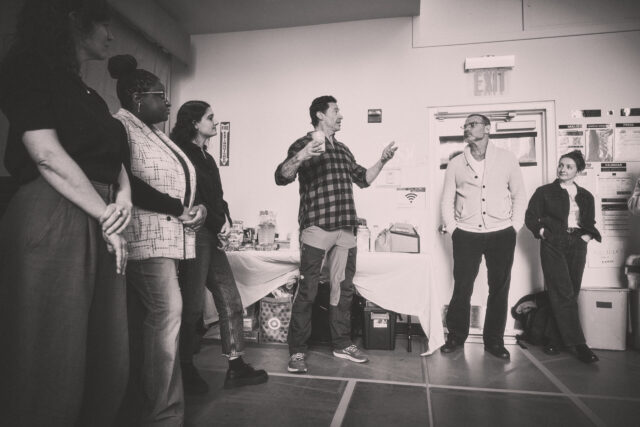
Hugh Jackman, Liev Schreiber, and others rehearse for two Together plays running in repertory at Audible theater (photo by Guy Aroch)
Three-time Olivier winner Ian Rickson (Jerusalem,The Weir), who previously directed Jackman in Jez Butterworth’s The River, guides the proceedings with a sure hand, maintaining an air of mystery as the relationship grows more complicated, perhaps more like that between J. D. Salinger and Joyce Maynard than the one in David Mamet’s two-character Oleanna. Moscovitch, whose 2016 Bunny also involves a sexual liaison between a male professor and one of his female students, avoids falling into any traps; her dialogue is concise and believable, and Jon and Annie are no mere cardboard cutouts but complex characters who are not sure what they want — or what they don’t.
Sexual Misconduct of the Middle Classes, which is running in repertory through June 18 with Jen Silverman’s new adaptation of August Strindberg’s Creditors, with Liev Schreiber, Maggie Siff, and Justice Smith, is not a he said/she said cliché-ridden narrative but a tense, realistic parable with plenty of bite and a finale that will have the drama spinning back through your mind for a long time to come.
[Mark Rifkin is a Brooklyn-born, Manhattan-based writer and editor; you can follow him on Substack here.]
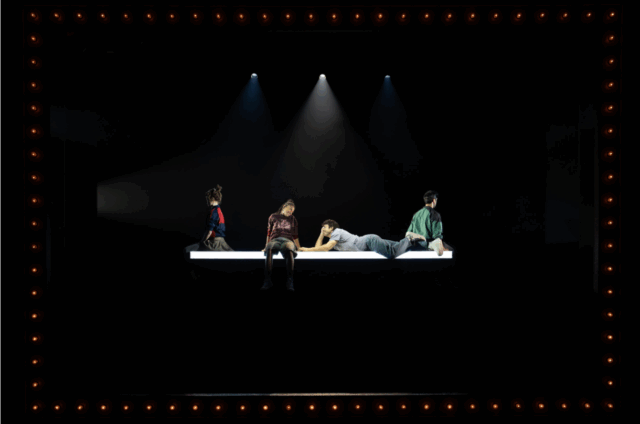
Caryl Churchill’s Glass. takes place on a glowing, floating platform (photo by Joan Marcus)
GLASS. KILL. WHAT IF IF ONLY. IMP.
Martinson Theater, the Public Theater
425 Lafayette St. at Astor Pl.
Tuesday through Sunday through May 25, $89
212-539-8500 publictheater.org
British playwright Caryl Churchill burrows into the fragility of human life and the concept of impermanence in Glass. Kill. What If If Only. Imp., four short works being performed together at the Public’s Martinson through May 25.
For more than fifty years, Churchill, now eighty-six, has been writing inventive, experimental plays that challenge audiences through abstract narratives and unique, unexpected stagings, from Cloud Nine and Top Girls to Vinegar Tom and Love and Information, creating her own genre, with flourishes of Beckett, Pinter, and Brecht mixed in. The four-time Obie winner has penned more than fifty works for the stage, radio, and television; three of the pieces at the Public were written in 2019, the fourth in 2021. (Glass.,Kill., and Imp. were originally performed with Bluebeard’s Friends at the Royal Court Theatre in September 2019 but has been replaced here by What If If Only, her latest play.)
The 135-minute show (with intermissions) is a triumph for both Churchill and Miriam Buether, whose breathtaking sets lift Churchill’s themes to the next level, along with stunning lighting by Isabella Byrd and compelling sound by Bray Poor, making it a visual and sonic treat. First up is Glass., which unfolds on a glowing rectangular platform hanging in the middle of the space, surrounded by darkness. It’s a kind of mantel where a Girl Made of Glass (Ayana Workman), a Clock (Sathya Sridharan), a Vase (Japhet Balaban), and a Red Plastic Dog (Adelind Horan) interact, attempting to define their existence and importance.
“She doesn’t want to be touched. She’s afraid of being broken,” the Girl’s protective mother says, explaining how there are many cracks in her daughter, who needs bubble wrap to go out.
The defensive Clock tells the Girl, “You’re beautiful but I’m also useful.” The Girl responds, “A clock isn’t useful anymore. Who looks at you? Time’s on the phones.” The Clock answers back, “They look at me because I’m worth looking at. Time from me is richer because I’m old and time’s run through me since before their parents were born. And you see it flow because my second hand goes round and my minute hand goes round and my hour hand goes slowly round and there’s none of this digital jumping. You gaze at me and think how long a minute lasts. Pain for a whole minute would be torture. Joy for a whole minute would be exceptional. And even if I stopped I’d be kept as an object because my history is intriguing and my shape is graceful and my value is unquestioned.”
The Dog says she is a reminder of happy times, even if she’s dusty and hasn’t been played with in years. The Vase is thrilled when the Girl says he is beautiful even without flowers. A group of schoolgirls stop by and taunt the Girl. A friend tells her a secret.
The play ends with a moving monologue in which the Girl expresses her fears in a way we can all relate to, how easy it is to become physically and emotionally damaged.
During the first break, hand balancer Junru Wang performs remarkable feats on canes in the pit in front of the stage as the set is changed behind the red velvet curtain. Wang pushes herself high into the air, stretching, switching hands, and contorting her limbs, a dazzling display of what the human body is capable of, a thrilling counterpoint to the delicate Girl Made of Glass.
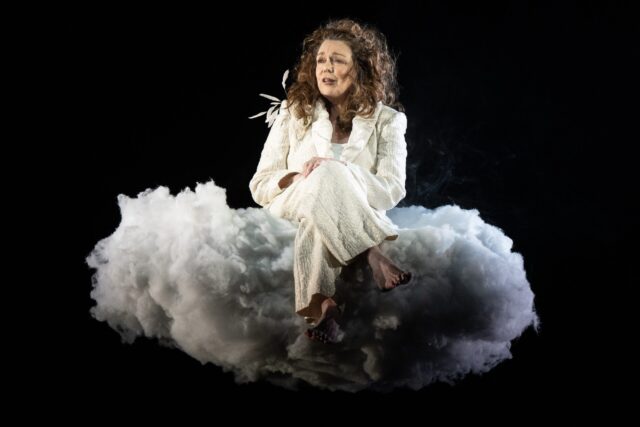
Deirdre O’Connell relaxes on a cloud while talking about death in Kill. (photo by Joan Marcus)
In the solo Kill., Tony winner Deirdre O’Connell, wearing all white, sitting comfortably on a floating cloud in a black sky, delivers a treatise on the gods’ power over humans, treating them as playthings as they watch them murder one another as if orchestrating a Greek tragedy for fun. Fathers, mothers, husbands, brothers, cousins, lovers, and kings are brutally murdered, sent to hell, eaten, brought back for more punishment — it’s a vicious cycle of death and destruction put on for pleasure, a sly comment on the theater itself as well as the violence inherent in everyday life.
She begins, “We take this small box and shut the furies up in it, they’re furious and can’t get out, they say let us out and we’ll be kind. We gods can do that sometimes, quieten the furies, we can’t do everything, we don’t exist, people make us up, they make up the furies and how they bite. They’re after the boy, they won’t let him sleep or wake or sleep and he suffers. He suffers and suffers because he kills his mother, which we’re against and so is everyone but he has his reason so he’s right and wrong. He kills his mother, hoping she’ll die quickly, it can’t be over quickly enough, he doesn’t want her unrecognisable but still here, both slipping in the blood, his duty to do it, everyone thinks that and so do we, and he kills her lover happy to kill him but taking out the knife he remembers loving his mother and the nonsense words they’d say to each other though he still has the same hate in his heart coming home as when he’s little and runs away when she’s killing his father.”
It’s a tour de force for O’Connell, the words spilling out in a nonstop poetic assault that underlines humanity’s penchant for real and fictional violence; Churchill also questions the notion of faith, people’s belief that someone else is pulling the strings, be it a supreme being or, perhaps, a playwright, from Ancient Greece or twenty-first-century England. As the god says multiple times, “We don’t exist.”
During the second break, Maddox Morfit-Tighe juggles clubs, involving a few audience members; it’s not as awe-inspiring as what Wang did, and the metaphor is more obvious, but it is still entertaining as the stage is prepared for the third tale.
A man (Sathya Sridharan) faces loss in What If If Only. at the Public (photo by Joan Marcus)
What If If Only. is set in a mysterious large white cube reminiscent of Churchill’s Love and Information. A man identified in the script as Someone on Their Own (Sridharan) is sitting at a small table with a bottle of wine and two chairs; it is apparent that he is waiting for a person who is unlikely to come.
“If I was the one who was dead would you still be talking to me? We once said if one of us died if there was any way of getting in touch we should do it, I thought we’d be old. Are you not trying?” he says. “If you’d wanted to talk to me you could have stayed alive. I’ve nothing to say really, I just miss you. I once thought I saw a ghost, not spooky like Halloween, just a wisp of something standing in the door. I’ve told you this already, do you remember? Is remembering something you can do or has it all gone now? I miss you I miss you I miss you I miss you. I miss you. Please, can you? Just a wisp would be fine. If you can, please. Please, I miss you. A small thing, just any small thing, let me know you’re there somewhere. If you can.”
A woman (Workman) does arrive, but the man is not sure what or who she is. They agree she is at least a little like his lost love, then talk about regrets and possibilities, living and dying. She tells him, “I’m the ghost of a dead future. I’m the ghost of a future that never happened. And if you can make me happen then there would be your beloved real person not a ghost your real real living because what happened will never have happened what happened will be different will be what you want will be a happy happy.”
Soon the walls of the white cube rise and others enter, including a young girl (Cecilia Ann Popp), Asteroid, Empire, Silver, Nature, Small, and a calm, supportive older man (John Ellison Conlee) who tries to help the younger man face the reality of his situation, that there are so many futures but only one that will happen. It’s a gorgeous existential conversation with a surprise conclusion.
Imp. concludes quartet of existential works by Caryl Churchill (photo by Joan Marcus)
Imp. follows a full intermission (without acrobatics), featuring another brilliant set, this time a raggedy living room with a couch, a comfy chair, a floor lamp, and a red oriental rug on a slanted platform. It is the home of nonkissing cousins Jimmy (Conlee) and Dot (O’Connell), who bicker like an old married couple with nothing better to do. While the widowed Jimmy occasionally gets up to go running, training for a half marathon, the divorced Dot never leaves her chair.
Their several-times-removed Irish niece, Niamh (Adelind Horan), was recently orphaned, so she is visiting Jimmy and Dot while making a new life for herself in England. When Niamh says she needs to lose a stone by summer, Dot disagrees and says, “You’re lovely how you are. Don’t do it.” Jimmy argues, “Leave her alone, goals are good, you want everyone not to be fit so they’re no better than you. Just like you want everyone to be miserable.” Dot barks back, “You’re fattist is what he is, not he’s the fattest, Niamh, I mean like racist.” It’s rarely easy to parse Dot’s logic.
Another day they are speaking with the homeless Rob (Sridharan), a world traveler who’s been sleeping in a cemetery, wanting to go back to his son and estranged wife. The ever-suspicious Dot worries that if they let him stay in their house, he might kill them and take the residence for himself. “Why would he want to do that? He’s not stupid,” Jimmy says. Dot replies, “But if he could get away with it and have the flat. Don’t tell me you’ve never thought it.” Rob deadpans, “I’ve never thought it.” Soon Dot and Jimmy are hoping that Niamh and Rob get together.
They delve into faith and religion, with Niamh wondering what being Catholic ever did for her except make her terrified of sin and hell. Dot, a former nurse, is afraid of her temper, which might have cost her her marriage and career. Rob is deeply worried about his immediate future. Meanwhile, Jimmy is an eternal optimist.
But when Jimmy tells Rob about the bottle Dot keeps that she claims has a wish-giving imp in it, new questions arise about what’s next.
There might be a period after the name of each part of Glass. Kill. What If If Only. Imp., but they form a cohesive whole in this stellar production, gorgeously directed by longtime Churchill collaborator James Macdonald (Infinite Life,Escaped Alone). In three of the four plays, the characters wear Enver Chakartash’s casual, naturalistic costumes (O’Connell is in heavenly garb in Kill.), equating them with the audience, making the otherworldliness more believable. The pain of loss, the brittleness of life, the lack of power humans have over their destiny hover over all four plays. In each one, there is also trepidation about the future of each character, the sets tilted and suspended in ways that make it seem like the actors could at any moment fall off into the darkness or be trapped in blazing white light.
Churchill and Macdonald practically implore us to take a look at ourselves and examine how we deal with faith, grief, and, perhaps most important, time. “I sit on the mantelpiece and time goes by,” the Girl says in Glass. The characters in the other three works also are often sitting down, not taking action but watching and waiting.
It’s enough to force you to face your own future once you get out of your theater seat and venture back into the real world.
[Mark Rifkin is a Brooklyn-born, Manhattan-based writer and editor; you can follow him on Substack here.]