Kay (Marsha Mason) brings up some very private details in Little Gem at the Irish Rep (photo by Carol Rosegg)
Irish Repertory Theatre, Francis J. Greenburger Mainstage
132 West 22nd St. between Sixth & Seventh Aves.
Through September 8, $50-$70
212-727-2737 irishrep.org
Three generations of women in a North Dublin family share their foibles and exert their fortitude in successive monologues in Marc Atkinson Borrull’s engaging if not quite sparkling revival of Elaine Murphy’s Little Gem, running at the Irish Rep through September 8. First seen in the US at the Flea in 2010, the hundred-minute play begins with eighteen-year-old Amber (Lauren O’Leary), who enters a doctor’s office waiting room (the antiseptic set is by Meredith Ries) and talks about a night of partying at a high school ball with her best friend, Jo, involving drugs and alcohol, dancing, and her maybe-boyfriend, Paul. “Jo and me just did a line in the toilets. Feeling nice. The music is thumping in my chest. Unce, unce, unce. Like this fuzzy feeling, know exactly where I am but when I close my eyes I could be anywhere,” she says dreamily.
When she is done, her mother, Lorraine (Brenda Meaney), comes in and, while Amber watches her, discusses a strange occurrence at the store where she works that ends up with her having to speak with human resources. The “HR bird” asks her about her ill father. “She reaches across the desk and touches my hand. Don’t remember the last time someone touched me, hugged me, or even bleedin’ nudged me,” Lorraine admits to the audience.
And then Kay (Marsha Mason), Amber’s grandmother and Lorraine’s mother, walks in and, while the other two look at her, describes her vaginal itch and her ill husband, Gem, who she loves but calls a “cantankerous oul’ fuck.” She says, “I’m the wrong side of sixty, not dead. I haven’t had sex in well over a year and it’s killing me.” So off she goes to Ann Summers to purchase her very first vibrator.
Grandmother Kay (Marsha Mason), granddaughter Amber (Lauren O’Leary), and mother Lorraine (Brenda Meaney) share their fears and desires in Irish Rep revival (photo by Carol Rosegg)
Sex, significant others, loneliness, and the pains of life and death are the key themes as the trio of women continue alternating monologues. Amber becomes pregnant. Lorraine, who is divorced from Ray, goes on her first date ever with a man she met at a salsa dance class. And Kay tries to use her vibrator while worrying about Gem’s health. They meander across the stage, occasionally sitting down, as they open up about intimate details of their innermost fears and desires; while the youngest, Amber, has no filter, Lorraine is ready to burst out of her sheltered existence and Kay is a bit surprised by how brutally honest she is.
Everything about Murphy’s (Ribbons, Shush) first play is solid, from Borrull’s (Beginning, Outlying Islands) effective direction to the performances by four-time Oscar nominee Mason (The Goodbye Girl, Fire and Air), Meaney (Indian Ink, Incognito), and, in her off-Broadway debut, O’Leary (The Awkward Years), but Little Gem never quite grabs you as it should, falling just short of reaching the next level it aims for. Like life itself, it can be disappointing, but there are enough genuine moments to recommend it, even if it doesn’t glitter.
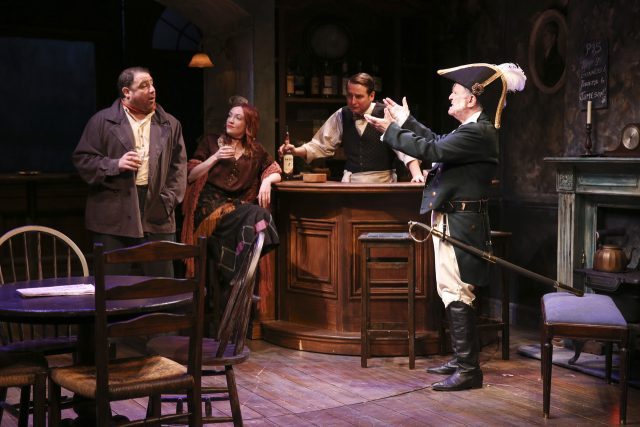
Irishman battles Irishman in Sean O’Casey’s The Plough and the Stars (photo by Carol Rosegg)
Irish Repertory Theatre, Francis J. Greenburger Mainstage
132 West 22nd St. between Sixth & Seventh Aves.
Through June 22, $50-$70
212-727-2737 irishrep.org
The Irish Rep concludes its outstanding “O’Casey Cycle” with the third play in Sean O’Casey’s Dublin Trilogy, The Plough and the Stars. The controversial 1926 work, the follow-up to 1923’s The Shadow of a Gunman and 1924’s Juno and the Paycock, the semiautobiographical The Plough and the Stars is the earliest of the stories, taking place in 1915-16 around the Easter Rising, when the Irish Volunteers and the Irish Citizen Army battled the British army and Dublin Fusiliers, Catholics against Protestants in a violent rebellion. Charlie Corcoran’s immersive set, which extends up the sides of the theater and down the hall, changes from a tenement apartment to a pub and the street outside as a close-knit collection of intriguing characters prepare for a fight.
The play begins in November 1915 in the living room of Jack Clitheroe (Adam Petherbridge), a bricklayer, and his wife, Nora (Clare O’Malley), an elegant woman who wants more out of life; he’s a bit disappointed as well, dismayed that he had been passed over for a promotion to captain in the ICA. Carpenter Fluther Good (Michael Mellamphy) is attempting to get rid of the squeak in the front door as nosy charwoman Mrs. Grogan (Úna Clancy) accepts a package for Nora and opens it to find a fancy hat. “Such notions of upper-osity she’s getting’,” she declares. “Oh, swank, what!” Nora comes home to find her uncle, the daffy Peter Flynn (Robert Langdon Lloyd), and Fluther having words with the Young Covey (James Russell), a wisecracking atheist and socialist who enjoys riling people with his progressive beliefs.
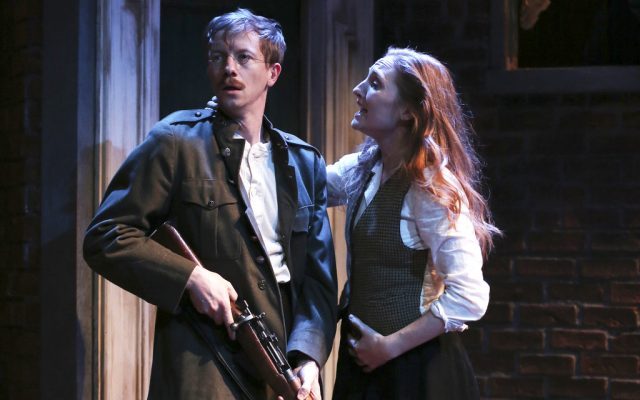
Nora (Clare O’Malley) begs her husband, Jack (Adam Petherbridge), not to join the fight in conclusion of Sean O’Casey’s Dublin Trilogy (photo by Carol Rosegg)
Fruit vendor and Protestant loyalist Bessie Burgess (Maryann Plunkett) stops by to heap disdain on Nora, calling her a “little over-dressed trollope.” After everyone else leaves, Capt. Brennan (John Keating) arrives to tell Jack that he is the new commander of the eighth battalion of the ICA and must lead a reconnaissance attack, which upsets Nora, who wants him to stay home with her. Jack storms out with Capt. Brennan, and a distraught Nora is then visited by Mollser (Meg Hennessy), Mrs. Gogan’s sickly fifteen-year-old daughter who dreams of having the life Nora does. “I often envy you, Mrs. Clitheroe, seein’ th’ health you have, an’ th’ lovely place you have here, an’ wondherin’ if I’ll ever be sthrong enough to be keepin’ a home together for a man,” Mollser says. As a regiment passes by on its way to the front, Bessie sticks her head in to condemn the soldiers. It’s a brilliant first act, firmly establishing the characters, mixing in humor with dread as darkness awaits. “Is there anybody goin’, Mrs. Clitheroe, with a titther o’ sense?” Mollser asks.
The next three acts build on that extensive framework, with the addition of prostitute Rosie Redmond (Sarah Street), a barman (Harry Smith), a woman from Rathmines (Terry Donnelly) who is terrified of what is going on outside, and Jack’s flag-waving compatriots Lt. Langon (Ed Malone) and Sgt. Tinley (Smith). Director Charlotte Moore, the cofounder of the Irish Rep with Ciarán O’Reilly, knows the play well; she previously helmed the company’s 1988 production, its first show ever, as well as its 1997 revival. In honor of the Irish Rep’s thirtieth anniversary season, O’Reilly again is the voice of the speaker, as he was in 1988, spouting rhetoric to the assembled masses based on the words of Irish activist Padraig Pearse. The cast, most of whom also appear in The Shadow of a Gunman and Juno and the Paycock, is exemplary, creating a wholly believable fictional world.
During the first week of the premiere of The Plough and the Stars at the Abbey Theatre in Dublin in 1926, there were protesters and demonstrators angry with O’Casey’s treatment of Irish nationalism and religion, leading to a riot in which actor Barry Fitzgerald punched out a man who had climbed onstage, knocking him into the orchestra pit. “You have disgraced yourselves again,” senator and Abbey director W. B. Yeats said to the crowd. “Is this going to be an ever-recurring celebration of the arrival of Irish genius?” The 2019 iteration of the play might not pack the same kind of wallop, but it is a potent portrayal of civil strife and the power religious and political disagreement has to tear apart friends and neighbors, something we know all too well given the current climate in America.
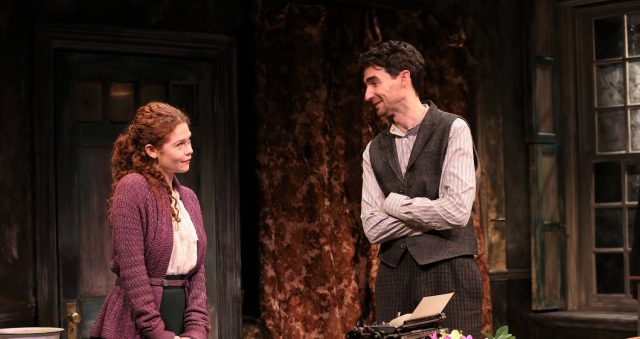
Minnie Powell (Meg Hennessy) and Donal Davoren (James Russell) flirt in Irish Rep revival of Sean O’Casey’s The Shadow of a Gunman (photo by Carol Rosegg)
Irish Repertory Theatre, Francis J. Greenburger Mainstage
132 West 22nd St. between Sixth & Seventh Aves.
Through May 25, $50-$70
212-727-2737 irishrep.org
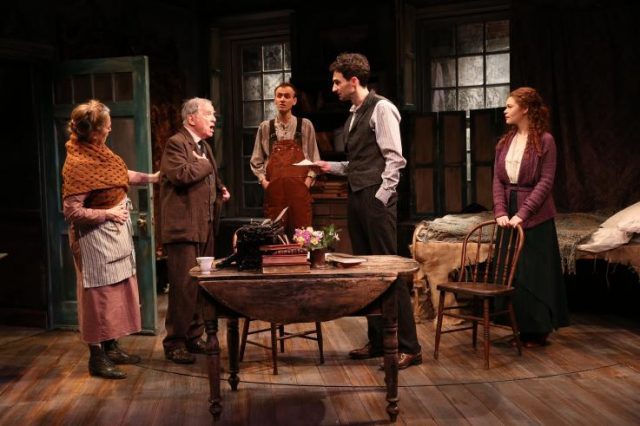
The Irish Rep’s thirtieth anniversary season, “The O’Casey Cycle,” features Sean O’Casey’s exceptional Dublin Trilogy. Last week I highly recommended Juno and the Paycock the 1924 play set during the Irish Civil War of 1922-23; 1925’s The Plough and the Stars, which takes place around the 1916 Easter Rising, was the first show Irish Rep ever put on, back in 1988, and will begin performances April 20. O’Casey’s first produced play was The Shadow of a Gunman, which premiered at the Abbey Theatre in 1923 and established the laborer as a new force on the scene. The play is set in May 1920, during the Irish War of Independence, in a tenement in Hilljoy Square in Dublin. Small-time peddler Seumas Shields (Michael Mellamphy) is sleeping late, something he appears to do often; while he waits for his colleague Mr. Maguire (Rory Duffy) to go out to sell their wares, a slew of other classic characters from Irish lore, from drunks and ne’er-do-wells to layabouts and overburdened women, come barging in.
Poet Donal Davoren (James Russell) is staying with him, which doesn’t make the landlord, Mr. Mulligan (Harry Smith), very happy, since the rent is overdue. The lovely young Minnie Powell (Meg Hennessy) develops a crush on Donal, believing him to be a heroic IRA gunman preparing for his next hit. “Maybe I am, and maybe I’m not,” he teases, taking advantage of the romantic attention. The blustery Tommy Owens (Ed Malone) stops by to let everyone know that he supports the IRA and will fight if called on. Mrs. Henderson (Una Clancy), who lives in a neighboring tenement, comes over with James Gallagher (Robert Langdon Lloyd), who reads a persnickety letter he wrote asking the IRA for help. And Mrs. Grigson (Terry Donnelly) is worried about her alcoholic husband, Adolphus (John Keating), who talks about himself in the third person. Maguire eventually shows up but is in a hurry, leaving a mysterious black bag with Seumas. Through all the mayhem and madness, the fear that the Black and Tans could show up at any minute hangs over the proceedings with so much dread.
James Gallagher (Robert Langdon Lloyd) seeks help from the IRA in The Shadow of a Gunman (photo by Carol Rosegg)
In the 105-minute two-act play, O’Casey avoids glorifying the lower class. “Upon my soul! I’m beginnin’ to believe that the Irish people are still in the stone age,” Seumas says, adding later, “Oh, this is a hopeless country!” Donal complains, “The people! Damn the people! They live in the abyss, the poet lives on the mountaintop . . . The poet ever strives to save the people; the people ever strive to destroy the poet. The people view life through creeds, through customs, and through necessities; the poet views creeds, customs, and necessities through life.” However, The Shadow of a Gunman is a slighter play than Juno and the Paycock, a less-layered tale lacking the same nuance and muscle. Charlie Corcoran’s fabulous tenement set, which runs throughout the theater, is only slightly altered from Paycock’s. Directed by Ciarán O’Reilly, who plays Capt. Boyle in Paycock,Gunman features many of the same actors, with Hennessy standing out as the coquettish Minnie and Donnelly reprising her role from the company’s 1999 production. In many ways, O’Casey’s vision of the country is personified by Seumas, who doesn’t want to get out of bed in the morning and does not want to go to work. “A land mine exploding under the bed is the only thing that would lift you out of it,” Donal says. It’s a funny line, but one more than tinged with seriousness.
Capt. Boyle (Ciarán O’Reilly) and his wife, Juno (Maryann Plunkett), see brighter days ahead in Juno and the Paycock (photo by Carol Rosegg)
Irish Repertory Theatre, Francis J. Greenburger Mainstage
132 West 22nd St. between Sixth & Seventh Aves.
Through May 25, $50-$70
212-727-2737 irishrep.org
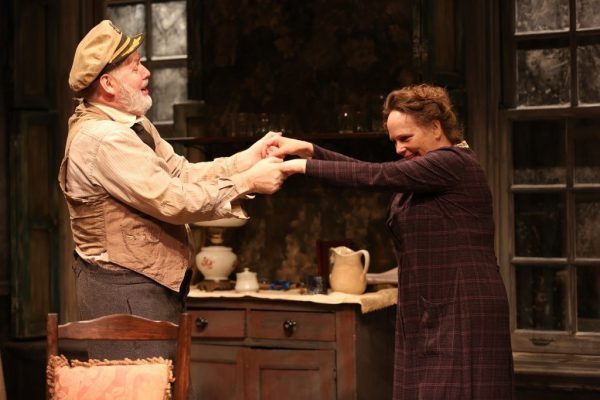
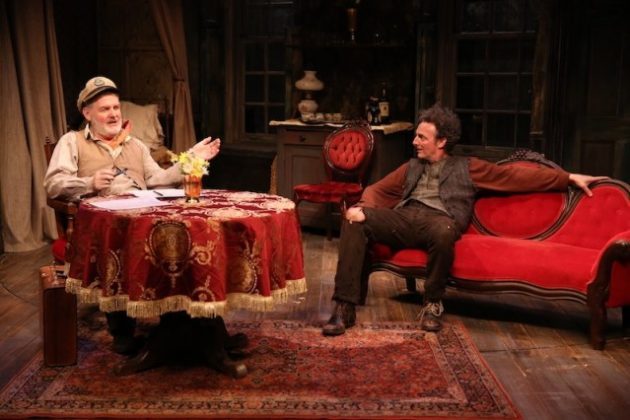
The Irish Rep’s inaugural 1988–89 season included The Plough and the Stars, part of Sean O’Casey’s 1923–26 Dublin Trilogy; the company brought it back again in 1997. To celebrate its thirtieth anniversary season, the Irish Rep is presenting revivals of the first two plays in the trilogy, the 1924 Juno and the Paycock and the 1923 The Shadow of the Gunman, in repertory through May 25, along with screenings of the 1937 John Ford film version of The Plough and the Stars with Barbara Stanwyck, Preston Foster, and Barry Fitzgerald and a reading series. For the occasion, which the Irish Rep is calling “The O’Casey Cycle,” the Francis J. Greenburger Mainstage theater has been transformed into a ramshackle 1920s tenement; Charlie Corcoran’s set extends well beyond the stage: Windows and brick walls run up the sides and down the hall, clothes are hanging to dry by the balcony, and there’s even a small bed hidden beneath the stairs by the restrooms. It’s now back in a “darling” adaptation after previous stagings at the Irish Rep by artistic director Charlotte Moore in 1995 and 2013–14.
Capt. Boyle (Ciarán O’Reilly) waxes philosophic with Joxer Daly (John Keating) in Sean O’Casey revival at the Irish Rep (photo by Carol Rosegg)
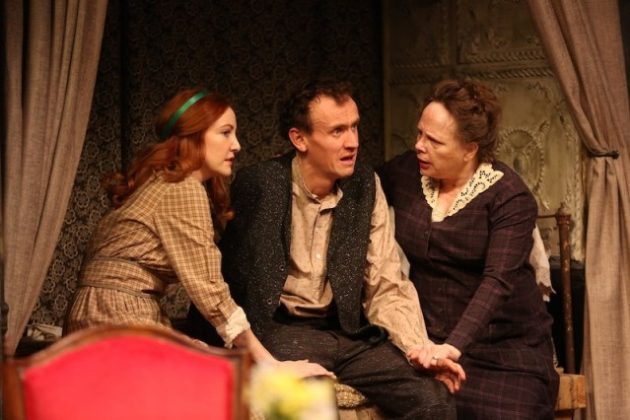
Juno and the Paycock takes place in 1922, during the Irish Civil War between the Diehard Republicans and the Free Staters, as matriarch Juno Boyle (Tony winner Maryann Plunkett) is trying to make ends meet in her family’s small apartment. Her husband, Capt. Boyle (Ciarán O’Reilly), spends most of his time, and what little money they have, hitting the pub with his best friend, the gangly ne’er-do-well Joxer Daly (John Keating), and complaining about terrible pains in his legs whenever the possibility of a job arises; their daughter, Mary (Sarah Street), is on strike with her trade union; and their son, Johnny (Ed Malone), is a bitter young man who lost an arm in the revolution and is worried that the IRA will show up at any moment to right a wrong. The Boyles hit the jackpot when schoolteacher Charles Bentham (James Russell) arrives to tell them that Capt. Boyle has inherited a significant sum of money from a dead relative. Mary, who has been courted by nudnik Jerry Devine (Harry Smith), begins dating the elegant Bentham, and the captain and Juno immediately start celebrating their good fortune by refurnishing their home and considering moving to a better location. But being a classic Irish melodrama about the futility of the working and lower classes, prosperity is not necessarily waiting for them around the corner.
Johnny (Ed Malone) is nervous as his sister, Mary (Sarah Street), and mother, Juno (Maryann Plunkett), try to calm him down in Juno and the Paycock (photo by Carol Rosegg)
Seamlessly directed by Neil Pepe, the longtime artistic director of the Atlantic Theater, Juno and the Paycock is a joy to behold. It’s somewhat reminiscent of The Honeymooners, only Irish, with Capt. Boyle / Ralph Kramden always scheming to fill his empty coffers, the none-too-bright Joxer / Ed Norton unwittingly by his side, offering comic relief, and Juno / Alice doing her best to keep it all together. “There’ll never be any good got out o’ him so long as he goes with that shouldher-shruggin’ Joxer,” Juno says about her husband. “I killin’ meself workin’, an’ he sthruttin’ about from mornin’ till night like a paycock!” As downtrodden as the times are, O’Casey injects plenty of humor into the story, which was also made into a film by Alfred Hitchcock in 1930. The cast, which is very similar to the 2013–14 edition (the main changes are Plunkett as Juno and Street as Mary; Terry Donnelly has played neighbor Maisie Madigan in all three Irish Rep versions), is outstanding, fully embodying a troubled family and its tight-knit, suspicious community, making the most of O’Casey’s well-drawn characters.
The socioeconomic conditions of 1920s Dublin might not provide a lot of opportunities for the Boyles, but they also have to take a long, hard look at themselves for the desperate situation they’re in, at least some of which they bear responsibility for, as O’Casey explores the concept of living by one’s principles. It’s also about looking forward. “Maybe, Needle Nugent, it’s nearly time we had a little less respect for the dead, an’ a little more regard for the livin’,” Mrs. Madigan says to the tailor (Robert Langdon Lloyd). Joxer, wonderfully played by the tall, gangly, wild-haired Keating, the longtime Irish Rep treasure, has a habit of describing things as “darling,” and that’s just what this production is, a darling adaptation of a powerful, poignant play.
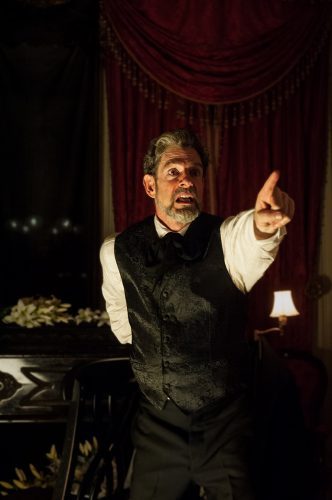
John Kevin Jones pays tribute to Edgar Allan Poe at historic Merchant’s House Museum (photo by Joey Stocks)
KILLING AN EVENING WITH EDGAR ALLAN POE: MURDER AT THE MERCHANT’S HOUSE
Merchant’s House Museum
29 East Fourth St. between Lafayette St. and the Bowery
October 12-31, $18
212-777-1089 merchantshouse.org www.summonersensemble.org
Purely by coincidence, I saw three one-man shows this week, on three successive nights, and all three have strong reasons for me to recommend them. On Tuesday, I was at the historic Merchant’s House Museum on East Fourth St. to see John Kevin Jones in Killing an Evening with Edgar Allan Poe: Murder at the Merchant’s House. Jones has a kind of cult fan club for his annual one-man version of A Christmas Carol at the museum, a home built in 1831-32 that was occupied continuously by the Tredwell family from 1835 to 1933. The nineteenth century feels very present in the house, which was one of the first twenty buildings to gain landmark status under the city’s 1965 law and functions as a museum, preserving the Tredwell family’s furnishings as they would have appeared when Poe, coincidentally, lived nearby for a time at 85 West Third St. and later in a cottage in the Bronx. Dressed in nineteenth-century-style jacket, vest, top hat, and ascot, Jones celebrates Edgar Allan Poe with three of his most popular writings, preceded by short introductions about each work and Poe’s career.
Forty people are squeezed into the Tredwells’ candlelit double parlor — with a coffin at one end and a dining table at the other — and Jones walks up and down the narrow space between, where the audience is seated on three sides, boldly delivering two classic Poe tales of treachery and murder, “The Tell-Tale Heart” and “The Cask of Amontillado,” both from memory. His deep, theatrical voice resonates through the room as he catches the eye of audience members, adding yet more chills and thrills to the mystery in the air. He then sits down with a book for the long poem “The Raven,” evoking the great Poe actor Vincent Price. Jones, director Dr. Rhonda Dodd, and stage manager Dan Renkin, the leaders of Summoners Ensemble Theatre, keep the focus on Poe’s remarkable narrative technique; you might be watching one man, but you’ll feel like you’re seeing each of Poe’s characters in vivid detail. The sold-out show continues October 22, 23, and 31; tickets for A Christmas Carol, however, are still available.
Aasif Mandvi brings back his Obie-winning Sakina’s Restaurant to the Minetta Lane (photo by Lisa Berg)
SAKINA’S RESTAURANT
Audible Theater at Minetta Lane Theatre
18 Minetta Lane between Sixth Ave. and MacDougal St.
Tuesday – Sunday through November 11, $57-$97
sakinasrestaurantplay.com
On Wednesday night I headed to the Minetta Lane Theatre, where Audible has been staging one-person shows that are also available as audios. First, Billy Crudup starred in David Cale’s modern noir Harry Clarke, then Carey Mulligan excelled in Dennis Kelly’s intense Girls & Boys, and now Aasif Mandvi has brought back his Obie-winning 1998 show, Sakina’s Restaurant. Born in India and raised in England, Mandvi studied with acting teacher Wynn Handman, whose students have also included solo specialists Eric Bogosian and John Leguizamo. In the slightly revamped autobiographical tale, directed by Kimberly Senior (Disgraced, The Niceties), Mandvi plays six characters, beginning with Agzi, an eager young man who is leaving his small, tight-knit Indian village to go to America, where he will be sponsored by Hakim (his father’s real name) and Farrida, who run Sakina’s Restaurant on, of course, East Sixth St. Before leaving, Agzi promises his mother he will write to her from all across the United States. “I will even write to you from Cleveland! Cleveland, Ma! Home of all the Indians!”
Mandvi (Disgraced, Halal in the Family) creatively slips into each character, adding glasses, a tie, a dress, or a Game Boy to delineate among Hakim, a serious man who wants only the best for his family; Farrida, who desires more out of her mundane life; their high-school-age daughter, Sakina, who has an American boyfriend and wants to immerse herself in Western culture but who has already been promised to an Indian man by their fathers; their younger son, Samir, who doesn’t really care about anything but his immediate enjoyment; Ali, Sakina’s nervous intended in the arranged marriage; and Agzi, who is not having as exciting a time as he imagined in America. Wilson Chin’s set looks just like several Sixth St. Indian restaurants I’ve been to. The story itself occasionally drags and has trouble skirting stereotypes, but Mandvi is superb, warm and likable, particularly when he talks directly to the audience as Agzi, sharing his hopes and dreams.
Bill Irwin shares his love of all things Samuel Beckett at the Irish Rep (photo by Carol Rosegg)
ON BECKETT
Irish Repertory Theatre
Francis J. Greenburger Mainstage
132 West 22nd St. between Sixth & Seventh Aves.
Tuesday – Sunday through November 4, $50-$70
212-727-2737 irishrep.org
On Thursday night I was at the Irish Rep to see On Beckett, Bill Irwin’s very personal exploration of the work of Samuel Beckett and, in many ways, a combination of the two previous one-man shows I saw, evoking John Kevin Jones’s mastery of Edgar Allan Poe’s texts and Aasif Mandvi’s expert handling of multiple characters. For eighty-seven minutes, Tony-winning actor and certified clown Irwin delves into his vast enthusiasm for Beckett’s writings without ever becoming professorial or pedantic. “I am not a ‘Beckett scholar’ — nooo. Nor am I a Beckett biographer,” he admits. “Mine is an actor’s relationship with this language. By which I mean the deep knowledge that comes from committing words to memory, and speaking them to audiences.” Irwin (Old Hats, Who’s Afraid of Virginia Woolf?) performs selections from Beckett’s 1955 collection Texts for Nothing, his 1950s novels The Unnamable and Watt, and the Irish writer’s most famous play, Waiting for Godot, significantly altering his delivery style, voice, and rhythm for each work.
Irwin adds fascinating insight to Beckett and his oeuvre, discussing the Nobel Prize winner’s punctuation and pronoun usage, his identity and heritage, the possible influence of vaudeville on his work, his detailed stage directions, and other intricacies. “Was Beckett a writer of the body, or of the intellect?” Irwin asks. “Smells like a question you could waste a lot of time on, but I think you can say that he was a writer acutely attuned to silhouette.” His appreciation of Beckett echoes that of Jones’s for Poe, while his simple but effective costume changes — switching among numerous bowlers, putting on baggy pants and clown shoes — work like Mandvi’s to distinguish individuals. Irwin spends a significant part of the show on Waiting for Godot, discussing the correct pronunciation of the title character’s name, examining the role of Lucky, and reminiscing about the production he appeared in with Robin Williams, John Goodman, Steve Martin, and Nathan Lane. Charlie Corcoran’s spare black set consists only of a podium and two rectangular boxes that Irwin can rearrange for various purposes. Irwin is a delight to watch, his passion for Beckett infectious. He occasionally goes off topic in comic ways, wrestling with a microphone and toying with the podium, but he eventually gets back on track for an enchanting piece of theater about theater.
The following evening, my string of one-man shows came to an end with the Wheelhouse Theater’s new adaptation of Kurt Vonnegut’s Happy Birthday, Wanda June, opening Tuesday at the Duke. Bringing the theme full circle, Wanda June features a ferocious performance by Jason O’Connell, whom I saw last year in his own solo outing, The Dork Knight, about his lifelong affinity for Batman.
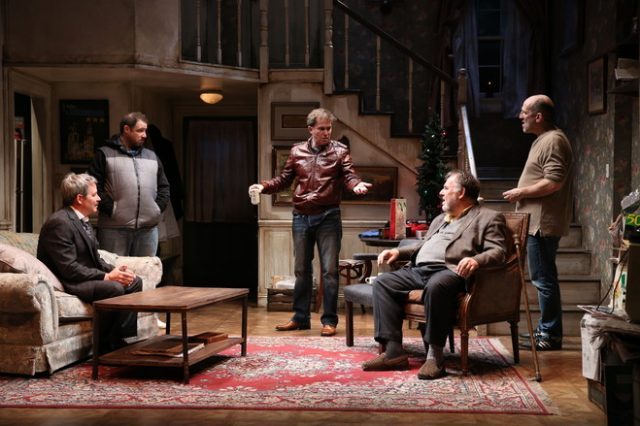
Five men celebrate Christmas Eve with plenty of drink in Irish Rep revival of The Seafarer (photo by Carol Rosegg)
Irish Repertory Theatre, Francis J. Greenburger Mainstage
132 West 22nd St. between Sixth & Seventh Aves.
Wednesday – Sunday through May 24, $50-$70
212-727-2737 www.irishrep.org
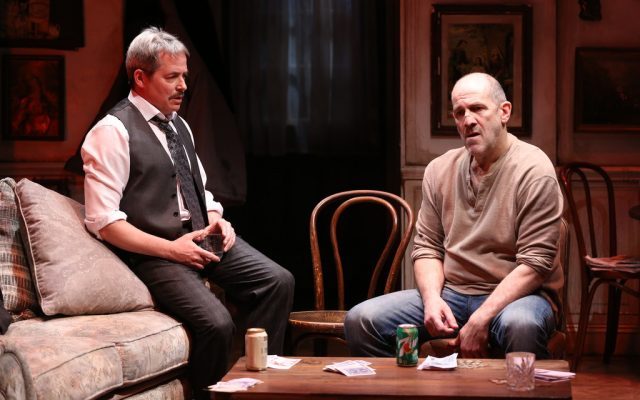
Lightning doesn’t quite strike twice for director Ciarán O’Reilly, star Matthew Broderick, and playwright Conor McPherson in the Irish Rep revival of The Seafarer. In June 2016, O’Reilly directed Broderick in a haunting revival of McPherson’s 2004 West End hit, Shining City, which was nominated for Best Play and Best Actor (Oliver Platt) when it moved to Broadway in 2006. Two years later, The Seafarer garnered four Tony nods, including Best Play and Best Director (McPherson). The current version of The Seafarer, continuing on the Francis J. Greenburger Mainstage through May 24, is a stormy black comedy that takes place on Christmas Eve morning in a squalid, creaky basement apartment in Baldoyle, a coastal settlement north of Dublin City, that looks like a hurricane just passed through. Sharky (an exceptional Andy Murray) is cleaning up after what must have been one helluva drunken gathering the night before. Bottles and cans are strewn all over Charlie Corcoran’s vividly detailed, dank and dingy, crowded set, a shambles stuffed full of piles of junk, old record albums, ratty furniture, stained wallpaper, a small iron stove, and a puny fake Christmas tree. Recently on the wagon, Sharky is an uptight, tense fisherman and chauffeur who is taking care of his perpetually drunk, recently blinded, overweight wastrel of an older brother, Richard (Colin McPhillamy). Their friend Ivan (Michael Mellamphy) spent the night, too drunk to go home to his wife and kids. Ivan has misplaced his car and his glasses, which serves as a metaphor for all the characters, who are each unable to look ahead and move forward in life. Sharky is none too keen when Nicky (Tim Ruddy) arrives, a somewhat slicker man who is now living with Sharky’s ex-girlfriend. Nicky also brings a special guest, the well-dressed, well-spoken Mr. Lockhart (Broderick), who is more than he appears to be. “I’ve seen you. On your travels. On your wandering ways,” Lockhart tells Sharky when the two of them are alone. “I’ve seen all those hopeless thoughts, buried there, in your stupid scrunched-up face.” The mysterious Lockhart has come to collect on a debt, one that Sharky might not even have realized he still owes but has been tearing at his soul for decades. In the second act, the five men sit down for a game of cards in which the stakes are a lot higher for Sharky than for his drinking buddies.
Mr. Lockhart (Matthew Broderick) and Sharky (Andy Murray) have a lot riding on a game of cards in Conor McPherson play (photo by Carol Rosegg)
The Seafarer was inspired by an Olde English poem about the hardships men suffer as well as the Irish folktale “The Hellfire Club,” involving a rather dramatic card game. All five characters, including Lockhart, are carrying personal demons, but it’s Sharky’s tale that drives the narrative, and Murray (War Horse,The Emperor Jones) is more than up to the task, playing Sharky — whom he also portrayed in a 2008 production in California — with the brooding intensity of a once-proud man whose chances are quickly running out. His penetrating eyes reveal a deeply troubled individual who might at last be coming to terms with the things he has done and the choices he has made. Two-time Tony winner Broderick (Brighton Beach Memoirs, How to Succeed in Business . . .), fiddling with an Irish brogue, gets to break out of his stiffness near the end in a part previously played by Ron Cook, Ciarán Hinds, and Tom Irwin. Ruddy (The Weir, Swansong) is fine as the thinly drawn Nicky, but Mellamphy (Guy Walks into a Bar, When I Was God) is underwhelming as Ivan, and McPhillamy (The Woman in Black, Shakespeare in Love) severely overplays Richard; true, it’s a big, meaty part, one that earned Jim Norton an Olivier and a Tony, but McPhillamy never gets inside the character, playing his many physical and psychological maladies too broadly. Irish Rep producing director O’Reilly (The Emperor Jones, The Weir) does a good job with the surprise revelations that come at the end of each act, but the play is saddled with too much repetition, a few unresolved issues, and too many distractions, particularly the winos creating a ruckus outside. As with The Weir and Shining City, the supernatural is dealt with in clever ways, this time more overtly. And speaking of the supernatural, religion is key as well. There are numerous depictions of Jesus hanging on the walls, but the only thing the failed men worship is booze. When Richard proclaims, “I have so little left to live for!,” it could apply, in different ways, to every one of them, who, in the tradition of many alcoholic Irishmen before them, live only for the next drink.
Colin Hamell portrays more than twenty characters in one-man show at the Irish Rep (photo by Carol Rosegg)
Irish Repertory Theatre
W. Scott McLucas Studio Theatre
132 West 22nd St. between Sixth & Seventh Aves.
Tuesday – Sunday February 18, $50
212-727-2737 irishrep.org
Playwright Bernard McMullan takes audiences from the fiery furnaces of hell to the heavens above in the seventy-five-minute one-man show Jimmy Titanic, cruising along at the Irish Rep through February 18. The play was first performed in 2012 in tribute to the centennial of both the birth and death of the RMS Titanic, which sank on April 14-15, 1912, after hitting an iceberg on its maiden voyage. The show is now back with its stalwart captain, Colin Hamell, who has been with it since the beginning, steering it around the world. Hamell serves as narrator/guide as well as playing every character, including Jimmy Boylan, who works on board with his best friend, Tommy Mackey, who helped build the luxury liner at the Harland and Wolff shipyard in Belfast and knows all there is to know about the Titanic. Hamell portrays more than twenty characters in all, from Jimmy and Tommy and other crew members to numerous fictional passengers, the editor of the New York Times, the mayor of Belfast, the real-life John Jacob Astor, Jacques Futrelle, and Senate committee chairman William Alden Smith, and the angel Gabriel, St. Peter, and God. The play works best when Jimmy is on board the “ship of dreams,” relating stories about how it was built, sharing details about its overall impressiveness, and assisting people trying to survive as it begins sinking. Those scenes are chock-full of surprising facts as Hamell floats across Michael Gottlieb’s tight set, a series of riveted metal panels representing the inside of the bottom of the ship, where the men toil in mind-numbing heat. Gottlieb also designed the effective lighting, which changes colors as the tale continues with director Carmel O’Reilly (McMullan’s Return of the Winemaker) at the helm.
Colin Hamell teaches how to shovel coal in Bernard McMullan’s Jimmy Titanic (photo by Carol Rosegg)
The scenes on board the ship are genuinely gripping as Hamell reveals how passengers of different backgrounds, from class to ethnicity to gender, faced peril. Whenever McMullan steers the story back up to heaven, the energy is drained as Hamell portrays Gabriel as a cunning thief, Peter as a selfish lapdog, and God as a gangster. The scenes in the newsroom, the US Senate, and the Belfast mayor’s office offer a look into how the media, politics, and economics dealt with the disaster, but the show drags a bit until it shifts back to the commotion rising on the ship. To those not familiar with many of the facts, it is shocking to learn that there were far more passengers traveling in second and third class than in first, and how there were travelers from more than thirty nations, many seeking a new life in America. “Titanic was primarily an emigrant ship,” Jimmy says, while also talking about the large crew: “Two hundred and forty men worked below in the stokeholds. Only a quarter of them survived. Of the eighty lads working that night on the eight to midnight shift, just twelve made it out.” Jimmy is also proud to point out how most everyone reacted in the midst of the crisis. “The prospect of what lay ahead that night brought out instincts you never knew you had. People were trying to do the right thing. Saving themselves and their loved ones,” he explains. Despite its drawbacks, Jimmy Titanic offers a unique and compelling view of one of the worst tragedies of the twentieth century, focusing on the men behind the scenes.