Tag Archives: Irish Repertory Theatre

THE EMPEROR JONES

(photo by Carol Rosegg)

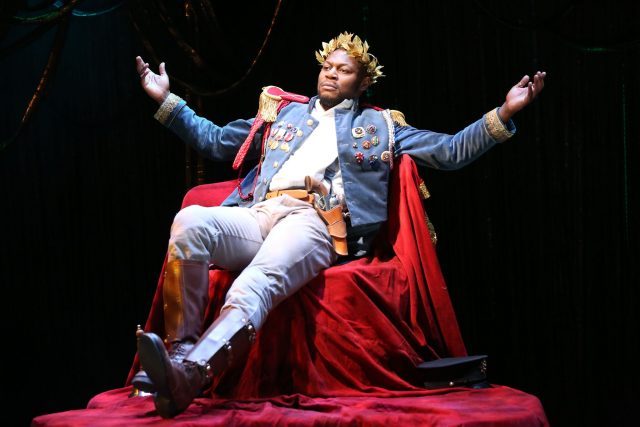
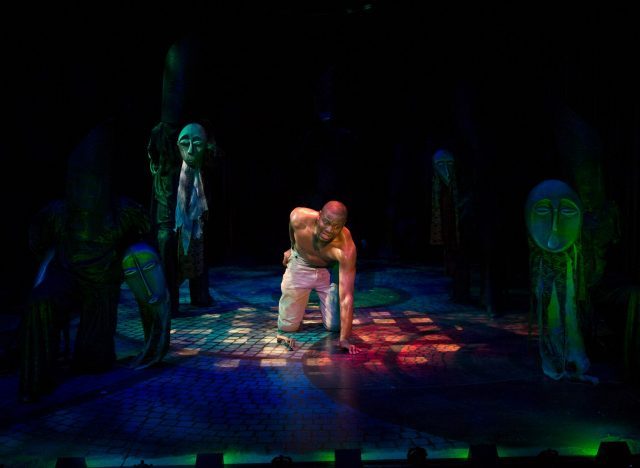
Brutus Jones (Obi Abili) suddenly finds himself in trouble as the emperor of an unnamed Caribbean nation in Eugene O’Neill revival (photo by Carol Rosegg)

Irish Repertory Theatre, Francis Greenburger Mainstage
132 West 22nd St. between Sixth & Seventh Aves.
Tuesday – Sunday through May 21, $50-$70
212-727-2737
irishrep.org

In the fall of 2009, the Irish Rep presented Eugene O’Neill’s 1920 play, The Emperor Jones, during President Barack Obama’s first year in office, a positive time of hope and change that also saw a rise in hate speech in what was most definitely not a postracial America. Irish Rep producing director Ciaran O’Reilly’s award-winning production is now back, returning on the heels of Donald Trump’s election to the White House, also a time of rising hate crimes and political correctness across a deeply divided country. Inspired by stories about Haitian president Vilbrun Guillaume Sam as well as German Expressionism and Joseph Conrad’s 1899 novella, Heart of Darkness, O’Neill sets The Emperor Jones in an unnamed Caribbean nation, where Brutus Jones (Obi Abili) has declared himself dictator after escaping from a U.S. prison. Wearing a military uniform reminiscent of Marcus Garvey’s, Jones says to brash British colonialist Henry Smithers (Andy Murray), “Talk polite, white man! Talk polite, you heah me! I’m boss heah now, is you fergettin’?” A moment later, Jones brags to Smithers, “Ain’t r de Emperor? De laws don’t go for him. You heah what I tells you, Smithers. Dere’s little stealin’ like you does, and dere’s big stealin’ like I does. For de little stealin’ dey gits you in jail soon or late. For de big stealin’ dey makes you Emperor and puts you in de Hall o’ Fame when you croaks. If dey’s one thing I learns in ten years on de Pullman ca’s listenin’ to de white quality talk, it’s dat same fact.” Smithers warns Jones that a revolt against him is under way, which the emperor first dismisses but then believes, sending him off on a hallucinatory journey through the Great Forest, where, in the spirit of Macbeth, he encounters his checkered past and faces his ultimate fate, all the while a tom-tom beating in the distance like the pumping aorta in Edgar Allan Poe’s “The Tell Tale Heart.”
(photo by Carol Rosegg)

Brutus Jones (Obi Abili) faces his past in Irish Rep revival directed by Ciaran O’Reilly (photo by Carol Rosegg)

The role of Jones was originated by Charles S. Gilpin at the Provincetown Playhouse and then on Broadway, but it was later made famous onstage and onscreen by Paul Robeson. Controversy has surrounded the play from the very beginning because of its use of stereotypes, speech, and rampant use of the N-word by both Jones and Smithers. However, in a 1924 article in Opportunity: A Journal of Negro Life, Robeson wrote, “And what a great part is ‘Brutus Jones.’ His is the exultant tragedy of the disintegration of a human soul. How we suffer as we see him in the depths of the forest re-living all the sins of his past — experiencing all the woes and wrongs of his people — throwing off one by one the layers of civilization until he returns to the primitive soil from which he (racially) came.” The debate over whether the work itself is racist or an exploration of racist oppression, especially now, following the recent expurgation of the N-word from a new edition of Mark Twain’s Adventures of Huckleberry Finn, continues; however, O’Neill doesn’t do himself any favors by describing one character in the script as “a heavy-set, ape-faced old savage of the extreme African type, dressed only in a loin cloth.”

Regardless of where you find yourself on the racist controversy, it’s hard to deny the sheer power of the play, which is both uncomfortable to watch and utterly captivating in this intense and intimate production. Following in the footsteps of John Douglas Thompson at the Irish Rep (in addition to such other Jones portrayers as Ossie Davis, Albie Woodington, Paterson Joseph, and Kate Valk in blackface), Abili (Six Degrees of Separation, Titus Andronicus) fully embodies the role, his fear palpable as he encounters moving trees, masked figures, and puppets acting out scenes from his past as he gets lost in the forest and starts doubting his mind. Murray (War Horse) makes Smithers a fine foil for Jones, as ready to cut him down as to cower at his feet. Everyone involved deserves kudos: The haunting set design is by Charlie Corcoran, with regional costumes by Antonia Ford-Roberts and Whitney Locher, evocative lighting by Brian Nason, eerie choreography by Barry McNabb, affecting music by Christian Frederickson, stirring sound design by Ryan Rumery and M. Florian Staab, Caribbean puppets and masks by Bob Flanagan, and cool props by Deirdre Brennan. The ensemble also includes William Bellamy, Carl Hendrick Louis, Sinclair Mitchell, Angel Moore, and Reggie Talley. It might have been written nearly a century ago, but The Emperor Jones can still shock, providing no easy outs, particularly in this poignant version that bookends the Obama years.
QUIETLY

QUIETLY

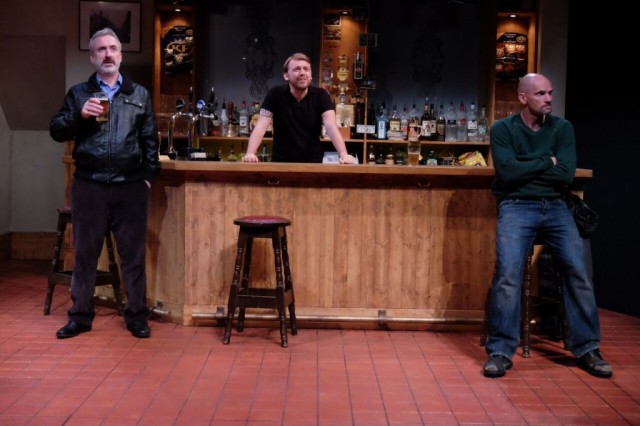
Ian (Declan Conlon), Robert (Robert Zawadzki), and Jimmy (Patrick O’Kane) do more than just watch the match in Owen McCafferty’s QUIETLY

Irish Repertory Theatre
132 West 22nd St. between Sixth & Seventh Aves.
Tuesday – Sunday through September 11, $50 – $70
212-727-2737
www.irishrep.org

Owen McCafferty’s searing, sharp-edged, fictional Quietly might be set in a Belfast pub in 2009, but its theme is so frighteningly universal that it could be describing real events in any part of the world today. Polish émigré and barman Robert (Robert Zawadzki) is watching a World Cup qualifier between Poland and Northern Ireland when everyday regular Jimmy (Patrick O’Kane) comes in for a few pints. A bitter, angry man with a massive chip on his shoulder, Jimmy claims not to care about the game, or the news about a pub that was smashed up by some Poles. He warns Robert that there is likely to be a different kind of trouble when a man he is waiting for arrives. “But it’s nothin for you to worry about,” Jimmy says. Robert: “No trouble — can’t afford for trouble — I get the blame.” Jimmy: All a meant was just in case there was a bit a shoutin — don’t panic.” Robert: “A bit of shouting.” Jimmy: “Yes, a bit a shoutin — nothin for you to get involved in — ya understan — stay out of it — nothin to do with you.” Robert: “A bit of shouting — everyone shouts here — it’s the national sport.” Jimmy: “We all need to be heard at the same time.” The soft-spoken Robert is in Northern Ireland trying to make a new life for himself but is stuck in the same rut. “I didn’t come over here to be a barman — Belfast isn’t barman mecca — not the fucking capital of the barman world — I came over to work and ended up a barman because I was one before,” he tells Jimmy, who is lost in his own drama. The situation explodes almost immediately when Ian (Declan Conlon) enters the pub. Although both Ian and Jimmy are fifty-two and well aware of each other’s existence, they have never met before, despite their involvement in an event thirty-six years earlier that profoundly altered both their lives. “I’m here because we’re the same age,” Ian says. “You’re not my fuckin age — my age has to do with the life I’ve led — you haven’t led my life,” Jimmy responds, to which Ian adds, “I led a life — my life.” As the facts slowly start coming out on what happened on that fateful day of July 3, 1974, the tension builds to a shattering conclusion.

The award-winning Abbey Theatre production, being staged at the Irish Rep in association with the Public Theater, is a sizzling drama zeroing in on how politics, religion, status, and birthplace can tear people apart, leading to senseless violence no matter what side you’re on. It’s also very much about forgiveness, specifically referencing the controversial truth and reconciliation process. Conlon (The House, Terminus) is rock solid as Ian, carefully balancing pride and regret, and Zawadzki (The Shoemakers, Who Is That Bloodied Man?) is calm as Robert, who is caught in the middle. But Quietly belongs to the Belfast-born O’Kane (The House, As the Beast Sleeps), who won several UK best actor awards for his compelling performance. O’Kane commands the stage, whether sitting with crossed arms on a barstool, drinking a pint of Harp, or confronting Ian face-to-face. (Catherine Fay’s set is based on a real pub that McCafferty used to live near and which was blown up by the Ulster Volunteer Force.) You can almost see the heat rising from O’Kane’s bald pate. It’s a memorable performance in a gripping play, tautly directed by Lyric Theatre executive producer Jimmy Fay (The Risen People, Here Comes the Night). And it ends with a final reminder that, in this increasingly polemic, xenophobic world, anyone could be next.

SHINING CITY

(photo by Carol Rosegg)

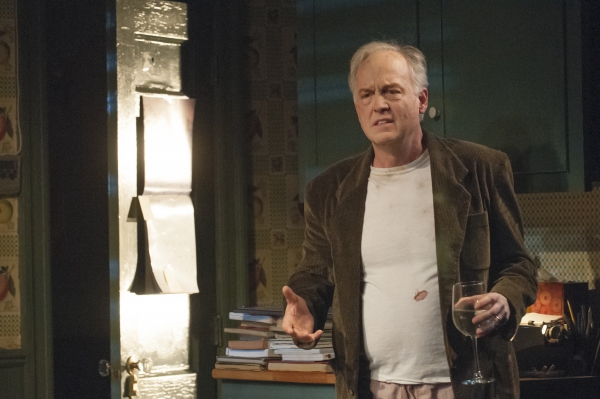
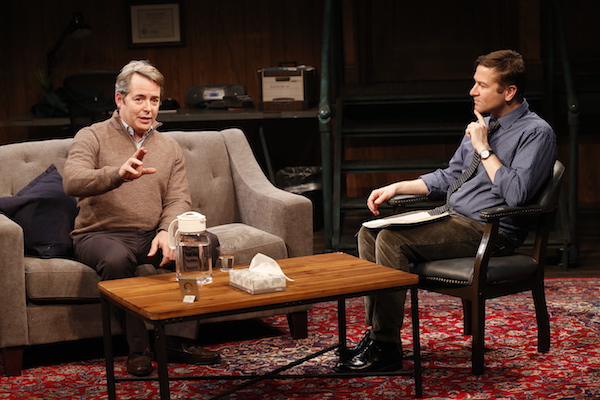
Recently widowed John (Matthew Broderick) shares his haunting tale with his therapist, Ian (Billy Carter), in Irish Rep revival of Conor McPherson’s SHINING CITY (photo by Carol Rosegg)

Irish Repertory Theatre
132 West 22nd St. between Sixth & Seventh Aves.
Tuesday – Sunday through July 3, $50
212-727-2737
www.irishrep.org

The Irish Rep has inaugurated its newly renovated space in its longtime Chelsea home with a play very much about, appropriately enough, home. Back in the Stanwick Building on West Twenty-Second St. following a season at the DR2 Theatre in Union Square, the Irish Rep is currently presenting a thrilling version of Conor McPherson’s Tony-nominated Shining City, a haunting psychological tale of dislocation, lack of communication, guilt, and the search for one’s place in the world. Matthew Broderick, in full Irish brogue, gives a thoroughly impressive performance as John, a fifty-four-year-old Dublin catering-supply rep who is seeing a therapist for the first time because he claims to have seen the ghost of his recently deceased wife in their house. Frightened and confused, John has temporarily moved into a bed and breakfast, but his disconnection began when his wife was still alive. “I started pretending I had to stay down the country, for work, you know, overnight, but I was really just staying in places so that I didn’t have to deal with the terrible pressure of going home, you know?” he tells his therapist, Ian (Billy Carter), a former priest who has left the house of God for a cozy third-floor office. Ian, meanwhile, is reconsidering his future with his wife, Neasa (Lisa Dwan), and their baby, who live with Ian’s brother. “I have nowhere to fucking go!” she screams at him when he talks about leaving her. “It’s their house! What right do I have to stay there if you’re not there?” Later, Ian meets Laurence (James Russell), a destitute man who has taken to the streets to try to survive after being kicked out of his cousin’s flat. “I don’t even want to go back, though, but I need an address,” a haggard Laurence tells Ian. Nearly everyone the four characters reference in their various stories relate to the concept of home, from a builder and a hotel executive to the B&B owners and women in a house of prostitution. Over the course of one hundred minutes, the four lost souls examine their loneliness and try to find a way out, to reconnect.

Shining City — which was nominated for a Best Play Tony for its Broadway debut in 2006, directed by Goodman Theatre head Robert Falls and starring Oliver Platt as John, Martha Plimpton as Neasa, Peter Scanavino as Laurence, and a Tony-nominated Brían F. O’Byrne as Ian — is a brilliantly written work, an intricate and endlessly inventive investigation into the hearts and minds of John and Ian, who are mirror images of each other; even their names are the same, as Ian is the Scottish version of John. John, a traveling salesman, often speaks in long monologues filled with the adjective “fucking” and the rhetorical phrase “you know” — the latter is spoken more than two hundred times throughout the play, and not just by John — during which Ian merely nods or makes quick comments; one entire scene is essentially a riveting soliloquy delivered exquisitely by Broderick in a breathless tour de force. Carter (McPherson’s Port Authority and The Weir at the Irish Rep), Beckett specialist Dwan (Not I / Footfalls / Rockaby), Russell (Port Authority, Juno and the Paycock), and two-time Tony winner Broderick (Torch Song Trilogy, Brighton Beach Memoirs) beautifully perform McPherson’s fragmented dialogue, maintaining its graceful poetic rhythm under the smooth direction of Ciarán O’Reilly (The Weir, The Hairy Ape). Charlie Corcoran’s therapist-office set subtly evokes the concept of home as well, with several boxes strewn around that hint at either someone moving in or moving out, and John settles in a little more with each visit even as Ian feels more uncomfortable. Shining City is an impeccable, haunting piece of theater and a deserving drama to welcome the Irish Rep, well, back home.

THE BURIAL AT THEBES

(photo © Carol Rosegg)

The Irish Rep’s version of Seamus Heaney’s adaptation of ANTIGONE continues at the DR2 Theatre through March 6 (photo © Carol Rosegg)

Irish Repertory Theatre
DR2 Theatre
103 East 15th St. between Irving Pl. & Park Ave.
Tuesday – Sunday through March 6, $70
212-727-2737
www.irishrep.org

In 2003, Dublin’s Abbey Theatre asked poet and translator Seamus Heaney to do a new version of Sophocles’ Antigone, a kind of follow-up to the Irish Nobel laureate’s only other play, The Cure at Troy, a 1990 adaptation of the Greek playwright’s Philoctotes. Heaney, who passed away in August 2013 at the age of seventy-four, hesitated in accepting the request until he found an angle that intrigued him: focusing on the treatment of the body of Polyneices, one of Oedipus’s two sons who killed each other while fighting on opposite sides of battle. King Creon decided to give Etocles a proper hero’s burial, while he ordered that Polyneices was to rot in the desert and that anyone who attempted to bury him would be executed. Heaney was ultimately inspired by his memories of the death of hunger-striking IRA prisoner Francis Hughes in 1981 as well as President George W. Bush’s determination to invade Iraq following 9/11. “Basically Creon turns Polyneices into a non-person, in much the same way as the first internees in Northern Ireland and the recent prisoners in Guantanamo Bay were turned into non-persons,” he said in a 2004 Jayne Lecture he gave at Harvard. “By refusing Polyneices burial, Creon claims ownership of the body and in effect takes control of his spirit, because the spirit will not go to its right home with the dead until the body is buried with due ceremony. When Antigone refuses Creon’s ruling and performs the traditional rites, her protest is therefore a gesture that is as anthropological as it is political, and it was only when I saw it in this light that I found a way out of the cat’s cradle of political arguments and analogies the play has become and could re-approach it as a work atremble with passion, with the human pity and terror it possessed in its original cultural setting.”

Unfortunately, the Irish rep’s current production, its last at the troupe’s temporary home at the DR2 Theatre, doesn’t take full advantage of Heaney’s powerful, poetic words in a staging that is woefully given short shrift, as if cobbled together at the last minute. Three-time Tony winner Tony Walton’s set feels like an afterthought, a tiny space with a couple of rocks, twelve strands of frayed rope descending from above, and a backdrop that changes colors throughout the show’s eighty minutes, occasionally oddly displaying an audience watching from behind. Linda Fisher’s drab costumes and Charlotte Moore’s barely there direction don’t add anything to what should have been a compelling investigation of honor, loyalty, and family. The ethical and moral conflict between Antigone and Creon fails to catch fire; Rebekah Brockman is too meek as the former, while Paul O’Brien, who stepped in late for the previously announced John Cullum and then Larry Bryggman in the role of Creon, never captures the poetry of Heaney’s words. The cast, who all seem to speak in different accents, also features Ciaran Bowling as Haemon, Creon’s son, who is engaged to marry Ismene (Katie Fabel), Antigone’s sister; Winsome Brown as Eurydice, Creon’s wife; Robert Langdon Lloyd as Tiresias, the blind soothsayer; Rod Brogan as the messenger; and Colin Lane, who fares the best as the squirmy guard. “What are Creon’s rights / When it comes to me and mine?” Antigone asks her sister at one point. The same can be asked of Heaney and the audience’s rights from this usually reliable troupe, which has done much better work in its twenty-six-year history.

THE QUARE LAND

(photo © Carol Rosegg)

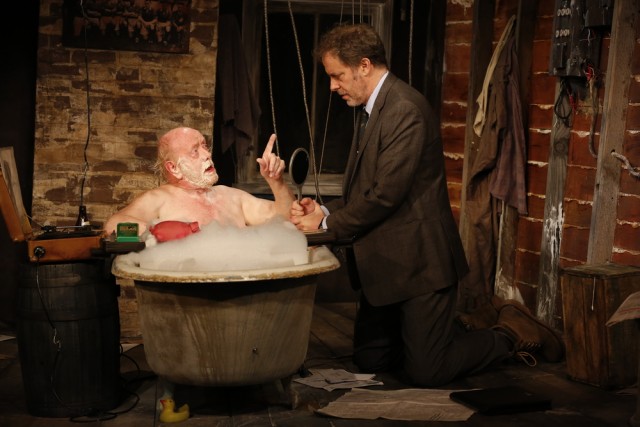
Hugh Pugh (Peter Maloney) tries to teach Rob McNulty (Rufus Collins) a lesson in drab revival (photo © Carol Rosegg)

Irish Repertory Theatre
DR2 Theatre
103 East 15th St. between Irving Pl. & Park Ave.
Tuesday – Sunday through November 15, $70
212-727-2737
www.irishrep.org

Something magical happens during the Irish Rep’s revival of John McManus’s The Quare Land. Unfortunately, it’s not the play itself but a bit of mysterious stagecraft. Star Peter Maloney spends the entire show in a cast-iron bathtub — and the bubbles never go away during the ninety minutes. I don’t know which brand of bubbles he uses, but I can’t get the bubbles in my bath to stay afloat for more than a handful of minutes. Otherwise, The Quare Land is a rather ordinary work that offers no new takes on a familiar story. Maloney plays the silly-named Hugh Pugh, an old farmer living in a ramshackle house on the Irish countryside in County Cavan. (The wonderful set is by Charlie Corcoran.) Pugh is relaxing in the tub with his rubber ducky, listening to Bobby Darin on his ancient phonograph, enjoying beer he retrieves via a complex pulley system that brings him bottles from inside a filthy toilet, when the well-dressed Rob McNulty (Rufus Collins) shows up unannounced and walks into the bathroom. McNulty is a real-estate developer who wants to purchase land from Pugh that he didn’t even know he owned, in order to turn a nine-hole golf course into an eighteen-holer to attract professional events. McNulty assumes the sale is a slam dunk, but he can barely get a word in edgewise as Pugh shares stories from his life nonstop, cannily dodging McNulty’s best efforts. The play, directed by Ciaran O’Reilly, starts out well enough, but as it continues, it grows more and more annoying, the plot turning into a stale retread of such films as The Field and Local Hero, except neither character here turns out to be very likable. The play is billed as a “Cantankerous Comedy,” and cantankerous it is, but not in the intended way. Maloney (Outside Mullingar) and Collins (The Royal Family) give fine performances, but the sour script ultimately lets them down. Now, about those bubbles….

THE IRISH REP READING SERIES: CHESTER BAILEY

Reed Birney will take a break from his starring role in IM GONNA PRAY FOR YOU SO HARD to participate in Irish Rep Reading Series (photo by  Ahron R. Foster)

Reed Birney will take a break from his starring role in I’M GONNA PRAY FOR YOU SO HARD to participate in free Irish Rep Reading Series on January 30 with Noah Robbins (photo by Ahron R. Foster)

Who: The Irish Repertory Theatre
What: Staged reading of Joseph Dougherty’s Chester Bailey
Where: DR2 Theatre, 103 East 15th St. between Park Ave. South & Irving Pl., 212-727-2737
When: Friday, January 30, free (advance reservations strongly suggested), 3:00
Why: The Irish Rep Reading Series continues with Tony nominee Reed Birney (I’m Gonna Pray for You So Hard, Casa Valentina) and Noah Robbins (Punk Rock, Brighton Beach Memoirs) reading WWII-set drama by Emmy-nominated writer and producer Joseph Dougherty (Thirtysomething, Saving Grace, Digby), directed by Emmy and Tony nominee Ron Lagomarsino (Digby, Driving Miss Daisy, Pretty Little Liars); Irish Rep literary manager Kara Manning explains that the series “gives playwrights, both emerging and more established, the invaluable opportunity to develop their new work in a supportive, safe environment and will also introduce some Irish playwrights, especially those who might not yet have the New York recognition they merit, to an American audience.”

DA

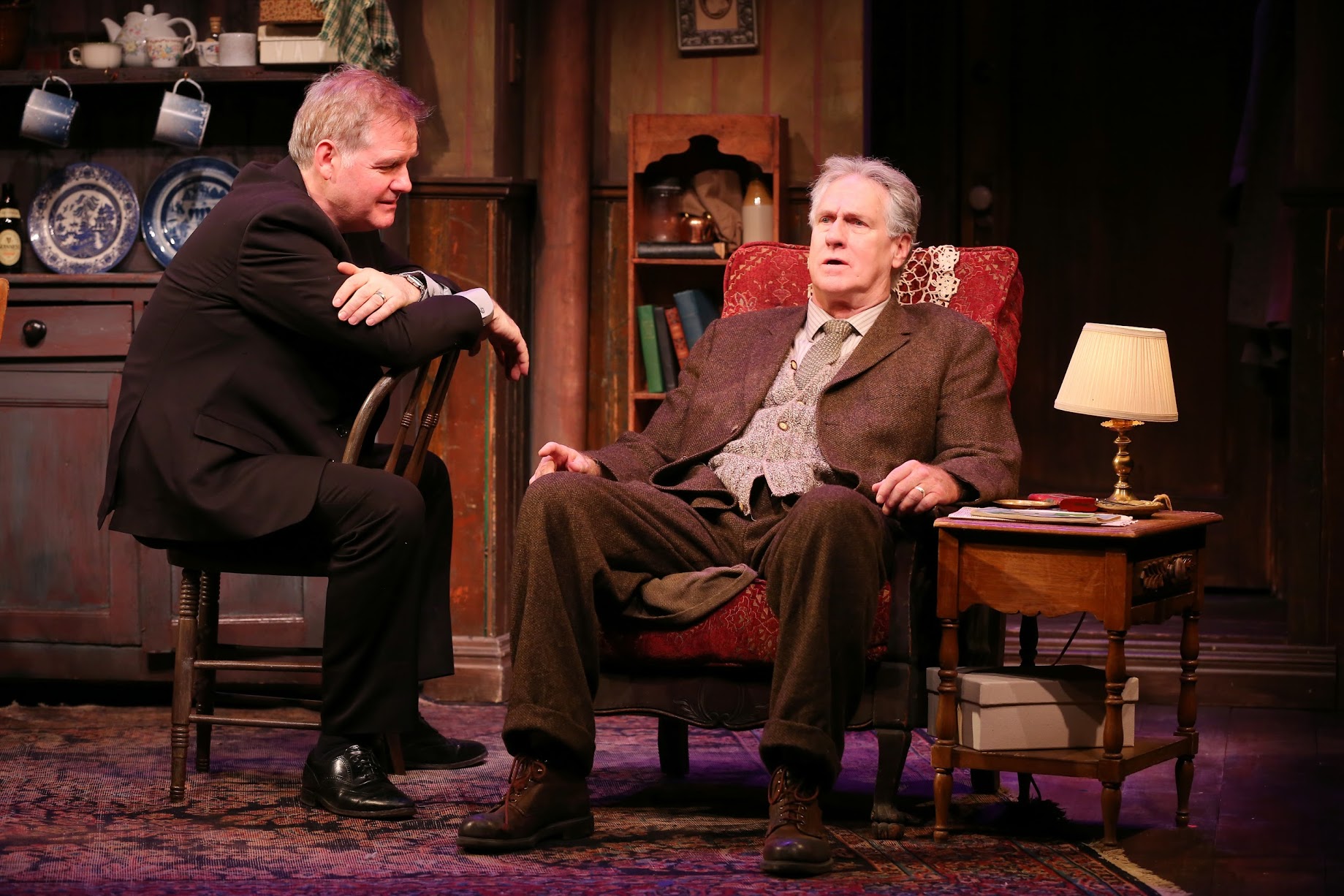
Ciarán O’Reilly and Paul O’Brien star as a son and father looking back at the past in DA (photo by Carol Rosegg)

Ciarán O’Reilly and Paul O’Brien star as a son and father looking back at the past in DA (photo by Carol Rosegg)

Irish Repertory Theatre
DR2 Theatre
103 East 15th St. between Irving Pl. & Park Ave.
Tuesday – Sunday through April 5, $70
212-727-2737
www.irishrep.org

During renovation of its permanent home on West Twenty-Second St., the Irish Repertory Theatre has moved into the cozy DR2 Theatre in Union Square, presenting a cozy revival of Hugh Leonard’s cozy Tony-winning 1978 play, Da. It’s May 1968, and Charlie (Irish Rep producing director Ciarán O’Reilly) has returned to the cluttered family home in Dublin following the death of his father, who he called Da (Paul O’Brien). While cleaning up the house, he is visited by his childhood friend Oliver (the curiously coiffed John Keating), who starts dredging up memories for Charlie. As soon as Oliver leaves, Charlie, a playwright, is then visited by his late father, a gardener who seems not quite ready for the afterlife, instead hanging around, sitting in his chair, and preparing for tea. “I’ve a cupful,” Charlie says. “It’s empty,” Da responds. “It’s full,” the son declares, setting the stage for the two to confront disagreements they had as father and son. As the memories flood forth, Charlie watches his younger self (Adam Petherbridge) flirt with local girl Mary Tate (Nicola Murphy) and get a job with the strict, straightforward Drumm (Sean Gormley); his beloved mother, Maggie Tynan (Fiana Toibin), is back as well. “I’d forgotten what she looked like,” the older Charlie says wistfully. He watches scenes from his and his family’s life play out right in front of him but can’t do anything about it, wondering if he made the right choices. But at the center of it all is Charlie’s relationship with Da, who often embarrassed him, particularly when it came to girls, Hitler, and his mother. “Say nothing. Ignore him,” Charlie tells his younger self at the beginning of the second act as his father is relating an old story. But it’s too late to change things now.

Revival of Hugh Leonards Tony-winning play is at the Irish Reps temporary home in Union Square  (photo by Carol Rosegg)

Revival of Hugh Leonard’s Tony-winning play is at Irish Rep’s temporary home in Union Square (photo by Carol Rosegg)

Irish Rep artistic director Charlotte Moore guides the production with a gentle hand as the characters move between the past and the present on James Morgan’s comfy living room/kitchen set. It takes a while to warm to O’Brien and O’Reilly as father and son, because they appear to be too close in age, but once things get going, the characters all fall into step. O’Reilly is pensive and reflective as Charlie, who does not want to look back at what was and what could have been. O’Brien is somewhat rough at first but soon settles down in a role made famous by Barnard Hughes in the original Tony-winning Broadway production in 1978, which featured Brian Murray as Charlie, Sylvia O’Brien as Charlie’s mother, and Mia Dillon as Mary Tate. (Matt Clark’s 1988 film starred Hughes as Da, Martin Sheen as Charlie, and William Hickey as Drumm.) Da is a lovely little play, a tenderhearted story of the ties that bind family together — and that can lead to a painful loss of innocence.