Tag Archives: Irish Repertory Theatre

THE ARAN ISLANDS: A PERFORMANCE ON SCREEN

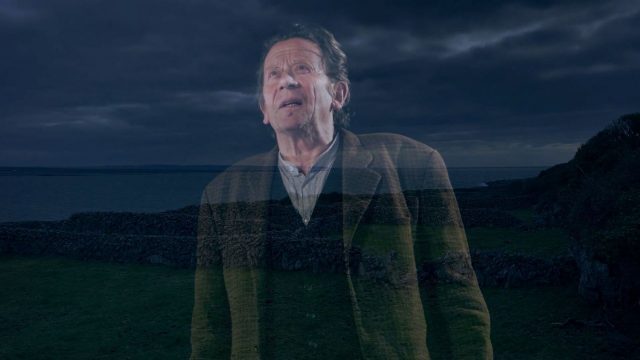
Brendan Conroy roams empty theaters and a rocky landscape in cinematic reimagining of The Aran Islands (photo courtesy Irish Rep)

THE ARAN ISLANDS
Irish Rep Online
March 23-28, suggested donation $25
irishrep.org

As far as I can tell, no other company in the world has been able to accomplish what the Irish Rep has during the pandemic lockdown. And the West Twenty-Second St. institution has done it again with the stirring hybrid presentation of John Millington Synge’s The Aran Islands, about the Dublin writer’s experiences in the islands off the west coast of Ireland in 1898, a journey urged by W. B. Yeats.

The Irish Rep has quenched at least part of the thirst of theater lovers desperate for entertainment by reimagining past works for the virtual environment, using innovative techniques that include green-screened backgrounds and real props that make it appear that the actors are in the same room. In Conor McPherson’s The Weir, the characters seemed to be passing around drinks as they each shared a ghost story. In Eugene O’Neill’s A Touch of the Poet, it looked as if family members were sitting at the same table at an inn.

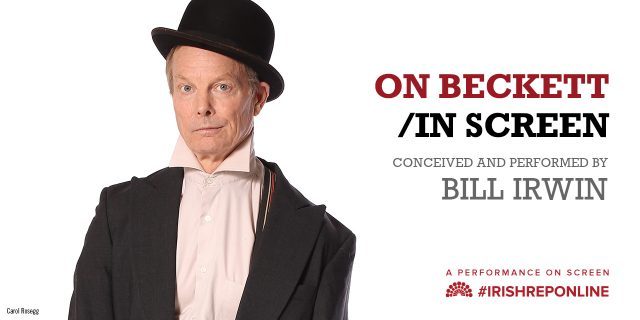
The company, which was founded in 1988 by Charlotte Moore and Ciarán O’Reilly, who are still at the helm and leading the online programming, also has produced Darren Murphy’s The Gifts You Gave to the Dark, a live show filmed with a smartphone (and one of the first to address the health crisis directly); Bill Irwin’s On Beckett, updated for the pandemic and beginning with Irwin walking down Twenty-Second St. and entering the Irish Rep, performing onstage to empty seats; and Love, Noël: The Songs and Letters of Noël Coward, in which Steve Ross and KT Sullivan revisit their recent two-person hit at the Irish Rep by moving into the Players, following all Covid-19 protocols.

And now the Irish Rep and Co-Motion Media, which teamed up in 2017 for Joe O’Byrne’s adaptation of Synge’s 1907 book, The Aran Islands, have transformed the one-man show into a gripping, uncanny film, directed by O’Byrne and again starring Brendan Conroy. The ninety-minute work was shot by O’Byrne in the New Theatre and the Smock Alley Theatre in Dublin as well as on the rocky shores of the title location, where a grizzled Conroy, portraying a descendant of Synge’s, roams around through the fog and mist, searching for folks speaking Gaelic and relating wonderful tales, often with a supernatural twist, by and about the people he encounters, taking on their personas. A fairy steals a child. An elderly man misses the old days. The blind storyteller of Mourteen, bent over with rheumatism, spins a yarn about two farmers, their son and daughter, and a bargain involving a bag of gold and cut-off flesh. A dead man tries to catch his unfaithful wife in the act. These and other anecdotes reveal a unique, incorruptible people who have different ideas about family and justice, hell and death.

He says of the islanders, “If a man has killed his father, and is already sick and broken with remorse, they can see no reason why he should be dragged away and killed by the law. Such a man, they say, will be quiet all the rest of his life, and if you suggest that punishment is needed as an example, they ask, ‘Would any one kill his father if he was able to help it?’”
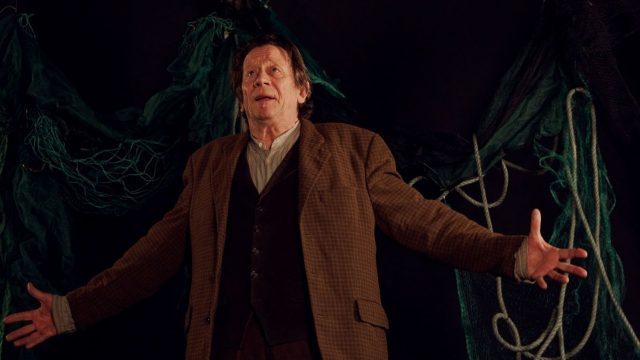
Brendan Conroy gives a tour-de-force performance in The Aran Islands (photo courtesy Irish Rep)

At a burial, the traveler poetically explains, “This grief of the keen is no personal complaint for the death of one woman over eighty years, but seems to contain the whole passionate rage that lurks somewhere in every native of the island. In this cry of pain the inner consciousness of the people seems to lay itself bare for an instant, and to reveal the mood of beings who feel their isolation in the face of a universe that wars on them with winds and seas. They are usually silent, but in the presence of death all outward show of indifference or patience is forgotten, and they shriek with pitiable despair before the horror of the fate to which they are all doomed.”

The interior set design is by Margaret Nolan, with costume by Marie Tierney, lighting by Conleth White, and lovely original music by Kieran Duddy; O’Byrne (Departed, Enough) also edited the film, with shadowy superimpositions and ruminative shots of the sea. Conroy (Translations, Synge’s The Playboy of the Western World) delivers a tour de force performance, adjusting his accent, demeanor, and intonation for each character, every story worn into the deep lines of his face. It’s a treat for lovers of story, and one that is triumphant as a film, evolving from a book and a play in what feels like a seamless, organic way.

It’s also a marker of time, of a life lived, of right now, after a year spent in isolation, without travel or in-person theater. As Synge’s descendant states: “The old man is suggesting that I should send him a clock when I go away. He’d like to have something from me in the house, he says, the way they wouldn’t forget me, and wouldn’t a clock be as handy as another thing, and they’d be thinking of me whenever they’d look on its face.” We do have this play, although it will be available only through March 28.
2021 ORIGIN 1st IRISH THEATRE FESTIVAL

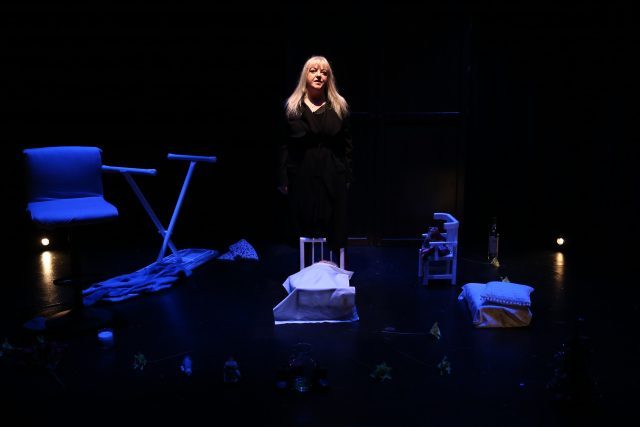
Michelle Dooley Mahon’s The Scourge tells of a woman reliving her mother’s battle with Alzheimer’s (photo by Carol Rosegg)

2021 ORIGIN 1st IRISH THEATRE FESTIVAL
January 11-31, free – $10 per event
www.origintheatre.org

The thirteenth annual Origin 1st Irish Theatre Festival has been reimagined for its 2021 iteration, a three-week collection of theatrical dramas ($10), fiction and nonfiction films ($5), and free panel discussions shedding light on the current state of Irish theater. Curated by actors Mick Mellamphy and Sarah Street, the festivities kick off January 11 with the opening ceremony on Zoom and Fishamble’s Mustard, Eva O’Connor’s one-woman Edinburgh Fringe play about a woman who falls hard for a Tour de France competitor. “The cyclist knows nothing of the madness in my bones or the mustard in my mind,” the character says. The other plays are the Wexford Arts Center’s production of Michelle Dooley Mahon’s one-woman The Scourge, an Alzheimer’s story directed by Ben Barnes; Darren Murphy’s deeply moving The Gifts You Gave to the Dark, the Irish Rep tale told over a smartphone, one of the first live works dealing with Covid-19; Origin’s Under the Albert Clock, comprising monologues by five playwrights from Northern Ireland (Emily Dedakis, Gina Donnelly, Sarah Gordon, Fionnuala Kennedy, and Alice Malseed) set around the historic Albert Clock in Belfast in 2050; About Face Ireland’s Zoom presentation Transatlantic Tales, eight original works by Matthew Cole Kelly, Melissa Annis, James McLindon, Rachel White, Emily Bohannon, Krystal Sweedman, Seamus Scanlon, and Neil Sharpson, each pairing one actor in Ireland and one in America (Amie Tedesco, Kathleen Warner Yeates, Brandon Jones, Helena White, Kevin Collins, Darina Gallagher, Orlagh Cassidy, Mark Tankersley, Erin Healani Chung, Michael Rhodes, David Ryan, John Keating, Megan Day, Kate Grimes, Paul Nugent, Richard Topol, and Maureen O’Connell); and Origin’s Stay Home and Stay Safe, four short pieces by Geraldine Aaron, Honor Molloy, Derek Murphy, and Ursula Rani Sarma about domestic violence during the pandemic, with Angel Desai, Alan Kelly, Niamh Hopper, David Spain, and Jade Jordan.

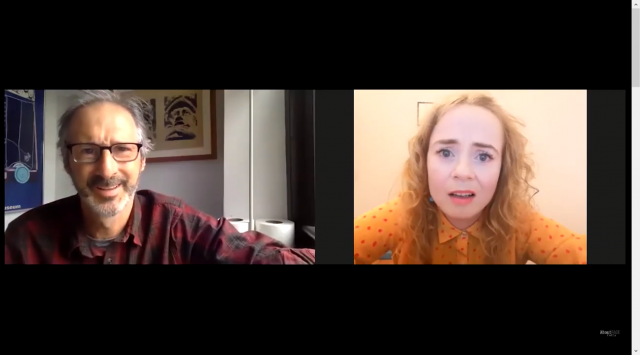
Richard Topol and Maureen O’Connell star in one of five short Zoom plays that comprise Transatlantic Tales

In addition to three showings of each play, there will be two screenings of each film, which explore unemployed actors going on a camping trip (O’Connell’s Spa Weekend), a possible miracle (Aislinn Clarke’s The Devil’s Doorway), what happens when your horse comes in (Seanie Sugrue’s Misty Button), the 1998 Good Friday Agreement (Rory Duffy’s A Fragile Peace), an incident in the Irish War of Independence (Conal Creedon’s The Burning of Cork), and a 1905 journey across Connemara by John Millington Synge and Jack B. Yeats (Margy Kinmonth’s To the Western World). There will also be five panel discussions that will stream twice; the full schedule is below.

Monday, January 11
Opening Ceremony, 3:00

Friday, January 15
“Irish Redemption — An Irish Invasion into the World of Video Games,” with Roger Clarke and Penny O Brien, 8:00

Sunday, January 17
“Producing in a Pandemic,“ offering first looks at new works, with Aoife Williamson, Derek Murphy, Tim Ruddy, David Gilna, and Lorna Fenenbock, 8:00

Monday, January 18
“Black&Irish,” focusing on diversity and inclusion in Irish arts and culture, with Femi Bankole, Leon Diop, Bonni Odoemene, Jade Jordan, and Zainab Boladale, 8:00

Wednesday, January 20
“Casting and the Irish Perspective,” with Christine McKenna Tirella, 3:00

“The Irish Tunes of Tin Pan Alley,” with Mick Moloney and Larry Kirwan, 8:00

Friday, January 22
“Irish Redemption — An Irish Invasion into the World of Video Games,” with Roger Clarke and Penny O Brien, 3:00

Saturday, January 23
“Producing in a Pandemic,“ offering first looks at new works, with Aoife Williamson, Derek Murphy, Tim Ruddy, David Gilna, and Lorna Fenenbock, 3:00

Monday, January 25
“Casting and the Irish Perspective,” with Christine McKenna Tirella, 8:00

Wednesday, January 27
“The Irish Tunes of Tin Pan Alley,” with Mick Moloney and Larry Kirwan, 3:00

Saturday, January 30
“Black&Irish,” focusing on diversity and inclusion in Irish arts and culture, with Femi Bankole, Leon Diop, Bonni Odoemene, Jade Jordan, and Zainab Boladale, 3:00

Saturday, January 31
Closing Ceremony, 5:00

#IRISHREPONLINE: ON BECKETT / IN SCREEN

Who: Bill Irwin
What: Livestreams of updated show
Where: Irish Rep online
When: November 17-22, suggested donation $25
Why: In my October 2018 review of Bill Irwin’s mostly one-person-show, On Beckett, at the Irish Rep, I wrote, “Irwin adds fascinating insight to [Samuel] Beckett and his oeuvre, discussing the Nobel Prize winner’s punctuation and pronoun usage, his identity and heritage, the possible influence of vaudeville on his work, his detailed stage directions, and other intricacies. . . . Irwin is a delight to watch, his passion for Beckett infectious. He occasionally goes off topic in comic ways, wrestling with a microphone and toying with the podium, but he eventually gets back on track for an enchanting piece of theater about theater.” Irwin (Old Hats, Who’s Afraid of Virginia Woolf?) is now revisiting the play, updating it in this time of pandemic lockdown, in a Covid-19-sensitive version he codirected onstage at the Irish Repertory Theatre with M. Florian Staab; Brian Petchers served as director of photography and editor, with set design by Charlie Corcoran, lighting by Michael Gottlieb, and music and sound by Staab. Irwin’s revised take on Waiting for Godot could probably make a show all its own. The seventy-five-minute On Beckett / In Screen will stream November 17-22; suggested donation is $25.

IRISH REP ONLINE: BELFAST BLUES

Who: Geraldine Hughes
What: Livestream of prerecorded final performance of Belfast Blues
Where: Irish Rep online
When: September 22-27, suggested donation $25
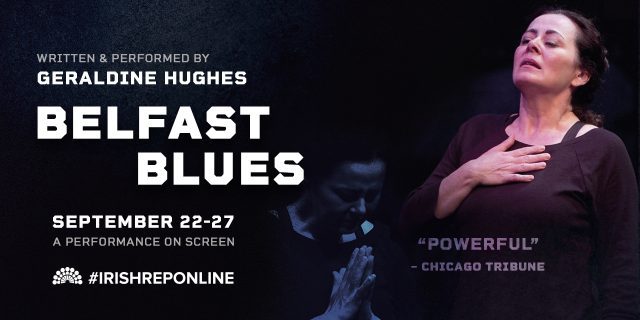
Why: Born in Belfast and based in New York, Irish actress and playwright Geraldine Hughes has appeared in such films as Rocky Balboa and Killing Lincoln, such television series as Law & Order SVU and The Blacklist, and such Broadway hits as Harry Potter and the Cursed Child and Jerusalem. But she’s most well known for Belfast Blues, her autobiographical one-woman show about her childhood growing up during the Troubles in Northern Ireland in the 1980s. She first performed the play, in which she portrays twenty-four characters, in 2003 and has since taken it all over the world. She retired the play after a 2019 run back at the Lyric Theatre in Belfast, but that grand finale, held as part of West Belfast’s Féile an Phobail (Festival of the People) and directed by actress Carol Kane, was recorded for posterity and will be livestreamed by the Irish Rep in its continuing innovative online programming during the pandemic. “There’s no audience better than a Belfast audience!” Hughes said upon reviving the seventy-five-minute show one last time at the Lyric. “I’m so excited to share the story of Belfast Blues with a new generation of theatergoers and eager to retell it to all those who are returning! The support from home is truly incomparable!”

The Irish Rep has previously staged the intimate, moving The Gifts You Gave to the Dark, a spectacular online iteration of The Weir, Aedin Moloney’s sexy one-woman show Yes! Reflections of Molly Bloom, and other presentations, making it one of the busiest theater companies during the pandemic, and one of the most successful when it comes to adapting to online viewing. Tickets are free, but there is a suggested donation of $25. Next up for the company is Give Me Your Hand (a poetic stroll through the National Gallery of London) October 13-18, Eugene O’Neill’s A Touch of the Poet October 27 to November 1, and the two-part A Beggar Upon Horseback with John Douglas Thompson as Frederick Douglass on November 9 and A Beggar on Foot on November 10.

#IRISHREPONLINE: THE WEIR

Who: Dan Butler, Sean Gormley, John Keating, Tim Ruddy, Amanda Quaid
What: Live online performance
Where: Irish Rep online
When: July 21-25, free with advance RSVP (suggested donation $25),
Why: One of Irish Repertory Theatre’s most popular recent productions is Conor McPherson’s ghostly The Weir. The work debuted in England in 1997 and on Broadway two years later; Irish Rep first staged it in 2013 and again in 2015 by popular demand. The company is now bringing it back for an online version running July 21-25, following the success of its livestreamed adaptation of Yes! Reflections of Molly Bloom and the new short pandemic-related tale The Gifts You Gave to the Dark. The six live performances reunite three members of the original Irish Rep production, Sean Gormley as Finbar, John Keating as Jim, and Dan Butler as Jack, with Tim Ruddy as Brendan and Amanda Quaid as Valerie. The show is directed by Irish Rep cofounder Ciarán O’Reilly. McPherson is an Irish Rep institution; the company has also staged Dublin Carol, St. Nicholas, Port Authority, Shining City, and The Seafarer. Irish Rep has done exceptional work during the pandemic; don’t miss what should be a thrilling show.

YES! REFLECTIONS OF MOLLY BLOOM

molly bloom

Who: Aedín Moloney of the Irish Repertory Theatre
What: Livestreamed performances adapted for onscreen viewing
Where: Irish Rep onine (link sent after RSVP)
When: Tuesday, June 16, 7:00; Wednesday, June 17, 3:00 & 8:00; Thursday, June 18, 7:00; Friday, June 19, 8:00; Saturday, June 20, 3:00, advance RSVP required (suggested donation $25)
Why: The Irish Rep has become one of the busiest theater companies in New York City during the pandemic, presenting a brand-new coronavirus-related work and hosting the Meet the Makers and The Show Must Go Online series. On May 27 it premiered The Gifts You Gave to the Dark, Darren Murphy’s short, heartbreaking work about a man (Marty Rea) in Belfast with Covid-19 unable to visit his dying mother (Marie Mullen) in Dublin, who is being cared for by her brother (Seán McGinley). Directed by Caitríona McLaughlin, the play gets right to the heart of the crisis as only Irish tales can; it will be available online through October 31.

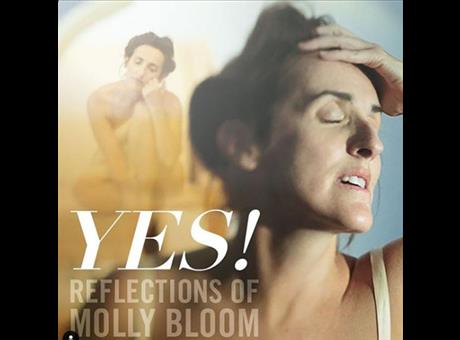
The Irish Rep now turns its attention to adapting several recent stage productions for the internet, beginning with Yes! Reflections of Molly Bloom. The award-winning seventy-five-minute one-woman show, based on James Joyce’s epic Ulysses, was adapted by Aedín Moloney and Colum McCann, directed by Kira Simring, and features music by Paddy Moloney of the Chieftains (and Aedín’s father); it originally ran at the company’s home on West Twenty-Second St. in June and July of last year, with Moloney as Molly Bloom in the early morning hours of June 17, 1904, as she considers love, loneliness, and isolation. The full team has now reimagined the play for onscreen viewing, with Aedín Moloney reprising her role; it will be performed live from June 16 — Bloomsday, when Joyce’s iconic tome takes place — through June 20. Admission is free with advance RSVP, with a suggested donation of $25.

The Irish Rep continues its online foray with “Meet the Maker: Frank McCourt . . . And How He Got That Way: A Conversation with Ellen McCourt and Malachy McCourt” on June 18; “Meet the Maker: Conor McPherson” on July 2; a special gala screening with new video of Frank McCourt’s The Irish . . . and How They Got That Way on July 13; “Meet the Makers: John Douglas Thompson and Obi Abili on Breaking Barriers in Eugene O’Neill’s The Emperor Jones” on July 16; Dan Butler, Sean Gormley, John Keating, Tim Ruddy, and Amanda Quaid in an online version of Conor McPherson’s The Weir from July 21 to 25; and a virtual version of Barry Day’s Love, Noël, a musical about Noël Coward starring Steve Ross and KT Sullivan, from August 11 to 15. I’m exhausted just thinking about it, but I can’t wait to be at my computer to experience the joy of live theater, even if it’s through a screen.

INCANTATA

(photo by Carol Rosegg)

Stanley Townsend channels Joseph Beuys in one-man show by Paul Muldoon about his later partner, Mary Farl Powers (photo by Carol Rosegg)

Irish Repertory Theatre, Francis J. Greenburger Mainstage
132 West 22nd St. between Sixth & Seventh Aves.
Tuesday – Sunday through March 15, $50-$70
212-727-2737
irishrep.org

In 1992, influential printmaker Mary Farl Powers died of breast cancer at the age of forty-three. Shortly after, her partner, Irish poet Paul Muldoon, wrote Incantata, an exquisite long-form poem about the Minnesota-born artist, who spent most of her life in Ireland. Director Sam Yates and award-winning actor Stanley Townsend transformed Muldoon’s work into a wholly original sixty-minute one-man show that continues at the Irish Rep through March 15.

In the program, Muldoon recalls about writing the poem, “I was in the state of ecstasy in which almost all my poems are written — that’s to say I was standing outside myself in ‘mystic self-transcendence’ — but this particular state of ecstasy was somehow more pronounced than usual.” Yates and Townsend capture that ecstatic feeling throughout Incantata as Townsend whirls around the claustrophobic set, delivering Muldoon’s words at a glorious operatic scale, his voice deepening at certain moments, hitting you right in the gut.

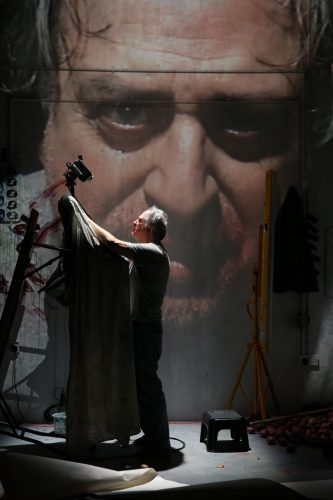
Early on, he says, “I thought again of how art may be made, as it was by André Derain, / of nothing more than a turn in the road where a swallow dips into the mire / or plucks a strand of bloody wool from a strand of barbed wire / in the aftermath of Chickamauga or Culloden / and builds from pain, from misery, from a deep-seated hurt, / a monument to the human heart / that shines like a golden dome among roofs rain-glazed and leaden.” Like several stanzas, Townsend repeats it as he moves across Rosanna Vize’s set, a studio with three walls onto which he tapes sheets of paper he has imprinted with squiggly red images he creates using carved potatoes and dye, evoking Powers’s abstract “Emblements” etchings, which he refers to as “army-worms.” The stage represents Dublin’s Graphic Studio, where Powers was director for more than a decade. Potatoes are piled in one corner, a boombox plays cassettes, and Townsend, in a painter’s jumpsuit (his costumes are also by Vize), uses and repurposes a chair and table in Beuys-ian ways while often speaking directly into a camera on a tripod, as if it’s Powers herself. His face and body are projected onto the back wall, like he’s some kind of gigantic force; when he looks into the lens, his larger-than-life image is gazing straight at the audience, which can be imposing, especially as we decide whether to look at his cinematic image or his actual self. The video design is by Jack Phelan, with lighting by Paul Keogan and sound by Sinéad Diskin.

Muldoon’s (The Dead, 1904) structure was inspired by W. B. Yeats’s In Memory of Major Robert, which itself was influenced by Abraham Crowley’s seventeenth-century On the Death of Mr William Hervey, placing it firmly within the canon of Irish literary elegies. His writing also contains a tour-de-force of pop-culture, mythological, and historical references, from Van Morrison, Rembrandt, Burt Lancaster, Emily Post, Frankie Valli, Samuel Beckett, and Enrico Caruso to the Shirt of Nessus, Thomism, Lugh of the Long Arm, Dr. John Arbuthnot, Jean-Paul Sartre’s La Nausée, Brecht, and the Red Hand Commandos; please don’t Google them during the show (but you might want to afterward).

Townsend (All About Eve, Jerusalem) is extraordinary as he hunkers about the stage with an intense, intricately choreographed physicality; be sure to get to the theater early in order to watch him creating his art, which begins as soon as the doors open. He resembles a beguiling mix between William Kentridge, Christopher Hitchens, Gerard Depardieu, and Stephen Bannon, with piercing eyes and unkempt hair. Yates (The Starry Messenger, The Phlebotomist) illuminates the text with a keen understanding of its potency.

The late John Kelly, Powers’s predecessor as head of the Graphic Studio, said, “Mary Farl Powers never took an ordinary image. She always had a fantastic reason for making an image and the image gained from her intelligent approach. It set her aside. You’d see a real character behind the image. She had a very high technique, very high finish.” That description applies as well to this ingenious production of Incantata, an audacious, uncompromising elegy and love story poetically reimagined into a unique and unforgettable theatrical experience.