Tag Archives: Irish Repertory Theatre

THE BUTCHER BOY

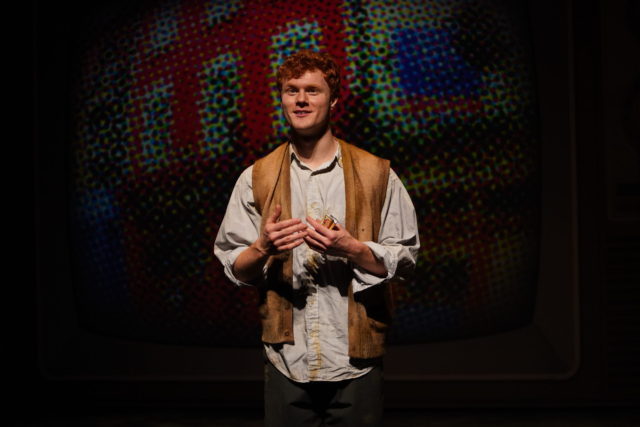
Nicholas Barasch sparkles as Francie Brady in world premiere musical at the Irish Rep (photo by Carol Rosegg)

THE BUTCHER BOY
Irish Repertory Theatre, Francis J. Greenburger Mainstage
132 West 22nd St. between Sixth & Seventh Aves.
Wednesday – Sunday through September 11, $50-$70
212-727-2737
irishrep.org

Five years ago, high school senior Asher Muldoon came to the Irish Rep with a musical adaptation of Patrick McCabe’s award-winning 1992 novel, The Butcher Boy, about thirteen-year-old Francie Brady (Nicholas Barasch), a red-haired lad on a destructive path to do some very bad things in the village of Clones in County Monaghan in the mid-1960s. Shortlisted for the Booker Prize, the novel was turned into a well-received 1997 dark comedy by Neil Jordan starring Stephen Rea, Fiona Shaw, Brendan Gleeson, Milo O’Shea, and Sinéad O’Connor. Muldoon’s show opened last night at the Irish Rep, the first new musical developed by the company in eight years. Unfortunately, it could use some slicing and dicing; while the narrative parts work well, the musical numbers don’t bring home the bacon.

Nicholas Barasch is terrific as Francie Brady, a neighborhood bully from a dysfunctional family; he narrates the story in a series of flashbacks, disconcertingly oblivious to the full weight of his actions. “When I was a young lad twenty or thirty or forty years ago I lived in a small town where they were all after me on account of what I done on Missus Nugent,” he says at the beginning. “Now, it started with Joe and me out at the hide we had built. ‘Death to all dogs who enter here!’ we said. Except us of course.”

Francie’s mother, Annie (Andrea Lynn Green), suffers from severe depression, and his father, Ben (Scott Stangland), is a nasty alcoholic and failed trumpet player. Francie’s uncle, Alo (Joe Cassidy), his father’s brother, left his girlfriend, Mary (Kerry Conte), without saying goodbye, to try his luck in London. He comes to a party as a conquering hero until the two siblings have a bit of a contentious row.

Francie hangs around with his best friend, Joe Purcell (Christian Strange), fishing; seeking to create mayhem; doing whatever he can to obtain his favorite candy, Flash Bars; and bullying Phillip (Daniel Marconi), Mrs. Nugent’s (Michele Ragusa) nerdy son, stealing his treasured comic books. “Oh, if we lived like this forever we’d be fine / So why can’t we live like this forever?” Francie and Joe sing.

Upset at Francie’s treatment of Phillip, Mrs. Nugent visits Mrs. Brady and complains, “I’ll tell you something, Annie, it’s no wonder your boy is such a mean little runt. His father lying round in bars morning to midnight, a disgrace to the family, to the whole town, he’s no better than a pig. A PIG.” Francie, as narrator, tells the audience, “She didn’t know what she was doing then, Mrs. Nugent.” Mrs. Nugent then adds, “Pigs! Sure the whole town knows it. PIGS!!!”
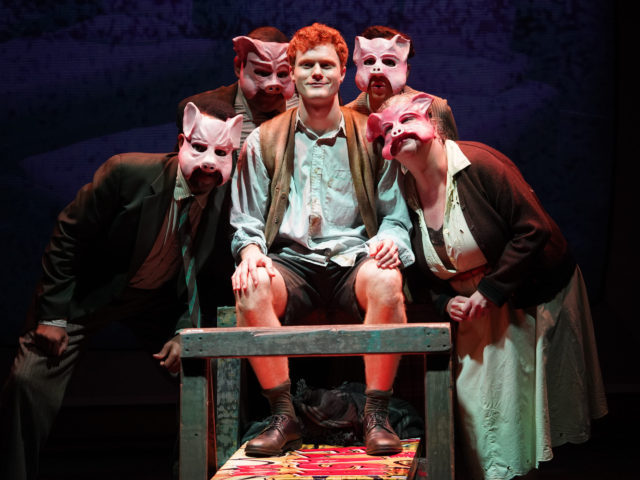
Four pigs spur Francie Brady (Nicholas Barasch) to do bad things in The Butcher Boy (photo by Carol Rosegg)

The “pigs” comments get to Francie, who does not want to be seen as inferior to anyone. He soon finds himself accompanied by four imaginary pigs (Teddy Trice, Carey Rebecca Brown, Polly McKie, and David Baida), a quartet of adults wearing pig masks and goading him on. “Well, I’ll be damned if I let all those piggies take what’s mine / This town ain’t big enough for both of us, you filthy swine / Let’s open up an abattoir and / Drain their blood for boudin noir / Save room for sausage,” one of the pigs sings. The four then chime in together, “Cause those big fat piggies have too much to say / Show em we’re not afraid to go to war / Unless those pigs grow piggy wings and fly away / Within a day or two you won’t know who is you and who is piggy.”

Francie runs away to Dublin (using the elegant pseudonym Algernon Carruthers), believing, “We can all just stay together / And I know that we’ll be fine / And the world will be back where the world is supposed to be,” but he winds up back in Clones with his family, gets a job working for Mr. Leddy (Baida) the butcher (“I’m used to seeing pigs,” Francie says), and has to redefine his place in a community where everyone seems to have grown up around him but he has stayed the same. It doesn’t go well.

Directed by Irish Rep cofounder Ciarán O’Reilly (Autumn Royal, The Emperor Jones), The Butcher Boy is an intense look into the mind of a troubled teen whose dark fantasies lure him away from reality. The show begins on Charlie Corcoran’s superb set, a kind of confined hideout with wooden slats at the right and left side covered in colorful comic-book regalia and a large, old-fashioned black-and-white television screen in the back, where Francie watches The Lone Ranger, Captain Z-Ro, and The Twilight Zone, including clips from the famous TZ episode “It’s a Good Life,” in which Bill Mumy portrays a young boy with special powers that allow him to control every part of life — and death — in a small town (“You’re a bad man! You’re a very bad man!”). During intermission, the classic “Eye of the Beholder” episode is shown, in which Rod Serling asks, “What kind of world where ugliness is the norm and beauty the deviation from that norm?” The pig masks are reminiscent of two TZ episodes, but the musical overdoes the comparisons by having Phillip morph into Serling during an otherwise harrowing scene.

There are also references to John F. Kennedy, America’s first Irish-Catholic president, who was almost brought down by the Bay of Pigs invasion, and three iterations of women named Mary, all played by Conte, a clever melding of the Virgin Mary and Mary Magdalene, a trio of characters who intrigue Francie.

Francie’s descent into mental illness is both heartbreaking and frightening, particularly as the United States is involved in a wide-ranging discussion about mental health, especially as it relates to disturbed young white males who are prone to mass shootings. Barasch (Hadestown, She Loves Me) walks the fine line of Francie’s sanity with an infectious charm even though we know that things are going to get bloody at any moment; his smile, and bright red hair, lights up the room.

However, the musical numbers (“Big Fat Piggies!,” “My Lovelies,” “Francie Gets Mad,” “Don’t Forget About Me”), featuring limited, tongue-in-cheek choreography by Barry McNabb, actually detract from the story; they feel tacked on, like garnish, merely extending the show to a too-long two hours and twenty minutes (with intermission). I found myself rooting for them to end, like television commercials, so I could get back to the regularly scheduled program, which I was otherwise immersed in, enjoying thoroughly.

Muldoon, who is currently an undergrad at Princeton, wrote the book, music, and lyrics; the score is performed by the Slaughterhouse Five, consisting of conductor and musical director David Hancock Turner on keyboards, Danielle Giulini on violin, Joseph Wallace on bass, Martha Hyde on reeds, and Mike Rosengarten on guitar and banjo, playing behind the television screen, only occasionally visible.

The Butcher Boy could have used some more tenderizing and trimming before being served, as it has the promise of being one delicious meal where audiences wouldn’t mind making pigs of themselves.
BELFAST GIRLS

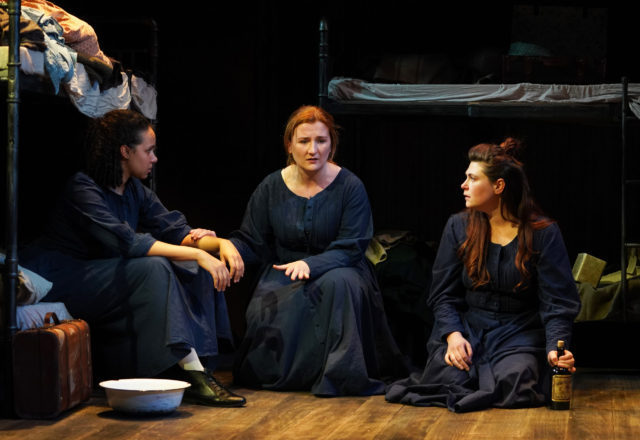
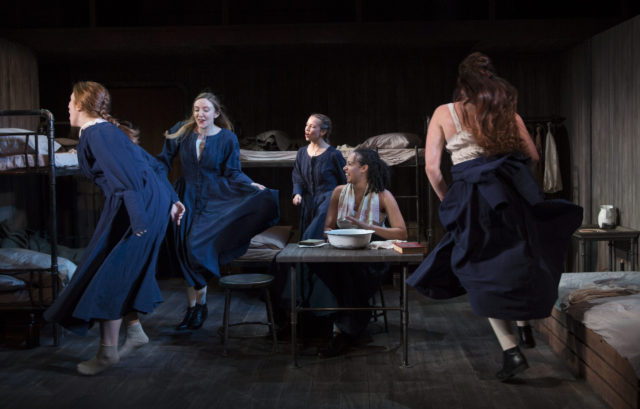
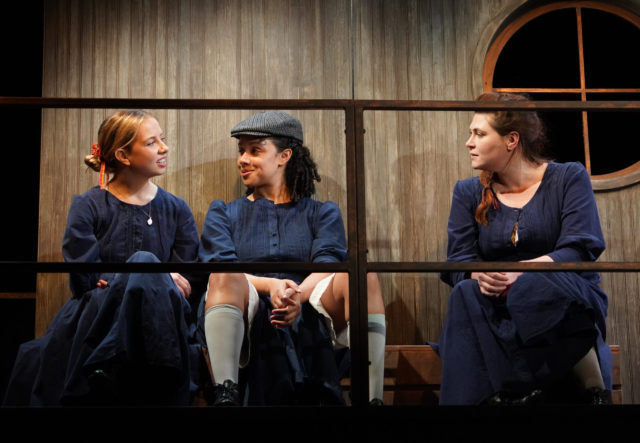
Five women believe they are on their way to a better life in Belfast Girls (photo by Carol Rosegg)

BELFAST GIRLS
Irish Repertory Theatre, Francis J. Greenburger Mainstage
132 West 22nd St. between Sixth & Seventh Aves.
Wednesday – Sunday through June 26, $50-$70
212-727-2737
irishrep.org

“From now on on this ship we’re to be mistresses of our own destiny,” Judith Noone declares early in Belfast Girls, which opened tonight at the Irish Rep. Moments later, she adds, “Youse think the English poor are any better off than us? They’re not. An’ besides, we’re women. An’ we’ll never be anythin’ here. For we are as the peat; to be used up an’ walked on.”

During the Great Famine, also known as the Great Starvation, the Orphan Emigration Scheme was put into effect in Ireland by British secretary of state for the colonies Earl Grey, purportedly to send young, parentless Irish girls (nineteen and under) who had been toiling in overcrowded workhouses to a better life in Australia. Between 1848 and 1850, more than four thousand women made the treacherous months-long journey by ship; however, many of them were not orphans but older prostitutes who had been soliciting on the streets. Their occupation would be quite a surprise to the Australian men who were supposed to be waiting for them with open arms on the shores of the faraway continent.

London-born Irish playwright Jaki McCarrick tells the fictionalized story of one such harrowing trip in Belfast Girls, making its New York City debut at the Irish Rep through June 26. It’s 1850, and the Inchinnan, the name of a real ship, is about to set sail. Four Catholic girls from Belfast have been assigned a small room with two bunks, Judith (Caroline Strange), Hannah Gibney (Mary Mallen), Ellen Clarke (Labhaoise Magee), and Sarah Jane Wylie (Sarah Street). At first, it’s like a dorm room at a girls school, one none of them would have been able to afford. They poke fun at one another while also hoping for a different future than the one they had been destined for.

When Hannah and Ellen take an immediate liking to the (unseen) attractive male cook, Judith, the most no-nonsense of the group, tells them to stay away from the men onboard. “All a youse, get your heads round the plain fact we’re leavin’ an’ we won’t ever be comin’ back,” she says. “Look, I know some of youse an’ youse know me. We have this one an’ only chance. An’ in all the kingdom of Ireland aren’t we — us women — aren’t we damned lucky to be gettin’ out of it?”

Molly (Aida Leventaki), Judith (Caroline Strange), and Hannah (Mary Mallen) take a break on board the Inchinnan (photo by Carol Rosegg)

A few moments later, Hannah says, “I hear there’s fine English farmers in the colony with thousands of acres, Judith, an’ more cattle than ya could dream of seein’ in the whole of Ireland, just drippin’ wit need for female companionship.” Ellen responds, “I want no damn Englishman. Haven’t they been trouble enough in this country? Why in the name a god would I travel halfways across the earth ta find one of them when every self-respectin’ Irishman is tryin’ to get them outta the place?”

Hannah, Sarah, and Judith are none-too-pleased when Ellen, who had gone for a walk, comes back with Molly Durcan (Aida Leventaki), a whisper-thin maidservant from the much wealthier county of Sligo who will be staying with them as well. Hannah is suspicious of Molly, but the five women attempt to bond through a terrible storm and some surprising revelations. And for good measure, McCarrick adds an Irish ghost story and several traditional folksongs.

In Belfast Girls, McCarrick (Leopoldville, The Naturalists) takes on such issues as class, gender, and religion, adding a dose of Marxism, all seen through a feminist lens as the women contemplate what’s next for them. They talk a lot about what was considered women’s responsibilities a hundred and seventy years ago: being a maidservant, sewing adornments on bonnets, not learning how to read, existing primarily as birthing vessels.

“When I arrive in the Colony what choice do I have only to work as I always worked?” Sarah asks. Molly answers, “But you do have choices. There are groups starting all over the world. Where women stand up and talk and demand the privileges only men have now; to be paid as men are paid, to be allowed to do the same things — to tour in a theatrical, for instance, without people thinking you’re loose or worse.” Molly has dreams of being an actress, perhaps playing Puck in Shakespeare’s A Midsummer Night’s Dream, a character who, as Robin Goodfellow in the play within the play, says, “Lord, what fools these mortals be! . . . Follow my voice: we’ll try no manhood here.” But all five of the women are acting, adapting their personas, and toying with the truth, in order to get away from their miserable lives.

Judith (Caroline Strange), Ellen (Labhaoise Magee), and Hannah (Mary Mallen) contemplate their future in Belfast Girls (photo by Carol Rosegg)

Director Nicola Murphy (A Girl Is a Half-formed Thing, Pumpgirl) keeps a fast pace and steady ship as controversies ensue and truths come out. Chika Shimizu’s two-story set is like a kind of liminal prison for the women, cramped in a room with no windows. China Lee’s costumes emphasize the type of restrictive clothing women had to wear at that time. Caroline Eng’s sound puts the audience on the water, birds chirping outside, tempting freedom. The only male member of the primary cast and crew is lighting designer Michael O’Connor.

The cast is exemplary, led by Strange (London Assurance, Meditations on a Magnetic North) as the Jamaican-born mixed-race Judith; her last name, Noone, might imply that she is “no one,” but she is a force to be reckoned with, unafraid to defend her decisions in a patriarchal society. “We didn’t leave Ireland at all, ladies,” Judith declares. “Ireland has spat us out.” The Orphan Emigration Scheme ended in 1850, but the battle for women’s rights in Ireland continues.

TWO BY SYNGE: IN THE SHADOW OF THE GLEN / THE TINKER’S WEDDING

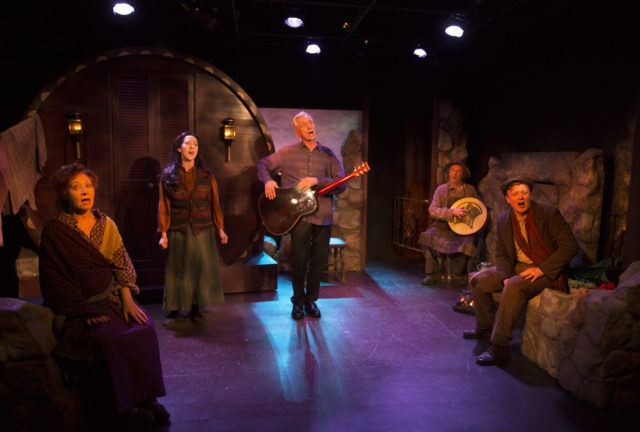
The Irish Rep’s Two by Synge features several musical interludes (photo by Carol Rosegg)

TWO BY SYNGE: IN THE SHADOW OF THE GLEN / THE TINKER’S WEDDING
Irish Repertory Theatre, W. Scott McLucas Studio Theatre
132 West 22nd St. between Sixth & Seventh Aves.
Wednesday – Sunday through May 22, $50
212-727-2737
irishrep.org

I am here to sing — pun intended — the praises of the great John Keating, currently starring in the theatrical twinbill Two by Synge: In the Shadow of the Glen & The Tinker’s Wedding at the Irish Rep. It’s a rave long in coming. If you don’t know the name, you must not have visited the Irish Rep much in the last quarter century, during which time the Tipperary native has appeared in more than a dozen productions (as well as numerous Shakespeare adaptations at TFANA).

Keating, a wiry fellow who stands six-foot-three with wildly curly hair and an immediately recognizable face, portrayed the fearful, deeply religious Shawn Keogh in John Millington Synge’s Playboy of the Western World at the Irish Rep in 2002; he is not the same John Keating who illustrated a 1927 edition of the work.

Directed by Irish Rep founding artistic director Charlotte Moore, Two by Synge consists of a pair of early short works about Irish peasantry, which the Dublin-born Synge based on stories he heard and saw, then wrote about at the urging of his friend and colleague W. B. Yeats. They take place in the company’s downstairs W. Scott McLucas Studio Theatre, a tiny, intimate black box where you can practically reach out and touch the actors — while getting the sensational opportunity to revel in Keating’s extraordinary talent.

It begins with The Tinker’s Wedding, Synge’s bawdy tale of a poor couple, Sarah Casey (Jo Kinsella), the onetime Beauty of Ballinacree, and Michael Byrne (Keating), a tinker, who want to get married. Their relationship is more out of necessity than true love.

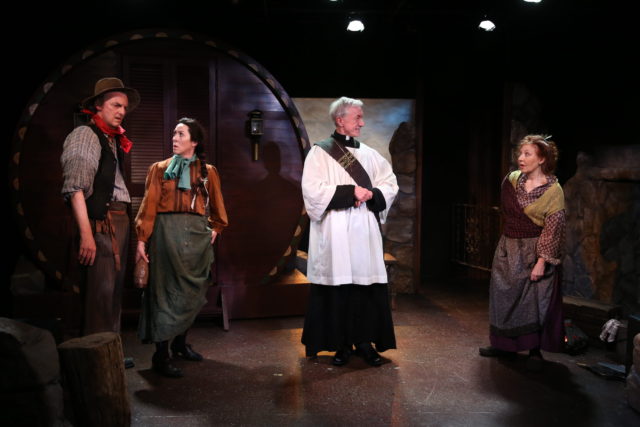
A couple of peasants want the local priest to marry them in The Tinker’s Wedding (photo by Carol Rosegg)

Sarah harasses Michael, arguing, “It’ll be small joy for yourself if you aren’t ready with my wedding ring. Is it near done this time, or what way is it at all?” He replies, “A poor way only, Sarah Casey, for it’s the divil’s job making a ring, and you’ll be having my hands destroyed in a short while the way I’ll not be able to make a tin can at all maybe at the dawn of day.” Sarah says, “If it’s the divil’s job, let you mind it, and leave your speeches that would choke a fool.” Michael retorts, “And it’s you’ll go talking of fools, Sarah Casey, when no man did ever hear a lying story even of your like unto this mortal day. You to be going beside me a great while, and rearing a lot of them, and then to be setting off with your talk of getting married, and your driving me to it, and I not asking it at all.”

Sarah tries to force the local priest (Sean Gormley) to perform the ceremony, but he is not about to do so without getting some form of payment, as Sarah and Michael are not church regulars and she does not live the life of a model Christian. “A holy pair, surely! Let you get out of my way,” the harried priest declares, attempting to leave them, but Sarah is adamant. Soon arriving is Michael’s mother, Mary (Terry Donnelly), a well-known drunk who has a way of ruining everything. She tells the priest, “Isn’t it a grand thing to see you sitting down, with no pride in you, and drinking a sup with the like of us, and we the poorest, wretched, starving creatures you’d see any place on the earth?” When the priest threatens again to not marry the couple, Sarah and Michael come up with a bizarre plan to ensure their union.

The Tinker’s Wedding — which Synge never got to see performed, as he died of Hodgkin’s lymphoma at the age of thirty-seven, more than seven months before its 1909 debut — is a bit too jumbled at first but eventually finds its legs. Daniel Geggatt’s set features stone walls, a fireplace, a small gate, and the facade of a house that resembles a huge Native American drum. Keating is a joy to watch, whether he is front and center or drifting off into the background, tinkering with the ring or a tin can. In full character, he follows the action with intricate gestures, from smiles and nods of agreement to frowns and head shakes. His eyes gape open in wonder and shudder in fear. While that might be what good acting is about, he takes it to another level, in the simplest moments as well as the turning points.

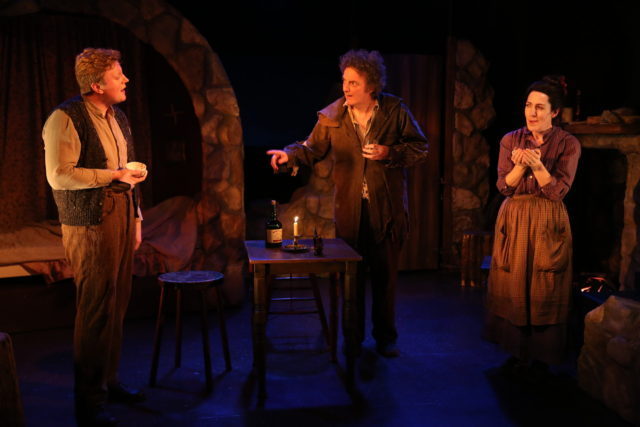
Keating (The Naturalists, The Winter’s Tale) is even better in the second play, the significantly superior In the Shadow of the Glen, the first of Synge’s works to be staged (in 1903). Keating plays a tramp in a shoddy coat (courtesy of costume designer David Toser) who has wandered in from a storm to seek temporary shelter in the home of Nora Burke (Kinsella) and her husband, Dan (Gormley), who is lying lifeless in the bed. (The set is essentially the same save for the “drum,” which has been rotated to reveal the bedroom.) She seems relatively nonplussed by the corpse, and the tramp is taken aback.

“It’s a queer look is on him for a man that’s dead,” the tramp points out. Nora responds, “He was always queer, stranger, and I suppose them that’s queer and they living men will be queer bodies after.” The tramp adds, “Isn’t it a great wonder you’re letting him lie there, and he is not tidied, or laid out itself?” She answers, “I was afeard, stranger, for he put a black curse on me this morning if I’d touch his body the time he’d die sudden, or let any one touch it except his sister only, and it’s ten miles away she lives in the big glen over the hill.” Tramp: “It’s a queer story he wouldn’t let his own wife touch him, and he dying quiet in his bed.” Nora: “I’m thinking many would be afeard, but I never knew what way I’d be afeard of beggar or bishop or any man of you at all. It’s other things than the like of you, stranger, would make a person afeard.”

The tropes of a classic ghost story turn on a fabulous plot twist and the arrival of the Burkes’ neighbor, young farmer Micheal Dara (Ciaran Bowling) — the character Keating played in his first professional performance in 1994 — in whom Nora sees a rescuer from her sudden predicament. “What way would I live and I an old woman if I didn’t marry a man with a bit of a farm, and cows on it, and sheep on the back hills?” she asks.

A tramp finds himself caught between a young farmer (Ciaran Bowling) and a woman (Jo Kinsella) mourning her husband in J. M. Synge’s In the Shadow of the Glen (photo by Carol Rosegg)

Keating (Autumn Royal, The O’Casey Cycle) is again magnificent in Glen, his body movements and shifting of his eyes utterly hypnotizing. He is an actor’s actor, making everyone around him better; watching him watching the other characters also offers another way into the play for the audience, no matter how successful it already is, and In the Shadow of the Glen is just that, a short but satisfying foray into the fear of death that hovers over Irish stories. Moore (The Streets of New York, The Playboy of the Western World) and lighting designer Michael O’Connor makes sure to never have Keating fade too far into the background as members of the rest of the fine cast take center stage.

The two shows, which total seventy-five minutes, also include six songs, two by Synge, three traditionals, and one original by Gormley, “A Smile upon My Face,” which comes between the two comedies. Yes, despite such lines as “It’s a cruel and a wicked thing to be bred poor,” said by Sarah Casey, Two by Synge is very funny.

In his preface to The Tinker’s Wedding, the playwright explained, “The drama is made serious — in the French sense of the word — not by the degree in which it is taken up with problems that are serious in themselves, but by the degree in which it gives the nourishment, not very easy to define, on which our imaginations live. We should not go to the theatre as we go to a chemist’s, or a dram-shop, but as we go to a dinner, where the food we need is taken with pleasure and excitement. . . . Of the things which nourish the imagination humour is one of the most needful, and it is dangerous to limit or destroy it. Baudelaire calls laughter the greatest sign of the Satanic element in man; and where a country loses its humor, as some towns in Ireland are doing, there will be morbidity of mind, as Baudelaire’s mind was morbid. In the greater part of Ireland, however, the whole people, from the tinkers to the clergy, have still a life, and view of life, that are rich and genial and humorous. I do not think that these country people, who have so much humor themselves, will mind being laughed at without malice, as the people in every country have been laughed at in their own comedies.”

Whenever you’re not sure if something is funny or not, just follow Keating’s lead and he’ll make sure you’re on the right path.

THE STREETS OF NEW YORK

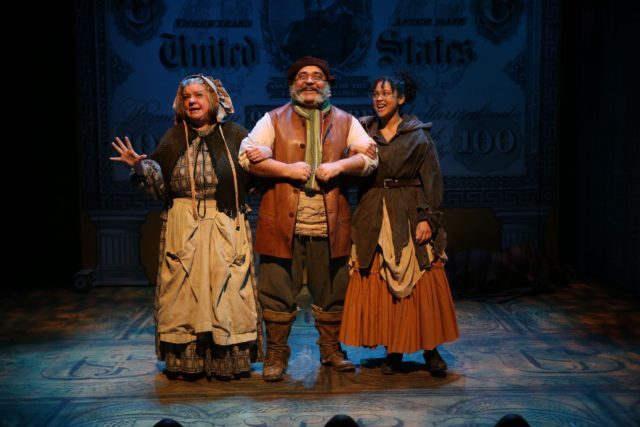
Irish Rep revival of The Streets of New York shines a light on greed, poverty, and the power of love (photo by Carol Rosegg)

THE STREETS OF NEW YORK
Irish Repertory Theatre, Francis J. Greenburger Mainstage
132 West 22nd St. between Sixth & Seventh Aves.
Wednesday – Sunday through January 30, $50-$70
212-727-2737
irishrep.org

As the pandemic lockdown lifted and the city opened back up, Irish Rep artistic director Charlotte Moore decided to revisit the company’s 2002 hit, The Streets of New York. “In this time of Covid, I was sure it would be appropriate to rewrite my original director’s note,” Moore explains in the program. “But upon rereading the original, so many things are exactly the same that I have changed my mind. There is still great poverty and hunger, and the heartbreak of lost love never changes. Add to that a worldwide pandemic and a masked society and Boucicault’s eighteenth-century world seems to fit right into our twenty-first with its darkness and restrictions.”

Moore adapted Dublin-born Dion Boucicault’s 1857 play The Poor of New York, itself based on Édouard Louis Alexandre Brisebarre’s Les Pauvres de Paris, adding more than a dozen songs to the Dickensian tale of greed and hardship. The result is a delightful, indelible tale that feels just right for this moment in time, one that I can envision becoming an annual holiday tradition.

The show begins on the eve of the Panic of 1837, which led to an economic depression. “The poor man’s home is a filthy street / You sell your shoes for a scrap of meat,” a man sings. An older couple adds, “The violence of poverty breeds everywhere / And a cloud of injustice hangs in the air/ And till it clears / It could be years / But till it clears / We must survive / And stay alive / On these unholy, shadowy, crime ridden, black hearted, / Blood sodden, filthy, mean / Streets of New York!”

Wealthy banker Gideon Bloodgood (David Hess) is preparing to abscond with his Nassau St. bank’s money when sea captain Patrick Fairweather (Daniel J. Maldonado) arrives after hours to entrust Bloodgood with his life savings before going on a voyage, seeking the banker’s protection of the financial security of his wife and two children. Fairweather departs but returns moments later, changing his mind and demanding his fortune back. But the greedy Bloodgood is not about to surrender his newfound gains, and when Fairweather suddenly drops dead, Bloodgood decides to dump the body and keep the money — but not before one of his clerks, Brendan Badger (Justin Keyes), grabs the signed deposit receipt, hiding it away for a rainy day.

The Puffy family (Polly McKie, Richard Henry, and Jordan Tyson) find a way to smile amid their drudgery in The Streets of New York (photo by Carol Rosegg)

Twenty years later, Bloodgood, accompanied by his ever-faithful butler, Edwards (Price Waldman), is basking in his vast success, built on the cash he stole from Fairweather. While Bloodgood is looking for a suitable husband for his spoiled daughter, Alida (Amanda Jane Cooper), Fairweather’s children, Lucy (DeLaney Westfall) and Paul (Ryan Vona), and widow, Susan (Amy Bodnar), are living in abject poverty in the dangerous area of New York City known as Five Points. Their poor but goodhearted landlord, Dermot Puffy (Richard Henry), has fallen behind on his mortgage payments, so the heartless Bloodgood threatens to evict Puffy, his wife, Dolly (Polly McKie), and their daughter, Dixie (Jordan Tyson), which would leave the Fairweathers homeless as well.

The Fairweathers hope to be saved by Lucy’s childhood love, Mark Livingstone (Ben Jacoby), scion of a well-heeled, prosperous society family, while Alida plots to marry Mark herself to restore the Bloodgood name to respectability even as she fools around with the philandering Duke Vlad (Maldonado). Like her father, it’s only money and appearances that matter. “Isn’t it wonderful to be in control / Who cares if Daddy has to sell his soul / To keep me in accoutrements / To keep me in the things I want / To keep me happy,” Alida selfishly admits. “Allowed to be horrid and rude to everyone / A sense of entitlement is so much fun / I ride whilst poorer people walk, (with a frown) or run! / Oh! How I love being rich!”

As Christmas approaches, some are destined to be showered with yet more wealth while others seem bound for anonymity, struggling to survive day by day in the perilous gutters of an uncaring metropolis. The very best kind of mustache-twirling melodrama ensues as the plot leaps and twists to its conclusion.

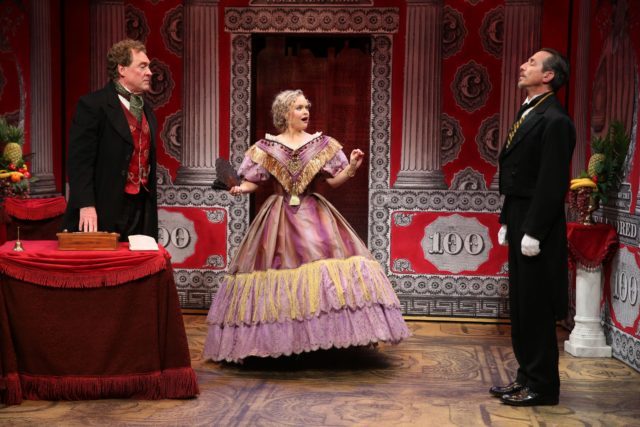
Robber baron Gideon Bloodgood (David Hess) and his obnoxious daughter (Amanda Jane Cooper) boss around their butler (Price Waldman) in The Streets of New York (photo by Carol Rosegg)

Moore, who with Irish Rep producing director Ciarán O’Reilly created some of the most compelling and innovative online shows during the pandemic, goes back to the basics with The Streets of New York. Linda Fisher’s period costumes feel authentic, and Hugh Landwehr’s set, covered with giant bills and help wanted ads, is centered by a large wall that the actors and masked staff members move around, magically morphing into the Bloodgoods’ opulent home and office as well as doomed tenements in Five Points.

The five-piece orchestra is partially visible offstage right, consisting of Melanie Mason on cello, Jeremy Clayton on woodwinds, Karen Lindquist on harp, Sean Murphy on bass, and Joel Lambdin on violin, performing lovely orchestrations by music director Mark Hartman and associate conductor Yasuhiko Fukuoka.

Two-time Tony nominee Moore, who previously directed Boucicault’s London Assurance in addition to plays by O’Casey, Yeats, Friel, and Synge and such musicals as Meet Me in St. Louis and Love, Noël: The Letters and Songs of Noël Coward, gives ample room for the material, which often evokes operetta, to breathe on the cramped stage, the two and a half hours (with intermission) never slowing down for a minute. Moore’s lyrics do what they’re supposed to, help develop the narrative and give depth to the characters; nary a word is extraneous. Barry McNabb’s choreography shines in the vaudevillian duet “Villains,” a riotous showstopper featuring Hess and Keyes. Cooper brings down the house in her engaging solo, “Oh, How I Love Being Rich,” her obnoxious coquettishness channeling Bernadette Peters and Kristen Chenoweth. (She’s worked onstage with Chenoweth several times.) Hess stands out as the scoundrel Bloodgood, reveling in his egomaniacal affairs, while Jacoby is heart-wrenching as a man who just wants to do the right thing but is thwarted at every turn.

Still caught up in a pandemic and social justice movement that have magnified the sorry state of income inequality in America, The Streets of New York doesn’t feel old-fashioned as much as fresh and prescient. We all want a “taste of the good life,” as the Puffys explain, but it’s not always within reach. However, the power of love — and a delightful musical — has the ability to transcend suffering and bring light to lead us out

AUTUMN ROYAL

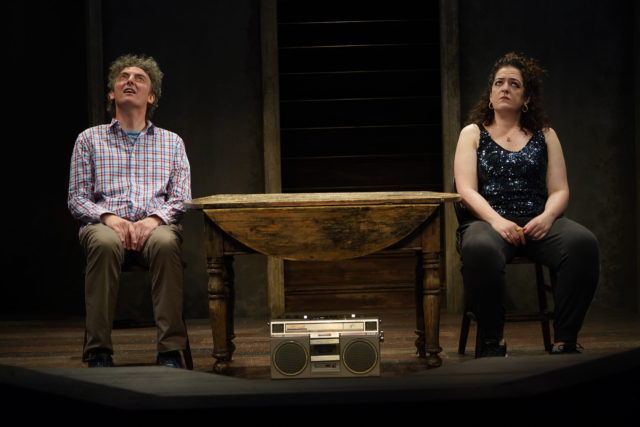
Life is not exactly looking up for Timmy (John Keating) and May (Maeve Higgins) in Autumn Royal (photo by Carol Rosegg)

AUTUMN ROYAL
Irish Repertory Theatre, Francis J. Greenburger Mainstage
132 West 22nd St. between Sixth & Seventh Aves.
Tuesday – Sunday through November 21, $50-$70
212-727-2737
irishrep.org

It was with a bittersweet wistfulness that I entered the Irish Rep for the first time in more than a year and a half. During the pandemic lockdown, the company was at the global forefront of digital theater, presenting more than a dozen outstanding livestreamed and recorded shows online, using cutting-edge technology that went far beyond Zoom boxes and clumsy green-screening. (Among the best were The Weir, Bill Irwin’s On Beckett / In Screen, and The Cordelia Dream; twelve of the shows are still available on demand.) Of course, I was excited to be back at the Francis J. Greenburger Mainstage on West Twenty-Second St. for a matinee, greeted by masked founding directors Charlotte Moore and Ciarán O’Reilly as I made my way in to sit with an audience of real people rather than virtual avatars Zooming in from home.

The Irish Rep has brilliantly reopened with the North American premiere of Kevin Barry’s Autumn Royal, a charming two-character, seventy-minute dark comedy that takes place on a claustrophobic set, an oddly appropriate reminder of the lockdown. The walls seem to be closing in on May (Maeve Higgins) and Timothy (John Keating), a pair of thirtysomething siblings who are caregivers for their ailing father, who lives upstairs in the attic. Charlie Corcoran’s set consists of a small table, two chairs, a doorway leading out of the house, and stairs to the attic, which appear ridiculously small and narrow, practically untenable. It’s as if May and Timmy are trapped, not only in their quaint Cork City home, but in the past, still reeling from their mother’s sudden departure when they were young. (“Went out for a packet o’ Birds custard and never came back,” Timmy recalls.)

Timmy dreams of moving to Australia to become a surfer, while May is much more realistic in their lack of options. She counters his talk of riding a wave with a detailed description of a local woman whose mother fell into a fireplace and “half the face melted off her.” It’s as if they’re fire and water, opposites who need each other.

Their father is never seen — it’s like he’s quarantining — but is occasionally heard, and every once in a while he bangs on the floor, sending dust and crumbling parts of the ceiling down on his grown children, who are not particularly fond of a poem he is writing about a duck walking across a puddle. However, the three of them bond over the 1982 song “Zoom” by Fat Larry’s Band, which Timmy blasts from an old boombox, on cassette. (Yes, even the name of the song evokes virtual theater, even though the play was first performed in Cork in 2017.)

May and Timmy share memories with little thought of their future. “I remember fucking everything,” May proclaims. A moment later, she adds, “We’re never going to get past ourselves here, Tim.” Timmy replies, “I’m definitely going to Australia, May. All I need is to have, like, two grand, I think is it?, in the, am . . .” She shoots back, “Timmy? You’re not going to make it as far as the Esso station.”

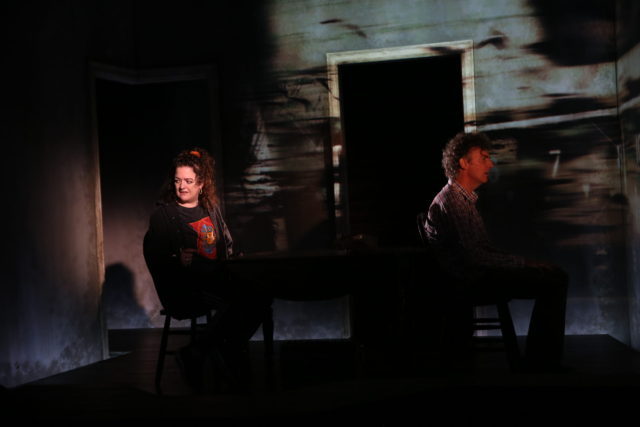
A haunting darkness hovers over a sister and brother in Irish drama (photo by Carol Rosegg)

They start to believe that their lives might be different if they put their father in a nursing home, but whenever they start thinking about how things can improve, their discussions turn sour. “All we’re doin’ now is talkin’ ourselves into a very dark read o’ things, yunno?” Timmy says. “Ah, the world sometimes is just complete . . . fucken . . . bollocks, like,” May opines. No matter which way they turn, regardless of their desires, they just seem to end up stuck back at home, their parents practically ghosts haunting their lives.

Directed by O’Reilly (The Weir, The Emperor Jones) with a deft touch, Autumn Royal features projections by Dan Scully, sometimes of blood covering a wall, while others evoke the siblings as kids in the back of a car on a Sunday drive to Tipperary, a beach scene, the silhouette of a mysterious woman, white picture frames, and, repeatedly, a loud washing machine, the spin cycle representing the inner chaos and repetition of their existence, just going around in circles. Keating (The O’Casey Cycle, Pericles) — a true New York theater treasure — and Higgins (Extra Ordinary, Naked Camera) deliver a terrific one-two punch as the arguing siblings, he tall, gangly, and comical, she short, tough, and harder-edged. They each get long monologues, but they really shine when they are both onstage, playing off each other like a classic comedy team, one goofy and wide-eyed, the other harshly direct and to the point. In his first stage work, novelist and short story writer Barry (Beatlebone, City of Bohane) adds a healthy dose of Irish doom and gloom to a common situation, one that hits a little closer to home in the time of Covid.

THE CORDELIA DREAM: A PERFORMANCE ON SCREEN

Danielle Ryan and Stephen Brennan are exceptional as a bitter daughter and father in streaming revival of Marina Carr’s The Cordelia Dream

THE CORDELIA DREAM
Irish Rep Online
Daily through August 8, suggested donation $25
irishrep.org

Summer theater in New York City is dominated by outdoor Shakespeare presentations, including Shakespeare in the Parking Lot’s Two Noble Kinsmen, the Classical Theatre of Harlem’s Seize the King, the Public Theater’s Merry Wives of Windsor at the Delacorte and the Mobile Unit’s Shakespeare: Call and Response, and NY Classical’s King Lear with a happy ending.

One of the best productions is taking place indoors, but not in a theater with an audience. I wouldn’t be giving anything away if I told you that there is no happy ending in the Irish Rep’s virtual revival of Marina Carr’s The Cordelia Dream, streaming online through August 8. The brutal, relentless two-act, ninety-minute play was commissioned by the Royal Shakespeare Company and debuted in 2008 at Wilton’s Music Hall in London. Charlotte Moore and Ciarán O’Reilly of the Irish Rep, in association with casting director and producer Bonnie Timmermann, enlisted director Joe O’Byrne to helm a new version filmed at the New Theatre in Dublin, as part of the innovative company’s continuing onscreen works made during the pandemic.

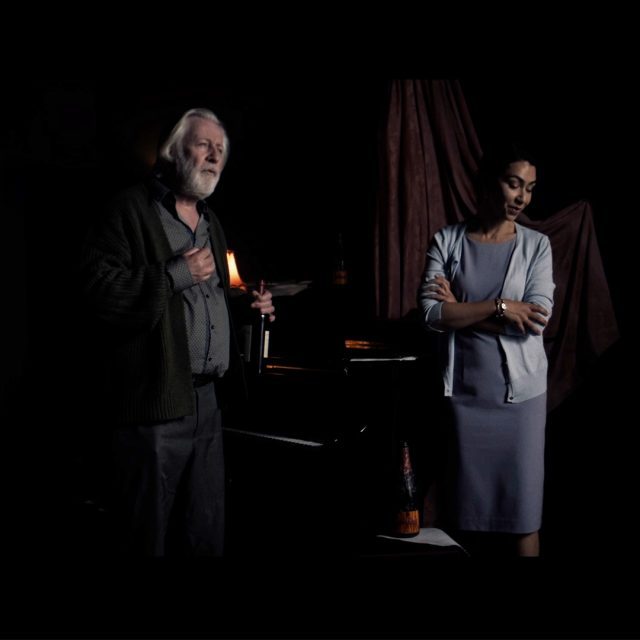
The play takes place in a dark, eerie room where an elderly man (Stephen Brennan) lives alone, drinking by himself and playing his piano. He is visited one day by his long-estranged daughter (Danielle Ryan); they have not seen each other in many years, and their discomfort and hostility are immediately apparent in their initial exchange.

Man: You.
Woman: Yes. Me.
Man: Well.
Woman: It wasn’t easy . . . seeking you out.
Man: Wasn’t it?
Woman: I stayed away as long as I could.
Man: You think I’m going to die soon?
Woman: Maybe.
Man: You want to kiss and make up before the event?
Woman: Some people visit each other all the time.
Man: I’m not some people. You of all people should know that.
Woman: Can I come in or not?

There is no love lost between father and daughter; it’s as if an older Cordelia has come to see her aging father, both filled with resentment, no reconciliation in sight. “Love needs a streak of darkness. The day is for solitude. Morning especially. Morning is for death,” he says. “And afternoons?” she asks. “At your age they’re for transgressions, at mine they’re for remorse,” he replies. “You know about remorse?” she wonders. “I’m an expert on it,” he answers.

Both characters are revealed as cold and cruel as details of their lives emerge in the corrosive conversation. He is an extremely talented but failed composer attempting to create his magnum opus before he dies, while she is a famous composer who has not been able to enjoy her success. He accuses her of wasting her gifts, claiming his superiority, unashamed of his hatred of her. He is glad that none of her children are named after him; he even criticizes the wine she brought. “You are very mediocre,” he declares. “Does mediocre need ‘very’ in front of it?” she asks. “When talking about you. Yes, it does,” he replies with bitterness.

She is there to say her piece, not about to cower from him. “You haven’t left me alone,” she says. “You’ve retreated to this sulphurous corner to gather venom for the next assault. You? Leave me alone? You haunt me.”

She has also come to tell him about a dream she has had, about their life and death, about the four howls and the five “never”s in Shakespeare’s grand tragedy. “You think you’re Cordelia to my Lear. No, my dear. You’re more Regan and Goneril spun,” he spits at her. “And you’re no Lear,” she shoots back, soon leaving.

She returns five years later, but it is not quite the same. His mental faculties are decreasing, not unlike the mad Lear’s, thinking her to be the goat-faced, dog-hearted dark lady of his nightmares, a reference to the character Shakespeare addresses in Sonnet 130 and others, whom he loves but cannot outright compliment, disparaging her instead. He recalls moments from his past but is foggy. “Your self-delusion is complete,” she says. “Men should not have daughters,” he opines. The acerbic cat-and-mouse dialogue continues as they eviscerate each other till nothing’s left.

Fiercely directed by Joe O’Byrne (McKeague and O’Brien present “The Rising,” Frank Pig Says Hello), The Cordelia Dream is a merciless, unyielding depiction of an unredeemable relationship between a father and daughter. With biting language, Carr (Woman and Scarecrow, Marble) brilliantly compares the creation of a work of art to the birth of a child and all the responsibilities that are supposed to accompany it. The play is intimately photographed and edited by Emmy winner Nick Ryan, with ghostly set design by Robert Ballagh and sound and original music by Emmy nominee David Downes, the actors naturally lit by a few lamps and a window that offers brief reprieves from the enveloping darkness that makes it feel like it is all a dream.

Brennan (A Life, The Pinter Landscape) commands the screen with an immense presence, his white-haired, white-bearded character skewering his daughter with relish, unafraid of any consequences. Ryan (Harry Wild, Wild Mountain Thyme), who made her professional debut in 2007 playing Cordelia and Brigitte in the Edinburgh Fringe award winner Food, portrays the lost woman with a graceful finesse as she tries to unburden herself of the many ways she claims he destroyed her life. The harrowing work hits even deeper at a time when loved ones are reuniting after the long pandemic lockdown, with hugs and kisses, smiles of relief and unabashed joy, none of which is evident in these two characters who harbor a disturbing, apparently unsalvageable history.

LITTLE GEM: A PERFORMANCE ON SCREEN

Who: Marsha Mason, Brenda Meaney, Lauren O’Leary
What: Virtual play reading
Where: #IrishRepOnline
When: April 27 – May 9, free with RSVP (suggested donation $25)
Why: The Irish Rep continues its outstanding productions made during the pandemic lockdown with a virtual reading of Elaine Murphy’s Little Gem. The show is a reunion for the cast — Marsha Mason, Brenda Meaney, and Lauren O’Leary are back to re-create their roles from the in-person production that ran at the Irish Rep in in the fall of 2019. I wrote of that production, “Three generations of women in a North Dublin family share their foibles and exert their fortitude in successive monologues in Marc Atkinson Borrull’s engaging if not quite sparkling revival. First seen in the US at the Flea in 2010, the hundred-minute play begins with eighteen-year-old Amber (O’Leary), who enters a doctor’s office waiting room and talks about a night of partying at a high school ball with her best friend, Jo, involving drugs and alcohol, dancing, and her maybe-boyfriend, Paul. When she is done, her mother, Lorraine (Meaney), comes in and, while Amber watches her, discusses a strange occurrence at the store where she works that ends up with her having to speak with human resources. And then Kay (Mason), Amber’s grandmother and Lorraine’s mother, walks in and, while the other two look at her, describes her vaginal itch and her ill husband, Gem, who she loves but calls a ‘cantankerous oul’ fuck.’ She says, ‘I’m the wrong side of sixty, not dead. I haven’t had sex in well over a year and it’s killing me.’”

The reading is again directed by Borrull, with the actors filmed remotely at their homes in Connecticut, London, and New York. It works surprisingly well as the story, a series of monologues, unfolds in personal, private spaces that lend an intimacy that was just off in the stage play. When Lorraine explains about an HR person, “She reaches across the desk and touches my hand. Don’t remember the last time someone touched me, hugged me, or even bleedin’ nudged me,” it strikes deep, as we’ve all been quarantining, not interacting with other people for more than a year, watching works online in which actors are in separate Zoom boxes, unable to make physical contact. (Kay’s complaint about not having sex in a year also has additional impact because of the coronavirus crisis.) Little Gem is streaming on demand at specific times from April 27 to May 9; tickets are free, but a $25 donation is suggested if you can afford it. The Irish Rep, which has broken the mold of what is possible during the lockdown, has also brought back its ten previous virtual productions, including the must-see On Beckett with Bill Irwin, The Weir by Conor McPherson, and Brendan Conroy in The Aran Islands, each available on demand here.