Tag Archives: Irish Repertory Theatre

THE FRIEL PROJECT: MOLLY SWEENEY

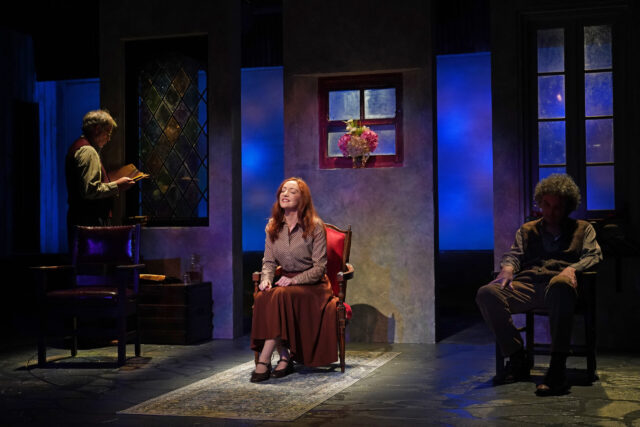
Rufus Collins, Sarah Street, and John Keating star in Irish Rep revival (photo by Carol Rosegg)

MOLLY SWEENEY
Irish Repertory Theatre, Francis J. Greenburger Mainstage
132 West Twenty-Second St. between Sixth & Seventh Aves.
Wednesday – Sunday through June 30, $60-$95
212-727-2737
irishrep.org

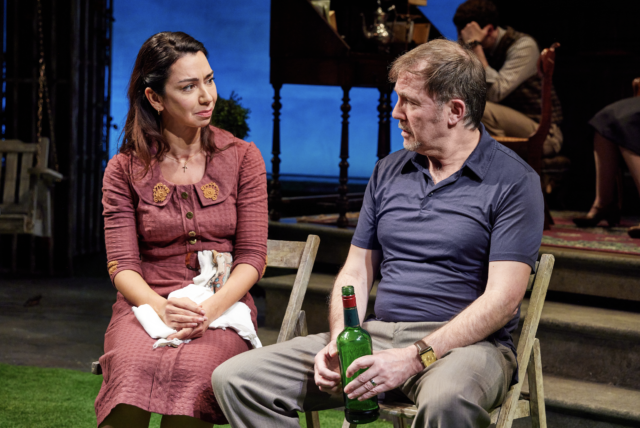
Early on in Irish Rep’s riveting revival of Brian Friel’s 1994 three-character play Molly Sweeney, Mr. Rice (Rufus Collins), an ophthalmologist, recounts his first meeting with Molly Sweeney (Sarah Street), who has been blind since she was ten months old, and her husband of two years, Frank Sweeney (John Keating). “I liked her. I liked her calm and her independence; the confident way she shook my hand and found a seat for herself with her white cane. And when she spoke of her disability, there was no self-pity, no hint of resignation. Yes, I liked her,” he tells the audience. “She had a full life and never felt at all deprived.”

He then describes the irrepressible Frank’s constant interruptions, insisting that there was some hope to restore her eyesight because she could detect shadows when Frank passed his hand in front of her face. Mr. Rice recalls agreeing with Frank, saying, “If there is a chance, any chance, that she might be able to see, we must take it, mustn’t we? How can we not take it? She has nothing to lose, has she? What has she to lose? — nothing! — nothing!” But they come to this conclusion without Molly’s input, two males deciding what is best for a woman.

At a party the night before her surgery, Molly realizes that she is not doing it for herself. “With sudden anger I thought: Why am I going for this operation? None of this is my choosing. Then why is this happening to me? I am being used,” she says. “Of course, I trust Frank. Of course, I trust Mr. Rice. But how can they know what they are taking away from me? How do they know what they are offering me? They don’t. They can’t. And have I anything to gain? — anything? — anything?”

In her 2019 Missouri Medicine article “Hear Me Out,” Amelia Cooper explores the controversy over cochlear implant devices; while some members of the deaf community and their families celebrate, in online videos, people being able to hear for the first time, others find them “oppressive and offensive. For these critics, deafness is not defined by the lack of ability to hear, but, rather, by a distinct cultural identity of which they are proud.” Much like deaf people who get implants and regain at least some of their ability to hear, Molly realizes that if she were to regain at least some of her sight, she may have plenty to lose, something that Mr. Rice and Frank could never understand.

John Keating again proves himself to be one of New York’s finest actors in conclusion of the Friel Project at Irish Rep (photo by Carol Rosegg)

In fact, the play was inspired by a real-life case that British neurologist Oliver Sacks documented in his May 2, 1993, New Yorker article “To See and Not See,” later included in his 1995 book An Anthropologist on Mars: Seven Paradoxical Tales. He writes, “The rest of us, born sighted, can scarcely imagine such confusion. For we, born with a full complement of senses, and correlating these, one with the other, create a sight world from the start, a world of visual objects and concepts and meanings. When we open our eyes each morning, it is upon a world we have spent a lifetime learning to see. We are not given the world: we make our world through incessant experience, categorization, memory, reconnection.”

Molly’s father had taught her how to experience a world they thought she would never see. He encouraged her to touch and smell objects, especially the plant species Nemophila, better known as Baby Blue Eyes. “I know you can’t see them but they have beautiful blue eyes, just like you. You’re my nemophila,” he told her. She remembers the smell of whiskey on his breath, which made her giddy; she does not feel the same when she smells whiskey on Mr. Rice’s breath.

In the second act, the bandages are taken off Molly, and she, her husband, and her doctor each has a different reaction to what happens next.

Molly Sweeney concludes Irish Rep’s four-part Friel Project, preceded by lovely productions of Translations, Aristocrats, and Philadelphia, Here I Come! The company previously staged Molly Sweeney in person in 2011 with Jonathan Hogan, Geraldine Hughes, and Ciaran O’Reilly and virtually in May 2020. Like those versions, this revival is intricately directed by founding artistic director Charlotte Moore (Aristocrats, The Streets of New York). (A 1996 Roundabout production starred Catherine Byrne, Alfred Molina, and Jason Robards.)
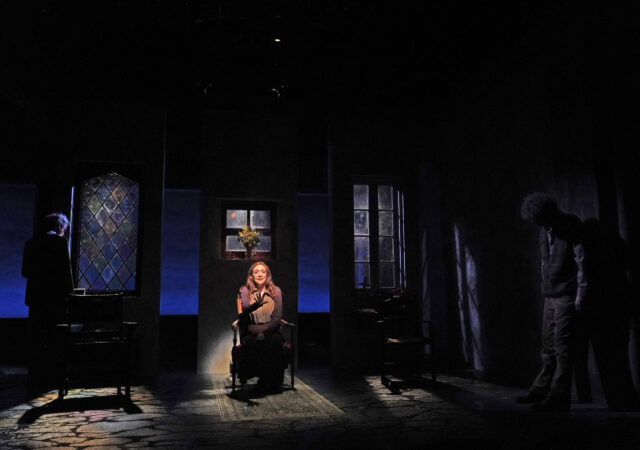
Molly (Sarah Street) dreams of a better life in Brian Friel’s Molly Sweeney (photo by Carol Rosegg)

Charlie Corcoran’s set consists of three chairs on a fake stone-paved floor, each with a slightly different rectangular wall and window behind it; Mr. Rice’s has a chest with folders and a bottle of whiskey, Molly’s has a vase of flowers on the windowsill, and Frank’s has a shelf with books and random objects. Linda Fisher’s costumes are in a muted Irish palette. Michael Gottlieb’s lighting is razor sharp; while focusing on one character, the others are bathed in shadow. In addition, abstract projections in blue, red, and purple morph on the rear horizontal wall, evoking what might be going on inside Molly’s head. Hidenori Nakajo’s sound envelops the audience in Molly’s auditory realm.

The actors are exceptional. Collins (Translations, The Quare Land) brings a cool serenity to Mr. Rice, who has not had an easy life; his wife left him for another ophthalmologist, and he eventually found himself working at a small hospital in Ballybeg in County Donegal, the fictional town where many of Friel’s plays take place. When Mr. Rice speaks, he stands up, sometimes holding a book or folder, and talks succinctly.

New York City treasure Keating (Translations, Autumn Royal) gives the unemployed Frank a harried demeanor, his tall, wiry frame flitting about as he relates his fondness for getting involved in charity cases — he’s been asked to supervise a food convoy in Ethiopia — but he has no conception of how he can help his wife.

Sitting in between them is Street (Aristocrats, Belfast Girls), who gazes into the audience, making eye contact when she or the others speak, as opposed to Collins and Keating, whose characters appear to rest their eyes or doze off, not listening to what Molly is saying; they choose, essentially, not to see or hear her and concentrate on their own future. Molly shares her story matter-of-factly, not getting wrapped up in emotion but not cold and distant either.

She could be any woman, fighting for personal freedom of any kind in a country that was still struggling with women’s rights in the late twentieth century. It’s a complex performance in a complex play that will make you think twice before offering certain types of medical advice to friends and loved ones.

[Mark Rifkin is a Brooklyn-born, Manhattan-based writer and editor; you can follow him on Substack here.]
THE FRIEL PROJECT: PHILADELPHIA, HERE I COME!

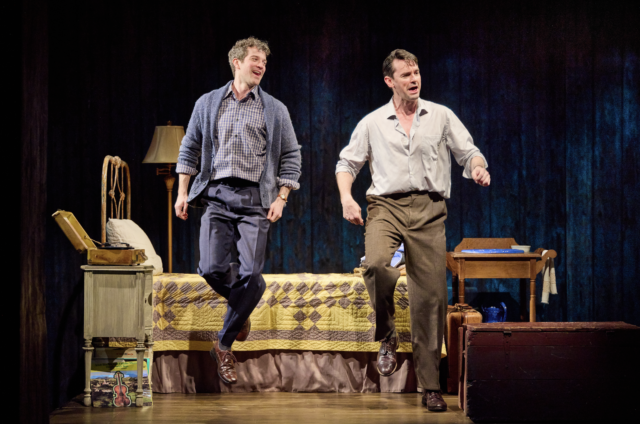
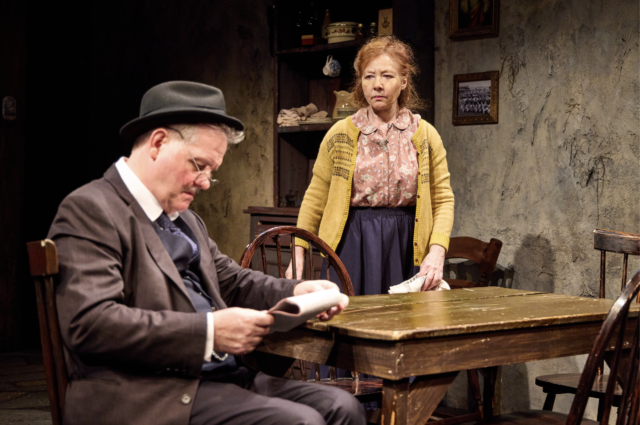
Gar is portrayed by two actors (A. J. Shively and David McElwee) in third Irish Rep adaptation of Brian Friel play (photo by Jeremy Daniel)

PHILADELPHIA, HERE I COME!
Irish Repertory Theatre, Francis J. Greenburger Mainstage
132 West Twenty-Second St. between Sixth & Seventh Aves.
Wednesday – Sunday through May 5, $60-$125
212-727-2737
irishrep.org

In January, I wrote that the Irish Rep’s second production in its Friel Project, Aristocrats, the follow-up to Translations, was another example of “what it does best, an exquisite revival of a superb Irish drama.” The same can be said for the third of its four-play celebration, an intimate and powerful staging of Irish dramatist Brian Friel’s 1964 international breakthrough, Philadelphia, Here I Come!

Previously presented by the company in 1990 and 2005, Philadelphia, Here I Come! takes place over the course of one night, as twenty-five-year-old Gareth Mary O’Donnell prepares to leave his hometown of Ballybeg in Ireland for a new life in America, moving in with his aunt Lizzy (Deirdre Madigan) and uncle Con (Ciaran Byrne) in Philadelphia. Gar, as he’s known, is ingeniously portrayed by two actors: David McElwee is the Public Gar, a tightly wound man incapable of speaking up for his wants and desires, described by Friel as “the Gar that people see, talk to, and talk about,” while A. J. Shively is the Private Gar, an exuberant soul aching to enjoy life’s endless pleasures, who the playwright calls “the unseen man, the man within, the conscience.” The two are side by side the entire two-hour play (plus intermission), singing and dancing, hovering behind other characters, and packing a ratty old suitcase that has to be sealed shut with rope.

Gar works for his father, S.B. (Ciarán O’Reilly), who Private Gar calls Screwballs, selling dry goods, hardware, dehydrated fish, and other disparate items. Both men are haunted by the death of Gar’s mother, Maire, who passed away three days after Gar was born. S.B. is dour and guarded, rarely saying anything of interest, barely even looking at Gar and their longtime housekeeper, Madge (Terry Donnelly). Dressed in black, as if in perpetual mourning, he sits at the small kitchen table drinking tea, reading the paper, and going back and forth between the house and the store to check on things, avoiding at all costs the topic of his son’s imminent departure.

“He’ll have something to say . . . you’ll see. And maybe he’ll slip you a couple of extra pounds,” Madge tells Gar, who responds, “Whether he says good-bye to me or not, or whether he slips me a few miserable quid or not, it’s a matter of total indifference to me, Madge.”

Meanwhile, Gar is trying to convince himself that he’s made the right choice, having previously been too frightened to ask his father for fair wages or to fight for the woman he loves, Katie Doogan (Clare O’Malley). He’s even unsure of just how close he really is with his drinking buddies, Tom (Tim Palmer), Ned (James Russell), and Joe (Emmet Earl Smith).

S. B. O’Donnell (Ciarán O’Reilly) doesn’t have much to say in Philadelphia, Here I Come! (photo by Jeremy Daniel)

Private Gar: You are full conscious of all the consequences of your decision?
Public Gar: Yessir.
Private: Of leaving the country of your birth, the land of the curlew and the snipe, the Aran sweater and the Irish Sweepstakes?
Public: I . . . I . . . I . . . I have considered all these, sir.
Private: Of going to a profane, irreligious, pagan country of gross materialism?
Public: I am fully sensitive to this, sir.
Private: Where the devil himself holds sway, and lust . . . abhorrent lust is everywhere indulged in shamelessly?
Public: Shamelessly, sir, shamelessly.
Private: And yet you persist in exposing yourself to these frightful dangers?

They are then interrupted by the sensible Madge, who chides, as if she can see and hear both of them, “Oh! You put the heart across me there! Will you quit eejiting about!”

But Gar can’t stop eejiting about as the hour of his emigration approaches.

Part of the Irish Rep’s thirty-fifth anniversary, Philadelphia, Here I Come! takes its name from the 1921 song “California, Here I Come,” in which Al Jolson, in the Broadway musical Bombo, declares, “California, I’ve been blue / Since I’ve been away from you . . . California, here I come / Right back where I started from.” California has always been the land of opportunity, where anyone has the possibility of striking it rich, from gold mining to Hollywood dreaming. Gar might be thinking the same thing about Philadelphia, but there’s an ominous undertone throughout that not only asks whether Gar will actually leave but wonders if he will eventually end up right back where he started from, as if his potential escape is doomed by the old baggage the Irish seem fated to carry.

Katie Doogan (Clare O’Malley) discusses her prospects with her father, a senator (Ciaran Byrne), in Friel revival (photo by Jeremy Daniel)

Irish Rep founding producing director O’Reilly knows this play well, and it shows in this outstanding production. O’Reilly played Private Gar in the 1990 version and directed the 2005 revival; he helms the current iteration with a gentle grace, and he plays S.B. with a quiet loneliness. Like his son, S.B. is unable to share his thoughts, which he keeps bottled up; at one point, after Gar leaves the table, S.B. returns to reading his paper, but it is upside down, a hint that he cares more than he is letting on.

Shively (A Man of No Importance) and McElwee (A Man for All Seasons) are a dynamic duo as Gar, the former spirited and lively, flitting about the stage with boundless energy, just the right foil for the latter, who wants to break out in front of other people but just can’t. They bounce around between the kitchen table and the bedroom in the back, where Public Gar puts on scratchy Mendelssohn records. The comfy but cold set is by Charlie Corcoran, with effective costumes by Orla Long, soft lighting by Michael Gottlieb, and keen sound and original interstitial music by Ryan Rumery and M. Florian Staab.

Donnelly (Juno and the Paycock) gives a tender, poignant performance as Madge, a motherly matron who has sacrificed her personal life to take care of S.B. and Gar. The rest of the ensemble is in fine form, with Fitzgerald (Katie Roche), who played Public Gar opposite O’Reilly in 1990, quirky as professor and poet Master Boyle and Con; Madigan (Coal Country) is a whirlwind as Lizzy, who is desperate to have Gar join them in Philadelphia; O’Malley (The Plough and the Stars) is sweetly innocent as Katie, who is waiting for Gar to finally step up; and Byrne (A Touch of the Poet) excels as the proper Senator Doogan and the perhaps less-than-proper Canon O’Byrne.

Philadelphia, Here I Come! is a timeless, quintessentially Irish drama from one of the best playwrights the country has produced. At one point, Lizzy, speaking about S.B., proclaims to Gar, “Sure! Sure! Typical Irish! He will think about it! And while he’s thinking about it the store falls in about his head. What age are you? Twenty-four? Twenty-five? What are you waiting for? For S.B. to run away to sea? Until the weather gets better?”

Philadelphia! is a fitting third selection for this special Irish Rep season, which began with Translations, in which the Irish watched the British literally take their language away; continued in Aristocrats, as the title characters gradually receded into fantasy, their words less and less consonant with the reality around them; and proceeds with Philadelphia!, as Gar, choking on silence, prepares to leave the only home he’s ever known for a new life in America. The Friel Project concludes May 15 – June 30 with the three-character Molly Sweeney, in which a woman seeks to restore her eyesight.

[Mark Rifkin is a Brooklyn-born, Manhattan-based writer and editor; you can follow him on Substack here.]
THE FRIEL PROJECT: ARISTOCRATS

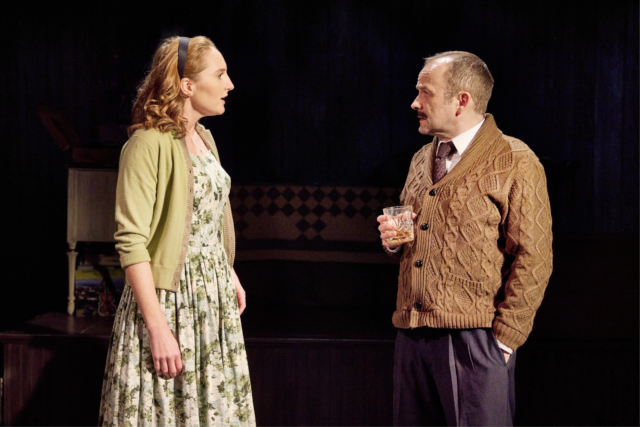
Uncle George (Colin Lane) goes for a stroll in Irish Rep revival of Brian Friel’s Aristocrats (photo by Jeremy Daniel)

ARISTOCRATS
Irish Repertory Theatre, Francis J. Greenburger Mainstage
132 West Twenty-Second St. between Sixth & Seventh Aves.
Wednesday – Sunday through March 3, $60-$125
212-727-2737
irishrep.org

The Irish Rep continues its 2023–24 Friel Project with what it does best, an exquisite revival of a superb Irish drama, in this case Brian Friel’s 1979 Aristocrats.

In 2005, when the company was in danger of losing the lease on its home on West Twenty-Second St., Friel, a native of Northern Ireland, praised the Irish Rep’s excellence, writing about cofounders Charlotte Moore and Ciarán O’Reilly, “The ground they occupy has now been made sacred by them. They have made their space hallowed. It would be unthinkable if 132 West Twenty-Second St. were to slip from them and become secularized. It must remain under their wonderful guardianship.”

Friel passed away in 2015 at the age of eighty-six, coincidentally during a major renovation of the Irish Rep’s hallowed space.

Since its beginnings in 1988, the Irish Rep has staged ten of Friel’s works, including Making History, Molly Sweeney, Dancing at Lughnasa, The Freedom of the City, Afterplay, and The Home Place. The Friel Project kicked off with Translations last fall and continues in March with Philadelphia, Here I Come!, which the troupe previously presented in 1990 and 2005, before concluding with Molly Sweeney, seen at the Irish Rep in 2011 and online in 2020.

Moore first directed Aristocrats in 2009; fifteen years later, she is helming another exemplary production. The story, partially inspired by such classic Chekhov family tales as The Cherry Orchard, Three Sisters, Uncle Vanya, and The Seagull, takes place in Ballybeg Hall in County Donegal in the mid-1970s, as the fortunes of a Catholic family have turned. (Friel wrote adaptations of Three Sisters and Uncle Vanya and set several other plays in the fictional Ballybeg, which means “small town.”)

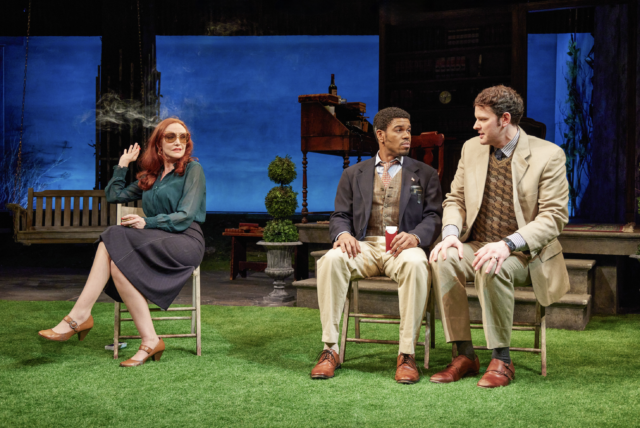
Alice (Sarah Street) is suspicious as Casimir (Tom Holcomb) shares more information with Tom (Roger Dominic Casey) in Aristocrats (photo by Jeremy Daniel)

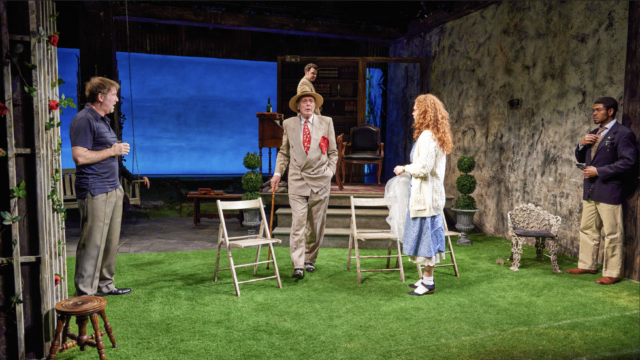
Charlie Corcoran, one of New York City’s finest scenic designers, has created a lovely indoor-outdoor set that features a flowered trellis and (fake) grass by an unseen tennis court, a porch swing, a desk in an old, dusty study raised a few steps, and a rear hallway with no front wall, so the audience can see people coming and going. The open set hints at the many secrets that will soon be revealed.

The decaying estate is run by Judith (Danielle Ryan), who lives there with her youngest sister, Claire (Meg Hennessy), who is getting married to a middle-aged widower with four young children; their father, former District Justice O’Donnell (Colin Lane), who has dementia; and their uncle George (Lane), a dapper old gent who rarely speaks. Their brother, Casimir (Tom Holcomb), has traveled from Hamburg for the wedding festivities, arriving without his wife, Helga, and their two children. The fourth sibling, the cynical Alice (Sarah Street), and her husband, the brash bully Eamon (Tim Ruddy), have also come, but it seems that they would prefer to be anywhere else.

As the play opens, family friend and handyman Willie Diver (Shane McNaughton) is installing a baby alarm on the top of a bookcase so the family can hear any noises coming from their father’s room, alerting them if there are any problems. An American scholar, Tom Hoffnung (Roger Dominic Casey), is at the estate researching a book he’s writing on “the life and the life-style of the Roman Catholic big house — by no means as thick on the ground but still there; what we might call a Roman Catholic aristocracy — for want of a better term. . . . And the task I’ve set myself is to explore its political, cultural, and economic influence both on the ascendancy ruling class and on the native peasant tradition.”

Casimir is only too happy to share the estate’s history with Tom, telling stories about such regular literary visitors as Sean O’Casey, G. K. Chesterton, Gerard Manley Hopkins, and W. B. Yeats. But Eamon has a different perspective, advising Tom that the book should be “a great big blockbuster of a gothic novel called Ballybeg Hall — From Supreme Court to Sausage Factory.

Casimir, who can’t get through on the phone to his wife in Germany, continually plays a game with Claire, a trained classical pianist who suffers from anxiety, guessing the pieces she is playing from an offstage room; they also challenge each other to an invisible game of croquet, representing their vanishing lifestyle. Alice, who has a suspiciously bruised face, drinks too much. Judith, who participated in the Battle of the Bogside, smokes too much. The O’Donnells are a family on the decline, existing in their own world, refusing, or unable, to confront the reality that’s staring down at them.

Judith (Danielle Ryan) and Eamon (Tim Ruddy) can’t forget the past in Friel revival at Irish Rep (photo by Jeremy Daniel)

Moore has a firm grasp on the proceedings, having previously directed five other Friel plays at the Irish Rep; the narrative flows smoothly, then hits hard when revelations come. The sound and original music by Ryan Rumery and M. Florian Staab immerse the audience in the elegiac world the O’Donnells are trying to hold on to, representative of an evolving Ireland as the Troubles pit the Catholics against the Protestants. Birds chirp and Claire’s piano emits beautiful melodies, but that is just background noise that can’t hide the truth. David Toser’s costumes range from casual to elegant to old-fashioned, further evoking the family’s loose relationship with time and change.

The expert cast is highlighted by Holcomb, who portrayed Chekhovian dreamer Conrad Arkadina in Woolly Mammoth’s adaptation of Aaron Posner’s reimagining of The Seagull, the fabulous Stupid Fucking Bird. The tall, thin Holcomb glides through the play, an unreliable narrator who is lost in a snow-globe fantasy.

Street, Hennessy, and Ryan are lovely as the three very different sisters; one of the most tender moments is when Alice and Claire are entwined on the swing, the former more mother than sibling to the latter. McNaughton is warm and friendly as Willie, Casey is stalwart as the observant Tom, and Lane makes the most of his short appearances as Uncle George and the father. Ruddy is strong as Eamon, a tough man who sees through much of the charade. “Between ourselves, it’s a very dangerous house, professor,” he tells Tom. He also refers to the lack of discussion of his mother-in-law as “the great silence.”

In addition to the four plays, the Irish Rep will also be paying tribute to Friel with several special events. On February 26, violinist Gregory Harrington, joined by pianist Simon Mulligan, will perform “Melodies for Friel: Echoing through the Landscape of Ballyweg,” and the Friel Project Reading Series continues through May 2 with readings of eleven Friel plays, anchored around a March 26 benefit presentation of the Tony-winning Dancing at Lughnasa.

[Mark Rifkin is a Brooklyn-born, Manhattan-based writer and editor; you can follow him on Substack here.]
THE SAVIOUR

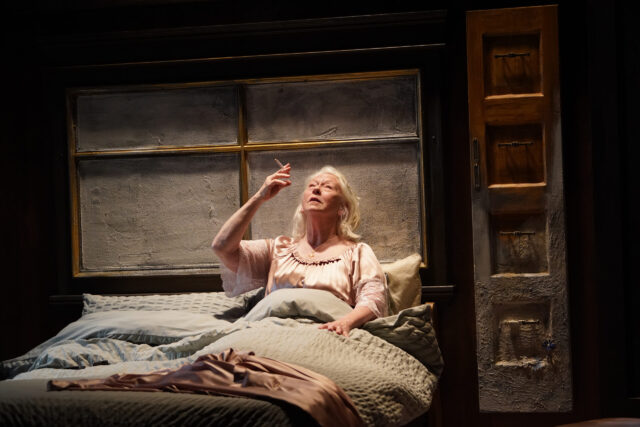
Máire Sullivan (Marie Mullen) glows in the bask of postcoital sex in The Saviour (photo by Carol Rosegg)

THE SAVIOUR
Irish Repertory Theatre, Francis J. Greenburger Mainstage
132 West 22nd St. between Sixth & Seventh Aves.
Tuesday – Sunday through August 13, $50-$90
212-727-2737
irishrep.org

The first half of the world stage premiere of Deirdre Kinahan’s The Saviour at the Irish Rep is gorgeous. On the morning of her sixty-seventh birthday, Máire (Marie Mullen) is basking in the glow of having had sex with a much younger man the night before. Lying in bed with a cigarette, the widowed mother and grandmother, during a long monologue to Jesus, says, “Get a grip on yourself, Máire Sullivan! I can hear you say that, Jesus. And you’re right. Do you know you’re right . . . I’m acting ridiculous. At my age! I hope you’re not getting all jealous now or anything? Are you, Jesus?”

But when a man (Jamie O’Neill) arrives, the play takes a decidedly different tack, one that raises several important issues but also turns its back on what had come before.

A devout Irish Catholic, Máire is in her glory after “heaving and shunting” with Martin. She is explaining herself to Jesus, hoping her lord and savior understands her new feelings. “Sex has always been a means to an end. Foisted on me when I didn’t want it or offered for a bit of peace,” she says. Barefoot and in a long white nightgown (the costumes are by Joan O’Clery), Máire gets up and walks over to her night table, putting on makeup and fixing her hair; there is actually no glass in the mirrors she is using, so we can see her in a frame as she gussies herself up. “I mean, I didn’t even know that sex was possible at my age,” she tells Jesus.

Waiting for Martin to come upstairs with breakfast and coffee, she shares scenes from her hardscrabble life. Her mother died when she was young, so her father, who found work in England, sent her off to the Magdalene Laundries, Irish sweatshops operated by nuns that were primarily a place to hide and punish pregnant teenagers.

“In the convent in Stanhope Street you gave your name away at the door,” she sadly recalls. “And I don’t think Daddy knew that when he put me in there. . . . Stanhope Street wasn’t really a school. A reformatory for whores and hussies! But I wasn’t one of them. Was I? No. I was good,” she says unsurely, as if having to convince herself.

She is haunted by the experience, remembering, “You didn’t ask any questions of the silence. Because we worked in silence. Lived in silence. Silence was our penance . . . for being orphaned girls. Forgotten girls. Bad girls. Or just . . . girls.”

But mostly, she is anticipating Martin coming upstairs and showering her with yet more attention — and sex. But that’s not quite what she has in store for her birthday.

Máire (Marie Mullen) and an unexpected figure (Jamie O’Neill) face some hard truths in The Saviour (photo by Carol Rosegg)

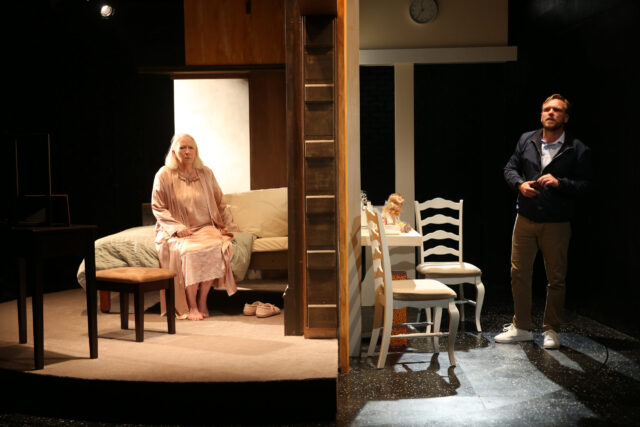
Ciarán Bagnall’s set is a slightly elevated turntable that revolves between the creaky bedroom, highlighted by a cross high on one wall, and the kitchen, with an open space stage right. Bagnall’s lighting and Aoife Kavanagh’s sound turn eerie whenever Máire drifts back into her memories of Stanhope Street, when the show briefly becomes a ghost story.

I cannot begin to tell you how uplifting it was to watch an actress of a certain age portray a woman who is euphoric about having had sex. Tony winner Mullen (The Beauty Queen of Leenane, The Gifts You Gave to the Dark) radiates as Máire details some of the events of the previous night, and the audience celebrates along with her as she carefully brushes her hair and shuffles around the bedroom, animated by this new lease on life, suddenly filled with hope and promise.

But Kinahan (Embargo, Halcyon Days) and director Louise Lowe (The Book of Names, The Party to End All Parties) then pull the rug out from under everyone’s feet when the visitor, ably played by O’Neill (Staging the Treaty, Luck Just Kissed You Hello), starts sharing some difficult truths about Máire, going all the way back to when she was raising her children. The Saviour abruptly becomes an issue play bringing up controversial topics instead of being about an older woman experiencing a positive life change. In addition, it grows repetitive, covering the same angles multiple times.

I felt like it was a kind of theatrical bait-and-switch; it might be my own fault for wanting the play to go in another direction, but, a week later, I still feel let down and betrayed. Perhaps I was so invested in Máire’s exhilaration that I didn’t want anything to get in the way of my enjoyment of that reaction. I can’t help but wonder whether it would have been so bad to have an older, decidedly unglamorous character simply enjoy sex in a show for a full seventy minutes.

But if anything, The Saviour, originally produced online during the pandemic in June 2021, is a distinctly Irish tale, one that delves into family, religion, and societal ills in which happy endings are far from guaranteed.

ENDGAME

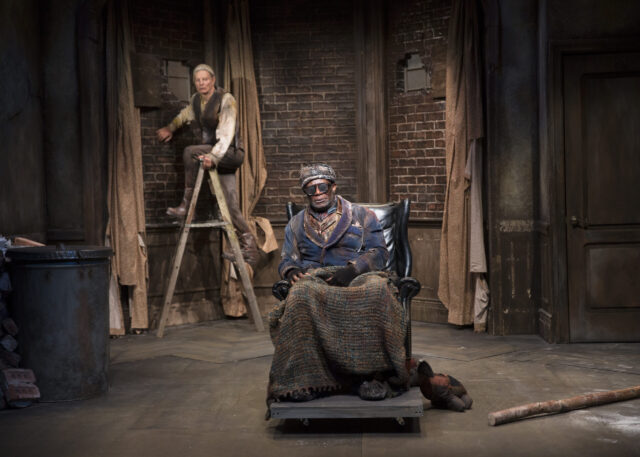
Clov (Bill Irwin) peers at Hamm (John Douglas Thompson) in Irish Rep adaptation of Beckett’s Endgame (photo by Carol Rosegg)

ENDGAME
Irish Repertory Theatre, Francis J. Greenburger Mainstage
132 West 22nd St. between Sixth & Seventh Aves.
Wednesday – Sunday through April 9, $25-$95
212-727-2737
irishrep.org

The Queen’s Pawn Opening is one of the safest first moves in chess. But there’s not much that’s safe in Samuel Beckett’s Endgame, which is named after the strategic maneuverings when there are only a few pieces left on the board and the match is approaching its conclusion.

The end is near from the very beginning of Endgame, as Clov (Bill Irwin) declares, “Finished, it’s finished, nearly finished, it must be nearly finished.” That opening salvo leads to eighty-five minutes of thrilling confusion as four characters face the end of everything in a seemingly postapocalyptic world. “I can’t be punished any more,” Clov claims, since for him life is nothing but suffering.

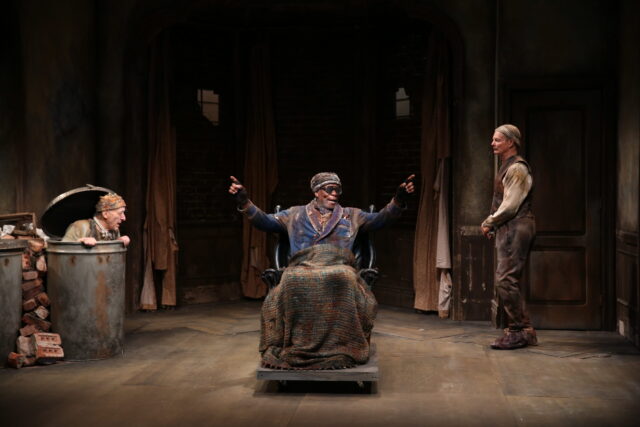
Clov, who limps severely, is a servant toiling for the mysterious, blind Hamm (John Douglas Thompson), a regal, angry figure in a homemade wheelchair: a chair attached to a wooden platform with wheels on it. When we first see Hamm, his face is covered by a bloody handkerchief; beneath it, he wears steampunk goggles. A ratty blanket is wrapped around his lower half; he can’t see or walk.

To Hamm’s right is a pile of garbage and two metal trash cans, where his “accursed progenitors” reside, his father, Nagg (Joe Grifasi), and mother, Nell (Patrice Johnson Chevannes), who have no legs. Thus, three of the characters cannot move on their own, and the fourth has major difficulty getting around. Even Hamm’s dog, a stuffed toy, is missing an appendage.

“Oh, I am willing to believe they suffer as much as such creatures can suffer,” Hamm says. “But does that mean their sufferings equal mine? No doubt. No, all is a — [yawns] — bsolute, the bigger a man is the fuller he is. And the emptier. . . . Enough, it’s time it ended, in the shelter, too. And yet I hesitate, I hesitate to . . . to end. Yes, there it is, it’s time it ended and yet I hesitate to — [yawns] — to end.”

Hamm, Clov, Nell, and Negg are living in some kind of end times, in a dingy basement dungeon that resembles a dark corner alley. Occasionally, Hamm calls for Clov to look through two small windows behind a brick wall in the back. To do so, Clov has to get out a step ladder, struggle uncomfortably to the wall, go up the ladder dragging one of his legs, and then peer through the gaps with a small telescope. On one side is a dim landscape, the other the sea, with nary a human being anywhere.

Nell (Patrice Johnson Chevannes) and Nagg (Joe Grifasi) share a laugh in Endgame (photo by Carol Rosegg)

However, when Clov aims the glass at the audience, he says, “I see . . . a multitude . . . in transports . . . of joy.” It’s one of several moments when the characters acknowledge that they are in a play with people watching them. Later, Clov threatens to leave, asking Hamm, “What is there to keep me here?” Hamm responds, “The dialogue.”

Hamm also makes references to “asides” and a “soliloquy”; when he calls for his gaff, Clov brings him the spear with a hook (used for fishing, sailing, and impaling), which resembles the vaudeville hook that unceremoniously pulls performers offstage when their acts go sour. In England, “gaff” is slang for “home,” something the four characters don’t exactly have. Scanning his surroundings, Hamm tells Clov, “My house a home for you. . . . But for Hamm, no home.”

The characters are like chess pieces, unable to move well on their own. “Take me for a little turn,” Hamm commands Clov, who awkwardly pushes him slowly around the room until Hamm barks, “Back to my place! Is that my place? . . . Put me right in the center!” as if he is the king on a chessboard demanding to be returned to his noble space, where he rules over nothing, the end in view, and not necessarily unwelcome. “The whole place stinks of corpses,” Hamm says. “The whole universe,” Clov adds. “To hell with the universe,” Hamm spits out. A few beats later, Clov declares, “The end is terrific!”

The cast is also terrific in this solid if not-quite-spectacular adaptation, directed by Ciarán O’Reilly. Longtime Shakespeare and August Wilson stalwart Thompson (Jitney, The Merchant of Venice) is majestic as Hamm in his return to the Irish Rep, where in 2009 he portrayed the title character in O’Reilly’s adaptation of Eugene O’Neill’s The Emperor Jones, spending much of the time on an oversized, red-draped throne. When Hamm calls out, “My kingdom for a nightman!,” it feels like a nod to Thompson’s numerous Bard performances, which do not include playing Richard III. However, the whistle Hamm keeps blowing grows ever-more annoying.

Hamm (John Douglas Thompson) sits center stage throughout Beckett adaptation at Irish Rep (photo by Carol Rosegg)

Tony winner Irwin (Old Hats, Who’s Afraid of Virginia Woolf?) is sublime as the put-upon Clov, a role that fits him to a T; Irwin is a vaudeville-style clown who has played Vlad and Lucky in Beckett’s Waiting for Godot and Hamm in a 2012 revival of Endgame in San Francisco as well as starring in his one-man show On Beckett, which was staged at the Irish Rep in 2018 and again (online) during the pandemic lockdown.

Chevannes (runboyrun/In Old Age, I’m Revolting) and Grifasi (Dinner at Eight, The Boys Next Door) are hilarious as Hamm’s parents, whose bins are just far enough apart to prevent them from kissing, an apt metaphor for the lack of connection that comes with the end (and with pandemics).

Charlie Corcoran’s dingy set evokes the end times, along with Orla Long’s costumes, which seem to decay right on the characters’ bodies. Michael Gottlieb’s lighting and M. Florian Staab’s sound enhance the dread, with fun props by Deirdre Brennan that ratchet up the humor. The eighty-five-minute play, which Beckett claimed was his personal favorite, debuted at the Royal Court in London in 1957 and was previously presented at the Irish Rep in 2005, directed by Charlotte Moore and starring Tony Roberts as Hamm, Adam Heller as Clov, Kathryn Grody as Nell, and Alvin Epstein as Nagg. (Epstein portrayed Clov in the show’s 1958 New York debut at the Cherry Lane and was also Nagg in the 2008 BAM revival, with Elaine Stritch as Nell, Max Casella as Clov, and John Turturro as Hamm.)

After explaining, “Nothing is funnier than unhappiness,” one of the show’s most famous and enduring lines, Nell tells Nagg, “We laugh, with a will, in the beginning. But it’s always the same thing. Yes, it’s like the funny story we have heard too often, we still find it funny, but we don’t laugh any more.” There are plenty of laughs in this version of Endgame, even as we may be edging closer and closer to the apocalypse.

JACK WAS KIND / SANDRA

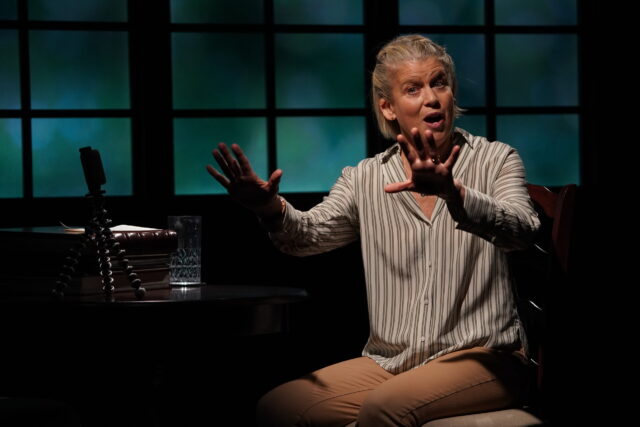
Mary (Tracy Thorne) explains why she chose to just sit there in Jack Was Kind (photo by Carol Rosegg)

JACK WAS KIND
Irish Repertory Theatre, W. Scott McLucas Studio Theatre
132 West 22nd St. between Sixth & Seventh Aves.
Wednesday – Sunday through December 18, $50
212-727-2737
irishrep.org

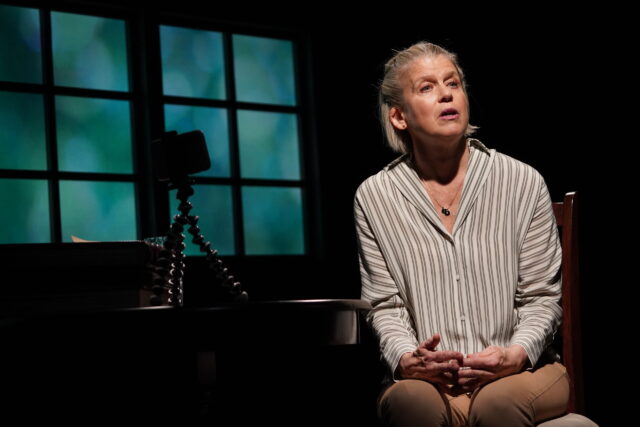
“How could I just sit there?” Mary asks at the beginning of Jack Was Kind, a one-woman show at the Irish Rep written by and starring Tracy Thorne. Thorne spends the entire seventy-minute show seated in a chair at a small table, relating critical choices she made to maintain the life she has; in fact, as the audience enters the downstairs W. Scott McLucas Studio Theatre, she’s already in place, deep in contemplation.

Meanwhile, over at the Vineyard Theatre, Marjan Neshat spends most of the eighty-minute, one-woman Sandra in a comfy easy chair, relating critical choices she made to get back at least part of the life she had. Both characters construct their own reality concerning a close male figure, with very different results, as one remains seated and the other takes to the road.

“Some people want me to stop . . . telling stories . . . to cease and desist,” Mary explains. “I don’t think those people will like this very much.” Married with two children, Mary is speaking into an iPhone, delivering a kind of public confession, or at least an explanation, of why she did what she did involving her husband, Jack, a famous, or, perhaps, infamous, public figure. On the table is a pile of photo albums, a reminder of their family life. Behind the table is a long, horizontal window that marks the passage of time as leaves blow gently in the wind. (The spare but effective set is by David Esler.)

Mary shares details of Jack’s life, as well as her own; her “beat up childhood” included sexual, psychological, and emotional abuse. She and Jack want only the best for their kids, Eli and Flo, but Flo in particular has issues with what her parents have done.

Tracy Thorne wrote and stars in one-woman show at the Irish Rep (photo by Carol Rosegg)

Mary tentatively admits, “Nearly two years of a nonsensically overpriced education results in our daughter having no observable intellectual curiosity, then boom, the match ignites, when it’s personal it ignites, and now she wants to know, but I don’t want her to know, I don’t know, though sometimes I wonder if I do, that’s a thing, right? ‘Really, Mom, you don’t know how you could just sit there?’ That’s what she says to me. So I guess this is how it starts for my daughter, maybe for me too, funny it starts at the end. But then I don’t know if it’s the end, or do I know if it’s the end, I don’t know what I know and now I’m threatening myself. ‘Don’t you think you should know, Mom.’ Frankly I’m appalled you don’t.’ She says that, too.”

The truth of what Jack did, and Mary’s complicity, slowly emerges; even if you guess it early on, the revelation is poignant, and timely. Thorne (Here We Are, Quick Bright Things), who was inspired by actual events and the writings of Elena Ferrante, delivers the monologue in a consistently even-paced manner, save for one loud moment; she’s trying to convince herself as much as her fictional virtual audience that she really couldn’t have done anything else, taking full advantage of her white privilege. Director Nicholas A. Cotz (My Name Is Gideon, rogerandtom) ensures that the play never gets boring; Thorne shifts in her seat, pauses, twiddles nearly incessantly with her hands, displaying how uncomfortable this whole situation is for her.

Jack Was Kind was first performed live on Zoom for several weeks during the pandemic, with each show followed by a discussion with a special guest. Essentially, home viewers were seeing Mary in her house, looking directly into her smartphone. At the Irish Rep, there’s a different kind of intimacy, as we watch Mary talking to the anonymous rabble on the other side of the camera. Physically, we are on her side, in the same space, but that doesn’t necessarily mean we are on her ethical side, especially as we discover who her husband is and what he did.

Marjan Neshat remains seated for much of one-woman Sandra at the Vineyard (photo by Carol Rosegg)

SANDRA
Vineyard Theatre
Gertrude and Irving Dimson Theatre
108 East 15th St. between Union Square East & Irving Pl.
Tuesday – Sunday through December 18, $37-$85
vineyardtheatre.org

Marjan Neshat caps off quite a year with Sandra, a one-woman show in which she spends most of the eighty-five minutes seated, telling her story directly to the audience. Last December, Neshat appeared in Sylvia Khoury’s Selling Kabul at Playwrights Horizons, followed by Sanaz Toossi’s English at the Atlantic and Wish You Were Here at Playwrights, a trio of unique and moving performances in which she displayed her range and proved herself to be a compelling stage presence.

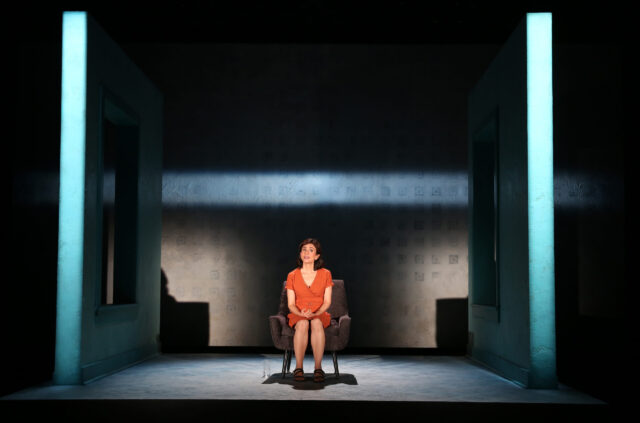
David Cale’s world premiere at the Vineyard further solidifies Neshat’s standing as a rising star, even if she towers over the material. Wearing an attractive knee-length red dress and supremely unflattering sandals, Sandra Jones shares a Lifetime-worthy neo-noir about her best friend, Ethan, who has gone missing. (The costume is by Linda Cho.) Rachel Hauck’s imposing set features large standing walls on either side of Sandra’s chair, each with a big glassless window that she occasionally approaches, as if offering a way out. Behind her is a somewhat dilapidated wall with a grid of hundreds of fading small squares. It’s as if Sandra is trapped, both physically and psychologically, but egress is within reach.

A burgeoning pianist who works behind the counter at Sandra’s café in Crown Heights, Ethan has dinner with Sandra the night before going on vacation to Puerto Vallarta. She remembers, “At the door, I hugged him goodbye and he said, ‘I feel like disappearing from my life. Part of me just isn’t in the world. I’m at a remove.’ I said, ‘Even from me?’ ‘No, not you,’ he said, ‘But you and I are so simpatico, if I vanish you’d probably disappear from your life too. I love you, Sandra. I love you so much.’ I said, ‘I love you too, Ethan. Have fun in Mexico.’ We hugged again and he left.”

Their relationship is purely platonic, as Ethan is gay and Sandra is married, although she is separated from her husband. Two and a half weeks later, two detectives visit her, as Ethan has indeed disappeared and Sandra is his emergency contact. Determined to find him herself, she quickly packs up and flies south to investigate. She considers, “The first day in Puerto Vallarta my thoughts run the gamut . . . to thinking, maybe he’d planned this. And becoming furious with him. To stopping on the street and thinking, what the hell am I doing here?”

Marjan Neshat caps off quite a year with David Cale’s Sandra (photo by Carol Rosegg)

The audience might ask the same, as Sandra immerses herself in an ever-more-absurd plot involving a couple that frequents her café, bottles with messages being thrown into the ocean, a wild and sexy Italian named Luca Messina, a federal agent named Stephen McCourt who dismisses Sandra’s ideas, and various other characters, all of whom Sandra portrays with different accents. Even as the evidence mounts, Sandra feels in her gut that he’s still alive, so she continues playing Nancy Drew.

While watching Neshat makes the play worth seeing all by itself, the narrative, accompanied by music by Matthew Dean Marsh, careens downhill. After learning of some very dangerous doings in Cozumel, Sandra announces that she flew down there, and the audience groaned in unison. But it was not the kind of groan audiences make when a person decides to go down into the basement or up to the attic in a horror movie; this was a you-gotta-be-kidding-me scolding. However, even as we lose faith in Cale and Sandra, we just can’t give up on Neshat, especially when she finally takes off those terrible shoes.

As she did with Cale’s 2017 one-man Harry Clarke, in which an often-seated Billy Crudup excelled as the title character in a thrilling yarn, director Leigh Silverman (Grand Horizons, Chinglish) keeps us actively engaged despite the script’s ludicrousness. Obie winner Silverman knows her way around solo shows; she has also helmed the harrowing On the Exhale with Marin Ireland and the charming The Search for Signs of Intelligent Life in the Universe with Cecily Strong.

At times you’re likely to ask yourself, “How could I just sit there?” But with such talented actors as Thorne and Neshat, the answer is simple.

CHESTER BAILEY

Real-life father and son Reed Birney and Ephraim Birney star in Chester Bailey at the Irish Rep (photo by Carol Rosegg)

CHESTER BAILEY
Irish Repertory Theatre, Francis J. Greenburger Mainstage
132 West 22nd St. between Sixth & Seventh Aves.
Wednesday – Sunday through November 20, $50-$70
212-727-2737
irishrep.org

Chester Bailey is one of the best plays of the year, a pristine example of the beauty and power of live drama.

In January 2015, the Irish Rep presented a free staged reading of Emmy-nominated writer and producer Joseph Dougherty’s Chester Bailey at the DR2 Theatre, directed by Emmy and Tony nominee Ron Lagomarsino and featuring Tony nominee Reed Birney as a doctor caring for a young man (Noah Robbins) who has suffered extreme, unspeakable trauma.

The show has been transformed into a touching, gorgeous, must-see production, running at the Irish Rep through November 20. Birney stars as Dr. Philip Cotton, a specialist working with soldiers, including amputees, suffering from battle fatigue and “other injuries that might keep a man from getting back to the life he had as a civilian.” It’s 1945, near the end of WWII, and Dr. Cotton has accepted a position at a Long Island hospital named after Walt Whitman, the poet who served as a nurse during the Civil War.

“The families of the men I was treating wanted their sons and husbands to be the way they were before the Solomons and the Philippines,” Dr. Cotton tells us. “I tried. Tried to take that look out of their eyes. That look acquired in the jungle. My successes were ‘limited.’”

Dr. Cotton’s newest case is Chester Bailey — played by Birney’s son, Ephraim Birney — a man in his midtwenties who refuses to acknowledge that he has lost both eyes and hands in a horrific incident at the Brooklyn Navy Yard, where he worked along the keel of a mine sweeper. Dr. Cotton might technically be unable to take that look out of Chester’s eyes, but the character is played with eyes and hands that are filled with emotion. Chester is overwhelmed with guilt because his parents got him the job in order to keep him out of the war; he had wanted to enlist, like most of the men he knew were doing, but his mother was determined to protect him.

Chester Bailey (Ephraim Birney) creates his own reality out of trauma in superb New York premiere (photo by Carol Rosegg)

“One night, I was reading the paper in the kitchen with the radio on, listening to the war news, and my folks came in and my mother was smiling,” he explains directly to the audience. “She said, ‘We’ve got a late Christmas present for you, Chester. Your father got you a job at the Navy Yards. Isn’t that wonderful?’ When she said job, she meant reserved occupation. She meant I wouldn’t be drafted because I’d be doing war work. Doing my patriotic part, but coming home to Vinegar Hill at the end of my shift. . . . My father looked up at me and I could see in his eyes this was just how it was going to be and there was nothing either one of us could do about it.” The horrible irony was that Chester ended up with the type of injuries men get on the field of battle anyway.

Chester has created a fantasy world in which he can still see and touch things. He describes in detail a copy of van Gogh’s Langlois Bridge at Arles that he thinks is hanging in his room. The 1888 painting relates to Chester’s state of mind: It depicts a woman in black standing on a small drawbridge under blue skies, holding a black umbrella as if in a dark storm. In the actual historical war, the bridge was blown up by the Germans in 1944, so it wouldn’t have existed in 1945 when Chester was supposedly seeing the print of it, made by an artist who would shortly thereafter cut off his own ear and live in an asylum. In fact, Chester believes that the only lasting effect the incident had on him was that he lost one ear. Meanwhile, we learn that Dr. Cotton is color blind, so he cannot process critical aspects of the painting that Chester believes is on the wall.

The first part of the play primarily goes back and forth between Chester and Dr. Cotton talking to the audience, delivering monologues about themselves. Chester discusses his parents and recalls going dancing with a former girlfriend at Luna Park, heading into Manhattan by himself for what he hoped would be a night of revelry, and falling instantly in love with a young red-haired woman selling papers at a newsstand in Penn Station.

Dr. Cotton carefully watches Chester sharing these memories, as if he’s not in the room with him, then adds elements from his own personal and professional life that intersect with similar themes that Chester’s deals with, just from a different angle; the doctor discusses his daughter, Ruthie; his wife’s infidelity and their eventual divorce; his career choices; going to the country club; his flirtation with his boss’s wife; and waiting at Penn Station to get home to Turtle Bay after work.

“It was difficult for Chester’s father to visit him on Long Island,” Dr. Cotton says. “He’d come on weekends, get off the train at the same station I used before I moved, walk the mile and a half around Holy Rood Cemetery to the hospital on Old Country Road. I think of him standing on the platform I used. Each of us waiting for the light of the westbound. Waiting. Not thinking. Trying not to think.”

In the second half, doctor and patient interact, as Dr. Cotton is determined to make Chester face what has happened to him and Chester keeps insisting he has eyes that can see and hands that can touch. Revisiting the incident, Chester tells his incorrect version. “Remember anything else?” Dr. Cotton says. “Nothing real,” Chester responds. “Do you remember anything that isn’t real?” the doctor asks before exploring Chester’s dreams and hallucinations.

The Irish Rep is justly celebrated for its sets, and Chester Bailey is no exception. Two-time Tony winner John Lee Beatty’s (Sweat, Junk) stage design combines a hospital room with bed, wheelchair, and table with the grandeur of old Penn Station, with stanchions in concrete blocks and a curved metal ceiling seemingly made out of railroad tracks. Brian MacDevitt’s lighting includes dangling lightbulbs that glow like stars in the night sky, going on forever in the mirrored walls. “The concourse of Penn Station is like the hull of a ship turned upside down, like you were looking up at the keel,” Chester says. “But instead of being all dark like where I work, it’s light. The light is just in the air. And there are no shadows. You want to know what the light looks like in heaven? You go to the main concourse of the Pennsylvania Station.” Beatty and MacDevitt have captured that image beautifully.

One of New York’s finest, most consistent actors, Reed Birney (The Humans, Man from Nebraska) inhabits the role from the very start, portraying Cotton not as a heroic wartime doctor but as a man with his own shortcomings. Whether he wants to or not, he becomes a kind of father figure to Chester, made all the more palpable since Ephraim (Exploits of Daddy B, Leon’s Fantasy Cut), who was cast first, is his son. While Reed moves slowly and carefully, Ephraim is much more active, jumping around with an eagerness that counters his character’s inability to come to terms with what has happened to him.

Two-time Drama Desk–nominated director Ron Lagomarsino (Digby, Driving Miss Daisy) guides the ninety-minute show with a graceful elegance; there’s nary a stray note in the play, which is not just about the travails of a single man but about family and everyday existence, about the big and small moments. The relationship between parents and their children are echoed here by a doctor and patient who happen to be father and son. At one point, Chester asks Dr. Cotton why he didn’t go into his father’s printing and binding company. “How come it wasn’t Cotton and Son?” he wonders. Dr. Cotton answers, “He wanted me to go to college. I wanted to be a doctor.” It takes on extra meaning in that Ephraim has followed his father and mother, actress Constance Shulman, into the family business. (All three appeared in the offbeat 2022 film Strawberry Mansion.)

Early on, Dr. Cotton states, “If there’s one thing reality can’t tolerate, it’s competition.” It’s a great line in a great play that brilliantly explores the human condition and the realities that each of us creates to help us deal with whatever life throws our way.