Tag Archives: Irish Repertory Theatre

THE PLUCK OF THE IRISH: THE US PREMIERE OF ULSTER AMERICAN

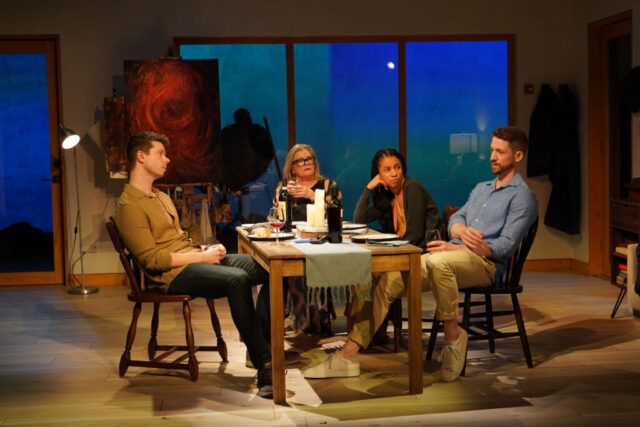
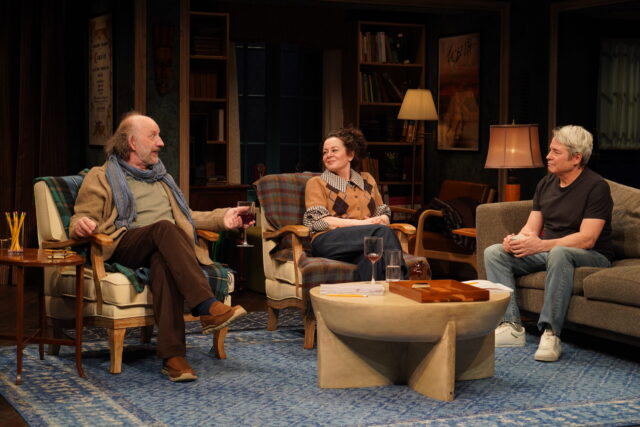
Director Leigh Carver (Max Baker), playwright Ruth Davenport (Geraldine Hughes), and actor Jay Conway (Matthew Broderick) meet for the first time in David Ireland’s Ulster American (photo by Carol Rosegg)

ULSTER AMERICAN
Irish Repertory Theatre, Francis J. Greenburger Mainstage
132 West Twenty-Second St. between Sixth & Seventh Aves.
Wednesday – Sunday through May 24, $55-$125
irishrep.org

Among the topics raised in the US premiere of David Ireland’s Ulster American are the n word, rape, murder, the Troubles, car crashes, religion, Brexit, alcoholism, and self-identity.

Oh, did I mention that it’s a comedy — and a hilarious one at that?

The eighty-minute play takes place in real time on a Sunday night in the cozy living room of British theater director Leigh Carver’s (Max Baker) London home, decorated by set designer supreme Charlie Corcoran, with two armchairs, a couch, several small tables, a writing desk, a window in a rear nook, theater posters for The Mousetrap, Camelot, London Assurance, Macbeth, and the National Theatre, and several bookcases filled with tomes about Noël Coward, Samuel Beckett, and other theater legends.

Leigh is meeting with Jay Conway (Matthew Broderick), an Oscar-winning American actor who is starring in a new work Leigh is directing, by Irish playwright Ruth Davenport (Geraldine Hughes). Rehearsals are set to begin the next day, and Leigh wants the three of them to get to know each other more first. Jay is on the couch, in the middle of a conversation with Leigh, telling him, “Is there homophobia in Hollywood? Of course. And misogyny? How can we deny it? It’s reflected in so much of our output. Narrative upon narrative centered around the abuse of women, the violent abuse of women. And racism? Only a fool could pretend otherwise.”

Leigh is surprised when Jay asks, “You ever use the n word?” After discussing James Baldwin, power dynamics, and the Bechdel test — a measure, proposed by cartoonist Alison Bechdel, that judges a fictional work based on whether it includes scenes in which at least two women talk about something other than men — Jay adds, “Why should I, a man, dictate to Bechdel, a woman, what should or should not be part of her fucking theory? This is me, learning from my mistakes, learning to shut the fuck up. . . . And that’s what I’m saying, this is where we’re at. Guys like me and you taking a back seat. Allowing the Ruth Davenports of the world to have their say. Fucking white heteronormative, privileged fucking uh . . . cis . . . motherfuckers like you and I who have to stand aside now. We have a moral responsibility to . . . I mean not me. Obviously. I’m Irish Catholic, so I can’t . . . I’m not part of that – the equation of – . . . I have an intersectional exemption.”

Jay speaks in a calm manner but with an undercurrent of excitement as he attempts to show off what he believes to be his supreme knowledge of society and his allyship with women and people of color. Leigh gets bored quickly but jumps in every once in a while to agree with Jay or correct a mistake, but nothing is going to stop Jay from making his points. He’s clearly a superstar who is used to being coddled and listened to.

Leigh is then shocked when Jay determinedly asks, “Do you think there are any circumstances where it’s morally acceptable to rape someone?” The audience is shocked as well as Jay describes a situation, inspired by a movie plot, when it might actually benefit a certain kind of woman; he names the person he would rape, then forces Leigh to choose his victim. The director squirms in his chair as they debate the validity of the question, but Jay is not about to give up until Leigh finally gives him a name, trapped by his need to suck up to Jay, since a lot is riding on this play.

A few minutes later, Ruth arrives, and things get really bizarre. She apologizes for being late, explaining that her mother had just gotten into an accident and is in the hospital. Her mother was driving Ruth to the airport and they were arguing about a friend of Ruth’s who was killed in the Troubles. Ruth tells the men, “I just lost it with her and — I don’t know what came over me, I just said, ‘Mummy — why do you always have to be such a cold-souled, blackhearted thoughtless fucking bitch?’” That was followed by the crash.

Initially, the three of them heap praise on one another. Ruth gushes that she’s Jay’s biggest fan and feels like she already knows him. Jay thanks her for writing him the role of a lifetime, saying, “Your script. Your fucking script, Ruth. Is the single best script I’ve read for ten fucking years.” Leigh believes that, given the quality of the script and the beloved star, they are critic-proof. “Hey, fuck the critics, I don’t give a fuck about the critics,” Jay declares. “They’re fucking animals, Leigh. They’re animals, Ruth. And we should do with them what we do with animals. Kill them and eat them. And the good ones keep as pets.”

But when Ruth says that, although she is from Northern Ireland, she considers herself British and that the protagonist of her play is the same, both Jay and Leigh are infuriated, and the real fireworks begin.

Jay: Are you British because Britain used to own Ireland? So they used to own you, like a slave, so you’re British?
Leigh: Exactly!
Ruth: They never owned me. I was never a slave!
Jay: It’s confusing because to me you sound Irish.

The confusion only increases as the battle lines are drawn.

History and identity collide in superb dark comedy at Irish Rep (photo by Carol Rosegg)

Ulster American debuted at the 2018 Edinburgh Fringe and had a highly touted 2023 London revival starring Woody Harrelson, Louisa Harland, and Andy Serkis. Director Ciarán O’Reilly’s (The Weir, The Emperor Jones) adaptation is a sizzling slow build, balancing humor with pathos and bravado until all hell breaks loose. Leigh, Ruth, and Jay dig deep into their personal sense of identity while also judging the others’. “You don’t get to decide who’s British and who isn’t,” Ruth says to Leigh, who replies, “Well, we sort of do. That’s the point.” A bewildered Jay chimes in, “This is more complicated than I thought.”

The argument relates to what is happening in the United States right now, as liberals and conservatives, both in the government and private citizens, feud over the status of legal and illegal immigrants.

The three characters also all bring up the subject of history, as if that will provide the answers they are seeking. “History is so important to this. For this play, I feel like I need to know the history of Ireland like I know my own ball sack,” Jay says. But even history is subjective these days.

Tony winner and New York City native Broderick (Shining City, Evening at the Talk House) is brilliant as Jay; his singsong delivery and stiff posture imbue the Hollywood icon with a sense of invulnerability, but in this case he is on his own, not surrounded by a sycophantic entourage he is probably used to. He glories in stating his opinions and flaunting his progressive ideals, but they are essentially only lip service, with curses casually thrown in not for emphasis but just because.

The Belfast-born Hughes (Molly Sweeney, Jerusalem) is a powder keg as Ruth, who is beyond thrilled to be working with Leigh and Jay until she starts learning more about them and some of their views; she’s not about to just sit back and let them run all over her, instead going toe-to-toe.

And Baker (Continuity, The Low Road), who hails from Baton Rouge, Louisiana, is completely convincing as the British Leigh, who has to walk the fine line between Jay and Ruth but is more conniving than he likes to admit, unable to remain neutral even as he attempts to befriend and care about each of them.

Ireland (What The Animals Say, Most Favoured) and O’Reilly (The Weir, The Emperor Jones) know what of they speak; both are from the north of Ireland, but the former is from Belfast and Ballybeen in Northern Ireland, while the latter is from Cavan, in the Republic of Ireland. In one of his previous, plays, the darkest of dark comedies Cyprus Avenue, Ireland also examines the issue when the protagonist insists, after calling another character the n word, “The last thing I am is Irish. I am anything but Irish. I am British. I am exclusively and non-negotiably British. I am not nor never have been nor never will be Irish.”

Ireland and O’Reilly take that to the next level in Ulster American, along with a sensational cast, critics be damned.

[Mark Rifkin is a Brooklyn-born, Manhattan-based writer; you can follow him on Substack here.]
ENCORE PRESENTATION: THE HONEY TRAP AT IRISH REP

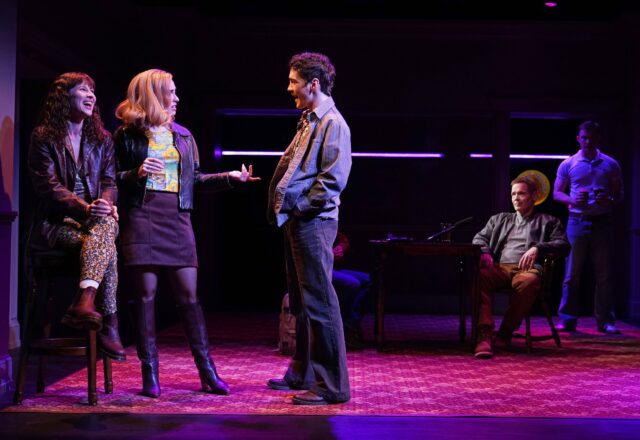
Leo McGann’s The Honey Trap at Irish Rep travels between the present and 1979 (photo by Carol Rosegg)

THE HONEY TRAP
Irish Repertory Theatre, Francis J. Greenburger Mainstage
132 West Twenty-Second St. between Sixth & Seventh Aves.
Wednesday – Sunday through February 15, $60-$125
irishrep.org

Inspired by Ed Moloney’s Belfast Project at Boston College, in which audio interviews were conducted with approximately fifty former paramilitaries involved in the Troubles in Northern Ireland in the 1970s and ’80s, Leo McGann’s The Honey Trap is a gripping thriller that explores the Troubles in a unique and compelling way. It is now back at the Irish Rep for an encore run January 10 through February 15, giving everyone a second chance to catch this piece of theatrical magic.

The play begins in the dark, with snippets of dialogue heard in voiceover from former members of the IRA, the UDR, and a Scottish soldier talking about the thirty-year conflict. “They act holier than thou but they were rotten to the core. They couldn’t kill us themselves so they got their death squads to do it for them,” a Republican woman says. A former Ulster Defence Regiment man states, “I see them rarely enough but I do now and then. The post office. The big supermarket. Petrol station sometimes. I look them straight in the eye. They know what they did.”

As the voiceovers fade out, we see Emily (originally Molly Ranson, now played by Rebecca Ballinger), a twentysomething American PhD candidate and researcher, sitting at a table preparing to interview David Henson (Michael Hayden), a former British soldier. He is suspicious of Emily’s possible biases, as the vast majority of her previous subjects were on the side of the IRA, but he sees this as an opportunity to set the record straight. “Okay. I mean, I know you’re more interested in talking to IRA types, but here we are. I’m glad I’m going to get a chance to tell you the truth. Because you won’t get that from them,” he says. She responds, “We’re thrilled that you’re telling your truth.” To which he shoots back, “My truth? No. The truth.”

For the next two hours (with intermission), the play shifts between the present and 1979, when the young Dave (Daniel Marconi) and his friend and fellow soldier, Bobby (Harrison Tipping), had a night out that ended up with Bobby’s murder, a case that was never solved. We gradually disover that Dave is not speaking with Emily merely to share his story but also to find out who killed Bobby — and perhaps exact revenge.

In 1979, Dave and Bobby, who are both married, are at a pub after a tough day working riot control in West Belfast. As part of a game meant to embarrass Bobby, Dave forces his mate to approach two young women, Kirsty (Doireann Mac Mahon) and Lisa (Annabelle Zasowski), despite Bobby’s initial reluctance. Soon the four of them are flirting.

The action occurs in flashback around the table where Emily is interviewing Dave, who carefully watches his memories unfold as Emily continues to probe. Dave insists that he and Bobby were at the bar just to relax and have a few pints. “Did you have any idea anything was amiss?” she asks. He replies, “Not a clue.”

Dave eventually takes off, leaving Bobby with the two women. “And that was it. Last I ever saw of him,” Dave explains. “They took him to some flat just outside Belfast. We don’t know if they interrogated him first or what. Then someone shot him twice in the head. His own mum wouldn’t have recognised him. But they left his army ID in his pocket. So that made it a bit easier. Thoughtful of them, eh?”

In the second act, the modern-day Dave travels to South Belfast to meet Sonia (Samantha Mathis), who he believes knows exactly what happened to Bobby that night.

Every character gets more than they bargained for in The Honey Trap. McGann (Friends Like These, In the Moment) and director Matt Torney (The White Chip, Stop the Tempo), both of whom grew up in Belfast, maintain a simmering tension all the way to an explosive conclusion, with plenty of shocks and surprises, overcoming a few awkward moments. At the center of it all is the older Dave, who is onstage the entire show, either in the present day meeting with Emily and Sonia or watching his younger self on the night his life changed forever.

Tony and Olivier nominee Hayden (Judgment at Nuremberg, Carousel) is riveting as Dave, a private man on a quest while fighting off his demons; it will make you wonder what you would do if given the opportunity to watch scenes from your past unfurl before your very eyes. The rest of the cast is strong, led by a tender performance by Mathis (33 Variations, Make Believe) as a woman who thought she had escaped her past.

Master set designer Charlie Corcoran expertly integrates the different time periods and locations, from the unionist pub to a coffee shop to a bedroom, enhanced by Sarita Fellows’s casual and military costumes and Michael Gottlieb’s sharp lighting, switching between brightness and dark, shadowy interiors. James Garver’s sound ranges from the voiceovers to a loud pub and a quiet café.

The Honey Trap — which takes its name from the form of covert deception in which an operative uses seduction to lure someone into a manipulative situation — is another winner from the Irish Rep, a complex play that explores issues of guilt, responsibility, trauma, and vengeance that might be about a specific fictional event but feels all too relevant in today’s world.

[Mark Rifkin is a Brooklyn-born, Manhattan-based writer and editor; you can follow him on Substack here.]
NOT AS SWEET AS HONEY: GRIPPING THRILLER AT IRISH REP

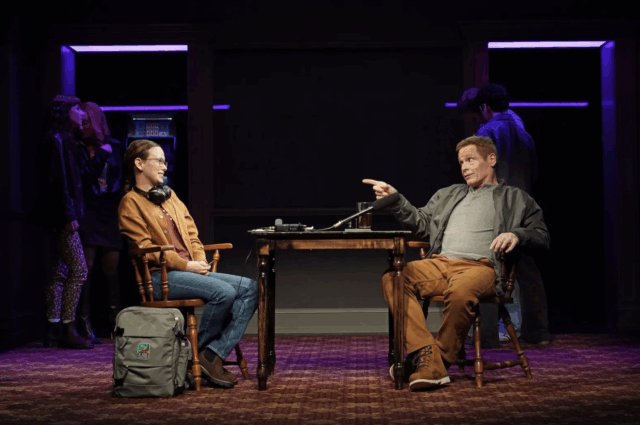
David Henson (Michael Hayden) shares his story — but not his motives — with Emily (Molly Ranson) in The Honey Trap (photo by Carol Rosegg)

THE HONEY TRAP
Irish Repertory Theatre, Francis J. Greenburger Mainstage
132 West Twenty-Second St. between Sixth & Seventh Aves.
Wednesday – Sunday through November 23, $60-$125
irishrep.org

Inspired by Ed Moloney’s Belfast Project at Boston College, in which audio interviews were conducted with approximately fifty former paramilitaries involved in the Troubles in Northern Ireland in the 1970s and ’80s, Leo McGann’s The Honey Trap is a gripping thriller that explores the Troubles in a unique and compelling way.

The play begins in the dark, with snippets of dialogue heard in voiceover from former members of the IRA, the UDR, and a Scottish soldier talking about the thirty-year conflict. “They act holier than thou but they were rotten to the core. They couldn’t kill us themselves so they got their death squads to do it for them,” a Republican woman says. A former Ulster Defence Regiment man states, “I see them rarely enough but I do now and then. The post office. The big supermarket. Petrol station sometimes. I look them straight in the eye. They know what they did.”

As the voiceovers fade out, we see Emily (Molly Ranson), a twentysomething American PhD candidate and researcher, sitting at a table preparing to interview David Henson (Michael Hayden), a former British soldier. He is suspicious of Emily’s possible biases, as the vast majority of her previous subjects were on the side of the IRA, but he sees this as an opportunity to set the record straight. “Okay. I mean, I know you’re more interested in talking to IRA types, but here we are. I’m glad I’m going to get a chance to tell you the truth. Because you won’t get that from them,” he says. She responds, “We’re thrilled that you’re telling your truth.” To which he shoots back, “My truth? No. The truth.”

For the next two hours (with intermission), the play shifts between the present and 1979, when the young Dave (Daniel Marconi) and his friend and fellow soldier, Bobby (Harrison Tipping), had a night out that ended up with Bobby’s murder, a case that was never solved. We gradually disover that Dave is not speaking with Emily merely to share his story but also to find out who killed Bobby — and perhaps exact revenge.

In 1979, Dave and Bobby, who are both married, are at a pub after a tough day working riot control in West Belfast. As part of a game meant to embarrass Bobby, Dave forces his mate to approach two young women, Kirsty (Doireann Mac Mahon) and Lisa (Annabelle Zasowski), despite Bobby’s initial reluctance. Soon the four of them are flirting.

The action occurs in flashback around the table where Emily is interviewing Dave, who carefully watches his memories unfold as Emily continues to probe. Dave insists that he and Bobby were at the bar just to relax and have a few pints. “Did you have any idea anything was amiss?” she asks. He replies, “Not a clue.”

Dave eventually takes off, leaving Bobby with the two women. “And that was it. Last I ever saw of him,” Dave explains. “They took him to some flat just outside Belfast. We don’t know if they interrogated him first or what. Then someone shot him twice in the head. His own mum wouldn’t have recognised him. But they left his army ID in his pocket. So that made it a bit easier. Thoughtful of them, eh?”

In the second act, the modern-day Dave travels to South Belfast to meet Sonia (Samantha Mathis), who he believes knows exactly what happened to Bobby that night.

Leo McGann’s The Honey Trap at Irish Rep travels between the present and 1979 (photo by Carol Rosegg)

Every character gets more than they bargained for in The Honey Trap. McGann (Friends Like These, In the Moment) and director Matt Torney (The White Chip, Stop the Tempo), both of whom grew up in Belfast, maintain a simmering tension all the way to an explosive conclusion, with plenty of shocks and surprises, overcoming a few awkward moments. At the center of it all is the older Dave, who is onstage the entire show, either in the present day meeting with Emily and Sonia or watching his younger self on the night his life changed forever.

Tony and Olivier nominee Hayden (Judgment at Nuremberg, Carousel) is riveting as Dave, a private man on a quest while fighting off his demons; it will make you wonder what you would do if given the opportunity to watch scenes from your past unfurl before your very eyes. The rest of the cast is strong, led by a tender performance by Mathis (33 Variations, Make Believe) as a woman who thought she had escaped her past.

Master set designer Charlie Corcoran expertly integrates the different time periods and locations, from the unionist pub to a coffee shop to a bedroom, enhanced by Sarita Fellows’s casual and military costumes and Michael Gottlieb’s sharp lighting, switching between brightness and dark, shadowy interiors. James Garver’s sound ranges from the voiceovers to a loud pub and a quiet café.

The Honey Trap — which takes its name from the form of covert deception in which an operative uses seduction to lure someone into a manipulative situation — is another winner from the Irish Rep, a complex play that explores issues of guilt, responsibility, trauma, and vengeance that might be about a specific fictional event but feels all too relevant in today’s world.

[Mark Rifkin is a Brooklyn-born, Manhattan-based writer and editor; you can follow him on Substack here.]
SCARY STORIES IN THE DARK: THE WEIR RETURNS TO IRISH REP

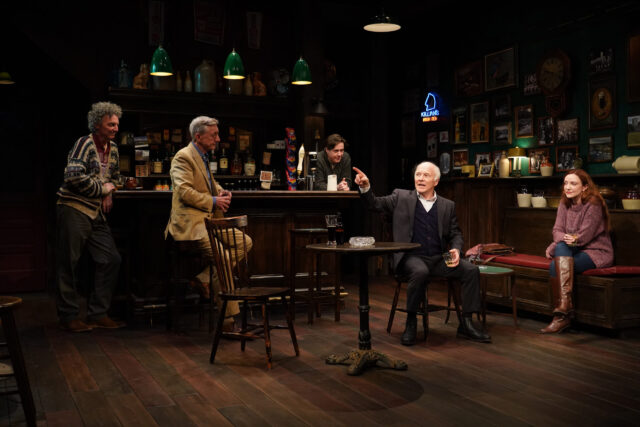
Jack (Dan Butler) shares a ghost story as Jim (John Keating), Finbar (Sean Gormley), Brendan (Johnny Hopkins), and Valerie (Sarah Street) listen intently in The Weir (photo by Carol Rosegg)

THE WEIR
Irish Repertory Theatre, Francis J. Greenburger Mainstage
132 West Twenty-Second St. between Sixth & Seventh Aves.
Wednesday – Sunday through August 31, $60-$125
212-727-2737
irishrep.org

There’s a reason why the Irish Rep keeps returning to Conor McPherson’s The Weir: It’s a marvelous play, and a marvelous adaptation.

The work debuted in England in 1997 and on Broadway two years later; Ciarán O’Reilly first staged it at the Irish Rep in 2013 and again in 2015 by popular demand. The company presented a livestreamed version in July 2020, and now it’s back in person for another engagement through August 31. As in all previous iterations, Sean Gormley is Finbar Mack, John Keating is Jim Curran, and Dan Butler is Jack Mullen; this time around Johnny Hopkins is Brendan Byrne and Sarah Street is Valerie.

The hundred-minute show is set in 1998 in a rustic pub in a rural town near Carrick in the north of Ireland. On a night with a raging wind that sounds like banshees are prowling the weir and pushing against the door, the characters share stories of the supernatural that chill the bone, especially as real life seeps into the tales — part Edgar Allan Poe, part Twilight Zone, part Oscar Wilde.

You know it’s going to be an unusual evening when Jack discovers that the Guinness tap is out of order; he’s not about to have a Harp, the only other draft option. “Well, would you not switch them around and let a man have a pint of stout, no?” Jack asks. Brendan replies, “What about the Harp drinkers?” Jack answers derisively, “‘The Harp drinkers.’” Brendan: “Your man’s coming in to do it in the morning. Have a bottle.” Jack: “I’m having a bottle. I’m not happy about it, now mind, right? But, like.” I understand that exchange all too well.

Finbar is a proudly successful businessman who left for nearby Carrick but is now back for a visit, accompanied by the younger, single Valerie, to whom he has rented an old house once owned by Maura Nealon. Jack is a lifelong bachelor who runs a local garage where Jim occasionally works when not caring for his elderly mother. Brendan has taken over the bar and connected farm from his father and lives upstairs. Jack doesn’t trust the married Finbar, thinking that he has ulterior motives in shepherding around the inquisitive, personable Valerie.

Upon arriving, Finbar orders a Harp, eliciting a chuckle from Jack and Brendan; Valerie asks for white wine, sending Brendan on a hunt to try to find a bottle he received as a Christmas present. What each person drinks — beer, wine, or “small ones,” meaning shots of whiskey — and smokes helps define how they are viewed by the others and lead to playful blarney.

Valerie is interested in the many photos that line one of the walls, and the men start filling her in on the history of the region and the roles their families played in it. Looking at a picture of the weir, Finbar tells her, “Nineteen fifty-one. The weir, the river, the weir, em, is to regulate the water for generating power for the area and for Carrick as well.” A moment later, examining a photo of a scenic field, Finbar asks Jack to tell the story of the fairy road (based on something that actually happened to McPherson’s grandfather). Jack is hesitant, but Finbar insists, even though the events take place in the Nealon house where Valerie is now staying. The ninety-year-old tale involves a widow, a young prankster, and mysterious knocks at the door.

While Finbar dismisses the story as “only old cod,” Valerie notes, “Well. I think there’s probably something in them. No, I do.” Finbar shares a yarn about a spectral figure on the stairs, then Jim relates a frightening event that occurred in a church graveyard. After, the men want to stop telling these tales, but Valerie has one of her own that explains her situation all too well. She says, “No, see, something happened to me. That just hearing you talk about it tonight. It’s important to me. That I’m not . . . bananas.” It’s a devastating narrative, one that the men don’t want to believe is true. The evening concludes with Jack recalling the most critical moment of his life, free of supernatural elements but no less haunting.

The Weir opened at London’s Royal Court Upstairs to an audience of sixty; McPherson (Shining City, Girl from the North Country) wasn’t expecting much from his fourth play, which was directed by Ian Rickson, but it was an instant hit, transferring to the Duke of York’s for a two-year run and earning McPherson an Olivier. It’s been revived around the world over the years, including a new production directed by McPherson this summer and fall in Dublin and London, starring Brendan Gleeson as Jack, a part previously played by Jim Norton, Sean McGinley, Brendan Coyle, and Brian Cox.

The Irish Rep production is exemplary in every way. Charlie Corcoran’s set is wonderfully detailed and inviting, a comforting respite from the threatening winds, expertly captured by Drew Levy’s sound design. Leon Dobkowski’s costumes are naturalistic, from Jack’s black-and-white suit and Jim’s old-fashioned cardigan to Finbar’s persnickety ensemble and Valerie’s purple sweater and knee-high boots; Michael Gottlieb’s lighting keeps it all appropriately shadowy, while Deirdre Brennan’s props add to the believability of the constructed environment.

O’Reilly’s (Molly Sweeney, The Emperor Jones) direction is impeccable, every detail, every movement, every pause accounted for, fully immersing the audience in the play’s magic. At times I felt like bellying up to the bar, grabbing a pint and a small one, and regaling the denizens with one of my own ghost stories, of which I have quite a few.

Butler (Travesties, The Lisbon Traviata), New York City treasure Keating (Autumn Royal, Two by Singe), and Gormley (Jonah and Otto, A Day by the Sea) are such old hands at The Weir that they are like three friends out for yet another evening of drinking, smoking, and talking about life. Hopkins (The Home Place, Rock Doves) fits right in as the publican — the only one who doesn’t impart his own anecdote — while the exquisite Street (Aristocrats, Belfast Girls) has a constant glow around her, giving Valerie a saintlike quality; you want to be in her presence and bask in that radiance.

“There’s no dark like a winter night in the country,” Jack says during his first tale. “And there was a wind like this one tonight, howling and whistling in off the sea. You hear it under the door and it’s like someone singing. Singing in under the door at you. It was this type of night now. Am I setting the scene for you?”

That’s exactly the scene O’Reilly and McPherson set for us with The Weir, which is so much more than a series of eerie saws; it is a play about the stories we tell others, and ourselves, and what we believe and don’t, as we search for our place in an ever-complicated world.

[Mark Rifkin is a Brooklyn-born, Manhattan-based writer and editor; you can follow him on Substack here.]
HOW IRISH DOES AN IRISH PLAY HAVE TO BE? IRISHTOWN AT THE IRISH REP

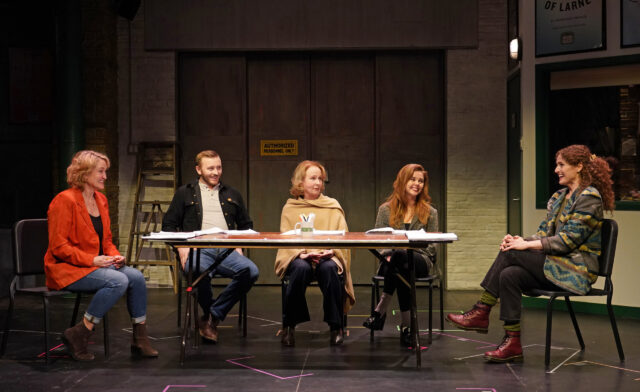
The Dublin-based Irishtown theater company prepares to stage a play in New York in Irish Rep world premiere (photo by Carol Rosegg)

IRISHTOWN
Irish Repertory Theatre, Francis J. Greenburger Mainstage
132 West Twenty-Second St. between Sixth & Seventh Aves.
Wednesday – Sunday through May 25, $60-$125
212-727-2737
irishrep.org

Ciara Elizabeth Smyth’s Irishtown, making its world premiere at the Irish Rep through May 25, tackles an issue that the theater company probably faces regularly: How Irish must a play be to be staged at the Irish Rep? How far does its cultural responsibility extend, and, perhaps most important, can it be a comedy?

As one of the characters asks the writer during rehearsals of the play within the play, a contemporary legal drama about sexual assault in Hertfordshire, England, “Where’s the lyricism? Where’s the backward syntax? And I’m sorry, I know I’ve said it before, but a happy ending? Do you know one happy Irish person?”

The ninety-minute show is set at the offices of the Dublin theater company Irishtown. Actors Constance (Kate Burton), Síofra (Saoirse-Monica Jackson), and Quin (Kevin Oliver Lynch) are completing a table read with director Poppy (Angela Reed) and playwright Aisling (Brenda Meaney) of Aisling’s latest work, Who Are We if We Are Not Ourselves at All, which is scheduled to open in New York City in four weeks.

The actors’ initial fawning displays of support soon give way to underhanded comments, sideways digs, and outright suggestions for changes, which infuriates Aisling, who insists the script will be locked and that the story is based on her own real-life experiences. Constance, an Irish legend who is struggling to pay for care for her ailing mother, is worried that “the script isn’t displaying as ‘authentically’ Irish” and that Poppy is English. Quin, who is bad at accents and has just been dumped by his girlfriend, complains about the script, “I think everything is wrong with it.”

Even Síofra, who is Aisling’s girlfriend and has been named Newcomer of the Year twice — ten years apart — and Poppy, who was kicked out of the Royal Shakespeare Company for having sex with numerous cast members, get in on the attacks.

Quin: We have one card in America, the Irish card, and you didn’t even play it? Even the English are playing the Irish card.
Poppy: Are they?
Constance and Síofra: Yes.
Aisling: Hang on now, not everything I write needs to be about being Irish.
Quin: But we are Irish.
Aisling: But if Irish drama needs to define Irish identity and its claims of independence from Britain, what further declaration of independence can there be than an Irish play not desperately seeking to be Irish?
Síofra: It’s a balance though, isn’t it? You want to represent Ireland as a home of ancient idealism with a rich cultural heritage but not tip it over into depicting us as buffoons of easy sentiment or drunken fucking monkies.

As the trip to New York inches closer and Aisling battles the producer, McCabe (voiced by Roger Clark), she decides to walk off with her script, leaving Constance, Quin, Síofra, and Poppy to come up with their own Irish play in a week.

Constance (Kate Burton) watches carefully as playwright Aisling (Brenda Meaney) and her girlfriend, Síofra (Saoirse-Monica Jackson), share a moment (photo by Carol Rosegg)

As always with the Irish Rep, the production is stellar. Colm McNally’s dingy, basement-like office set, featuring posters of such Irish classics as Waiting for Godot, Dancing at Lughnasa, and The Beauty Queen of Leenane — in addition to Aisling’s The Happy Leper of Larne — has a claustrophobic feel as time is running out; McNally also designed the lighting, with sound by Caroline Eng and casual costumes by Caroline Eng, highlighted by Aisling’s sweaters.

The cast is led by Burton (Hedda Gabler, The Elephant Man) as the careful Constance, Reed (Harry Potter and the Cursed Child, The Power of Darkness) as the tough but vulnerable Poppy, and the ever-dependable Meaney (Little Gem, The New Morality) as the defensive Aisling.

Even at only ninety minutes, the play, directed by Nicola Murphy Dubey (Belfast Girls, Pumpgirl), gets bogged down in slapstick while a few subplots get short shrift and the ending is rushed. But Smyth (Lie Low, We Can’t Have Monkeys in the House) has a lot to say about celebrating, and being honest about, personal and cultural identity, as exemplified by the title of the play within the play, Who Are We if We Are Not Ourselves at All. When Poppy talks about having “inherited” the cast, an English director in charge of an Irish crew, it brings up centuries of conflict.

But Quin sums it up best when he asks, “We could just devise an Irish play . . . How hard could it be?”

The Irish Rep knows the answer.

[Mark Rifkin is a Brooklyn-born, Manhattan-based writer and editor; you can follow him on Substack here.]
BECKETT, BRIEFLY: A TRIO OF GEMS AT THE IRISH REP

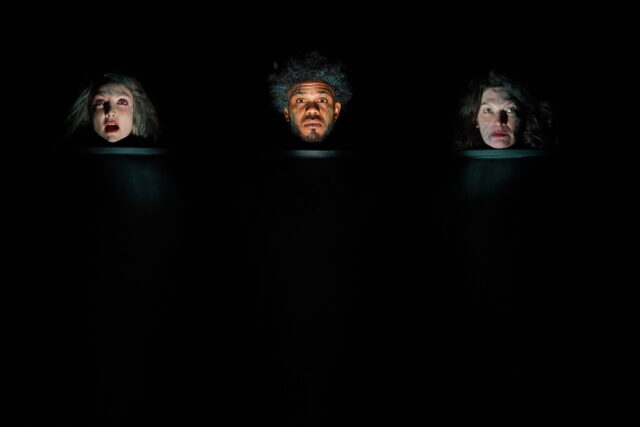
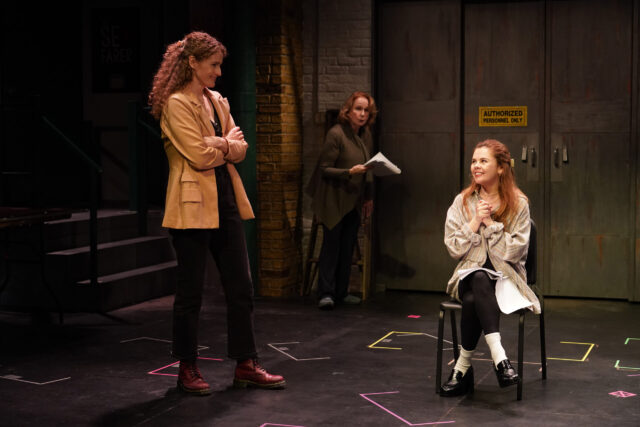
Sarah Street’s mouth is the star of the first of three short Beckett plays at Irish Rep (photo by Carol Rosegg)

BECKETT BRIEFS: FROM THE CRADLE TO THE GRAVE
Irish Repertory Theatre, Francis J. Greenburger Mainstage
132 West Twenty-Second St. between Sixth & Seventh Aves.
Wednesday – Sunday through March 9, $60-$125
212-727-2737
irishrep.org

Why is the Irish Rep presenting Beckett Briefs: From the Cradle to the Grave, three short works by Samuel Beckett, now? “Because he’s Irish, and he knows things,” Irish Rep artistic director Charlotte Moore and producing director Ciarán O’Reilly explain in a program note.

The Dublin-born playwright died in Paris in 1989 at the age of eighty-three, during the Irish Rep’s second season, in which they staged Chris O’Neill and Vincent O’Neill’s one-man Endworks, based on more than a dozen Beckett plays. The company has since performed Beckett’s Krapp’s Last Tape in 1998, Endgame in 2005 and 2023, A Mind-Bending Evening of Beckett in 2013 featuring Act without Words, Play, and Breath, and Bill Irwin’s solo show On Beckett in 2018, 2020, and 2024.

In his unique, existential writings, Beckett displayed a flair for knowing things, although it is usually not easy to parse out exactly what he means, a significant part of the joy of experiencing his plays, which also include the full-length All That Fall, Happy Days, and Waiting for Godot. Theater itself is a regular subject; his scripts have extremely detailed instructions of nearly every movement, costume, and prop, and the narratives are often about the art of storytelling.

Such is the case with Beckett Briefs, a trio of tales about life, death, and the afterlife in which the narrative style drives the work.

First up is Not I, Beckett’s 1972 monologue that has been performed by Beckett muse Billie Whitelaw, Jessica Tandy, Julianne Moore, Lisa Dwan, and British comedian Jess Thom, who incorporated her copralalia (cursing) form of Tourette’s syndrome into her delivery of the nonstop barrage of text. The play generally runs between nine and fifteen minutes; it is not a race, but the actor is expected to go through the 2,268 words as fast as possible. “I am not unduly concerned with intelligibility. I hope the piece may work on the nerves of the audience, not its intellect,” Beckett wrote in a 1972 letter to Tandy prior to the play’s world premiere at Lincoln Center.

A hole has been cut in a black curtain more than eight feet above the stage, so the only thing we can see is a mouth peeking through, in this case belonging to Irish Rep regular Sarah Street. Her teeth are sparkling white and her red lipstick thick and emotive — resembling the famous movie poster for The Rocky Horror Picture Show — as she speeds through Beckett’s wildly unpredictable verbiage, barely stopping to breathe. Known as Mouth, the character has been mostly speechless since her parents died when she was an infant, but now, at the age of seventy, words start pouring out of her.

The audience is not meant to understand every plot detail as she relates stories involving shopping in a supermarket, going to court, sitting on a mound in Croker’s Acres, and searching for cowslips in a field, bringing up such concepts as shame, torment, sin, pleasure, and guilt. The protagonist has suffered an unnamed trauma that has led to her becoming an outcast from society and virtually unable to communicate with others. In many ways, she is as surprised at what she’s saying as we are at what we are hearing. For example:

“imagine! . . . whole body like gone . . . just the mouth . . . lips . . . cheeks . . . jaws . . . never . . . what? . . . tongue? . . . yes . . . lips . . . cheeks . . . jaws . . . tongue . . . never still a second . . . mouth on fire . . . stream of words . . . in her ear . . . practically in her ear . . . not catching the half . . . not the quarter . . . no idea what she’s saying . . . imagine! . . no idea what she’s saying! . . and can’t stop . . . no stopping it . . . she who but a moment before . . . but a moment! . . could not make a sound . . . no sound of any kind . . . now can’t stop . . . imagine! . . can’t stop the stream . . . and the whole brain begging . . . something begging in the brain . . . begging the mouth to stop . . . pause a moment . . . if only for a moment . . . and no response . . . as if it hadn’t heard . . . or couldn’t . . . couldn’t pause a second . . . like maddened . . . all that together . . . straining to hear . . . piece it together . . . and the brain . . . raving away on its own . . . trying to make sense of it . . . or make it stop . . .”

O’Reilly, the director of all three parts of Beckett Briefs, has excised the second character, known as the Auditor, who in some renderings stands off to the side of the stage, hidden in the shadows. (In Thom’s case, the Auditor served as ASL translator.) So the focus is completely on the mouth in a dazzling performance by Street, a celebration of language and a potent reminder that life is to be lived, not merely watched or listened to, that there is more to our existence, even beyond theater.

Sarah Street, Roger Dominic Casey, and Kate Forbes examine their love triangle in Beckett’s Play (photo by Carol Rosegg)

In Endgame, a married couple named Nell and Nagg live in garbage cans. In Play, the middle section of Beckett Briefs, three people find themselves in urns in the afterlife, only their heads and the outlines of the vessels visible. A man (Roger Dominic Casey) appears to be doomed for eternity to be trapped between his wife (Kate Forbes) and his mistress (Street). They look straight ahead “undeviatingly,” the script says, and speak only when a spotlight shines on them.

Their initial exchange sets the stage of this forever love triangle.

W1: I said to him, Give her up. I swore by all I held most sacred —
W2: One morning as I was sitting stitching by the open window she burst in and flew at me. Give him up, she screamed, he’s mine. Her photographs were kind to her. Seeing her now for the first time full length in the flesh I understood why he preferred me.
M: We were not long together when she smelled the rat. Give up that whore, she said, or I’ll cut my throat — [Hiccup.] pardon — so help me God. I knew she could have no proof. So I told her I did not know what she was talking about.
W2: What are you talking about? I said, stitching away. Someone yours? Give up whom? I smell you off him, she screamed, he stinks of bitch.
W1: Though I had him dogged for months by a first-rate man, no shadow of proof was forthcoming. And there was no denying that he continued as . . . assiduous as ever. This, and his horror of the merely Platonic thing, made me sometimes wonder if I were not accusing him unjustly. Yes.
M: What have you to complain of? I said. Have I been neglecting you? How could we be together in the way we are if there were someone else? Loving her as I did, with all my heart, I could not but feel sorry for her.

It’s a tour de force for Casey (Aristocrats, CasablancaBox), Forbes (A Touch of the Poet, Rubicon), and Street (Molly Sweeney, Belfast Girls) as well as lighting designer Michael Gottlieb and sound designers M. Florian Staab and Ryan Rumery, who must be in perfect sync and not miss a beat as the spotlight switches from face to face in the snap of a finger, sometimes illuminating all three characters at the same time. Occasionally the light grows dim, signaling the actors to slow down. As with Not I, it is not a race, but it leaves the audience breathless, as if we had just finished running laps.

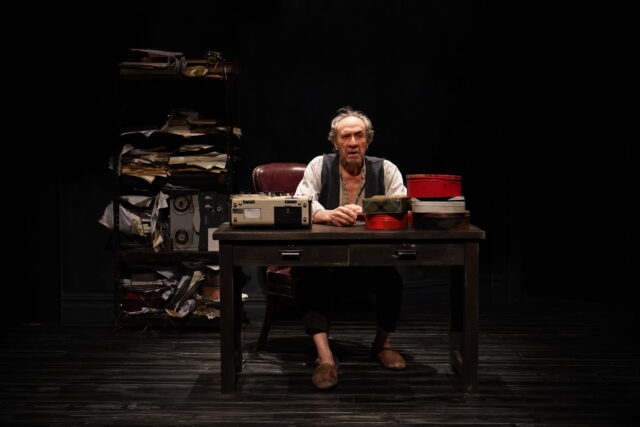
Everything slows down in the finale, Krapp’s Last Tape, but that doesn’t mean it is any easier to decipher. The set, by Irish Rep genius Charlie Corcoran, is a dark, messy room with overstuffed shelves, a desk with an old-fashioned reel-to-reel tape player and several canisters on it, and a light fixture with a single bulb dangling overhead. The unkempt, disheveled Krapp (F. Murray Abraham) shuffles around the floor, struggles to open one of the drawers in the front, and takes out a banana, which he fondles before eating it, tossing the peel to his right. Beckett, a vaudeville fan, does indeed have Krapp slip on it. Krapp, occasionally letting out tired grunts of woe, then opens the second drawer, takes out another banana, peels it, and puts it in his mouth, being more careful this time with the peel. However, he decides not to eat the banana, instead putting it in his pocket.

An aging man (F. Murray Abraham) looks back at his younger self in Krapp’s Last Tape (photo by Carol Rosegg)

He goes in the back and returns with a large ledger that he looks through, reading out loud, “Box . . . thrree . . spool five. Spool! Spooool!” He finds the box he needs, starts playing the recording, then sweeps everything else off the desk and onto the floor. He has chosen to listen to a memory of his thirty-ninth birthday, his young self explaining, “Thirty-nine today, sound as a bell, apart from my old weakness, and intellectually I have now every reason to suspect at the . . . crest of the wave — or thereabouts. Celebrated the awful occasion, as in recent years, quietly at the Winehouse. Not a soul. Sat before the fire with closed eyes, separating the grain from the husks. Jotted down a few notes, on the back of an envelope. Good to be back in my den, in my old rags. Have just eaten I regret to say three bananas and only with difficulty refrained from a fourth. Fatal things for a man with my condition. Cut’em out! The new light above my table is a great improvement. With all this darkness round me I feel less alone. In a way. I love to get up and move about in it, then back here to . . . me. Krapp.”

It doesn’t appear that much has changed over the last three decades, Krapp still alone, still eating bananas, still surrounded by darkness. As the tape continues, Krapp scampers off to take a few gulps from a bottle of liquor, looks up the meaning of “viduity,” sings, and recalls a romantic evening on a lake. But the tape does not provide him with happiness; he barks out, “Just been listening to that stupid bastard I took myself for thirty years ago, hard to believe I was ever as bad as that. Thank God that’s all done with anyway.”

The autobiographical, poetic Krapp’s Last Tape was written in 1958 for Patrick Magee and has also been performed by Harold Pinter, Brian Dennehy, Michael Gambon, and, primarily, John Hurt, who brought it to the 2011 BAM Next Wave Festival. Oscar and Obie winner and Emmy and Grammy nominee Abraham (Good for Otto, It’s Only a Play), who is eighty-five, fully inhabits the role of a man long past the crest of the wave. The desk is near the front of the stage, so close to the audience that you can practically reach out and touch him, although you’re probably inclined to stay away from such a dour, sad, disheveled person.

All three plays, which total about seventy-five minutes, deal with time, memory, and the futility of language, as each character faces issues with communication yet delivers masterful articulation. Expertly directed by O’Reilly (Endgame, The Emperor Jones), Beckett Briefs is a vastly entertaining evening that immerses you in the unique, engaging, complex, and minimalistic worlds the playwright is renowned for, enigmatic works that are worth revisiting over and over again, offering new and fascinating insights as viewers age and understand them in ever-changing, profound ways.

[Mark Rifkin is a Brooklyn-born, Manhattan-based writer and editor; you can follow him on Substack here.]

GOOD BONES AND FIRM FOUNDATIONS ON AND OFF BROADWAY

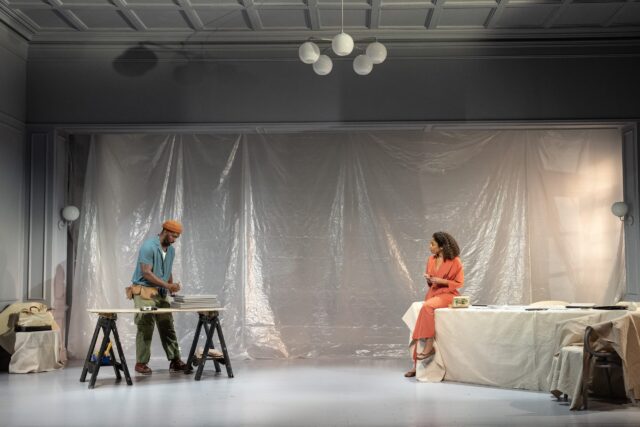
Mamoudou Athie, Susan Kelechi Watson, and Khris Davis star in Good Bones at the Public (photo by Joan Marcus)

GOOD BONES
Martinson Hall, the Public Theater
425 Lafayette St. at Astor Pl.
Tuesday through Sunday through October 27, $95
212-539-8500
publictheater.org

According to the Canadian website houseful, “‘Good bones’ refers to the core foundational elements of the home — a steady structure that can withstand time, wear, and elements. A home with good bones typically has a sturdy foundation, structural stability, and a strong roof. A well-staged home can hide imperfections with beautiful rugs, a fresh coat of paint, or features that pull your attention.”

Four current plays that take place primarily in a home struggle with the core foundational elements, with varying results.

Playwright James Ijames and director Saheem Ali follow up their Pulitzer Prize–winning Fat Ham, which ran at the Public’s Anspacher Theater before transferring to Broadway, with Good Bones, continuing at the Public’s Martinson Hall through October 27. Maruti Evans’s set is a skeletal house surrounded by plastic, undergoing renovation in an unidentified American city that itself is experiencing controversial gentrification.

Travis (Mamoudou Athie), who comes from money, and Aisha (Susan Kelechi Watson), who grew up in the projects, are a married couple who have moved back to her neighborhood and are considering having a baby. He is a chef preparing to open a restaurant, and she is working on a new sports complex she believes will vastly improve the community. Their contractor, Earl (Khris Davis), flirts with Aisha, who returns the interest, but when she shares the plans for the complex with him, he sees her as a traitor to her roots.

She explains, “We’re calling it the Jewel. It’s going to be kind of like a little village over there. This neighborhood has been abandoned to decay and atrophy. The Jewel will bring together the best of the old and the new. Will there be change? Yes. But change is the only thing consistent in this life. We have been sowing into this community. We have worked diligently to revitalize this neglected corner of the city. We’re changing this neighborhood for the better.” His quick response: “It’s the death star.”

James Ijames’s Good Bones is in need of further renovation (photo by Joan Marcus)

Remembering how he used to play in the very house he is now working in, Earl tells Aisha, “These houses are sturdy. Shit’s built like a ribcage. The bones are so good. If . . . uh . . . you sit really still in here, you can feel the walls breathing and the floors lifting to meet your feet. That’s why I love these old houses. I get to spend time in a lot of haunted places.”

Good Bones follows in the lofty footsteps of Lorraine Hansberry’s A Raisin in the Sun and Bruce Norris’s Clybourne Park, but it lacks the character development and depth of those two award-winning works. Watson (Eureka Day, Merry Wives) and Athie (The Mystery of Love and Sex) have little chemistry; it might be the relationship between Travis and Aisha that requires renovating, but it’s hard to root for them because their marriage has no firm foundation.

Davis (Fireflies, Sweat) steals the show as the honest, hardworking, well-meaning contractor who has a more realistic view of the world, the only one who can see the ghost in the machine, and Téa Guarino (A Hundred Words for Snow, Antony and Cleopatra) is charming as his daughter, Carmen. But Good Bones needs more work, more than just a fresh coat of paint.

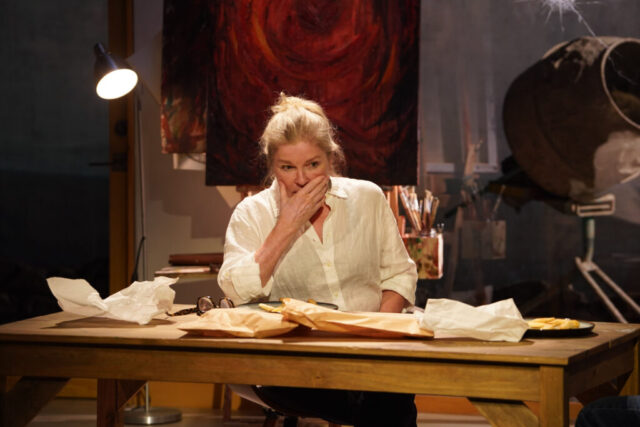
Kate Mulgrew outshines the material in Nancy Harris’s The Beacon at the Irish Rep (photo by Carol Rosegg)

THE BEACON
Irish Repertory Theatre, Francis J. Greenburger Mainstage
132 West Twenty-Second St. between Sixth & Seventh Aves.
Wednesday – Sunday through November 3, $60-$125
212-727-2737
irishrep.org

Obie winner and Emmy nominee Kate Mulgrew excels as an Irish abstract painter renovating her seaside home in Nancy Harris’s The Beacon, making its North American premiere at the Irish Rep through November 3. Mulgrew is Beiv (rhymes with gave), who is transforming her late husband’s cottage into a glass-enclosed space, as if she has nothing to hide — it has been long rumored that she might have had something to do with her spouse’s death.

She is surprised when her son, Colm (Zach Appelman), arrives with his new wife, Bonnie (Ayana Workman), who is a big fan of hers. Colm is surprised when he finds out that one of his old friends, Donal (Sean Bell), is helping with the renovation and has grown close to Beiv, who Colm always calls by her name, never “mom” or “mother.”

At the back of the room is Beiv’s most recent canvas, which is not quite finished yet. Examining it, Bonnie says, “You can really see the female rage. Like I’m instantly getting menstrual blood, the blood of childbirth, genital mutilation, hemorrhaging — pretty much all female suffering. Abortion is in there obviously . . . and repression and shame. But there’s also something really — tender too. Like there, in those softer shades, I see the vulva. And the clitoris, and this really female desire for pleasure, for sexual intimacy but also for like a really fucking explosive orgasm, you know. But yeah. No, it’s powerful. And brutal. And sad too.”

Beiv’s quick response: “It’s a blood orange.”

Of course, it’s actually something in between, and that “in between” is where the play, directed by Marc Atkinson Borrull, find itself stuck, unable to escape from its own trappings.

The Beacon is in need of more structure at the Irish Rep (photo by Carol Rosegg)

Beiv is a complex and fascinating character, superbly portrayed by Mulgrew (The Half-Life of Marie Curie, Tea at Five) with a compelling thread of intrigue. But when she’s not onstage, the narrative drags with didactic dialogue and meandering subplots, some of which feel completely unnecessary, such as the one involving Ray (David Mattar Merten) and Bonnie, although Ray overdramatizes things when he describes the house: “On one hand it looks like an idyllic little artist’s garret. Half-finished charcoal sketches sit scattered on a table. A large oil painting rests on an easel; there’s a huge glass window with sweeping views of the Atlantic. But the crack in the window from a recent break-in suggests another story. A darker story . . . a story of sex and violence and betrayal that’s hung around this cottage for over a decade.”

As always at the Irish Rep, the set, in this case by Colm McNally, is an impressive structure, but the story does not have the requisite good bones. It’s as if Harris and Borrull (Little Gem, Bedbound) knew where they wanted to end up but threw in too much as they get there.

Even the title is wasted on an unimaginative metaphor. Mulgrew herself is a beacon, but alas, in this production, she’s the only one who shines.

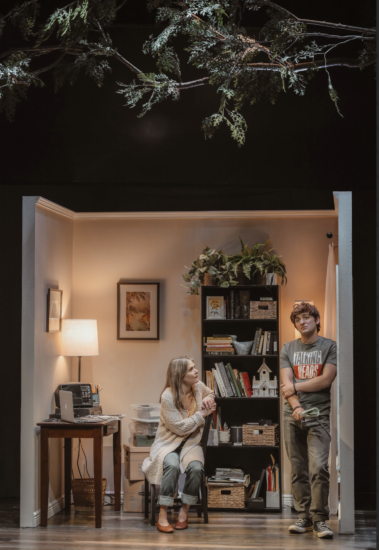
Martha Pichey’s Ashes & Ink trap the actors and characters in uncomfortable ways (photo by Thomas Mundell, Mundell Modern Pixels)

ASHES & INK
AMT Theater
354 West Forty-Fifth St. between Eighth & Ninth Aves.
Wednesday – Sunday through November 3, $39-$49
ashesink.ludus.com
www.amttheater.org

“‘Structure.’ Our lives need structure,” Molly (Kathryn Erbe) says early in the New York premiere of Martha Pichey’s Ashes & Ink. It’s a word that’s repeated several times in the play, which itself needs considerable rebuilding.

Running at the AMT Theater through November 3, Ashes & Ink moves between Molly’s apartment in New York City and her boyfriend Leo’s home in the country. Molly is a widow with a vast archive of birdsong she’s recorded and is categorizing with her sister, Bree (Tamara Flannagan); Molly’s teenage son, Quinn (Julian Shatkin), is an addict who has been in and out of rehab and is seeking a career in acting after having made an impact in a few movies. Leo is a widower raising his eight-year-old son, Felix (Rhylee Watson), by himself.

Quinn has once again left rehab, a place called Serenity House, so he can rehearse for his audition to get into the Royal Academy of Dramatic Arts in London. Prepared to do a monologue from Richard II — his father’s name was Richard — he instead does the classic, and obvious, “Tomorrow, and tomorrow, and tomorrow” soliloquy from MacBeth. The most important phrase is “signifying nothing,” to which he adds, “Nothing. Not a fucking thing.” That goes for the play as well, echoed later by Molly, who opines, “I am so deep inside my sucked dry bones sick and tired. I don’t know how to do this anymore. I don’t even know how to think anymore. I can’t remember anything.”

Tim McMath’s set switches from Molly’s cramped apartment, which resembles a psychiatrist’s office, where Quinn often sits in a chair complaining about his life, and the kitchen of Leo’s country house and under a tree on his property. The actors move the sets themselves; the first time they do it is fresh and exciting, but over the course of fifteen scenes, it grows tiresome, dragging down any pace the show is trying to achieve. For some reason, Molly leaves the window over the fire escape wide open, not the safest thing to do, especially when Quinn is running away from trouble.

Stagnantly directed by Alice Jankell, the play — Pichey’s debut — can’t get out of its own way as subplots turn ever-more ludicrous and the holes in the central story keep expanding. And I couldn’t help but cringe when Tony nominee Erbe (Something Clean, The Speed of Darkness, The Father) had to deliver the following lines: “If somebody told me my little boy would grow up to be an addict, I would’ve spat in their face. Aimed right for their mouth. . . . Take the lid off the pressure cooker, Molly! Watch it plaster the walls with all this gummy smelly stuff. Put your nose up to it, take a good whiff of this shit, this mix of ‘Could’ve done this,’ ‘Should’ve known that.’”

Without any kind of firm foundation, Ashes & Ink fails the smell test, among others.

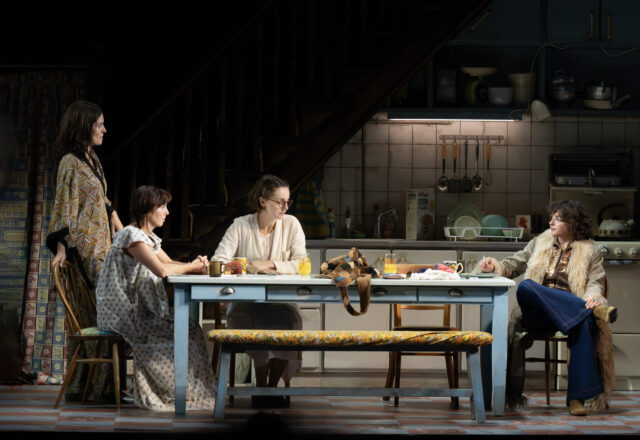
Sisters Gloria (Leanne Best), Ruby (Ophelia Lovibond), Jill (Helena Wilson), and Joan (Laura Donnelly) reunite as their mother lies on her deathbed in The Hills of California (photo by Joan Marcus)

THE HILLS OF CALIFORNIA
Broadhurst Theatre
235 West 44th St. between Broadway & Eighth Ave.
Tuesday – Sunday through December 22, $58-$351
thehillsofcalifornia.com

Rob Howell’s magnificent multilevel set for Jez Butterworth’s new play, The Hills of California, is a character unto itself, an Escher-like maze of rooms and staircases that rise into a mystical darkness. The main floor switches between 1955 and 1976 at a family-run Victorian guesthouse on the outskirts of the seaside resort town of Blackpool on the Irish Sea, providing a firm foundation for the gripping, if overburdened, narrative.

In 1976, sisters Gloria (Leanne Best), Ruby (Ophelia Lovibond), and Jill (Helena Wilson) have gathered at the fading Seaview Luxury Guesthouse and Spa because their mother, Veronica Webb, is dying in a room upstairs; they are waiting for their fourth sister, Joan (Laura Donnelly), who has not stepped foot in the house for twenty years, living in America. They are in what once was the private kitchen but is now a tiki bar with a one-armed bandit and broken jukebox that represent the siblings’ once-promising career. Their mother’s nurse, Penny (Ta’Rea Campbell), has offered the sisters the opportunity to bring in a doctor to end Veronica’s pain, but they don’t want to make any critical decisions until Joan arrives, something Gloria believes is highly unlikely.

“Times like these you find out who a body is. But go on. Stick up for her,” Gloria says sharply to Jill, who has spent her life taking care of the guesthouse and Veronica and is sure that Joan is on her way, exclaiming, “Well, I’m sorry. But it’s not Silly Jilly head-in-the-clouds, nor sticking up for no one. I know my sister. If Joan says she’s coming, she’s coming. There. I’ve said it.”

In 1955, single mother Veronica (Donnelly) is training young Gloria (Nancy Allsop), Ruby (Sophia Ally), Jill (Nicola Turner), and Joan (McDonnell) to become the next Andrews Sisters, rehearsing Johnny Mercer’s 1948 hit “The Hills of California,” which features the lines “The hills of California will give ya a start / I guess I better warn ya cuz you’ll lose your heart / You’ll settle down forever and never stray from the view / The hills of California are waiting for you.”

“What is a song?” Veronica asks, answering, “A song is a place to be. Somewhere you can live. And in that place, there are no walls. No boundaries. No locks. No keys. You can go anywhere.” A song is its own kind of structure, its own kind of home, meant to bring people together, but in The Hills of California, it tears a family apart.

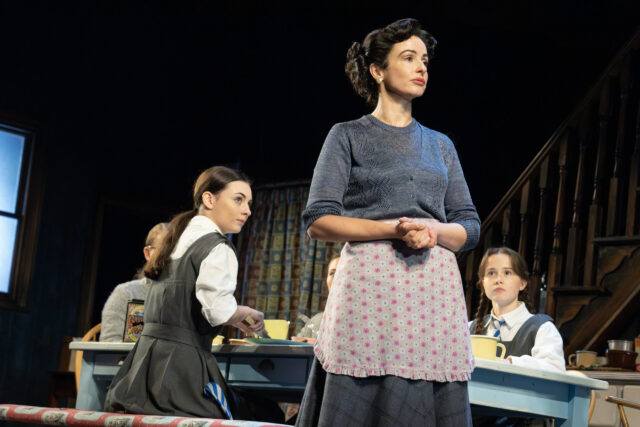
Veronica Webb (Laura Donnelly) is a controlling British stage mother in Jez Butterworth’s The Hills of California (photo by Joan Marcus)

Tony winner Butterworth (The River, Jerusalem) and Oscar, Tony, and Olivier-winning director Sam Mendes (The Lehman Trilogy, Cabaret) previously teamed up on The Ferryman, which won four Tonys and boasted an ensemble of nearly three dozen performers including covers. The Hills of California is overstocked with minor male characters who disappear into the woodwork, even Luther St. John (David Wilson Barnes), who is involved in a key scene that influences the girls’ future and their relationship with their mother.

About fifteen minutes have been cut from the original three-hour London production and the early previews on Broadway, leaving some gaps in the narrative, along with several moments that feel extraneous, such as when Veronica forces a lodger (Richard Short) to take the long way home, barring him from the shortcut through the kitchen. But when the story focuses on the mother and her daughters, in both time periods, the play finds its foundation, with sharp, poignant dialogue, lovely music by Nick Powell, and pinpoint choreography by Ellen Kane.

Donnelly, who has appeared in several plays written by Butterworth, her partner (they have two children together), is whip-smart as Veronica, a controlling stage mother who recalls Rose Hovick in Gypsy, currently played by Audra McDonald right next door at the Majestic. (On the other side is another show about a mother and daughter and music, Hell’s Kitchen.)

America is not referenced just in the song; the rooms in the guesthouse are named after such US states as Colorado, Alabama, Indiana, Minnesota, and Mississippi, where the critical event happens in 1955 and where Veronica is dying in 1976, reminding the audience that this kind of tale can happen anywhere.

In her 2016 poem “Good Bones,” British actress Maggie Smith, who passed away in September at the age of eighty-nine, writes, “Any decent realtor, / walking you through a real shithole, chirps on / about good bones: This place could be beautiful, / right? You could make this place beautiful.” Even with its occasional skeletal forays, The Hills of California has good bones, filled with a glorious beauty.

[Mark Rifkin is a Brooklyn-born, Manhattan-based writer and editor; you can follow him on Substack here.]