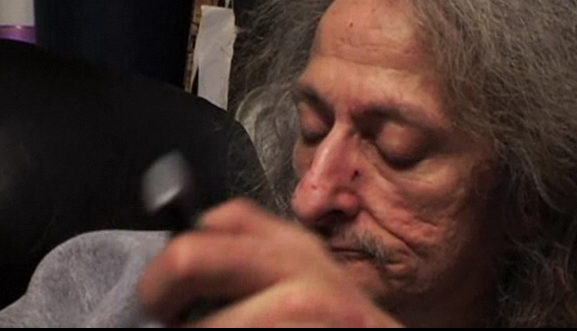
Pentagram leader Bobby Liebling struggles through some very hard times in LAST DAYS HERE
LAST DAYS HERE (Don Argott & Demian Fenton, 2011)
IFC Center
323 Sixth Ave. at West Third St.
Opens Friday, March 2
212-924-7771
www.ifccenter.com
www.914pictures.com
 While doing work for Philly record label Relapse, hard rock fan Sean “Pellet” Pelletier became obsessed with Bobby Liebling, lead singer and songwriter for the 1970s Virginia doom metal band Pentagram. Over the course of four decades, the highly influential but deeply troubled group had gone through myriad lineup changes and constant breakups, never achieving mass success primarily because of the wildly unpredictable and self-destructive frontman. In his mid-fifties, Liebling was a casualty of the classic sex, drugs, and rock and roll story, living in his parents’ basement, smoking crack, and picking at the horrific oozing scabs on his bandage-wrapped arms. He is the unlikeliest of heavy metal heroes, but Pelletier is so determined to help bring Liebling and Pentagram back into the public limelight that he becomes their manager, trying against all odds to get the band back together to make a new record and go out on tour. But when he finally convinces Liebling to give up the pipe, the singer turns to another addiction, the love of his much younger girlfriend, Hallie Miller, an extremely strange and inexplicable relationship. For Last Days Here, an almost hard-to-believe combination of VH1’s Behind the Music and Bands Reunited, directors Don Argott (Rock School, The Art of the Steal) and Demian Fenton followed Pelletier and Liebling around for three years, speaking with Liebling’s parents, such former Pentagram members as Geof O’Keefe, Greg Mayne, Gary Isom, and Joe Hasselvander, über fan Callae Gotz, and music producer Murray Krugman, who share personal tales about the rise and many falls of Liebling and Pentagram. Liebling gives the filmmakers access to every part of his life, resulting in an intimate portrait of a bizarre existence; it is almost impossible to equate the basement-dwelling, near-death Liebling with the metal madman responsible for such songs as “Be Forewarned,” “When the Screams Come,” “Livin’ in a Ram’s Head,” “Relentless,” and “Day of Reckoning.” Argott and Fenton focus on Liebling while not getting overinvolved with the music itself, which is kept to a minimum; you don’t have to be a fan of heavy metal to appreciate this compelling tale of survival. Last Days Here opens March 2 at the IFC Center, with Argott and Fenton appearing at the 7:55 and 9:55 Friday-night screenings.
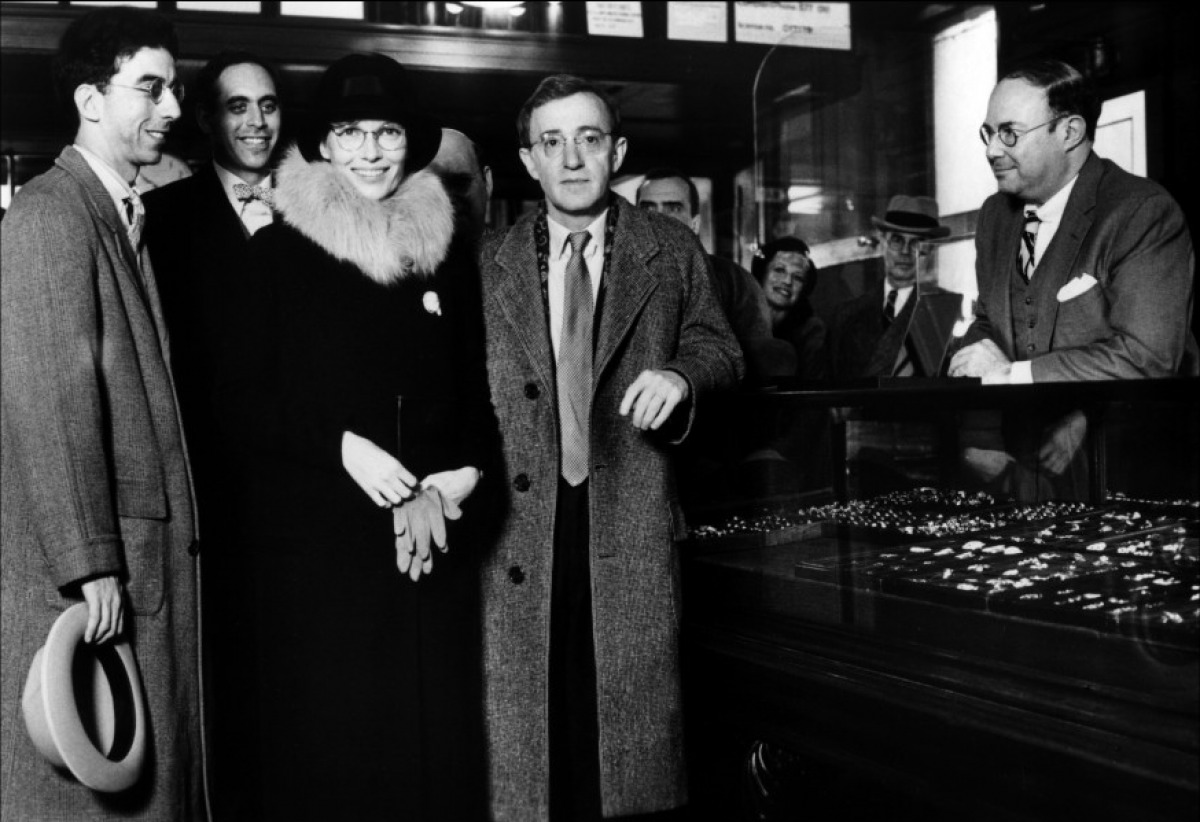
 The IFC Center’s Stranger Than Fiction series generally consists of classic and new documentaries, often with the filmmakers and/or subjects participating in postscreening Q&As. But on Valentine’s Day, it takes a slightly different approach, showing Woody Allen’s Zelig, a story of love and acceptance disguised as a historical newsreel. Allen stars as the fictional Leonard Zelig, a lonely little man who becomes known as the Human Chameleon for his ability to change not only the way he talks and acts but how he looks, based on whatever situation he is currently involved in. Zelig becomes a cultural phenomenon, hobnobbing with Charles Lindbergh, Al Capone, William Randolph Hearst, Charlie Chaplin, F. Scott Fitzgerald, and many other famous figures of the 1920s and 1930s while also being studied by eminent psychiatrist Dr. Eudora Fletcher (Mia Farrow). Master cinematographer Gordon WIllis (The Godfather) earned an Oscar nomination for the way he was able to insert Allen and Farrow into existing footage, including literally stepping on the film to make it look older. As wildly funny as Zelig is, it is also an extremely insightful examination of identity, individuality, and the basic human need to be part of something. The STF series continues February 21 with Lisa Katzman’s Tootie’s Last Suit, February 28 with The Promise: The Making of Darkness on the Edge of Town, and March 6 with Leon Gast’s Smash His Camera.

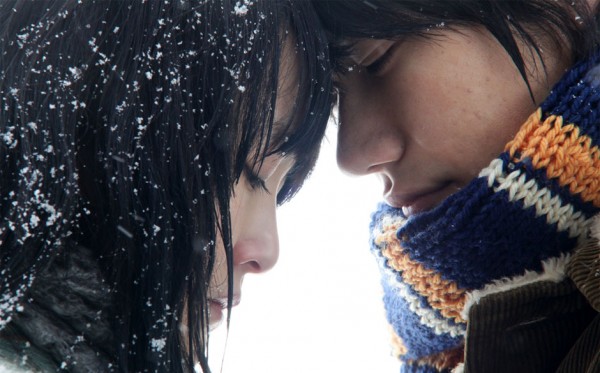
 First it took a long time for French-Vietnamese writer-director Tran Anh Hung (Ths Scent of Green Papaya) to convince Japanese novelist Haruki Murakami to let him adapt his 1987 novel, Norwegian Wood — Tran had been interested in turning the book into a movie ever since he first read it in 1994, but Murakami notoriously does not allow his novels to become films — and then, once the film was made and played at prestigious festivals in Venice, Toronto, and Dubai, still took more than a year to find a U.S. distributor. Currently running at the IFC Center, Norwegian Wood is a moving, faithful adaptation of Murakami’s elegiac novel about unrequited love, romantic communication, and death. After his best friend, Kizuki (Kengo Kora), commits suicide, Watanabe (Death Note’s Ken’ichi Matsuyama) and Kizuki’s girlfriend, Naoko (Babel’s Rinko Kikuchi), who previously were part of an inseparable trio with Kizuki, go their separate ways. After a short time, they meet up accidentally in Tokyo, where Watanabe is attending university and Naoko is trying to get over her loss. But an event on her twentieth birthday causes Naoko to take off again, this time seeking professional help at a sanitarium. Watanabe can’t stop thinking about Naoko, jeopardizing a possible relationship with the aggressive, sexually open Midori (Kiko Mizuhara), who already has a boyfriend but is extremely interested in Watanabe. Meanwhile, Watanabe disapproves of how his friend Nagasawa (Tetsuji Tamayama) continually cheats on his girlfriend, Hatsumi (Eriko Hatsune), who is devoted to him. With the student riots of the late 1960s swirling around them, Watanabe, Naoko, Midori, Nagasawa, Hatsumi, and Naoko’s roommate, Reiko (Reika Kirishima), take long, hard looks at what they want out of life and love, and they don’t always like what they find. Beautifully shot by Mark Lee Ping Bin (In the Mood for Love) and featuring a subtle score by Radiohead’s Jonny Greenwood (There Will Be Blood), Norwegian Wood is a slow-paced, psychologically intense drama. Watanabe and Naoko are often shown walking amid vast natural landscapes of green forests and snow-covered mountains, but they are tied up tight within themselves, trapped in their own memories. The carefully composed sex scenes give depth and intelligence to the main characters without overplaying their emotions. The story itself might be relatively slight — it lacks the range of Murakami’s later books — but Tran has done a fine job bringing it to the screen.
 For The Interrupters, director, producer, and editor Steve James (Hoop Dreams, At the Death House Door) teamed up with journalist Alex Kotlowitz (There Are No Children Here) to hit the dangerous inner-city streets of Chicago with the men and women of CeaseFire, a grass-roots organization of former gang members who are now trying to stop the violence. Inspired by Kotlowitz’s New York Times Magazine article, the two men concentrate on three primary stories. Ameena Matthews, the Muslim daughter of notorious gang leader Jeff Fort, is working with a deeply troubled young woman who’d rather fight than flee, even if it means being sent back to prison. Cobe Williams has his hands full with the angry, recently released Flamo, who thinks the whole world is against him. And Eddie Bocanegra is attempting to come to grips with a cold-blooded revenge murder he committed when he was a teenager by visiting schools and talking about turning his life around. One of the most poignant moments of the film occurs when Williams brings Lil Mikey back to the barbershop he and several of his cohorts robbed at gunpoint as he again faces some of his victims. Matthews, Williams, and Bocanegra are paid employees of CeaseFire, which was founded by Dr. Gary Slutkin, an epidemiologist who believes that violence is a disease that can be treated in similar ways, and is run by Tio Hardman, who handles his extremely tough task with intelligence and dignity as he deals with what he calls “the madness.” But in a society in which “words’ll get you killed,” as Matthews says early on, these tireless violence interrupters put their own lives on the line every day, battling a sickness that seems to have no end in sight. The award-winning film, a hit at numerous film festivals, felt a bit long at its original 144 minutes, but James edited it down to a more streamlined 124 minutes for its recent theatrical release. The Interrupters is screening January 12 at 8:00 at the IFC Center as part of the Stranger than Fiction series and will be followed by a Q&A with the director.