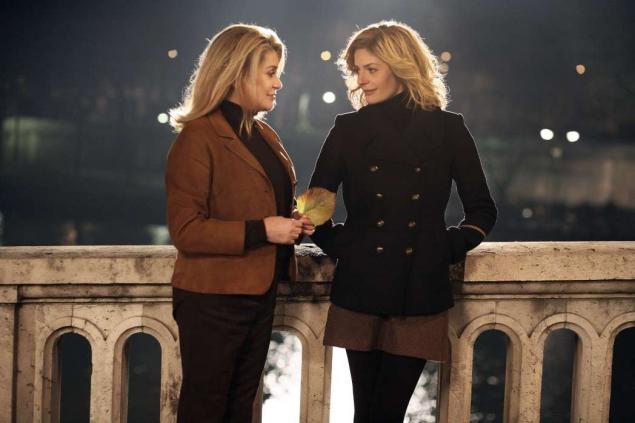
Real-life mother and daughter Catherine Deneuve and Chiara Mastroianni play fictional mother and daughter in Christoph Honoré’s BELOVED
BELOVED (LES BIEN-AIMÉS) (Christophe Honoré, 2011)
IFC Center, 323 Sixth Ave. at Third St., 212-924-7771
Lincoln Plaza Cinema, 1886 Broadway at 63rd St., 212-757-2280
Opens Friday, August 17
www.ifcfilms.com
 The closing-night selection of the 2011 Cannes Film Festival, Christophe Honoré’s Beloved attempts to be a sweeping romantic epic, but it works best when it when it keeps it simple. In 1964 Paris, Madeleine (Ludivine Sagnier) decides that making a little extra money by selling her body is a better way to afford fancier things than by stealing them, until she falls for Czech doctor Jaromil (Rasha Bukvic). But after they have a child, Soviet tanks invade Prague, and Jaromil takes a lover, they separate. Over the years, as Madeleine (later played by Catherine Deneuve) tries to make a new life for her and Vera (Deneuve’s real-life daughter, Chiara Mastroianni), Jaromil (Czech director Milos Forman) keeps reappearing in their lives, but while Madeleine seems comfortable being with her former husband again, displaying a free and open sexuality, Vera seems unable to sustain a real relationship, adored by a younger teacher (Louis Garrel) while chasing after a gay American musician (Paul Schneider). A sort of mash-up of Luis Buñuel’s Belle de Jour and Jacques Demy’s The Umbrellas of Cherbourg, Beloved features characters calmly turning to song to contemplate their inner dilemmas as they walk through the streets, singing such numbers as “Heaven Knows I’m Miserable Now” (adapted from the Smiths’ original), then proceeding on. When Honoré (Love Songs, Dans Paris) keeps to the central plotlines, Beloved is an engaging, intimate look at sex, love, and family over a forty-five-year period. Unfortunately, he injects unnecessary sociopolitical elements that sidetrack the story and feel forced. At 135 minutes, the film is also at least a half hour too long. Had Honoré stopped earlier, he would have had quite a film, but instead it seems to go on interminably, passing up what could have been fine endings for additional scenes that quickly become tiresome and repetitive. Beloved does have its moments, but it sadly falls short of what it could have been. The director will be on hand at the IFC Center to discuss the film at the 6:55 screenings on Friday and Saturday night of opening weekend.
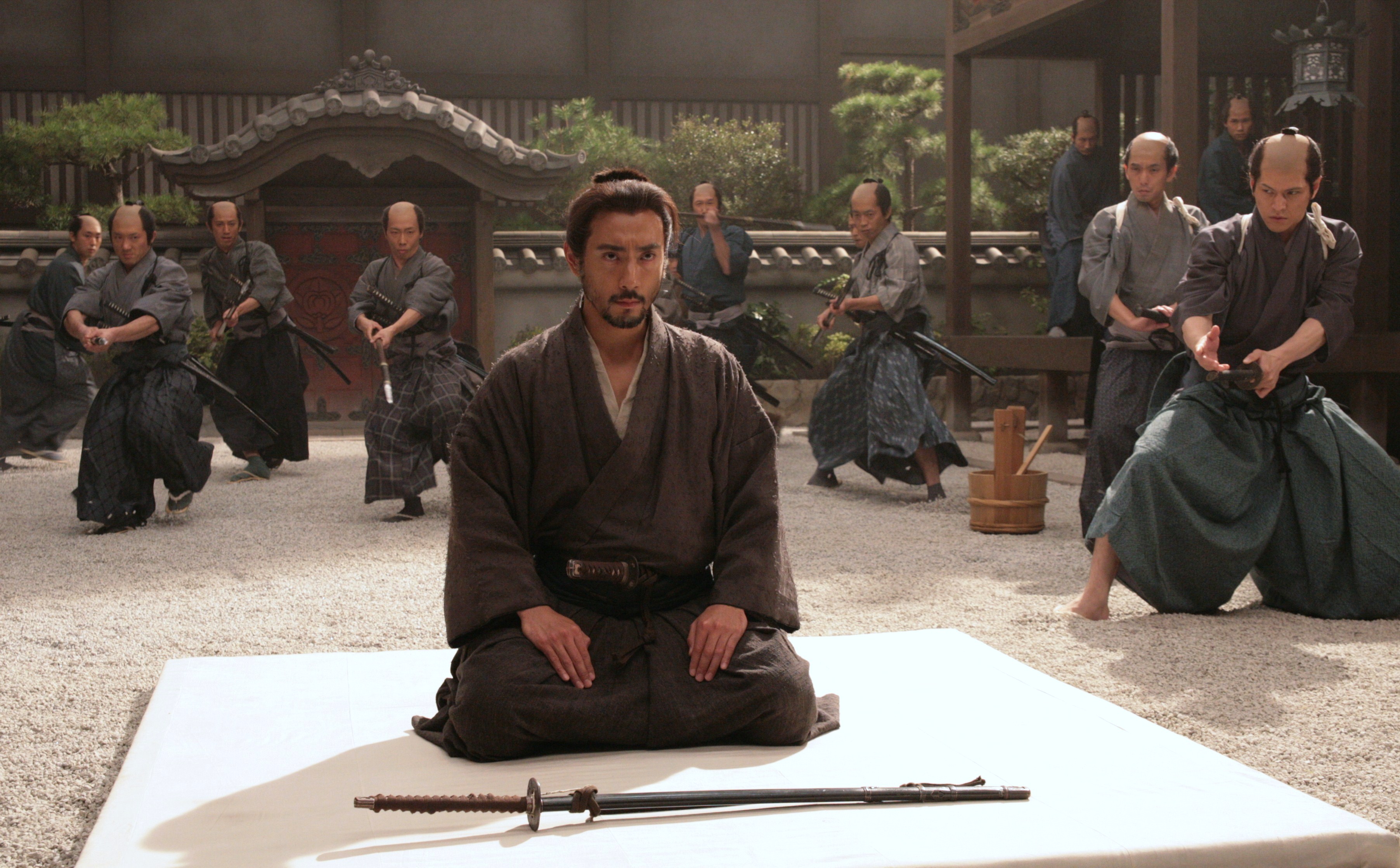
 Nearly fifty years after Masaki Kobayashi’s Harakiri won the Special Jury Award at the 1963 Cannes Film Festival, Takashi Miike’s magnificent 2011 remake was also entered into competition at the prestigious French event. During peaceful times in 1634 Edo, a masterless samurai named Hanshiro Tsukumo (Kabuki star Ebizo Ichikawa) comes to the Lyi clan, requesting permission to commit seppuku in the estate’s courtyard, seeking an honorable death. But clan retainer Kageyu Saito (Kōji Yakusho) and his right-hand man, Hikokuro Omodaka (Munetaka Aoki), believe he might be yet another penniless samurai using a suicide bluff in order to get either a job or money. Trying to discover if the man is serious about wanting to commit hara-kiri, the retainer tells him the horrific story of a young samurai named Motome Chijiiwa (Eita) who requested the same thing two months before. But soon Hanshiro has his own story to tell, one that turns everything around in surprising ways. Miike, who has directed more than eighty movies across a multitude of genres during his twenty-two-year career, including such masterworks as Audition, Ichi the Killer, and Thirteen Assassins, has made his most emotional, compassionate film yet with Hara-Kiri: Death of a Samurai. Ichikawa, taking on the role played in the original by Tatsuya Nakadai, is brilliant as Hanshiro, a deeply thoughtful samurai with a fierce dedication to honor and loyalty. As he stares into Yakusho’s eyes, the tension can be cut with a steel sword. Miike and cinematographer Nobuyasu Kita shot the film in 3D, but they chose not to get gimmicky with the effects, just making the film they wanted to as if it were in regular 2D. “There was no change to my approach other than I was able to go brag to the director shooting at the studio next door and say, ‘Huh? Yours is flat and level? Ours is bumpy and convexo-concave,’” Miike explains in the press notes. Although he adds, “I definitely anticipate making more 3D movies. Next, if I have the chance, I want to have things that shouldn’t come out of our bodies be hurled at the audience.” The 3D adds a beautiful depth to Akira Sakamoto and Kazuto Kagoo’s gorgeous sets, which are enhanced by Yuji Hayashida’s rich art direction, bathed in deep black, white, gray, and red. The 3D also makes it easier to read the subtitles, which pop off the screen, along with the snow. Hara-Kiri might be a thinking person’s samurai movie, but it is still a Miike film, so it also features one of the most brutal suicides ever depicted on celluloid, and it ends with one helluva fight scene.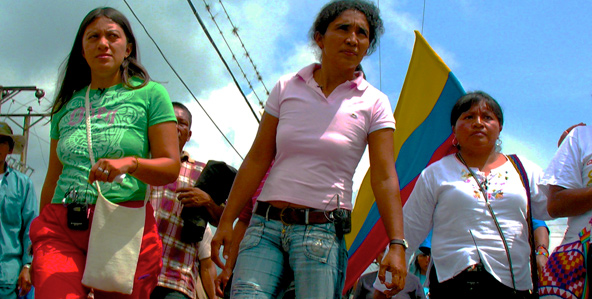
 “If we don’t open our eyes, if we are afraid of challenges, then we won’t be cultivating life,” Flor Ilva Triochez says near the start of the compelling documentary We Women Warriors, continuing, “We will be cultivating death.” From 2002 to 2009, journalist Nicole Karsin covered the ongoing bloody battle in Colombia between the army, the paramilitary, and rebel guerrillas, a violent struggle whose collateral damage includes atrocities being suffered by the more than one hundred indigenous tribes caught in the middle, their very existence being threatened by the unending drug-related violence. Karsin picked up a camera to tell the story through the eyes of three three brave women who, independent of one another, decided to do what the government and others refused to and take matters into their own hands. Karsin follows Doris Puchana, an Awá governor who risks her life by speaking out publicly about a horrific massacre; Ludis Rodriguez, a Kankuamao mother who watched her husband get murdered and was then falsely accused of having killed fifteen policemen; and Flor Ilva, who, as the first female leader of the Nasa people in three hundred years, demands that the police take down their barracks and leave her community. Eventually the three amazing women come together to share details not only of their lives but of their organizational methods, unwilling to be silenced as they seek peace for their people. Part of the sixteenth annual DocuWeeks festival at the IFC Center, We Women Warriors is an inspiring tale filled with hope in the face of seemingly insurmountable odds, as three strong women overcome personal tragedy to fight for justice and freedom. We Women Warriors runs August 10-16, with the filmmakers on hand for one of the two daily screenings. The festival continues through August 23 with such other documentaries as Eugene Martin’s The Anderson Monarchs, about an African-American girls soccer team in an at-risk Philadelphia neighborhood, Dafna Yachin’s Digital Dharma: One Man’s Mission to Save a Culture, about Mormon E. Gene Smith’s determination to preserve ancient Sanskrit and Tibetan writings, and Thomas Riedelsheimer’s Garden in the Sea, in which Spanish artist Cristina Iglesias builds an underwater sculpture in the Mexican Sea of Cortez.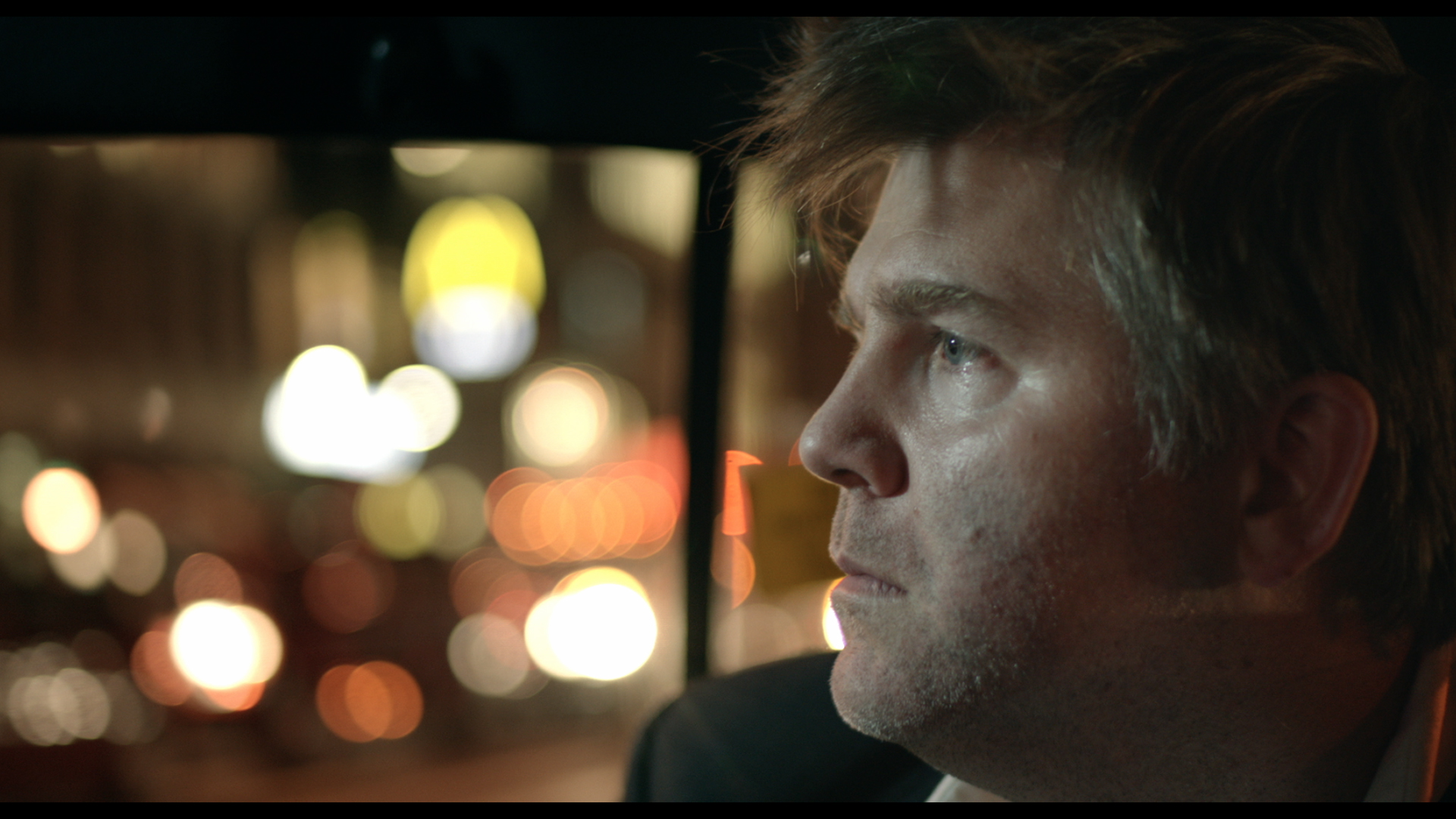
 On April 2, 2011, after ten years of building a devoted following that was still growing, electronic dance-punk faves LCD Soundsystem played its
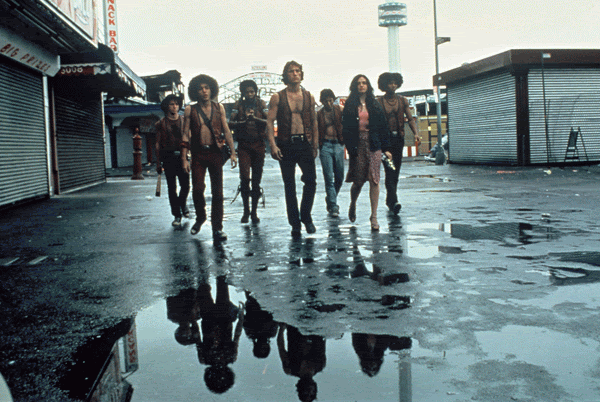
 At a huge gang meeting in the Bronx (actually shot in Riverside Park), the Warriors are wrongly accused of having killed Cyrus (Roger Hill), an outspoken leader trying to band all the warring factions together to form one huge force that can take over the New York City borough by borough. The Warriors then must make it back to their home turf, Coney Island, with every gang in New York lying in wait for them to pass through their territory. This iconic New York City gang movie is based on Sol Yurick’s novel, which in turn is loosely based on Xenophon’s Anabasis, which told of the ancient Greeks’ retreat from Persia. Michael Beck stars as Swan, who becomes the de-facto leader of the Warriors after Cleon (Dorsey Wright) gets taken down early. Battling Swan for control is Ajax (Dexter’s James Remar) and tough-talking Mercy (Too Close for Comfort’s Deborah Van Valkenburgh). Serving as a Greek chorus is Lynne (Law & Order) Thigpen as a radio DJ, and, yes, that young woman out too late in Central Park is eventual Oscar winner Mercedes Ruehl. Among the cartoony gangs of New York who try to stop the Warriors are the roller-skating Punks, the pathetic Orphans, the militaristic Gramercy Riffs, the all-girl Lizzies, the ragtag Rogues, and the inimitable Baseball Furies. Another main character is the New York City subway system. The Warriors is a gritty, tense, violent, funny, romantic, wholly absorbing movie, a brutal yet tender tale that will quickly work its way into your heart. The Warriors is screening May 25-27 as part of the IFC Center’s Wild Hill: Walter Hill at Midnight series, celebrating the career of the director of such films as 48 Hrs., Streets of Fire, and The Long Riders. The IFC Center will also be showing Hill’s underrated bare-knuckle drama Hard Times, with James Coburn and Charles Bronson, on June 1-2, followed on June 8-9 by the Hill-scripted Hickey & Boggs, starring Bill Cosby and Robert Culp (who directed the film), and June 15-16 by Sam Peckinpah’s The Getaway, which Hill wrote and stars Steve McQueen and Ali McGraw.