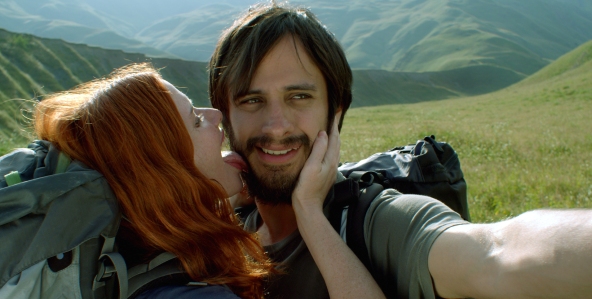
Nica (Hani Furstenberg) and Alex (Gael García Bernal) experience a moment that changes everything in THE LONELIEST PLANET
THE LONELIEST PLANET (Julia Loktev, 2011)
IFC Center
323 Sixth Ave. at West Third St.
Opens Friday, October 26
212-924-7771
www.ifcfilms.com
www.ifccenter.com
 The first half of Julia Loktev’s second feature film, The Loneliest Planet, is a dazzling tour de force, as young lovers Alex (Gael García Bernal) and Nica (Hani Furstenberg) revel in all that life has to offer. Shortly before getting married, they have decided to go on a hiking trip through the Caucasus Mountains in Georgia, led by a guide named Dato (real-life mountaineer Bidzina Gudjabidze, in his first acting role). Alex and Nica are fresh and alive, their eyes filled with wonder, their faces in perpetual, infectious smiles as they make their way through spectacular landscapes gorgeously photographed by cinematographer Inti Briones. In several shots, the three hikers are barely visible walking in the distance as Briones focuses on breathtaking views of the lush green mountainside and vast Central Asian landscape (as well as, in close-up, Furstenburg’s dazzling red hair). What little dialogue there is doesn’t really matter; in fact, much of it is hard to hear, more like background noise, and what is spoken in foreign languages isn’t even translated. But when the travelers run into three locals, something happens that upends the dynamic and severely changes the relationship among Alex, Nica, and Dato, something that requires the kind of split-second decision that one can never take back, resulting in a return journey that is much darker, the smiles, laughter, and romance disappearing in a stark moment. Based on Tom Bissell’s short story “Expensive Trips Nowhere,” The Loneliest Planet recalls such seminal works as Mikhail Kalatozov’s The Letter Never Sent, Andrei Tarkovsky’s Stalker, John Boorman’s Deliverance, Akira Kurosawa’s Dersu Uzala, and Roberto Rosselini’s Voyage in Italy, in which location serves as a character of mystery and potential danger. Loktev, a visual artist who previously made the 1998 documentary Moment of Impact, which details her family’s very personal experiences after her father was hit by a car, and her 2006 narrative debut, Day Night Day Night, about a female Palestinian suicide bomber, has crafted a mesmerizing tale built around small subtleties and the tender, fragile nature of human relationships, in which one misstep can have shattering consequences. Mexican actor García Bernal and New York-born Israeli star Furstenberg make a terrifically believable couple, so vibrant in the first half, so tentative and subdued in the latter sections.
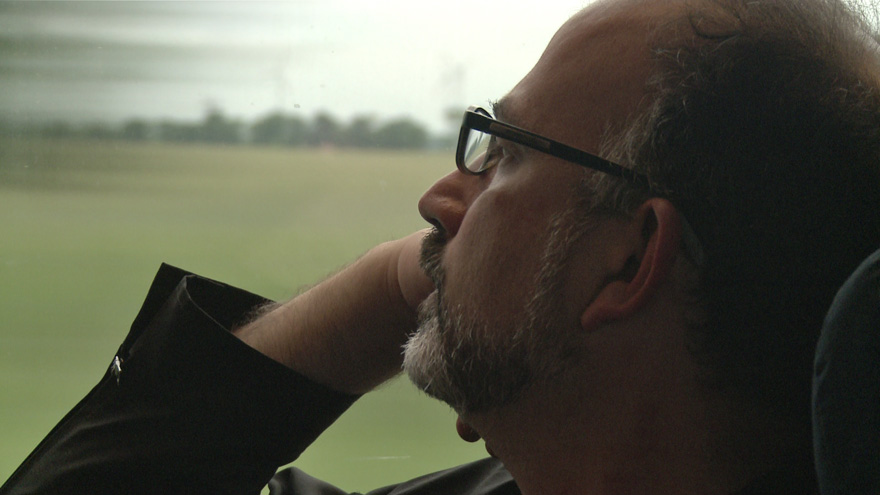

 Nothing is off limits for South Park dudes Trey Parker and Matt Stone in this marionette musical actioner that mixes Top Gun, Mission: Impossible, and The Matrix with that old classic television puppet show Thunderbirds. Kim Jong Il is determined to unleash his weapons of mass destruction on an unsuspecting world, and it is up to Team America and its newest member, actor Gary Johnston, formerly of the hit musical Lease, to stop the North Korean leader’s heinous plan. But Team America is a reckless bunch that has a tendency to destroy major cities and landmarks (the Eiffel Tower, the Sphinx) as it attempts to take out terrorists. Meanwhile, love threatens to complicate the success of their mission. Parker and Stone skewer international politics, the military, celebrity, and the media in this very dirty, very funny flick; among their victims are Alec Baldwin, Susan Sarandon, Sean Penn, Peter Jennings, Hans Blix, George Clooney, and, mercilessly, Matt Damon and Ben Affleck. There’s lots of blood and gore, a very hot puppet sex scene, and the best description ever about the three kinds of people in the world. Although it often misses its target or goes way too far — it could have been a classic like South Park: Bigger Longer & Uncut — it’s still a good way to spend a late night out at the movies. Team America: World Police is screening in 35mm at 12:15 am on Friday and Saturday night as part of the IFC Center’s Waverly Midnights series, which continues October 26-27 with Paul Verhoeven’s Starship Troopers and November 2-3 with Todd Solondz’s Election.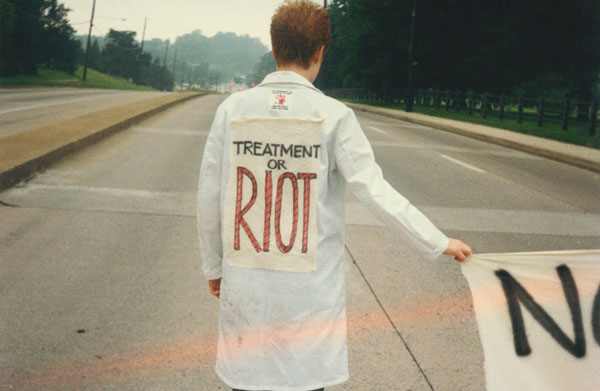
 Based on the play by Charles Bennett, Alfred Hitchcock’s 1929 thriller, Blackmail, is both his last silent picture as well as his first sound film. The transition is evident from the very beginning, eight glorious minutes of a police arrest with incidental music only, highlighted by an unforgettable mirror shot (courtesy of cinematographer Jack E. Cox) as the cops close in on their suspect. After those opening moments, the film switches to a talkie, as New Scotland Yard detective Frank Webber (John Longden) gets into a fight with his girlfriend, Alice White (Anny Ondra, later to become the longtime Mrs. Max Schmeling), who goes off on a secret rendezvous with a slick artist named Crewe (Cyril Ritchard). When things go horribly wrong at Crewe’s studio, Frank assures Alice that he will help her, but slimy ex-con Tracy (Donald Calthrop) has other ideas, thinking he can use some inside information to make a small killing. After shooting the picture with sound — including having Ondra’s dialogue spoken off-screen by Joan Barry because Ondra’s Eastern European accent was too thick — Sir Alfred filmed some scenes over again in silence, resulting in two versions of this splendid psychological thriller, both laced with elements of German Expressionism and early film noir as well as flashes of Edgar Allan Poe’s “The Tell-Tale Heart” and Fyodor Dostoyevsky’s Crime and Punishment. Look for Alfred as the man on the subway being menaced by a young boy. The sound version of Blackmail is being screened September 14-16 at the IFC Center as part of the “Weekend Classics: Hitchcock, Part II” series, which continues in September with such other early Hitchcock films as Secret Agent and Number 17.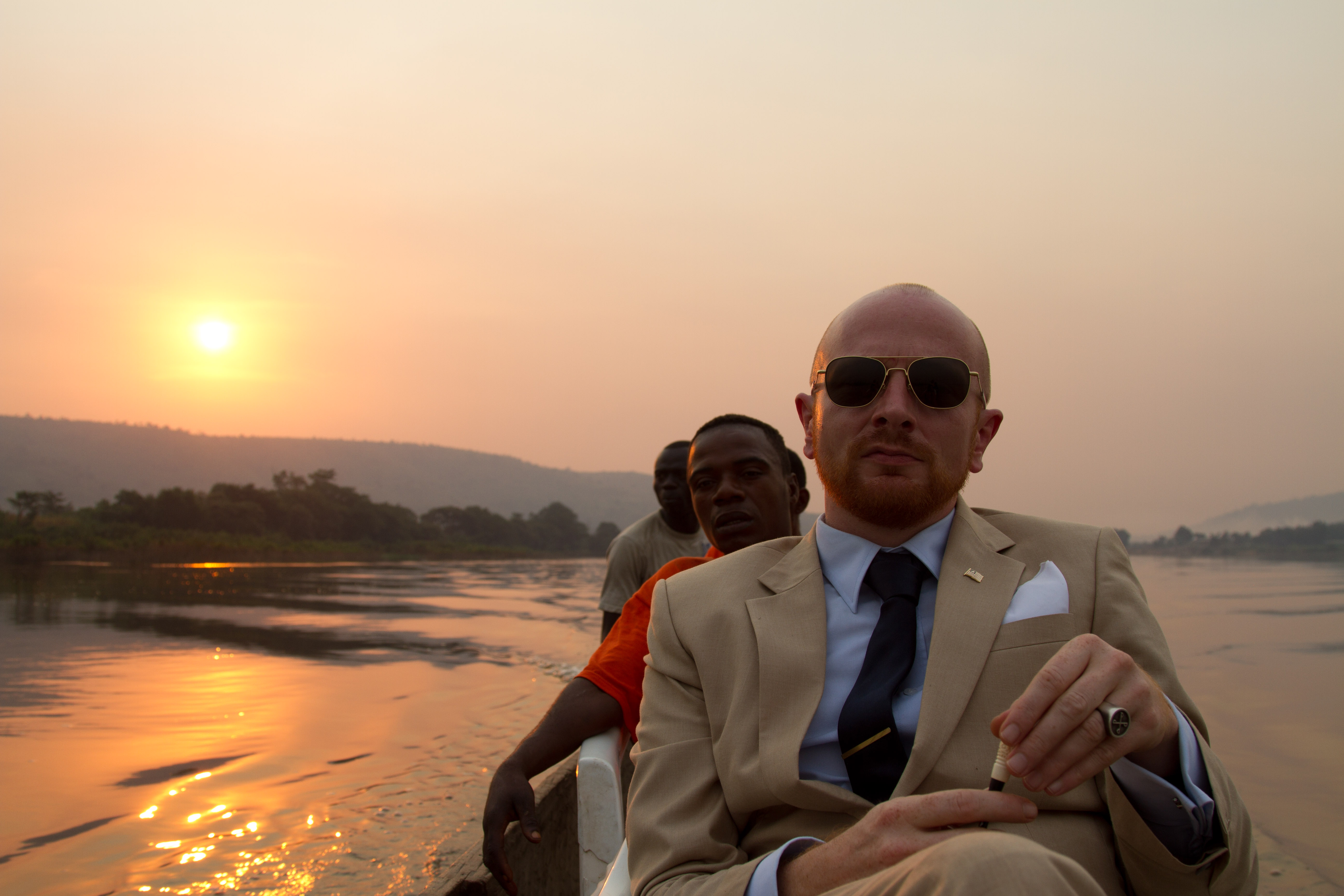
 Danish journalist Mads Brügger risked a lot more than just his career in making The Ambassador; he put his life on the line as well. “If you do it the way we will set you up to do it, you have a very high probability of success,” he is told by Colin Evans, who works for a company that can allegedly make anyone a diplomat of a diamond-rich African nation for the right price. “If you do it any other way, the best that you can hope for is to be arrested and go to jail and lose everything you’ve got. That’s the best you can hope for. The worst you can hope for is that you end up dead in a ditch in Africa.” Using his full name, Mads Johan Brügger Cortzen seeks to become a Liberian diplomat to the Central African Republic, meeting with powerful, important, and dangerous people on his fascinating journey, handing out “envelopes of happiness” filled with cash while claiming to want to build a match factory with the help of native pygmies. As Brügger’s story gets more and more ridiculous, he gains greater access, with soon only President Ellen Johnson Sirleaf’s signature necessary to achieve his absurd goal. An intriguing mix of Sacha Baron Cohen’s Borat and Ali G characters and controversial filmmaker and activist Michael Moore, Brügger, whose previous film, The Red Chapel, found him leading a bizarre experimental theater troupe into North Korea, goes about his business with a sly confidence, balancing the serious nature of the proceedings with humorous moments that threaten to reveal his ruse, but nobody seems to catch on as the money keeps flowing. (The film was financed by Lars Von Trier’s Zentropa studio.) Primarily using hidden cameras that he keeps rolling even after being told that filming is not allowed, Brügger employs his unique brand of what he calls “performative journalism,” a blend of performance art and investigative journalism that results in an outrageously entertaining film that exposes surprisingly blatant international corruption and has led to a firestorm of debate. The film opens August 29 at the IFC Center, with Brügger on hand for a Q&A following the 8:20 screenings on August 29 and 30.