Tag Archives: ifc center

FIRST COMES LOVE

Documentarian Nina Davenport shares intimate details of her private life in FIRST COMES LOVE

Documentarian Nina Davenport shares intimate details of her private life in warts-and-all documentary FIRST COMES LOVE

FIRST COMES LOVE (Nina Davenport, 2012)
IFC Center
323 Sixth Ave. at West Third St.
July 24-30
212-924-7771
www.ifccenter.com
www.ninadavenport.com

Back in 2000, documentarian Nina Davenport made Always a Bridesmaid, in which she shared her views on being single and nearly thirty as she worked as a wedding videographer. A dozen years later, in the deeply personal First Comes Love, she turns the camera on her private life once again as she contemplates being single, childless, and forty-one — and takes matters into her own hands, deciding to have a baby on her own. With her best friend, Amy, by her side and her college friend, Eric, agreeing to be the sperm donor, Nina details every critical moment and more as she goes on this intimate journey, opening up her life for all to see. She discusses things with her family, particularly her adoring mother and her distant, hard-to-please father, as well as other relatives and friends, who give their opinions on whether they think it’s a good idea. Several of her acquaintances have also either recently had a baby on their own or are considering it as well, revealing the changing patterns of the American family in the twenty-first century, especially in New York City. Serving as writer, director, producer, editor, cinematographer, and principal subject, Davenport, in the style of one of her Harvard mentors, Ross McElwee (Sherman’s March), holds nothing back, which at times becomes overly self-indulgent and a bit much to take, but the combination of her eagerness and her fears, along with her willingness to show it all, ultimately makes First Comes Love the most human of stories. The film is running July 24-30 at the IFC Center, with Davenport participating in Q&As following the 7:35 screenings on July 24 and 25; it also premieres on HBO on July 29.

QUEER/ART/FILM: HAROLD AND MAUDE

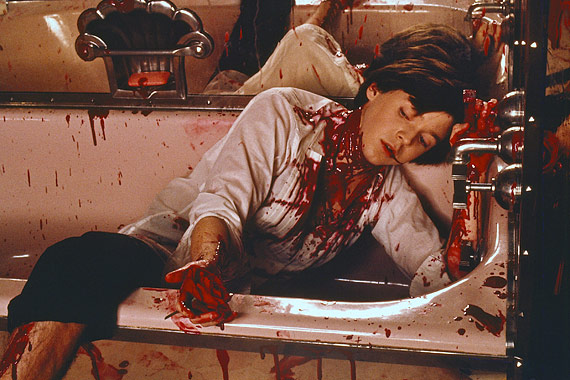
Harold (Bud Cort) has a little bit of an obsession with death in very different kind of romantic comedy

HAROLD AND MAUDE (Hal Ashby, 1971)
IFC Center
323 Sixth Ave. at West Third St.
Monday, July 22, 8:00
212-924-7771
www.ifccenter.com

Bud Cort (Harold) and Ruth Gordon (Maude) are magnificent in this glorious black comedy from director Hal Ashby (The Last Detail, Shampoo, Being There) and writer Colin Higgins (Foul Play, 9 to 5). Harold is an eighteen-year-old rich kid obsessed with death, regularly flirting with suicide. Maude is a fun-loving, free-spirited senior citizen approaching her eightieth birthday. Ashby throws in just the right amount of post-1960s social commentary, including a very funny antiwar scene, without becoming overbearing, as this could have been a maudlin piece of sentimental claptrap, but instead it’s far from it. Even the Cat Stevens soundtrack (“If You Want to Sing Out, Sing Out,” “Tea for the Tillerman,” “Where Do the Children Play?”) works. Harold and Maude is a tender, uproarious, bittersweet tale that is one of the best of its kind, completely unforgettable, enlightening, and, ultimately, life-affirming in its own odd way. Harold and Maude is screening in a DCP projection July 22 at 8:00 as part of the IFC Center series “Queer/Art/Film” and will be followed by a discussion with Chilean multidisciplinary artist, musician, and director Sebastián Silva (Crystal Fairy, Iwannawin & Friends). The monthly series, which consists of films selected by gay New York City artists, concludes August 19 with Stephen Frears’s My Beautiful Laundrette, picked by Brooklyn-born visual artist Chitra Ganesh.

BENEATH

BENEATH

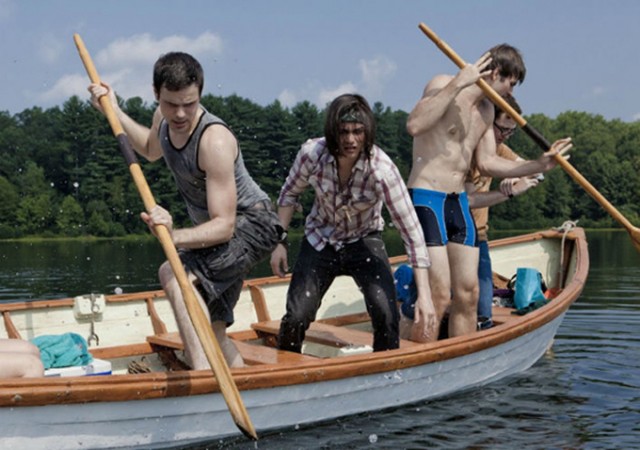
A group of teenagers are going to need a much bigger boat in Larry Fessenden’s tense thriller BENEATH

BENEATH (Larry Fessenden, 2013)
IndieScreen, 2899 Kent Ave. at South Second St., 347-227-8030, July 16, 19, 20, 9:00
IFC Center, 323 Sixth Ave. at West Third St., 212-924-7771, opens Wednesday, July 17
www.beneaththewater.com

Jaws and Friday the 13th meet Lifeboat and Lord of the Flies in indie filmmaker Larry Fessenden’s latest thriller, Beneath. Made for Syfy’s Chiller TV channel, where it will be available on demand beginning July 16 — it is also being released theatrically in New York City this week — Beneath is the first feature film Fessenden (The Last Winter, Habit, Wendigo) has directed but did not write; the occasional actor and musician also served as producer and editor, while the script is by Tony Daniel and Brian D. Smith. The story takes place on a Connecticut lake, where a group of teenagers have gone to celebrate high school graduation. Sexy blonde Kitty (Bonnie Dennison), athletic meathead brothers Matt (Chris Conroy) and Simon (Jonny Orsini), camera-obsessed nerd Zeke (Griffin Newman), demure brunette Deb (MacKenzie Rosman), and pouty townie Johnny (Daniel Zovatto) head out on a rowboat to cross the Black Lake, but they soon learn that they’re going to need a much bigger boat, as there’s something lurking in the water that prefers not to be disturbed. As the teens battle the evil, giant piranha/monkfish, deep, dark secrets float to the surface, leading the kids to fight amongst themselves as much as their mechanical tormentor. Fessenden clearly has fun playing with genre clichés, although there are still plenty of moments in which viewers will find themselves yelling at the screen because of stupid decisions or gigantic plot holes, but he does a good job given his restrictions — because this is essentially a basic-cable movie, there is no cursing or nudity, and the tense action has to have carefully timed pauses built in to allow for eventual commercials. Still, Beneath is an involving, claustrophobic tale in which the characters’ true individual natures emerge as their fear of death grows. To find out more about the history of the lake, a prequel comic book is available, written by Daniel and Smith and illustrated by Brahm Revel. Beneath opens July 17 at the IFC Center and will also be shown July 16, 19, and 20 at IndieScreen in Williamsburg, with Fessenden participating in a Q&A following the July 16 screening.
BIG STAR’S THIRD: AN ORCHESTRATED LIVE PERFORMANCE OF THE LEGENDARY ALBUM

Jody Stephens will lead a special SummerStage concert performance of Big Star's THIRD on June 30 (photo by Daniel Coston)

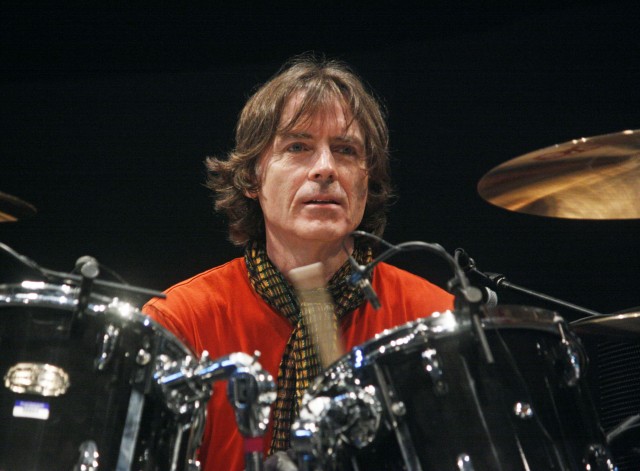
Jody Stephens will lead a special SummerStage concert performance of Big Star’s THIRD on June 30 (photo by Daniel Coston)

Central Park SummerStage
Rumsey Playfield
Sunday, June 30, free, 7:00
www.cityparksfoundation.org
www.bigstarthird.com

In March 2010, Chris Stamey was getting ready to head to SXSW to ask the re-formed Big Star if he could put together an all-star band to play the group’s seminal 1970s record Third / Sister Lovers when he found out that Alex Chilton had suddenly passed away at the age of fifty-nine. With the help of Big Star cofounder Jody Stephens, the project eventually went on because, as Stamey explains on his blog, “regardless of who performed it, it should be heard out in the air, not confined to earbuds, cars, and living rooms. In the same way that Mozart and Beethoven, in their day, were heard.” On June 30, Stamey will lead a diverse group of friends in a performance of the full album, which includes such tracks as “Kizza Me,” “Holocaust,” “Kangaroo,” “You Can’t Have Me,” “Femme Fatale,” and “Take Care,” in Central Park, with vocalists Sharon Van Etten, Kurt Vile, Marshall Crenshaw, Pete Yorn, Reeve Carney, Jonathan Donahue, and Becky Stark joining instrumentalists Mike Mills, Mitch Easter, Ken Stringfellow, Richard Lloyd, Dale Baker, Charles Cleaver, Django Haskins, Brett Harris, Skylar Gudasz, Stephens, and a twenty-piece chamber orchestra featuring Jane Scarpantoni and the Uptown Horns. Big Star fans can get even more beginning on July 3, when Drew DeNicola’s documentary Big Star: Nothing Can Hurt Me opens at the IFC Center, with Stephens, DeNicola, and others participating in Q&As at select shows on July 4.

HUMAN RIGHTS WATCH FILM FESTIVAL: TALL AS THE BAOBAB TREE

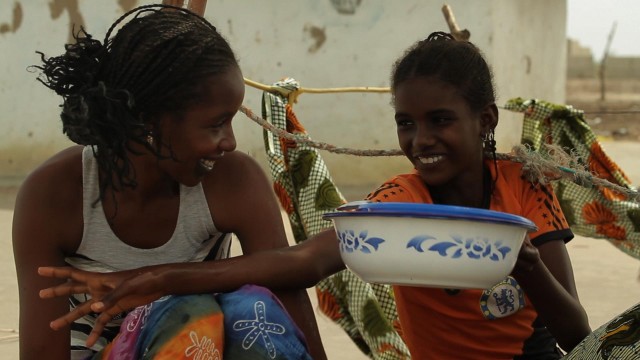
Real-life sisters Dior and Oumoul Kâ play fictional sisters facing a family crisis in TALL AS THE BAOBAB TREE

Real-life sisters Dior and Oumoul Kâ play fictional sisters facing a family crisis in TALL AS THE BAOBAB TREE

TALL AS THE BAOBAB TREE (GRAND COMME LE BAOBAB) (Jeremy Teicher, 2012)
IFC Center
323 Sixth Ave. at West Third St.
Sunday, June 23, 7:00 & 9:30
212-924-7771
www.tallasthebaobabtree.com
www.ff.hrw.org

The 2013 Human Rights Watch Film Festival comes to a close on June 23 with Jeremy Teicher’s heart-wrenching Tall as the Baobab Tree, an involving, powerful, yet gentle drama about a Senegalese family trapped by tradition in a modernizing world. Real-life sisters Dior and Oumoul Kâ star as Coumba and Debo, close siblings who live in the tiny rural village of Sinthiou Mbadane (where they actually are from). When their older brother, Silèye (Alpha Dia), falls out of a baobab tree and breaks his leg, their father (Mouhamed Diallo) doesn’t have enough money to pay for the necessary medical care so he instead sends Coumba out to do Silèye’s job of herding the cows and decides to sell off eleven-year-old Debo to suitors for marriage. Their mother (Mboural Dia) is unwilling to stand up to her husband, so Coumba hatches a plan in which her friend Amady (Cheikh Dia), who has a crush on her, will watch the herd for her secretly while she heads into the city and gets a job until she makes enough money to help Silèye heal and prevent Debo from having to marry so young. Unfortunately, not everything goes quite as planned. But through it all, no matter how difficult things get, all of the characters maintain their faith, praising peace and continually saying, “God is great.”

Teicher came up with the idea for Tall as the Baobab Tree when he was a student working on This Is Us, a documentary for the nonprofit organization CyberSmart Africa in which the children of Sinthiou Mbadane created brief digital stories about their lives. Teicher, who directed Tall as the Baobab Tree and cowrote it with Alexi Pappas, chose to focus on the very real African problem of forced marriage of young girls between the ages of eight and twelve, collaborating closely with the nonprofessional actors selected from the village, allowing their own stories to meld together, blending fact and fiction. Another central issue is the importance of education, particularly for girls, as Debo clearly would rather follow in Coumba’s footsteps and prepare for university instead of becoming a child bride. The narrative unfolds slowly and calmly, with no overemotional, melodramatic moments or any soapbox preaching, while the tender mood is enhanced by cinematographer Chris Collins’s lush photography and Salieu Suso’s Kora-based score. Presented in conjunction with the African Film Festival and Girls Not Brides: The Global Partnership to End Child Marriage, Tall as the Baobab Tree, the first feature ever filmed in the Puular language, is screening June 23 at the IFC Center at 7:00, followed by a discussion with Teicher and Human Rights Watch African division deputy director Rona Peligal, and again at 9:30, introduced by Teicher.

HUMAN RIGHTS WATCH FILM FESTIVAL: FATAL ASSISTANCE

FATAL ASSISTANCE

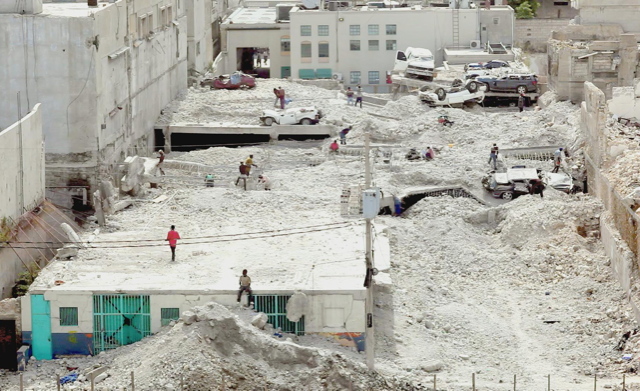
Documentary reveals that there’s still a whole lot to be done in Haitian recovery effort as organizations fight over details

FATAL ASSISTANCE (ASSISTANCE MORTELLE) (Raoul Peck, 2012)
Wednesday, June 19, 6:30, Film Society of Lincoln Center, Elinor Bunin Munroe Film Center, Francesca Beale Theater, 144 West 65th St. at Amsterdam Ave.
Thursday, June 20, 7:00, IFC Center, 323 Sixth Ave. at West Third St.
Festival runs June 13-23
www.ff.hrw.org

Award-winning Haitian filmmaker Raoul Peck’s Fatal Assistance begins by posting remarkable numbers onscreen: In the wake of the devastating earthquake that hit his native country on January 12, 2010, there were 230,000 deaths, 300,000 wounded, and 1.5 million people homeless, with some 4,000 NGOs coming to Haiti to make use of a promised $11 billion in relief over a five-year period. But as Peck reveals, there is significant controversy over where the money is and how it’s being spent as the troubled Haitian people are still seeking proper health care and a place to live. “The line between intrusion, support, and aid is very fine,” says Jean-Max Bellerive, the Haitian prime minister at the time of the disaster, explaining that too many of the donors want to cherry-pick how their money is used. Bill Vastine, senior “debris” adviser for the Interim Commission for the Reconstruction of Haiti (CIRH), which was co-chaired by Bellerive and President Bill Clinton, responds, “The international community said they were gonna grant so many billions of dollars to Haiti. That didn’t mean we were gonna send so many billions of dollars to a bank account and let the Haitian government do with it as they will.” Somewhere in the middle is CIRH senior housing adviser Priscilla Phelps, who seems to be the only person who recognizes why the relief effort has turned into a disaster all its own; by the end of the film, she is struggling to hold back tears. A self-described “political radical,” Peck doesn’t play it neutral in Fatal Assistance, instead adding mournful music by Alexei Aigui, somber English narration by a male voice (Peck narrates the French-language version), and a female voice-over reading melodramatic “Dear friend” letters that poetically trash what is happening in Haiti. “Every few decades, the rich promise everything to the poor,” the male voice-over says. “The dream of eradication of poverty, disease, death remains a perpetual fantasy.” Even though Peck (Lumumba, 2010 Human Rights Watch Film Festival centerpiece Moloch Tropical) attacks the agendas of the donors and NGOs while pushing an agenda of his own, Fatal Assistance is an important document that shows that just because money pours in to help in a crisis situation doesn’t mean that the things that need to be done are being taken care of properly. Fatal Assistance is the centerpiece selection of the 2013 Human Rights Watch Film Festival, where it will be screening June 19 at Lincoln Center and June 20 at the IFC Center with Peck, the former Haitian minister of culture, the 1994 winner of the festival’s Nestor Almendros Award for courage in filmmaking, and the 2001 festival Lifetime Achievement Award winner, on hand for Q&As after both presentations.

HUMAN RIGHTS WATCH FILM FESTIVAL: THE ACT OF KILLING

THE ACT OF KILLING

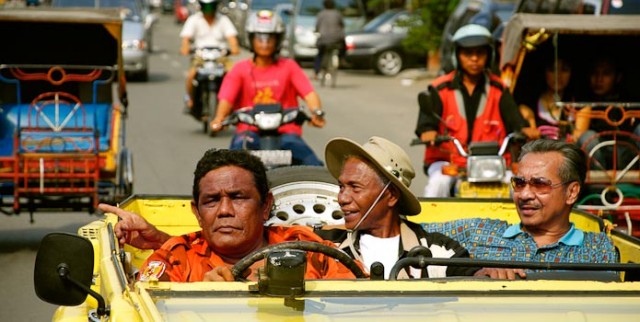
Proud mass murderers envision themselves as movie stars in Joshua Oppenheimer’s THE ACT OF KILLING

THE ACT OF KILLING (Joshua Oppenheimer, 2012)
IFC Center
323 Sixth Ave. at West Third St.
Tuesday, June 18, 9:30, and Wednesday, June 19, 9:00
Festival runs June 13-23
212-875-5601
www.theactofkilling.com
www.ff.hrw.org

Joshua Oppenheimer’s The Act of Killing is one of the most disturbing, and unusual, films ever made about genocide. In 1965-66, as many as a million supposed communists and enemies of the state were killed in the aftermath of a military coup in Indonesia. Nearly fifty years later, many of the murderers are still living in the very neighborhoods where they committed the atrocities, openly boasting about what they did, being celebrated on television talk shows, and even being asked to run for public office. While making The Globalization Tapes in Indonesia in 2004, the Texas-born Oppenheimer met some of these self-described gangsters and, struck by their brash, bold attitudes, decided to create a different kind of documentary. In addition to following them around as they go bowling, play golf, sing, and dance, proudly showing off how happy their lives are, Oppenheimer offered them the opportunity to tell their story as if it were a Hollywood movie. The men, whose love of American noir and Westerns heavily influenced the stylized killings they perpetrated, loved the idea and began to restage torture and murder scenes in great detail for the camera, getting in period costumes, putting on makeup, going over script details, reviewing the dailies, and playing both the violent criminals and their victims. The leader is master executioner Anwar Congo, who is perhaps the only one haunted by his deeds; although on the surface he is proud of what he did, he is tormented by constant nightmares. Such is not the case for the others, who laugh as they go over the gory details, especially paramilitary leader Herman Koto, Congo’s protégé and a man seemingly without a conscience. Meanwhile, fellow executioner Adi Zulkadry wonders whether telling the truth will actually negatively impact their legendary status. “Human rights! All this talk about ‘human rights’ pisses me off,” Congo says in one scene. “Back then there was no human rights.” Oppenheimer also depicts how frighteningly powerful the three-million-strong, government-connected Pancasila Youth is, ready to fight for the very same things that led to the genocide in the first place. It’s hard to comprehend how these men continue to walk free, and one can argue whether Oppenheimer should indeed be giving them the platform that he does. Watching these gangsters — or “free men,” as they like to call themselves, since the Indonesian word for gangster is “preman,” derived from the Dutch “vrijman” — artistically re-create scenes of horrific violence is both illuminating and infuriating on multiple levels that will leave viewers angry and incredulous. The Act of Killing is screening June 18 & 19 at the IFC Center as part of the “Focus on Asia” section of the 2013 Human Rights Watch Film Festival before opening July 19 at the Landmark Sunshine Cinema.