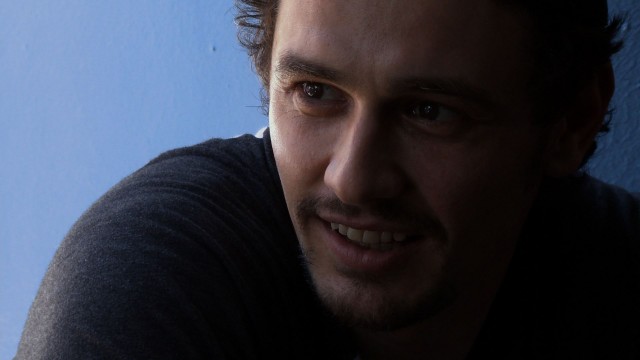
James Franco seeks to re-create the forty missing minutes of CRUISING in collaboration with Travis Mathews
INTERIOR. LEATHER BAR (James Franco & Travis Mathews, 2013)
IFC Center
323 Sixth Ave. at West Third St.
March 5-13
212-924-7771
www.ifccenter.com
www.interiorleatherbar.com
 In his 2013 autobiography, The Friedkin Connection, writer-director William Friedkin delves into his controversial 1980 film, Cruising, explaining, “I cut at least half an hour from the club scenes and the murder scenes. I had purposely let these scenes of pornography and violence run long, knowing they’d be cut and I’d be left with the story I wanted to tell. Despite these cuts, the film pushes the boundaries of what is acceptable in an R-rated film, something the critics were quick to point out.” Cruising, which stars Al Pacino as an undercover cop hunting a serial killer in New York City’s underground gay community, was a critical and financial flop; the Variety reviewer wrote, “If this is an R, then the only X left is actual hardcore.”
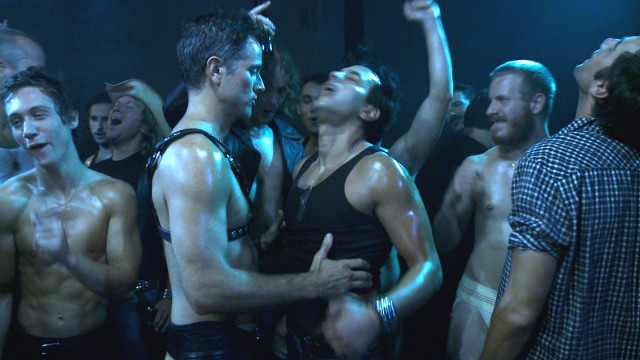
INTERIOR. LEATHER BAR runs March 5-13 at the IFC Center as part of FrancoFest
Cut to Interior. Leather Bar. Last year, James Franco and San Francisco filmmaker Travis Mathews (In Their Room) decided to re-create what the never-screened forty minutes of missing footage might have been like. Franco hired Val Lauren, who played Sal Mineo in Franco’s Sal, to take on the Pacino role, surrounded by a cast of leather-clad actors who were told to pretty much go wild, no holds barred. And they do, as Franco and Mathews show graphic gay sex and S&M. After one particularly intense scene, Lauren expresses his doubts to Franco. “You think that this should be in movies, that people should be able to see this?” he asks. “Sex should be a storytelling tool, but we’re so f$%king scared of it,” Franco answers enthusiastically. “Everybody talks about sex, but then, ‘Don’t dare put it in a movie.’” But Lauren, and Variety, is right; this kind of graphic sex, whether gay or straight, does not belong in an R-rated movie. Most of the sixty minutes of Interior. Leather Bar are spent showing how happy Franco is as he pushes the envelope proudly, pontificating on society’s morals and hang-ups, and how Lauren is questioning his decision to star in the film, talking things over with his wife on his cell phone. What might have been an intriguing concept at the start ends up being Franco’s Brown Bunny (Vincent Gallo’s unwatchable 2003 film highlighted by real oral sex between him and former girlfriend Chloë Sevigny). The ubiquitous Franco can be sly, funny, and clever, especially with his own image — which includes a strong relationship with the gay community — but he’s truly annoying in Interior. Leather Bar, on a misguided, pointless mission that goes nowhere. The film is having its U.S. theatrical release March 5-13, being shown with Franco’s The Feast of Stephen and Mathews’s original I Want Your Love, as part of the IFC Center’s FrancoFest, consisting of features and shorts made by and/or starring Franco, in addition to a DCP projection of Cruising. Franco and Mathews will be on hand to discuss their collaboration following several screenings on March 5, 7, and 8.
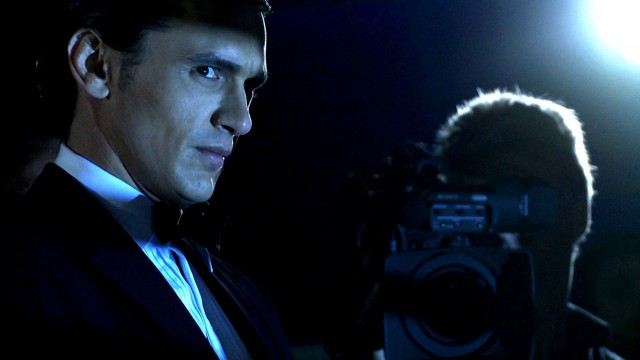
 Okay, we have an important confession to make: We can’t get enough James Franco. There, we said it. And we are truly excited about the IFC Center’s FrancoFest, a nine-day cinematic tribute to the California-born actor, screenwriter, director, artist, poet, teacher, philanthropist, college student, novelist, Oscar cohost, dance-theater enthusiast, fragrance spokesman, bon vivant, and soon-to-be Broadway star. We’re not about to fault him for wanting to get the most out of life. He’s also not afraid to poke fun of his own image, which he does in Francophenia (Or: Don’t Kill Me, I Know Where the Baby Is). The film follows Franco as he prepares for a critical scene for General Hospital, the soap opera in which he has portrayed a visual artist named Franco on and off since 2009. Dressed in a sharp tux, the fictional Franco is getting ready for the opening of his new exhibition at the Museum of Contemporary Art in Los Angeles as well as plotting to commit murder. He eagerly meets with adoring fans and speaks with the media, but as day turns to night, he starts doubting himself, although it’s not clear which Franco is suffering the psychological dilemma. In whispered voice-overs by codirector Ian Olds and cowriter Paul Felten, the actor/character becomes overwhelmed with fear and paranoia. “What’s gonna happen to me? Can you tell me?” he says, adding, “What was I thinking?” But he then remembers who he is and seeks to gain control. “I made this machine, and all the parts are moving perfectly, just as they should. I’m the foreman of the factory. I made this happen, all of it. And it’s brilliant. It’s a masterpiece,” he murmurs. The ramblings also take shots at his own “Being James Franco” persona as he declares, “Look at this: I’m everywhere. I’m the light of this world. I begat this motherf&*ker. What have you ever made?” Is Franco/Franco/Franco in on all the jokes or the subject of derision? Who cares, since it all seems to be in such good, self-referential fun. Francophenia is screening March 6 & 10 at the IFC Center, with Franco and Olds on hand for the first showing to talk about the work. FrancoFest runs March 5-13 with screenings of Danny Boyle’s 127 Hours, Rob Epstein and Jeffrey Friedman’s Howl (in which Franco plays Allen Ginsberg), Harmony Korine’s Spring Breakers, William Friedkin’s Cruising, Gus Van Sant’s My Own Private Idaho, and such Franco-directed flicks as Sal, My Own Private River, Good Time Max, The Broken Tower, As I Lay Dying, The Ape, and his latest, Interior. Leather Bar, which he directed with Travis Mathews, with Franco present at various screenings the first four days.
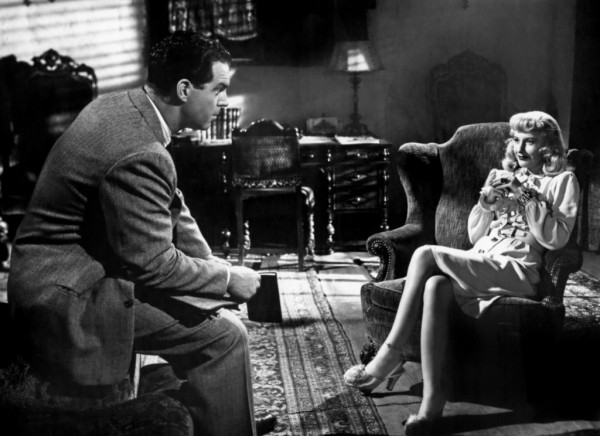
 The IFC Center is offering a wonderful way to celebrate Valentine’s Day with four screenings of that endlessly romantic noir classic, Billy Wilder’s Double Indemnity. Three years after a brunette Barbara Stanwyck tried to swindle Henry Fonda in Preston Sturges’s The Lady Eve, a blonde Stanwyck is looking for a way out of her loveless marriage when opportunity knocks in the form of acerbic insurance salesman Walter Neff (Fred MacMurray). Stanwyck plays alluring, tough-talking femme fatale Phyllis Dietrichson, who falls for Neff and soon convinces him that they should do away with her husband (Tom Powers). They’re both in it “straight down the line,” as she repeats throughout the film, but insurance fraud investigator Barton Keyes (Edward G. Robinson) isn’t so sure that Mr. Dietrichson’s death was an accident. John F. Seitz’s inventive black-and-white cinematography — watch for those Venetian blind shadows — set the standard for the genre. MacMurray, who had to be convinced by Wilder to take the part because he thought he’d be awful in the role, is sensational as Neff, oh-so-cool as he recites his cynical dialogue and lights matches with one hand. He might think he’s tough, but he’s no match for Stanwyck, who rules the roost. Both Stanwyck and MacMurray would go on to successful careers in television in the 1960s, he in My Three Sons, she in The Big Valley. Directed by Wilder from a script he wrote with Raymond Chandler based on a pulp novel by James Cain, with music by Miklós Rózsa — how’s that for a pedigree? — Double Indemnity, which was nominated for seven Oscars and won none, is screening February 14-17 at 11:00 am at the IFC Center, kicking off the “American Hustlers: Grifters, Swindlers, Scammers & Cheats” series, which continues through May 4 with such other tricky fare as George Roy Hill’s The Sting, David Mamet’s House of Games, Charles Crichton’s A Fish Called Wanda, and Peter Bogdanovich’s Paper Moon.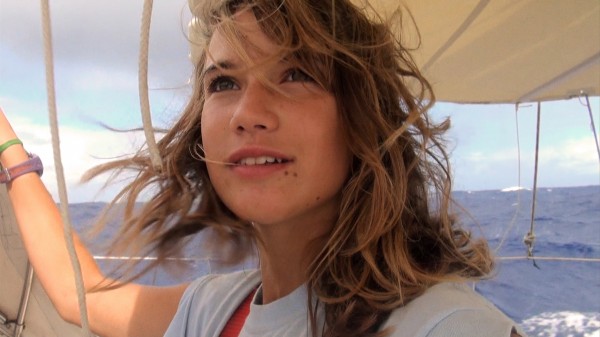
 In 2009, thirteen-year-old Laura Dekker announced that she was going to try to become the youngest person to sail around the world solo. After a long battle with the Dutch court, the teen, who was born on a boat in New Zealand and spent her first five years at sea, took off on her journey in her thirty-eight-foot ketch appropriately dubbed Guppy. Laura’s inspiring — and controversial — story is told in the winning documentary Maidentrip. Jillian Schlesinger’s debut feature-length film follows Laura as she circumnavigates the globe by herself, sailing across long stretches of sometimes treacherous ocean and making stops to experience a variety of lands and cultures. The bulk of Maidentrip is told in Laura’s own voice, as she films herself on board Guppy and talks not only about her adventure but also about her personal life, including discussing the effects of her parents’ divorce on her and her sister when she was five. “I love being alone,” Laura says at one point. “And I guess, yeah, I feel like freedom is when you’re not attached to anything.” As serious as she is about sailing, she is still a teenager, dancing in front of the camera playfully and throwing a little hissy fit when a visitor annoys her. It all makes for an intimate coming-of-age story as Laura, who values her privacy, grows up in public. Should her parents, particularly her father, who she chose to live with, have allowed the teen to go on this trip in the first place? Is it the court’s responsibility to intercede in such situations? Schlesinger gets the controversy out of the way early, never again revisiting what many people will consider a wrongheaded and dangerous decision, but they’re likely to change their mind once they watch Laura persevere and flourish at sea. Winner of the Audience Award at the Cannes Film Festival and SXSW, Maidentrip opens January 17 at the IFC Center, with Schlesinger and producer Emily McAllister on hand to talk about the film at the 6:25 and 8:25 screenings on Friday and Saturday night.