The relationship between actor and director becomes an intense psychosexual battle in Roman Polanski’s VENUS IN FUR
VENUS IN FUR (Roman Polanski, 2013)
IFC Center, 323 Sixth Ave. at Third St., 212-924-7771
Lincoln Plaza Cinema, 1886 Broadway between 62nd & 63rd Sts., 212-757-2280
Opens Friday, June 20
www.ifcfilms.com
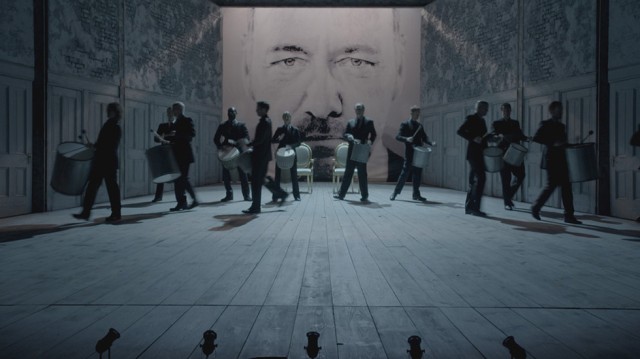
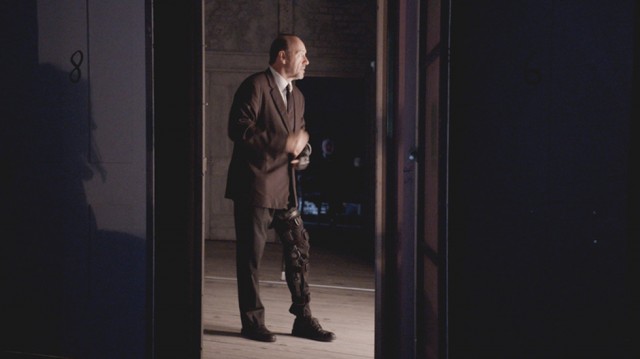
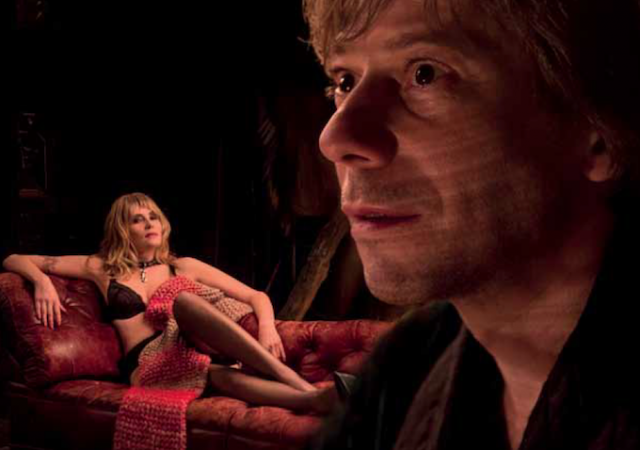
 For his third stage adaptation in ten years, following 1994’s Death and the Maiden and 2011’s Carnage, Roman Polanski has created a marvelous, multilayered examination of the intricate nature of storytelling, consumed with aspects of doubling. David Ives’s Tony-nominated play, Venus in Fur, is about a cynical theater director, Thomas Novachek, who is auditioning actresses for the lead in his next production, a theatrical version of Leopold von Sacher-Masoch’s psychosexual novella Venus in Furs (which led to the term “sado-masochism”), itself a man’s retelling of his enslavement by a woman. In the film, as he is packing up and about to head home, Thomas (Matthieu Amalric) is interrupted by Vanda (Emmanuelle Seigner), a tall blond who at first appears ditzy and unprepared, practically begging him to let her audition even though she isn’t on the casting sheet, then slowly taking charge as she reveals an intimate knowledge not only of his script but of stagecraft as well. An at-first flummoxed Thomas becomes more and more intrigued as Vanda performs the role of Wanda von Dunayev and he reads the part of Severin von Kushemski, their actor-director relationship intertwining with that of the characters’ dangerous and erotic attraction.
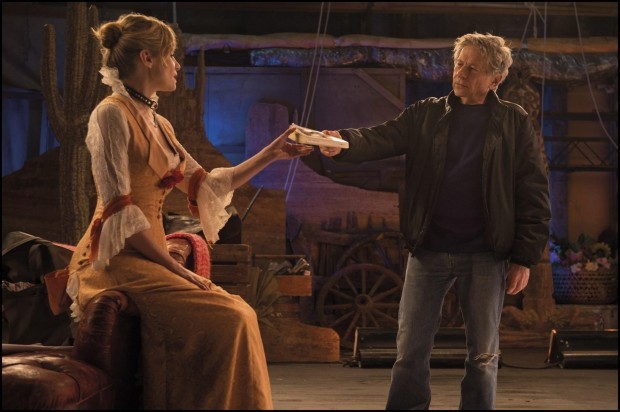
Roman Polanski directs wife Emmanuelle Seigner in thrilling stage adaptation of Tony-nominated play
Ives’s English-language play, which earned Nina Arianda a Tony for Best Actress, was set in an office, but Polanski, who cowrote the screenplay with Ives, has moved this French version to an old theater (the Théâtre Récamier in Paris, rebuilt by designer Jean Rabasse) where a musical production of John Ford’s Stagecoach has recently taken place, with some of the props still onstage, including a rather phallic (and prickly) cactus. Polanski has masterfully used the machinations of cinema to expand on the play while also remaining true to its single setting. One of the world’s finest actors, Amalric, who looks more than a little like a younger Polanski, is spectacular as the pretentious Thomas, his expression-filled eyes and herky-jerky motion defining the evolution of his character’s fascination with Vanda, while Seigner, who is Polanski’s wife, is a dynamo of breathless erotic power and energy, seamlessly weaving in and out of different aspects of Vanda. Venus in Fur was shot in chronological order with one camera by cinematographer Paweł Edelman, who has photographed Polanski’s last five feature films, making it feel like the viewer is onstage, experiencing the events in real time. Alexandre Desplat’s complex, gorgeous score is a character unto itself, beginning with the outdoor establishing shot of the theater. The film also contains elements that recall such previous Polanski works as The Tenant, Bitter Moon, Tess, and The Fearless Vampire Killers, placing it firmly within his impressive canon. Polanski was handed Ives’s script at Cannes in 2012, and this screen version was then shown at Cannes for the 2013 festival, a whirlwind production that is echoed in Seigner’s performance; perhaps what’s most amazing is that it is only now finally getting its official U.S. theatrical release, beginning June 20 at the IFC Center and Lincoln Plaza.
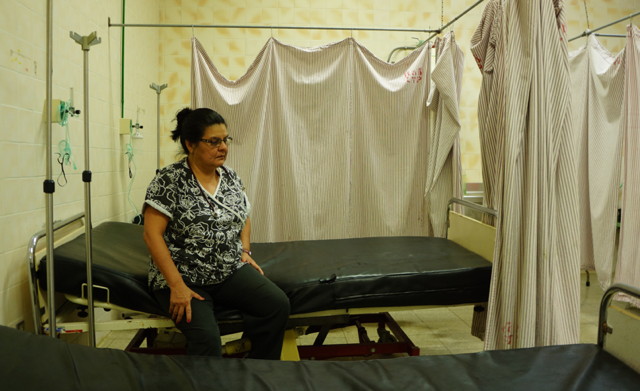
 Alessandra Zeka and Holen Sabrina Kahn delve into the very real and personal impact of Nicaragua’s total ban on abortion as seen through the eyes of a doctor forced to comply with the law in the eye-opening documentary A Quiet Inquisition. In Hospital Aleman Nicaraguense, Dr. Carla Cerrato must regularly deal with patients, many of whom are teenagers, whose pregnancies could severely harm or even kill them. But since 2006, when former president Daniel Ortega of the Sandinista National Liberation Front ran for reelection in Nicaragua, all kinds of abortions are illegal, including cases involving rape, incest, and the health of the mother and fetus. The film shows Dr. Cerrato counseling pregnant girls, attempting to come up with options that can save their lives through what are known as therapeutic abortions, but she is often thwarted by her colleagues. They refuse to carry out her orders even when the live birth of the baby is considered impossible and the death of the mother a certainty, fearing their own prosecution and imprisonment. “We are at a crossroads because of a law that impedes us from inducing a pregnancy or making a determination that can prevent further complications in the mother,” says Dr. Zamora, another OBGYN at the public hospital. He later adds, “I have fear too. My wife is pregnant. If any of these complications happen to her, as a doctor my hands would be tied. But as a person I would decide to act on it differently.” While Dr. Cerrato applauds the Sandinista revolution for helping her and other women become doctors in the first place, she now blames President Ortega and the FSLN for making deals with the Catholic Church, trading votes for the rights of women to control their own bodies. As the title of the film implies, Dr. Cerrato, a calm, good-natured woman with a realistic perspective on the situation, is fighting back in a quiet way; anything louder is liable to place her career in jeopardy.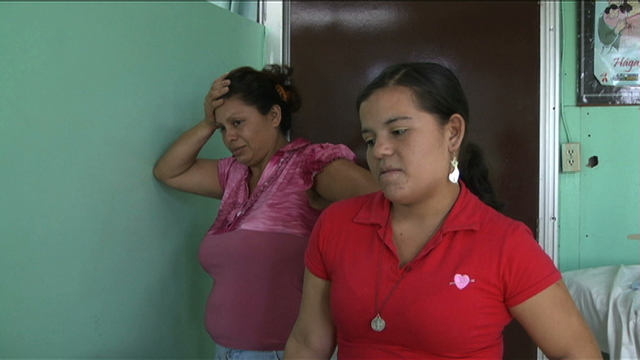
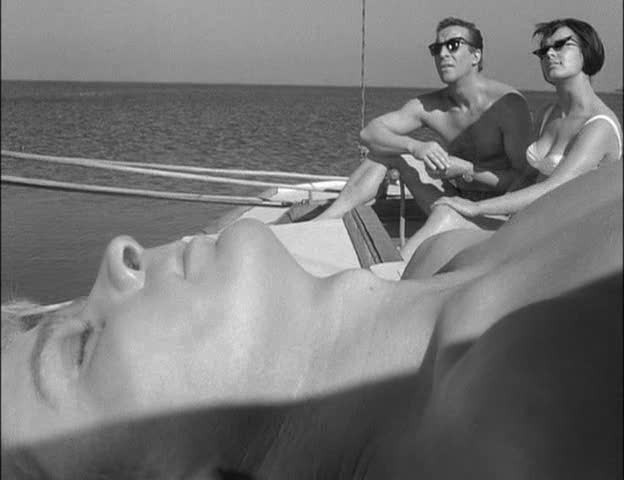
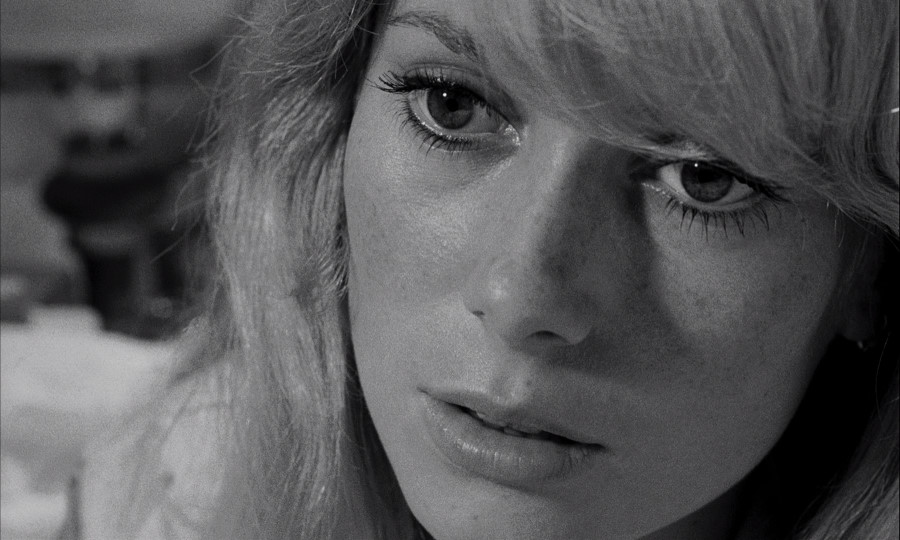
 “Even discounting wind, weather, and the natural hazards of filming afloat, Knife in the Water was a devilishly difficult picture to make,” Roman Polanski wrote in his 1984 autobiography, Roman by Polanski. That is likely to have been a blessing in disguise, upping the ante in the Polish filmmaker’s debut feature film, a tense three-character thriller set primarily on a sailboat, filmed on location. Upper-middle-class couple Andrzej (theater veteran Leon Niemczyk) and Krystyna (nonprofessional actor Jolanta Umecka) are on their way to their sailboat at the marina when a young hitchhiker (drama school grad Zygmunt Malanowicz) forces them to pull over on an otherwise empty road. Andrzej and the unnamed man almost immediately get involved in a physical and psychological pissing contest, with Andrzej soon inviting him to join them on their sojourn, practically daring the hitchhiker to make a move on his wife. Once on the boat, the two men continue their battle of wills, which becomes more dangerous once the young man reveals his rather threatening knife, which he handles like a pro. Lodz Film School graduate Polanski, who collaborated on the final screenplay with Jerzy Skolimowski (The Shout, Moonlighting) after initially working with Jakub Goldberg, envelops the black-and-white Knife in the Water in a highly volatile, claustrophobic energy, creating gorgeous scenes intimately photographed by cinematographer Jerzy Lipman, from Andrzej and Krystyna in their small car to all three trying to find space on the boat amid the vast sea and a changing wind. Many of the shots are highlighted by deep focus in which one character is shown in close-up in the foreground with the others in the background, alerting the viewer to various potential conflicts — sexual, economic, class- and gender-based — all underscored by Krzysztof T. Komeda’s intoxicating jazz score featuring saxophonist Bernt Rosengren.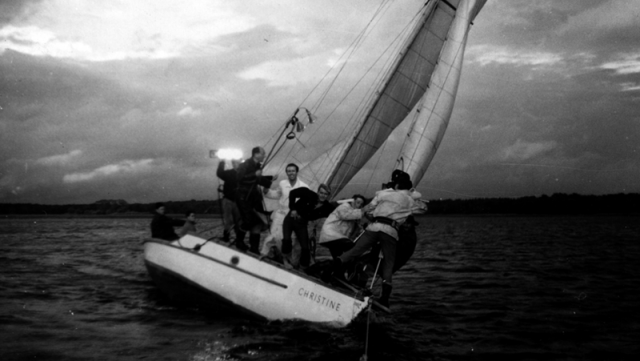
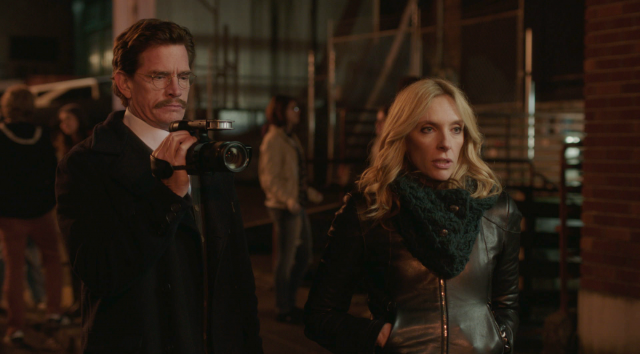
 With the music magazine she works for facing financial difficulties, longtime rock writer Ellie Klug (Toni Colette) is assigned by her editor, Giles (Oliver Platt), the one story she doesn’t want to cover: the mysterious death of Seattle musician Matthew Smith, who made one highly influential album, then drove his car over a waterfall. The main problem is that the jaded Ellie, who has a penchant for sleeping with her subjects, had a relationship with Matthew, one she wants to keep buried. But soon she is on the road with former fling Charlie (Thomas Haden Church), a straitlaced, wealthy bore who decides to make a documentary about her search. At the same time, Ellie is pursued by singer-songwriter Lucas (Ryan Eggold), a younger man who has the hots for her. When she gets a tip that Matthew might actually still be alive, she has to decide whether holding on to her career is worth dredging up the past. Inspired by cowriter and producer Emily Wachtel’s real life as a singles columnist for the Fairfield County Weekly and a contributing writer for Westport magazine, for which she used the pseudonym Ellie Klug, Lucky Them can’t decide whether it’s Eddie and the Cruisers, Velvet Goldmine, or Almost Famous, resulting in a tedious drama filled with genre clichés and dull, predictable scenes. Even a supposed shock near the end ultimately feels trite and obvious. Haden Church’s character is so ludicrously unbelievable that it drags down the entire film by itself, but he gets no help from the overwrought script, mediocre music, and stagnant direction by Megan Griffiths (Eden, The Off Hours). The film is dedicated to Paul Newman, whose widow, Joanne Woodward, is one of the executive producers; Woodward and Wachtel previously teamed up with director Treva Wurmfeld on the documentary Shepard & Dark. But this disappointing follow-up is more like a vanity project that should never have seen the light of day. Lucky Them opens May 30 at the IFC Center, with Griffiths and Wachtel participating in Q&As Friday night with Ira Glass following the 7:15 screening and Saturday night with Dick Cavett after the 7:15 show and Lauren Hutton after the 9:30 screening.