
Documentary provides an alternate view of a specific part of the porn business
KINK (Christine Voros, 2013)
IFC Center
323 Sixth Ave. at West Third St.
August 22-26
212-924-7771
www.ifccenter.com
www.kinkdoc.com
 In Kink, cinematographer and documentarian Christine Voros takes viewers behind the scenes of Kink.com, a hugely successful subscription website that specializes in fetish and BDSM (Bondage & Disclipline / Dominance & Submission / Sadism & Masochism) videos. Started in 1997 by bondage enthusiast Peter Acworth, the company, located in the two hundred thousand square foot, one-hundred-year-old San Francisco Armory, Kink.com attempts to offer a different kind of pornography for people with more discerning tastes, making videos that are as truthful and authentic as possible even when they appear to be what some would consider dangerous, depraved, and, most important, abusive to women. What makes Kink.com unique is that the stars of the videos — who are always referred to as models, not actors — can help guide the action, doing only those things that they want to do, with express instructions that all their reactions be real and to improvise as necessary. Whether pleasure or pain, there is no faking going on, and the shoot can be stopped at any time by anyone on the set if things appear to be getting out of hand, with aftercare being an important part of the process. And there are rarely ever silly plot lines and embarrassing dialogue; these videos go straight to what Kink.com’s customers — as well as the models and directors — want to see, and Voros shows it all, rather graphically. (Get ready for spanking, flogging, chaining, slapping, punching, tying up, choking, clamping, tweaking — and just wait till you get a load of the sex machines that are used on these more-than-willing and ultimately extremely satisfied subjects.)

Documentary goes behind the scenes of popular fetish and BDSM website Kink.com
In her feature-length directorial debut, the Brooklyn-based Voros, who has previously served as cinematographer on such James Franco projects as Child of God, Sal, As I Lay Dying, and 127 Hours: An Extraordinary View — and was introduced to the armory by Franco, who is the lead producer on Kink — journeys deep inside the world of Kink.com, letting the directors (Maitresse Madeline, Van Darkholme, Princess Donna), models (Jessie Colter, Porno Bobbie, Felony), and other employees (talent coordinator Jessie Lee, videographer Five Star, set decorator Chris Norris) share their points of view on the value of what they do and why they do it. “The one thing, especially if you’re looking at BDSM porn and you’re getting freaked out about it, just say to yourself that this isn’t for me, but it is for someone. And that’s that, then move on,” says Tomcat, another Kink.com director. “Everyone’s got a limit, and everyone’s gonna find something sexy and someone’s gonna find something not sexy. . . There’s nothing more to it.” Voros foregoes bringing in outside sex-industry experts, even when the discussion turns to elements that are usually associated with porn, including drugs and abused women; instead, the Kink.com people talk about the freedom and feminism that they believe is part of what makes the company so popular. Kink is like a celebratory, if at times defensive, infomercial, albeit an insightful and entertaining one that just might have you checking out the website when you get back home, when no one else is around.
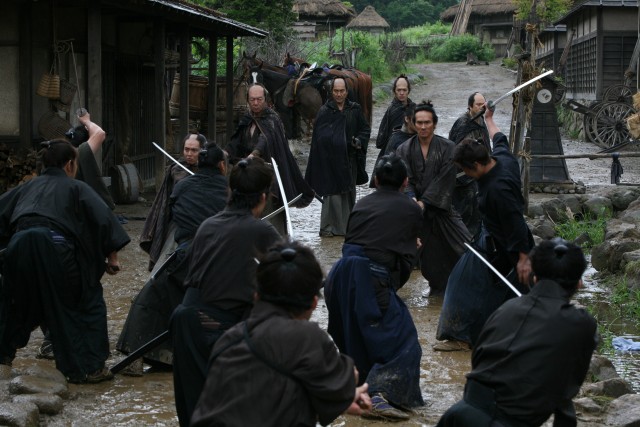
 Japanese director Takashi Miike’s first foray into the samurai epic is a nearly flawless film, perhaps his most accomplished work. Evoking such classics as Kurosawa’s Seven Samurai, Mizoguchi’s 47 Ronin, Aldrich’s The Dirty Dozen, and Eastwood’s High Plains Drifter, 13 Assassins is a thrilling tale of honor and revenge, inspired by a true story. In mid-nineteenth-century feudal Japan, during a time of peace just prior to the Meiji Restoration, Lord Naritsugu (Gorô Inagaki), the son of the former shogun and half-brother to the current one, is abusing his power, raping and killing at will, even using his servants and their families as target practice with a bow and arrow. Because of his connections, he is officially untouchable, but Sir Doi (Mikijiro Hira) secretly hires Shinzaemon Shimada (Kôji Yakusho) to gather a small team and put an end to Naritsugu’s brutal tyranny. But the lord’s protector, Hanbei (Masachika Ichimura), a former nemesis of Shinzaemon’s, has vowed to defend his master to the death, even though he despises Naritsugu’s actions. As the thirteen samurai make a plan to get to Naritsugu, they are eager to finally break out their long-unused swords and do what they were born to do.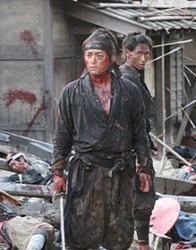

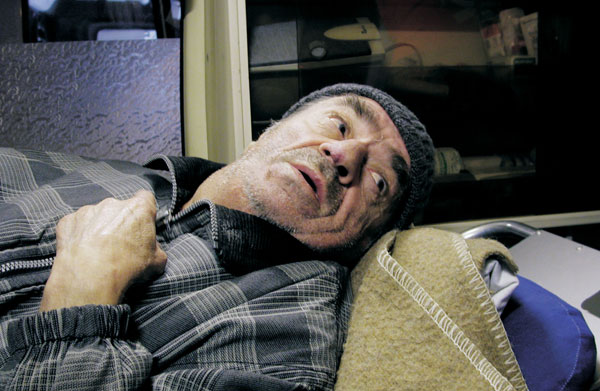
 Poor Mr. Lazarescu. He lives in a shoddy hovel of an apartment in Bucharest, where he drinks too much and gets out too little. He moves around very slowly and has trouble saying what’s on his mind, even to his three cats. His family is sick and tired of telling him to lay off the booze, so they ignore his complaints. Suffering from headaches and stomach pain, he phones for an ambulance several times, but it arrives only after a neighbor calls as well. Mr. Lazarescu then spends the rest of this very long night fading away as he is taken to hospital after hospital by the ambulance nurse, who gets involved in a seemingly endless battle with doctors to try to save him. Ian Fiscuteanu is sensationally realistic as Mr. Lazarescu; you’ll quickly forget that he’s not really a drunk, disgusting, dying old man. Luminita Gheorghiu is excellent as Mioara, the nurse who gets caught up in Mr. Lazarescu’s case. Winner of the Cannes Film Festival’s Un Certain Regard Award, cowriter-director Cristi Puiu’s very dark comedy is simply captivating; despite a slow start, it’ll pull you in with its well-choreographed scenes, documentary style, and careful camera movement. (Also look for the subtle and very specific naming of characters.) Using Éric Rohmer’s “Six Moral Tales” as inspiration, Puiu has said that The Death of Mr. Lazarescu is the first of his own “Six Stories from the Bucharest Suburbs,” this one dealing with “the love of humanity,” followed by 2010’s Aurora.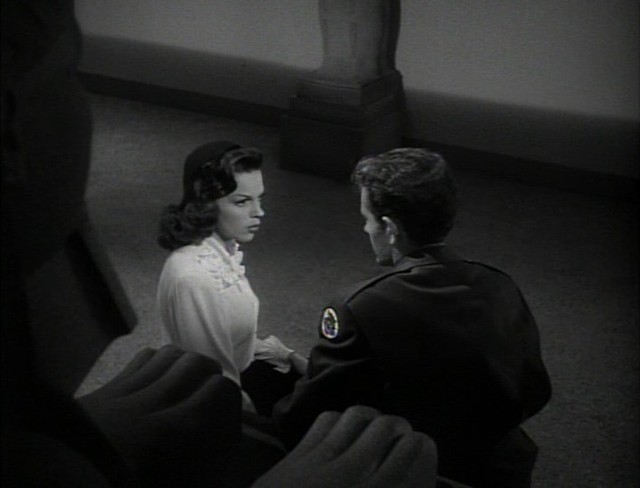

 With
With