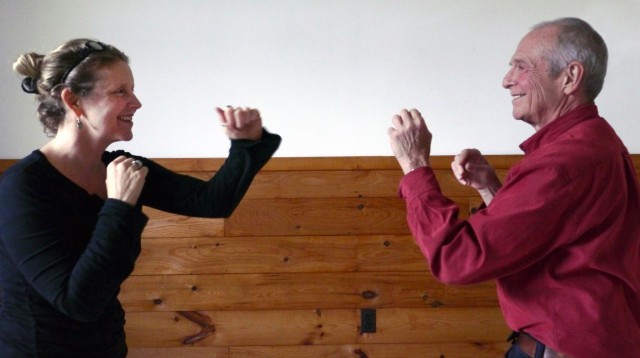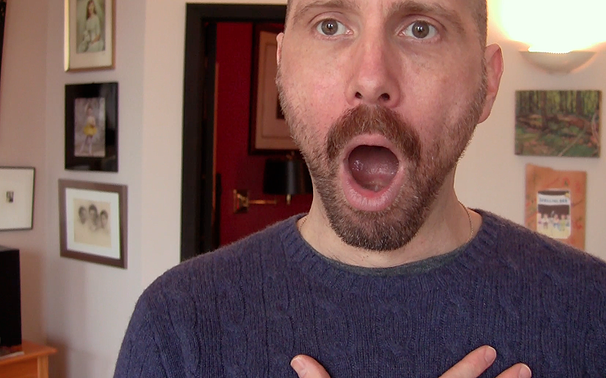
David Thorpe examines how his voice affects his life in DO I SOUND GAY? (photo courtesy of ThinkThorpe)
DO I SOUND GAY? (David Thorpe, 2015)
IFC Center
323 Sixth Ave. at West Third St.
Opens Friday, July 10
212-924-7771
www.doisoundgay.com
www.ifccenter.com
 About ten minutes into journalist David Thorpe’s absolutely charming yet emotionally bittersweet Do I Sound Gay?, he is at dinner with his best friends, Alberto and Sam, and the three are discussing the title question. It’s a fascinating conversation that is worth detailing extensively here. “I have the impression that you think it sounds bad,” Alberto says about David’s voice. “I interpret David’s feelings about this, and the feelings around this whole project, as bad. He has negative feelings about his voice, about the perception that it creates.” “And you don’t feel that at all yourself?” Sam asks. Alberto responds, “I have sort of a generic self-loathing that is created around my gayness. . . . . But I don’t think I can say it’s the only thing, or the main thing.” Finally, David chimes in, explaining, “I think I feel out of sync with my voice, and, at least it seems to me, that it’s anxiety about sounding too gay, so, okay, let’s see what it’s like to not sound gay, and maybe I’ll feel more in sync and maybe I’ll have some idea what my voice should sound like.” Alberto then gets to the heart of the matter, inquiring, “But you could also argue, why don’t you just accept how you sound?” And Alberto sums it all up: “We have never talked about this idea until you brought it up. I don’t know anybody else that I’ve talked to about it either. So I think there is this thing, obviously, that we all are aware of that hasn’t been spoken of. Maybe this is the elephant in the room.” David spends the rest of the film exploring the elephant in the room, meeting with speech therapists who examine his voice and teach him how to change it; talking to such out-of-the-closet gay icons as Dan Savage, Tim Gunn, Margaret Cho, David Sedaris, Don Lemon, and George Takei, who delve into their own gayness and how their voice is part of that; introducing us to a boy who was beaten up at school at a very young age because of his voice; and interviewing gay people on the street, who share their thoughts on whether they, or he, do or don’t sound gay, and whether that matters. Sedaris, whose short story “Go Carolina” served as inspiration for Thorpe, tells him, “I’m embarrassed to say this, but sometimes somebody will say, ‘I didn’t know you were gay.’ It’s like, Why does that make me feel good. I hate myself for thinking that. It’s very disturbing. I thought I was beyond that. What’s the problem if somebody assumes that I’m gay when I open my mouth? Why do I have a problem with that?”
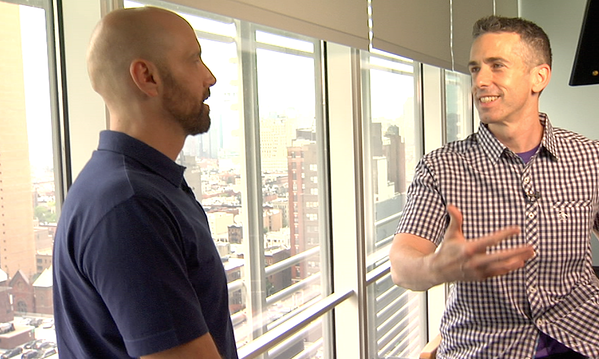
David Thorpe meets with such gay icons as Dan Savage as he explores how one’s voice affects perception (photo courtesy of ThinkThorpe)
Indeed, why does anyone have a problem with that? Do I Sound Gay? raises a host of important issues, both directly and indirectly, that deal with how we all judge ourselves, and others. We’ve all heard someone’s voice and assumed him or her to be gay, but Thorpe interviews one friend who “sounds gay” but isn’t. We all want to believe we don’t see race or ethnicity or religion, or see or hear “gay,” but of course we do; what’s key is how we respond to that, or even whether we respond at all. After breaking up with his boyfriend, Thorpe decided that his voice was part of the reason why he was forty and single; watching him practice changing his voice makes one think of kids who are sent to special camps to get rid of the gay. There are things we all would like to change about ourselves, but do we actually want or need to change ourselves in this way? Thorpe has an appealing personality, so it hurts to watch him try to alter his voice, even if it’s also funny. Interestingly, he doesn’t get into nature vs. nurture and biological issues, but it’s engrossing to follow this parade of men who sound a certain way and to see that some of them are proud of it, some are not, and others just accept it for what it is. “Some of the gayest people I know are straight, and some of the butchest men I’ve ever met are gay,” Gunn says. “So in some ways, never assume.” In a country mired in a fierce debate over same-sex marriage, Do I Sound Gay? feels like it’s just what the doctor ordered, a playful, fun, yet riveting look into a rarely examined issue that is more ubiquitous than anyone has been willing to admit before, a serious topic with critical ramifications that is handled with grace and humor by Thorpe in his feature-length debut. Do I Sound Gay? opens July 10 at the IFC Center, with Thorpe in person for Q&As following the 7:55 shows on Friday (hosted by Mo Rocca) and Saturday (hosted by Catie Lazarus).
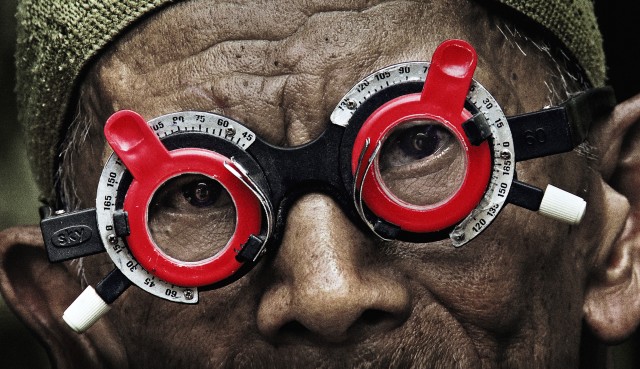
 Joshua Oppenheimer’s The Look of Silence opens with an old man, wearing a pair of red optic trial lens frames, gazing into and around the camera for twelve uncomfortable seconds, in complete silence, showing no emotion. It is a striking metaphor for the rest of the film, a shocking documentary about the 1965–66 Indonesian genocide and a bold man determined to confront the men who brutally murdered his brother then, along with a million other supposed communists. In 2012, Oppenheimer made the Oscar-nominated
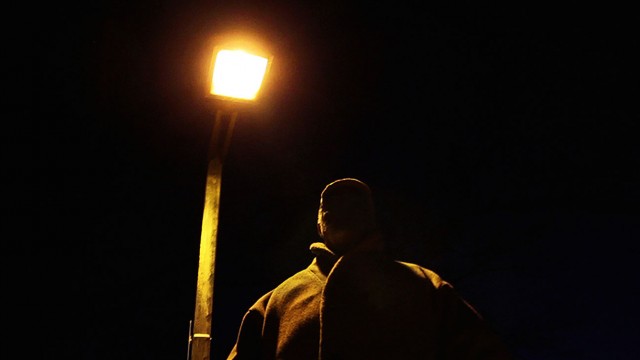
 (T)error is a great name for a horror movie, but even though it turns out that Lyric R. Cabral and David Felix Sutcliffe’s debut is not part of that genre, there still is plenty scary about it. Winner of the U.S. Documentary Special Jury Award for Break Out First Feature at Sundance, (T)error is a surprising look inside one aspect of the FBI’s counterterrorism program. Shortly after Saeed “Shariff” Torres, a friend and neighbor of filmmaker and photojournalist Cabral’s, suddenly disappeared, he contacted her, eventually letting her inside his secret career as a longtime FBI informant. A Muslim and former Black Panther revolutionary, the sixty-three-year-old school kitchen employee and father of a young son goes on camera as he takes on what he claims will be his final assignment, cozying up to a Pittsburgh man named Khalifa Ali Al-Akili, previously known as James Marvin Thomas Jr., who the FBI thinks might be involved in terrorist plots. It’s not exactly the most thrilling game of cat and mouse; Cabral and codirector Sutcliffe (Adama) follow Shariff as he goes about a lot of mundane business, arguing over how much money the FBI gave him, text-messaging back and forth with agents and his prey, examining Facebook pages, and Skyping with his son, whose face is blurred for protection. And Sharrif is not quite the kind of well-trained operative you read about in books or see in action-packed movies, making one wonder just what the FBI is thinking — and how it’s spending our money — especially after a major twist occurs about halfway through the film, turning everything around and inside out, providing a new vantage point that makes the whole sting operation even more bizarre and surreal. But it’s all too real, and rather frightening in its own very strange way. (T)error is screening June 14 at 9:00 at the IFC Center as part of the Human Rights Watch Film Festival, with Cabral and Sutcliffe participating in a Q&A with Human Rights Watch deputy Washington director Andrea Prasow. The festival runs June 11-21 at IFC, the Film Society of Lincoln Center, and the Times Center, featuring such other socially, culturally, and politically sensitive and important works as Marc Silver’s 3½ Minutes, Ten Bullets, Laurent Bécue-Renard’s Of Men and War, Laura Nix’s The Yes Men Are Revolting, and Joshua Oppenheimer’s The Look of Silence.