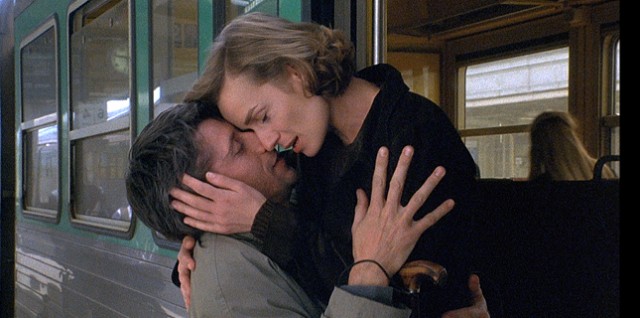
Marlon Brando and Maria Schneider star in Bernardo Bertolucci’s controversial LAST TANGO IN PARIS
CINÉSALON: LAST TANGO IN PARIS (ULTIMO TANGO A PARIGI) (Bernardo Bertolucci, 1972)
French Institute Alliance Française, Florence Gould Hall
55 East 59th St. between Madison & Park Aves.
Tuesday, November 4, $13, 4:00 & 7:30
212-355-6100
www.fiaf.org
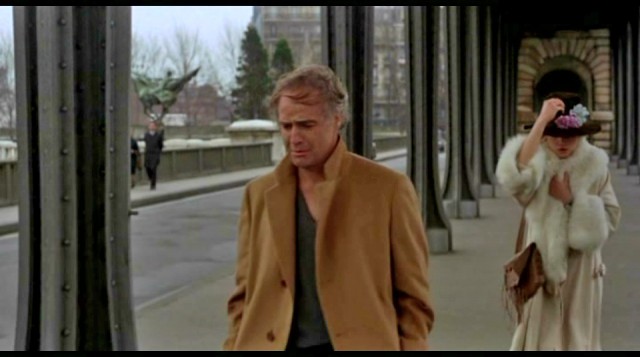
 One of the most artistic films ever made about seduction, Bernardo Bertolucci’s controversial X-rated Last Tango in Paris kicks off the French Institute Alliance Française’s CinéSalon series “The Art of Sex and Seduction” on November 4. Written by Bertolucci (The Conformist, The Spider’s Stratagem) with regular collaborator and editor Franco Arcalli and with French dialogue by Agnès Varda (Le Bonheur, Vagabond), the film opens with credits featuring jazzy romantic music by Argentine saxophonist Gato Barbieri and two colorful and dramatic paintings by Francis Bacon, “Double Portrait of Lucian Freud and Frank Auerbach” and “Study for a Portrait,” that set the stage for what is to follow. (Bacon was a major influence on the look and feel of the film, photographed by Vittorio Storaro.) Bertolucci then cuts to a haggard man (Marlon Brando) standing under the Pont de Bir-Hakeim in Paris, screaming out, “Fucking God!” His hair disheveled, he is wearing a long brown jacket and seems to be holding back tears. An adorable young woman (Maria Schneider) in a fashionable fluffy white coat and black hat with flowers passes by, stops and looks at him, then moves on. They meet again inside a large, sparsely furnished apartment at the end of Rue Jules Verne that they are each interested in renting. Both looking for something else in life, they quickly have sex and roll over on the floor, exhausted. For the next three days, they meet in the apartment for heated passion that the man, Paul, insists include nothing of the outside world — no references to names or places, no past, no present, no future; the young woman, Jeanne, agrees. Their sex goes from gentle and touching to brutal and animalistic; in fact, after one session, Bertolucci cuts to actual animals. The film is nothing if not subtle.
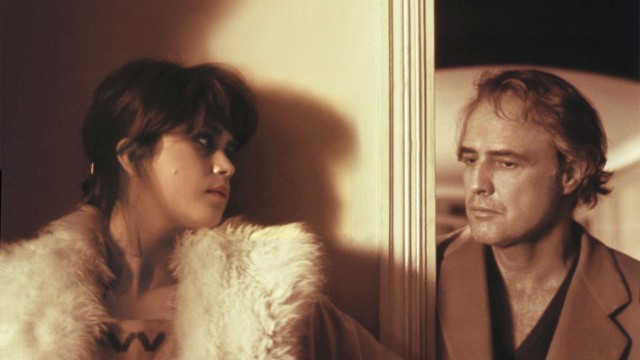
Jeanne (Maria Schneider) and Paul (Marlon Brando) share a private, sexual relationship in LAST TANGO IN PARIS
The lovers’ real lives are revealed in bits and pieces, as Paul tries to recover from his wife’s suicide and Jeanne deals with a fiancée, Thomas (Jean-Pierre Léaud), who has suddenly decided to make a film about them, without her permission, asking precisely the kind of questions that Paul never wants to talk about. When away from the apartment, Jeanne is shown primarily in the bright outdoors, flitting about fancifully and giving Thomas a hard time; in one of the only scenes in which she’s inside, Thomas makes a point of opening up several doors, preventing her from ever feeling trapped. Meanwhile, Paul is seen mostly in tight, dark spaces, especially right after having a fight with his dead wife’s mother. He walks into his hotel’s dark hallway, the only light coming from two of his neighbors as they open their doors just a bit to spy on him. Not saying anything, he pulls their doors shut as the screen goes from light to dark to light to dark again, and then Bertolucci cuts to Paul and Jeanne’s apartment door as she opens it, ushering in the brightness that always surrounds her. It’s a powerful moment that heightens the difference between the older, less hopeful man and the younger, eager woman. Inevitably, however, the safety of their private, primal relationship is threatened, and tragedy awaits.
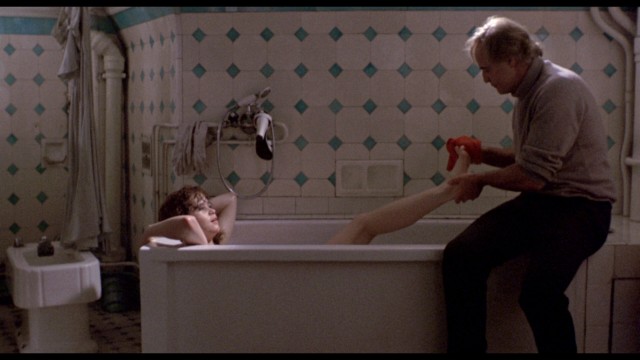
Jeanne and Paul develop a complicated sexual relationship in LAST TANGO
“I’ve tried to describe the impact of a film that has made the strongest impression on me in almost twenty years of reviewing. This is a movie people will be arguing about, I think, for as long as there are movies,” Pauline Kael wrote in the New Yorker on October 28, 1972, shortly before Last Tango closed the tenth New York Film Festival. “It is a movie you can’t get out of your system, and I think it will make some people very angry and disgust others. I don’t believe that there’s anyone whose feelings can be totally resolved about the sex scenes and the social attitudes in this film.” More than forty years later, the fetishistic Last Tango in Paris still has the ability to evoke those strong emotions. The sex scenes range from tender, as when Jeanne tells Paul they should try to climax without touching, to when Paul uses butter in an attack that was not scripted and about which Schneider told the Daily Mail in 2007, “I felt humiliated and to be honest, I felt a little raped, both by Marlon and by Bertolucci. After the scene, Marlon didn’t console me or apologise. Thankfully, there was just one take.” At the time of the shooting, Brando was forty-eight and Schneider nineteen; Last Tango was released between The Godfather and Missouri Breaks, in which Brando starred with Jack Nicholson, while Schneider would go on to make Michelangelo Antonioni’s The Passenger with Nicholson in 1975. Brando died in 2004 at the age of eighty, leaving behind a legacy of more than forty films. Schneider died in 2011 at the age of fifty-eight; she also appeared in more than forty films, but she was never able to escape the associations that followed her after her breakthrough performance in Last Tango, which featured extensive nudity, something she refused to do ever again. Even in 2014, Last Tango in Paris is both sexy and shocking, passionate and provocative, alluring and disturbing, all at the same time, a movie that, as Kael said, viewers won’t easily be able to get out of their system.
Last Tango in Paris is being shown at FIAF on November 4 at 4:00 and 7:30, with the later screening introduced by New School philosophy professor Simon Critchley and followed by a wine reception; the series continues Tuesdays through December 16 with Pascale Ferran’s Lady Chatterley introduced by Catherine Cusset, François Ozon’s Swimming Pool introduced by Ry Russo-Young, Alain Guiraudie’s Stranger by the Lake introduced by Alan Brown, Catherine Breillat’s The Last Mistress introduced by Melissa Anderson (Breillat also appears as Mouchette in Last Tango), and François Truffaut’s The Man Who Loved Women introduced by Laura Kipnis. There will also be talks, panel discussions, Jean-Daniel Lorieux’s “Seducing the Lens” photography exhibition, and other programs as part of “The Art of Sex & Seduction.”
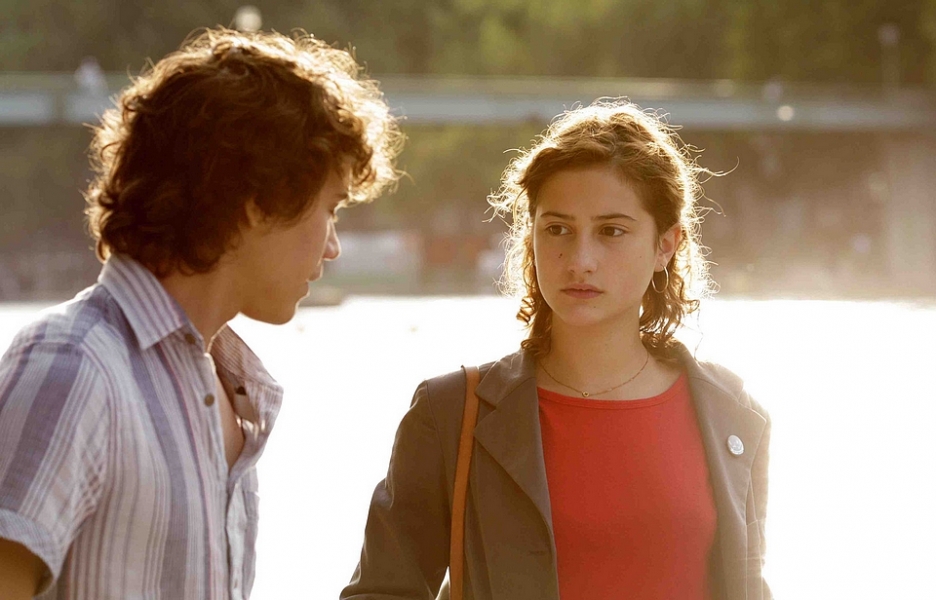
 French filmmaker Mia Hansen-Løve’s third film is an infuriating yet captivating tale that runs hot and cold. Goodbye First Love begins in Paris in 1999, as fifteen-year-old Camille (Lola Créton) frolics naked with Sullivan (Sebastian Urzendowsky), her slightly older boyfriend. While she professes her deep, undying lover for him, he refuses to declare his total dedication to her, instead preparing to leave her and France for a long sojourn through South America. When Camille goes home and starts sobbing, her mother (Valérie Bonneton), who is not a big fan of Sullivan’s, asks why. “I cry because I’m melancholic,” Camille answers, as only a fifteen-year-old character in a French film would. As the years pass, Camille grows into a fine young woman, studying architecture and dating a much older man (Magne-Håvard Brekke), but she can’t forget Sullivan, and when he eventually reenters her life, she has some hard choices to make. Créton (Bluebeard) evokes a young Isabelle Huppert as Camille, while Urzendowsky (The Way Back) is somewhat distant as the distant Sullivan. There is never any real passion between them; Hansen-Løve (All Is Forgiven,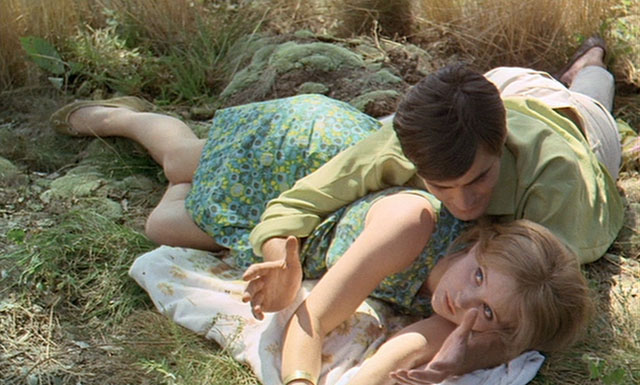
 In 1965, French Nouvelle Vague auteur Agnès Varda said about her third film, Le Bonheur, which translates as Happiness: “Happiness is mistaken sadness, and the film will be subversive in its great sweetness. It will be a beautiful summer fruit with a worm inside. Happiness adds up; torment does too.” That is all true nearly fifty years later, as the film still invites divided reaction from critics. “Miss Varda’s dissection of amour, as French as any of Collette’s works, is strikingly adult and unembarrassed in its depiction of the variety of love, but it is as illogical as a child’s dream,” A. H. Weiler wrote in the New York Times in May 1966. “Her ‘Happiness,’ a seeming idyll sheathed in irony, is obvious and tender, irresponsible and shocking and continuously provocative.” All these decades later, the brief eighty-minute film is all that and more, save for the claim that it is illogical. In a patriarchal society, it actually makes perfect, though infuriating, sense.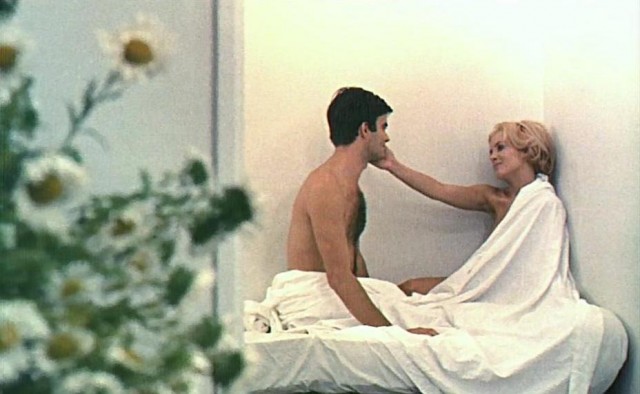
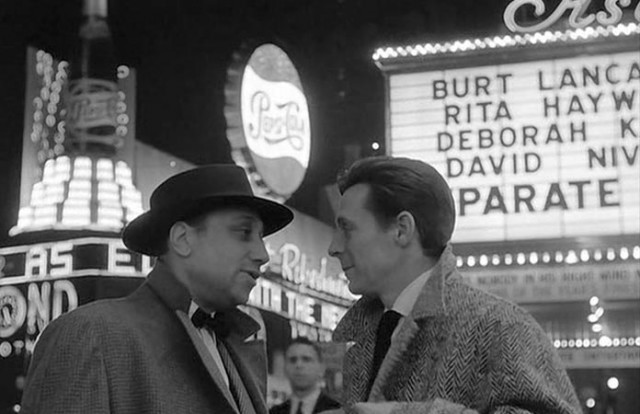
 When French U.N. delegate Fèvre-Berthier goes missing in director Jean-Pierre Melville’s 1959 noir, Two Men in Manhattan, reporter Moreau (Melville) of the French Press Agency and freelance photographer Pierre Delmas (Pierre Grasset) go out on the town, trying to find out what happened. While Moreau is seeking the truth, Delmas is after a sensationalist photograph he can sell to the highest bidder. They meet up with several women who knew the married diplomat — some much better than others — including his secretary, Françoise Bonnot (Colette Fleury), actress Judith Nelson (Ginger Hall), stripper Bessie Reid (Michèle Bailly), and jazz singer Virginia Graham (Glenda Leigh). As the men make their way through Rockefeller Plaza, Times Square, Greenwich Village, Broadway, the subway, and the United Nations, Marial Solal’s and Christian Chevallier’s jazzy score dominates the outdoor scenes, soaking the viewer in the New York at night atmosphere. And all the while, the reporter and photographer are trailed by someone in a mysterious car. As they get closer to their destination, they are faced with some serious ethical choices, not just about journalism, but about life itself. Nearly fifty-five years after its release, Two Men in Manhattan feels as stiff and dated as Melville’s (Bob le Flambeur, Le Doulos, Le Samouraï) lead performance, his only starring role and his sole appearance in one of his own films. It’s difficult to tell if Two Men in Manhattan is a serious procedural, an homage to classic noirs, a tribute to New York City, or a sly genre parody — perhaps it’s all of them, but far too many of the twists and turns are hard to swallow, especially when it comes to Delmas’s selfish decisions and Moreau’s often absurd brainstorms that seem to exist just to quicken the plot despite their incredulity. Still, it’s beautifully shot in shadowy darkness by Nicholas Hayer, and it was proclaimed by Jean-Luc Godard to be the second best film of the year. A digitally remastered version of Two Men in Manhattan is screening March 4 at 4:00 & 7:30 as part of the FIAF CinéSalon series “Remastered & Restored: Treasures of French Cinema”; the later screening will be presented by Phillip Lopate, and both shows will be followed by a wine reception. The three-month festival continues March 11 with Claire Denis’s Chocolat, introduced by African Film Festival founder Mahen Bonetti, before concluding March 18 with Henri-Georges Clouzot’s The Truth.