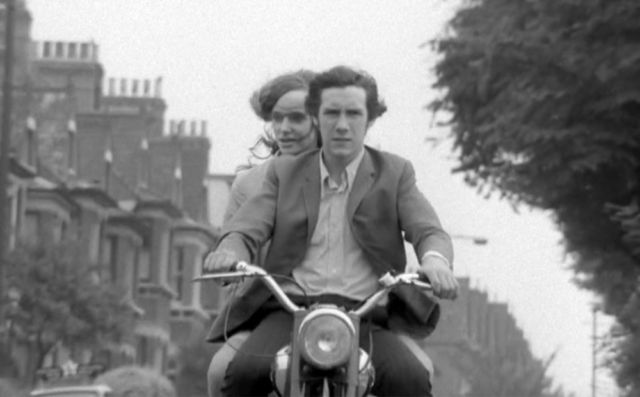
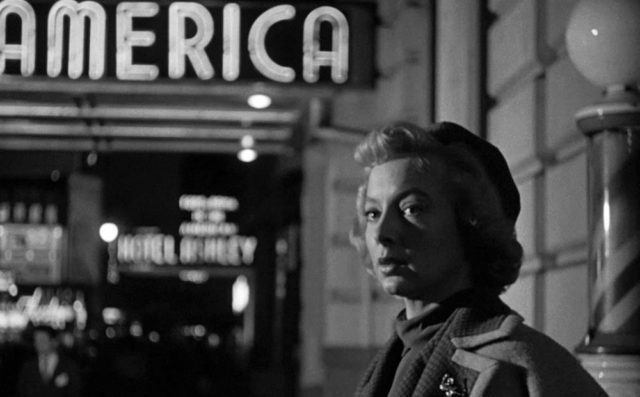
Del (Del Walker) takes Irene (Anne Gooding) on a ride to nowhere in Bronco Bullfrog
BRONCO BULLFROG (Barney Platts-Mills, 1969)
Film Forum
209 West Houston St.
March 25-31
212-727-8110 filmforum.org
It’s a shame that writer-director Barney Platts-Mills won’t be around for the US theatrical premiere of the 2K restoration of his remarkable, long-forgotten 1970 underground black-and-white cult favorite, Bronco Bullfrog. But the British auteur, who passed away in October at the age of seventy-six, did supervise the restoration, and the film’s cinematographer, Adam Barker-Mill, will be at the 7:00 show at Film Forum on opening night, March 25, to talk about the making of the kitchen sink drama, the British neorealist subgenre that included such works as Tony Richardson’s Look Back in Anger, Ken Loach’s Kes, and Jack Clayton’s Room at the Top.
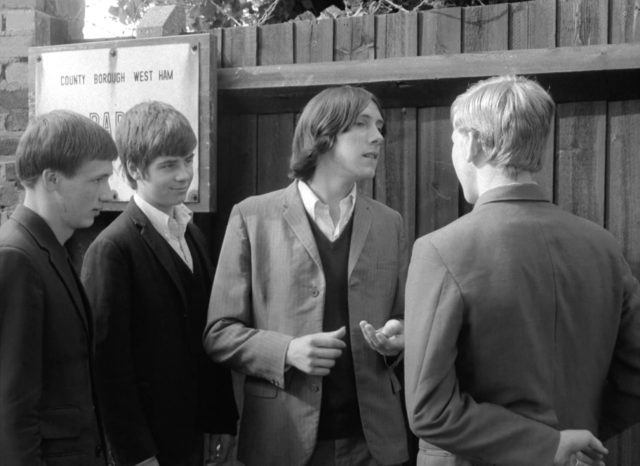
The story takes place in the shabby East End of London, where a group of boys battle malaise and boredom by sneaking into the movies, pulling off petty robberies, and fighting a gang of well-dressed, better-educated guys led by Parker (J. Hughes Jr.). Del Quant (Del Walker) is a seventeen-year-old welding apprentice who hangs around with his ne’er-do-well buddies, Roy (Roy Haywood), Chris (Chris Shepherd), and Geoff (Geoffrey Wincott). When Del meets Chris’s cousin, Tina (Tina Syer), and her fifteen-year-old friend, Irene Richardson (Anne Gooding), Del and Irene start seeing each other, but with little money they don’t exactly go out on the town; sometimes they merely head to the group’s hideout, a ramshackle space with dirty words and magazine pictures of naked women on the walls.
When local legend Jo Saville (Sam Shepherd), also known as Bronco Bullfrog, gets out of reform school, he offers Del a chance to make some fast cash, but they’re not exactly a crackerjack bunch of thieves; Jo, Del, Roy, and Chris are not even the droogs from Stanley Kubrick’s A Clockwork Orange, which came out the following year. In fact, the films have several elements in common; perhaps Platts-Mills was familiar with Anthony Burgess’s 1962 novel. Like Clockwork,Bronco Bullfrog has its own language and features heavy accents, so subtitles are often used, which has also been the case with many of Loach’s films. (In Platts-Mills’s second film, the more free-wheeling Private Road, the protagonists go to see Kubrick’s Spartacus.)
Neither Del’s father (Dick Philpott) nor Irene’s mother (Freda Shepherd) is happy about the kids’ relationship, especially when Sergeant Johnson (Stuart Stones) shows an interest in Del. But Del and Irene keep doing their thing, not talking or doing much as they try to figure out if there’s anything out there in the world for them; they know what they don’t want but not what they do, their lives devoid of the promise of a happy future while they seek out instant, temporary kicks.
Bronco Bullfrog is a wonderfully drawn study of teen angst and ennui. The characters wander aimlessly through empty, decrepit streets and alleys, every turn leading nowhere. Much of the poetic and deeply romantic film is improvised and shot on location where the nonprofessional actors live; it was made for a mere eighteen thousand pounds. Platts-Mills himself ran away from his expensive public school when he was fifteen; his father, John Platts-Mills, was a prominent barrister and member of Parliament.
The idea for the film came from Walker and his friends, who had participated in theater director Joan Littlewood’s workshop at the Play Barn, which was depicted in Platts-Mills’s 1969 documentary, Everybody’s an Actor, Shakespeare Said. They needed something to do, so Walker asked the director to make a movie with them.
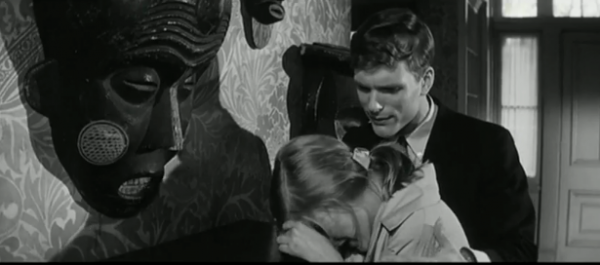
Four East End teens battle malaise in Barney Platts-Mills’s Bronco Bullfrog
Although there was a script, the disenfranchised youth, neither mods nor rockers, just go about a fictionalized version of their lives, making it up on the fly as Platts-Mills and Barker-Mill — who became a successful installation artist — keep the cameras rolling. The charmless Del fancies himself a ladies’ man, but the scene in which he meets Irene is hysterical. He and Chris sit opposite Irene and Tina in a small tea shop, with nothing to say; Roy, playing pinball, looks over as if he’s jealous that his pals are talking to girls, but he’s not ready for that either and goes back to his game. On another date, Del, who recently bought a used motorbike, sits with Irene outside the fence of a motocross race, watching the kind of excitement that never comes his way.
Meanwhile, Bronco Bullfrog is no tough gang leader; he’s a bit of a doofus and maybe even just a nice guy who’s lost, which is perhaps why Platts-Mills named the film after him, because he’s a relatively minor character. He’s so thoughtful and gentle with his landlady (E. E. Blundell) that it’s easy to see through his supposed tough exterior. And the battles with Parker and his friends are pathetic; after Del and his group lamely push one of them to the ground, they later brag about how they beat him up.
The 2K restoration, made from the original 35mm print that was saved out of the garbage, is stark and sharp, capturing the feel of the teens’ mundane existence in this downtrodden corner of British society. The soundtrack is by drummer Tony Connor, saxophonist Keith Gemmell, bassist Trevor Williams, and guitarist Howard Werth of the British art-rock band Audience, adding to the late-1960s vibe. The multi-award-winning Platts-Mills went on to make the 1982 sword and sorcery film Hero and the 2010 drama Zohra: A Moroccan Fairy Tale, also about teen lovers. But it all started with Bronco Bullfrog, a landmark of British cinema that is finally getting its due here in America.
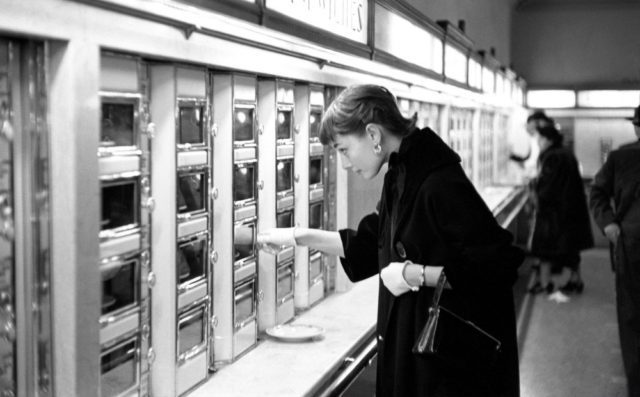
Audrey Hepburn grabs a bite at the Automat in New York City (photo by Lawrence Fried, 1951)
THE AUTOMAT (Lisa Hurwitz, 2021)
Film Forum
209 West Houston St.
Opens Friday, February 18
212-727-8110 filmforum.org automatmovie.com
New Yorkers are used to saying goodbye to iconic institutions, from the old Penn Station and Ebbets Field to the Carnegie Deli and the Stork Club. One of the hardest to bid farewell to was a most unusual eatery that catered to anyone who had a couple of nickels and time for a quick lunch or dinner: the Automat, a type of self-service restaurant that flourished in New York City and Philadelphia, predominantly during the first six decades of the twentieth century.
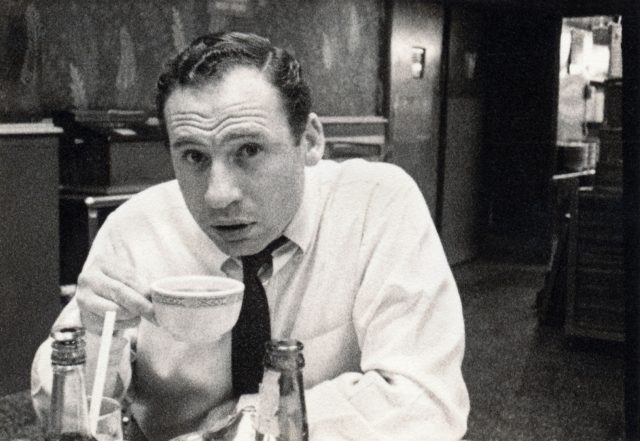
At the beginning of Lisa Hurwitz’s thoroughly satisfying yet elegiac debut documentary, The Automat, comedian Mel Brooks tells her, “I’m going to give you what I can in terms of time and effort, and I’ll try to write the song.” He continues, “I suggest you do some narration at the beginning to frame what you’re going to talk about. You know, with pictures — do you have enough pictures of Automats?”
Hurwitz has plenty of pictures of Automats and just the right narrator to open the film, Brooks himself, who explains, “Of course, when you say ‘Automat,’ or ‘Horn & Hardart,’ very few people know what you’re talking about. But one of the greatest inventions in insane centers of paradise were these places that had little glass windows framed in brass with knobs, and if you put two nickels into the slot next to the windows, the windows would open up, and you could take out a piece of lemon meringue pie for ten cents and you could eat it.”
Brooks is one of many people who more than just enjoyed going to the Automat; for them, it was an integral part of their lives, a place to gather with friends, colleagues, and family, schmooze a bit, and have a cheap but good meal. From 1902 to 1991, the Automat served young and old, rich and poor; race, religion, politics — none of that mattered in the egalitarian spaces.
The late Supreme Court Justice Ruth Bader Ginsberg recalls, “Yes, this is the great USA, with people of all different colors, and religions, and manner of dress, and yet we are all together.” The late Secretary of State Colin Powell notes, “All the Automats had that beautiful diversity that didn’t exist in most of the rest of the country, of economic standing, of color, of ethnicity, of language. You never knew what you’d run into in an Automat.” Among the others waxing poetic about the Automat are Carl Reiner, Elliott Gould, former Philly mayor Wilson Goode, and former Starbucks chairman and CEO Howard Schultz, who says, “The Automat for me was a seminal moment in my childhood, and I became a merchant the day that I was in that Automat.” Brooks declares, “The Automat had panache.”
Made over the course of seven years, the film also features interviews with Lorraine Diehl and Marianne Hardart, authors of The Automat: The History, Recipes, and Allure of Horn & Hardart’s Masterpiece; former Automat VP of engineering John Romas; Edwin K. Daly Jr., whose father was president of Horn & Hardart from 1937 to 1960; New York City historian Lisa Keller; H&H architect Roy Rosenbaum; architectural dealer and restorer Steve Stollman, who bought a lot of the old mechanisms when the restaurants closed; and historian Alec Shuldiner, whose PhD dissertation inspired Hurwitz to make the film.
Mel Brooks sings the praises of the Automat in loving documentary (photo by Carl Reiner)
There are tons of great photos and film clips in the documentary, including shots of Audrey Hepburn, Debbie Reynolds and Eddie Fisher, Jackie Gleason, Donna Reed, Abbott & Costello, and James Dean at the Automat and scenes from That Touch of Mink,The Bob Hope Show,The Flintstones, Warner Bros. cartoons A Hare Grows in Manhattan and Tree Cornered Tweety,Candid Camera, and such old movies as The Early Bird,No Limit, and Thirty Day Princess. Jack Benny hosts an opening there, giving out nickels to his guests. The Irving Berlin and Moss Hart musical Face the Music begins with the song “Lunching at the Automat.”
Hurwitz also deals with socioeconomic change that helped make the Automat so popular after the Great Depression and through both wars and, later, led to its downfall. The sentimental attachment everyone has for the Automat in the film is contagious, even if you never had the baked beans, ham and cheese sandwich, or creamed spinach; it was a special place to so many through several generations, and Hurwitz captures those sentimental feelings with panache while leaving you with an ache in your heart and stomach — and a song from Mel Brooks. The Automat opens February 18 at Film Forum, with Hurwitz participating in Q&As on Friday at 7:00, Saturday at 7:30, and Sunday at 5:40.
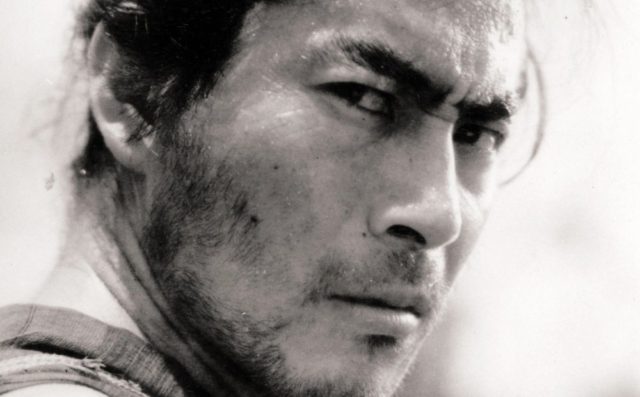
Rashomon helps kick off delayed monthlong centennial celebration of Toshirō Mifune at Film Forum
MIFUNE
Film Forum
209 West Houston St.
February 11 – March 10
212-727-8110 filmforum.org
No other international actor stands out for his country as Japanese star Toshirō Mifune does for his. Quick: Name another big-time Japanese thespian. Born in Seitō on April Fools Day in 1920, Mifune made nearly two hundred appearances in films and on television, including a particularly fertile period between 1948 and 1966, when he made movies with Akira Kurosawa, Hiroshi Inagaki, Kihachi Okamoto, Masaki Kobayashi, and Mikio Naruse that would become classics. He worked in multiple genres, from Western Westerns and Eastern Westerns to noir detective thrillers, police procedurals, samurai epics — and, yes, romance.
Film Forum is celebrating Mifune’s fifty-year career and the hundredth anniversary of his birth — the series was scheduled for 2020 but was postponed because of the pandemic lockdown — with an exciting retrospective running February 11 to March 10, consisting of thirty-three films over four weeks, from his onscreen debut in 1947’s Snow Trail to all sixteen films he made with Kurosawa, from the little-seen A Wife’s Heart and All About Marriage to grandiose Shakespearean adaptations, from the Musashi Miyamoto trilogy to his fling with Hollywood. Mifune, who died on Christmas Eve, 1997, could out-Eastwood Eastwood, out-Bronson Bronson, and out-McQueen McQueen. “I’m not always great in pictures, but I’m always true to the Japanese spirit,” he once said. You can decide for yourself how great he was by heading over to Film Forum and catching a bunch of these flicks, several of which are not available for streaming; below are some recommendations.
RASHOMON (Akira Kurosawa, 1950)
Friday, February 11 at 2:55, 7:10
Wednesday, February 16, 5:35
Friday, March 4, 3:50
Saturday, March 5, 12:40
Wednesday, March 9, 6:00
Thursday, March 10, 12:40, 5:10 filmforum.org
One of the most influential films of all time, Akira Kurosawa’s 1950 masterpiece, adapted from Ryunosuke Akutagawa’s short story “In a Grove,” stars Toshirō Mifune as a bandit accused of the brutal rape of a samurai’s wife (Machiko Kyo) and the murder of her husband (Masayuki Mori). However, four eyewitnesses tell a tribunal four different stories, each told in flashback as if the truth, forcing the characters — and the audience — to question the reality of what they see and experience. Kurosawa veteran Takashi Shimura — the Japanese Ward Bond — plays a local woodcutter, with Minoru Chiaka as the priest. The mesmerizing work, which won an Oscar for Best Foreign Language Film, is beautifully shot by Kazuo Miyagawa; Rashomon is nothing short of unforgettable. (What is forgettable is the English-language remake, The Outrage, directed by Martin Ritt and starring Edward G. Robinson, Paul Newman, Laurence Harvey, Claire Bloom, and William Shatner.)
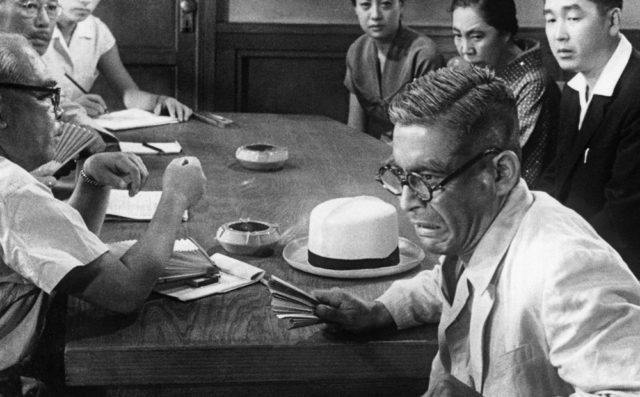
Nakajima (Toshirō Mifune) lives in fear in Akira Kurosawa’s I Live in Fear
I LIVE IN FEAR (Akira Kurosawa, 1955)
Friday, February 11, 12:40, 4:55, 9:10
Friday, February 18, 12:30
Saturday, February 19, 2:50 filmforum.org
Akira Kurosawa’s powerful psychological drama I Live in Fear, also known as Record of a Living Being, begins with a jazzy score over shots of a bustling Japanese city, people anxiously hurrying through as a Theremin joins the fray. But this is no Hollywood film noir or low-budget frightfest; Kurosawa’s daring film is about the end of old Japanese society as the threat of nuclear destruction hovers over everyone. A completely unrecognizable Toshirō Mifune stars as Nakajima, an iron foundry owner who wants to move his large family — including his two mistresses — to Brazil, which he believes to be the only safe place on the planet where he can survive the H bomb. His immediate family, concerned more about the old man’s money than anything else, takes him to court to have him declared incompetent; there he meets a dentist (the always excellent Takashi Shimura) who also mediates such problems — and fears that Nakajima might be the sanest one of all.
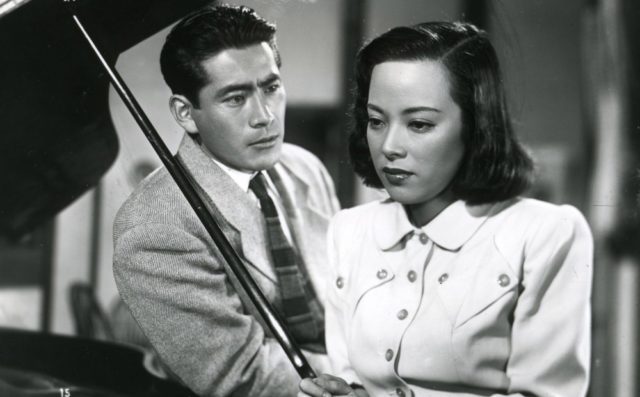
Toshirō Mifune and Shirley Yamaguchi face unwarranted gossip in Akira Kurosawa’s Scandal
SCANDAL (Akira Kurosawa, 1950)
Sunday, February 13, 12:40
Monday, February 14, 3:00 filmforum.org
When two famous people are caught together at a hotel in the mountains, a scandal breaks out as a lurid gossip magazine prints their picture and makes up a sordid romance that is not true. With their reputations tainted, they consider suing the publication, but they run into problems with their ragtag lawyer, who has a bit of a gambling problem. Akira Kurosawa regular Toshirō Mifune stars as Ichiro Aoye, a well-known painter who likes smoking pipes and riding his flashy motorcycle. Yoshiko Yamaguchi is Miyaka Saijo, a timid pop singer who is terrified of the unwanted publicity. And Takashi Shimura is Hiruta, the struggling lawyer devoted to his young daughter, who is dying of TB. The first half of the movie is involving right from the roaring opening-titles sequence, with good characterization and an alluring story line. Unfortunately, the film bogs down in the second half, especially during the hard-to-believe courtroom scenes, the only ones of Kurosawa’s career. And the Christmas bit is tired and cliché-ridden, even if might have been unique at the time for a film made in postwar Japan. But Kurosawa’s attack on the media is still valid today, even if he did fill it with sappy melodrama.
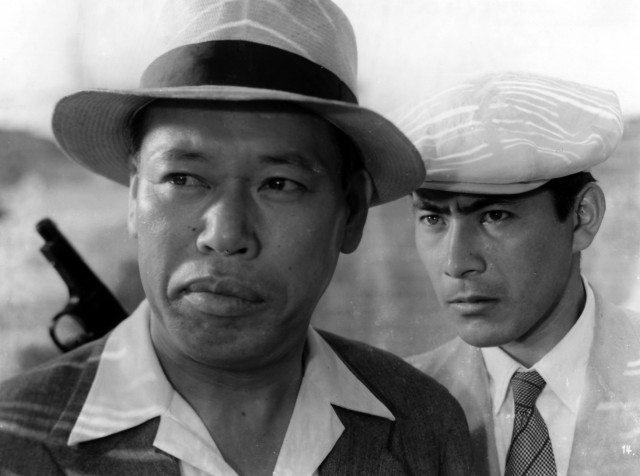
Takashi Shimura and Toshirō Mifune team up as detectives tracking a stolen gun in Akira Kurosawa’s Stray Dog
STRAY DOG (Akira Kurosawa, 1949)
Monday, February 14, 8:10
Friday, February 18, 2:40
Sunday, February 20, 12:40
Thursday, February 24, 5:50
Wednesday, March 9, 8:10 filmforum.org
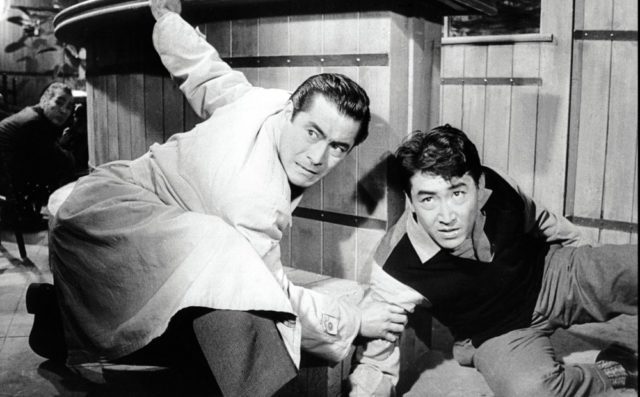
Akira Kurosawa’s thrilling police procedural Stray Dog is one of the all-time-great film noirs. When newbie detective Murakami (Toshirō Mifune) gets his Colt lifted on a trolley, he fears he’ll be fired if he does not get it back. But as he searches for the weapon, he discovers that it is being used in a series of robberies and murders — for which he feels responsible. Teamed with seasoned veteran Sato (Takashi Shimura), Murakami risks his career — and his life — as he tries desperately to track down his gun before it is used again. Kurosawa makes audiences sweat, showing postwar Japan in the midst of a brutal heat wave, with Murakami, Sato, dancer Harumi Namiki (Keiko Awaji), and others constantly mopping their brows — the heat is so palpable, you can practically see it dripping off the screen. (You’ll find yourself feeling relieved when Sato hits a button on a desk fan, causing it to turn toward his face.) In his third of sixteen films made with Kurosawa, Mifune plays Murakami with a stalwart vulnerability, working beautifully with Shimura’s cool, calm cop who has seen it all and knows how to handle just about every situation. (Shimura was another Kurosawa favorite, appearing in twenty-one of his films.)
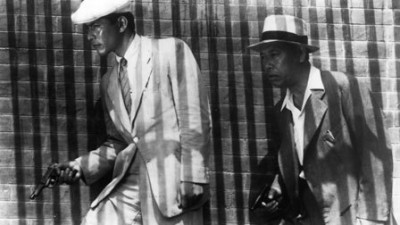
Rookie detective Murakami (Toshirō Mifune) often finds himself in the shadows in Stray Dog
Mifune is often seen through horizontal or vertical gates, bars, curtains, shadows, window frames, and wire, as if he’s psychologically and physically caged in by his dilemma — and as time goes on, the similarities between him and the murderer grow until they’re almost one and the same person, dealing ever-so-slightly differently with the wake of the destruction wrought on Japan in WWII. Inspired by the novels of Georges Simenon and Jules Dassin’s The Naked City,Stray Dog is a dark, intense drama shot in creepy black and white by Asakazu Nakai and featuring a jazzy soundtrack by Fumio Hayasaka that unfortunately grows melodramatic in a few key moments — and oh, if only that final scene had been left on the cutting-room floor. It also includes an early look at Japanese professional baseball. Kurosawa would soon become the most famous Japanese auteur in the world, going on to make Rashomon, Ikiru, Seven Samurai, Throne of Blood, The Hidden Fortress, The Bad Sleep Well, The Lower Depths, and I Live in Fear in the next decade alone.
The Lower Depths is another masterful collaboration between Akira Kurosawa and Toshirō Mifune
THE LOWER DEPTHS (Akira Kurosawa, 1957)
Tuesday, February 15, 2:45, 8:00
Wednesday, February 16, 12:40
Tuesday, March 1, 5:40 filmforum.org
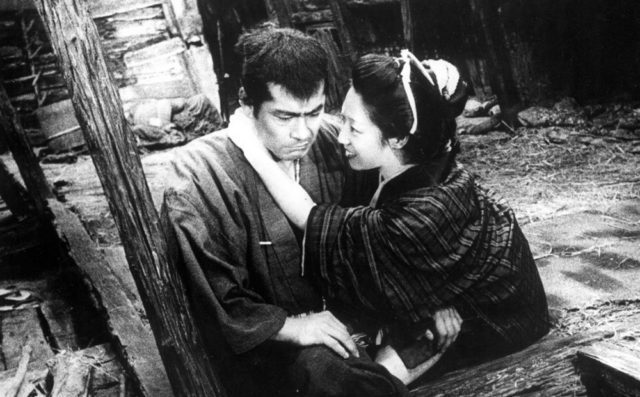
Loosely adapted from Maxim Gorky’s social realist play, The Lower Depths is yet another masterpiece from Japanese auteur Akira Kurosawa. Set in an immensely dark and dingy ramshackle skid-row tenement during the Edo period, the claustrophobic film examines the rich and the poor, gambling and prostitution, life and death, and everything in between through the eyes of impoverished characters who have nothing. The motley crew includes the suspicious landlord, Rokubei (Ganjiro Nakamura), and his much younger wife, Osugi (Isuzu Yamada); Osugi’s sister, Okayo (Kyôko Kagawa); the thief Sutekichi (Toshirō Mifune), who gets involved in a love triangle with a noir murder angle; and Kahei (Bokuzen Hidari), an elderly newcomer who might be more than just a grandfatherly observer. Despite the brutal conditions they live in, the inhabitants soldier on, some dreaming of their better past, others still hoping for a promising future. Kurosawa infuses the gripping film with a wry sense of humor, not allowing anyone to wallow away in self-pity. The play had previously been turned into a film in 1936 by Jean Renoir, starring Jean Gabin as the thief.
Toshirō Mifune and Akira Kurosawa take on Shakespeare in Throne of Blood
THRONE OF BLOOD (Akira Kurosawa, 1957)
Wednesday February 16, 3:15
Thursday, February 17, 12:40, 8:20
Sunday, February 27, 12:40, 8:10
Sunday, March 6, 9:05 filmforum.org/film/throne-of-blood-mifune
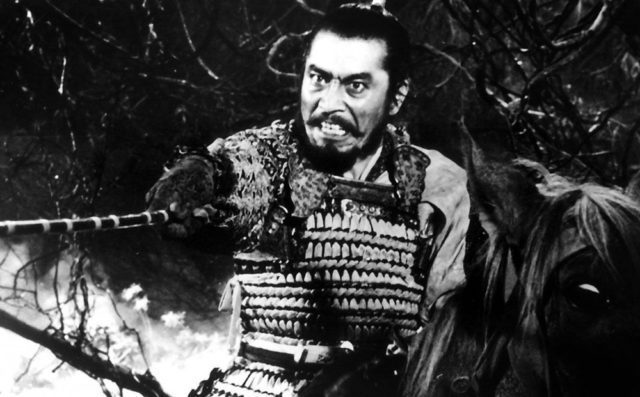
Akira Kurosawa’s marvelous reimagining of Macbeth is an intense psychological thriller that follows one man’s descent into madness. Following a stunning military victory led by Washizu (Toshirô Mifune) and Miki (Minoru Chiaki), the two men are rewarded with lofty new positions. As Washizu’s wife, Asaji (Isuzu Yamada, with spectacular eyebrows), fills her husband’s head with crazy paranoia, Washizu is haunted by predictions made by a ghostly evil spirit in the Cobweb Forest, leading to one of the all-time classic finales. Featuring exterior scenes bathed in mysterious fog, cinematographer Asakazu Nakai’s interior long shots of Washizu and Asaji in a large, sparse room carefully considering their next bold move, and composer Masaru Sato’s shrieking Japanese flutes, Throne of Blood is a chilling drama of corruptive power and blind ambition, one of the greatest adaptations of Shakespeare ever put on film.
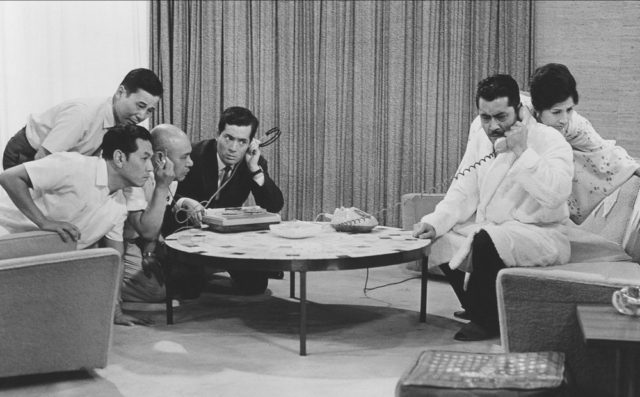
A group of men try to help Kingo Gondo (Toshirō Mifune) find kidnappers in Akira Kurosawa’s tense noir / police procedural
HIGH AND LOW (Akira Kurosawa, 1963)
Saturday, February 19, 8:00
Wednesday, March 2, 2:30
Tuesday, March 8, 12:40, 7:50 filmforum.org
On the verge of being forced out of the company he has dedicated his life to, National Shoes executive Kingo Gondo’s (Toshirō Mifune) life is thrown into further disarray when kidnappers claim to have taken his son, Jun (Toshio Egi), and are demanding a huge ransom for his safe return. But when Gondo discovers that they have mistakenly grabbed Shinichi (Masahiko Shimazu), the son of his chauffeur, Aoki (Yutaka Sada), he at first refuses to pay. But at the insistence of his wife (Kyogo Kagawa), the begging of Aoki, and the advice of police inspector Taguchi (Kenjiro Ishiyama), he reconsiders his decision, setting in motion a riveting police procedural that is filled with tense emotion. Loosely based on Ed McBain’s 87th Precinct novel King’s Ransom, Akira Kurosawa’s High and Low, photographed by longtime Kurosawa cinematographer Asakazu Nakai, is divided into two primary sections: The first half takes place in Gondo’s luxury home, orchestrated like a stage play as the characters are developed and the plan takes hold. The second part of the film follows the police, under the leadership of Chief Detective Tokura (Tatsuya Nakadai), as they hit the streets of the seedier side of Yokohama in search of the kidnappers. Known in Japan as Tengoku to Jigoku, which translates as Heaven and Hell, High and Low is an expert noir, a subtle masterpiece that tackles numerous socioeconomic and cultural issues as Gondo weighs the fate of his business against the fate of a small child; it all manages to feel as fresh and relevant today as it probably did back in the ’60s.
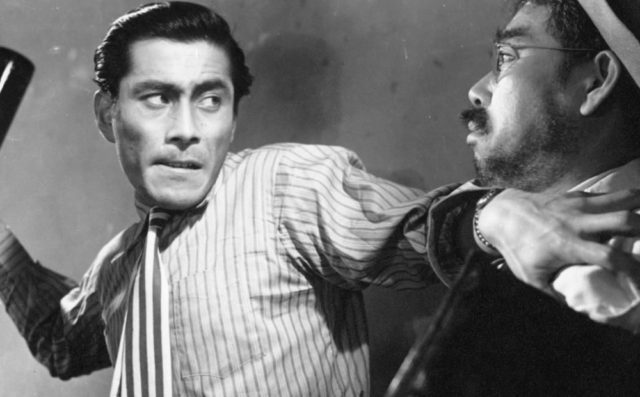
Toshirō Mifune and Takashi Shimura made fifty-three movies together
DRUNKEN ANGEL (Akira Kurosawa, 1948)
Saturday, February 19, 12:40
Sunday, February 27, 6:00
Monday, February 28, 12:40
Tuesday, March 1, 8:20
Wednesday, March 2, 5:50
Thursday, March 10, 2:45 filmforum.org
The first film that Kurosawa had total control over, Drunken Angel tells the story of a young Yakuza member, Matsunaga (Toshiro Mifune), who shows up late one night at the office of the neighborhood doctor, Sanada (Takashi Shimura), to have a bullet removed from his hand. Sanada, an expert on tuberculosis, immediately diagnoses Matsunaga with the disease, but the gangster is too proud to admit there is anything wrong with him. Sanada sees a lot of himself in the young man, remembering a time when his life was full of choices — he could have been a gangster or a successful big-city doctor. When Okada (Reisaburo Yamamoto) returns from prison, searching for Sanada’s nurse, Miyo (Chieko Nakakita), the film turns into a classic noir, with marvelous touches of German expressionism thrown in. We deducted a quarter star for the terrible incidental music that lapses into melodramatic mush.
Nishi (Toshirô Mifune) is desperate for revenge in Akira Kurosawa’s dark Shakespearean noir, The Bad Sleep Well
THE BAD SLEEP WELL (Akira Kurosawa, 1960)
Thursday, February 24, 2:50
Sunday, February 27, 3:00
Friday, March 4, 8:20 filmforum.org
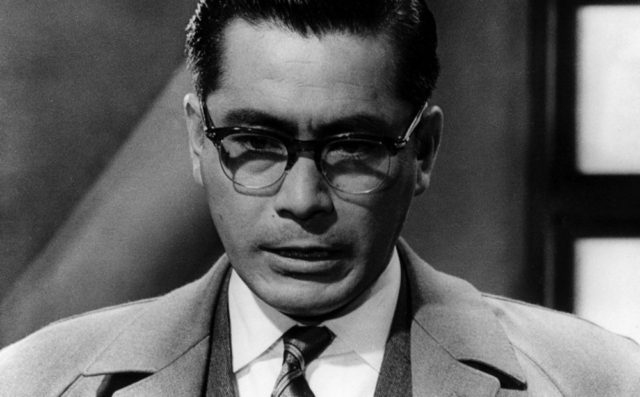
The twelfth of sixteen films director Akira Kurosawa and actor Toshirô Mifune made together between 1948 and 1965, the Shakespearean noir The Bad Sleep Well is a tense, gripping thriller in which Kurosawa takes on post-WWII Japanese corporate culture, incorporating elements of Hamlet into the complex narrative. The 1960 film begins with a long wedding scene in which everything is set in motion, from identifying characters (and their flaws) to developing the central storylines. Kōichi Nishi (Mifune) is marrying Yoshiko (Kyōko Kagawa), a young woman with a physical disability whose father is Iwabuchi (Masayuki Mori), the vice president of Public Corporation, a construction company immersed in financial scandal as related by one of the many cynical reporters (Kōji Mitsui) covering the party and anticipating possible arrests. Also at the affair are Iwabuchi’s cohorts in crime, Miura (Gen Shimizu), Moriyama (Takashi Shimura), Shirai (Kō Nishimura), and Wada (Kamatari Fujiwara), as well as Iwabuchi’s rogue son, Tatsuo (Tatsuya Mihashi), who threatens to kill Nishi if he does anything to hurt his sister. It soon becomes clear that Nishi in fact does have more on his mind than just marrying into the company. “Even now they sleep soundly, grins on their faces,” Nishi declares. “I won’t stand for it! I can never hate them enough!”
Photographed in an enveloping, almost 3-D black-and-white by Yuzuru Aizawa and with a propulsive, jazzy score by Masaru Sato, The Bad Sleep Well is a deeply psychological, eerie tale that finds inspiration in the story of Hamlet, Polonius, Ophelia, Claudius, Gertrude, Laertes, and Horatio. But whereas Kurosawa’s Throne of Blood and Ran were more direct interpretations of Macbeth and King Lear, respectively, Kurosawa, who edited the film and cowrote it with Hideo Oguni, Eijirô Hisaita, Ryûzô Kikushima, and Shinobu Hashimoto, uses the Shakespeare tragedy more subtly as he investigates greed, envy, revenge, betrayal, suicide, torture, ghosts, and murder; in fact, many critical plot points, including those involving violence, occur offscreen. The locations are spectacular, especially a volcano and an abandoned, decimated munitions factory that clearly references the destruction wrought by WWII. The actors wear their hearts on their sleeves, often emoting with silent-film tropes, especially Shimura, Fujiwara, and Nishimura as Iwabuchi’s nervous, perpetually worried underlings and Mihashi as the wild, unpredictable prodigal son. Mifune is stalwart throughout, wearing pristine suits and eyeglasses that mask what is bubbling inside him, threatening to explode, while Mori is a magnificently evil villain. At 150 minutes, it’s a long film, but it’s worth every minute; it could have actually been longer, but Kurosawa, in his first film made through his own independent production company, instead chose an abrupt yet fascinating ending with all kinds of future implications. Made between the period piece The Hidden Fortress and the samurai Western Yojimbo,The Bad Sleep Well was advertised as “a film that will violently jolt the paralyzed soul of modern man back to its senses,” and it still does just that, as corporate corruption seems to never end. Oh, and it also features one of the best wedding cakes ever put on celluloid.
Toshirō Mifune stars as a corrupt cop in The Last Gunfight
THE LAST GUNFIGHT (Kihachi Okamoto, 1960)
Friday, February 25, 3:50, 8:40 filmforum.org
In the little-known Kihachi Okamoto yakuza noir The Last Gunfight, Toshirō Mifune stars as corrupt detective Saburo Fujioka, who has been reassigned from Tokyo to Kojin City and instantly becomes caught in the middle of a mob war between rival gangs looking to pay him off so he will work for them. He befriends Tetsuo Maruyama (Kôji Tsuruta), whose wife might have been murdered, while alternately meeting with some bad people and angering his fellow cops, who are not happy to have a bad apple on their team. Director Kihachi Okamoto has fun with clichés — guns firing at the camera, as if aimed at the viewer; newspaper headlines forwarding the plot; barroom brawls; femmes fatales; nightclub scenes with live music, but in this case performed by three hitmen, singing, “Rub ’em Out”; evil baddies who think they’re untouchable; a loud, jazzy score by Masaru Satô with strange hints of other genres; and a bland color scheme that makes you wish it was made in black-and-white. And through it all, Fujioka never loses the tie and only takes off his trench coat twice. There’s also a poignant surprise twist at the end. Based on a story by Haruhiko Oyabu, it might not be a top-of-the-line thriller, but it’s worth it just to watch Mifune strut his stuff.
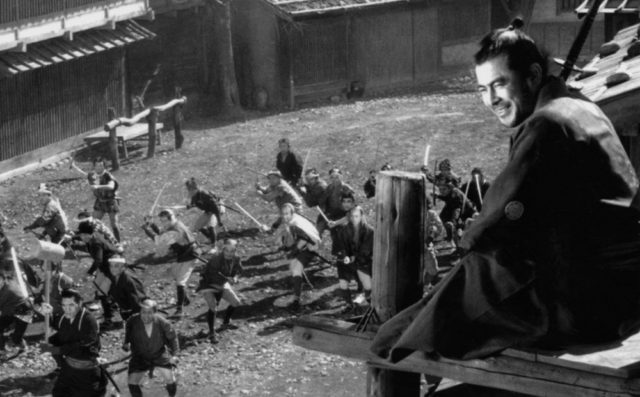
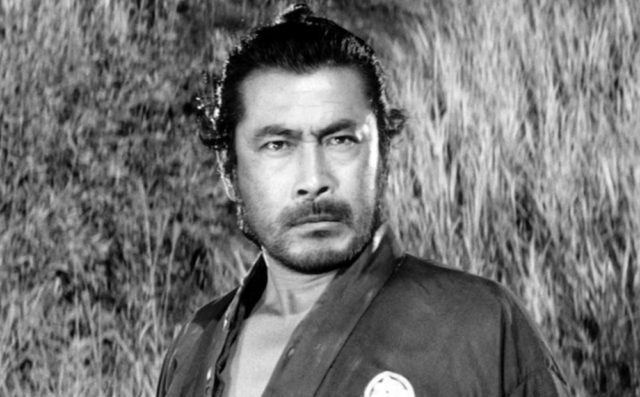
Toshiro Mifune can’t believe what he sees in Yojimbo
YOJIMBO (Akira Kurosawa, 1961)
Wednesday, February 23, 8:30
Saturday, February 26, 12:40, 5:10
Monday, February 28, 2:45
Thursday, March 3, 12:40
Tuesday, March 8, 3:30 filmforum.org
Kuwabatake Sanjuro (Toshirō Mifune) is a lone samurai on the road following the end of the Tokugawa dynasty in yet another of Akira Kurosawa’s unforgettable masterpieces. Sanjuro comes to a town with two warring factions and plays each one off the other as a hired hand. Neo’s battles with myriad Agent Smiths are nothing compared to Yojimbo’s magnificent swordfights against growing bands of warriors that include the evil Unosuke (Tatsuya Nakadai), who is in possession of a new weapon that shoots bullets. Try watching this film and not think of several Clint Eastwood Westerns (particularly Sergio Leone’s A Fistful of Dollars, since this is a direct remake of that 1964 Italian flick) as well as High Noon.
Toshirō Mifune can’t believe what he sees in Sanjuro
SANJURO (Akira Kurosawa, 1962)
Saturday, February 26, 3:00
Thursday, March 3, 3:00
Tuesday, March 8, 5:45 filmforum.org
In this Yojimbo-like tale, Toshirō Mifune shows up in a small town looking for food and fast money and takes up with a rag-tag group of wimps who don’t trust him when he says he will help them against the powerful ruling gang. Funnier than most Kurosawa samurai epics, Sanjuro is unfortunately brought down a notch by a bizarre soundtrack that ranges from melodramatic claptrap to a jazzy big-city score.
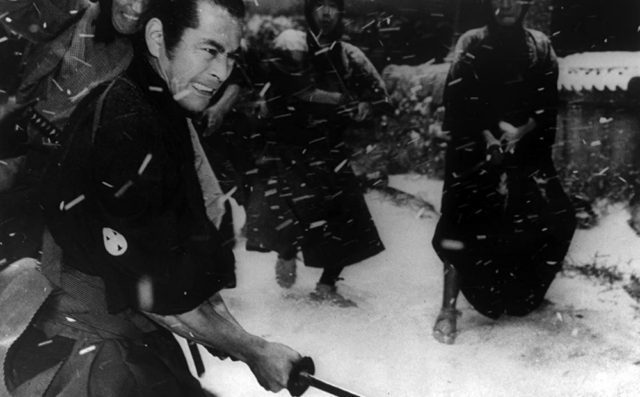
Toranosuke Shimada (Toshirō Mifune) shows rogue samurai Ryunosuke Tsukue (Tatsuya Nakadai) how its done in The Sword of Doom
THE SWORD OF DOOM (THE GREAT BODHISATTVA PATH) (Kihachi Okamoto, 1966)
Monday, February 21, 7:55
Wednesday, March 9, 3:10 filmforum.org
The Sword of Doom tells the story of one of the screen’s most brutal antiheroes, a samurai you can’t help but root for despite his coldhearted brutality, a heartless killer called “a man from hell.” Based on Kaizan Nakazato’s forty-one-volume serial novel Dai-bosatsu Tōge, Kihachi Okamoto’s The Sword of Doom, aka The Great Bodhisattva Pass, begins in 1860 with Ryunosuke Tsukue (Tatsuya Nakadai) slaying an elderly Buddhist pilgrim (Ko Nishimura) apparently for no reason as the man visits a far-off mountain grave. Shortly before Ryunosuke is to battle Bunnojo Utsuki (Ichiro Nakaya) in a competition using unsharpened wooden swords, the man’s wife, Ohama (Michiyo Aratama), comes to him, begging for Ryunosuke to lose the match on purpose to save her family’s future. A master swordsman with an unorthodox style, Ryunosuke takes advantage of the situation in more ways than one. As emotionless as he is fearless, Ryunosuke is soon ambushed on a forest road, but killing, to him, comes natural, whether facing one man or dozens — or even hundreds. The only person he shows even the slightest respect for is Toranosuke Shimada (Toshirō Mifune), the instructor at a sword-fighting school. “We have rules concerning strangers,” Toranosuke tells him, but Ryunosuke plays by no rules. “The sword is the soul. Study the soul to know the sword. Evil mind, evil sword,” Toranosuke adds, words that torment Ryunosuke, who tries to start a family in spite of his hard, detached demeanor. But regardless of circumstance, Ryunosuke continues on his bloody path, culminating in an unforgettable battle that is one of the finest of the jidaigeki genre.
The Sword of Doom boasts a memorable performance by Nakadai, the star of such other classics as Masaki Kobayashi’s Harakiri, Hiroshi Teshigara’s The Face of Another and Samurai Rebellion, and Okamoto’s Battle of Okinawa and Kill!, as well as many Akira Kurosawa films, including Yojimbo, Sanjuro, High and Low, and Ran. In The Sword of Doom he is reunited with Aratama, who played his wife in Okamoto’s masterpiece trilogy, The Human Condition. Nakadai is brilliant as Ryunosuke, able to win over the audience, riveting your attention even though he is portraying a horrible man who rejects all sympathy. Also contributing to the film’s relentless intensity are Hiroshi Murai’s gorgeous black-and-white cinematography, which features a beautiful sword fight in the snow and an exquisitely photographed scene in a claustrophobic mill, and Masaru Sato’s sparse but effective score. The Sword of Doom is a masterful tale of evil, of one man’s struggle with inner demons as he wanders through a changing world.
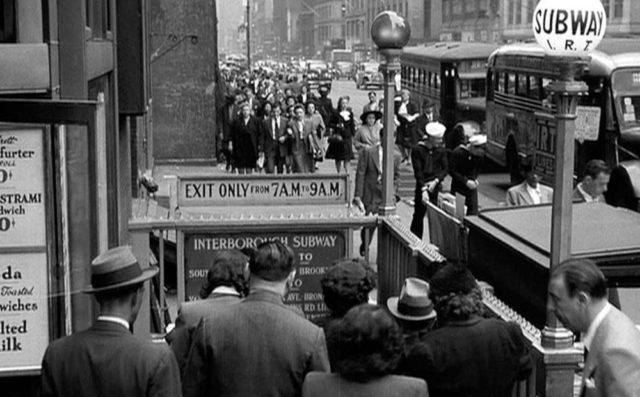
New Yorkers should be flocking to see The Naked City and other Big Apple flicks at Film Forum
NYC’S MOVIE RENAISSANCE 1945 – 1955
Film Forum
209 West Houston St.
Through February 10
212-727-8110 filmforum.org
In his July 2021 book “Keep ’Em in the East”: Kazan, Kubrick, and the Postwar New York Renaissance (Columbia University Press, $40), film historian Richard Koszarski details how New York City came to be a haven for making movies. “Fiorello La Guardia was the first New York mayor to realize the full significance of the motion picture industry to the city’s economic well-being. The few hundred jobs directly at stake in the late 1930s were not unimportant, but ever since the turn of the century, the movies — along with broadcasting and publishing — had also been doing something else for New Yorkers. Where the twentieth century had begun with a range of great American cities competing for world and national attention, it was now clear that modern America was no longer so flat a landscape. Now there was New York — and all those other places. Pittsburgh, Chicago, and San Francisco were all great cities, but New York was the city.”
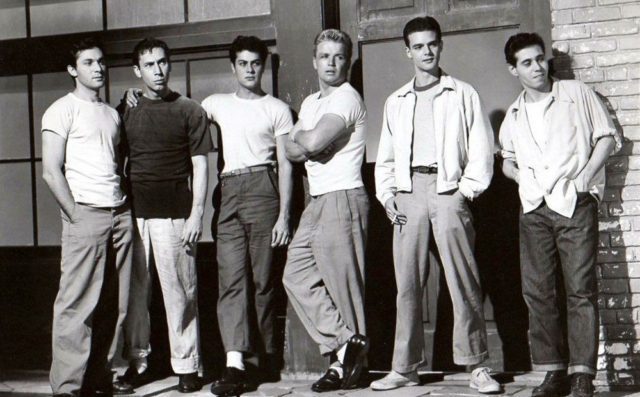
Tony Curtis and Richard Jaeckel are two of the toughies in Maxwell Shane’s City Across the River
New York City native Koszarski will be at Film Forum to talk about a few of the films in “NYC’s Movie Renaissance 1945 – 1955,” a two-week series consisting of two dozen flicks that take place in and around Gotham, released in the ten years beginning around the end of WWII. The diverse selection ranges from noir and romcoms to musicals and courtroom dramas, psychological studies and cop stories with car chases. Among the many stars you’ll encounter are Joseph Cotten, Jennifer Jones, Marlon Brando, Eva Marie Sainte, Richard Conte, Judy Holliday, Ray Milland, Jane Wyman, Jack Lemmon, Tony Curtis, Coleen Gray, Richard Widmark, Thelma Ritter, Dana Andrews, Jane Wyatt, Frank Sinatra, Ann Miller, Vittorio Gassman, Gloria Grahame, John Garfield, Moms Mabely, and Victor Mature.
Earl McEvoy’s The Killer That Stalked New York is among the many surprises in Film Forum series
Familiar classics such as Abraham Polonsky’s Force of Evil, Henry Hathaway’s The House on 92nd St. and Kiss of Death, Billy Wilder’s The Lost Weekend, Gene Kelly and Stanley Donen’s On the Town, and William Dieterle’s Portrait of Jennie are joined by such lesser-known works as George Cukor’s The Marrying Kind, Maxwell Shane’s City Across the River, Earl McEvoy’s The Killer That Stalked New York, Maxwell Shane’s City Across the River, Josh Binney’s Boardinghouse Blues, cinematographer extraordinaire Ted Tetzlaff’s The Window, and Bernard Vorhaus’s incarcerated women tale So Young, So Bad with Rita Moreno and Anne Francis.
Stanley Kubrick’s Killer’s Kiss is part of Film Forum series about the renaissance of NYC-set flicks
Koszarski writes about Fletcher Markle’s Jigsaw, “Interesting suggestions of widespread corruption involving the mafia, right wing vigilantes, and political power brokers who operate out of Manhattan penthouses. . . . Most of the cast consisted of unfamiliar New York faces, but Markle and [Franchot] Tone did convince quite a few of their friends to pop up in oddball cameos.” And he explains about Morris Engel, Ruth Orkin, and Ray Ashley’s absolute gem Little Fugitive, in which a young boy goes on a Coney Island adventure, its “simplicity was itself a great part of its appeal: no pointed moral, no dramatic character arc, no allegorical references to corruption, intolerance, World War II, or nuclear disarmament. Instead the audience is led on by the film’s uncanny sense of observation — not just in terms of photographic imagery but in the way ordinary New Yorkers relate to one another, solve their little problems, and go about the mundane details of their everyday lives.”
Moms Mabely stars in Josh Binney’s Boardinghouse Blues
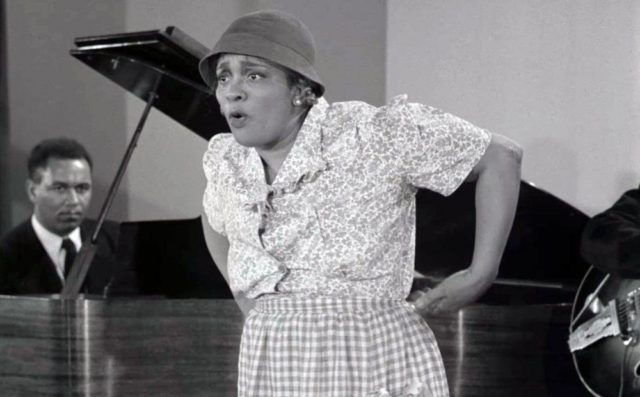
Koszarski will introduce Joseph Lerner’s awesomely titled Guilty Bystander, featuring Zachary Scott as an ex-cop house detective, on February 2 at 6:40. Master Film Forum programmer Bruce Goldstein will introduce Jules Dassin’s genre-defining The Naked City on February 5 at 7:50, accompanied by his short personal documentary, Uncovering The Naked City, and Susan Delson, author of Soundies and the Changing Image of Black Americans on Screen: One Dime at a Time (Indiana University Press, December 2021, $35-$85), will present “Soundies: America for a Dime” on February 10 at 6:50, focusing on “movie jukebox” clips from Duke Ellington, Nat “King” Cole, Dorothy Dandridge, Fats Waller, Sister Rosetta Tharpe, and others.
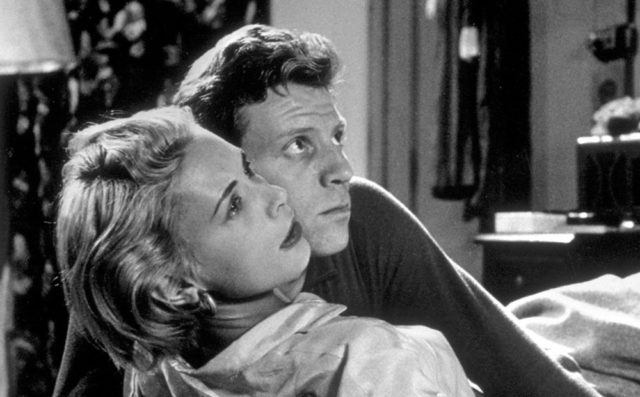
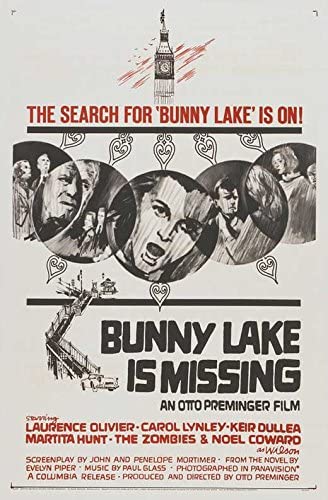
Stephen (Keir Dullea) tries to comfort his sister, Ann (Carol Lynley), in Bunny Lake Is Missing
BUNNY LAKE IS MISSING (Otto Preminger, 1965)
Film Forum
209 West Houston St.
Sunday, December 7, $15, 7:00
212-727-8110 filmforum.org
“I had heard all the rumors about Preminger, but I felt he wouldn’t do that to me. I was wrong, oh so wrong,” Keir Dullea told Foster Hirsch in the 2007 biography Otto Preminger: The Man Who Would Be King, referring to the making of the 1965 psychological noir thriller Bunny Lake Is Missing and Preminger’s notorious treatment of actors. “I was playing a crazy character and the director was driving me crazy. . . . About halfway through the shoot, I began to wonder, Who do you have to f&ck to get off this picture?” On December 7, Dullea (2001: A Space Odyssey, David and Lisa) will talk with Hirsch over Zoom following a special screening at Film Forum of the fiftieth anniversary 4K digital restoration of the 1965 work. In the intensely creepy film, loosely based on the novel by Merriam Modell (under the pseudonym Evelyn Piper), Carol Lynley stars as Ann Lake, a young woman who has just moved to London from New York. She drops off her daughter, Bunny, for her first day of school, but when she returns later to pick her up, there is no evidence that the girl was ever there. When Superintendent Newhouse (Laurence Olivier) and his right-hand man, Sergeant Andrews (Clive Revill), begin investigating the case, they are soon wondering whether Bunny really exists, more than hinting that she might be a figment of Ann’s imagination.
Television veteran Lynley, who seemed on the verge of stardom after appearing in such films as Return to Peyton Place, Bunny Lake Is Missing, Shock Treatment, and The Poseidon Adventure but never quite reached that next level, gives one of her best performances as Ann, a tortured woman who is determined to stop her world from unraveling around her. Dullea is a model of efficiency as the cold, direct Stephen, a character invented by Preminger and screenwriters John and Penelope Mortimer. Shot in black-and-white by Denys N. Coop on location in London, the film also features cameos by longtime English actors Martita Hunt, Anna Massey, and Finlay Currie as well as the rock group the Zombies and Noël Coward, who plays Ann’s very kooky landlord, Horatio Wilson. Saul Bass’s titles, in which a hand tears paper as if the story is being ripped from the headlines, set the tense mood right from the start. The ending offers some neat twists but is far too abrupt. “No actor ever peaked with him. How could you?” Dullea added to Hirsch about Preminger (Laura, Stalag 17). “The subtlety that I felt I was able to give to my work in 2001, because Stanley Kubrick created a safe atmosphere where actors were not afraid to be foolish or wrong, was missing on Otto’s set. I don’t hate him; it’s too long ago. But the experience was the most unpleasant I ever had.” It should be quite fascinating to hear more from Dullea and Hirsch on December 7; Hirsch will be on hand to sign copies of his book as well.
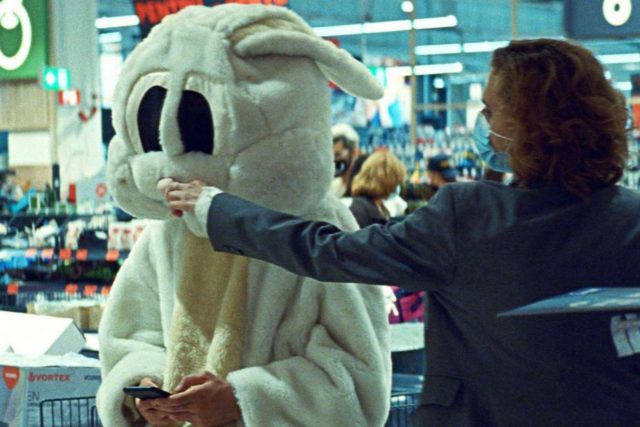
Emi (Katia Pascariu) goes on a strange journey in Rade Jude’s Bad Luck Banging or Loony Porn
BAD LUCK BANGING OR LOONY PORN: A SKETCH FOR A POSSIBLE FILM (BABARDEALA CU BUCLUC SAU PORNO BALAMUC) (Radu Jude, 2021)
Film at Lincoln Center, Walter Reade Theater, Francesca Beale Theater
144/165 West Sixty-Fifth St. at Amsterdam Ave.
Film Forum, 209 West Houston St.
Opens Friday, November 19 www.filmlinc.org filmforum.org
Radu Jude’s brilliantly absurdist Bad Luck Banging or Loony Porn lives up to its title, a wildly satiric takedown of social mores that redefines what is obscene. Winner of the Golden Bear for Best Film at the 2021 Berlinale, the multipart tale begins with an extremely graphic prologue, a XXX-rated homemade porn video with a woman and an unseen man holding nothing back. In the first main section, the woman, a successful teacher named Emi (Katia Pascariu), is distressed to learn that the video is threatening to go viral. She determinedly walks through the streets of Bucharest, buying flowers (which she holds upside down), discussing her dilemma with her boss, the headmistress (Claudia Ieremia), and calling her husband, Eugen, trying to get the video deleted before her meeting with angry parents at the prestigious private school where she teaches young children.
Jude and cinematographer Marius Panduru follow the masked Emi — the film was shot during the pandemic, so masks are everywhere — on her journey, the camera often lingering on the scene well after Emi has left the frame, focusing on advertising billboards, couples in the middle of conversations, people waiting for a bus, and other random actions, before finding Emi again. She sometimes fades into the background, barely seen through the windows of a passing vehicle or amid a crowd crossing at a light. She gets into an argument with a man who has parked on the sidewalk, blocking her way; she insists that he move the car, but he unleashes a stream of misogynistic curses. Swear words are prevalent throughout the film, mostly adding poignant humor.
The second segment consists of a montage of archival and new footage that details some of Romania’s recent history, involving the military, the government, religion, fascism, Nazi collaboration, patriotism, the two world wars, the 1989 revolution, Nicolae Ceaușescu, domestic violence, jokes about blondes, and the value of cinema itself. The bevy of images also points out which NSFW word is most commonly looked up in the dictionary, as well as which is second. (The film is splendidly edited by Cătălin Cristuțiu, with a fab soundtrack by Jura Ferina and Pavao Miholjević.)
It all comes together in the third section, in the school garden, where Emi faces a few dozen masked, socially distanced, very angry parents and grandparents who want her fired immediately, while the headmistress demands a calm discussion. The masked Emi is a stand-in for all of us, facing the wrath of the unruly mob forcing its sanctimonious platitudes on others when it really needs to look at itself. It’s a riotously funny sitcomlike debate in which Jude roasts many common, hypocritical beliefs held by Romanians (and people all over the world) that have not necessarily changed much from the news clips shown in the previous part.
The cartoonish cast, which includes Olimpia Mălai as Mrs. Lucia, Nicodim Ungureanu as Lt. Gheorghescu, Alexandru Potocean as Marius Buzdrugovici, and Andi Vasluianu as Mr. Otopeanu, really gets to strut its stuff while making sure their masks are properly covering their mouths and noses. They argue about beloved national poet Mihai Eminescu and Russian writer Isaac Babel, delve into various sexual positions, repeat Woody the Woodpecker’s trademark call, and quote long, intellectual passages from the internet as Jude (I Do Not Care If We Go Down in History as Barbarians,Aferim!) reveals where society’s true obscenities lie. It’s an irreverent tour de force that offers three distinct endings to put a capper on the strangely alluring affair, turning a scary mirror on the sorry state of twenty-first-century existence.
Playfully subtitled A Sketch for a Possible Film in a reference to André Malraux’s description of Eugène Delacroix’s belief that his sketches could be of the same quality as his paintings, Bad Luck Banging or Loony Porn, Romania’s official Oscars submission, opens November 19 at Lincoln Center and Film Forum.
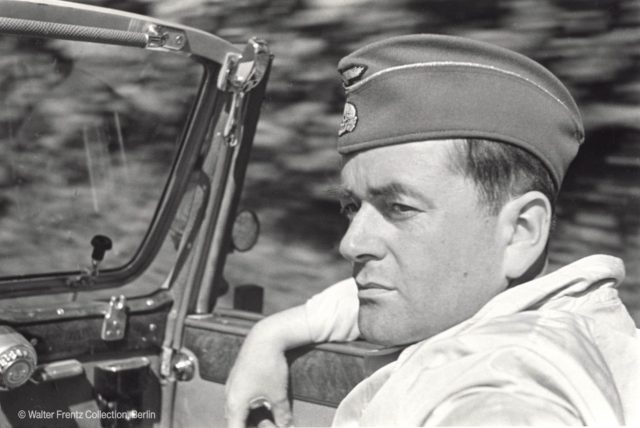
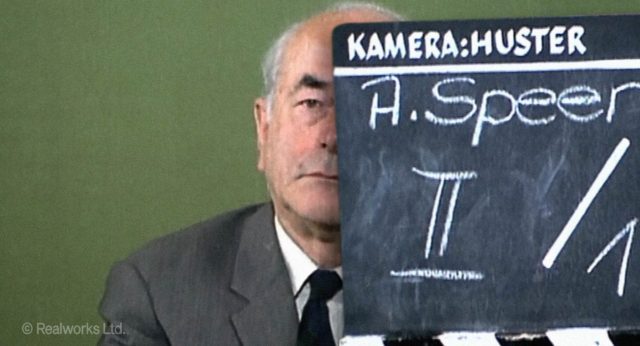
Nazi leader Albert Speer tries to whitewash history in Speer Goes to Hollywood
SPEER GOES TO HOLLYWOOD (Vanessa Lapa, 2021)
Film Forum
209 West Houston St.
Opens Friday, October 29
212-727-8110 filmforum.org speergoestohollywood.com
In 2014, Belgium-born, Israel-based documentarian Vanessa Lapa made her feature-length debut with The Decent One, in which she painted a frightening portrait of Heinrich Himmler, using the private diary of the Reichsführer of the Schutzstaffel (Himmler’s official title). She has now followed that film with Speer Goes to Hollywood, which incorporates archival footage from the Nuremberg trials and clips from propaganda films accompanying forty hours of recordings made in 1971 by up-and-coming British screenwriter Andrew Birkin as he worked with convicted Nazi leader Albert Speer, known as Hitler’s Architect, collaborating on a screenplay for Paramount Pictures based on the former Reichsminister of Munitions’ bestselling memoir, Inside the Third Reich.
Birkin, the brother of model and actress Jane Birkin and whose mentors include Stanley Kubrick and Carol Reed, met with Speer in the latter’s country home in Heidelberg in the winter of 1971. Birkin kept the tape rolling as he and Speer carefully reviewed every scene in the screenplay, as Speer tries to whitewash many of the more outrageous and gruesome details regarding his culpability in the Nazis’ reign of terror while Birkin tries to not let him off the hook.
“I would be careful,” Reed (The Third Man,Oliver!) warns Birkin over the phone after reviewing the first draft of the script. “You can’t build without him knowing. The man holds his mind blank to that. This is not a sweet man.”
Tall and elegant, Speer seizes control of the narrative again and again, claiming to be a dreamer and making sure he is seen with his dog, as if he’s just a normal guy. “I want a private life too,” he opines. He considers war “an adventure” and the Nazi regime “just good fun” to downplay the piles of murdered bodies the Third Reich left in its wake. He refers to the tortured prisoners of war in factories and the concentration camps as workmen and laborers, making excuses that argue that the negative aspects of what the Nazis did have been exaggerated. “I did not know what crimes I’m committing,” he claims. He explains that the “camps were necessary” and blames his Labor Department head, Fritz Sauckel, for the mistreatment of the Jews and other captives under his watch. “I was not responsible for those things. It was him,” he points out.
All the while, Birkin attempts to convince himself that he is doing the right thing by sharing Speer’s story on film. “I’ve been saying all along that I find it easy to identify myself with you,” he tells Speer. “The only point where I think I would have opted out would have been if I had been present or if I witnessed a scene that involved children being carted off. Can you ever remember a situation where you either read about, or more probably heard about, children being separated up or families being torn apart? Anything. Can you ever remember anything that happened? Even if, at the time, you were able to rationalize it?” Speer says no, “But . . . Yes, well, but you know, small things are now seen as the center of a thing. But I’m sorry. It would be wrong to say now I had a sentimental reaction or so. Your idea of the film and of my person that I had any reaction is wrong.”
Speer talks about Himmler, Hermann Göring, and Joseph Goebbels and admits to being one of Hitler’s best friends — and still claims he did not know what was going on despite his heavy involvement with the Mathausen camp and his visit to Auschwitz. “Indirectly, I knew from Hitler that he was planning to annihilate the Jewish people. He said it quite often. But I had no direct knowledge until ’44.” Seeking to garner some sympathy, he says, “If ever I can get rid of the guilt, and quite often I was thinking that I never shall get rid of it, that this burden will ever last with me.”
Albert Speer is profiled in new documentary built around revelatory footage
Birkin might want to give Speer the benefit of the doubt to some degree, but it’s hard for viewers to see anything but a twisted man who lacks empathy and compassion for his fellow human being, lording his sense of superiority over all others, trying to skirt his responsibilities during the war and rewrite history — a project that cannot help but make one reflect on the way America is these days when it comes to slavery, remembering the Holocaust, removing public statues of the founding fathers, tearing apart immigrant families at the border, and changing textbooks to present partisan views of the nation’s past.
Explaining one of Kubrick’s arguments, Birkin (The Name of the Rose,The Cement Garden) says the director told him, “I would find it very difficult to do the film if your character, the Speer in the film, you still made out that he didn’t know what was going on.” Speer just wanted a normal life, reveling in his being called “the good Nazi,” but as Lapa’s film shows, there is not a whole lot of good in him.
Winner of the Israeli Oscar for Best Documentary, Speer Goes to Hollywood is a chilling work that gets into the mind of one of the twentieth century’s most terrifying figures. Lapa and producer Tomer Eliav will be at Film Forum for the 7:00 shows on October 29 and 30 for Q&As that will dig even deeper into this extraordinary story.