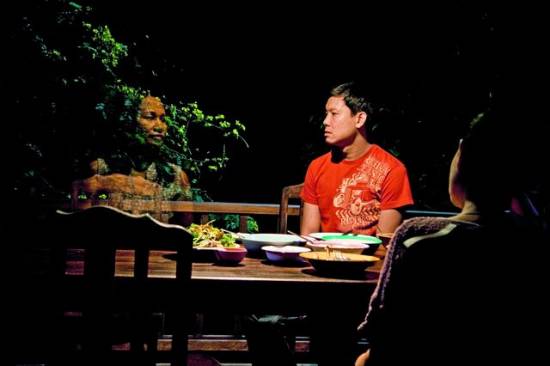
Apichatpong Weerasethakul’s Palme d’Or winner is a subtly beautiful meditation on death and rebirth, memory and transformation
UNCLE BOONMEE WHO CAN RECALL HIS PAST LIVES (LUNG BOONMEE RALUEK CHAT) (Apichatpong Weerasethakul, 2010)
Film Forum
209 West Houston St.
March 2-15
212-727-8110
www.filmforum.org
 Winner of last year’s Palme d’Or at Cannes, Thai writer-director Apichatpong Weerasethakul’s Uncle Boonmee Who Can Recall His Past Lives is an elegiac meditation on memory, transformation, death, and rebirth, a fascinating integration of the human, animal, and spirit worlds. Uncle Boonmee (Thanapat Saisaymar) is dying of kidney failure, being tended to by his Laotian helper, Jaai (Samud Kugasang). Boonmee is joined by his dead wife’s sister, Jen (Jenjira Pongpas), in his house in the middle of the jungle. Boonmee and Jen have nearly impossibly slow conversations that seem to go nowhere, just a couple of very simple people not expecting much excitement out of what’s left of their lives. Even when Boonmee’s long-dead wife, Huay (Natthakarn Aphaiwonk), and his long-missing son, Boonsong (Geerasak Kulhong), now a hairy ghost monkey covered in black fur and with two laserlike red eyes, suddenly show up, Boonmee and Jen pretty much just go with the flow. Weerasethakul maintains the beautifully evocative pace whether Jaai is draining Boonmee’s kidney, the characters discuss Communism, Tong (Sakda Kaewbuadee) questions his monkhood, a princess (Wallapa Mongkolprasert) has sex with a catfish, or they all journey to a cave in search of another of Boonmee’s past lives. The film, which was shot in 16mm and was inspired by a 1983 book called A Man Who Can Recall His Past Lives, is part of the Primitive Project, Weerasethakul’s multimedia installation that also includes the short films A Letter to Uncle Boonmee and Phantoms of Nabua. Weerasethakul, who gained a growing international reputation with such previous works as Blissfully Yours (2002), Tropical Malady (2004), and Syndrome and a Century (2006) and has a bachelor’s degree in architecture from Khon Kaen University and an MFA in filmmaking from the Art Institute of Chicago, is a master storyteller who continues to challenge viewers with his unique visual language and subtly effective narrative techniques.
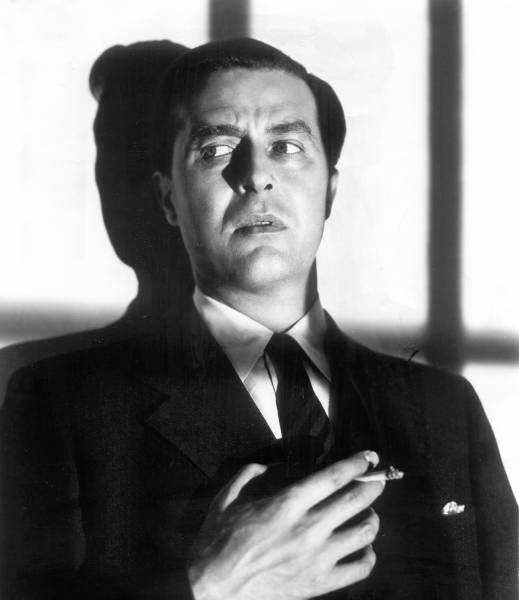
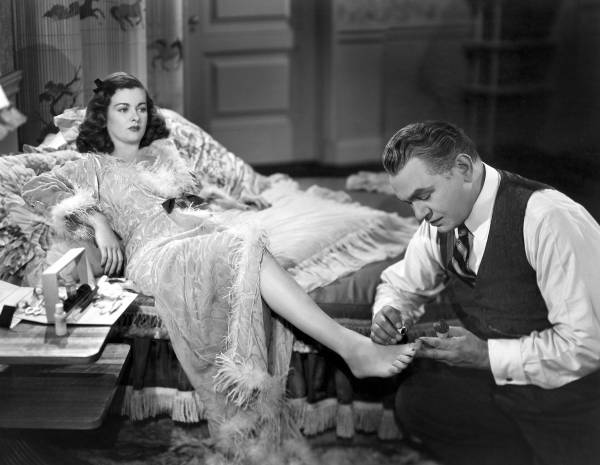
 Based on the 1943 novel by Graham Greene, Fritz Lang’s MINISTRY OF FEAR is a classic Hitchcockian noir about an innocent man caught up in a dangerous web of mystery and intrigue. Ray Milland stars as Stephen Neale, a man who, as the film opens, is being released from an asylum after serving time related to the death of his wife. His freedom doesn’t last long, as he stops at a local fair and visits the fortune-teller, who accidentally helps him win a guess-the-weight cake that some very bad people want to get their hands in. Out on the run, his only friends are Willi (Carl Esmond) and Carla (Marjorie Reynolds), foreign siblings who run the charity organization the Mothers of Free Nations, the sponsor of the fair. Throw in a séance, the Blitz, an old blind man, an alcoholic private investigator, a book called THE PSYCHOLOGY OF NAZISM, a disbelieving Scotland Yard detective, and wonderfully shadowy camerawork and the result is a tense, exciting spy tale filled with plenty of twists and surprises. MINISTRY OF FEAR is screening with Lang’s 1941 thriller MAN HUNT, starring Joan Bennett and Walter Pidgeon, as part of Film Forum’s Fritz Lang in Hollywood series, which continues through February 10 with such other great twin bills as CLASH BY NIGHT (1952) and RANCHO NOTORIOUS (1952) on February 6-7 and YOU ONLY LIVE ONCE (1937) and YOU AND ME (1938) on February 9-10.
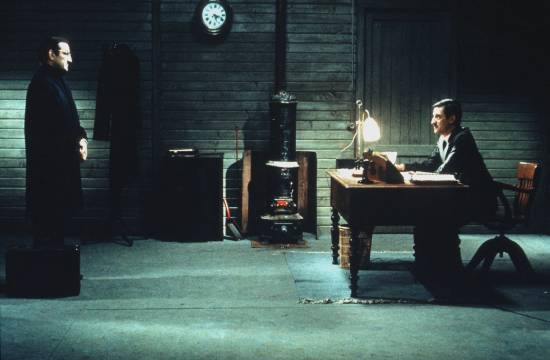
 Based on the novel by Joseph Kessel (BELLE DE JOUR), Jean-Pierre Melville’s 1969 WWII drama ARMY OF SHADOWS got its first theatrical release in America a few years ago, in a restored 35mm print supervised by the film’s cinematographer, Pierre Lhomme, who shot it in a beautiful blue-gray palette. The film centers on a small group of French resistance fighters, including shadowy leader Luc Jardie (Paul Meurisse), the smart and determined Mathilde (Simone Signoret), the nervous Jean-François (Jean-Pierre Cassel), the steady and dependable Felix (Paul Crauchet), the stocky Le Bison (Christian Barbier), the well-named Le Masque (Claude Mann), and the unflappable and practical Gerbier (Lino Ventura). Although Melville, who was a resistance fighter as well, wants the film to be his personal masterpiece, he is too close to the material, leaving large gaps in the narrative and giving too much time to scenes that don’t deserve them. He took offense at the idea that he portrayed the group of fighters as gangsters, yet what shows up on the screen is often more film noir than war movie. However, there are some glorious sections of ARMY OF SHADOWS, including Gerbier’s escape from a Vichy camp, the execution of a traitor to the cause, and a tense MISSION: IMPOSSIBLE–like (the TV series, not the Tom Cruise vehicles) attempt to free the imprisoned Felix. But most of all there is Ventura, who gives an amazingly subtle performance that makes the overly long film (nearly two and a half hours) worth seeing all by itself. ARMY OF SHADOWS is back at Film Forum for a special one-week return engagement December 29 – January 4.