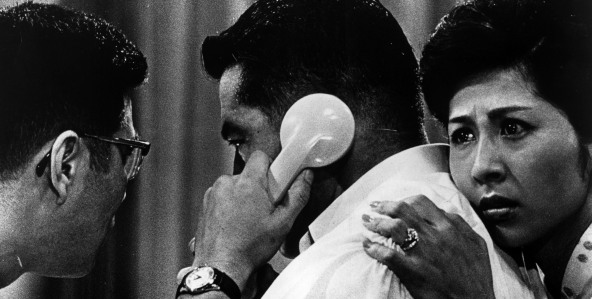
HIGH AND LOW is screening September 8 as part of Film Forum’s NYPD festival
HIGH AND LOW (TENGOKU TO JIGOKU) (Akira Kurosawa, 1963)
Film Forum
209 West Houston St.
Thursday, September 8, 3:00 & 7:00
Series continues through September 13
212-727-8110
www.filmforum.org
 On the verge of being forced out of the company he has dedicated his life to, National Shoes executive Kingo Gondo’s (Toshirō Mifune) life is thrown into further disarray when kidnappers claim to have taken his son, Jun (Toshio Egi), and are demanding a huge ransom for his safe return. But when Gondo discovers that they have mistakenly grabbed Shinichi (Masahiko Shimazu), the son of his chauffeur, Aoki (Yutaka Sada), he at first refuses to pay. But at the insistence of his wife (Kyogo Kagawa), the begging of Aoki, and the advice of police inspector Taguchi (Kenjiro Ishiyama), he reconsiders his decision, setting in motion a riveting police procedural that is filled with tense emotion. Loosely based on Ed McBain’s 87th Precinct novel King’s Ransom, High and Low is divided into two primary sections: the first half takes place in Gondo’s luxury home, orchestrated like a stage play as the characters are developed and the plan takes hold. The second part of the film follows the police, under the leadership of Chief Detective Tokura (Tatsuya Nakadai), as they hit the streets of the seedier side of Yokohama in search of the kidnappers. Known in Japan as Tengoku to Jigoku, which translates as Heaven and Hell, High and Low is an expert noir, a subtle masterpiece that tackles numerous socioeconomic and cultural issues as Gondo weighs the fate of his business against the fate of a small child; it all manages to feel as fresh and relevant today as it probably did back in the ’60s.
Even though it takes place in Japan and not New York City, High and Low is screening on Thursday, September 8, in a double feature with William A. Berke’s 1958 police drama, Cop Hater, as part of Film Forum’s “NYPD” festival, paying tribute to the tenth anniversary of the amazing, selfless work done by New York’s Finest on September 11 (as well as every day of every year). The festival, which continues through September 13, also includes such cool double features as Sweet Smell of Success (Alexander Mackendrick, 1957) and The Wrong Man (Alfred Hitchcock, 1957) on September 7, Phantom Lady (Robert Siodmak, 1944) and I Wake Up Screaming (H. Bruce Humberstone, 1941) on September 8, and the inspired pairing of William Friedkin’s controversial 1980 serial killer movie Cruising and Abel Ferrara’s awesome Bad Lieutenant on September 12, two pictures that are cult classics for very different reasons.
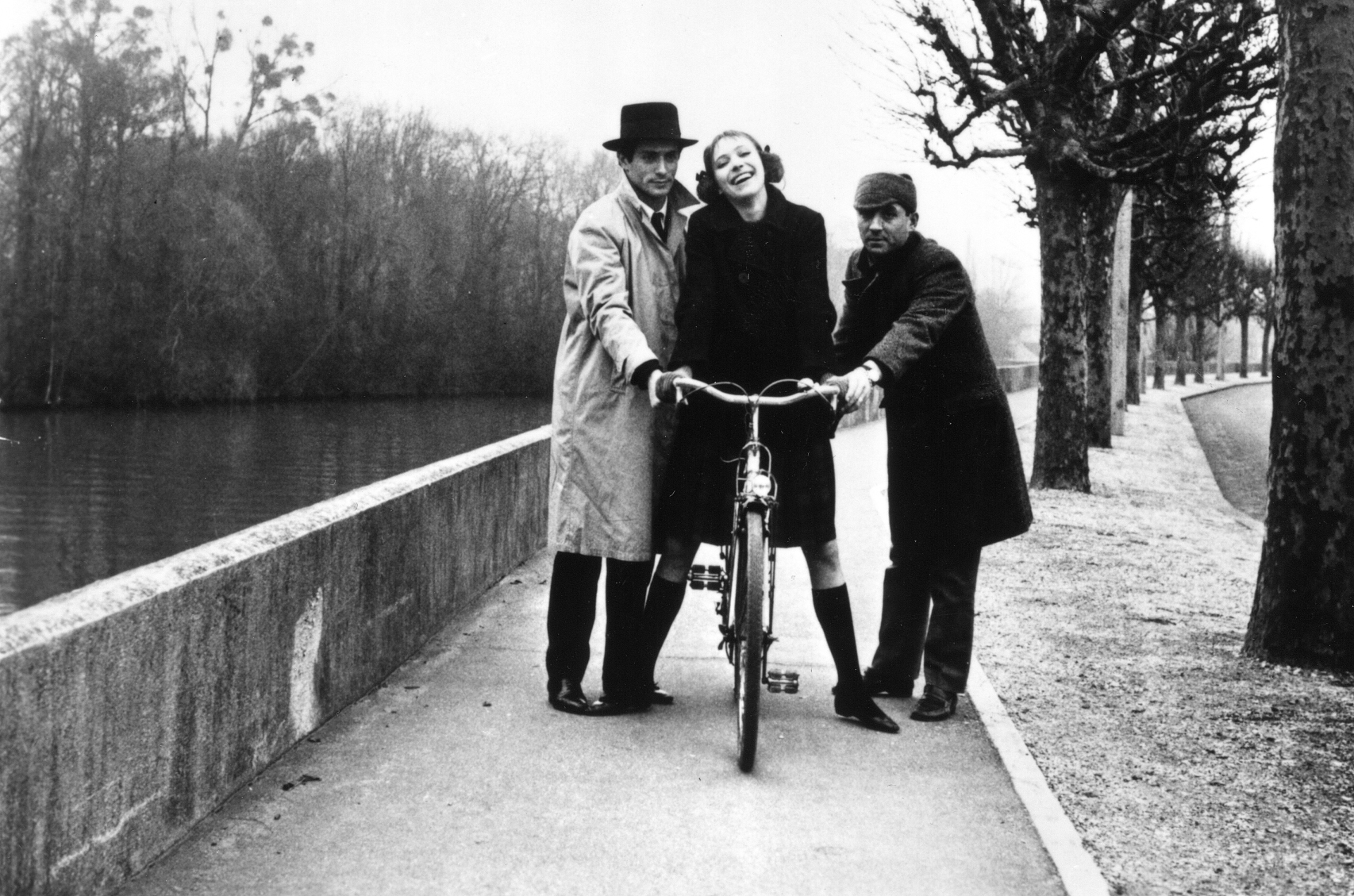
 When a pair of disaffected Parisians, Arthur (Claude Brasseur) and Franz (Sami Frey), meet an adorable young woman, Odile (Anna Karina), in English class, they decide to team up and steal a ton of money from a man living in Odile’s aunt’s house. As they meander through the streets of cinematographer Raoul Coutard’s black-and-white Paris, they talk about English and wealth, dance in a cafe while director Jean-Luc Godard breaks in with voice-over narration about their character, run through the Louvre in record time, and pause for a near-moment of pure silence. Godard throws in plenty of commentary on politics, the cinema, and the bourgeoisie in the midst of some genuinely funny scenes. Band of Outsiders is no ordinary heist movie; based on Dolores Hitchens’s novel Fool’s Gold, it is the story of three offbeat individuals who just happen to decide to attempt a robbery while living their strange existence, as if they were outside from the rest of the world. The trio of ne’er-do-wells might remind Jim Jarmusch fans of the main threesome from Stranger Than Paradise (1984), except Godard’s characters are more aggressively persistent. One of Godard’s most accessible films, Band of Outsiders will be playing a one-week engagement at Film Forum September 7-13, with no screenings on September 11.

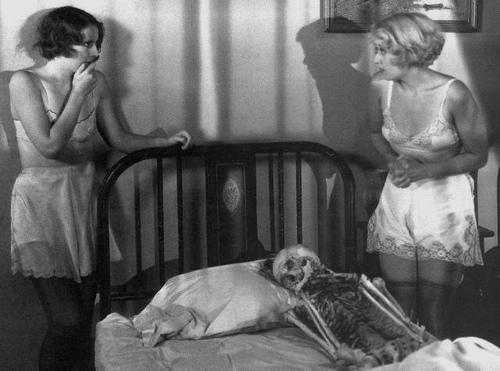
 It’s hard to believe that the Hays Code, a set of standards initiated by two religious figures and named after chief censor Will H. Hays, was enacted and enforced, to varying degrees, in Hollywood from 1934 all the way up to 1968. Film Forum is looking back at some of the racier movies made right before the code took effect in the series “Essential Pre-Code,” consisting of fifty films made between 1931 and 1934, all being shown in 35mm prints. One of the best examples of pre-code films is William A. Wellman’s rarely screened 1931 doozy, Night Nurse. The first of five collaborations between Wellman and Barbara Stanwyck, Night Nurse, based on Dora Macy’s 1930 novel, stars Stanwyck as Lora Hart, a young woman determined to become a nurse. She gets a probationary job at a city hospital, where she is taken under the wing of Maloney (Joan Blondell), who likes to break the rules and torture the head nurse, the stodgy Miss Dillon (Vera Lewis). Shortly after treating a bootlegger (Ben Lyon) for a gunshot wound and agreeing not to report it to the police, Lora starts working for a shady doctor (Ralf Harolde) taking care of two sick children (Marcia Mae Jones and Betty Jane Graham) whose proudly dipsomaniac mother (Charlotte Merriam) is being manipulated by her suspicious chauffeur (Clark Gable). Wellman pulls out all the stops, hinting at or simply depicting murder, child endangerment, rape, alcoholism, lesbianism, physical brutality, and Blondell and Stanwyck regularly frolicking around in their undergarments. It’s as if Wellman is thumbing his nose directly at the Hays Code in scene after scene. Although far from his best film — Wellman directed such classics as Wings (1927), The Public Enemy (1931), A Star Is Born (1937), Nothing Sacred (1937), Beau Geste (1939), and The Ox-Bow Incident (1943) — Night Nurse is an overly melodramatic, dated, but entertaining little tale with quite a surprise ending. Night Nurse is screening at Film Forum on July 19 as part of a triple feature with Howard Bretherton and William Keighley’s Ladies They Talk About, starring Stanwyck in one of the earliest women-in-prison movies, and William Dieterle’s Lawyer Man, which pairs Blondell with the always charming William Powell. The series continues through August 11 with such films as Rouben Moumalian’s Love Me Tonight, Frank Tuttle’s Roman Scandals, Cecil B. DeMille’s The Sign of the Cross, Josef von Sternberg’s Blonde Venus, Howard Hawks’s Scarface, Ernst Lubitsch’s Trouble in Paradise, and Merian C. Cooper and Ernest B. Schoedsack’s King Kong (bestiality!), nearly all of which are part of double or triple features.